Mineral oil for powdery mildew in grapes: does it work and when to use it

TL;DR
- Mineral oil at 1-3% concentration kills powdery mildew on grapes by physically coating fungal hyphae and blocking spore germination.
- It works best as a rotation partner, not your whole program.
- Apply from 5-inch shoot through pre-bloom, stop by veraison, keep it below 90F, and never mix it with sulfur.
- It's approved for organic use when the specific product is listed.
How does mineral oil actually control powdery mildew on grapes?
Mineral oil kills grape powdery mildew by physical suffocation, not chemistry. There's no translocation and no disruption of a fungal pathway. The oil coats the hyphae and conidia of Erysiphe necator on the leaf and berry surface, blocking spore germination and choking colony growth. Think mechanical, not systemic.
Research summarized in the UC IPM Grape Pest Management Guidelines shows horticultural oils, including highly refined paraffinic mineral oils, reduce powdery mildew severity when applied on a 7 to 14 day interval during early to mid-season [1]. The oil prevents new infections rather than eradicating established ones, which is why timing carries the whole program. You spray ahead of the disease. You don't rescue a block after a heavy outbreak.
There's also an anti-sporulation effect. When hyphae sit under a film of oil, conidial chains don't release as readily, so the epidemic cycle slows even without killing the parent colony. That partial curative window runs roughly 24 to 48 hours after infection. It's real, and it's narrow. Don't build a program around it.
Mineral oil works at 1 to 3% by volume of finished spray. Higher rates raise both efficacy and phytotoxicity risk, and nothing in the literature suggests going above 3% buys you anything worth the burn [1]. Some growers run oil at 1% purely as a tank-mix partner, to improve coverage and spreading of another fungicide rather than to control disease on its own.
What concentration of mineral oil should you use on grapevines?
Use 1 to 3% by volume, calculated on finished spray. That's the standard commercial range. UC trials generally tested 1% and 2%, and the 2% rate showed better control but demanded closer attention to temperature and vine stress [1].
Here's the math on a common spray volume. At 50 gallons per acre, a 1% rate means 0.5 gallons (64 oz) of oil per acre, and a 2% rate means 1 gallon per acre. Pre-mix the oil into a small volume of water before it goes in the tank. Pour straight oil into a full tank and you get an unstable emulsion and streaky coverage.
Many products come pre-formulated at 80 to 98% paraffinic mineral oil, labeled at rates that land you around 1 to 3% in the tank. Read the label. Under FIFRA, the label is the law, and the label math should put you inside that 1 to 3% window [2].
Below 1% isn't worth the pass. You're burning fuel and hours for coverage that folds under real disease pressure. A clean 2% application on a 10 to 12 day interval in early season, from pre-bloom through fruit set, is where most California advisors land.
When should you apply mineral oil in the season, and when should you stop?
Start at 5-inch shoot growth and run through pre-bloom. That window, roughly BBCH 12 to BBCH 57, is when vines are most susceptible and early control pays the biggest return [3]. Miss an early infection and you seed permanent inoculum on the clusters that you'll chase all season.
The hard stop is veraison. Oil applied after veraison (BBCH 81, when 50% of berries have softened) can stain skins, shift aroma compounds, and split berries, and thin-skinned varieties like Pinot Noir and Chardonnay take it worst [1]. Most California advisors stop oil by fruit set, and no later than pea-size berry.
Inside the window, interval follows pressure. Ten to fourteen days holds up under low-to-moderate pressure. Under heavy inoculum or a wet, humid forecast, tighten to seven. Oil has no residual once rain or heavy dew washes it off, so the post-rain protection window is basically zero.
Temperature is the other hard line. Don't spray oil above 90F (32C), or on vines carrying drought or heat stress. Phytotoxicity risk climbs sharply past that point. A cool early-morning pass beats a warm midday run every time.
What are the real phytotoxicity risks with mineral oil on grapes?
Phytotoxicity is the main reason vineyard managers keep oil on a short leash. Symptoms are leaf burn, russeting on young berries, and defoliation in bad cases. They show up 2 to 5 days after application, and they don't reverse.
The drivers are predictable: concentration above 3%, air temperature above 90F, application to drought-stressed vines, and tank-mixing with sulfur. The sulfur interaction is bad enough that most labels flat-out prohibit mixing oil with sulfur or applying within 14 days of a sulfur pass [1]. Some labels push that to 21 days. Read your specific label, because this is exactly where growers get burned, literally and on paper.
Varietal sensitivity matters too. Concord and other labrusca types run more sensitive than most Vitis vinifera. Among vinifera, Chardonnay and Pinot Noir show more sensitivity than Cabernet Sauvignon or Zinfandel, though any of them can burn under the wrong conditions. There's no single published sensitivity ranking that covers every variety. The closest usable data comes from UC Cooperative Extension trial notes [1].
New to oil in a block? Spray a small trial on 2 or 3 rows first. Wait 5 days, check for burn, then commit the fleet. That's basic stewardship, and it saves you a very bad conversation with the owner.
Is mineral oil approved for organic grape production?
Yes, with conditions. Highly refined, food-grade paraffinic mineral oils are allowed for plant disease control under the National Organic Program, as long as the specific product is OMRI-listed or otherwise cleared by your certifier [4]. The operative phrase is highly refined paraffinic mineral oil. Crude and unrefined oils don't qualify.
The NOP regulations at 7 CFR 205.601 list "oils, horticultural" as allowed for crop production [4]. Your certifier may want the product's safety data sheet and the manufacturer's NOP-compliance documentation before your first use. An OMRI listing doesn't automatically satisfy your certifier, so confirm it. As USDA's National Organic Program guidance states, certifiers must approve inputs, and OMRI listing alone does not clear a material for use in every operation [10].
California growers face another layer. The state requires the product to be registered with CDPR before use, on top of federal NOP compliance. Check both.
Documentation carries as much weight as the spray here. If you track applications in a system like VitiScribe, log the product name, EPA registration number, OMRI listing status, and certifier approval date next to the application data. An auditor asking about your organic inputs should find that in seconds, not after twenty minutes of digging.
How does mineral oil compare to sulfur, neem oil, and synthetic fungicides for powdery mildew?
Here's an honest comparison across the tools growers actually reach for:
| Product | Mode of action | Efficacy vs PM | Organic OK? | Key limit |
|---|---|---|---|---|
| Mineral oil (paraffinic) | Physical, surface coating | Moderate | Yes (OMRI) | No sulfur tank-mix; heat phytotoxicity |
| Elemental sulfur | Disrupts fungal respiration | High | Yes | Phytotoxic >90F; off-flavors if late |
| Neem oil (azadirachtin-based) | Disrupts growth, physical | Moderate | Yes (OMRI) | Short residual; REI 4 hrs |
| Potassium bicarbonate | Raises surface pH | Moderate | Yes | Minimal residual; best with adjuvant |
| DMI fungicides (e.g., myclobutanil) | Sterol biosynthesis inhibitor | High | No | Resistance risk; preharvest interval |
| SDHI fungicides (e.g., fluopyram) | Succinate dehydrogenase inhibitor | High | No | Resistance risk group |
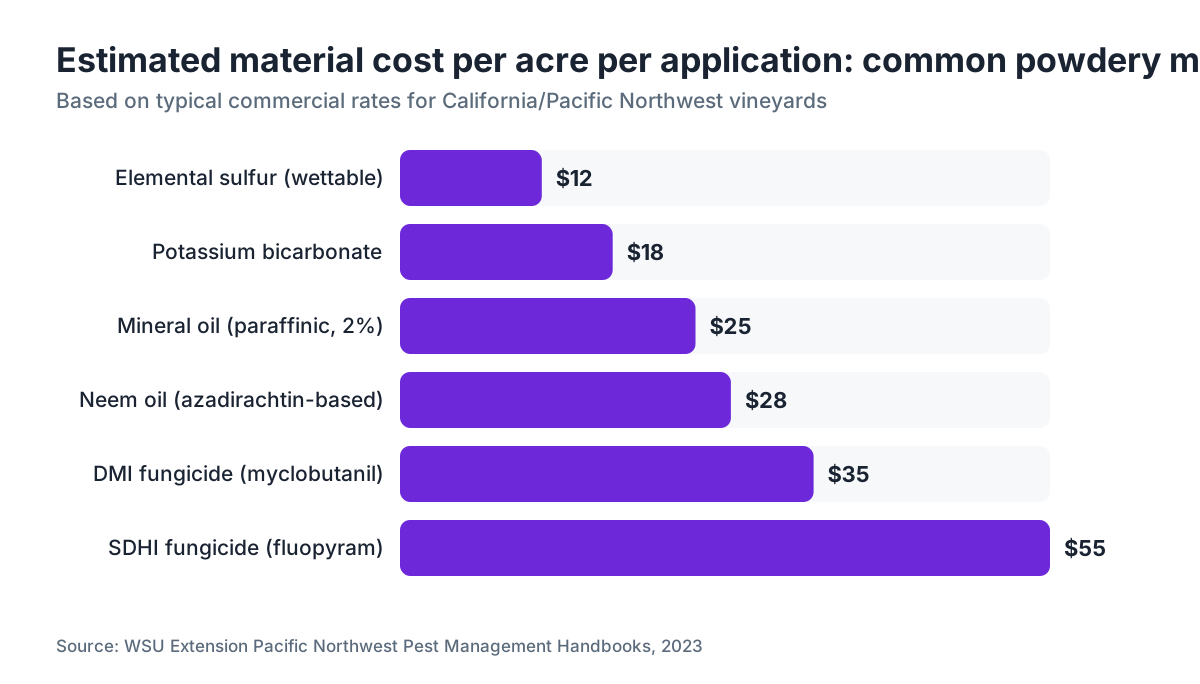
Sulfur is still the workhorse in most California and Pacific Northwest organic programs. It runs cheaper per acre (roughly $8 to $15 for sulfur against $15 to $35 for paraffinic oil at typical rates, though price swings hard by region and formulation), and its efficacy record goes back decades [5]. Oil earns its rotation slot on resistance management. Rotating modes of action slows resistance, and oil's physical mode has no known resistance pathway.
Neem oil deserves a real look. Azadirachtin-based products have documented activity against E. necator, and UC trials have tested them as rotation partners [1]. The knock on neem is short residual, poor emulsification at low temperatures, and a strong smell that tasting-room staff notice during harvest-adjacent passes. Neem works. It just wants tighter intervals and cleaner application than mineral oil does.
Synthetics win on efficacy per dollar in conventional programs. Managing a high-value Cabernet block under heavy pressure? A DMI or SDHI at labeled rate outperforms any oil program. Oils earn their place as resistance rotators and in certified-organic blocks, not as a swap for systemic chemistry in a tough year.
What does the research actually show about mineral oil efficacy on grapes?
The most cited U.S. work comes out of UC Davis viticulture and plant pathology trials. Cooperative Extension farm advisors documented paraffinic mineral oils at 1 to 2% producing 50 to 70% reduction in powdery mildew severity versus untreated controls in some trial years, with results swinging hard on disease pressure and timing [1].
Cornell's viticulture extension program, working the disease-heavy Northeast, has documented oil more as a tank-mix partner than a standalone. Their guidelines note oils improve the spreading and sticking of other materials and add incremental control to sulfur programs [3].
Washington State University extension work in the Columbia Valley and Yakima AVA leans toward sulfur and DMI programs, given the semi-arid conditions, but the PNW handbooks list mineral oils as a lower-efficacy, lower-restriction rotation option for organic blocks [5].
Nobody has strong head-to-head data comparing mineral oil against modern SDHI fungicides in the same vineyard over multiple seasons. The closest multi-year comparisons come from California Cooperative Extension trials from the 1990s and early 2000s, which predate much of today's high-efficacy synthetic chemistry. Recent trials tend to test oil as a rotation component, not on its own.
The honest read: mineral oil control of powdery mildew is real but modest. It's not your best tool in a high-pressure year. It's a sound rotation partner in a well-timed program.
What are the worker protection and re-entry requirements for mineral oil sprays?
Under the EPA Worker Protection Standard, every agricultural pesticide application carries a re-entry interval (REI) before workers can enter the treated area without PPE [6]. For most registered mineral oil products on grapes, the REI is 4 hours. Some formulations run 12 hours, so check your label.
The WPS also requires you to post application information (or keep an equivalent central posting) and provide workers pesticide safety training. Mineral oil's lower toxicity usually puts it in the "Caution" signal word band rather than "Warning" or "Danger," but the WPS documentation rules apply no matter the toxicity category [6].
For operators, standard PPE runs to a long-sleeved shirt, long pants, chemical-resistant gloves, and eye protection. Respiratory protection is generally not required for most mineral oil formulations, but the label decides that.
California layers on the Pesticide Use Report through CDPR and county agricultural commissioners. Every registered pesticide application, mineral oil included, has to be reported [7]. The report captures product name, EPA registration number, acres treated, application date, and operator information. Miss a PUR filing and it's a violation regardless of how safe the product is. Record it the same day you spray.
How do you integrate mineral oil into a full-season powdery mildew program?
A practical program for a California North Coast organic block might run like this: sulfur at 5-inch shoot (BBCH 12), sulfur again at 10-inch shoot, mineral oil at pre-bloom as a rotation break, sulfur through bloom and fruit set with potassium bicarbonate as a partner, mineral oil again at pea-size berry (your last oil pass), then sulfur through veraison, and only non-oil, low-residue materials after veraison.
The design goal is simple. Protect the cluster from infection at every susceptible stage, and rotate modes of action to slow resistance in the local E. necator population. Oil's physical mode faces zero resistance pressure, which makes it the ideal break between sulfur passes rather than a cornerstone material.
Interval length follows disease pressure, and the UC Davis Gubler-Thomas risk model gives you the number to drive it. The model assigns a daily severity value from temperature and wetness period, and that value sets your interval [8]. A low value might allow 14 days; a high value calls for 7, whatever material you're spraying. Run that model as your scheduling backbone and slot oil into the rotation at the right points. It's far more defensible than a fixed calendar.
For blocks with a history of heavy pressure or documented fungicide resistance nearby, don't lean on oil for anything beyond rotation. There, the DMI and SDHI rotations in a conventional program, or aggressive sulfur-plus-bicarbonate rotations in an organic one, carry the main load.
What records do you need to keep for mineral oil applications in a vineyard?
Spray records fall into three overlapping buckets: state pesticide use reporting, your organic certification trail (if it applies), and any sustainability or third-party audit paperwork your winery program demands.
Federally, the WPS requires you to keep pesticide application records for at least 2 years and make them available to workers and handlers on request [6]. California's PUR system requires reporting within 30 days of the application month-end, though county deadlines vary and some counties want reports within 7 days [7].
A minimum record for a mineral oil pass should capture application date and time, block ID and acres, product name and EPA registration number, rate (oz or gallons per acre, plus concentration as a percent of finished spray), water volume per acre, REI, equipment used and calibration date, operator name and license number, and weather (temp, wind speed, wind direction) at application.
Organic auditors will also want purchase receipts for the oil, the OMRI listing documentation, and any certifier approval correspondence. Keep those in the same file as the spray records.
Tracking all of this across multiple blocks and passes buries you in spreadsheets fast. VitiScribe is built for vineyard spray record compliance, with fields structured to match California PUR requirements and NOP documentation. Purpose-built software or a well-organized binder, the rule holds either way: capture it same-day, every time, no gaps.
Are there any grape varieties where you should not use mineral oil?
There's no universal banned-variety list for mineral oil, but a few groups earn extra caution. American hybrids, especially Concord, Niagara, and other V. labrusca selections, show higher oil sensitivity in grower experience and some extension trial notes. Managing a juice grape block in New York or Pennsylvania? Test before the fleet goes out.
Among vinifera, thin-skinned clones of Pinot Noir and Chardonnay russet more visibly from oil than thick-skinned varieties. That isn't necessarily systemic damage, but it hits fruit-quality perceptions at harvest and can trigger rejection against a contract spec that demands unblemished fruit.
Muscadine (V. rotundifolia) has a completely different disease profile and is generally resistant to E. necator anyway, so oil efficacy there is largely a moot question.
The safe path with any variety you haven't oiled before is a small-plot trial, at the rate you plan to use, in the temperatures you'll actually be spraying in. See leaf margin burn or berry russeting on the trial rows after 5 days? Cut the rate or drop the product from that block.
Where can you find approved mineral oil products for grape powdery mildew?
Products must be EPA-registered for use on grapes with powdery mildew on the label. In the U.S., several paraffinic mineral oil products are registered and widely used, including JMS Stylet-Oil (a highly refined paraffinic oil with a long track record in California and the Pacific Northwest) and Saf-T-Side, among others. Both are OMRI-listed for organic production [9].
To confirm a product is currently registered in your state, check the state pesticide registration database. In California, CDPR maintains a searchable database at cdpr.ca.gov. In Washington, WSDA keeps equivalent records. A product can be federally registered and still not registered in your state, and applying an unregistered product is a federal and state violation.
Buy from a reputable ag chemical distributor, not a retail garden center. Consumer-grade "horticultural oil" may not carry the specific grape and powdery mildew label language your spray records need, and some contain adjuvants that aren't NOP-compliant.
Registered paraffinic oil runs about $15 to $35 per gallon depending on formulation and volume. At 2% and 50 gallons of water per acre, you're using roughly 1 gallon per acre, so material cost lands at $15 to $35 per acre per application before labor and equipment [5]. That's not cheap next to sulfur, which is one more reason oil earns its keep as a rotation partner rather than a primary material.
Frequently asked questions
Can you mix mineral oil and neem oil together for powdery mildew on grapes?
Mixing mineral oil and neem oil in one tank is generally not recommended. Both are oils and can interfere with each other's emulsification, giving you poor coverage and higher phytotoxicity risk. Use them as separate rotation partners, not a combined spray. Check both labels for tank-mix compatibility language before you attempt any combination.
How long does mineral oil last on grapevine leaves after application?
Mineral oil has essentially no residual once rain or heavy dew hits. Under dry conditions the physical film may hold 7 to 10 days, but efficacy against powdery mildew degrades as the coating breaks down. Set intervals accordingly. In wet or humid weather, reapply every 7 days. In dry conditions, 10 to 14 days works.
Will mineral oil affect wine quality or leave residue on harvested grapes?
Applied at label rates and stopped by pea-size berry, or no later than veraison, mineral oil residues on harvested grapes are extremely low. Studies have not identified off-flavor contributions from properly timed applications. Late-season passes, particularly within 30 days of harvest, are the concern for residue and aroma. Most programs stop oil by fruit set for exactly this reason.
Is mineral oil effective against downy mildew as well as powdery mildew?
No. Mineral oil has documented efficacy against powdery mildew (Erysiphe necator) by coating fungal structures on the surface. Downy mildew (Plasmopara viticola) is an oomycete with completely different biology, including systemic infection inside leaf tissue. Oil has no meaningful effect on downy mildew. Use copper-based materials or registered oomycete-specific products for that.
Can you use mineral oil on grapes during bloom?
Most extension advisors say avoid application during full bloom. The oil film can interfere with pollen and pollinator activity, and berries just setting are among the most phytotoxicity-sensitive tissue on the vine. Spray shortly before bloom (a pre-bloom spike) or wait until fruit set. Cornell and UC Davis both flag bloom as a period demanding extra caution with any oil.
What is the preharvest interval (PHI) for mineral oil on grapes?
Most registered paraffinic mineral oil products for grapes carry a preharvest interval of 0 days, so they're technically allowed up to harvest. The practical recommendation from extension programs is to stop oil at pea-size berry, or veraison at the latest, because of quality concerns with late-season passes. Always confirm the PHI on your specific label.
Why should you never mix mineral oil with sulfur fungicide?
Mixing oil and sulfur in one application, or applying oil within 14 to 21 days of a sulfur pass, causes severe phytotoxicity. The combination reacts on leaf and berry surfaces and drives burn risk way up. Most mineral oil labels explicitly prohibit it. The interval runs both directions: wait after a sulfur pass, and wait before the next sulfur pass after an oil spray.
How does the Gubler-Thomas powdery mildew risk model affect your mineral oil spray timing?
The Gubler-Thomas model assigns a daily severity value from temperature and leaf wetness. Low cumulative values let you stretch to a 14-day interval; high accumulation calls for 7 days. This holds no matter what material you spray. Oil fits a Gubler-Thomas program the same way sulfur does: the model tells you when to spray, and your rotation plan tells you what.
Does mineral oil resistance develop in powdery mildew populations?
No resistance to mineral oil has been documented in Erysiphe necator. Because the mechanism is physical (coating and suffocating fungal structures) rather than biochemical, there's no molecular target the fungus can mutate around. That's exactly why oil earns a spot in resistance management programs, rotating alongside DMI and SDHI fungicides that do carry resistance risk.
What PPE is required when spraying mineral oil in a vineyard?
Under the EPA Worker Protection Standard, requirements vary by product. Most mineral oil products labeled for vineyards carry a Caution signal word and require a long-sleeved shirt, long pants, chemical-resistant gloves, and eye protection. Respiratory protection is generally not specified for most formulations. Check your specific label, which is the legal requirement, not the general category.
How does neem oil for powdery mildew on grapes compare to mineral oil in practice?
Both are OMRI-listable and work by physical action, but neem's azadirachtin content adds a growth-disrupting effect that mineral oil lacks. Neem has shorter residual, typically 5 to 7 days in the field, emulsifies poorly below 50F, and carries a strong odor. Mineral oil is simpler to use but has no added biochemical activity. Most organic programs can rotate both successfully.
Do California and Washington state have different rules for using mineral oil in certified organic vineyards?
Federal NOP rules (7 CFR 205.601) govern organic certification in both states. Operationally, California requires CDPR state registration of the specific product plus PUR filing; Washington requires WSDA state registration. Your certifying agent may add documentation requirements above the federal minimum. Confirm state registration of your specific product before first use in either state.
Sources
- UC Cooperative Extension, Grape Pest Management Guidelines (UC IPM): Paraffinic mineral oils at 1-2% showed efficacy against grape powdery mildew in UC trials; applications above 90F or within 14 days of sulfur increase phytotoxicity risk
- U.S. EPA, Federal Insecticide, Fungicide, and Rodenticide Act (FIFRA): Under FIFRA, pesticide labels are legally binding; use must comply with label directions including rate and tank-mix restrictions
- Cornell University Cooperative Extension, Viticulture and Enology Program: Cornell extension documents horticultural oils as tank-mix partners for powdery mildew programs and flags bloom as a period of elevated phytotoxicity risk
- USDA National Organic Program, 7 CFR 205.601: 7 CFR 205.601 lists 'oils, horticultural' as allowed for crop disease control in certified organic production
- Washington State University Extension, Pacific Northwest Pest Management Handbooks: WSU extension lists mineral oils as a rotation option for powdery mildew in organic grape programs; sulfur costs approximately $8-15/acre per application compared to $15-35/acre for registered paraffinic oils
- U.S. EPA, Worker Protection Standard (WPS) for Agricultural Pesticides: WPS requires pesticide application records be maintained for at least 2 years and be accessible to workers; REI posting and worker training are required for all agricultural pesticide applications
- California Department of Pesticide Regulation (CDPR), Pesticide Use Reporting: California requires Pesticide Use Reports to be filed within 30 days of the application month-end (some counties within 7 days); all registered pesticide applications including mineral oil must be reported
- UC IPM, Gubler-Thomas Powdery Mildew Risk Index for Grapes: The Gubler-Thomas model assigns daily severity values based on temperature and wetness; values drive spray interval decisions from 7 to 14 days
- OMRI (Organic Materials Review Institute), Products List: JMS Stylet-Oil and other highly refined paraffinic mineral oil products appear on the OMRI Products List as allowed for use in certified organic crop production
- USDA Agricultural Marketing Service, National Organic Program: NOP requires certifiers to approve materials before first use; OMRI listing does not automatically satisfy all certifier requirements
Last updated 2026-07-09