Modified Munson trellis system: how it works and when to use it
TL;DR
- The modified Munson trellis is a high-cordon, divided-canopy system.
- Two pairs of catch wires spread shoots outward from a single fruiting wire set at roughly 5 feet, creating two separate foliage curtains.
- It improves air circulation, opens the fruit zone to spray coverage, and suits vigorous varieties in humid climates.
- Post spacing runs 18 to 24 feet, with 4 to 6 wire runs per row.
What is the modified Munson trellis system?
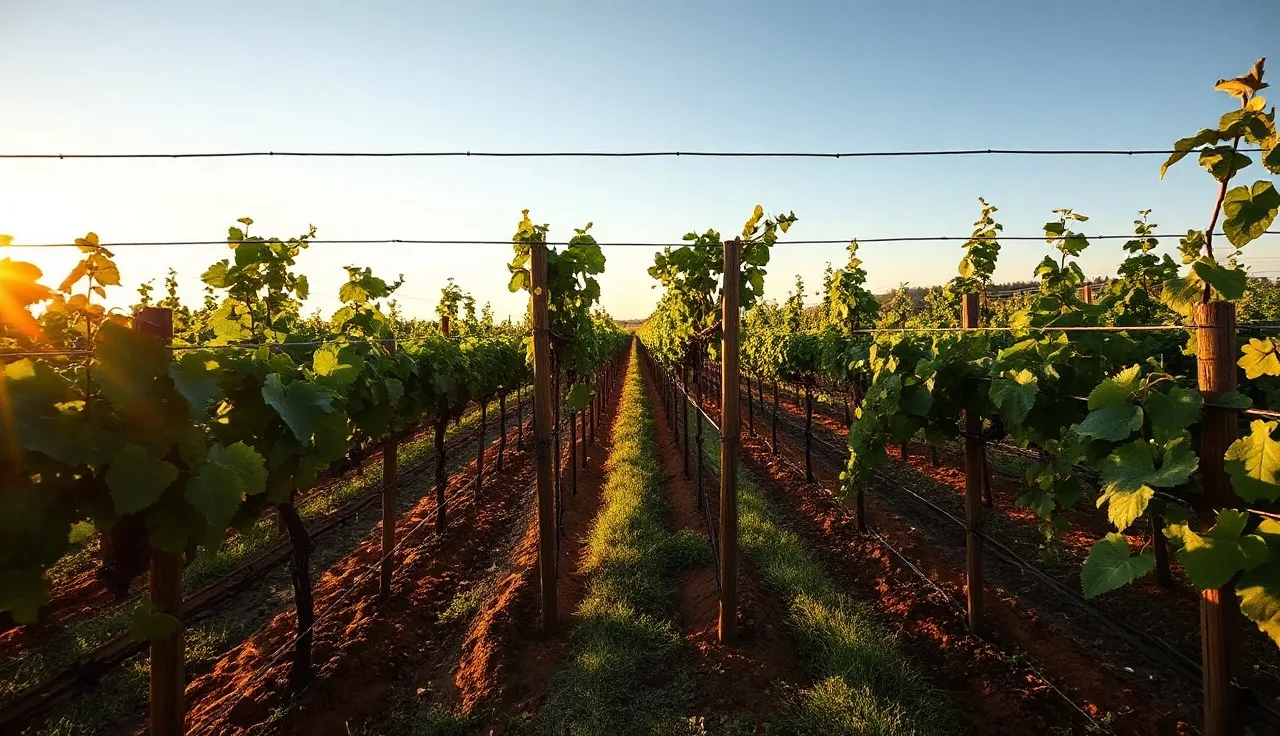
The modified Munson trellis takes T.V. Munson's 19th-century divided-canopy idea and updates it for modern vineyards. The core move is simple. You raise the fruiting wire high enough that shoots drape outward and downward in a falling curtain, then you catch those shoots with two pairs of wires set below and outside the cordon. The result is two separate curtains of foliage, one on each side of the row, instead of the tangled wall you get from a basic vertical shoot positioning setup.
The system shares DNA with other divided canopy designs like the Geneva Double Curtain (GDC) and the Lyre. The difference is that the modified Munson keeps both cordons on a single shared trunk rather than splitting the trunk itself. That distinction matters at planting and again at replanting.
Most installations put the cordon wire at 52 to 60 inches, with the outer catch-wire pairs dropping 8 to 12 inches below that and spreading 12 to 18 inches on each side. From the end of the row the canopy reads as a V. Cornell's extension viticulture team has documented the system as a high-vigor management tool, especially for American and French-American hybrid cultivars in the Northeast [1].
What are the origins of the Munson trellis and who should care?
Thomas Volney Munson was the Texas viticulturist who shipped American rootstock to France after the phylloxera epidemic of the 1870s. He designed the original system for vigorous native American varieties in hot, humid southern conditions. His targets were light penetration and air movement, two things a dense single-curtain canopy can't deliver when you're growing something like Concord or Cynthiana at high vine density.
The "modified" label entered the literature in the mid-20th century, when researchers at Cornell and other land-grant universities adapted the geometry to mechanical harvesting and modern trellis hardware. The change is mostly about wire placement and cordon height. Munson's original insight stayed intact.
Growing low-vigor Vitis vinifera on well-drained soil in a dry climate? You probably don't need this system. The modified Munson earns its cost when you have vigorous rootstock-scion combinations, heavy clay soils that push vegetative growth, humid conditions where botrytis and downy mildew are constant threats, or varieties with naturally dense canopies. Think Norton, Chambourcin, Niagara, Concord, or Vidal Blanc. It shows up rarely in California's drier appellations and often in the Midwest, Mid-Atlantic, and Southeast, the exact regions where vineyards fight canopy management hardest.
How is a modified Munson trellis built? Wire placement and post specs
The build starts with the post. Most growers use round treated wood or steel T-posts for line posts, with heavier corner and end posts to carry the lateral wire tension. Post height above ground runs 7 to 7.5 feet, enough to hold the high cordon and still leave working clearance underneath.
Here's the wire layout from bottom to top:
| Wire | Height from ground | Notes |
|---|---|---|
| Trunk tie wire | 18-24 in | Temporary or permanent guide for young vines |
| Cordon wire | 52-60 in | Main fruiting wire; carries the permanent cordon |
| Inner catch wires (pair) | 44-50 in | 6-10 in apart, bracketed outward 6-8 in from cordon |
| Outer catch wires (pair) | 36-44 in | Wider spread, 14-20 in from cordon center |
Some growers add a fifth run for the trunk training phase, then pull it. Others leave it as a spur-positioning guide. The outer catch wires are the ones that define the divided drape, so their spread angle against the cordon height is the variable you dial in for your canopy density.
Line post spacing usually falls between 18 and 24 feet. Closer spacing costs more but handles wire tension better on slopes. End post assemblies need deadman anchors or H-brace setups. The lateral forces on a fully fruiting, divided canopy row are no joke. WSU Extension recommends at least a two-post H-brace on any run longer than 400 feet [2].
Total wire per acre depends on row spacing and post layout. A typical install runs 4 to 6 wire strands per row, roughly 4,000 to 6,500 feet of wire per acre at 9-foot row spacing. Number 9 galvanized or 12.5-gauge high-tensile wire is standard for the load-bearing cordon and catch wires [11].
How does the modified Munson compare to GDC, VSP, and Scott Henry?
Every trellis comparison comes with one caveat: variety, climate, and soil vigor matter more than the hardware you bolt on. With that said, the systems differ in ways you'll feel every season.
The Geneva Double Curtain, developed at Cornell by Nelson Shaulis in the 1960s, splits the canopy at the top of the post, running two parallel cordon wires roughly 4 feet apart at the same height [3]. The modified Munson keeps a single cordon and gets its divided drape by angling the catch wires outward, not by splitting the cordon. GDC harvests better by machine. Modified Munson is friendlier to hand crews, who can reach under the curtain more naturally.
VSP trains shoots straight up into catch wires above the cordon, building a vertical wall of leaves. It's the dominant system for premium Vitis vinifera because it controls leaf-to-fruit ratio well, suits mechanical shoot thinning, and matches low-vigor sites. Put VSP on a high-vigor site and you get a shading disaster. Modified Munson moves the canopy out of its own shadow.
Scott Henry is another divided canopy, but it alternates upward and downward shoot training on the same trellis. It's harder to manage than modified Munson and demands consistent shoot selection. Many growers find modified Munson easier to explain to seasonal labor.
Here are the practical tradeoffs:
| System | Divided canopy | Best vigor | Mechanical harvest | Relative cost |
|---|---|---|---|---|
| Modified Munson | Yes (single cordon, two curtains) | High | Moderate | Medium-high |
| GDC | Yes (dual cordon) | High | Best | High |
| VSP | No | Low-medium | Good | Medium |
| Scott Henry | Yes (alternating) | Medium-high | Moderate | Medium-high |
| Single curtain/sprawl | No | High | Limited | Low |
What are the canopy management and spray coverage benefits?
Air circulation is where the modified Munson earns its install premium. When shoots drape outward and downward in two separate curtains, each cluster sees airflow from both sides. Cluster-zone relative humidity drops measurably against a closed VSP canopy under the same conditions. Lower humidity at the fruit means less botrytis pressure and, in humid eastern climates, less downy and powdery mildew.
UC Davis extension notes that divided-canopy systems generally raise fruiting-zone sunlight exposure by 30 to 50 percent versus dense single-curtain configurations [4]. That figure shifts with row orientation, vine spacing, and how well you've held shoot density in check, but the direction of the finding holds across studies.
Spray coverage is the practical payoff growers overlook until they try it. An airblast sprayer running alongside a modified Munson canopy reaches clusters from below (through the gap between curtains), from outside (through the draping shoots), and from the row middle. That three-angle exposure beats a wall canopy where the cluster zone hides behind leaves. Under the EPA Worker Protection Standard, spray records must document application rate, target pest, and equipment [5]. Getting adequate coverage in fewer passes has a real cost impact.
For growers tracking application records digitally, tools like VitiScribe can log spray events tied to specific blocks, which makes coverage history easy to audit during a regulatory inspection. That helps most when you run several trellised blocks with different systems and need proof each one got adequate coverage at the right timing.
What does a modified Munson trellis cost per acre to install?
The honest answer: no single figure fits everywhere, and anyone quoting a tight number without knowing your terrain, soil, post material, and local labor rates is guessing. You can still triangulate.
End posts, corner assemblies, and bracing hardware eat a disproportionate share of the cost. For a standard install with treated round wood posts (line posts at 20-foot spacing), high-tensile wire, and five wire runs:
- Posts alone typically run $0.40 to $0.80 per linear foot of row, depending on material and diameter.
- Wire (high-tensile 12.5 gauge) runs roughly $0.04 to $0.07 per foot per strand at current commodity prices. Five strands at 9-foot row spacing adds up fast.
- Staples, clips, wire ties, and tensioners are a small line item, but they add labor time.
- Labor is usually the largest single variable. In the Mid-Atlantic and Midwest, trellis installation labor runs $800 to $1,500 per acre depending on terrain, according to enterprise budget estimates from Virginia Cooperative Extension [6].
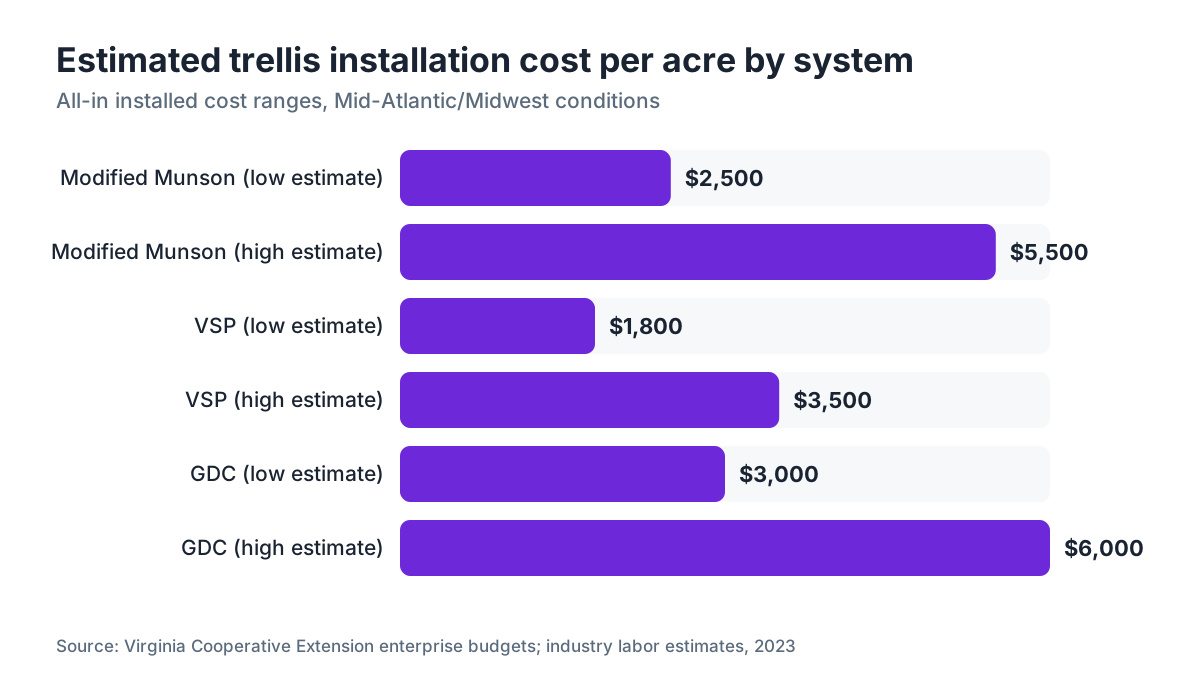
All-in estimates for a new trellis (not counting vine planting) generally run $2,500 to $5,500 per acre for a full divided-canopy system like modified Munson. A basic VSP install in the same market comes in at $1,800 to $3,500 per acre. The premium is real, mostly from the extra wire runs and the heavier end assemblies.
Long-term, the bet is that lower disease pressure and better spray efficiency beat the higher up-front cost over a 20-year vineyard life. That math holds better in humid climates, where fungicide applications run 12 to 18 per season, than in dry western regions where you might spray 4 to 8 times.
How do you train vines on a modified Munson trellis in the first three years?
The training sequence follows the same logic as any cordon-trained system, with one twist. You're aiming for a higher cordon and you have to plan for how the mature canopy will drape.
Year one. Build a strong trunk and nothing else. Select the most vigorous shoot at planting, tie it to a temporary stake or the lowest permanent wire, and let it run without pinching until it passes cordon height. Then tip it. Side shoots below cordon height get trimmed back to one leaf. They're temporary solar panels, not permanent wood.
Year two. Pick two balanced, well-placed shoots just below the cordon wire and train them in opposite directions along it. These become your permanent cordons. Keep growth on the cordon and strip competing wood off the trunk. Spur development starts in earnest here, with young spurs spaced 4 to 6 inches apart.
Year three. Cordon wood should reach most of your post spacing in each direction. Spurs push two to four shoots each. Train them into the catch-wire system so they drape outward and downward in the right geometry. A light crop in year three is fine if vine health looks good, but don't push it. Root establishment still beats early yield.
Growers underestimate how much the high cordon changes the ergonomics of pruning. Workers reaching overhead for hours tire faster and cut worse. Some operations build low rolling platforms or use tractor-mounted pruning seats to cut fatigue and improve cut quality on the upper spurs. It isn't glamorous. It matters for pruning accuracy.
What varieties work best with the modified Munson system?
Short answer: vigorous varieties that build dense canopies on high-rainfall or high-fertility sites. The system does nothing for a low-vigor variety on shallow soil. It's engineering aimed at a specific problem.
French-American hybrids are the most common match in eastern North America. Chambourcin, Norton (Cynthiana), Vidal Blanc, and Seyval Blanc all put out the kind of vigorous, dense growth that gains from the divided curtain. These are workhorse varieties across Mid-Atlantic, Midwest, and Southeast appellations. Missouri extension documents Norton and other French-American hybrids as well suited to divided-canopy training in humid Midwest conditions [9].
Native American varieties like Concord, Niagara, and Catawba have grown on Munson-style systems for over a century. The Great Lakes grape belt, which produces most U.S. Concord and Niagara for juice and jelly, ran Munson-derived systems before GDC took over for mechanical harvesting.
Vitis vinifera is a harder case. Vigorous vinifera on fertile soil, say Merlot on a high-organic-matter river-bottom site, can benefit from divided-canopy management. But most premium vinifera in California, Oregon, and Washington runs on VSP or a variation of it, and switching an established block to modified Munson is a major renovation. A few growers at Paso Robles wineries and south coast winery operations in southern California have tried divided-canopy approaches on vigorous rootstocks, though it's not the regional norm. Penn State extension covers trellis selection for high-vigor Mid-Atlantic sites, including modified Munson and GDC [10].
What pruning and dormant pruning practices apply to modified Munson?
Modified Munson is almost always run as a spur-pruned cordon, not a cane-pruned system. The height and geometry make annual cane replacement impractical in most commercial settings. You'd be working overhead with loppers, trying to lash long canes to a wire 5 feet off the ground.
Spur pruning on modified Munson follows the same principles as any cordon. Retain two-bud spurs spaced 4 to 6 inches apart, positioned on the lower side of the cordon where you can, to push shoots downward into the catch-wire system. Spurs on the top of the cordon train shoots upward before they eventually cascade, which fights the divided-curtain geometry and packs a dense mass at cordon level.
Budwood selection matters more here than on lower cordons, because you're choosing from wood that spent the whole season 5 feet in the air, often with more sun on the outer face than the inner. Outer-facing spurs may throw stronger, better-placed shoots. Take dormant pruning seriously. Leave too many buds and you defeat the canopy-division benefit by the time July rolls in.
Winter pruning timing on high cordons ties into cold hardiness. Cordons at 52 to 60 inches swing through wider temperature extremes than low cordons sitting near the thermal mass of the soil. In marginal cold-hardiness regions, holding dormant pruning until after the worst freeze risk has passed can protect cordon wood. Cornell's cold hardiness research on Concord and hybrid grapes in New York documents this difference [7].
Are there mechanical harvesting considerations for modified Munson?
Yes, and this is one spot where the system has a real limit against GDC. Over-the-row harvesters straddle the trellis and shake the catch-wire zone to dislodge clusters. GDC, with two parallel cordon wires spread wide at the top, is almost built for the job. Modified Munson, with a single central cordon and outward-draping catch wires, needs a different harvester head setup.
It isn't impossible. Some harvester makers offer adjustable lateral finger positions and catch-plate geometries that work reasonably well with the modified Munson drape. But growers planning to harvest by machine from day one should either spec their trellis to harvester clearance dimensions or talk to their equipment dealer before they set wire placement.
Hand harvesting on modified Munson is easy. Pickers work down the row, reaching under the drooping shoot curtains to the cluster zone. Clusters hang below the catch wires in a naturally reachable spot, and the divided canopy keeps light on the fruit at picking time, so spotting clusters is quick. Compared to a dense VSP wall, many pickers report faster rates on modified Munson once they learn the geometry.
Operations that run both hand and machine harvest (hand-picking a premium block, machine-harvesting a juice-grape block) often carry two trellis systems on one farm. Tracking which blocks carry which system, along with their spray histories and yield data, is the kind of detail field-record platforms like VitiScribe handle without letting blocks blur together in a spreadsheet.
What are the most common mistakes when installing or managing modified Munson?
The biggest install mistake is setting the cordon wire too low. Growers who've only run VSP get nervous about a 58-inch cordon and drop it to 48 or 50 inches to feel safe. At that height the outward-draping catch wires end up too close to the ground, shoots drag in wet weather, and the air-circulation benefit you paid for mostly vanishes. Trust the geometry.
The second mistake is skimping on end-post assemblies. The lateral forces in a fully loaded modified Munson row are heavy, because the outer catch wires carry drooping shoot tips plus fruit load at an angle. A weak H-brace or a single post without a deadman will pull and sag within two or three seasons, and once the geometry goes, the canopy-division benefit goes with it.
On the management side, the failure mode is letting shoot density rebuild the closed canopy the trellis was built to prevent. It happens through under-pruning at dormancy and skipping shoot thinning in late spring. Leave six or eight shoots per spur position and you'll have as many leaves per square foot in July as a standard VSP wall, just hung at a different angle.
Some growers also underestimate the irrigation side. A divided canopy with good air movement has higher evapotranspiration than a closed canopy. In hot dry summers that means more irrigation demand per acre. Budget for it, or you'll see August stress that looks like disease but is really water deficit.
How does modified Munson affect compliance recordkeeping and pest management documentation?
Better canopy architecture changes how you design a pesticide program, and program design drives your recordkeeping load.
Under the EPA Worker Protection Standard (WPS), agricultural employers must keep records of every pesticide application, including product name, EPA registration number, active ingredient, rate, date, location, and the name of the certified applicator [5]. Those records must be held for two years and made available to WPS-trained workers and their designated representatives within 15 days of a request.
The WPS also sets restricted entry intervals (REIs), and a modified Munson canopy touches REI compliance in a practical way. Workers thinning shoots or doing canopy work under the catch wires may enter the cluster zone more often, and at different times, than they would in a standard VSP block. Your spray records need to show which blocks got treated and when, so supervisors can enforce REIs block by block instead of across the whole vineyard.
State recordkeeping rules often go past the federal WPS. California's DPR, for example, requires a pesticide use report for every commercial application, submitted monthly to the county agricultural commissioner [8]. Many eastern states require similar documentation. Keeping separate records by trellis system isn't legally required, but it's smart practice, because spray rates, coverage patterns, and product choices can legitimately differ between your modified Munson blocks and your VSP blocks.
WSU Extension's IPM program for Pacific Northwest vineyards recommends documenting canopy density assessments alongside spray records to show that coverage decisions rested on agronomic grounds [2]. That kind of paper trail supports you in a compliance inspection.
Frequently asked questions
Is modified Munson the same as the Geneva Double Curtain?
No, though both are divided-canopy systems. GDC runs two parallel cordon wires spaced about 4 feet apart at the top of the trellis, splitting the canopy at cordon level. Modified Munson keeps a single central cordon wire and gets the two-curtain effect by angling pairs of catch wires outward and downward below the cordon. GDC suits mechanical harvesting better. Modified Munson is more hand-harvest-friendly.
What cordon wire height is correct for modified Munson?
Most published guidelines put the cordon wire at 52 to 60 inches above the ground. The catch-wire pairs then sit 8 to 12 inches below, spread 12 to 18 inches outward on each side. Going lower than 52 inches compresses the catch-wire zone and kills the air-circulation benefit. Going higher than 60 inches creates ergonomic problems for pruning and canopy work without a meaningful canopy gain.
Can you use modified Munson for Vitis vinifera varieties?
You can, but the system is built for high-vigor situations. Most premium vinifera production in California, Oregon, and Washington uses VSP because low-to-moderate vigor suits that system better. Vigorous vinifera on fertile soils (say Merlot or Chardonnay on high-organic river-bottom ground) can benefit from the divided canopy, but switching an established vinifera block to modified Munson is a costly multi-year renovation.
How many wire runs does a modified Munson trellis need?
A standard install uses four to six wire runs: one cordon wire, two inner catch wires (one on each side), and two outer catch wires. Some growers add a trunk-training wire during establishment, which may be temporary. The extra runs compared to a three-wire VSP system account for most of the cost premium on a modified Munson install.
What post spacing works for modified Munson?
Line post spacing of 18 to 24 feet is standard. Closer spacing (18 feet) handles wire tension better on slopes and under heavier crop loads. Wider spacing (24 feet) cuts material cost. End posts and corner assemblies need H-brace or deadman anchor setups to handle the lateral tension from the angled outer catch wires. WSU Extension recommends a two-post H-brace for rows over 400 feet.
How does modified Munson affect botrytis and fungal disease pressure?
Divided-canopy systems improve air circulation through the cluster zone, which lowers relative humidity at the fruit and cuts the damp, still conditions botrytis loves. UC Davis extension research documents 30 to 50 percent better sunlight penetration in divided-canopy configurations versus dense single-curtain systems. Less humidity plus more sun on the clusters means earlier, more thorough drying after rain, which is exactly when botrytis infection risk peaks.
What is the typical cost to install a modified Munson trellis?
All-in installation costs generally range from $2,500 to $5,500 per acre, depending on post material, terrain, local labor rates, and row spacing. That premium over a basic VSP install ($1,800 to $3,500 per acre) reflects the extra wire runs and heavier end-post assemblies. Virginia Cooperative Extension enterprise budgets put trellis labor alone at $800 to $1,500 per acre in Mid-Atlantic conditions.
How do you prune vines trained on modified Munson?
Modified Munson is almost always spur-pruned. Two-bud spurs sit 4 to 6 inches apart along the cordon, preferably on the lower side to push shoots down into the catch wires. Cane pruning is impractical at 5-foot cordon heights in most commercial settings. Leave too many buds at dormancy and you rebuild the closed canopy the divided system was meant to prevent, wiping out the spray and disease benefits.
Is modified Munson practical for small vineyards under 5 acres?
Yes, and arguably more practical on small blocks where hand operations dominate. The system doesn't require specialized mechanical harvesting gear to work well, and the canopy benefits (lower disease pressure, better spray coverage) apply at any block size. The higher install cost per acre hurts more at small scale, but the payback through fewer fungicide applications can offset it over 5 to 10 years in humid climates.
What varieties are most commonly grown on modified Munson in the United States?
French-American hybrids dominate: Chambourcin, Norton/Cynthiana, Vidal Blanc, and Seyval Blanc. Native American varieties including Concord, Niagara, and Catawba have historic ties to Munson-style systems in the Great Lakes region. These varieties share the high vigor and dense canopy habits that make divided-canopy training worthwhile. Low-vigor Vitis vinifera varieties rarely need this system outside unusual site conditions.
What does EPA Worker Protection Standard require for spray records on trellised blocks?
The WPS requires records of every pesticide application covering product name, EPA registration number, active ingredient, application rate, date, block location, and the name of the certified applicator. Records must be kept for two years and provided to trained workers or their representatives within 15 days of request. State requirements (California DPR monthly use reports, for example) often add to this federal baseline.
Can modified Munson be retrofitted onto an existing VSP trellis?
A full retrofit is expensive and usually not worth it if posts are already set at VSP heights (typically 6 feet or less above ground). The cordon wire needs to move up a lot, which may mean replacing or sister-posting all line posts. In practice, most growers do a modified Munson install on new ground or on complete replants, not as a mid-life conversion. The retrofit economics rarely pencil out versus replanting with correct infrastructure.
How does row orientation affect modified Munson performance?
North-south rows put the most morning and afternoon sunlight on both curtains of the divided canopy, the same principle that applies to VSP. East-west rows shade the inner faces of both curtains for part of the day, cutting the light-exposure benefit. On slopes, running rows with the contour rather than up and down the slope matters for drainage and erosion, which sometimes overrides the light-optimization argument.
How do you handle irrigation management differently on modified Munson?
Divided-canopy systems with good air movement have measurably higher evapotranspiration than closed canopies under the same conditions, because more leaf surface catches wind and sun. In hot dry summers this can raise drip irrigation demand by 10 to 20 percent versus a comparable VSP block. Budget for that added demand at the design stage, and set your soil moisture monitoring thresholds accordingly.
Sources
- Cornell Cooperative Extension, Viticulture and Enology: Cornell extension documents modified Munson as a high-vigor management system for American and French-American hybrid cultivars in the Northeast
- Washington State University Extension, Pacific Northwest Pest Management Handbooks: WSU Extension recommends at least a two-post H-brace on runs longer than 400 feet and documents vineyard IPM spray record practices
- Cornell Cooperative Extension, Viticulture and Enology: The Geneva Double Curtain was developed at Cornell by Nelson Shaulis in the 1960s, running two parallel cordon wires spread wide at the top of the trellis
- UC Davis Viticulture and Enology: UC Davis extension notes divided-canopy systems increase sunlight exposure of the fruiting zone by 30 to 50 percent compared to dense single-curtain configurations
- U.S. EPA, Agricultural Worker Protection Standard: The EPA Worker Protection Standard requires records of pesticide applications including product name, EPA registration number, active ingredient, rate, date, location, and certified applicator, kept for two years
- Virginia Cooperative Extension, Enterprise Budgets for Grape Production: Virginia Cooperative Extension enterprise budgets put trellis installation labor at $800 to $1,500 per acre in Mid-Atlantic conditions
- Cornell University College of Agriculture and Life Sciences, Viticulture and Enology Cold Hardiness Research: Cornell cold hardiness research documents that high cordons experience greater temperature swings than low cordons and that delayed dormant pruning can protect cordon wood in marginal cold-hardiness regions
- California Department of Pesticide Regulation, Pesticide Use Reporting: California DPR requires a pesticide use report for every commercial application, submitted monthly to the county agricultural commissioner
- University of Missouri Extension, Viticulture Resources: Missouri extension documents Norton/Cynthiana and other French-American hybrid varieties as well-suited to divided-canopy training in humid Midwest conditions
- Penn State Extension, Wine and Table Grapes: Penn State extension covers trellis system selection for high-vigor sites in the Mid-Atlantic including modified Munson and GDC
- WSU Extension: WSU Extension documents wire gauge recommendations and post spacing for high-tensile trellis installations in vineyard settings
Last updated 2026-07-09