Mold on grapevines: diseases, ID, and what to do about them
TL;DR
- Grapevines face six main fungal and oomycete diseases: powdery mildew, downy mildew, Botrytis bunch rot, black rot, Phomopsis cane and leaf spot, and Eutypa dieback.
- Most are manageable with correct spray timing, canopy management, and variety selection.
- Powdery mildew is the most widespread in North American vineyards.
- Botrytis is the costliest at harvest.
- Early ID and accurate spray records are the foundation of control.
What types of mold and fungal disease actually affect grapevines?
Six diseases account for most fungal and mold-related losses in North American vineyards: powdery mildew, downy mildew, Botrytis bunch rot, black rot, Phomopsis cane and leaf spot, and Eutypa dieback. Five are true fungi. One, downy mildew, is an oomycete, which looks like a fungus but isn't. That distinction is money in your pocket, because the chemistry that kills one group often does nothing to the other.
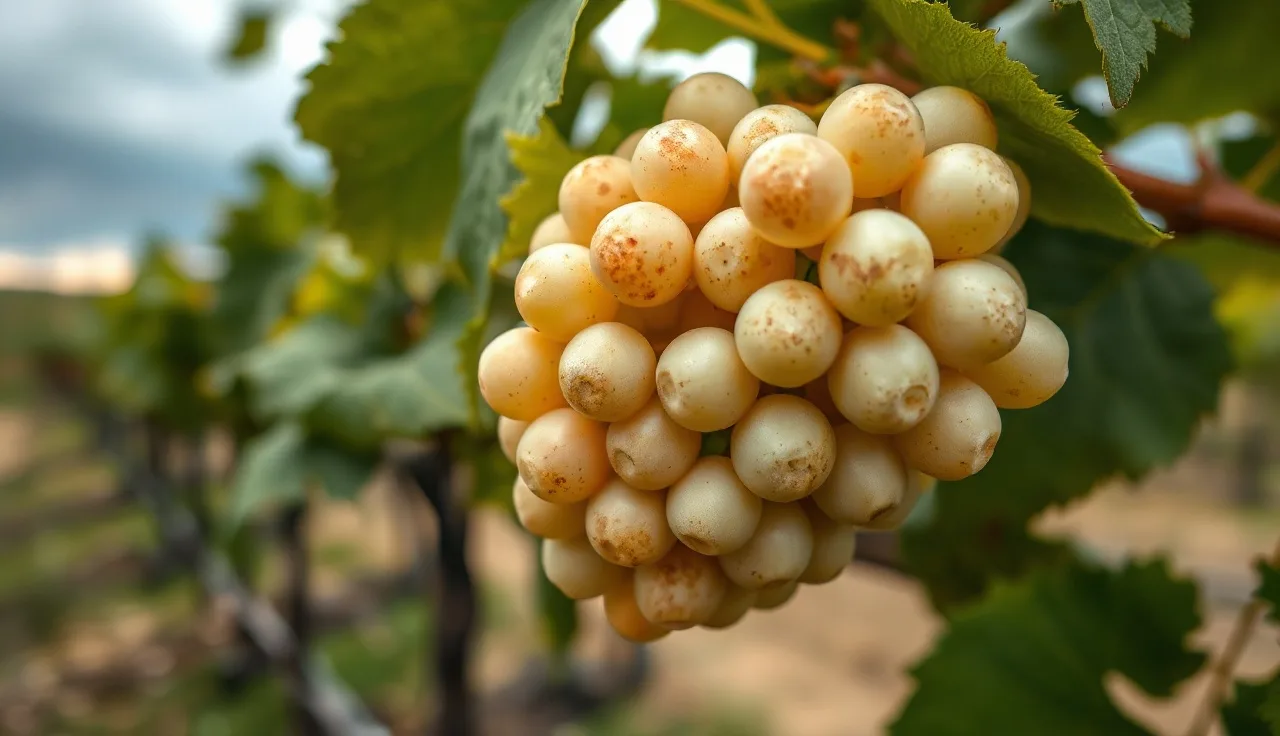
Powdery mildew, caused by Erysiphe necator (formerly Uncinula necator), is the most geographically widespread grapevine disease in North America. [1] Downy mildew, Plasmopara viticola, is the dominant threat in humid eastern regions. Botrytis bunch rot (Botrytis cinerea) is the leading economic problem at harvest in most wine regions worldwide. [2] Black rot (Guignardia bidwellii), Phomopsis cane and leaf spot (Phomopsis viticola), and Eutypa dieback (Eutypa lata) round out the core list.
None of these is a true mold in the household sense. Growers use the word anyway, especially for Botrytis, which produces the gray fuzzy growth that looks exactly like bread mold. The table below compares the six at a glance.
| Disease | Pathogen type | Primary target | Key symptom | Worst season |
|---|---|---|---|---|
| Powdery mildew | True fungus | Shoots, leaves, berries | White powdery coating | Dry, warm summers |
| Downy mildew | Oomycete | Leaves, clusters | Yellow oil spots, white sporulation below | Wet spring/summer |
| Botrytis bunch rot | True fungus | Berries, clusters | Gray fuzzy sporulation | Wet harvest period |
| Black rot | True fungus | Leaves, berries | Brown lesions, black mummified berries | Wet spring |
| Phomopsis | True fungus | Canes, shoots, berries | Dark lesions at base of shoots | Wet spring |
| Eutypa dieback | True fungus | Permanent wood | Dead spurs, wedge-shaped wood stain | Slow, multi-year |
Identify the disease before you spray. Put a copper downy mildew material on a powdery mildew outbreak and you've wasted the pass.
How do you identify powdery mildew on grapevines?
Powdery mildew is the easiest grapevine disease to spot once you know the look. White to gray powdery colonies appear on both surfaces of young leaves, on shoot tips, and on green berries. [1] It doesn't need free water to infect, which sets it apart from downy mildew and Botrytis. It runs between 70 and 85 degrees F with relative humidity above roughly 40%, so it's a problem even in dry country like the Central Valley or the Columbia Basin. [3]
Berry infection before or shortly after fruit set is the worst outcome. The fungus colonizes the skin, the berry keeps growing, and the skin cracks, which opens the pulp to secondary rots. Infected clusters can carry taint at very low levels of visible infection. That matters for reds, where E. necator throws a sulfur-like, musty note into the wine.
Scout in the morning before it heats up. Flip young leaves at the shoot tips and look underneath. The colonies fluoresce faintly under UV light, a real field trick some larger operations use for early detection. For most growers, a hand lens and a feel for your canopy do the job.
UC IPM describes powdery mildew as "the most economically important grapevine disease in California." [1] The protection window that pays is from budbreak through about 6 to 8 weeks after bloom, when berries are most susceptible.
What does downy mildew look like on grapevines, and how is it different from powdery mildew?
Downy mildew (Plasmopara viticola) shows first as pale yellow, irregular spots on the upper leaf surface that look greasy or oily. Growers call them oil spots. Flip the leaf on a humid morning and you'll see white, downy sporulation on the underside, right below the yellow. That's the diagnostic sign. [4]
Here's the fast field distinction. Powdery mildew grows on top of plant surfaces. Downy mildew sporulates underneath the leaf and needs free moisture to spread.
Downy mildew needs a specific infection event: temperature above 50 degrees F, at least 10mm of rain, and 10 or more hours of leaf wetness. Cornell's IPM materials call this the 10-10-10 rule, a handy shorthand for when to start a spray program in the Northeast. [4] In the Pacific Northwest, WSU Extension flags downy mildew as an increasing threat as rainfall patterns shift. [5]
On fruit, downy mildew causes gray rot in young berries and leather rot in more mature fruit, both leaving shriveled, brownish clusters. Infected shoot tips curl downward in a shepherd's crook. Late-season infections may show no obvious sporulation but still strip leaves early, which drains vine carbohydrate reserves heading into dormancy.
Chemistry is where growers lose money if they guess. Downy mildew is an oomycete, so true fungicides like the DMI (sterol inhibitor) materials have limited or no activity. You need oomycete-specific products: mancozeb, copper hydroxide, phosphorous acid materials, cymoxanil, or mandipropamid. Read the label every time.
What is Botrytis bunch rot and when does it become a serious problem?
Botrytis bunch rot is caused by Botrytis cinerea, one of the most genetically variable plant pathogens in agriculture. It infects nearly every above-ground grape tissue, but the phase that costs you is berry infection near or at harvest. Gray, fuzzy sporulation on clusters, soft watery berries, and a musty smell are the signs. [2]
The fungus is on your vines all the time as a latent, dormant infection in old canes and dead tissue. It wakes up when things turn wet and cool, usually late summer into harvest. Tight-clustered, thin-skinned varieties like Pinot Noir, Gewurztraminer, and Chardonnay get hit far harder than loose-clustered or thick-skinned ones.
Botrytis management has three parts. Canopy management comes first: good air circulation through the fruiting zone is one of the cheapest and most effective moves you can make, and correct leaf removal around clusters cuts cluster humidity and limits sporulation. Spray timing comes next: applications at bloom, pre-bunch closure, and pre-harvest (if residue intervals allow) are the standard program. Harvest timing is the third: fruit left on the vine after rain longer than it needs to be is asking for losses. Winemakers chasing Botrytis-affected fruit for dessert wines are making a deliberate call with tight tolerances. It's a style, not a rescue for a neglected block.
Resistance to some Botrytis fungicides, especially the FRAC Group 1 benzimidazoles, is documented and serious in regions where those chemistries got overused. [2] Rotating FRAC groups isn't optional in any serious Botrytis program.
What is black rot on grapes and how do you stop it spreading?
Black rot, caused by Guignardia bidwellii, is the dominant disease in hot, humid eastern and midwestern vineyards. The name comes from the hard, black, mummified berries it leaves behind. Those mummies overwinter on the vine and in the soil and become the main inoculum source the next season. [6]
Symptoms move fast. On leaves, look for tan to brown circular lesions with a dark brown border, usually a quarter to a half inch across, with tiny black pycnidia (spore-producing bodies) in the center of older lesions. On berries, infection before veraison turns the berry dark brown to black and shrivels it into a mummy within about two weeks. After veraison, berries turn largely resistant.
The infection window tracks the weather closely. Black rot needs wet conditions and temperatures between 50 and 90 degrees F, and it moves faster when it's warm. Cornell's viticulture resources note that a 2-hour wetness period at 86 degrees F is enough for infection, while infection at 50 degrees F takes 24 hours of wetness. [4]
Mummy removal at dormant pruning is one of the most cost-effective steps there is. It won't replace a spray program in a high-pressure year, but it measurably cuts inoculum load. The spray program usually starts at 1 to 2 inch shoot growth and runs through about 4 weeks after bloom, covering the most susceptible berry stages. Mancozeb, myclobutanil, and tebuconazole all have documented efficacy. [6]
What are Phomopsis and Eutypa, and why do they matter for long-term vine health?
Phomopsis cane and leaf spot (Phomopsis viticola) and Eutypa dieback (Eutypa lata) are both wood diseases, which puts them in a different management category from the foliar and fruit diseases. The damage stacks up slowly and often stays hidden until the vine has already lost real structure.
Phomopsis attacks in cool, wet springs during early shoot growth. The first symptom is dark brown to black lesions at the base of young shoots, sometimes with a bleached, cracked area on the cane after the lesion dries. Berries can get infected too, turning light brown and shriveling. Infected basal internodes weaken and snap easily, which some growers first notice when tying canes. The window is tight: applications work best from budbreak through the first four to six inches of shoot growth. [4]
Eutypa dieback is a slower crisis. The fungus enters through pruning wounds, grows through the wood, and can take three to eight years to show obvious symptoms. When it does, you'll see dead spurs, stunted fan-shaped shoots coming off an infected cordon, and a wedge-shaped brown stain in cross-sectioned wood. [7] There's no cure once the wood is colonized. Management means cutting away from infected tissue, applying pruning wound protectants (products with trichoderma or certain fungicides labeled for the use), and doing major pruning in drier weather when you can.
Growers running older Cabernet Sauvignon on California's Central Coast or older Chardonnay in New York know Eutypa as a long-term threat that gets underestimated right up until replanting comes up. See more on established vineyard operations at vineyard.
If you're tracking sprays across several diseases and several blocks, keeping disease notes attached to each spray entry makes patterns jump out over multiple seasons. Tools like VitiScribe are built for that field-to-compliance record workflow.
What spray programs actually work, and what does the research say about timing?
The honest answer: within a given chemistry class, timing beats product selection. A well-timed sulfur application for powdery mildew outperforms a late application of a premium DMI fungicide. UC Davis trial data has shown this for decades, and it's why most extension recommendations lead with growth-stage timing instead of product lists. [1]
For powdery mildew in California, UC IPM recommends a dormant sulfur application, then protective sprays starting at budbreak on 10 to 14 day intervals, tightened to 7 days under high pressure. The 3 to 5 inch shoot stage and pre-bloom are the top-priority windows. [1]
For downy mildew in the Northeast, Cornell's guidelines say start when the 10-10-10 rule is met and continue on 7 to 10 day intervals through veraison. [4]
Sulfur is still the backbone of powdery mildew programs in many regions. It's cheap, effective, OMRI-listed for organic use, and unlikely to select for resistance. The catch is phytotoxicity above about 90 degrees F. Spray on a hot day and you can defoliate vines or burn berries. Fixed copper is the backbone of downy mildew programs, with the same organic approval and the same need to watch your rates. Copper accumulation in soil is a real long-term issue. [8]
Resistance management is why FRAC group rotation exists. Lean only on FRAC Group 3 (DMIs) for powdery mildew, or only on Group 11 (QoIs, the strobilurins), year after year, and you select for resistant isolates fast. WSU Extension's resistance guidelines recommend no more than two sequential applications of any one FRAC group and no more than four applications per group per season. [5]
Re-entry intervals (REI) and pre-harvest intervals (PHI) are legally binding under the EPA Worker Protection Standard, not friendly suggestions. 40 CFR Part 170 requires that workers be informed of applications and that REIs be posted. [9] Apply a restricted-use pesticide and the record-keeping requirement is real and auditable.
How does canopy management reduce grapevine disease pressure?
Canopy management is one of the few disease practices with no resistance risk, no re-entry interval, and no label to read. It works by changing the microclimate around leaves and clusters. Better air circulation dries free moisture faster, which shortens infection periods for downy mildew, Botrytis, and black rot. It also improves spray penetration, so the chemistry you do apply hits harder.
Leaf removal in the fruiting zone is the most studied piece. Work from Cornell and UC Davis shows that pulling basal leaves on the cluster-exposure side of the canopy, usually the morning (east-facing) side in most American trellis systems, cuts Botrytis incidence sharply without giving up yield in most varieties. The debate is timing. Early leaf removal around bloom reduces cluster compactness in tight-clustered varieties like Pinot Noir and Riesling. Later removal is more common in looser-clustered varieties. [2]
Shoot positioning and shoot thinning matter too. Tangled, overlapping canopies trap stagnant air and hold leaf wetness longer after rain. Aim for roughly one leaf layer of thickness through the fruiting zone, dense enough to catch sunlight but open enough that you can see sky through it from the other side. That's the classic point quadrant standard from Smart and Robinson's canopy management work.
None of this cancels the need for a spray program under high pressure. But growers who put work into the canopy consistently report longer spray intervals and lower disease severity. It also builds better fruit quality on its own, which makes it worth doing no matter the disease outlook.
Which grapevine varieties are most resistant to mold and fungal diseases?
Vitis vinifera, the European wine grapes, have essentially no natural resistance to downy or powdery mildew. Both pathogens are native to North America, and V. vinifera evolved in Eurasia without ever meeting them. American species like V. labrusca and V. riparia carry partial resistance, and the hybrids bred from crossing these with vinifera inherit varying levels. [10]
Hybrids with meaningful resistance include Marquette, Frontenac, La Crescent, Traminette (partial powdery mildew resistance), Vidal Blanc, and Chambourcin. None are immune. But in humid eastern regions you can grow them on much lighter fungicide programs than vinifera. [10]
In the PIWI category (Pilzwiderstandsfahig, or fungus-resistant) from European breeding programs, varieties like Regent, Solaris, Bronner, and Muscaris stack resistance genes from North American species and hold up well to both powdery and downy mildew in European trials. US adoption is still small, held back partly by consumer name recognition and partly by appellation rules, but grower interest is climbing as labor and input costs rise.
For conventional vinifera growers, variety choice is really about accepting the management bill that comes with it. Pinot Noir in a wet climate is a high-cost, high-risk choice on disease alone. Cabernet Sauvignon in a dry climate is far lower risk. That's not a quality judgment. It's arithmetic on spray costs and loss risk. See how climate and setting shape operations at mountain-winery and paso-robles-wineries.
What records do you legally need to keep for grapevine disease sprays?
Record-keeping comes from several overlapping sources: state agriculture departments, the EPA Worker Protection Standard, and, for certified organic operations, your certifier's audit requirements.
At the federal level, the EPA Worker Protection Standard (40 CFR Part 170) requires agricultural employers to keep records of pesticide applications for at least two years. That includes the product name, EPA registration number, active ingredient, location treated, date and time, and the applicator's information. [9]
Most states pile more on top. California's Department of Pesticide Regulation requires licensed applicators to submit pesticide use reports monthly to their county agricultural commissioner, with detailed records of each application including field acreage and the pest targeted. [11] New York requires similar records under its pesticide reporting law. If you're unsure of your state's specifics, your state department of agriculture is the authoritative source.
For organic certification, the National Organic Program (7 CFR Part 205) requires records sufficient to demonstrate compliance for at least five years. [12] Your certifier will want spray records, product purchase receipts, and field maps.
What turns a spray record from a compliance box-check into a real tool is attaching scouting notes, weather data, and disease observations to each entry. "Applied sulfur on 5/15" is compliant. "Applied sulfur on 5/15, 80% of shoots at 3-inch stage, first oil spots on block 4 leaves 5/13, 72F, RH 65%" is something you'll use next year. VitiScribe captures that level of detail without needing a spreadsheet engineer to set it up.
What are the economic losses from grapevine fungal diseases?
Pinning down losses is hard. Most data comes from survey-based estimates rather than controlled trials, and growers underreport for obvious reasons. The numbers that do exist are sobering.
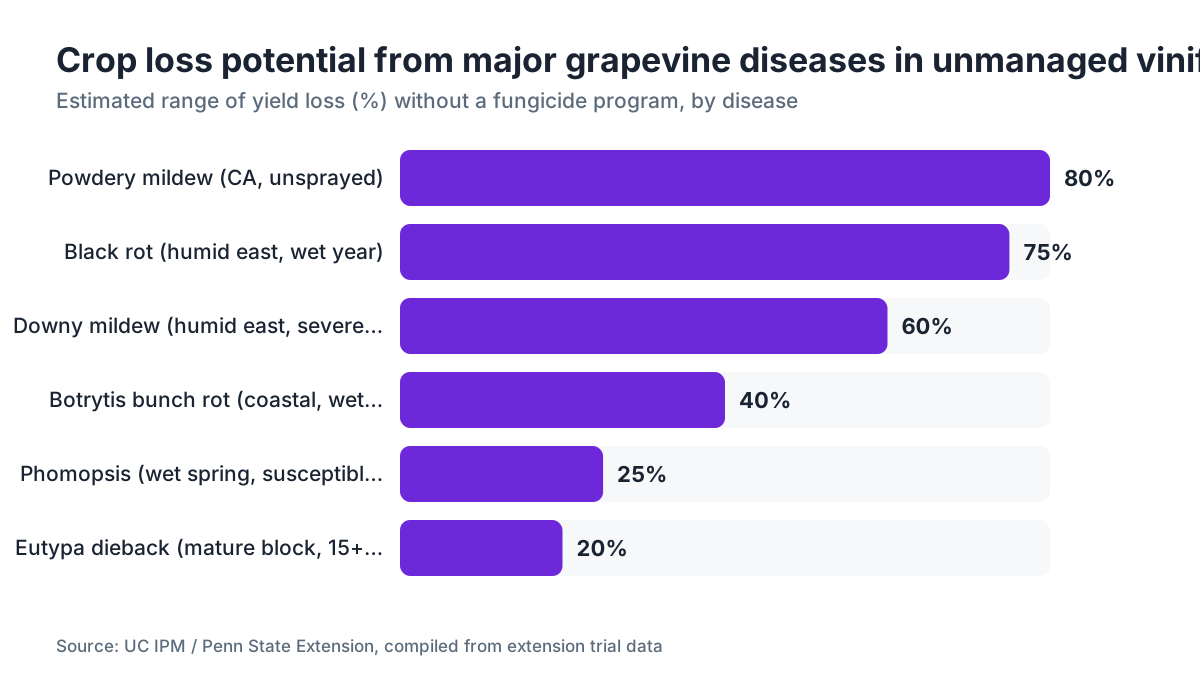
Botrytis bunch rot is routinely cited as costing California grape growers tens of millions of dollars a year in direct crop loss, plus winery-side costs from quality downgrades. UC Cooperative Extension economic work puts fungicide programs for Botrytis in coastal Chardonnay at $150 to $350 per acre per season, depending on spray frequency and product cost, before application labor. [1]
Powdery mildew left completely unmanaged in a susceptible vinifera variety in a warm climate can take the whole crop. Even a moderate outbreak in winegrapes cuts both yield and quality. UC Davis has documented yield losses of 10 to 80 percent in unsprayed California trials. [1]
In the eastern US, black rot in a wet year can destroy 50 to 80 percent of a crop in unprotected vinifera blocks, per Penn State Extension research. [6] That's not a rounding error. That's a farm failure.
A well-run spray program for a moderate-pressure season usually costs $200 to $600 per acre in materials alone, based on current conventional product pricing. Organic programs can run higher per acre on product cost and more frequent applications. Application costs (labor, equipment, fuel) add another $100 to $300 per acre depending on operation size and whether you own your equipment. These ranges reflect 2024 product and labor conditions and shift by region.
The economic case for canopy management, resistant varieties, and accurate spray timing is simple: all three cut the number of applications you need, which is the largest variable cost in most programs.
What are early warning signs that grapevine disease pressure is building?
Scouting discipline separates growers who stay ahead of disease from those who react after the damage shows. Most growers scout too rarely, especially in spring when growth is fast and weather swings.
A practical minimum for high-value vinifera blocks is weekly scouting from budbreak through veraison, bumped to twice weekly during and after rain or a stretch of warm, humid weather. Record what you see, more than what you spray.
Early warning signs by disease:
Powdery mildew: Check the underside of young basal leaves for faint white colonies. Check shoot tips for stunting or curvature. In blocks with history, start at budbreak.
Downy mildew: After rain, check upper leaf surfaces for oil spots, especially on young leaves near shoot tips. Flip suspect leaves over before 10 a.m. on a humid morning.
Botrytis: Check for dead flower parts held in the cluster after fruit set. That dead tissue is the primary entry point for early-season Botrytis, well before harvest.
Black rot: After spring rains, check for circular tan lesions with dark borders on leaves. Check last season's canes for bleached, cracked areas with dark pycnidia.
Phomopsis: At 4 to 6 inch shoot growth after wet spring weather, check basal internodes for dark lesions.
Weather-based disease models, like those in the Network for Environment and Weather Applications (NEWA) run by Cornell, generate infection risk forecasts for downy mildew, powdery mildew, Botrytis, and black rot from local weather station data. They're free and worth folding into your scouting calendar. [4]
Frequently asked questions
Can I eat grapes that have powdery mildew on them?
Grapes with light powdery mildew on the skin are generally not a food safety hazard, but they carry an off flavor, a musty or sulfurous note, and the skin may be cracked. For fresh table grapes, wash and inspect carefully. For winemaking, even low levels of powdery mildew infection can put detectable off-aromas into finished wine and should be avoided.
What is the white fuzz on my grapevine leaves?
White fuzz on the upper leaf surface is almost always powdery mildew (Erysiphe necator). White fuzz on the underside, especially after rain, is downy mildew (Plasmopara viticola). The difference drives treatment: powdery mildew responds to sulfur and DMI fungicides, while downy mildew needs copper-based or oomycete-specific materials. Check both leaf surfaces before you reach for a spray.
Does rain cause more grapevine mold and disease problems?
Yes, for most diseases. Downy mildew, black rot, Phomopsis, and Botrytis all need free moisture for infection. Powdery mildew is the exception: it needs only moderate humidity, no rain. Extended wet periods during spring and around bloom are the highest-risk windows. Growers in dry climates like Eastern Washington deal mostly with powdery mildew, while humid climates get the full suite.
How do I tell Botrytis from downy mildew on grape berries?
Botrytis produces gray to tan fuzzy sporulation on berries, often with a musty smell, and the berries go soft, watery, and collapse easily. Downy mildew on berries shows white cottony growth on young green fruit, then turns berries brown and leathery. Botrytis is most common near harvest in wet weather, while downy mildew berry infection usually hits earlier on young fruit.
What is the best organic spray for grapevine mold?
Sulfur is the most effective and widely used OMRI-listed material for powdery mildew in organic grape production. Fixed copper (copper hydroxide, copper sulfate) is the standard for downy mildew. Both have decades of field data behind them. Phosphorous acid products (like potassium phosphonate) are also labeled for downy mildew and OMRI-approved in some formulations. Bicarbonate products work but need shorter intervals and thorough coverage.
How often should I spray for grapevine diseases?
Interval depends on disease pressure, product, and weather. Sulfur for powdery mildew usually needs 7 to 14 day intervals, tightened to 7 days after rain or during high pressure. Copper for downy mildew is similar. Premium DMI or SDHI fungicides may allow 14 to 21 day intervals under moderate pressure. Most labels set a maximum interval. During wet springs or pre-harvest, shorter is safer. Never exceed label rates or ignore pre-harvest intervals.
What is Eutypa dieback and how do I know if my vines have it?
Eutypa dieback is a wood disease caused by Eutypa lata that enters through pruning wounds. It grows slowly through permanent vine structure and can take 3 to 8 years to show symptoms. Key signs: dead spurs, stunted fan-shaped shoots from affected cordons, and a wedge-shaped brown stain in cross-sectioned wood. There is no cure once wood is infected. Management means removing and destroying infected wood and applying wound protectants at pruning.
Does powdery mildew on grapes spread to other plants?
Grapevine powdery mildew (Erysiphe necator) is host-specific to Vitis species. It won't infect your roses, cucumbers, or other garden plants, which have their own host-specific powdery mildew species. Likewise, powdery mildews from neighboring plants won't infect your vines. Spores travel by wind, so infected neighboring vines are the primary inoculum source to worry about.
What is the 10-10-10 rule for downy mildew?
The 10-10-10 rule is a shorthand from Cornell's viticulture extension program for when primary downy mildew infection risk begins: temperatures above 50 degrees F (10 degrees C), at least 10mm of rain since budbreak, and 10 or more hours of leaf wetness. When all three are met, protective sprays should begin. Growers use it mainly as a spray-start trigger in northeastern and midwestern vineyards.
Can grapevine diseases spread from wild vines to my vineyard?
Yes. Wild Vitis species along hedgerows, fence lines, and woodlands can harbor powdery mildew, downy mildew, black rot, and other pathogens that release spores into your vineyard. Managing wild vines near block edges is worth considering as part of an integrated disease program, especially for black rot, where infected wild vines carry inoculum through winter in mummified berries and infected canes.
Do I need to keep spray records even for organic fungicides?
Yes. Federal EPA Worker Protection Standard requirements (40 CFR Part 170) apply to all pesticide applications, including OMRI-listed organic materials. Organic certifiers under the National Organic Program (7 CFR Part 205) require records for at least five years. State requirements vary but generally match or exceed federal minimums. A product being organic does not exempt you from documentation.
What grapevine diseases are worst in California compared to New York?
California's dry summers make powdery mildew the dominant disease, with downy mildew limited mostly to North Coast regions that get winter and spring rain. New York and the broader Northeast face the full suite: downy mildew, powdery mildew, black rot, Botrytis, and Phomopsis, all driven by humid summers. Spray program complexity and cost run much higher in eastern regions, one reason hybrid resistant varieties get more commercial attention there.
How long does it take for grapevine fungal diseases to kill a vine?
Foliar diseases like powdery mildew, downy mildew, and black rot don't usually kill vines directly, but repeated severe defoliation drains carbohydrate reserves and cuts cold hardiness, which can kill vines in cold-climate regions. Botrytis kills individual berries and clusters, not the vine. Eutypa dieback, over 10 to 20 years, can kill individual cordons and eventually whole vines, and it's a significant driver of replanting decisions in older California blocks.
What spray equipment works best for grapevine disease control?
Airblast sprayers are the standard for most operations above a few acres. They deliver good canopy penetration at reasonable speed. For small plots, backpack or handgun sprayers work but are slow and depend heavily on the operator for coverage. Whatever you run, calibration matters more than brand: knowing your actual output per acre at your operating pressure and speed is what keeps you at label-compliant rates. Calibrate at the start of each season.
Sources
- UC IPM, University of California, Grape Powdery Mildew: Powdery mildew is the most economically important grapevine disease in California; yield losses of 10-80% documented in unsprayed trials; spray interval and timing recommendations
- UC IPM, University of California, Botrytis Bunch Rot: Botrytis bunch rot is the leading economic disease at harvest; fungicide resistance to benzimidazoles is documented; leaf removal as a management tool
- UC Davis Plant Pathology, Erysiphe necator biology: Powdery mildew thrives at 70-85°F with relative humidity above ~40% and does not require free moisture for infection
- Cornell University Cooperative Extension, New York State IPM Program, Grape Disease Management: 10-10-10 rule for downy mildew; black rot infection periods by temperature; Phomopsis management timing; NEWA disease model access
- Washington State University Extension, Pacific Northwest Pest Management Handbooks: Downy mildew increasing as threat in Pacific Northwest; FRAC group rotation guidelines (no more than 2 sequential applications per group)
- Penn State Extension, Black Rot of Grapes: Black rot can destroy 50-80% of crop in unprotected vinifera blocks in wet years; mummy removal reduces inoculum load
- UC Davis Plant Pathology, Eutypa Dieback: Eutypa lata enters through pruning wounds and may take 3-8 years to show symptoms; wedge-shaped brown stain in cross-sectioned wood is diagnostic
- UC ANR, Copper Use in Organic Production Systems: Copper accumulation in vineyard soil is a documented long-term concern; fixed copper is the backbone of organic downy mildew programs
- U.S. Environmental Protection Agency, Worker Protection Standard, 40 CFR Part 170: EPA WPS requires employers to keep records of all pesticide applications for at least two years; REI posting requirements; 40 CFR Part 170
- Cornell University, New York State Agricultural Experiment Station, Disease-Resistant Grape Varieties: Vitis vinifera has essentially no natural resistance to downy or powdery mildew; hybrid varieties including Marquette, Frontenac, Traminette carry partial resistance
- California Department of Pesticide Regulation, Pesticide Use Reporting: California requires licensed pesticide applicators to submit monthly pesticide use reports to county agricultural commissioner
- USDA National Organic Program, 7 CFR Part 205: National Organic Program requires records sufficient to demonstrate compliance be kept for at least five years
Last updated 2026-07-09