What diseases can affect grapevines: a field guide for growers
TL;DR
- Grapevines get hit by more than 15 significant diseases from fungi, bacteria, viruses, and oomycetes.
- The ones that cost the most money are powdery mildew, downy mildew, Botrytis bunch rot, Pierce's disease, and crown gall.
- Most need a mix of cultural practices, well-timed sprays, and tight records to manage them legally and keep crop losses below the economic threshold.
What are the most common diseases that affect grapevines?
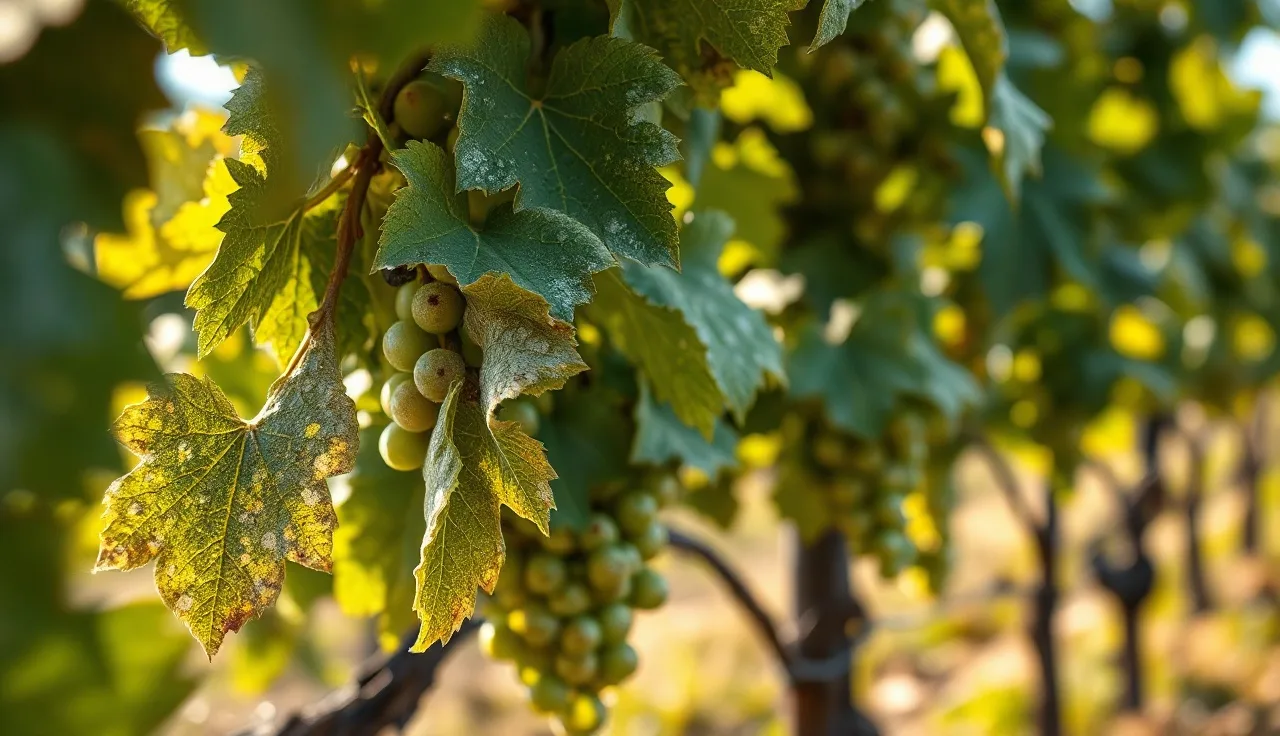
Grapevine diseases split into four groups based on what causes them: fungal and oomycete pathogens (the biggest group by far), bacterial diseases, viral diseases, and phytoplasma diseases. The group matters because it decides your whole response. A fungicide does nothing to a bacterium. A bactericide won't touch a virus. Get the category wrong and you've wasted a spray and a week.
The diseases growers actually lose sleep over, in rough order of how often they cause economic damage across North American vineyards, are powdery mildew, downy mildew, Botrytis bunch rot (gray mold), Eutypa dieback, black rot, Phomopsis cane and leaf spot, Pierce's disease, crown gall, fanleaf degeneration virus, and leafroll virus. Some regions carry extra load: Texas root rot in the Southwest, trunk diseases in older California plantings, and Xylella fastidiosa pressure all along the Gulf Coast and through the Southeast.
No vineyard escapes all of these. The goal is never zero disease. It's keeping damage below the economic threshold while staying inside your spray budget and your pesticide label requirements.
How does powdery mildew damage grapevines and how do you stop it?
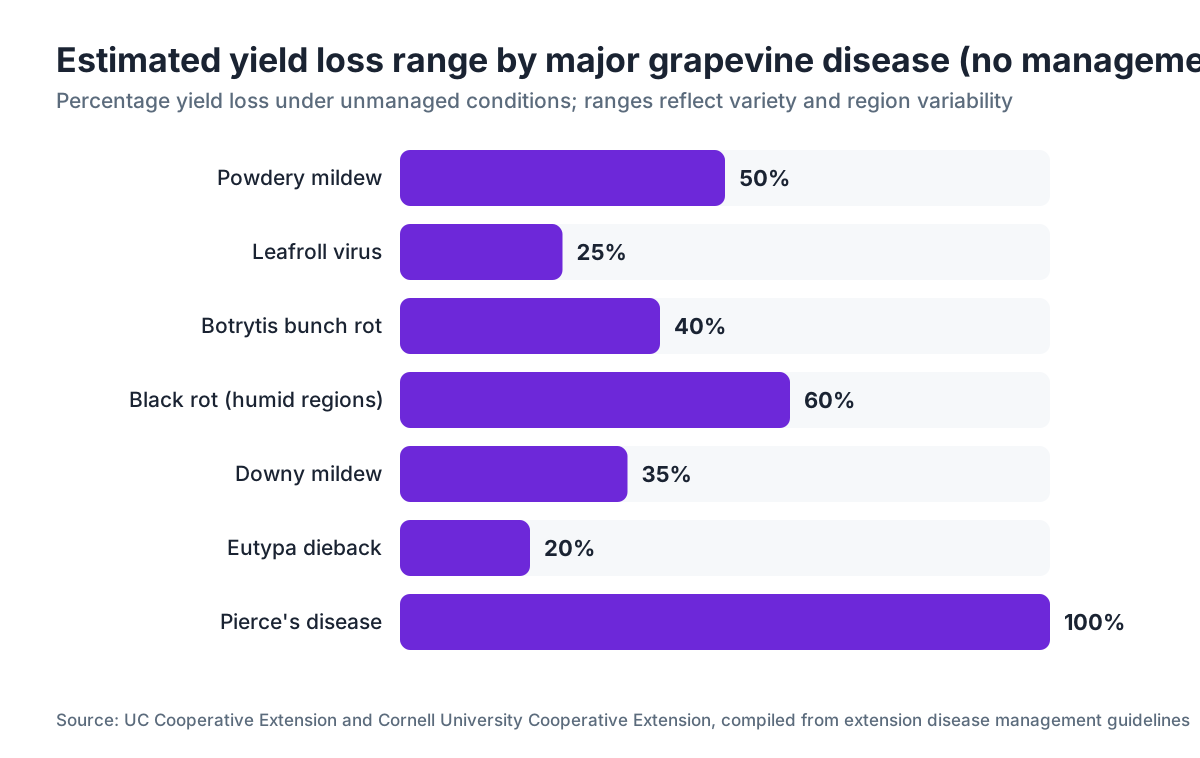
Powdery mildew is the most costly grapevine disease in California and across most of the western United States. It's caused by the obligate fungal pathogen Erysiphe necator (older references still call it Uncinula necator) [1]. Left alone, it can cut yields by 20 to 80 percent depending on variety and when infection hits, according to UC Cooperative Extension grape pest management guidance.
You'll spot it as white to gray powdery growth on shoot tips, young leaves, and, worst of all, developing berries. Infected berries crack. That crack opens the door to Botrytis. Any infection before berry set can cause shot berries and yield loss that no later spray brings back.
The pathogen overwinters two ways: as chasmothecia (sexual spores) tucked in bark crevices, and as dormant mycelium inside infected buds. That second route explains flag shoots, the infected shoots that show up in spring and catch growers off guard. Mild, dry, moderately humid weather between 65 and 85 degrees F feeds it hard. Rain actually knocks it back, which is the opposite of almost every other fungal disease you'll fight.
Management starts at budbreak and runs through veraison. Sulfur (wettable or liquid) is the backbone of most small and mid-size programs because it's cheap, it works, and resistance to it barely exists. Resistance to DMI fungicides (sterol inhibitors like myclobutanil and tebuconazole) and QoI fungicides (strobilurins) is confirmed in California and Washington populations [2]. Cornell's IPM guidelines recommend rotating FRAC code groups and anchoring the program with sulfur to slow resistance [3]. Don't spray sulfur above 90 degrees F, and mind the label interval before harvest.
What is downy mildew and why is it worse in wet climates?
Downy mildew comes from Plasmopara viticola, an oomycete (a water mold), not a true fungus. That distinction decides your chemistry. Oomycetes shrug off most traditional fungicides, so the mode-of-action language on the label is what tells you whether a product actually works. Phenylamides (FRAC 4, like metalaxyl) and fluopicolide are oomycete-active. Many strobilurins are not.
It needs free water to sporulate. Overnight temps above 50 degrees F plus rain or heavy dew trigger the first primary infections, usually around the 10-10-10 rule: 10 straight hours of wetness, a 10 degree C minimum, and shoots at least 10 cm long. The upper leaf surface shows oily, angular, yellow lesions people call oil spots, with white downy sporulation on the underside. Infected clusters turn brown and shrivel.
Eastern and Midwestern vineyards fight downy mildew far harder than the Pacific Coast does, thanks to spring and summer rain. In Oregon's Willamette Valley, growers track degree-day models and rain events almost daily through the season. Washington State University Extension publishes a downy mildew risk model that ties predicted infection events to spray timing [4]. Copper materials give protectant activity and are allowed in organic programs, but repeated copper builds up in soil, and that's a real cost you have to weigh.
How serious is Botrytis bunch rot and which grape varieties are most at risk?
Botrytis cinerea is a necrotrophic fungus that can infect grape tissue all season, but it does its worst work at or after veraison, when berries soften and sugar climbs. It's also the organism behind noble rot, the Botrytis-affected fruit used for Sauternes-style dessert wines. So it has a split personality, depending on whether you want it or not.
For dry table wine, you don't. Tight, compact clusters trap humidity and hand the pathogen the exact microclimate it likes. Pinot Noir, Gewurztraminer, Riesling, and Zinfandel, with thin skins and packed clusters, are far more exposed than Cabernet Sauvignon or Grenache. Cornell research on cluster architecture found per-berry infection rates 3 to 5 times higher in compact-cluster varieties than in loose-cluster types under identical humidity [3].
Canopy management is your first defense. Leaf removal in the fruit zone, shoot thinning, and upright shoot positioning all pull humidity out of the cluster zone without a drop of fungicide. After that, spray timing around bloom (when inflorescences are susceptible), berry set, and pre-bunch closure are the windows that pay off. Fenhexamid (FRAC 17) and cyprodinil plus fludioxonil (Switch, FRAC 9+12) are common choices, but Botrytis develops resistance fast, so rotate.
What trunk diseases affect grapevines and how long before they kill a vine?
Trunk diseases are a set of fungal wood pathogens that together rank as the second-largest cause of vineyard replanting in California, behind Pierce's disease. The main players are Eutypa dieback (Eutypa lata), Esca (a complex of Phaeomoniella chlamydospora and Phaeoacremonium species), Bot canker (Botryosphaeria species), and Phomopsis cane and leaf spot (Phomopsis viticola).
Every one of them enters through pruning wounds. Eutypa lata throws ascospores that ride winter rain and can travel several miles from infected wood. The infection is internal. The external tell, stunted shoots with cupped, chlorotic leaves, doesn't show up for 3 to 10 years after the wound got infected [1]. By the time you see it, a canker is already eating the wood.
Esca is more dramatic. The apoplexy form causes sudden wilting and death of whole vines in midsummer. The chronic form shows a tiger-stripe pattern on leaves. There's no cure for established Esca. UC Cooperative Extension has documented the pathogen complex and is blunt that prevention is the only thing that works: paint or spray pruning wounds with a registered fungicide (thiophanate-methyl is the usual choice) within hours of cutting, especially in wet weather [1].
Pruning timing matters too. Dry weather at pruning slashes the spore load in the air. Some growers in wet-winter regions now save their heaviest pruning for late winter to shrink the gap between making the wound and the next wet spell. It's a legitimate strategy that costs nothing but planning.
Phomopsis throws small, black, circular lesions on canes and leaves and can girdle young shoots in wet spring weather. Early sprays of mancozeb or captan after budbreak protect against it.
What is Pierce's disease and where is it a problem?
Pierce's disease (PD) comes from the bacterium Xylella fastidiosa, which colonizes the xylem vessels and eventually kills the vine by choking off water transport. There is no cure. Infected vines decline over 2 to 5 years and die.
Sharpshooter leafhoppers spread it. The glassy-winged sharpshooter (Homalodisca vitripennis), which arrived in California in the 1990s, widened the range and severity of PD across southern California [11]. The disease is endemic through the southeastern United States, where most Vitis vinifera varieties simply can't be grown commercially [5]. The California Department of Food and Agriculture runs an active Pierce's Disease Control Program that has put more than $23 million into research since 2001 [5].
Symptoms include leaf scorch that starts at the margins and works inward, uneven cane maturation where leaves dry and drop but the petioles stay attached (that matchstick look is diagnostic), and berry shriveling called raisining. USDA Agricultural Research Service has been breeding PD-resistant rootstocks and vinifera varieties, using both traditional crosses and, more recently, cisgenic approaches [11]. Some PD-resistant varieties are on the market, though winemakers often flag quality trade-offs.
Management in endemic areas comes down to controlling the insect vector, removing riparian vegetation that shelters sharpshooters, and picking sites away from low-lying, creek-adjacent ground where sharpshooter pressure runs high.
How do bacterial diseases like crown gall spread through a vineyard?
Crown gall comes from Agrobacterium vitis (and less often Agrobacterium tumefaciens), a soil bacterium that triggers tumors at the base of the trunk and on the cordons, usually right where freeze injury cracked the bark. The bacterium slips a piece of its own DNA (T-DNA) into vine cells and reprograms them to grow tumors and feed the bacteria. That's the same mechanism used in plant transformation research, which is why the biology is so well understood.
Freezing damages bark tissue, and the bacterium, which lives systemically inside infected vines, exploits the wound. Cold-climate vineyards (upstate New York, Michigan, Pennsylvania, parts of Colorado) carry far more economically damaging crown gall than frost-free zones do. Cornell's viticulture program has documented crown gall losses across Finger Lakes vineyards after hard-freeze winters [3].
There's no cure. Management is all prevention: plant certified disease-free vines, bury the graft union in cold-climate sites so you can renew the trunk from below-ground canes, use freeze-tolerant rootstocks, and pick sites with good cold-air drainage. Once the bacterium is in a site's soil, it stays for good. You manage around it. You don't get rid of it.
One more thing. Fire blight is not a grapevine disease (it hits apple-family trees), but the blackened-shoot look sometimes gets confused with grape problems. Nail the diagnosis before you spray anything.
Which virus diseases affect grapevines and why are they so hard to control?
Grapevines host more than 80 known viruses. The ones that do real economic damage in commercial vineyards are the grapevine leafroll-associated viruses (GLRaVs, especially GLRaV-1 and GLRaV-3), grapevine fanleaf virus (GFLV), and grapevine red blotch virus (GRBV).
Leafroll is probably the most widespread grapevine virus worldwide. It delays ripening by 1 to 3 weeks, drops sugar accumulation by 2 to 5 Brix units, and causes yield losses of 10 to 40 percent depending on strain and vine age [6]. In red varieties it shows as red or yellow interveinal coloring in late summer while the veins stay green. In whites it's a yellow-on-green pattern that's easy to walk right past.
Leafroll spreads two ways: through infected planting material (the main long-distance route) and through mealybugs and soft scale insects (the short-distance, within-vineyard route). Once it's in a block, your only moves are pulling infected vines, controlling the insect vectors to slow spread, and replanting with certified clean material. UC Cooperative Extension work in Napa found leafroll-infected Cabernet Sauvignon can lose $3,000 to $5,000 per acre in annual revenue depending on severity [6].
Grapevine fanleaf virus rides the dagger nematode Xiphinema index, which can survive in soil for decades after the vines are gone. Replant into GFLV-infested ground without fumigation or a long fallow and you've all but guaranteed reinfection. The nematode is the reservoir. Killing it is the only long-term fix, and fumigation options keep shrinking as products get de-registered.
Grapevine red blotch virus, first described in 2012, is now confirmed across most major North American wine regions. It causes red blotching on leaves (easy to mistake for leafroll), delays ripening, and cuts anthocyanin and sugar levels. Its main vector looks to be the three-cornered alfalfa treehopper, and it also moves in infected cuttings. Cornell and UC Davis worked together on the initial characterization and both run ongoing monitoring programs [3][1].
What does black rot do to grapes and how do you prevent it?
Black rot, caused by Guignardia bidwellii, is a serious threat in humid eastern and midwestern regions. Warm temperatures (60 to 90 degrees F) plus wet weather drive infections, and the window that matters runs from budbreak through 4 weeks after bloom. After that, berries develop resistance.
Leaf infections show as tan to brown circular lesions with dark borders and tiny black pycnidia (fruiting bodies) in the center. The real damage is on the fruit. Infected berries turn brown, then shrivel into hard, black, mummified raisins that cling to the cluster. One missed spray during the critical window can cost you 100 percent of the crop on a susceptible variety.
American and French-American hybrids (Vidal, Chambourcin, Norton) resist black rot far better than vinifera, which is a big reason they dominate eastern viticulture. For vinifera in the East, mancozeb, captan, myclobutanil, and tebuconazole all work on a 7 to 14-day schedule from early shoot growth through post-bloom. Washington State University Extension's disease management calendar covers black rot timing for eastern growers in detail [4].
How do you track and document grapevine disease management for compliance?
Pesticide application records are a legal requirement in every state, though the format and retention period vary. California requires licensed pest control advisors to sign spray recommendations and applicators to keep records for 2 years, with fields including product name, EPA registration number, application rate, target pest, date, time, and treated acreage [7]. The federal Worker Protection Standard (WPS) under EPA adds requirements for posting treated areas with field warning signs and giving workers safety information [8].
The paperwork from a full-season fungicide program is heavy. A vineyard running 12 to 18 spray passes across multiple blocks, each pass needing its own record, ends the year with 50 to 150 records before you count any other pesticide use. Keeping those organized, matched to your PCA's written recommendations, and pullable during a county agricultural commissioner inspection is where most small operations get buried.
That's where a field operations platform like VitiScribe earns its keep. Spray records get entered once in the field. EPA registration numbers and REI/PHI windows auto-populate from the product database. Each record stays attached to the block it was applied to. The compliance work doesn't vanish, but you're not digging through paper folders the morning an inspector pulls up.
Organic operations carry an even heavier load. Every material has to be verified as listed with the National Organic Program, and your certifier audits records at least once a year. Keep copies of all product labels and safety data sheets right alongside the application records.
Which grapevine diseases are hardest to diagnose correctly in the field?
Misdiagnosis costs money. You spray the wrong fungicide, knock out beneficial insects for nothing, or burn a whole season managing the wrong pathogen while the real one runs loose.
The usual mix-ups: leafroll virus versus potassium deficiency (both redden or yellow leaves in summer), Botrytis versus bunch stem necrosis (a non-pathogenic physiological disorder), Esca apoplexy versus heat or drought stress, and powdery mildew on fruit versus spray residue or spray burn.
The only reliable way to confirm most viruses, some bacterial diseases, and many fungal trunk diseases is lab testing. PCR-based virus testing runs through UC Davis Foundation Plant Services, Cornell's Plant Disease Diagnostic Clinic, and several commercial labs [1][3]. For trunk diseases you often have to section canes and read the internal discoloration, which means knowing what healthy vine wood looks like first.
When you're not sure, send a sample before you spray. A tissue test runs $30 to $150 depending on what you're screening for. A wrong spray on 20 acres costs far more than that, and some mistakes (like a systemic fungicide applied in conditions that drive phytotoxicity) create problems that keep compounding.
How do disease pressure and vineyard site affect which diseases you'll face?
Site selection is the most underrated disease tool in viticulture. Wind exposure, distance to riparian areas, soil drainage, frost risk, and regional climate all decide which pathogens you'll fight and how hard.
A vineyard in Paso Robles with 12 inches of annual rain and dry summers will almost never see downy mildew, and black rot is basically unheard of there [see paso-robles-wineries]. A Finger Lakes vineyard with 35 inches of rain, high summer humidity, and winters that drop below 0 degrees F faces all of it at once: powdery mildew, downy mildew, black rot, Botrytis, crown gall, and leafroll. Those two growers need different spray programs, different varieties, and different risk tolerances.
Slope position matters inside a single property. Low, frost-prone ground gets more crown gall after freeze years and stays wet longer after rain, pushing up Botrytis and downy mildew pressure. South-facing slopes in cool climates ripen earlier and move more air, which cuts late-season Botrytis risk. These micro-climate realities are worth mapping block by block, because block-level disease records over several years show patterns you'll never spot from a whole-vineyard view.
For a broader look at how established vineyards handle these pressures in different environments, operations like Gervasi Vineyard in Ohio and South Coast Winery in Southern California show just how differently disease management plays out across climate regions.
What organic and low-input options exist for managing grapevine diseases?
The organic toolbox is real but narrower, and pretending otherwise does growers a disservice. Sulfur and copper are the two workhorses, and both have been in use for over a century. Sulfur controls powdery mildew well. Copper gives protectant activity against downy mildew, Botrytis, and some bacterial diseases. Both are allowed under USDA National Organic Program standards, though copper carries use limits (no more than 6 pounds of metallic copper per acre per year in California organic programs) because it accumulates in soil and turns toxic [9].
Bicarbonate sprays (potassium bicarbonate, FRAC code NC) have documented efficacy against powdery mildew and are allowed organically, though they need frequent reapplication. Bacillus-based biocontrols like Bacillus subtilis (Serenade) and Bacillus amyloliquefaciens (Double Nickel) have legitimate trial data against Botrytis and powdery mildew as rotation partners, though they don't perform as consistently as conventional fungicides [10]. They earn their spot in low-to-moderate pressure years or as rotation partners that slow resistance.
Canopy management, cover crop choices, and irrigation timing all cut disease pressure with zero chemical input. Reducing leaf area in the fruit zone, skipping overhead irrigation, and timing fertigation to avoid excess vigor all have real evidence behind them. UC Cooperative Extension trials in Sonoma found leaf removal at bloom cut Botrytis incidence by 40 to 60 percent in Pinot Noir with no change to the fungicide program [1].
The honest reality for organic vinifera in humid eastern climates is that it's brutally hard. Plenty of growers there lean on hybrid varieties with built-in resistance instead of fighting the biology with a short toolbox.
Frequently asked questions
Can grapevines recover from powdery mildew infection?
Vegetative tissue that survives the season will recover, but berries infected before veraison won't. Badly infected clusters crack, shrivel, or pick up off-flavors that carry into the wine. The vine itself won't die from powdery mildew, but that season's crop can be partly or fully lost. Good canopy management and well-timed sprays the following season reset the situation.
How do I know if my vine has a virus or a nutrient deficiency?
Symptom overlap between viruses (especially leafroll) and deficiencies (especially potassium and magnesium) is significant, so eyeballing it is unreliable. The safe path is a tissue test or PCR assay from a lab like UC Davis Foundation Plant Services or Cornell's Plant Disease Diagnostic Clinic. If the vine also shows delayed ripening and the symptoms creep earlier each year, a virus is more likely than a deficiency.
What is the most destructive grapevine disease in the United States?
Pierce's disease causes the most complete vine loss in affected areas, especially the southeastern US and parts of California, because there's no cure and infected vines die within 2 to 5 years. Powdery mildew causes the greatest total annual economic loss across all regions combined because it hits nearly every vineyard and demands expensive yearly management. The California Department of Food and Agriculture has spent over $23 million on Pierce's disease research since 2001.
How long do I need to keep pesticide spray records for grapevines?
California requires a minimum of 2 years of retention for pesticide application records, and federal Worker Protection Standard records must also be kept for 2 years. Some states require 3 years. Organic certification audits typically look back at least 3 years as part of the review. Keeping records longer than required is smart if you're managing a site with documented pest pressure or regulatory attention.
Are there grapevine varieties that resist disease?
Yes. French-American hybrids like Marquette, Frontenac, Chambourcin, and Vidal blanc carry real resistance to powdery mildew, downy mildew, and black rot compared to Vitis vinifera. For Pierce's disease, USDA ARS has bred PD-tolerant vinifera crosses. In Europe, PIWI varieties (pilzwiderstandsfahig, meaning fungus-resistant) are gaining ground. True vinifera varieties have no meaningful field resistance to most major diseases.
Can crown gall be treated with antibiotics or bactericides?
No. No chemical treatment eliminates crown gall once Agrobacterium vitis is established in a vine or the soil. Biological control with the non-pathogenic strain K84 (Galltrol) shows some preventive value in certain Agrobacterium tumefaciens situations but isn't reliably effective against A. vitis in vineyards. Prevention through certified clean planting material and freeze protection is the only practical strategy.
How does the EPA Worker Protection Standard apply to vineyard spray programs?
The EPA Worker Protection Standard requires that vineyard workers be notified of applications, that treated areas be marked with field warning signs during restricted entry intervals (REI), and that workers get safety training and access to emergency medical information. Employers must provide the personal protective equipment the label requires and must not let workers enter a treated area during the REI. Non-compliance can bring civil penalties from state agricultural commissioners.
What is Esca disease and is it spreading?
Esca is a complex of fungal wood pathogens including Phaeomoniella chlamydospora and Phaeoacremonium species that cause progressive wood decay and, in the apoplexy form, sudden vine death. It's present in every major wine region and appears to be increasing, likely because of larger wound surfaces from mechanical pruning and stress from climate variability. There's no registered treatment. Wound protection at pruning is the only management option.
How do I prevent grapevine diseases from spreading between blocks?
The vectors to control are equipment, workers, and planting material. Sanitize pruning tools (70% isopropyl alcohol or a 10% bleach solution between vines or at block boundaries) during scouting and pruning. Never take cuttings from symptomatic vines. Buy certified virus-tested and pathogen-tested nursery material for replants. Control the insect vectors (mealybugs, sharpshooters, leafhoppers) that move viruses and bacteria around the vineyard.
What is grapevine leafroll virus and how does it affect wine quality?
Grapevine leafroll-associated viruses (especially GLRaV-1 and GLRaV-3) delay ripening by 1 to 3 weeks and drop sugar accumulation by 2 to 5 Brix units versus healthy vines under identical conditions. UC Cooperative Extension work in Napa found revenue losses of $3,000 to $5,000 per acre annually in infected Cabernet Sauvignon. The viruses also cut color and anthocyanin in reds. There's no cure. Infected vines should be pulled and replaced with certified clean material.
When should I send a vine sample to a diagnostic lab?
Send a sample any time symptoms don't match what your spray program should be producing, when multiple vines in a block show the same odd pattern, when a new symptom shows up on recently planted material, or when vines perform poorly without an obvious nutrition or irrigation cause. Early-season, actively symptomatic tissue gives the best read. Dried or badly decomposed samples give unreliable results.
Does botrytis bunch rot affect all grape varieties equally?
No. Variety, cluster architecture, and skin thickness all move susceptibility a lot. Compact-cluster, thin-skinned varieties like Pinot Noir, Riesling, Gewurztraminer, and Zinfandel are far more exposed than loose-cluster, thick-skinned varieties like Cabernet Sauvignon or Mourvedre. Cornell research found infection rates 3 to 5 times higher in compact-cluster varieties under identical humidity. Canopy management that opens the fruit zone to airflow cuts Botrytis pressure in every variety.
What are PIWI varieties and are they worth planting?
PIWI is a German term, pilzwiderstandsfahig, meaning fungus-resistant. These are grapes bred with disease-resistance genes from wild Vitis species, with generally acceptable wine quality. They need far fewer fungicide passes than vinifera, sometimes zero in low-pressure years. The trade-off is that many European PDO/AOC appellations won't allow them, and US market familiarity is low. In humid climates where fungicide costs and labor run high, they deserve serious thought.
Sources
- UC Cooperative Extension, Grape Pest Management (UC Agriculture and Natural Resources): Powdery mildew can reduce yields 20 to 80 percent without management; Eutypa dieback symptoms appear 3 to 10 years after infection; leaf removal at bloom reduced Botrytis incidence 40 to 60 percent in Pinot Noir trials; Esca prevention through wound protection is the only effective strategy
- UC Agriculture and Natural Resources, Fungicide Resistance in Grape Powdery Mildew: Resistance to DMI and QoI fungicides confirmed in California and Washington powdery mildew populations
- Cornell University Cooperative Extension, Integrated Crop and Pest Management Guidelines for Commercial Viticulture: Rotating FRAC code groups and anchoring with sulfur slows resistance development; compact-cluster varieties show 3 to 5 times higher Botrytis infection rates; crown gall losses documented in Finger Lakes after hard-freeze winters; Cornell and UC Davis collaboration on Grapevine red blotch virus characterization
- Washington State University Extension, Grape Disease Management: WSU publishes downy mildew risk models tied to rain events and degree-days; disease management calendar covers black rot timing for eastern growers
- California Department of Food and Agriculture, Pierce's Disease Control Program: California CDFA has invested more than $23 million in Pierce's disease research since 2001; disease is endemic through the southeastern United States
- UC Cooperative Extension, Napa County (UC Agriculture and Natural Resources), Leafroll Virus Economic Impact: Leafroll-infected Cabernet Sauvignon vines in Napa lose $3,000 to $5,000 per acre in annual revenue; leafroll reduces sugar accumulation by 2 to 5 Brix units and delays ripening 1 to 3 weeks
- California Department of Pesticide Regulation, Pesticide Use Reporting: California requires pesticide application records to be kept for 2 years with specific required data fields including EPA registration number, rate, target pest, date, time, and acreage
- U.S. Environmental Protection Agency, Agricultural Worker Protection Standard: EPA Worker Protection Standard requires field warning signs during REIs, worker safety training, and access to emergency medical information for agricultural pesticide applications
- USDA Agricultural Marketing Service, National Organic Program: Copper use is allowed under USDA NOP with limits; California organic programs restrict metallic copper to no more than 6 pounds per acre per year due to soil accumulation concerns
- UC Agriculture and Natural Resources, Biological Control of Botrytis in Vineyards: Bacillus subtilis (Serenade) and Bacillus amyloliquefaciens (Double Nickel) have trial data supporting use against Botrytis and powdery mildew as rotation partners, though performance is less consistent than conventional fungicides
- USDA Agricultural Research Service, Timeout in milliseconds: USDA ARS working on PD-resistant rootstocks and vinifera varieties using traditional breeding and cisgenic approaches; glassy-winged sharpshooter confirmed as primary vector for Xylella fastidiosa in California
Last updated 2026-07-09