Pests and diseases of grapevines: the UC Davis field notebook guide

TL;DR
- UC Davis Cooperative Extension documents more than 30 pests and diseases that threaten grapevines, from powdery mildew and Botrytis to grape leafhopper and vine mealybug.
- Field identification, economic thresholds, and documented spray records are the foundation of a defensible IPM program.
- This guide covers what to look for, when to act, and how to keep the records that satisfy state and federal rules.
Why do UC Davis grapevine disease and pest resources matter so much?
UC Davis is the most cited source in American viticulture, and the reason is simple. The university's College of Agricultural and Environmental Sciences and its Cooperative Extension network have published peer-reviewed pest management guidelines for California vineyards since the 1970s. The UC Integrated Pest Management (UC IPM) program keeps free, continuously updated guidelines for every major grapevine pest and pathogen [1]. Those guidelines give you economic thresholds, monitoring protocols, and registered pesticide options in one place.
The UC IPM guidelines are also the right citation to have on file if you face a Department of Pesticide Regulation inspection. For growers outside California, the framework is still widely adopted, but cross-reference your state extension (Cornell for the Northeast, Washington State University for the Pacific Northwest) for locally registered materials and regional disease pressure calendars [2][3].
The "notebook" name matters too. The UC IPM grapevine guidelines went out as a printed notebook for years, and many older growers still call the digital resource by that name. The current version lives online at ipm.ucanr.edu and covers wine grapes, table grapes, and raisins. It's free. Use it.
What are the most economically damaging fungal diseases of grapevines?
Powdery mildew is the number-one fungal disease in California vineyards, and in most regions it triggers the first spray of the season. UC IPM ranks Erysiphe necator as the state's costliest grapevine disease [1]. The fungus overwinters as chasmothecia in bark and as mycelium in dormant buds. Primary infection starts when temperatures sit between 50 and 95 degrees F and shoot growth passes 1 inch, which in much of California means February or March. The window that matters runs from early shoot growth through 3 to 4 weeks past bloom. Infection during bloom can cut fruit set by 30 percent or more in susceptible varieties [4].
Botrytis bunch rot is next. It's a wound pathogen and a humidity lover. Tight-clustered varieties like Pinot Noir and Grenache get it far worse than loose-clustered ones. The UC IPM action trigger is infected flower parts or wounded berries plus extended leaf wetness. Canopy management is your first defense. Fungicides are the backstop, not the substitute.
Downy mildew is a bigger problem in the eastern U.S. and cool coastal California than in the warm interior. It needs free water (rain, heavy dew) to sporulate and infect. Cornell's extension materials cover it in depth for New York growers [2].
Eutypa dieback is the slow killer. It enters through pruning wounds, colonizes the xylem, and throws the classic "shepherd's crook" shoot symptom years after infection. UC Davis research found that pruning cuts stay open to infection for up to 72 hours in wet weather, which is why wound sealant or pruning in dry conditions earns its keep [4].
| Disease | Causal organism | Main infection window | Key UC IPM threshold |
|---|---|---|---|
| Powdery mildew | Erysiphe necator | Bloom through 4 wks post-bloom | >1 in. shoot growth + susceptible conditions |
| Botrytis bunch rot | Botrytis cinerea | Bloom, pre-harvest | Infected flower parts + leaf wetness |
| Downy mildew | Plasmopara viticola | Wet spring periods | 10-leaf stage + 0.1 in. rain |
| Eutypa dieback | Eutypa lata | Pruning wounds, wet weather | Prevent; no in-season threshold |
| Black measles (Esca) | Phaeoacremonium spp. + others | Chronic; symptom in summer | No curative option; track affected vines |
What are the most damaging insect and mite pests in California vineyards?
Grape leafhopper (Erythroneura elegantula) and variegated grape leafhopper (E. variabilis) are the primary leafhopper species in California. The UC IPM economic threshold for leafhoppers is 15 to 20 nymphs per leaf at second-generation egg hatch, usually June through July [1]. Damage shows as stippling and premature leaf drop. Heavy infestations cut photosynthesis and can delay ripening. Parasitic wasps (Anagrus spp.) give you real biological control if you leave hedgerow habitat in place.
Vine mealybug (Planococcus ficus) is the top-priority invasive insect on the UC Davis watch list. It feeds on roots, trunks, canes, leaves, and clusters, and it vectors grapevine leafroll-associated viruses. One infested vine can hold hundreds of thousands of crawlers. The UC IPM guideline recommends a two-spray program with trunk-applied insecticides timed to crawler emergence in spring, plus a soil drench where root infestation is confirmed [1].
Western grape rootworm (Bromius obscurus) is less common but worth knowing in Oregon and Washington, where WSU extension tracks it [3].
Grape berry moth (Paralobesia viteana) is the dominant berry pest in eastern U.S. vineyards. Cornell publishes degree-day models for timing insecticide applications [2]. California growers rarely deal with it.
Pacific spider mite (Tetranychus pacificus) and Willamette mite (Eotetranychus willamettei) turn damaging when predator populations crash, which happens most often after broad-spectrum insecticides kill off predatory mites. The UC IPM threshold is roughly 30 to 50 percent of leaves infested at 5 or more mites per leaf before bloom, and 20 percent of leaves at 10-plus mites per leaf after bloom [1].
Glassy-winged sharpshooter (Homalodisca vitripennis) vectors Pierce's disease and has been under a California-wide regulatory program since the early 2000s. The Pierce's Disease and GWSS Research Program at UC Davis is one of the largest targeted pest research efforts in the state's agricultural history [4].
How does Pierce's disease threaten vineyards and what does UC Davis research say?
Pierce's disease comes from the bacterium Xylella fastidiosa, which colonizes the xylem and blocks water movement. Infected vines show leaf scorching (the "match-stick" petiole symptom), uneven ripening, and death within 1 to 5 years. There is no cure. Roguing infected vines and controlling sharpshooter vectors are the only management options right now [4].
UC Davis runs a dedicated Pierce's Disease and GWSS Research Program, funded through assessments on wine grape sales, and it has produced more than 20 years of work on resistant rootstocks, biological controls for the sharpshooter, and early detection tools. UC Davis plant pathologist Rodrigo Almeida's lab has published extensively on X. fastidiosa genetics and spread.
The California Department of Food and Agriculture maintains a mandatory reporting and survey program for sharpshooter detections, and growers in high-risk counties can face quarantine restrictions on movement of plant material [5]. If you're in a high-risk area, check CDFA's current quarantine map before you buy vine material or move equipment.
What viruses commonly infect grapevines and how do you identify them?
Grapevine leafroll disease is the most economically significant virus complex in world viticulture. The associated viruses (GLRaVs, of which types 1, 2, and 3 are the most common) cause delayed ripening, lower sugar accumulation, leaf rolling and reddening in red varieties (yellowing in whites), and yield losses of 20 to 40 percent in badly affected blocks [6]. In California's warm interior, symptoms can be faint or missing even in infected vines, so serological or PCR testing is the only reliable diagnostic.
Vine mealybug is the primary vector for GLRaV-3, which is why mealybug control and leafroll management are the same program. The UC IPM guideline pushes hard on testing planting material before establishment and roguing confirmed leafroll-positive vines in blocks where mealybug is active.
Grapevine fanleaf virus (GFLV), vectored by dagger nematodes (Xiphinema index), causes severe stunting, distorted leaves, and reduced yield. It persists in soil for years after infected vines come out because the nematode vector survives in root debris. Fumigation before replanting is the standard California recommendation, though its efficacy is debated and alternatives like biofumigant cover crops are under study at UC Davis [1].
Grapevine red blotch virus (GRBV) is newer, first formally described in 2012. It looks like leafroll in red varieties but has a different vector (treehoppers, Membracidae, are suspected) and a different spread pattern within a vineyard. UC Davis researchers helped characterize its epidemiology.
How do you set up a field scouting and monitoring program that matches UC IPM standards?
The UC IPM grapevine program calls for systematic sampling, not casual walking. For most pests that means checking 10 to 15 randomly chosen vines per block per scouting date, recording counts on a per-leaf or per-cluster basis, and comparing those counts against published thresholds before you decide to spray [1].
Timing is everything. Powdery mildew risk peaks during shoot growth and bloom, so weekly scouting from budbreak through 4 weeks past bloom is standard. Leafhopper scouting peaks at first and second nymph generations. Mealybug monitoring runs on degree-day models plus visual inspection of trunk bark flaps.
A written field notebook per block (paper or digital) is more than good practice. It's required for compliance under California's Pesticide Use Reporting system and the EPA Worker Protection Standard [7][8]. Each entry should carry the date, block ID, pest or disease seen, count or severity estimate, the threshold you used, and the action or non-action that followed. That last point matters. Documenting a decision NOT to spray is worth as much as documenting a spray, because it proves your program is threshold-based.
Growers who want this without paper can use tools like VitiScribe to log scouting observations, attach photos, and auto-generate the pest and spray records state reporting needs, keeping field data and compliance documents in one place.
WSU Extension's IPM resources for the Pacific Northwest mirror the UC IPM structure and help most with grape berry moth and a leafhopper complex that differs from California's [3].
What are the legal spray record requirements for California vineyard operators?
California law requires every pesticide application to be reported to the county agricultural commissioner within 7 days under the Pesticide Use Reporting system [8]. The required data points: operator name, site location, pesticide product and EPA registration number, amount applied, application date, and acreage treated. Failure to report is a civil violation carrying fines up to $5,000 per violation per day under California Food and Agricultural Code Section 12999.
The EPA Worker Protection Standard (40 CFR Part 170) covers all agricultural pesticide applications. It requires pesticide safety information posted at a central location, pesticide safety training for workers, and application records maintained and available to workers and their representatives on request [7]. The 2015 revision strengthened both training and record-keeping.
For organic operations, the National Organic Program requires that every input, including allowed pesticides like sulfur and copper, be documented with quantities and application dates as part of the organic system plan [9]. USDA AMS National Organic Program guidance makes clear that record-keeping gaps are among the most common findings in certification audits.
Out-of-state growers: New York requires pesticide application records under 6 NYCRR Part 325, and Washington requires applicator records under WAC 16-228 [3]. The required fields differ slightly from California's system, so check with your state department of agriculture.
How do economic thresholds work for grapevine pest management decisions?
An economic threshold (ET) is the pest density at which you should act to head off economic damage. It's different from the economic injury level (EIL), which is the density where damage actually costs more than the control. UC IPM publishes ETs for every major grapevine pest, set conservatively enough to give you a spray window before injury hits [1].
Here's the practical version. The leafhopper ET for second-generation nymphs is 15 to 20 per leaf, depending on canopy density and time of season. Below that number, predatory wasps and natural mortality usually keep the population from doing economic damage. Above it, a targeted insecticide application pencils out. Spraying at lower counts wastes money and adds pesticide load for nothing.
For fungal diseases like powdery mildew, the ET isn't a count. It's a risk index. UC IPM runs a temperature-based powdery mildew risk model (on their website and through UC Cooperative Extension advisors) that combines nighttime and daytime temperature to project sporulation risk. A high-risk period earns a protectant fungicide. A low-risk period doesn't [1].
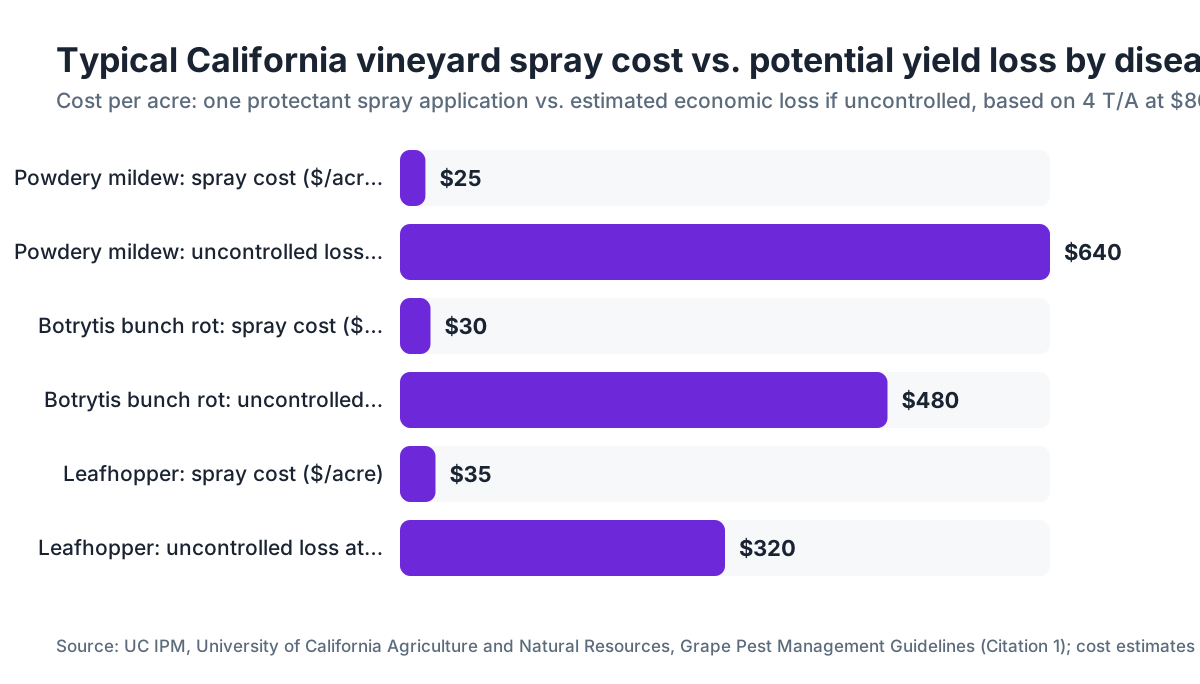
The math is simple. A sulfur application in California in 2024 runs roughly $15 to $35 per acre in materials and labor, depending on equipment and formulation. A 20 percent yield loss from uncontrolled powdery mildew on a block making 4 tons per acre at $800 per ton is $640 per acre. Thresholds tell you when that calculus tips.
What resistance management practices does UC Davis recommend for fungicides and insecticides?
Resistance is real, and in some pathogen populations it's speeding up. Powdery mildew with reduced sensitivity to QoI (strobilurin) fungicides is documented in California vineyards, and the Fungicide Resistance Action Committee (FRAC) classification is the standard tool for rotating modes of action [1][11].
The UC IPM powdery mildew guideline says rotate among FRAC groups. Don't use the same FRAC group more than twice per season, and never make back-to-back applications of the same group. Sulfur (FRAC M2) and copper (FRAC M1) show no documented resistance because they're multi-site inhibitors, which is why they stay the backbone of most California programs despite being old chemistry.
Insecticides follow the same principle through IRAC (Insecticide Resistance Action Committee) group rotation. Vine mealybug has shown reduced sensitivity to organophosphates in some California regions, which pushed growers toward newer chemistries. That's a good reason to note the IRAC group used each time in your spray records, more than the product name.
Organic growers have a narrower deck: sulfur, copper, kaolin clay, and a handful of OMRI-listed biorationals. The key resistance tool in organic systems is timing. Get protectant materials on before infection instead of trying to rescue a diseased block.
How does UC Davis recommend managing nematodes in vineyard soils?
Root-knot nematodes (Meloidogyne spp.) and dagger nematodes (Xiphinema index) are the two most important nematode groups in California vineyards. Root-knot nematodes cause galling and root damage that saps vine vigor and shortens vine life, especially in sandy soils. Dagger nematodes vector grapevine fanleaf virus, which makes them a double threat [1].
Pre-plant soil sampling is the standard UC IPM recommendation before you establish a new vineyard. Take samples to 4 feet deep in a grid across the site. If dagger nematodes turn up, fumigation with 1,3-dichloropropene or methyl bromide (with an approved exemption) before planting is the most reliable option. After planting, fumigation is impractical and mostly useless.
Rootstock selection is the most durable nematode tool you have. Rootstocks like 1616C and Harmony carry root-knot nematode resistance, and UC Davis viticulture specialists at Foundation Plant Services keep current rootstock recommendations with nematode tolerance ratings [10]. Harmony has known fanleaf virus sensitivity, so keep it off GFLV-infested sites.
The one thing nobody has great long-term data on is whether biofumigant cover crops (Brassica species) give durable suppression of Xiphinema populations in commercial vineyards at scale. The UC Davis small-plot studies look promising, but field results vary.
What should be in a vineyard field notebook for each pest or disease observation?
A useful field notebook entry says a lot more than "saw mildew today." Here's what UC IPM and the EPA WPS together require or strongly recommend you record [1][7]:
Date and time of observation. Block ID and GPS coordinates or map reference. Crop growth stage (use the BBCH scale for consistency). Pest or disease identified, with confidence level (suspected vs. confirmed). Count or severity estimate tied to the relevant threshold. Monitoring method used (visual, sticky trap, beating tray). Weather conditions (temperature, humidity, wind). The decision made and why (spray, monitor again, no action). If you sprayed: product name, EPA registration number, rate, application method, and applicator name.
Photographs indexed to block and date matter more every year, especially for disease calls where a pest control adviser (PCA) or county farm advisor may need to confirm. California requires a licensed PCA to write pesticide use recommendations for restricted materials [8].
Digital records have one real edge over paper: they're searchable and can spit out the summary reports your county agricultural commissioner wants without hand-transcribing anything. The trade-off is you need a backup and some form of offline access if you're in a block with no cell signal. VitiScribe does offline field logging and syncs when you reconnect, which fixes the most common data gap in paper-to-digital moves.
Cornell's New York State IPM program publishes a free scouting form template for grape growers that lists the key fields and sorts them by pest category. It's a good model even outside New York [2].
How do you read and apply the UC IPM grapevine pest management guidelines?
The UC IPM grapevine guidelines are organized by pest and pathogen, not by calendar date. That makes them clumsy as a seasonal planner but useful as a reference when you're standing in a vineyard trying to name something. Here's how to work them.
Start by bookmarking ipm.ucanr.edu/agriculture/grape. The search function is mediocre, so navigating by the crop dropdown and then the pest category (insects, diseases, weeds, vertebrates) is faster.
Each pest entry gives you a description and photos for ID, seasonal biology and when to expect each life stage, monitoring methods and thresholds, and a management section that ranks cultural, biological, and chemical options by effectiveness and environmental impact. The chemical table at the bottom lists active ingredients rather than brand names and cross-references FRAC or IRAC groups.
The "pest note" format lets you read the management summary first and go deeper only if you need the biology. That's the right order for an in-season field call. For winter planning, read the full note so you understand why the thresholds sit where they do.
California growers get one more thing: the guidelines link to CDPR's label database, so you can verify a product is currently registered for grapes in California before you buy it. Using a pesticide that isn't registered for that use in California is a violation no matter what the national label says [8].
Frequently asked questions
Where can I download the UC Davis grapevine pest and disease notebook?
The full UC IPM grapevine guidelines are free at ipm.ucanr.edu under the Agriculture/Grape section. There's no single downloadable PDF covering everything, but individual pest notes and management guides are printable. UC Cooperative Extension county offices stock printed materials and can connect you with a local farm advisor who knows your region's specific pest pressure.
What is the UC IPM economic threshold for grape leafhopper?
UC IPM sets the economic threshold for grape leafhopper at 15 to 20 nymphs per leaf during second-generation egg hatch, usually June through July in California. Below that count, parasitic wasps (Anagrus spp.) generally give adequate control. Above it, a targeted insecticide application is justified. The threshold is the same for both Erythroneura elegantula and E. variabilis.
How do I tell powdery mildew apart from downy mildew on grapevines?
Powdery mildew shows as white, powdery mycelium on upper and lower leaf surfaces, shoot tips, and clusters. Downy mildew shows as pale yellow-green 'oil spots' on the upper leaf surface with white to grey cottony sporulation underneath in humid conditions. Powdery mildew thrives without free water; downy mildew requires it. The UC IPM photo library at ipm.ucanr.edu has side-by-side comparison images.
What records does California require for pesticide applications in vineyards?
California's Pesticide Use Reporting system requires growers to file application records with the county agricultural commissioner within 7 days of any pesticide application. Required data: operator name, site, pesticide product and EPA registration number, application date, amount applied, and acres treated. Restricted-use pesticides also require a licensed pest control adviser recommendation. Penalties run up to $5,000 per violation per day under California Food and Agricultural Code Section 12999.
Can Pierce's disease be cured once a vine is infected?
No. There is no curative treatment for Pierce's disease (Xylella fastidiosa) in commercial vineyards. Infected vines should be rogued and removed to reduce inoculum. Management focuses on controlling the glassy-winged sharpshooter vector and using resistant or tolerant rootstocks where available. UC Davis has an ongoing research program breeding for X. fastidiosa resistance in Vitis vinifera and developing biological controls for the sharpshooter.
How do I manage vine mealybug organically?
Organic options for vine mealybug are limited. Kaolin clay and OMRI-listed insecticidal soaps can knock down crawler populations but won't clear a heavy infestation. Biological control with the parasitic wasp Anagyrus pseudococci is commercially available and works in smaller, contained infestations. The most important organic tool is early detection through regular bark-flap inspection, along with mating disruption, though mating disruption for vine mealybug is still not widely commercialized.
What does the EPA Worker Protection Standard require for vineyard spray records?
The EPA Worker Protection Standard (40 CFR Part 170) requires pesticide application records be maintained and made available to workers and their designated representatives. Records must include the product name, EPA registration number, active ingredient, application date, location, and restricted-entry interval. Records must be kept for 2 years. Posted pesticide safety information and WPS training for agricultural workers are also mandatory before workers enter treated areas.
How do you monitor for grapevine leafroll virus in a vineyard?
Visual scouting for leafroll symptoms (leaf rolling, reddening in red varieties, delayed ripening) is done in late summer through veraison. Symptomatic vines should be confirmed with ELISA or PCR testing because leafroll symptoms overlap with other disorders. UC IPM recommends testing all mother vines used as cutting source material. USDA-certified virus-tested planting material from Foundation Plant Services at UC Davis is the baseline for new plantings.
What FRAC groups work best for powdery mildew on grapevines?
UC IPM recommends rotating among FRAC groups to delay resistance. Effective groups include FRAC 3 (DMI/triazoles), FRAC 7 (SDHI), FRAC 11 (QoI/strobilurins, though resistance is documented), FRAC 13 (quinoline fungicides), and FRAC 50 (cyflufenamid). Sulfur (FRAC M2) stays the backbone of most California programs because it has no resistance risk. Never use the same FRAC group more than twice per season or in consecutive applications.
How do rootstock choices affect nematode and virus pressure?
Rootstock selection is the most durable long-term nematode tool. Rootstocks like 1616C and Freedom carry resistance to root-knot nematodes (Meloidogyne spp.). Harmony offers root-knot resistance but is sensitive to grapevine fanleaf virus, so avoid it on sites with Xiphinema index populations. UC Davis Foundation Plant Services publishes rootstock selection guides updated for California conditions, with nematode tolerance ratings for each cultivar.
What resources does Cornell Extension offer for grapevine pest management in the Northeast?
Cornell Cooperative Extension publishes the New York and Pennsylvania Pest Management Guidelines for Grapes, updated annually, covering grape berry moth, downy mildew, black rot, and other pests with heavier eastern U.S. pressure. Cornell also runs the Network for Environment and Weather Applications (NEWA), a free online tool providing degree-day models for grape berry moth timing and disease forecasting for downy mildew and Botrytis.
How often should I scout for pests during the growing season?
UC IPM recommends weekly scouting from budbreak through 4 weeks post-bloom for fungal diseases, and bi-weekly scouting for insects during their peak activity. At minimum, scout at budbreak, bloom, fruit set, veraison, and pre-harvest. High-risk or historically problematic blocks may need twice-weekly checks during critical disease windows. Document every scouting visit even when you find nothing, because non-detections are part of the threshold-based decision record.
Is Botrytis management different for organic vs. conventional vineyards?
The cultural practices are identical: canopy management, leaf removal to improve air circulation, and timing harvest before extended wet periods. Organic growers have fewer chemical tools: OMRI-listed options include Bacillus subtilis products, potassium bicarbonate, copper, and some OMRI-listed biorationals. Conventional growers can use FRAC 7, 9, 11, and 17 materials with proper rotation. In both systems, avoiding late-season nitrogen that produces lush, dense canopies is the single most effective cultural control.
Sources
- UC IPM, University of California Agriculture and Natural Resources, Grape Pest Management Guidelines: UC IPM publishes economic thresholds, monitoring protocols, and registered pesticide options for all major grapevine pests and diseases in California
- Cornell Cooperative Extension, New York State IPM Program, Grape Pest Management: Cornell Extension publishes grape pest management guidelines including grape berry moth degree-day models and disease forecasting for Northeast growers
- Washington State University Extension, Viticulture and Enology Program: WSU Extension tracks grape berry moth, western grape rootworm, and other Pacific Northwest vineyard pests and publishes pesticide record requirements under WAC 16-228
- UC Davis College of Agricultural and Environmental Sciences, Pierce's Disease and GWSS Research Program: UC Davis research established that pruning wounds remain susceptible to Eutypa lata infection for up to 72 hours after cutting in wet weather, and leads the Pierce's disease and GWSS research program
- California Department of Food and Agriculture, Pierce's Disease Control Program: CDFA maintains mandatory reporting and a survey program for glassy-winged sharpshooter detections, with quarantine restrictions in high-risk counties
- Maree H.J. et al., Grapevine leafroll disease and associated viruses: a unique pathosystem, Annual Review of Phytopathology, 2013: Grapevine leafroll-associated viruses cause yield losses of 20-40% in severely affected blocks and delayed ripening with reduced sugar accumulation
- U.S. EPA, Worker Protection Standard, 40 CFR Part 170: EPA WPS requires pesticide application records be maintained and made available to workers, with records kept for 2 years; revised requirements took effect in 2015
- California Department of Pesticide Regulation, Pesticide Use Reporting: California law requires pesticide applications to be reported to the county agricultural commissioner within 7 days, with fines up to $5,000 per violation per day under California Food and Agricultural Code Section 12999
- USDA Agricultural Marketing Service, National Organic Program: NOP requires that all inputs including allowed pesticides like sulfur and copper be documented with quantities and application dates as part of the organic system plan; record-keeping gaps are a common certification audit finding
- UC Davis Foundation Plant Services, Grapevine Rootstock Information: UC Davis Foundation Plant Services maintains rootstock recommendations including nematode tolerance ratings and provides USDA-certified virus-tested planting material
- Fungicide Resistance Action Committee (FRAC), Code List for Fungicides: FRAC classification system is the standard for rotating modes of action to manage fungicide resistance; QoI/strobilurin resistance in powdery mildew populations has been documented in California vineyards
Last updated 2026-07-09