Muscadine trellis systems: which setup actually works
TL;DR
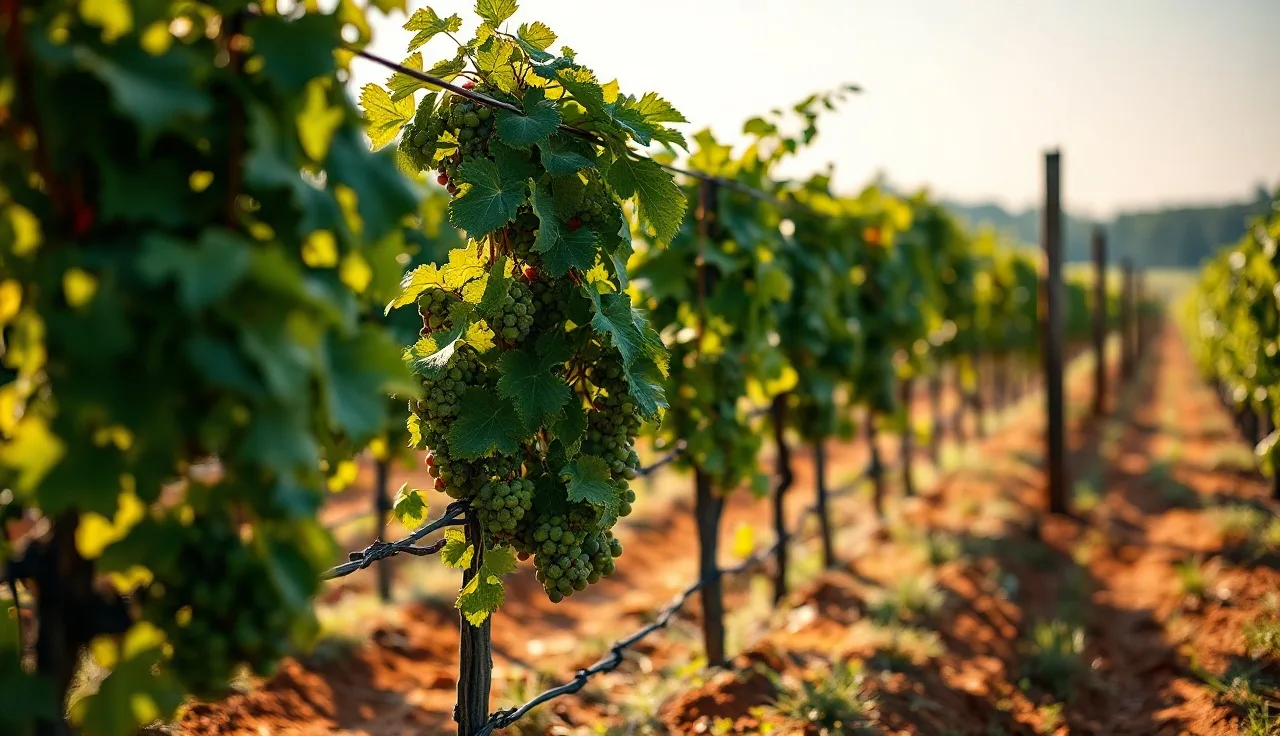
- Muscadines grow on high-wire systems, almost always a single-wire bilateral cordon at 5.5 to 6 feet or a Geneva Double Curtain at 6 feet with two curtains 4 feet apart.
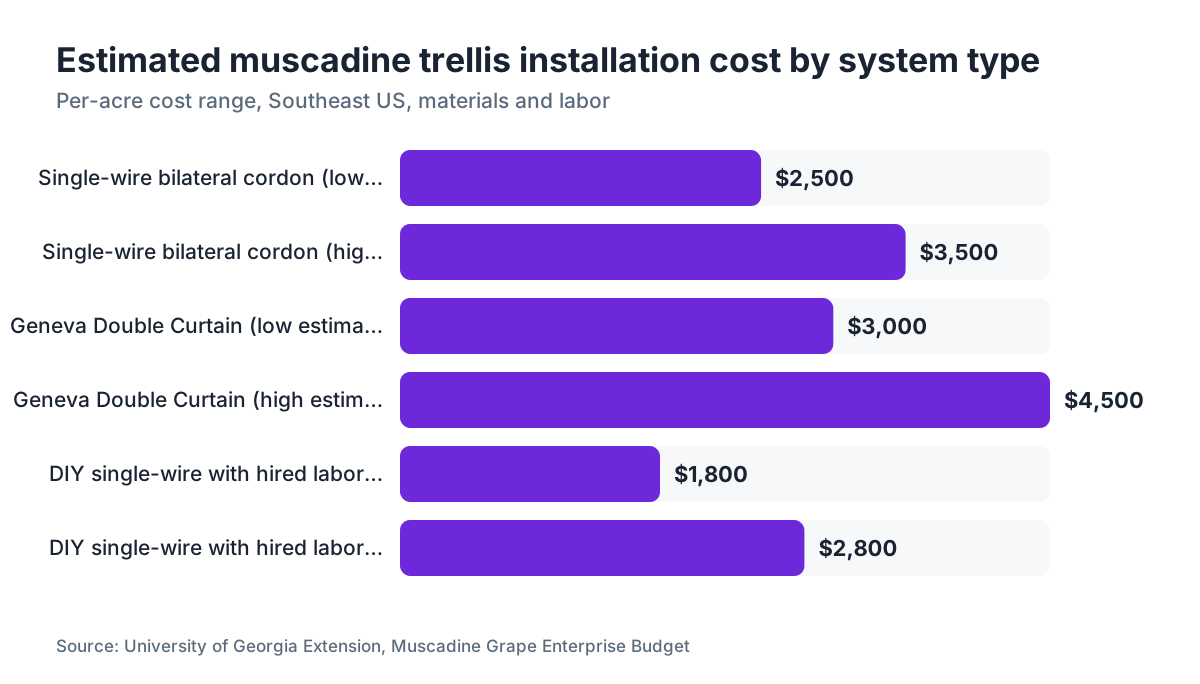
- Line posts go 18 to 24 feet apart, wire is 9- to 11-gauge galvanized, and a well-built trellis costs $2,500 to $4,500 per acre installed.
- Harvest method, vine vigor, and row width decide the system.
Why do muscadines need a different trellis than vinifera grapes?
Muscadines (Vitis rotundifolia) are a different plant from European wine grapes, and building their trellis like a vinifera trellis wastes money. The vines grow with wild, sprawling vigor and long tendrils, and they fruit almost entirely on shoots that come off one-year-old wood growing from established cordons. [1] So the system has to carry a lot more canopy weight per vine than a typical VSP, and the wire and posts have to match that load.
A vinifera trellis in a cool climate often sits at 36 to 42 inches with several catch wires managing a modest canopy. A muscadine trellis runs much higher. The main fruiting wire lands at 5.5 to 6 feet, which keeps fruit off the ground, moves air through the canopy in the humid Southeast where most muscadines grow, and puts the fruit at a reasonable height for hand-picking. [2]
The fruit itself behaves differently. Muscadines bear in small loose clusters or as single berries, and ripe fruit drops from the vine instead of clinging like a tight vinifera cluster. Some growers net below the trellis. Others run shake harvesters that vibrate ripe fruit into collection frames. Your harvest method drives post strength and wire gauge more than almost anything else you'll decide.
What are the main muscadine trellis systems used today?
Three systems cover almost every commercial muscadine block in the Southeast, plus one outlier worth knowing.
Single-wire bilateral cordon (the standard). One wire at 5.5 to 6 feet. Each vine trains to two permanent arms (the cordon) running opposite directions along that wire. Annual shoots hang down and fruit outward and below. This is the most common setup in North Carolina, Georgia, and Mississippi, and it's the easiest to run mechanically. [2] Line posts sit 18 to 24 feet apart. End posts have to be heavy, 4-inch treated wood or equivalent steel, because a loaded muscadine wire under summer humidity pulls hard.
Double-wire system. Two parallel wires, usually one at 5 to 5.5 feet and a catch wire 3 to 3.5 feet below it. The cordon trains on the upper wire and the canopy rests on the lower. Fruit hangs in a defined band, which cuts drop damage and makes hand-picking easier. It costs more in wire and cross-arm hardware. Growers who sell direct-to-consumer or run pick-your-own often pick it anyway because the clean fruit zone matters to them. [3]
Geneva Double Curtain (GDC). Cornell's Geneva station designed it in the 1960s for high-vigor American grapes. [4] A horizontal cross-arm at 6 feet carries two parallel wires about 4 feet apart. Each vine sends cordons down both wires, making two fruiting curtains per row. GDC pays off with very vigorous varieties like Carlos or Scuppernong and wide rows of 12 feet or more. It lifts yield per acre over a single wire. Skip the pruning discipline and the canopy turns into a solid mat.
Overhead arbor (pergola-style). Common in backyards and agritourism, rare at commercial scale. Mechanical harvest is basically impossible and pruning overhead growth is brutal labor. If you're planning a demonstration vineyard or a tasting-room block, the arbor looks great and muscadines love it. Just expect your cost per ton to run well above any wire-trained system.
What wire gauge, post size, and post spacing should you use?
Wire choice matters more than most growers think. A muscadine cordon can easily carry 20 to 30 pounds of fruit per linear foot at peak production, and the woody cordon adds several pounds on top. NC State Extension recommends 9-gauge high-tensile galvanized steel for the fruiting wire, with 11-gauge fine for the upper catch wire in double-wire systems. [2] High-tensile wire (Class 3 galvanized, 200,000 psi tensile strength) carries the load and lasts 20 or more years. Soft wire in the 12 to 14 gauge range, the stuff sold for ornamental trellises, sags badly inside two or three seasons.
Post specs depend on system and soil:
| Post type | Diameter / size | Recommended depth | Line post spacing |
|---|---|---|---|
| CCA-treated pine | 4 in. min. | 2.5 to 3 ft | 18 to 24 ft |
| Round steel T-post | 1.33 lb/ft min. | 24 in. | 18 to 20 ft |
| Square hardwood | 4x4 in. | 2.5 ft | 20 ft |
| End/anchor post (any material) | 5 to 6 in. | 3 to 3.5 ft | N/A |
End posts take the worst of it because they anchor every foot of wire tension. They need a deadman anchor or a diagonal strut. A single-wire row 400 feet long with no diagonal brace will pull the end post inward inside one growing season. [3] The diagonal anchor assembly is not optional.
Line posts at 18 to 20 feet is the commercial standard. You can stretch to 24 feet to save on materials, and plenty of growers do, but wire sag under a heavy crop turns into a real headache past 20 feet, especially in GDC where two curtains pile on weight. Here's my take. Twenty-foot spacing is the right call for most operations. The $150 to $200 an acre you save going to 24-foot spacing isn't worth a sagging canopy in year five.
How much does installing a muscadine trellis cost per acre?
A single-wire muscadine trellis runs about $2,500 to $3,500 per acre installed in the Southeast, and GDC adds $500 to $1,000 for the cross-arms and second wire. That range comes from University of Georgia Extension enterprise budgets, which give the most specific published figures for a system with 9-gauge wire, treated wood posts at 20-foot spacing, and proper end-post bracing. [5]
DIY installation with hired seasonal labor lands at $1,800 to $2,800 per acre if you shop materials well and already own a tractor with an auger. Rent the equipment and those savings shrink fast.
The numbers that move the total most:
- Wire price: 9-gauge Class 3 galvanized high-tensile wire runs roughly $0.06 to $0.10 per foot as of 2023 to 2024. A single-wire block with 18 rows per acre at 24-foot row spacing uses about 18,000 linear feet of wire per acre once you count end-post brace wire.
- Post price: Treated 4-inch pine line posts run $8 to $15 each depending on region and length. End posts at 5 to 6 inches run $20 to $35 each.
- Labor: Post setting is the slow part. A two-person crew with a tractor auger sets 80 to 120 posts a day.
Trellis life belongs in this math too. A well-built trellis lasts 25 to 35 years with light maintenance (re-tensioning, the odd post swap). Save $400 an acre with cheap materials and then replace sagging wire in year eight, and you lost the trade.
How do you train a muscadine vine onto a bilateral cordon system?
Year one is about the trunk, not fruit. Plant the vine, run a bamboo stake or a training string from the base up to the fruiting wire, tie the single strongest shoot to that guide, and pull every competing shoot at the base. Do not let the vine sprawl. [2]
Year two, the trunk shoot should reach the wire by midsummer if the vine got enough water and fertilizer. When it hits wire height, pinch the growing tip and let two lateral shoots run opposite directions along the wire. Those are the start of your bilateral cordon arms. Tie them loose. Don't expect real fruit in year two, and don't let side shoots off the trunk fruit early, because that stalls cordon establishment.
Year three and on, the permanent cordon arms push further down the wire. On a 10-foot-per-vine allocation, full cordon fill takes two to three seasons. Once the cordon is set, work shifts to annual spur pruning. Cut spurs back to two to four buds each winter. The shoots those spurs throw in spring become your fruiting wood.
UF/IFAS is specific on spur spacing: spurs should sit roughly 4 to 6 inches apart along the cordon for good fruit distribution and light. [6] Crowd them and you get shaded, low-grade fruit and more disease. After 10 years, gaps show up where old spurs died out. The usual fix is training a shoot from a nearby spur into the gap rather than fussing with grafting.
Does row spacing and orientation affect which trellis to choose?
Yes, a lot. Single-wire bilateral cordon works in rows as narrow as 10 feet, though 12 feet is more common for machine-harvested blocks. GDC wants 14 to 16 feet because the wide cross-arm needs room to run without the neighboring canopy touching. [3]
North-south rows put light on both sides of the canopy through most of the day, which is the standard call for any high-wire system. East-west rows shade the north side all morning and starve the south side of afternoon light, and the ripening comes in uneven. That matters most in the upper South and border states, where muscadines grow at the cold edge of their range. Deep in Georgia or Mississippi, where sun isn't the limit, orientation makes less agronomic difference.
Slope changes the picture too. Above 8 to 10 percent grade, contour rows are common because they hold soil and keep tractor passes safer. Contour rows run irregular lengths, which makes end-post placement awkward and long-boom mechanical harvest hard. On moderate slopes, many growers split the difference, running rows across the steepest grade rather than strict north-south and accepting a small light penalty to keep the block workable.
Can you harvest muscadines mechanically and what trellis specs support that?
Yes, and it's common on commercial muscadine farms in the Southeast, especially for the processed market (juice, wine, extract). The machines are over-the-row trunk shakers or catch-frame harvesters that straddle the row and vibrate the vine. [7]
Mechanical harvest needs the trellis built to real tolerances. The fruiting wire has to stay at a consistent height, usually 5.5 feet, across the whole row with almost no sag. Post spacing tighter than 20 feet helps because the catch frames have to slide past without snagging on posts. The row opening at ground level needs to stay clear of debris and rocks for the skirts that collect fallen fruit.
Wire tension is where blocks succeed or fail. A sagging wire on a mechanical block does two bad things: the harvester misses fruit that falls outside the catch frame, and the machine can grab low wire and damage both the equipment and the trellis. High-tensile wire with inline strainers at each end post is the standard fix. Re-tension every spring before bud break.
Hand-harvest blocks have more room to breathe. Double-wire systems, where fruit hangs in a band between 3.5 and 6 feet, are popular for pick-your-own and direct market. That lower catch wire costs a little more and pays back in less bruised fruit and an easier picking posture.
What wood treatment and materials hold up longest in the Southeast's humidity?
This is where growers in humid country make or lose money over a 20-year trellis. The Southeast combines high moisture, wood-boring insects, and soil fungi that chew through untreated or lightly treated posts in five to eight years.
The standard is CCA-treated (chromated copper arsenate) southern yellow pine at a minimum ground-contact retention of 0.40 lb/ft3, the UC-4A rating. [8] Some growers reach for ACQ or copper azole posts, which are easier to find in retail yards since CCA got restricted for residential use. For vineyard posts the spec that counts is the retention level and the UC-4 rating, not the chemistry. Posts rated UC-4B (0.60 lb/ft3) last longer in wet ground and earn their small price premium if your soil drains poorly or you're near the Gulf Coast.
Steel T-posts show up as line posts (never end posts) to save money, and they shrug off rot and insects. The catch: they're rough on mechanical harvest equipment if the machine catches one, and they need rubber or plastic caps so the cordon doesn't chafe where it rests on the post top.
Galvanized wire lives or dies on coating class. Class 1, the thin coating on typical farm-store wire, can start rusting in humid areas inside 10 to 15 years. Class 3 has three times the coating thickness and is the right choice for a 25-year trellis, even at a 15 to 20 percent premium. On an acre of wire that's about $80 to $150. Not a close call.
How does trellis design affect spray coverage and worker protection compliance?
Most trellis guides skip this, and that's a mistake. How your trellis trains the canopy shapes both pesticide penetration and your obligations under the EPA Worker Protection Standard (WPS). [9]
A well-thinned single-wire cordon lets spray reach the canopy from both sides better than an under-pruned GDC. Dense GDC canopies grow shaded interior zones that are disease-prone and hard to hit with fungicide. Run a GDC block and you'll need more summer shoot thinning, or your coverage goes patchy and your downy mildew and botrytis pressure will show it.
Under WPS (40 CFR Part 170), restricted-entry intervals depend on the specific product label, not the crop. Trellis height matters in practice. If you're spraying contact fungicides from a tractor rig calibrated for a 6-foot canopy and a lax-trained vine has grown to 7 feet, the top has coverage gaps. That's agronomic, but it's also a documentation problem if you're certifying applications and claiming full coverage. [9]
Keeping spray records tied to your trellis geometry is where a tool like VitiScribe saves real time. The application log captures canopy height, equipment settings, and product, so if you get audited or you're chasing why a block had disease pressure in a given year, you can reconstruct what actually happened.
Workers going back into a block to do trellis work (re-tensioning wire, replacing posts, tying canes) during an active REI need the PPE the label spells out. Train your crew on it. Trellis maintenance looks like low-exposure work, but it often happens right after a spray, exactly the window where label compliance bites.
What are common muscadine trellis mistakes and how do you fix them?
The mistakes that cost growers the most fall into a short list.
Undersized end posts. A 4-inch end post with no diagonal brace leans inward. Fix: run a diagonal brace post from the top of the end post to the ground three to four feet out in the row, tied with brace wire or a wood strut. Every extension trellis guide shows this, and it's the first thing skipped to save time at installation.
Wire set too low. A fruiting wire at 5 feet instead of 5.5 to 6 feet costs you the ergonomic benefit, drops the canopy into a humidity trap, and can leave mechanical harvesters unable to fit. Raising wire height on an established trellis is genuinely painful work. Get it right the first time.
Skipping inline strainers. Wire stretches over time, most in the first two to three years before it settles. Without inline tensioners at the end posts, you're re-stapling and re-tying all season. Strainers (also called in-line tensioners or monkey strainers) cost a few dollars each and save a season of wire management.
Vine spacing too tight for the system. Single-wire at 10-foot vine spacing works. GDC at 10-foot spacing crowds the canopy and defeats the whole point of the wider frame. GDC wants at least 20 feet between vines in the row, sometimes 30 feet for very vigorous varieties. [4] Install GDC over a block planted at 10 feet and you'll fight overcrowding for years.
Ignoring post replacement. Even the best treated posts fail in ground contact eventually. Walk your rows once a year and give each post a firm push at the base. Any wobble means the below-grade section is compromised. Replace it early, before the post drops and takes 50 feet of wire down with it.
How does trellis design interact with muscadine variety selection?
Vine vigor is probably the biggest single variable in matching a variety to a trellis. Muscadine varieties differ a lot in growth habit, and putting a very vigorous variety on a minimal trellis, or the reverse, buys you years of management problems.
Carlos, the dominant bronze variety in commercial production, is moderately vigorous and works on both single-wire and GDC. Noble, the most common red, is a bit less vigorous and may not fill a GDC as fast as Carlos. Scuppernong, the traditional variety that gave muscadines their old name, is extremely vigorous and actually benefits from the extra wire space in a GDC. [10]
Newer self-fertile varieties from NC State, like Alachua, Triumph, and Supreme, were bred partly for better production on single-wire systems. Older varieties were often pollinator-dependent, so you had to alternate rows or vines of a pollinator variety, which complicates row planning and can leave gaps in cordon coverage if a pollinator vine dies.
For a new planting, the practical order is simple. Choose the trellis system from your harvest method and row spacing first, then pick varieties that match that system's vigor demands. Retrofit a variety choice after the trellis is built and you end up either fighting overcrowding or staring at a half-filled GDC frame for three years while a low-vigor variety catches up.
Growers running field operations and compliance records across several varieties and blocks need structured record-keeping. VitiScribe lets you log variety, trellis type, and training stage by block, which helps when you're comparing block performance or planning spray programs across different canopy densities.
What resources and extension programs cover muscadine trellis systems?
The most current, region-specific guidance comes from the Southeast university extension programs where muscadines actually grow commercially.
NC State University Extension has a muscadine production guide that covers trellis specs in detail, including post sizes, wire gauge, and training timelines. NC State runs the country's main muscadine breeding program, and their recommendations reflect decades of local trial data. [2]
University of Florida IFAS publishes production guides for Florida and the Deep South, where the climate pushes disease pressure to the extreme and trellis choices that affect air movement and spray coverage carry even more weight. [6]
University of Georgia Extension covers the commercial systems common in Georgia, one of the largest muscadine states, with enterprise budgets that include trellis installation cost data. [5]
Cornell's Geneva station, where the Geneva Double Curtain was designed and tested starting in the 1960s, published the foundational GDC research. [4] Their viticulture program now leans toward vinifera and hybrids, but the GDC design specs in Cornell publications remain the reference standard.
For trellis physics that carries across species, the Washington State University Viticulture and Enology program publishes training-system guides that, while aimed at vinifera, cover trellis load and wire tension in a way that transfers straight to muscadine planning. [12]
If you're starting a new muscadine block, the best use of your time before you break ground is a call to your state extension viticulture specialist. They know your local soils, your local equipment availability, and your local disease pressure in a way no generic guide can match.
Frequently asked questions
What height should the wire be on a muscadine trellis?
The fruiting wire on a standard muscadine trellis sits at 5.5 to 6 feet above ground. That height keeps fruit off the ground, moves air through the canopy in humid climates, and lets mechanical harvest equipment operate. Below 5 feet you get canopy humidity problems and harder harvest. The 6-foot height is the most common in commercial Southeast blocks.
How far apart should posts be set for muscadine grapes?
Line post spacing of 18 to 20 feet is the commercial standard. You can push to 24 feet to trim material costs, but wire sag under a loaded canopy becomes a real problem there, especially with GDC carrying two curtains. End posts and anchor posts need to go at least 3 to 3.5 feet into the ground and must be braced with a diagonal strut.
What is the Geneva Double Curtain system and does it work for muscadines?
The Geneva Double Curtain (GDC) came out of Cornell's Geneva station in the 1960s for high-vigor American grapes. A horizontal cross-arm at 6 feet holds two parallel wires about 4 feet apart, each carrying a cordon arm. It works well for very vigorous muscadines like Carlos and Scuppernong in wide rows (12 feet or more), lifting yield per acre, but it demands steady pruning discipline or the canopy becomes unmanageable.
How much does it cost to install a muscadine trellis per acre?
University of Georgia Extension enterprise budgets put single-wire muscadine trellis installation at roughly $2,500 to $3,500 per acre for materials and labor in the Southeast. A GDC system with cross-arms and two wires adds $500 to $1,000 per acre. DIY installation with a tractor and auger can drop the cost to $1,800 to $2,800 per acre. A well-built trellis lasts 25 to 35 years.
What wire gauge should I use for a muscadine trellis?
NC State University Extension recommends 9-gauge high-tensile galvanized steel (Class 3 coating) for the main fruiting wire. Class 3 coating has three times the galvanizing thickness of standard farm wire and lasts 25 or more years in humid climates. Using 12 or 14 gauge soft wire is a common mistake; it sags under the canopy weight within a few seasons.
Can muscadines be harvested mechanically and what trellis specs are needed?
Yes. Trunk-shaker and catch-frame harvesters are common on commercial muscadine farms. For mechanical harvest, the fruiting wire has to hold a consistent 5.5 feet with minimal sag, post spacing should be 20 feet or tighter, and wire tension has to stay high with inline strainers. Inconsistent wire height or sagging wire makes harvesters miss fruit and can damage both equipment and trellis.
How long does it take to train a muscadine vine onto a bilateral cordon?
Full bilateral cordon establishment usually takes two to three growing seasons. Year one builds a straight trunk to wire height. In year two, two lateral shoots run opposite directions along the wire to form the cordon arms. By year three the cordon extends further and spur development begins. Meaningful commercial fruit production usually starts in year three to four.
What type of treated wood post lasts longest for muscadine trellises?
CCA-treated southern yellow pine at a UC-4A retention of 0.40 lb/ft3 is the standard. For wet or poorly drained sites near the Gulf Coast or in heavy clay, a UC-4B rating at 0.60 lb/ft3 earns its small price premium. ACQ and copper azole treatments also work at equivalent retention levels. Avoid anything rated UC-3 or lower; it isn't rated for ground contact.
How does muscadine trellis design affect fungicide spray coverage?
Trellis and training decisions directly shape spray penetration. Single-wire systems with well-spaced spurs let coverage reach from both sides. Dense GDC canopies that haven't been summer-shoot-thinned grow shaded interior zones fungicides can't reliably hit, which raises downy mildew and botrytis risk. Canopy management tied to your spray program is also an EPA Worker Protection Standard compliance matter, not only an agronomic one.
What vine spacing works best with muscadine trellis systems?
Single-wire bilateral cordon systems typically use 10-foot vine spacing in the row, with rows 12 feet or wider. GDC needs wider vine spacing, at least 20 to 30 feet in the row, because each vine has to fill a longer cordon across two wires. Plant GDC at 10-foot vine spacing and the canopy crowds within a few years of full establishment, defeating the system's purpose.
Does row orientation matter for muscadine trellis performance?
North-south row orientation puts light on both sides of the canopy through the day and is the standard recommendation. East-west rows create lopsided shading and uneven ripening, which matters most at the northern edge of the muscadine range where light can be limiting. In the deep Southeast, where sun is abundant, orientation matters less, and managing slope and erosion often outweighs it in practical decisions.
How do I fix a leaning end post on an existing muscadine trellis?
A leaning end post almost always means the diagonal brace anchor is missing or has failed. The fix is to set a new anchor post three to four feet into the row at a 45-degree angle from the top of the end post, connect them with 9-gauge wire or a wood strut, and re-tension the fruiting wire. If the end post itself rotted at ground level, replace it before re-tensioning or you'll just pull it out of the ground.
Which muscadine varieties are best suited to a single-wire trellis?
Carlos (bronze) and Noble (red) are the most widely planted commercial varieties, and both perform well on single-wire bilateral cordon. Carlos is moderately vigorous and fills a standard cordon reliably. Noble is slightly less vigorous. Newer self-fertile varieties from NC State's breeding program, including Alachua and Supreme, were selected partly for strong performance on single-wire systems in commercial conditions.
What extension resources offer the most reliable muscadine trellis guidance?
NC State University Extension has the most detailed muscadine trellis specifications, reflecting its active breeding and research program. University of Florida IFAS and University of Georgia Extension publish region-specific production guides with cost data. Cornell's Geneva station publications remain the foundational reference for GDC design. Contact your state extension viticulture specialist before establishing a new planting for locally current recommendations.
Sources
- NC State University Extension, Muscadine Grape Production Guide: Muscadines (Vitis rotundifolia) bear fruit on shoots arising from one-year-old wood growing off established cordons, requiring a high-wire trellis system different from vinifera
- NC State University Extension, Commercial Muscadine Grape Production: Standard fruiting wire height is 5.5 to 6 feet; 9-gauge high-tensile galvanized wire is recommended; post spacing of 18 to 24 feet is the commercial standard
- Mississippi State University Extension, Muscadine Grape Establishment and Production: Double-wire systems with a catch wire below the fruiting wire reduce fruit drop damage and improve hand-harvest ergonomics; diagonal end-post bracing is required
- Cornell University Geneva Station, Geneva Double Curtain Trellis System Development: The Geneva Double Curtain was developed at Cornell's Geneva station in the 1960s for high-vigor American grape varieties; cross-arm width of approximately 4 feet with two parallel wires at 6 feet height
- University of Georgia Extension, Muscadine Grape Enterprise Budget: Single-wire muscadine trellis installation costs approximately $2,500 to $3,500 per acre for materials and labor in the Southeast
- University of Florida IFAS Extension, Muscadine Grape Production in Florida: Spur spacing of 4 to 6 inches along the cordon is recommended for good fruit distribution and light penetration in established muscadine vines
- USDA Agricultural Research Service, Muscadine Grape Mechanized Harvest Research: Over-the-row trunk shaker and catch-frame harvesters are used commercially for muscadine harvest; consistent wire height at 5.5 feet and post spacing at or below 20 feet are required
- American Wood Protection Association, Use Category System for Treated Wood: UC-4A ground contact retention of 0.40 lb/ft3 CCA is the minimum standard for vineyard posts; UC-4B at 0.60 lb/ft3 recommended for wet sites
- US EPA Worker Protection Standard, 40 CFR Part 170: EPA Worker Protection Standard (40 CFR Part 170) governs restricted-entry intervals, PPE requirements, and worker safety for pesticide applications in vineyards and agricultural settings
- NC State University, Muscadine Grape Varieties for the Southeast: Scuppernong is extremely vigorous and benefits from GDC systems; Carlos is moderately vigorous and suits both single-wire and GDC; Noble is less vigorous and performs best on single-wire systems
- Washington State University Viticulture and Enology Extension: WSU Viticulture and Enology program publishes training system design guides covering post specifications, wire gauge, and end-post anchoring applicable to high-wire grape systems
Last updated 2026-07-09