Nematodes and grapevine diseases: what vineyard managers need to know

TL;DR
- Nematodes are microscopic roundworms that attack grapevine roots, causing stunted growth, nutrient deficiency symptoms, and yield losses up to 50% in heavily infested blocks.
- Root-knot, dagger, ring, and citrus nematodes are the main culprits.
- Management relies on resistant rootstocks, pre-plant fumigation, and soil sampling before you plant or replant anything.
What are nematodes and why do they matter for grapevines?
Nematodes are microscopic roundworms that live in soil and, in many cases, feed on plant roots. Most soil nematode species are harmless or even helpful, breaking down organic matter or preying on other soil pests. But a subset of plant-parasitic nematodes specifically target grapevine roots, and in vineyards they can be devastating.
Four genera cause the most economic damage to Vitis vinifera and hybrid grapes in North America: Meloidogyne (root-knot nematodes), Xiphinema (dagger nematodes), Pratylenchus (lesion nematodes), and Tylenchulus (citrus nematode). Each attacks roots differently. Root-knot nematodes induce galls on feeder roots that disrupt water and nutrient uptake. Dagger nematodes are ectoparasites that feed near root tips and vector Grapevine fanleaf virus (GFLV), which is the real reason they scare growers. Lesion nematodes cause necrotic lesions that open the door to secondary fungal infections. Citrus nematode causes a slow, chronic decline often misread as nutritional deficiency.
The reason these organisms matter so much is persistence. Once a field population is established, it does not go away. You can suppress it, but the conventional soil fumigants that were the backbone of pre-plant programs, particularly methyl bromide, are now largely phased out under the Montreal Protocol. The alternatives work, but they require planning. A manager who discovers nematode pressure after planting has very few affordable options left. [1]
For context on how grapevine health problems interact at the field level, see our overview of vineyard operations.
Which nematode species damage grapevines the most?
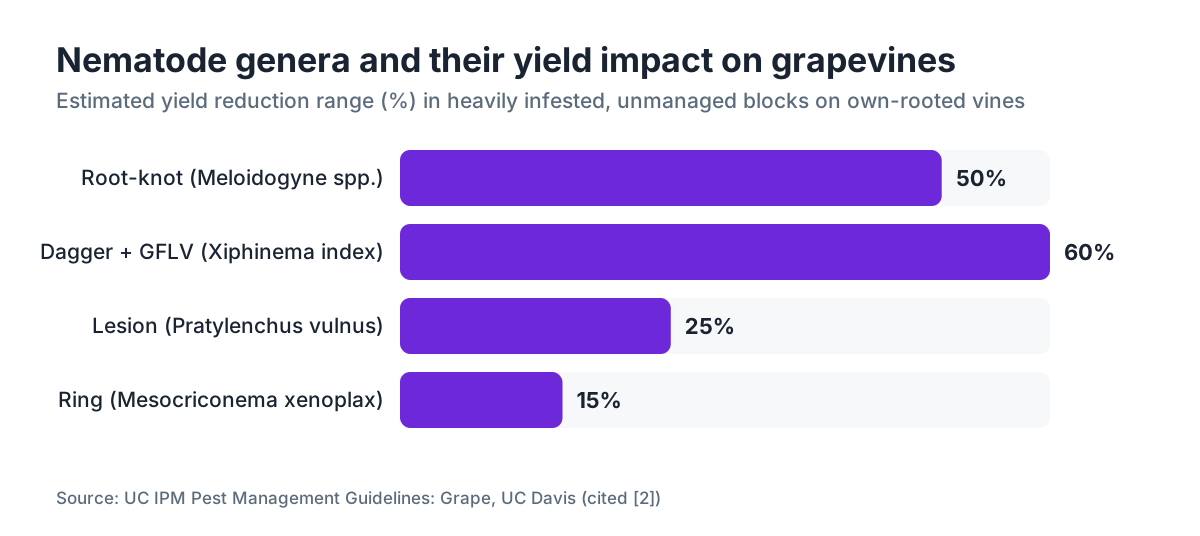
Root-knot nematodes (Meloidogyne spp.) top the list in most California and Pacific Northwest surveys. The two species of greatest concern in western U.S. vineyards are M. incognita and M. javanica, though M. arenaria and M. hapla also appear. They lay eggs in gelatinous masses on or inside root tissue. Second-stage juveniles hatch, penetrate feeder roots, and establish permanent feeding sites that swell into the characteristic galls. A severely galled root system cannot absorb water efficiently, and vines under heat or drought stress collapse faster. UC IPM guidelines document yield reductions of 30 to 50 percent in untreated, heavily infested sandy loam soils. [2]
Dagger nematodes (Xiphinema index) are arguably the most economically important single species in California wine grapes. Not for their direct feeding, which is real but moderate, but because they are the only known vector of Grapevine fanleaf virus. GFLV is a nepovirus that causes fanleaf degeneration, one of the most destructive virus diseases of grapevines worldwide. The virus reduces yields, causes irregular berry set, shortens vine life, and has no cure once a vine is infected. X. index can retain the virus through molts and transmit it to healthy vines over multiple feeding events. [3]
Lesion nematodes (Pratylenchus vulnus) are migratory endoparasites that move through cortical tissue, leaving behind brown necrotic lesions. Those wounds serve as infection courts for Cylindrocarpon, Phytophthora, and other root rot pathogens. In Oregon and Washington, P. vulnus and P. penetrans both show up in wine grape regions, and Washington State University Extension has flagged them as a replant concern in older blocks. [4]
Ring nematodes (Mesocriconema xenoplax, formerly Criconemella xenoplax) associate with Prunus and turn up in replanted vineyards where stone fruit previously grew. Their impact on grapevines is milder than the other genera, but their presence in a replant site warrants attention because they can co-infest with more damaging species.
How do nematodes spread the fanleaf virus and other grapevine viruses?
Grapevine fanleaf virus is a nepovirus in the family Secoviridae, and Xiphinema index is its only confirmed natural vector. When X. index feeds on an infected vine, it acquires virus particles that bind to specific sites in its esophagus. The nematode stays infective for months, sometimes carrying the virus through multiple juvenile instars into adulthood. When it migrates even a short distance through soil and feeds on a healthy root, it transmits the virus. [3]
The problem compounds over time. X. index moves slowly on its own, maybe a meter or two per season under normal conditions. But infected planting material, contaminated equipment, and water movement through furrow irrigation can spread infested soil much faster. A block planted into a site with established X. index and GFLV-infected root debris will watch the disease spread outward from those hot spots over years, creating the "spreading decline" pattern that aerial imagery sometimes catches as irregular patches of stunted, yellow vines.
Two other nepoviruses, Grapevine fanleaf satellite virus and Arabis mosaic virus (ArMV), are also vectored by Xiphinema species in European vineyards. In North America the primary concern stays with GFLV and X. index. Cornell's viticulture program notes that once GFLV is confirmed by ELISA or RT-PCR, the economically rational response is often full removal and a multi-year fallow or cover crop rotation before replanting with certified virus-free material on resistant rootstock. [5]
Nepoviruses vectored by other Xiphinema species include Tomato ringspot virus (ToRSV) and Tobacco ringspot virus (TRSV). Both have been found in North American vineyards and can cause decline symptoms that mimic fanleaf. Accurate diagnosis matters because knowing which virus is present helps predict the vector species and its soil distribution, even though the removal response is the same.
What symptoms should you look for in the vineyard?
Nematode damage rarely shows up as a clean diagnostic picture. That's the honest truth. What you see above ground is a set of non-specific symptoms: stunted shoot growth, small yellowing leaves, poor fruit set, reduced cane diameter, and early fall coloration. These overlap with drought stress, rootstock-scion incompatibility, soil compaction, and nutrient deficiencies, especially zinc and magnesium.
The patterns that should raise your suspicion are spatial. Nematode problems tend to cluster in light-textured sandy soils, in old replanted blocks, along fence lines or the ends of rows where equipment turns and drops infested soil, and in spots with a history of the same crop family. If a block of 12-year-old Cabernet shows declining vigor in scattered patches and the soil is sandy loam, sample before you assume it's a water or fertilization problem.
Below ground, root inspection tells more of the story. Pull a sample of feeder roots and look. Root-knot nematode galls are visible to the naked eye on fresh roots, appearing as swellings from 1 mm to several millimeters. Lesion nematode damage shows as brown, corky lesions on the root cortex. Dagger nematode damage is less distinctive because they feed from outside the root, but root tip browning and stunted root development are common.
Fanleaf virus symptoms are more specific when present. Classic fanleaf causes distorted, asymmetrical (fan-shaped) leaves with broad sinuses, yellow mosaic patches, and shortened internodes. Chrome yellow discoloration across the whole canopy in spring is another fanleaf expression called yellow mosaic. Not every infected vine shows clear symptoms every year, which is why serological or molecular testing of cane or leaf tissue is the only definitive confirmation. [5]
How do you sample soil and roots for nematodes?
Sampling correctly is everything. A poorly timed or poorly collected sample gives you a false negative, and you plant into an infested site without knowing it.
The best time to sample is fall, after harvest but before soil temperature drops below 10°C (50°F). Nematode populations peak in fall across most western wine regions because the summer feeding season has built up numbers. Spring sampling is second-best. Summer sampling after irrigation shutdown can badly underestimate populations because nematodes move deeper in the profile chasing moisture.
For a pre-plant assessment, UC Cooperative Extension recommends collecting 20 to 30 soil cores from 0 to 60 cm depth across a uniform sampling zone of no more than 2 to 4 acres. [2] Take cores from the future root zone, not the middle of alleys. Composite the cores from each zone into a single sample, mix thoroughly, and pull a roughly 500 mL subsample for the lab. Keep it cool, not frozen, in transit. Nematode populations crash in samples left in a hot truck.
Root samples should ride along with the soil samples. Collect 20 to 30 grams of feeder roots from the active root zone, seal in a plastic bag, and refrigerate. Root samples let the lab confirm endoparasitic species that may not be abundant in the bulk soil.
University diagnostic labs that handle nematode assays include the UC Davis Plant Pathology Nematology Lab, Cornell's Plant Disease Diagnostic Clinic, and WSU's Plant Pest Diagnostic Lab. [4][5] Commercial labs also offer nematode extraction and identification. Results typically come back in one to three weeks.
Interpretation uses population thresholds. For M. incognita and M. javanica, an action level of 1 to 5 juveniles per 200 cm³ of soil generally triggers pre-plant fumigation in California. For X. index, even a single individual in a replant sample warrants serious attention given the virus vector risk. [2]
What are your management options once nematodes are confirmed?
Management decisions branch depending on whether you're facing a pre-plant situation or an established vineyard.
Pre-plant is where you hold the most cards. The options, roughly in order of effectiveness and cost, are:
- Soil fumigation: The registered pre-plant fumigants as of 2025 include 1,3-dichloropropene (1,3-D, sold as Telone II), chloropicrin, and combinations of the two. Methyl bromide remains available under critical use exemption for certain nursery and replant situations, but availability is shrinking. Telone II at 37 to 40 gallons per acre injected at 45 to 60 cm depth is a common California recommendation for root-knot nematode in sandy soils. Efficacy depends heavily on soil moisture, temperature, and organic matter. [6] These are restricted-use pesticides requiring a licensed applicator and a California Pesticide Use Report or equivalent state filing. EPA Worker Protection Standard requirements apply for re-entry intervals, typically 5 days for Telone II under most conditions. [7]
- Resistant rootstocks: This is the single most cost-effective long-term tool. Rootstocks with Vitis rupestris and V. berlandieri parentage generally carry partial to high resistance to root-knot nematodes. AXR#1 (Aramon x Rupestris Ganzin No. 1) was once widely used in California but has high susceptibility to M. incognita race 3 and phylloxera biotype B, and is not recommended. Dog Ridge and Harmony offer good M. incognita resistance but come with agronomic tradeoffs in vigor and sandy soils. RS-3 (Ramsey) has high resistance to root-knot nematodes and suits sandy soils, but promotes very high vigor. 1103 Paulsen and 110 Richter perform well in heavier soils. [2] No commercially available rootstock provides reliable resistance to X. index feeding or GFLV transmission, which is why pre-plant fumigation stays on the table even when you plant resistant rootstock in a known X. index site.
- Cover crops and fallow: A 2 to 4 year fallow with a non-host cover crop (small grains, sudangrass hybrids, or marigolds as a biofumigant) can cut nematode populations meaningfully, though rarely to negligible levels in commercial soils. Sudangrass hybrids release allelopathic compounds from root exudates that suppress M. incognita. Results are variable. [8]
- Biological controls: Products based on Bacillus firmus (BioNem, Nortica) and Purpureocillium lilacinum (MeloCon) carry registered labels for nematode suppression. University trials show consistent but modest results, typically 20 to 40 percent reduction in root-knot populations under favorable conditions. Treat them as part of an integrated program, not a standalone fix.
In an established vineyard, the options narrow fast. You can't fumigate around live roots without unacceptable vine injury. Trunk injection and foliar nutrition programs can reduce stress on affected vines and extend productive life, but they don't lower nematode populations. Drip irrigation managed to hold consistent soil moisture without saturation reduces the peak physiological stress on infected vines. If a block is declining badly and is near the end of its economic life anyway, early removal and a proper pre-plant program before the next planting is often the right call.
Record-keeping for all pesticide applications, pre-plant fumigations included, is a legal requirement in California and most western states. If you're managing multiple blocks with different nematode histories and treatment records, a digital field record system saves time at audit. VitiScribe is built for vineyard spray record compliance and can track nematode sampling results alongside application records.
How do rootstock choices affect nematode resistance and what are the tradeoffs?
Rootstock selection is a 30-year decision, so getting the nematode resistance profile right matters a lot. The catch is that no rootstock is a clean winner on every dimension, and the resistance ratings in university tables often come from greenhouse or field trials that don't perfectly predict how a stock behaves in your specific soil with your specific nematode population.
The resistance ratings below are based on UC Cooperative Extension and WSU Extension published recommendations. [2][4]
| Rootstock | M. incognita resistance | M. javanica resistance | X. index feeding tolerance | Notes |
|---|---|---|---|---|
| Harmony | High | High | Low | Moderate vigor, good in sandy soils |
| Freedom | High | High | Low | High vigor, widely used in CA |
| Ramsey (RS-3) | Very High | High | Low | Very high vigor, sandy soils |
| 1103 Paulsen | Moderate | Moderate | Low | Good in heavier, drier soils |
| 110 Richter | Moderate | Moderate | Low | Drought-tolerant, heavier soils |
| 3309 Couderc | Low | Low | Low | Not recommended in nematode pressure |
| 5C Teleki | Low | Low | Low | Susceptible, avoid in infested sites |
| SO4 | Low-Moderate | Low | Low | Common in Europe, poor CA nematode data |
No entry shows high X. index tolerance because there genuinely is no commercial rootstock that significantly slows X. index feeding or GFLV transmission. That's not a gap in the table, it's the biology. Xiphinema index feeds at the root tip surface, and grapevine roots in general don't repel it.
One more practical note: resistance ratings describe population-level responses. A high-resistance rootstock like Harmony can still show significant root-knot galling in soils with extreme nematode pressure, in M. incognita race 3 situations, or where compaction and heat concentrate feeding. Resistance slows population buildup. It doesn't erase the organism.
What is the economic impact of nematodes on grape yield and quality?
Yield loss figures in the literature are real but swing hard depending on soil type, irrigation management, variety, rootstock, and nematode species and density. The range that turns up most consistently in California studies is 20 to 50 percent yield reduction in heavily infested, unmanaged blocks on own-rooted vines in sandy soils. [2]
A University of California analysis estimated annual losses from all soil-borne pests and diseases in California vineyards at over 100 million dollars, with nematodes accounting for a significant share of that figure. The exact nematode-specific number is hard to isolate because nematode damage interacts with virus presence and other stressors. [9]
When X. index and GFLV are both present, the story shifts from yield loss to vineyard longevity. Infected vines decline progressively. A block with moderate fanleaf spread might produce economically for 15 to 20 years with intensive management. A heavily infected block can go uneconomical in 8 to 10 years. Replanting cost in California wine country, including fumigation, certified planting material, trellis installation, and the 3 to 5 years to reach full production, runs $15,000 to $35,000 per acre depending on region, trellis system, and vine spacing. That number matters when you're deciding whether to replant a declining block now or squeeze out a few more vintages. [10]
For growers in high land-value regions, the opportunity cost of a poor block is also real. A Napa Valley block at 800 cases per acre losing 30 percent to nematode pressure gives up roughly 240 cases a year, which at any realistic price point adds up fast.
What do UC Davis, Cornell, and WSU recommend for nematode management?
All three major university extension programs with significant viticulture work push the same three-part message: sample before you decide, build long-term management on resistant rootstocks, and fumigate carefully before planting where nematode pressure is confirmed.
UC Davis and UC Cooperative Extension publish the most extensive nematode guidance for California wine grapes, including the UC IPM Pest Management Guidelines for Grape, updated periodically and free online. [2] They recommend a soil sampling program at every site before planting or replanting, with specific population thresholds for each nematode genus. They also publish rootstock resistance ratings that get updated as new trial data comes in.
Cornell's viticulture program, through the New York State IPM Program and Cornell Cooperative Extension, handles root-knot and ring nematodes in northeastern vineyards where cooler soils and heavier textures create different dynamics. M. hapla (northern root-knot nematode) is more common in New York and Oregon than the southern species that dominate California. Cornell also documents Tomato ringspot virus, vectored by Xiphinema americanum in the Northeast, which causes grape decline distinct from GFLV. [5]
WSU Extension addresses both M. hapla and Pratylenchus species across Washington and Oregon wine regions, noting that the Columbia Basin's irrigated sandy soils favor root-knot buildup even in a cooler climate. WSU's framework aligns closely with UC Davis on sampling and rootstock selection, though their fumigant registration landscape differs slightly from California's. [4]
All three agree on one point: the time to act is before planting. Every year a field sits with an established nematode population and no management is a year of population buildup that makes the next replant harder.
What are the regulatory and record-keeping requirements for nematicide use?
Pre-plant fumigants for nematode control are mostly restricted-use pesticides (RUPs) in the United States, which means you need a licensed pesticide applicator to buy and apply them. In California, all pesticide applications must be reported to the county agricultural commissioner within a specified period under the California Department of Pesticide Regulation's pesticide use reporting system. [11]
The EPA Worker Protection Standard (WPS) at 40 CFR Part 170 applies to all agricultural pesticide applications, nematicides included. It requires workers and handlers to receive safety training, application information to be posted at a central location, and re-entry intervals to be enforced. For 1,3-D (Telone II), the re-entry interval is typically 5 days, though buffer zone requirements and application timing restrictions on temperature and wind speed add complexity. [7]
In California, Telone II applications are also subject to township caps and buffer zones under the California Code of Regulations, managed by county agricultural commissioners. Those rules have tightened in recent years over air quality concerns, and in some high-use counties, applications require advance notification or face acreage limits per quarter section. Applicators working in California should check current county-specific requirements before scheduling a fumigation.
For organic certified vineyards, the registered pre-plant fumigants are generally not compliant with the National Organic Program. Organic options come down to resistant rootstocks, biofumigant cover crops, and OMRI-listed biological products with modest efficacy. This is an area where organic growers face a real constraint, not a theoretical one.
All of this generates paperwork: spray records, re-entry logs, worker training records, restricted-use purchase records. Keeping those organized by block and year is both a legal requirement and good farm management. A record system designed for vineyard compliance, like VitiScribe, cuts the time spent on this administrative layer while keeping your records audit-ready.
How do you confirm grapevine fanleaf virus versus other decline causes?
Visual diagnosis of fanleaf is unreliable on its own. Symptom expression varies by virus strain, season, vine age, and rootstock. Some strains produce very subtle symptoms or stay asymptomatic in warm, dry seasons.
The standard diagnostic tools are:
ELISA (enzyme-linked immunosorbent assay): The workhorse. Commercial ELISA kits for GFLV are widely available, and most university diagnostic labs and commercial plant disease labs run them. Tissue usually comes from young leaves or canes during the growing season. Sensitivity is good for symptomatic tissue but can miss low-titer infections in dormant wood.
RT-PCR (reverse transcriptase polymerase chain reaction): More sensitive than ELISA, better at confirming low-titer infections, and necessary for telling GFLV apart from ArMV and other nepoviruses that share some ELISA cross-reactivity. The UC Davis Plant Pathology lab offers RT-PCR-based virus panels for grapevine diagnostics. [12]
Bioassay: Inoculating indicator plants like Chenopodium quinoa with suspect tissue is a classical approach still used in research but rarely in commercial diagnostics because of time and cost.
If you're seeing decline symptoms and want to know whether nematodes and GFLV are involved, the practical move is to run soil and root nematode samples at the same time as a leaf ELISA panel that includes GFLV, GLRaV-3 (Grapevine leafroll-associated virus 3), and Grapevine red blotch virus, since all three can produce overlapping decline symptoms. The lab cost for this combined diagnostic runs roughly $50 to $150 per sample depending on the panel and lab. [9]
A confirmed GFLV diagnosis doesn't change what you can do for that vine, since there's no curative treatment. But it confirms X. index is likely in that soil, which directly shapes the replant plan for when the block eventually comes out.
What does a nematode management plan look like in practice?
Here's what a reasonable, step-by-step program looks like for a manager preparing to replant a block with known nematode history.
Year minus 2 (two years before target planting): Pull soil and root samples in fall. Get nematode extraction results and species identification. If X. index is present, test for GFLV in any remaining vines. Review rootstock options with your farm advisor against the soil profile, target variety, and nematode species present.
Year minus 1 (one year before planting): Remove old vines and as much root material as you can. Old root debris is a nematode reservoir and a source of virus inoculum for X. index. Chip and haul off debris rather than incorporating it. Consider a biofumigant cover crop rotation for one season. If fumigation is planned, coordinate with a licensed pest control advisor (PCA) on timing and county permit requirements. Many California counties require fumigation applications inside a specific seasonal window.
Year of planting, pre-plant: Apply fumigant per the PCA recommendation and label, observing all re-entry and buffer zone requirements. Pull a post-fumigation soil sample 60 to 90 days after treatment to check efficacy before you commit planting material. Order certified, virus-tested planting material from a licensed nursery. In California, the Foundation Plant Services program at UC Davis is the source for certified disease-tested propagative material. [12]
Year of planting: Plant on the recommended resistant rootstock. Keep records of the rootstock selection, planting date, certified material source, and any treatments applied. Those records matter for future sales, insurance claims, and replant decisions.
Years 1 to 5: Monitor vine establishment. Sample soil again in year 3 to gauge nematode population recovery. Adjust irrigation and nutrition to reduce stress on developing root systems in those first years, when it counts most.
This is a 3 to 4 year process from decision to productive vineyard. The economics only work if the pre-plant investment keeps you from redoing it in 10 years.
For broader context on field operations planning, the vineyard section of VitiScribe covers operational workflows that fit with this kind of multi-year replant planning.
Frequently asked questions
Can nematodes kill grapevines outright?
Direct nematode feeding rarely kills vines immediately. What happens is progressive decline: reduced vigor, smaller crop loads, shorter productive life. Vines under severe root-knot nematode pressure combined with drought or heat stress can die, but the more common outcome is a block that becomes uneconomical over 8 to 15 years. The combination of X. index feeding and GFLV transmission is the scenario most likely to end a block's productive life early.
How long does it take for nematodes to build up to damaging levels after planting?
It depends heavily on soil texture and species. In warm, sandy soils, Meloidogyne populations can reach economically significant levels within 2 to 3 seasons if initial inoculum is present and the rootstock has no resistance. In clay-heavy or cooler soils, buildup is slower. X. index populations grow more slowly but persist for decades because the organism has a long life cycle and survives in root debris.
Are nematodes worse in sandy soil or clay soil?
Root-knot nematodes are consistently worse in coarse-textured, well-drained sandy soils. Sand allows nematode movement, holds fewer predatory organisms, and warms faster in spring, speeding up reproduction. Clay soils suppress root-knot populations through physical restriction and higher biological diversity. Lesion nematodes are less sensitive to texture and can cause problems in heavier soils. Dagger nematodes also tolerate a wider range of textures.
Do nematodes spread from vine to vine during the growing season?
Nematodes move very slowly through undisturbed soil on their own, typically a meter or less per season. The faster spread mechanisms are contaminated soil moved on equipment or footwear, infected planting material, water movement through furrow or flood irrigation, and root-to-root contact. Drip irrigation reduces waterborne spread compared to furrow systems. The main protection against introducing nematodes to clean blocks is rigorous equipment sanitation.
Can I use organic methods to manage nematodes effectively?
Organic management can reduce nematode pressure but rarely eliminates it in a commercially planted vineyard. The best organic tools are resistant rootstocks, biofumigant cover crops like sudangrass hybrids or Tagetes marigolds, and OMRI-listed biological nematicides based on Bacillus firmus or Purpureocillium lilacinum. University trials generally show 20 to 40 percent population suppression with biologicals, which is meaningful but not curative. Fumigants available to conventional growers are generally not NOP-compliant.
What is the re-entry interval for nematicides like Telone II under the EPA Worker Protection Standard?
For 1,3-dichloropropene (Telone II), the re-entry interval under the EPA Worker Protection Standard is typically 5 days after application under most field conditions. Additional restrictions apply: workers must not enter treated fields during application, application-specific information must be posted, and handlers must have completed WPS pesticide safety training. California adds buffer zone requirements and county-level restrictions beyond the federal baseline. Always check the current label, which is the law.
How do I know if the fanleaf virus in my vineyard came from nematodes or infected plant material?
You can't tell from symptoms alone. The spatial pattern gives clues: GFLV spread by X. index tends to radiate outward from initial infection foci in a slowly expanding pattern. Virus introduced through infected planting material often shows up as scattered individual vines or rows matching a planting year. Soil testing for X. index around symptomatic vines, combined with vine age and planting history, gives the clearest picture. Molecular typing of GFLV strains can sometimes distinguish introduction events, but that's research-level work.
Is soil fumigation required before replanting if nematodes were present in the old block?
Required is too strong a word legally, but in California, UC Cooperative Extension guidelines strongly recommend pre-plant fumigation when root-knot or dagger nematodes are confirmed above action thresholds. Without fumigation, resistant rootstock alone lets nematode populations from existing soil and root debris rebuild quickly and compromise vine establishment. County agricultural commissioners may also require a licensed pest control advisor recommendation before issuing a restricted-use fumigant permit.
Are there nematode-resistant Vitis vinifera varieties?
No commercially significant Vitis vinifera wine grape varieties carry useful resistance to root-knot or dagger nematodes. Resistance in Vitis comes from wild American species, primarily V. rupestris, V. berlandieri, and V. champinii, which are the foundation of commercial rootstocks. Own-rooted vinifera vines are essentially defenseless against root-knot nematodes in infested soils. This is a primary reason phylloxera-resistant rootstocks were universally adopted after the 19th century phylloxera crisis, since those same rootstocks often carry nematode resistance too.
How much does a nematode soil sample and diagnostic test cost?
University diagnostic labs typically charge $25 to $60 per sample for nematode extraction and genus-level identification. Commercial labs vary but often run $40 to $80 per sample with species-level ID. Add a plant virus panel (ELISA for GFLV and other pathogens) and total diagnostic costs for a problem block with both soil and plant tissue samples generally run $100 to $200. Given that a replant decision can cost $15,000 to $35,000 per acre, this is arguably the cheapest information you can buy.
Can winter cover crops reduce nematode pressure between vine rows?
Winter cover crops have limited effect on nematode populations because most plant-parasitic nematode species in vineyards are relatively quiescent in cool winter soils regardless of what's growing above them. Summer biofumigant cover crops, particularly sudangrass hybrids and Tagetes marigolds grown and incorporated as green manure during a fallow period, have the most documented suppressive effect. Cover crops between established vine rows are unlikely to meaningfully change nematode pressure under the vine row where most feeder roots concentrate.
Do nematodes affect wine quality or just yield?
The direct research on nematode-specific wine quality effects is thin. What's documented is that vines under chronic nematode stress show earlier maturity, reduced canopy, and smaller berries, all of which interact with grape composition. When X. index and GFLV are both involved, the virus itself affects berry set and sugar accumulation. Some winemakers report that severely fanleaf-affected fruit produces wines with unusual flavor profiles, but controlled studies isolating nematode from virus effects on wine chemistry are sparse.
How do I sanitize vineyard equipment to prevent nematode spread?
Remove soil from equipment before moving between blocks. Physically cleaning soil off discs, cultivators, harvest machinery, and even tractor tires before entering a clean block is the baseline. There's no chemical treatment that effectively kills nematodes in moist soil clumps on equipment surfaces in practical field use. The most disciplined approach is to move equipment from clean to infested blocks in one direction, never the reverse, and to work infested blocks last in your operational sequence.
Sources
- USDA Agricultural Research Service, Methyl Bromide Alternatives Program overview: Methyl bromide phase-out under the Montreal Protocol and transition to alternative fumigants for pre-plant soil treatment
- UC IPM, Pest Management Guidelines: Grape, Nematodes section: Root-knot nematode yield reductions of 30 to 50 percent in infested sandy loam soils; sampling thresholds and rootstock resistance ratings
- UC Davis Department of Plant Pathology, Grapevine fanleaf virus and Xiphinema index: Xiphinema index is the only known natural vector of Grapevine fanleaf virus; nematode retains infectivity through molts
- Washington State University Extension, Nematodes in Pacific Northwest Vineyards: Pratylenchus vulnus and P. penetrans documented in Washington and Oregon wine grape regions as replant concern; sampling and management recommendations
- Cornell University, New York State IPM Program, Grape IPM: Nematodes and Virus Diseases: Cornell recommendation for full vine removal and fallow following confirmed GFLV; Tomato ringspot virus vectored by Xiphinema americanum in Northeast
- California Department of Pesticide Regulation, 1,3-Dichloropropene (Telone II) registration and use requirements: Telone II registered pre-plant fumigant application rates, county buffer zone requirements, and township cap regulations in California
- US EPA, Worker Protection Standard for Agricultural Pesticides, 40 CFR Part 170: EPA Worker Protection Standard requirements for re-entry intervals, worker training, and central posting of application information for agricultural pesticide applications including nematicides
- UC Cooperative Extension, Cover Crops and Biofumigants for Nematode Suppression in Vineyards: Sudangrass hybrids and biofumigant cover crops produce allelopathic compounds that suppress Meloidogyne incognita populations
- UC Davis Plant Pathology, Economic losses from soil-borne pests and diseases in California vineyards: Annual losses from soil-borne pests and diseases in California vineyards estimated at over 100 million dollars; combined ELISA diagnostic panel cost range
- UC Cooperative Extension, Sample Costs to Establish a Vineyard and Produce Wine Grapes: Vineyard replanting costs in California including fumigation, certified planting material, trellis, and establishment estimated at $15,000 to $35,000 per acre depending on region and system
- California Department of Pesticide Regulation, Pesticide Use Reporting Program: All pesticide applications in California must be reported to the county agricultural commissioner under the state pesticide use reporting system
- UC Davis Foundation Plant Services, Certified Grapevine Planting Stock Program: Foundation Plant Services at UC Davis is the source for certified, disease-tested grapevine propagative material; RT-PCR virus diagnostic services available
Last updated 2026-07-09