Nitrogen management record requirements under the Irrigated Lands Regulatory Program
TL;DR
- Under California's Irrigated Lands Regulatory Program (ILRP), grape growers enrolled in a third-party coalition or operating under an individual waiver must document all nitrogen inputs, sources, timing, and rates.
- Records must be retained for at least five years and available to the Regional Water Quality Control Board on request.
- Failure to comply can trigger violations, fines, or loss of waiver status.
What is the Irrigated Lands Regulatory Program and who does it cover?
The Irrigated Lands Regulatory Program (ILRP) is California's framework for regulating agricultural discharges of nitrogen and other constituents from irrigated cropland into surface water and groundwater. The State Water Resources Control Board and the nine Regional Water Quality Control Boards administer it jointly. Any grower irrigating land and discharging, or threatening to discharge, to waters of the state needs a waiver of waste discharge requirements under the program. [1]
For grape growers, that means essentially every irrigated vineyard in the San Joaquin Valley, Central Coast, Sacramento Valley, and most other California wine regions is covered. Dryland or dry-farmed parcels that have zero irrigation discharge may qualify for an exemption, but most commercial vineyards in California need to be enrolled. Growers usually enroll through a third-party coalition (a grower group that files coalitionwide monitoring reports) or hold an individual waiver, which carries heavier direct reporting obligations.
The ILRP's nitrogen focus sharpened considerably after the State Board adopted the Nitrate Control Program for groundwater in 2017 and after the Tulare Lake and Central Coast regions began requiring Management Practice Effectiveness reporting. Grape growers in those regions face the most detailed record-keeping demands right now, but other regions are updating their orders on similar timelines. If you farm in California and irrigate, confirm which regional order applies to your parcel before assuming you're covered only lightly.
What nitrogen records does the ILRP actually require growers to keep?
The specific record requirements vary by regional order, but the core categories are consistent across California's ILRP framework. [2]
Required records typically include:
- Nitrogen application records: product name, formulation, application date, field or block ID, rate per acre, total quantity applied, and application method (fertigation, broadcast, side-dress).
- Nitrogen source documentation: copies of fertilizer invoices or delivery receipts that confirm the product's guaranteed analysis (percent N on the label).
- Irrigation records: dates, duration or volume, and method, because irrigation timing ties directly to nitrogen leaching risk calculations.
- Crop nitrogen uptake information: for growers using a nitrogen management plan (NMP), the expected or measured crop removal numbers by variety and yield.
- Soil and tissue test results: labs, sample dates, and field locations where samples were pulled.
- Pest control adviser (PCA) or certified crop adviser (CCA) nitrogen recommendations, where a licensed adviser is the basis for application decisions.
For growers in regions that require a formal Nitrogen Management Plan, the NMP itself is a record. You must keep the current plan and any prior versions within the retention window. The Central Coast ILRP order, for example, explicitly requires growers to retain all NMP documents and supporting data used to develop the plan. [3]
A detail many growers miss: water source nitrogen counts. If you fertigate through a drip or micro-sprinkler system, the nitrogen already in your irrigation water (common in recycled or surface-diverted water) must be accounted for in the total nitrogen budget. You need water quality test records proving what your source water carries.
How long must nitrogen records be retained?
The statewide minimum is five years. California Water Code Section 13267 gives Regional Boards authority to require growers and coalitions to submit or retain records, and every regional ILRP order currently in force specifies a five-year retention period for nitrogen-related documents. [4]
Some regional orders extend this for specific document types. If your operation generated a nitrogen management plan that was used as the basis for a waiver condition, keep that plan for at least five years from the date the waiver or order expires or is revised, more than five years from the application date. That distinction matters if your regional order is renewed on a rolling basis.
Most orders say nothing about paper versus electronic storage, so electronic records are fine. You do need to produce them promptly if a Water Board inspector requests them. They can't live only in a system you can't open without three days' notice. Keep backups.
What is a nitrogen management plan and when is one required?
A nitrogen management plan is a written document that quantifies the nitrogen needs of your crop, accounts for all nitrogen sources (fertilizer, irrigation water, organic amendments, soil mineralization), and demonstrates that you're applying nitrogen at agronomic rates that minimize loss to water. [5]
Not every ILRP grower currently needs a formal written NMP, but the threshold for needing one is dropping. The Central Coast Regional Board has required NMPs from Tier 3 growers (high-risk dischargers based on proximity to water, practices, and crop type) since the mid-2010s. The State Board's 2017 Nitrate Control Program requires priority growers in high-nitrate groundwater basins to develop NMPs on a specific schedule. [6]
For wine grape growers specifically, UC Cooperative Extension and UC Davis have published guidelines on building a vineyard NMP that satisfies ILRP requirements. The UC Davis Department of Viticulture and Enology recommends tracking vine nitrogen status through petiole analysis at bloom and veraison, using those results to calibrate the following year's fertilizer program, and documenting that loop in the NMP. [7] Cornell and Washington State University have analogous extension guidance for their own states' nutrient management programs, though those programs differ structurally from California's ILRP. [8]
If a pest control adviser or certified crop adviser developed your NMP, that person's license number and the plan's preparation date are records you need to keep alongside the plan itself.
What records do coalitions keep versus what individual growers must keep?
This is the source of a lot of confusion. When you enroll through a third-party coalition, the coalition handles regionwide monitoring, report preparation, and filing with the Regional Board. But the coalition does not keep your farm-level records for you.
You, the grower, are responsible for your own on-farm nitrogen application records, fertilizer receipts, irrigation logs, soil tests, and any other farm-level data. The coalition aggregates anonymized data at the watershed or regional level, submits Coalitionwide Management Plan reports, and defends compliance at a group level. If a Water Board inspector comes to your property, they expect to see your records, not a reference to the coalition's database.
Some coalitions do offer growers a record-keeping portal or template system as a member benefit, which is worth using. But understand that populating that portal is your responsibility, and the data there belongs to your compliance file, not to the coalition's filing.
If you hold an individual waiver rather than enrolling through a coalition, your reporting obligations are heavier. You may need to submit annual nitrogen management reports directly to the Regional Board, more than maintain records for inspection. Check your specific waiver conditions.
What nitrogen thresholds or rates trigger additional scrutiny?
The ILRP doesn't set a universal per-acre nitrogen cap for vineyards. The standard is agronomic rate: applying no more nitrogen than the crop can use in the current season, accounting for soil and irrigation water contributions. Applying above the agronomic rate creates the leaching risk the program is designed to prevent.
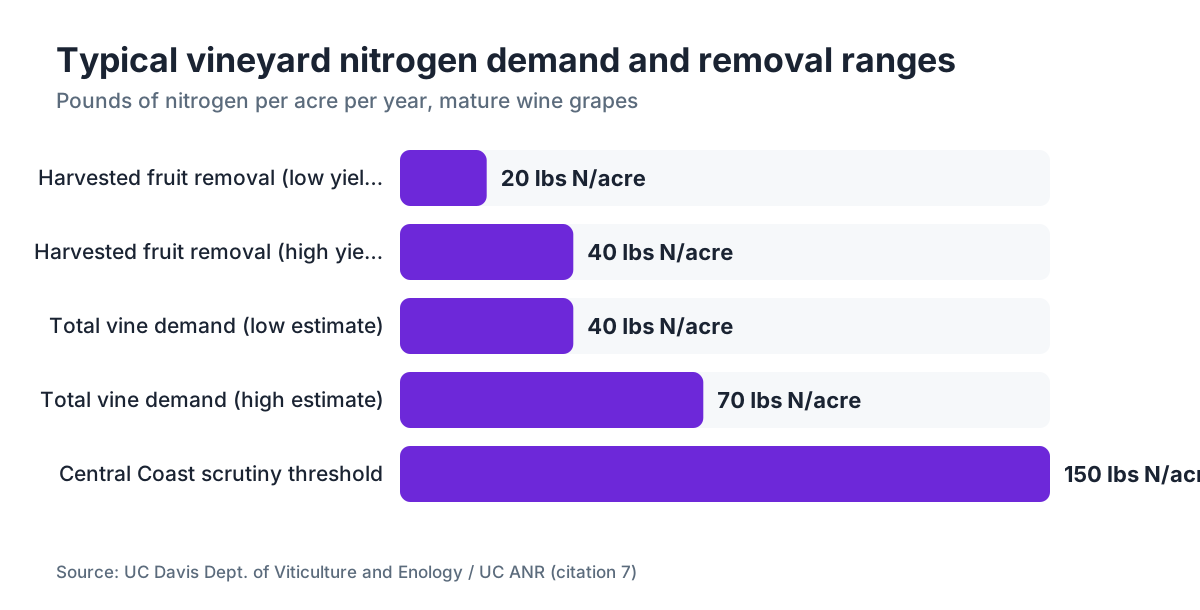
That said, some regional orders use indicative thresholds as screening tools. The Central Coast order has flagged operations applying more than 150 pounds of total nitrogen per acre as warranting closer review, though that number is not a hard legal ceiling. It's a trigger for the coalition or the Board to ask questions. [3]
For wine grapes, typical nitrogen removal with the crop is low compared with annual vegetable crops. UC Davis research suggests most mature wine grape vineyards remove roughly 20 to 40 pounds of nitrogen per acre in harvested fruit, with total vine demand (including canopy growth) closer to 40 to 70 pounds per acre annually depending on variety, yield, and rootstock. [7] Applying 150-plus pounds per acre to a low-yield Cabernet block is a number that should prompt you to document your reasoning very carefully. That gap between application and crop removal is exactly what regulators want explained.
The chart below shows typical nitrogen ranges for common vineyard inputs, drawn from UC Cooperative Extension published data.
How do irrigation records connect to nitrogen compliance?
Nitrogen leaches when water moves nitrate below the root zone. So irrigation management is inseparable from nitrogen management under the ILRP. Inspectors looking at nitrogen compliance will almost always ask to see your irrigation records alongside your fertilizer records.
The records you need for irrigation include: irrigation dates, duration or volume per event, system type (drip, micro-sprinkler, flood), and any ET-based scheduling information you used. If you run a soil moisture monitoring system (tensiometers, capacitance probes), records from that system strengthen your case considerably.
For fertigation specifically, the timing of nitrogen application within the irrigation set matters. Applying nitrogen at the start of a long irrigation cycle and then pushing it down with excess water is exactly the practice that gets growers flagged. If your records show nitrogen applied in the last 15 to 20 percent of an irrigation event (a practice sometimes called late-injection), that's your documentation that you minimized deep percolation of the fertilizer.
Many vineyards already keep electronic irrigation logs for water management and ET scheduling. Those same logs serve double duty as ILRP supporting documentation, which is reason enough to make sure they're organized and accessible.
What happens during an ILRP nitrogen compliance inspection?
Regional Water Quality Control Boards conduct inspections of individual farms as part of their ILRP compliance programs. An inspector may arrive with advance notice or, in some cases, with minimal notice under Water Code authority. [4]
During an inspection, expect requests to see: fertilizer application records for the current and prior seasons, fertilizer purchase invoices, irrigation logs, your nitrogen management plan (if you're required to have one), soil and tissue test results, and the name and license number of any PCA who made recommendations.
Inspectors also look at physical evidence: soil sample locations, irrigation system condition, and any visible runoff pathways or ponding that suggest over-irrigation. The paper record and the field condition should tell a consistent story.
Non-compliance findings can range from a notice of violation with a compliance schedule (most common for first-time record-keeping gaps) to formal enforcement actions and civil liability. Civil liability under California Water Code can reach $10,000 per day per violation for continuing violations. [4] That's a number serious enough to justify the time it takes to keep clean records.
One practical note: inspectors at the Regional Boards have told growers (at public workshops, not in writing I can cite directly) that growers who produce well-organized records quickly, even if the records show some application decisions they'd question, fare considerably better than growers who can't produce records at all. Organization signals good faith.
How should growers organize and store nitrogen records to pass an audit?
Organize by field or block, not by calendar year. An inspector will want to pull up the history for a specific parcel fast. If your records are filed only by month or by vendor, finding everything for Block 7 across three years becomes a scramble.
A workable paper system uses a binder per block per year, with sections for fertilizer applications, irrigation logs, soil/tissue tests, and invoices. A workable digital system does the same with folders and consistent file naming (e.g., "Block07_2024_FertApp_20240615"). Either works. The point is that someone other than you can find a specific record in under five minutes.
Keep original invoices. Photocopies or scanned PDFs are acceptable, but don't discard originals until the five-year window is fully closed.
For growers managing multiple blocks across multiple compliance regions, software built for field-level record-keeping can make a real difference. VitiScribe, for example, lets you log applications by block, attach photos of product labels, and export a date-sorted compliance report in the format most Regional Boards expect. That's not a sales pitch so much as a category note: whatever system you use, make sure it can export a flat record with date, block, product, rate, and applicator in a single view.
Back up everything offsite. A fire or flood that destroys your records doesn't dissolve your legal obligation to produce them.
Do federal or other state programs overlap with ILRP nitrogen record requirements?
Yes, and the overlaps are worth mapping so you don't keep separate systems unnecessarily.
The EPA's Worker Protection Standard (WPS) requires employers to keep pesticide application records that include product, rate, and location for 30 years for restricted-use pesticides and 2 years for general-use pesticides. [9] Nitrogen fertilizers are not pesticides under WPS, so WPS doesn't directly govern fertilizer records. But if you apply any nitrogen product as a pesticide (for example, some calcium cyanamide formulations labeled for weed control), the WPS record requirements apply in parallel.
The USDA Natural Resources Conservation Service (NRCS) provides financial assistance for nutrient management through EQIP (Environmental Quality Incentives Program). If you've received EQIP payments for nutrient management practices, you have a separate NRCS record-keeping obligation tied to that contract, typically requiring you to document that you followed the funded practice for the contract period plus three years. [10]
California's Fertilizer Inspection Advisory Board (CDFA) regulates fertilizer products but doesn't independently require grower application records beyond what ILRP mandates.
Where federal and state requirements overlap, keep the record set that satisfies the most stringent requirement. Five years under ILRP is longer than WPS's two-year general minimum, so five years covers both for most fertilizer records.
Are there specific nitrogen record requirements for organic vineyards?
Organic vineyards run two separate record-keeping systems that must both be maintained: the ILRP requirements described throughout this article, and the USDA National Organic Program (NOP) requirements administered by your certifying agent.
Under NOP, you must document every input applied to certified organic ground, including all nitrogen sources: compost, cover crop incorporation, blood meal, feather meal, fish emulsion, and so on. NOP records must be retained for five years and are subject to inspection by your certifier. [11] That five-year period matches ILRP's retention requirement, which simplifies storage.
The nuance for organic growers: some compost and manure inputs carry substantial nitrogen loads that are easy to undercount in a total nitrogen budget. A mature compost at 1.5 percent nitrogen applied at 5 tons per acre delivers roughly 150 pounds of nitrogen per acre, though only a fraction is plant-available in year one. UC Davis extension guidance on compost nitrogen credits for vineyards gives availability estimates of 10 to 20 percent in year one, rising over multiple years of application. [7] Document the assumed availability factor and its source in your NMP, because that reasoning is what an ILRP inspector will examine if your total application looks high.
What record-keeping tools or templates are available from extension programs?
UC Cooperative Extension has published nitrogen management worksheets and calculators specifically for California vineyards, accessible through the UC ANR catalog and the UC Davis Viticulture and Enology department website. These include vineyard nutrient budget templates that can double as NMP supporting documentation. [7]
The California Department of Food and Agriculture (CDFA) maintains a list of approved technical service providers who can help growers develop NMPs that satisfy ILRP requirements. [12] Using a CDFA-listed provider and retaining their recommendation as part of your records is one of the cleaner ways to demonstrate good faith compliance.
Washington State University Extension has comparable record-keeping guidance for growers under Washington's nutrient management framework, which, while not ILRP, uses a similar structure and is worth reviewing for growers thinking about best practices. [8]
For operations that want a purpose-built field log, VitiScribe's compliance module generates application records in the block-level format that California coalitions and Regional Boards commonly request, and it flags when a block's total seasonal nitrogen approaches a threshold you set. That kind of automated flagging is something a paper system simply can't do.
Free templates from UC ANR are genuinely useful and get growers most of the way there. The gap they don't fill is automated cross-referencing between irrigation events, fertigation logs, and cumulative nitrogen totals across a season. If you're managing more than 20 blocks, that manual aggregation gets time-consuming.
What are the consequences of incomplete or missing nitrogen records?
Missing records don't just create legal exposure. They create practical problems at renewal time for your waiver, during coalition audits, and when you need to demonstrate a history of compliant management to qualify for cost-share programs.
On the legal side: California Water Code Section 13268 makes it a misdemeanor to willfully violate a WDR or waiver condition, with fines up to $1,000 per day. Civil penalties under Section 13350 can reach $10,000 per day for each day of violation. [4] Regulators distinguish between willful non-compliance and administrative gaps, but even administrative gaps (records exist but can't be produced, records are incomplete) can result in a Notice of Violation that requires a formal response and compliance schedule.
On the practical side: if you're ever in a dispute with a neighbor or a water agency over nitrogen contributions to a local groundwater problem, your records are the evidence that your operation was managed correctly. Growers without records are in a much weaker position in those conversations.
The five-year retention window also covers you across a normal inspection cycle. Regional Boards typically inspect farms on a cycle of several years, not annually. A grower who keeps five years of clean records will have documentation covering multiple inspection cycles, which is exactly the demonstrated compliance history that keeps your farm in the lower-risk category.
Frequently asked questions
What is the minimum record retention period for nitrogen applications under the ILRP?
Five years is the minimum retention period specified in California's ILRP orders, consistent with State Water Board authority under California Water Code Section 13267. Some documents, like nitrogen management plans tied to a specific waiver condition, should be kept for five years from the date the waiver expires or is revised, more than five years from the date of application.
Does every California vineyard need a formal nitrogen management plan?
No, not every vineyard requires a written NMP right now, but the requirement is expanding. Growers in high-nitrate groundwater basins, Tier 3 operations under the Central Coast order, and growers under the State Board's 2017 Nitrate Control Program are required to have one. If you're unsure of your tier or basin designation, contact your regional coalition coordinator or your Regional Water Quality Control Board directly.
Can I use electronic records to satisfy ILRP nitrogen documentation requirements?
Yes. Regional orders don't mandate paper records. Electronic records are acceptable as long as they're accessible on request and backed up reliably. If your records live only in a cloud system that requires internet access you may not have at the farm, keep a local backup. Inspectors have authority to request records during a site visit.
Does the nitrogen in my irrigation water count toward my ILRP nitrogen budget?
Yes. Any nitrogen delivered through irrigation, whether from recycled water, surface diversions, or groundwater, counts toward your total nitrogen application. You need water quality test results showing the nitrate concentration in your source water to calculate this credit accurately. Leaving it out of your nitrogen budget can make your applied totals look lower than they actually are, which becomes a problem if a regulator runs the numbers independently.
What records does my coalition keep versus what I'm responsible for keeping on-farm?
Your coalition files coalitionwide monitoring reports, management plan summaries, and watershed-level data with the Regional Board. It does not hold your individual farm records. Farm-level fertilizer application logs, invoices, irrigation records, soil and tissue tests, and your NMP are your responsibility to maintain and produce if inspected. Some coalitions offer member record-keeping portals, but populating those is your job.
Are compost and cover crop nitrogen inputs subject to the same ILRP record requirements as synthetic fertilizers?
Yes. All nitrogen sources, including composts, manures, cover crop residues, and organic amendments, must be documented if you're preparing a nitrogen budget or NMP. For organic inputs, you need the product name or amendment type, the application rate, the nitrogen content (from a lab test or the manufacturer's guaranteed analysis), and the date and location of application. Compost nitrogen is harder to quantify but not exempt.
How does the ILRP nitrogen record requirement interact with USDA EQIP contracts?
If you've received EQIP payments for nutrient management, your NRCS contract specifies separate record-keeping obligations, typically requiring documentation that you followed the funded practice for the contract period plus three additional years. The ILRP five-year minimum is generally longer, so keeping records for five years from the application date satisfies both if the time windows overlap. Review your EQIP contract for its specific terms.
What should I do if I discover my nitrogen records have gaps for prior years?
Reconstruct what you can from invoices, delivery records, bank statements, and PCA recommendations, and document the reconstruction method. It's better to have a documented estimate than nothing. Contact your coalition coordinator or a technical service provider for guidance on how to document the gap honestly. Proactively disclosing a record-keeping deficiency before an inspection generally results in less severe consequences than having an inspector discover it.
Does California's ILRP apply to vineyards outside the San Joaquin Valley?
Yes. The ILRP covers irrigated agricultural land statewide, administered by each of California's nine Regional Water Quality Control Boards. Wine grape growers in the Central Coast, North Coast, Sacramento Valley, and other regions are subject to their respective regional ILRP orders. The specific record-keeping requirements, reporting tiers, and NMP triggers vary by region.
How do I find out which ILRP coalition covers my vineyard parcel?
The California State Water Resources Control Board maintains a current list of certified third-party coalitions with their geographic coverage areas on its ILRP program page. You can also contact your county's UC Cooperative Extension farm advisor, who typically knows which coalitions are active in your area and how to enroll. If no coalition covers your area, you'll need an individual waiver directly from the Regional Board.
What nitrogen records must I keep if I hire a pest control adviser to make fertilizer recommendations?
You need to keep the PCA's written recommendations, including the specific rate and timing they authorized, the PCA's license number, and the date the recommendation was made. You also need your own application records showing what was actually applied versus what was recommended. If there are deviations between the recommendation and the actual application, document the reason.
Is there a specific form or format required for ILRP nitrogen records?
No standardized statewide form is required. Regional orders specify the data elements that must be present, not the format. You can use your coalition's template, a commercial software system, a spreadsheet, or a paper log, as long as each record contains the required fields: date, location, product, rate, total quantity applied, and application method. UC ANR provides free template worksheets that meet most regional order requirements.
Can ILRP nitrogen records be requested by parties other than the Regional Water Board?
Under California's Public Records Act, records submitted to the Regional Board (for example, in a formal report) can be requested by the public. Records you maintain on-farm but have not submitted generally aren't subject to public records requests directly, but they can be compelled by Board investigators under Water Code Section 13267. In practice, on-farm records surface in regulatory proceedings if a formal investigation is opened.
Sources
- Central Valley Regional Water Quality Control Board, Irrigated Lands Conditional Waiver: Regional orders specify required nitrogen record fields including product, date, rate, field ID, and application method.
- Central Coast Regional Water Quality Control Board, Agricultural Order: Central Coast ILRP order requires Tier 3 growers to maintain NMPs and supporting documentation; operations applying above 150 lbs N/acre warrant closer review.
- California Water Code, Sections 13267, 13268, 13350: Regional Boards may require growers to retain records for compliance review; civil penalties can reach $10,000 per day per violation; misdemeanor provisions apply to willful violations.
- California Department of Food and Agriculture, Fertilizer Research and Education Program, Nitrogen Management Plans: An NMP quantifies crop nitrogen needs, accounts for all nitrogen sources, and demonstrates agronomic-rate application.
- UC Davis Department of Viticulture and Enology / UC ANR, Nutrient Management in Vineyards: Mature wine grape vineyards remove roughly 20-40 lbs N/acre in harvested fruit; total vine demand is 40-70 lbs/acre annually; petiole analysis at bloom and veraison is recommended for calibrating fertilizer programs; compost nitrogen availability is estimated at 10-20% in year one.
- Washington State University Extension, Nutrient Management for Vineyards and Small Farms: WSU Extension provides analogous nutrient management record-keeping guidance for growers in Washington's state nutrient management framework.
- USDA Agricultural Marketing Service, National Organic Program, Records Requirements (7 CFR Part 205): NOP requires certified organic producers to retain records of all inputs for five years, subject to inspection by the certifying agent.
- California Department of Food and Agriculture, FREP Technical Service Providers list: CDFA maintains a list of approved technical service providers who help growers develop ILRP-compliant nitrogen management plans.
Last updated 2026-07-11