No spray vineyard: what it really takes to grow grapes without pesticides
TL;DR
- A no spray vineyard skips synthetic pesticides entirely, relying on resistant varieties, canopy management, and biological inputs.
- It's achievable in dry climates like eastern Washington or parts of California, much harder in humid regions.
- Expect 20-40% higher labor costs, real disease risk in wet years, and a compliance record-keeping obligation that doesn't disappear just because you stopped spraying.
What does 'no spray vineyard' actually mean?
The phrase gets used loosely. Some growers mean zero pesticides of any kind, synthetic or organic. Others mean no synthetic pesticides but they're still applying sulfur, copper, and kaolin clay. A few mean they've stopped spraying entirely except for one emergency rescue treatment per season. None of those is wrong, but you need to know which category you're in before you design a program around it.
For regulatory purposes, the difference matters a lot. If you market fruit or wine as 'no spray' without a certified organic label, you're making an implied claim the FTC and state ag departments can scrutinize. Certified organic under the USDA National Organic Program (NOP) still allows a defined list of synthetic and non-synthetic materials, including copper fungicides and mineral oils [1]. So 'organic' and 'no spray' are not synonyms.
The most honest version of a no spray program, the one this article is built around, is a system that eliminates or near-eliminates pesticide applications by combining resistant varieties, site selection, canopy architecture, and biological or mechanical interventions. Rescue treatments stay in reserve as a rare last resort rather than a scheduled event. That's the goal. Getting there takes years, not one growing season.
Which climates can actually support a no spray approach?
Climate is the single biggest variable. Powdery mildew (Erysiphe necator) and downy mildew (Plasmopara viticola) are the diseases that make no spray programs fail in humid regions. Both need free moisture or high relative humidity to germinate and spread. Washington State University extension puts the critical infection period for powdery mildew at temperatures between 50 and 90°F with relative humidity above 40% [2]. That range describes most of eastern Washington's spring pretty well, but the region's dry summers make it far easier to manage than, say, the Finger Lakes in July.
As a rough guide:
| Region | Avg. summer RH | No spray feasibility | Notes |
|---|---|---|---|
| Columbia Valley, WA | 25-40% | High | Dry summers suppress mildew pressure sharply |
| Napa/Sonoma Coast, CA | 65-80% | Low to moderate | Fog drives botrytis and powdery mildew |
| Paso Robles, CA | 30-50% | Moderate to high | East side drier than west |
| Willamette Valley, OR | 70-85% | Low | Botrytis is a near-constant management challenge |
| Finger Lakes, NY | 70-85% | Low | Downy mildew pressure is severe most years |
| Midwest (MI, MO) | 75-90% | Very low | Full resistance package near-mandatory |
Nobody has clean region-by-region data on no spray success rates. The table above is drawn from extension disease pressure ratings rather than a single published study [2][3]. Growers in humid regions who attempt no spray on vinifera almost always report severe losses in at least one out of every three to five seasons.
If you're in a high-pressure region and committed to the concept, the path is resistant interspecific hybrids, not vinifera. That's a business decision as much as an agronomic one.
Which grape varieties work best in a no spray vineyard?
Disease-resistant varieties are the backbone of any serious no spray program. Cornell's grape breeding program has spent decades developing interspecific hybrids that carry resistance to both powdery and downy mildew [3]. The most widely planted today include Marquette, Frontenac, Traminette, Noiret, and the newer GRiS series. European PIWI varieties (a German acronym for fungus-resistant wine grapes) like Regent, Cabernet Blanc, and Souvignier Gris carry similar resistance genetics and are gaining ground in U.S. plantings.
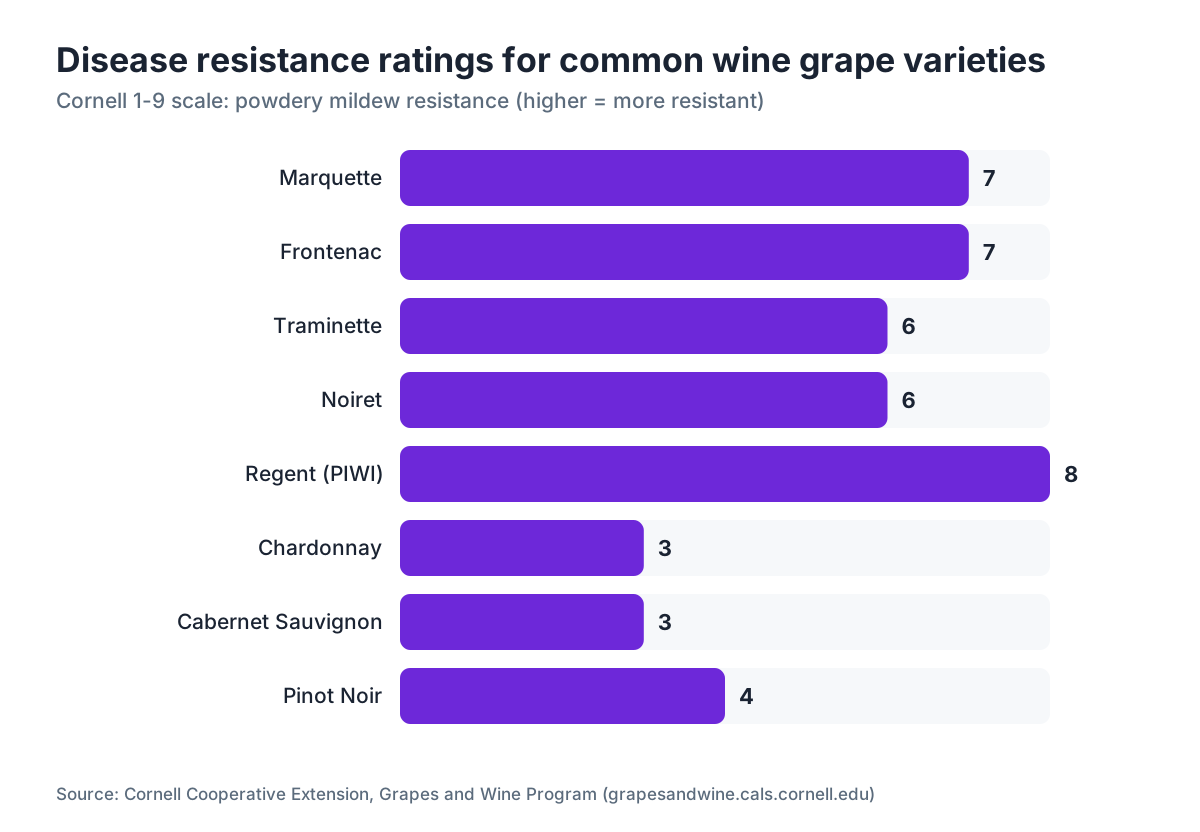
Resistance is not immunity. Even the best-rated varieties can show disease in extreme pressure years, especially if the canopy is dense or rain events are frequent. Cornell extension rates variety resistance on a scale of 1-9 for powdery mildew, downy mildew, and botrytis separately. Marquette scores roughly 7/9 for powdery mildew and 6/9 for downy mildew. Frontenac scores similarly. Vitis vinifera varieties like Cabernet Sauvignon or Chardonnay score 3-4 on the same scale, which is why they almost always need a spray program in humid climates [3].
In dry-climate regions, well-managed vinifera can succeed with minimal or no sprays in average years. UC Davis IPM guidance treats a dormant sulfur application as standard practice even on low-pressure sites for overwintering mite and disease management [4].
Pick varieties that match your site pressure. Planting Chardonnay in a humid region and hoping to go no spray is an expensive lesson.
How does canopy management reduce the need for sprays?
Open canopies dry faster. That's the whole idea. Every hour of leaf wetness you remove from the equation is measurable disease risk reduction. The research backs it: Cornell trials found that shoot positioning and fruit zone leaf removal reduced powdery mildew severity by 50-70% compared to unmanaged canopies [5]. That's without any fungicide.
The practices that move the needle most:
Vertical shoot positioning (VSP) keeps shoots upright and separated, improving air movement and light penetration through the canopy. Fruit zone leaf removal, typically stripping 4-8 leaves on the morning sun side after fruit set, exposes clusters to drying air and UV light. Both powdery and downy mildew are suppressed by UV exposure.
Row orientation matters at planting time. North-south rows maximize midday sun on both sides of the canopy and cut down the shaded, damp microclimate that mildew needs. If you're designing a new block with no spray intent, orient rows north-south if your topography allows it.
Cover crop management under the vines also affects humidity at the cluster zone. Mowing the undervine strip and keeping it dry during key susceptibility windows (from bud break through cluster closure) helps. Some no spray growers skip undervine cover crops entirely in favor of cultivation or mulch to keep the zone dry.
None of this is easy. Leaf removal alone adds 15-25 hours per acre in labor. That's real money. But it's often cheaper than the spray program it partially replaces.
What biological and mechanical tools replace pesticide sprays?
The short list of inputs that actually have research behind them in a low or no spray context:
Kaolin clay (Surround WP) forms a physical particle barrier on leaf and berry surfaces that confuses and deters leafhoppers, grape berry moth, and to a lesser degree mites. It's OMRI-listed and shows up often in organic and no spray programs [10]. It does not control mildew.
Bacillus subtilis (Serenade, Cease) is a naturally occurring bacterium that produces antifungal compounds. University trials show modest suppression of powdery mildew and botrytis, with efficacy generally 40-60% compared to 80-90% for conventional fungicides [4]. Enough for a low-pressure situation, not enough on its own in a wet year.
Potassium bicarbonate (Kaligreen, MilStop) disrupts fungal cell walls on contact and is allowed under NOP [10]. It works best as a protectant applied before infection, not as a rescue treatment. It also breaks down quickly and needs reapplication after rain.
Beneficial insects, including commercially purchased Trichogramma wasps for grape berry moth and predatory mites for spider mite control, reduce the need for insecticide applications. These programs require population monitoring to time releases correctly.
Some growers also run UV light robots for powdery mildew suppression. A 2019 Cornell study found that weekly nighttime UV-C treatments reduced powdery mildew by 80-90% without any fungicide in vineyard trials [5]. The equipment is expensive (roughly $40,000-$80,000 per unit as of 2023), and the practice is still uncommon, but it's the most promising mechanical tool on the horizon for no spray programs in humid regions.
Cover crop diversity matters for beneficial insect habitat. UC Davis research found that vineyards with flowering cover crops had significantly higher populations of natural predators of grape leafhopper [4].
Even with no registered pesticide in the tank, it's smart to document what you apply, when, and why. VitiScribe's field operations tools handle exactly that kind of input and activity logging, including for programs that never spray.
Do you still need to keep records if you don't spray?
Yes. The record-keeping obligation doesn't vanish just because your spray volume is zero.
If you apply any pesticide, even a material like sulfur or copper that's allowed under NOP, California (and most other states) requires a Pesticide Use Report (PUR) filed with the county agricultural commissioner. California Agriculture Code Section 12981 requires this for any licensed pest control operator or farm operator applying pesticides to an agricultural commodity [6]. California's statewide requirement is monthly reporting, and some counties tighten that further.
Even if you apply nothing, EPA's Worker Protection Standard (WPS) requires that you maintain a central posting location with information about pesticide applications in the last 30 days. For a genuinely spray-free operation, that posting may simply show no applications. But you still need the infrastructure in place: the posting location designated, decontamination supplies on hand, and workers trained on WPS basics [7].
For certified organic operations, the NOP requires you to keep records that demonstrate compliance with your organic system plan for at least 5 years. That includes records of all inputs, field activities, and any non-compliant materials that contacted the land [1].
Small vineyards sometimes assume that going no spray means less paperwork. It usually doesn't. What changes is the content of the records, not the obligation to keep them. A simple field activity log, paper or digital, covering what was applied (or not applied), who did the work, and what pest or disease pressure you observed, satisfies most state and federal requirements.
What does a no spray vineyard cost compared to a conventional program?
The economics are not simple. You spend less on materials, sometimes dramatically less. A conventional fungicide and insecticide program for vinifera in a humid region can run $400-$800 per acre per season in materials alone, plus application costs. A no spray program drops that number toward zero.
But labor goes up. Leaf removal, precision canopy work, cover crop management, and pest scouting all add time. A reasonable estimate is 15-30 additional hours per acre per season compared to a conventionally managed block, at whatever your labor rate is. At $20/hour, that's $300-$600 per acre in added labor before you account for any resistance variety premium, trellising changes, or cover crop seed costs.
Yield risk is the bigger financial exposure. In a bad disease year, a no spray vinifera vineyard can lose 30-80% of crop to powdery mildew, botrytis, or downy mildew. That's not hypothetical. Cornell extension documents untreated research plots losing 90%+ of crop in severe downy mildew years in New York [3]. Even with resistant varieties, disease escapes happen.
The honest math for most operations: no spray programs pay off in dry climates, on resistant varieties, and where the marketing premium for 'no spray' or 'pesticide free' fruit justifies the added labor. In humid regions on vinifera, the risk is too high to carry without a financial cushion.
For a vineyard thinking about this transition, the smartest first step is a 1-2 block pilot over three seasons before converting the whole property.
How do you monitor for disease and pests without a regular spray schedule?
Scouting becomes your insurance policy when you drop the preventive spray calendar. Without a spray buffer, you have to catch problems before they cross thresholds.
For powdery mildew, the UC Davis Powdery Mildew Risk Index model, available through the UC IPM program, uses temperature accumulation and vine growth stage to predict infection risk [4]. You input local weather data and get a daily risk rating. At moderate risk, you scout hard. At high risk, you either accept the exposure or apply a low-risk material like potassium bicarbonate.
For grape berry moth in eastern states, Cornell and WSU have degree-day models that predict egg hatch and adult flight timing [2][3]. Deploy pheromone traps and count captures twice weekly for population trend data. The economic threshold for treatment is roughly 3-5 moths per trap per week at first generation in most eastern states, though this varies by region.
For botrytis, the main tools are inspection of cluster architecture at fruit set (checking for tight-clustered varieties that trap moisture) and a look at cluster stems after veraison for early gray mold. There is no reliable predictive model for botrytis that works across all sites. Local weather pattern recognition and past experience on your blocks matter more than any app.
Scouting logs are also your defense if a neighbor or regulator questions a disease outcome. Documented observations showing you monitored and made a considered decision not to spray beat silence every time.
What does a no spray vineyard cost to certify organic?
Organic certification and no spray are different things, but they overlap more than most growers realize.
USDA NOP certification requires a 3-year transition period during which no prohibited substances are applied to the land [1]. If you've already been running a no spray or minimal spray program, and the materials you did apply were NOP-allowed, that transition period may already be partially complete. A certifying agent can audit your pesticide use records to determine your transition start date.
Once certified, you can use only materials on the OMRI (Organic Materials Review Institute) list or those specifically approved in your organic system plan [10]. Copper and sulfur are allowed with some restrictions. Certain synthetic adjuvants and most conventional fungicides and insecticides are prohibited.
Certification costs vary by certifier and operation size. For small vineyards under 50 acres, annual certification fees typically run $400-$1,500 per year through accredited certifiers, plus inspection costs [8]. USDA's Agricultural Marketing Service maintains a searchable list of accredited certifying agents by state.
The market premium for certified organic grapes varies enormously by region and buyer. In California, certified organic wine grape premiums over conventional have ranged from $50-$300 per ton in recent market surveys, though nobody has clean, current data across all varieties and regions. Anecdotally, the premium runs higher for well-known red varieties in established markets.
For growers at properties like Paso Robles wineries or in other regions with strong wine tourism, the story of a no spray or organic program can carry direct-to-consumer value that never shows up in grape price data.
What do WSU, Cornell, and UC Davis extension say about no spray programs?
The three major viticultural extension programs have each published guidance relevant to reduced-spray and no spray programs, and their recommendations are worth reading directly.
WSU's extension covers the Pacific Northwest integrated pest management approach in detail, including disease risk modeling tools, spray timing, and the list of materials most useful for reducing application frequency [2]. Their position is that a zero-spray program is achievable in the Columbia Basin in most years with the right variety selection and canopy management, though they stop short of recommending it broadly.
Cornell's viticulture extension, centered in Geneva, NY, has produced the deepest public-domain research on disease-resistant varieties and low-input viticulture in humid climates [3]. Their work on the GRiS variety series and the NEWA disease forecasting network is directly applicable to no spray planning. NEWA's weather-based disease models are free to use online.
UC Davis extension publishes the UC IPM guidelines for grapes, which include thresholds, reduced-risk materials, and a calendar of disease and pest pressure by growth stage [4]. Their guidelines explicitly include a minimal spray program option for low-pressure sites and dry years.
All three programs share one message: no spray is a site and variety decision before it's a management decision. If the site pressure is too high for the variety, no amount of canopy management closes the gap.
For growers who want tidy records of scouting observations, application decisions, and field notes across all of this, VitiScribe's field log captures exactly that kind of structured activity data, whether or not you're spraying anything.
What are the biggest mistakes growers make when going no spray?
The most common one: going all-in on no spray in year one without a rescue plan. Disease moves fast. Powdery mildew can go from first lesion to shoot-tip coverage in 10-14 days under ideal conditions. If you're philosophically committed to zero applications and you've got nothing in reserve, you'll watch a season's worth of crop deteriorate while you reconsider.
The second mistake is planting resistant varieties and then relaxing all canopy management because 'the variety handles it.' Resistance reduces pressure. It doesn't eliminate it. Dense, poorly ventilated canopies find the limits of any variety's resistance in a wet year.
Third: ignoring soil health. No spray programs generally perform better on sites with good organic matter, balanced nutrition, and active soil biology. Vines under nutritional or water stress are more susceptible to disease. Get a full tissue and soil analysis before transitioning and adjust inputs accordingly. It's not optional.
Fourth: underestimating the scouting labor. Dropping a spray calendar means doubling down on monitoring. Growers who don't build the scouting time into their labor budget catch problems too late.
Fifth: not documenting anything because 'we're not spraying.' Record-keeping obligations don't disappear. And your scouting records are your best evidence of sound decision-making if a crop failure or neighbor complaint ever becomes a legal or insurance issue.
Frequently asked questions
Is a no spray vineyard the same as organic?
No. Certified organic vineyards still apply approved pesticides including copper, sulfur, and potassium bicarbonate. A no spray vineyard eliminates or near-eliminates all pesticide applications. Organic is a USDA certification with legal requirements. 'No spray' is a management approach with no official certification, though a genuinely no spray operation is well on the way to meeting organic land requirements after the 3-year transition period.
Can you grow Cabernet Sauvignon without spraying?
In dry climates like eastern Washington's Columbia Valley or eastern Paso Robles, yes, in average to dry years. In humid regions like New York, Oregon's Willamette Valley, or the Midwest, Cabernet Sauvignon is highly susceptible to both powdery and downy mildew and would suffer severe losses without any fungicide program. The variety scores roughly 3-4 out of 9 on Cornell's disease resistance scale, meaning it needs active disease management most seasons.
What are PIWI varieties and are they worth planting?
PIWI is a German acronym for fungus-resistant wine grape varieties, mostly interspecific hybrids carrying resistance genes from wild Vitis species. Examples include Regent, Souvignier Gris, and Cabernet Blanc. They're widely grown in central Europe's wetter climate precisely because they reduce or eliminate fungicide applications. Wine quality has improved significantly in newer releases. For humid U.S. climates where no spray is the goal, they're worth serious consideration, especially alongside Cornell's own resistant varieties.
What's the 3-year transition period for organic certification?
Under USDA NOP rules, land must be managed without prohibited substances for 36 months before the first crop can be sold as certified organic. If you've been running a no spray or minimal spray program using only NOP-allowed materials, your transition may already be partially complete. A certifying agent reviews your input records to establish the start date. Annual certification fees for small vineyards typically run $400 to $1,500 depending on the certifier.
Do worker protection standard rules apply if you don't spray?
The EPA Worker Protection Standard requires all agricultural employers to maintain a central posting location with pesticide application information for the prior 30 days, provide decontamination supplies, and ensure workers receive WPS training. For a no spray operation, the posting simply shows no recent applications, but the posting location, supplies, and training obligation still apply. EPA's pesticide worker safety guidance covers all requirements for agricultural establishments regardless of application frequency.
How much does a no spray program save on pesticide costs?
Material costs for a conventional vinifera spray program in a humid region run $400-$800 per acre per season. Dropping to no spray eliminates most or all of that. However, additional labor for scouting, precision canopy management, and leaf removal typically adds $300-$600 per acre. The net savings depend on your labor cost, climate, and whether yield losses occur. In dry climates with resistant varieties, the economics favor no spray. In humid regions on vinifera, the yield risk usually outweighs material savings.
Can UV light robots replace fungicide sprays in vineyards?
Possibly, in low to moderate pressure situations. A Cornell University study from 2019 found weekly nighttime UV-C robot treatments reduced powdery mildew severity by 80-90% in research vineyard trials, comparable to fungicide programs. Current equipment costs roughly $40,000-$80,000 per unit. The technology is promising but not yet widely adopted commercially. It's most practical for high-value blocks where the equipment cost can be spread across multiple seasons.
What scouting tools are available for disease prediction without spraying?
UC Davis's UC IPM Powdery Mildew Risk Index uses temperature accumulation and vine growth stage to produce daily infection risk ratings, free online. Cornell's NEWA (Network for Environment and Weather Applications) provides weather-based disease models for powdery mildew, downy mildew, and botrytis, also free. WSU extension publishes degree-day models for grape berry moth. These tools let you make informed, threshold-based decisions rather than running a calendar spray program.
Do you still need to file pesticide use reports if you don't spray?
If you apply zero pesticides, you have nothing to report. But if you apply any material with a pesticide registration, even sulfur or copper that's OMRI-listed, most states require a Pesticide Use Report filed with the county agricultural commissioner. California's Agriculture Code Section 12981 covers this requirement. The obligation is triggered by any registered pesticide application, not by the type of material used.
What cover crops work best in a no spray vineyard?
Flowering cover crops that support beneficial insects are widely recommended in low-input programs. UC Davis research found vineyards with flowering understory had significantly higher populations of natural predators of grape leafhopper. Good options include buckwheat, phacelia, and low-growing clovers between rows. Under the vine, keeping the strip dry during key susceptibility windows matters more than species selection. Avoid cover crops that significantly raise humidity in the cluster zone during wet periods.
How do I know if my site is suitable for a no spray approach?
Look at three things: average summer relative humidity (below 50% makes no spray much more feasible), your variety list's disease resistance rating (Cornell's 1-9 scale is the best public reference), and your historic pest pressure records. Growers who've kept detailed spray logs over several seasons can review which applications were genuinely necessary versus calendar-driven. A 3-season pilot on 1-2 blocks, with intensive scouting, gives you real site-specific data before committing the whole property.
What's the realistic disease risk of going no spray in a wet year?
High, on susceptible varieties in humid regions. Cornell extension documents research plot losses of 90%+ to downy mildew in severe years in New York. Even with resistant varieties, a wet June and July can push disease past the resistance threshold. The practical answer is that a no spray program needs an emergency plan: either a single rescue application of a low-risk fungicide held in reserve, or the willingness to absorb significant crop loss in a bad year.
Can you sell grapes or wine as 'pesticide free' without organic certification?
You can market fruit or wine as 'pesticide free' or 'no spray' as a factual claim if it's accurate, but without third-party certification you bear the burden of proof if the claim is challenged. The FTC's Green Guides require environmental claims to be truthful and substantiated. Some regional certification programs (like Salmon Safe or Lodi Rules in California) provide third-party verification of reduced-input practices that may be easier to obtain than full NOP organic certification for genuinely no spray operations.
Sources
- USDA Agricultural Marketing Service, National Organic Program: NOP requires 36-month transition period, allows copper and sulfur fungicides, and mandates 5-year record retention for organic operations.
- Washington State University Extension: WSU extension documents powdery mildew infection conditions (50-90°F, RH above 40%) and disease risk modeling for Pacific Northwest vineyards.
- Cornell Cooperative Extension, Grapes and Wine Program: Cornell documents variety disease resistance ratings on a 1-9 scale, NEWA disease forecasting models, and case histories of severe downy mildew losses in untreated New York research plots.
- UC Statewide Integrated Pest Management Program, Grapes: UC IPM publishes powdery mildew risk index models, minimal spray program options for low-pressure sites, dormant sulfur guidance, and cover crop research showing higher beneficial insect populations in flowering understory vineyards.
- Cornell AgriTech, UV-C light and canopy management powdery mildew research: Cornell research found weekly nighttime UV-C robot treatments reduced powdery mildew severity by 80-90% in vineyard trials, and that shoot positioning plus fruit zone leaf removal reduced powdery mildew severity by 50-70% compared to unmanaged canopies.
- California Department of Pesticide Regulation, Pesticide Use Reporting: California Agriculture Code Section 12981 requires pesticide use reports filed with county agricultural commissioners for any registered pesticide applied to agricultural commodities.
- US EPA, Agricultural Worker Protection Standard: EPA's WPS requires agricultural employers to maintain central posting locations with 30-day application records, provide decontamination supplies, and ensure worker training regardless of application frequency.
- USDA Agricultural Marketing Service, Organic Certification: USDA AMS maintains a list of accredited organic certifying agents; small vineyard annual certification fees typically range $400-$1,500.
- Oregon State University Extension Service: OSU extension documents high disease pressure conditions in Oregon's Willamette Valley, with botrytis as a near-constant management challenge.
- Organic Materials Review Institute (OMRI): Kaolin clay, Bacillus subtilis, and potassium bicarbonate are OMRI-listed materials allowed under NOP for pest and disease management in organic vineyards.
- US Federal Trade Commission, Environmental Marketing (Green Guides): FTC Green Guides require that environmental claims including 'pesticide free' be truthful, not misleading, and substantiated with competent evidence.
Last updated 2026-07-10