Nursery source documentation requirements for new vineyard planting material
TL;DR
- Every state that sells certified grapevine planting material requires a nursery license, a phytosanitary certificate or state nursery stock certificate, and virus-testing documentation tied to a recognized program such as USDA NVSS or California's CDFA Grapevine Registration and Certification program.
- Keep those records at least three years.
- In many states, the law requires it.
- Symptoms of leafroll can take five years to show, so your paperwork is your only proof of origin.
Why does nursery source documentation matter for a new vineyard?
You're more than buying a plant. You're buying a perennial that sits in your soil for thirty or forty years, and if it arrives carrying leafroll virus, fanleaf, or Xiphinema index nematodes, no sprayer fixes that. Disease gets in at planting. That's it.
State departments of agriculture and the USDA treat grapevine planting material as regulated nursery stock. Documentation isn't optional paperwork. It's a condition of legal sale and transport across state lines. A nursery that ships vines to you without the right certificates is operating outside federal and state law, and you, as the receiver, may be liable for accepting regulated material without proper inspection records.
The documentation chain also protects you if a disease shows up years later. Buy certified, tested material from a licensed nursery with a phytosanitary certificate on file, and you have a defense. Skip it, and you're exposed to quarantine orders, replanting costs, and in some states, fines.
Small growers skip this because the vines look healthy on arrival. Wrong test. Grapevine leafroll-associated virus 3 (GLRaV-3) is symptomless in the nursery [1]. You won't see the damage for two to five growing seasons.
What federal rules govern grapevine planting material documentation?
The USDA Animal and Plant Health Inspection Service (APHIS) controls interstate movement of nursery stock under the Plant Protection Act (7 U.S.C. § 7701 et seq.) [2]. APHIS does not certify grapevines directly, but it administers the National Voluntary Scion and Rootstock Certification Program (USDA NVSS), which sets the technical standards state programs must meet to be recognized across state lines.
The NVSS program requires foundation-level vines to be tested and found free of a defined list of pathogens before propagation material moves down the certification tiers. The pest list includes Grapevine fanleaf virus, Grapevine leafroll-associated viruses 1, 2, and 3, Grapevine virus A and B, and several others [3]. States that run their own programs, like California, Washington, and Oregon, must align with NVSS standards for their certificates to be recognized elsewhere.
Importing from outside the United States is a different animal. APHIS requires a phytosanitary certificate issued by the national plant protection organization (NPPO) of the exporting country, plus compliance with the relevant APHIS import permit conditions. Grapevine budwood and cuttings from most foreign sources have to enter through a USDA-approved post-entry quarantine facility. Importing your own scion material to dodge documentation is not a workaround the agency overlooks.
Buying domestic material that crosses a state line? The shipment must travel with a state nursery certificate or phytosanitary certificate from the origin state. That document rides with the vines. Keep a copy.
What documents should you actually receive from a certified nursery?
A compliant nursery shipment comes with three or four documents. Check every one before the truck leaves your driveway.
First, a nursery stock certificate or phytosanitary certificate from the origin state's department of agriculture. This is the state-level inspection record showing the material was grown under an approved program and inspected before shipment. California calls this the Nursery Stock Certificate; Washington State issues a State Phytosanitary Certificate. The certificate lists the variety, rootstock, quantity, origin block, and the inspection date [4].
Second, a certification tag or label on the plant or bundle. In California's CDFA Grapevine Registration and Certification (R&C) program, each vine or bundle of cuttings carries a tag showing the registered variety name, the certification status (Registered, Certified, or Foundation), and the nursery license number [5]. A tag with no certification status means non-certified material, which may still be legal to sell but carries none of the virus-testing guarantees.
Third, virus test results. Most serious nurseries provide, or at least reference, the ELISA or PCR test reports behind the certification status of the mother block. Ask for these. A reputable nursery won't refuse. If they do refuse, that tells you something.
Fourth, the nursery's license number. Every state requires nurseries to hold a valid license to sell plant material, and most require that number to appear on invoices and shipping documents. Verify the license is current with your state's department of agriculture. Don't take the nursery's word for it.
| Document | Who issues it | What it proves |
|---|---|---|
| State nursery certificate / phytosanitary certificate | Origin state Dept. of Ag. | Legal inspection, species, quantity |
| Certification tag (R&C, NVSS tier label) | State program / nursery | Virus-tested status, variety identity |
| Virus test report (ELISA/PCR) | Accredited diagnostic lab | Pathogen-free status of mother block |
| Nursery license number | State Dept. of Ag. | Nursery is legally permitted to sell |
| Invoice with variety, rootstock, quantity | Nursery | Traceability record for your files |
How do state certification programs differ, and which one covers your vineyard?
California, Washington, Oregon, and New York run the most developed state certification programs for grapevines. Each has its own tiers, paperwork, and fees.
California's CDFA Grapevine Registration and Certification Program is the oldest and most widely referenced in the West. It uses three tiers: Foundation (the cleanest, nuclear-stock material at UC Davis's Foundation Plant Services), Registered (first propagation from Foundation), and Certified (commercial nursery stock propagated from Registered). UC Davis Foundation Plant Services (FPS) maintains the foundation blocks and publishes available varieties online [6].
Washington State University Extension describes a similar structure for the Pacific Northwest, where most commercial nurseries source from either Washington Department of Agriculture-certified blocks or California Foundation material [7]. Washington-originating material should include the Washington State Phytosanitary Certificate and reference to the certified source block.
New York's program runs through the New York State Department of Agriculture and Markets and Cornell Cooperative Extension. Cornell guidance notes that New York buyers should specifically request documentation of foundation source when purchasing from out-of-state nurseries, because New York's quarantine on certain pests means undocumented material can be stopped at the border [8].
No formal program in your state? The practical standard is still to buy from nurseries that source from NVSS-recognized programs in California, Washington, or Oregon, and to request the phytosanitary certificate and any available virus testing records. Buying cheap untagged vines off a local classified ad is how vineyards get leafroll into ground that's been clean for decades.
What records do you need to keep, and for how long?
Federal law doesn't set a single record retention period for nursery purchase documentation the way pesticide application records are spelled out under the Worker Protection Standard [9]. Several state regulations and certification program rules do specify retention requirements, and the practical industry standard is a minimum of three years, with many advisors saying keep records for the life of the block.
California's regulations for certified nursery stock require nurseries to keep records of sales and certification tags for three years, and buyers who are themselves licensed growers under the program carry the same three-year requirement [5]. Washington State's commercial nursery regulations reference a three-year retention period for shipping and inspection records too.
For your own protection, keep longer. A GLRaV-3 infection may not show obvious symptoms until five or six years after planting. If you need to file a complaint, make an insurance claim, or apply for a USDA emergency loan tied to a disease loss, documentation from planting time is the only way to prove the material's origin. Scan and back up everything digitally.
The minimum file for each block planting: the nursery invoice, the phytosanitary or nursery stock certificate, copies of any certification tags (photograph them on arrival), and whatever virus testing documentation the nursery provided. Date-stamp everything with the receipt date. If you use a field operations platform like VitiScribe to manage block records, attach the scanned documents to the block record so they're linked to GPS coordinates and variety data from day one.
What to keep, at minimum:
- Invoice (variety, rootstock, quantity, price, nursery name and license number)
- State phytosanitary or nursery stock certificate
- Certification tag photos or copies
- Virus test report reference or copy
- Any correspondence with the nursery about source block identity
What are the risks of buying uncertified or undocumented planting material?
Short answer: significant.
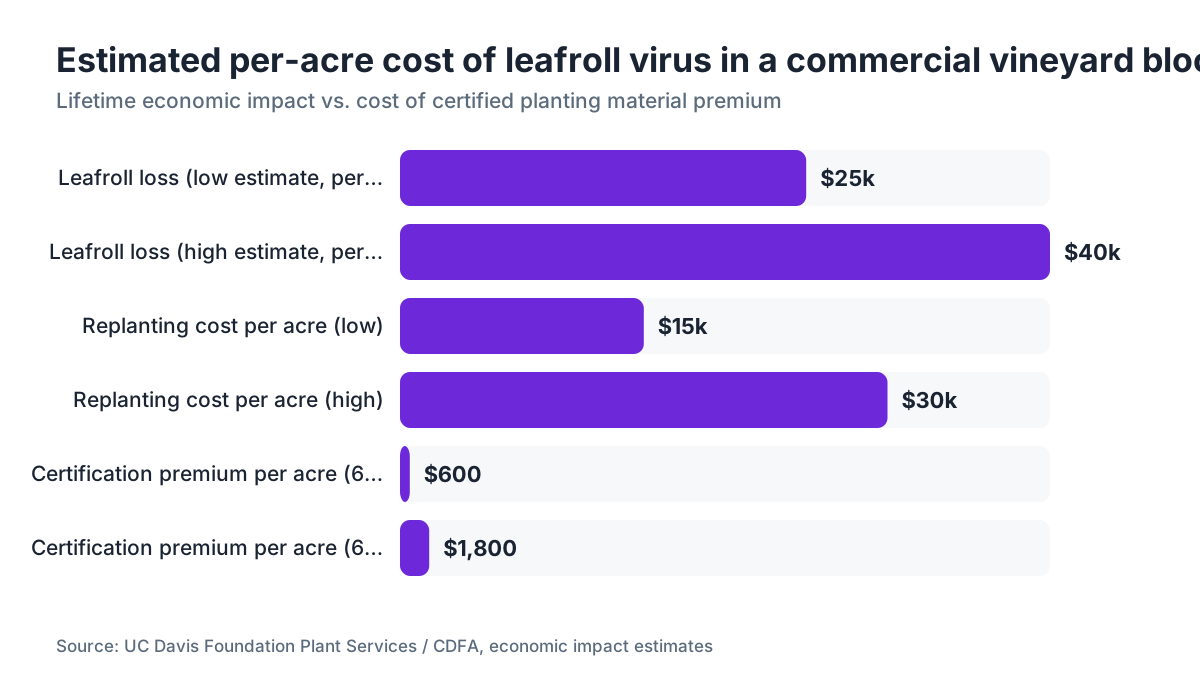
The economic case is well documented. A UC Davis study estimated leafroll virus-associated production losses in Napa Valley at roughly $25,000 to $40,000 per acre in lost fruit quality and yield over the life of an infected block, with the authors noting the range depends heavily on variety and management intensity [1]. Replanting a block costs $15,000 to $30,000 per acre before the vine even produces a crop, and you lose three to five years of production on top of that.
Beyond the money, buying undocumented material can expose you to state quarantine enforcement. California has the authority under the Food and Agricultural Code to order destruction of plants moved into the state without proper certification, and to assess costs against the receiver if the receiver knew or should have known the material was non-compliant. Washington and Oregon have similar authority.
Then there's the neighbor problem. Leafroll and fanleaf spread. Mealybugs vector leafroll viruses across property lines. Nematodes persist in soil indefinitely. Introduce a pathogen into your vineyard and it won't stay there.
The certification premium at a reputable nursery is real, typically $1 to $3 per vine more than uncertified stock, depending on variety and rootstock. On a five-acre planting at 600 vines per acre, that's $3,000 to $9,000 more upfront. That's not nothing. But set against a potential six-figure lifetime loss per acre from leafroll, the math isn't complicated.
How do you verify a nursery's license and certification status before you buy?
Every major grapevine-producing state publishes a searchable database of licensed nurseries. Verify California nursery licenses through CDFA's nursery program. Washington nurseries are listed through the Washington State Department of Agriculture's Nursery and Floral program. Oregon uses the ODA Nursery program. These are public, free, and updated regularly [4].
For certification program participation, call or email the state program office directly. In California, that's CDFA's Plant Health and Pest Prevention Services division. Ask whether a specific nursery is currently enrolled in the R&C program and whether the source block for the variety you want is listed in good standing. This call takes ten minutes and can save you years of heartache.
Check Foundation Plant Services' availability list directly. FPS publishes the current catalog of available foundation varieties and their certification status at fpms.ucdavis.edu [6]. If a nursery says they're propagating from Foundation material but the variety isn't listed at FPS, ask for clarification in writing.
For out-of-state purchases, ask the nursery to send you a sample copy of the phytosanitary certificate format they'll use before you commit. Compare it against your state's requirements for incoming material. Some states have specific fields or endorsements that must appear on the certificate, and a certificate missing one field can get a shipment held at the border.
One thing that surprises people: you can also check APHIS enforcement records for pest interceptions and actions against nurseries. It's not a full consumer-protection tool, but if a nursery shows up in enforcement records, that's a flag.
What happens during a state inspection, and what documentation do inspectors look for?
State agricultural inspectors can visit your property if they're investigating a disease report, a complaint, or running a routine survey. The first thing they ask for is documentation of your planting material's origin.
A well-prepared grower can produce, within a few minutes, the nursery invoice, the phytosanitary certificate from the shipment, and the nursery's license number. If the inspector is chasing a specific pest or disease, they may ask for the virus testing records tied to the mother block. They may also compare the varieties on your invoice to what's actually planted in the field, which is one more reason to photograph tags at planting and record block locations precisely.
Inspectors generally aren't looking to fine cooperative growers who bought in good faith and kept records. They're looking for uncontrolled pathways: growers who bought anonymous cuttings, imported budwood illegally, or propagated their own material without authorization. If your documentation is in order, an inspection is usually a short conversation.
The harder situation is a gap in the chain. If you bought vines from a licensed nursery that sourced from an unlicensed propagator, your phytosanitary certificate may be technically valid while the underlying virus testing never happened. In that case, the inspector may request laboratory testing of your existing vines, and depending on results, a quarantine order could follow.
For a new planting, the safest posture is to request the full documentation chain from nursery to foundation source, in writing, before you sign a purchase order.
Do documentation requirements differ for rootstock cuttings versus grafted vines?
Yes, and the distinction matters in practice.
Rootstock cuttings (own-rooted or bench-grafted) sourced separately from scion are regulated nursery stock in every state with a certification program. They need the same documentation as finished grafted vines: nursery license, phytosanitary certificate, and ideally virus test records. Rootstocks carry viruses too, including grapevine fleck virus and rupestris stem pitting-associated virus, both tested in NVSS-compliant programs [3].
Some growers assume that because they're buying dormant hardwood cuttings rather than finished plants, the rules loosen up. They don't. APHIS and state regulations attach to the material, not the form factor.
Field budwood programs, where a nursery or research station supplies certified budwood for on-farm grafting or budding, have their own documentation. In California, distribution of certified budwood from FPS-registered blocks is tracked through CDFA, and the receiving grower should retain records of the budwood lot number, source block registration number, and date of receipt.
Self-collected cuttings from your own certified vines? Most states allow on-farm propagation for your own use without a nursery license, but you need to document that the source vines came from certified material and haven't tested positive for any regulated pathogen since planting. Sell or give away cuttings, even informally, and you cross into nursery operator territory in most states, and the licensing requirements apply.
For vineyards in the Paso Robles region or other California AVAs where phylloxera pressure is high, rootstock documentation is worth auditing carefully before any new block goes in.
How do worker protection standard rules intersect with nursery documentation?
The EPA Worker Protection Standard (WPS), codified at 40 C.F.R. Part 170, doesn't directly govern nursery documentation for planting material [9]. But it matters for how you handle incoming plant material and the workers who touch it.
Nursery plants can arrive treated with systemic pesticides, including neonicotinoids used for aphid and mealybug suppression during propagation. Under the WPS, workers handling treated plants must be informed of pesticide residues on contact surfaces, provided with appropriate personal protective equipment, and kept out of treated areas during restricted-entry intervals. If your nursery treated vines before shipment, the shipping documentation should include pesticide application records or at least a statement of what was applied and when.
Ask your nursery straight out: were these vines treated with any pesticide within the 30 days before shipment? What was applied, at what rate, and when? Request the label for any products used. This protects your workers and puts you in WPS compliance from the moment the vines arrive.
WSU Extension's WPS training materials note that treated nursery stock is a category where grower awareness is consistently low, and where violations sometimes turn up during WPS compliance inspections [7]. The nursery is responsible for disclosure. You're responsible for passing that information to your workers.
Keep the pesticide disclosure from the nursery in the same file as the phytosanitary certificate and certification documentation. It's all part of the same incoming-material record.
What's a practical documentation system for a small or new vineyard operation?
You don't need elaborate software to do this right, though a consistent system matters more than most growers realize at planting time, when everything is chaotic.
At a minimum, set up a paper or digital folder for each block, labeled by block ID, variety, and rootstock. Into that folder goes every document tied to that planting: the purchase order, the nursery invoice, the phytosanitary certificate, photos of the certification tags as they arrived, any virus test documentation, and the pesticide disclosure from the nursery.
Date-stamp when you received each document. Note the plant count, any discrepancies between what you ordered and what arrived, and any visible plant health concerns at arrival. If anything shows up without proper documentation, stop the planting and call your state department of agriculture before vines go in the ground. Sorting out documentation before planting beats sorting it out after, every time.
For growers managing multiple blocks or adding new varieties regularly, a field operations platform like VitiScribe can attach scanned documents directly to georeferenced block records, so your phytosanitary certificate and planting records are searchable by block, variety, or nursery name years later when you need them.
Cornell Cooperative Extension recommends New York growers adopt a block-by-block documentation habit from the first year, noting that documentation gaps at planting are consistently the largest obstacle when growers need to file disease-related claims or join state survey programs [8].
One habit that pays off: photograph the certification tags still attached to the vines in the box, before anyone removes them. That timestamped photo is admissible evidence of what you received and when.
What questions should you ask a nursery before placing a planting order?
Most nurseries handle these questions without trouble if they're operating properly. If a nursery gets evasive on any of them, that's your answer.
Before you commit, ask:
- What is your nursery license number, and in which state is it issued? Can I verify it online?
- What certification tier is this material (Foundation, Registered, Certified, or non-certified)? If certified, under which program (CDFA R&C, NVSS, WSU, etc.)?
- What is the source block registration or lot number, and can you provide the associated virus test report or reference the testing lab and date?
- Will the shipment include a state phytosanitary certificate or nursery stock certificate? Which state will issue it, and will it accompany the shipment?
- Have these vines been treated with any pesticide? If so, what product, at what rate, and on what date?
- What are your variety verification practices? How do you confirm that what's labeled in the block matches what's in the box?
A good nursery answers questions 1 through 4 without hesitation and provides documentation in writing. Question 5 sometimes gets vague answers; push for specifics. Question 6 is worth asking even if the answer is informal, because mislabeled varieties are more common than the industry likes to admit, and your first sign of a problem is often three years post-planting when the fruit doesn't match the variety description.
For buyers in the Gervasi Vineyard region of Ohio or other eastern states without large certified nursery industries, ordering from California or Washington certified sources with full documentation is standard practice and generally accepted by state inspectors.
Frequently asked questions
Is a phytosanitary certificate the same as a nursery stock certificate?
Not exactly. Both are state-issued documents confirming that nursery stock has been inspected and meets movement requirements, but the terminology differs by state. California calls it a Nursery Stock Certificate; Washington calls it a State Phytosanitary Certificate. Functionally they do the same job: proof of inspection before interstate or intrastate shipment. Always ask which document your origin state issues and confirm it will accompany the shipment.
Can I propagate my own grapevine cuttings from certified vines without a nursery license?
In most states, yes, for your own use only. Propagating from your own certified blocks for replanting within your own operation generally doesn't require a nursery license. The moment you sell, trade, or give away cuttings to another grower, you cross into regulated nursery activity in most states. Check your state department of agriculture's nursery license exemptions. California's Food and Agricultural Code Section 6761 outlines the exemptions; other states have similar provisions.
What viruses are covered under the USDA NVSS certification program?
The USDA National Voluntary Scion and Rootstock Certification Program requires testing for Grapevine fanleaf virus, Grapevine leafroll-associated viruses 1, 2, and 3, Grapevine virus A, Grapevine virus B, Grapevine rupestris stem pitting-associated virus, and grapevine fleck virus, among others. APHIS updates the exact list periodically. Foundation Plant Services at UC Davis maintains current testing protocols aligned with the NVSS pest list.
How long should I keep nursery purchase documentation?
Keep it for the life of the block, or at least ten years. California regulations require three years for nursery operators; buyer requirements vary by state. But disease symptoms can appear five or more years after planting, insurance claims may arise years after purchase, and state survey programs may ask for planting origin records long after the nursery paperwork has faded from memory. Scan and back up digitally from day one.
What happens if my vines arrive without a phytosanitary certificate?
Stop planting and contact your state department of agriculture. In California and Washington, receiving regulated nursery stock without a certificate is a violation, and planting before resolving it can weaken your legal position if a disease problem arises. The nursery may be able to issue a retroactive or replacement certificate, but that process requires state involvement. Don't assume the paperwork will arrive later; confirm before the truck leaves.
Does the certification tier (Foundation vs. Registered vs. Certified) affect what documentation I receive?
Yes. Foundation material typically comes with the most rigorous documentation, including lab test reports tied to specific accession numbers at Foundation Plant Services. Registered material references the Foundation source but may not include the original lab reports. Certified commercial material typically includes the phytosanitary certificate and certification tag but may only reference the Registered block. Request the full chain documentation regardless of tier.
Are there documentation requirements specific to phylloxera-resistant rootstocks?
Rootstock cuttings require the same documentation as scion material under NVSS and state certification programs, including virus testing for rootstock-specific pathogens like grapevine rupestris stem pitting-associated virus. In California AVAs with confirmed phylloxera strains, growers have extra pressure to document rootstock variety identity, since mislabeled rootstocks have historically contributed to replanting losses. Request rootstock variety verification documentation from your nursery in writing.
What does UC Davis Foundation Plant Services actually provide, and how do I access it?
UC Davis Foundation Plant Services maintains the cleanest, most extensively tested foundation grapevine collection in the United States. Nurseries and researchers can order foundation budwood from FPS for propagation under a license agreement. Retail growers don't typically order directly from FPS; they buy from certified nurseries that propagate from FPS material. FPS publishes its available variety catalog at fpms.ucdavis.edu, which you can use to verify whether a variety a nursery claims to source from Foundation actually exists there.
Can I import grapevine cuttings from another country for my own vineyard?
Yes, but the requirements are strict. APHIS requires an import permit, a phytosanitary certificate from the exporting country's national plant protection organization, and compliance with post-entry quarantine requirements. Most imported grapevine material must spend time in a USDA-approved quarantine facility before it can be propagated or planted. The process typically takes one to three years. Attempting to import material without permits is a federal violation under the Plant Protection Act.
What's the difference between registered and certified grapevine planting material?
In California's CDFA R&C program, Registered material is the first generation propagated from Foundation blocks. It has tighter virus testing requirements and lower plant-per-block density limits than Certified material. Certified is the next tier, propagated from Registered, and it's what most commercial nurseries sell to growers. Certified material has been tested, but it's one step further from the original foundation source. Both require documentation; Foundation material requires the most rigorous.
Do documentation requirements apply to container vines bought at a local garden center?
Technically yes, if the garden center is selling regulated nursery stock. In practice, most garden centers carry only common table grape varieties, and their documentation is often minimal. For wine or commercial grape production, buying from a garden center is generally a bad idea regardless of documentation, because the certification status of that material is almost never traceable to a virus-tested foundation source. Use a licensed specialty viticulture nursery.
What should I do if I discover a virus in a block planted with certified material?
Document the symptoms photographically and request diagnostic testing from an accredited plant pathology lab. If the diagnosis confirms a regulated virus, notify your state department of agriculture and contact the nursery in writing with your documentation on file. Certified material isn't guaranteed 100% disease-free, but certification substantially reduces risk, and if a breach of certification standards caused the infection, you may have grounds for a claim. Your records from planting time are your primary evidence.
Are there Cornell or WSU extension publications I can use as reference guides?
Yes. Cornell Cooperative Extension has published guidance on grapevine disease management and planting material selection for New York growers, available through the Cornell Viticulture and Enology program website. WSU Extension publishes Pacific Northwest pest management handbooks and viticulture guides that address planting material documentation for Washington and Oregon growers. Both institutions update their materials regularly and are freely accessible online.
Sources
- UC Davis Foundation Plant Services, Grapevine Leafroll Disease economic impact research: Leafroll virus-associated production losses in Napa Valley estimated at approximately $25,000 to $40,000 per acre; virus is symptomless in nursery stock.
- California Department of Food and Agriculture, Plant Health and Pest Prevention Services: CDFA issues Nursery Stock Certificates for compliant grapevine shipments and maintains a searchable nursery license database.
- California Department of Food and Agriculture, Grapevine Registration and Certification Program: CDFA R&C program requires certification tags with variety name, certification tier, and nursery license number; records must be retained three years.
- UC Davis Foundation Plant Services, Grapevine Catalog: FPS maintains the foundation grapevine collection and publishes current available varieties and certification status.
- Washington State University, Viticulture and Enology Program: WSU Extension describes the Pacific Northwest certification program structure and notes that WPS compliance inspections frequently find low grower awareness of treated nursery stock disclosure requirements.
- Cornell University, College of Agriculture and Life Sciences, Viticulture and Enology Program: Cornell guidance recommends block-by-block documentation from first year; documentation gaps at planting are the largest obstacle for disease-related claims and state survey programs.
- U.S. EPA, Agricultural Worker Protection Standard (40 C.F.R. Part 170): WPS requires workers handling pesticide-treated nursery stock to be informed of residues and provided appropriate PPE.
- Washington State Department of Agriculture, Plant Services: WSDA issues State Phytosanitary Certificates for compliant nursery shipments and maintains a nursery license database.
- Oregon Department of Agriculture, Nursery Program: ODA regulates nursery licensing and phytosanitary certification for grapevine planting material in Oregon.
Last updated 2026-07-10