Only cluster shoots from buds: grapevine diseases that cause this symptom
TL;DR
- When a grapevine bud pushes only a cluster spout (a flower cluster with no leaf shoot), the usual suspects are Phomopsis viticola (dead arm), Botrytis infecting the primary bud, or winter freeze that kills the shoot meristem while sparing the floral tissue.
- Sorting them out takes timing, block history, and often a lab section of the affected canes.
What does it mean when a bud pushes only a cluster and no shoot?
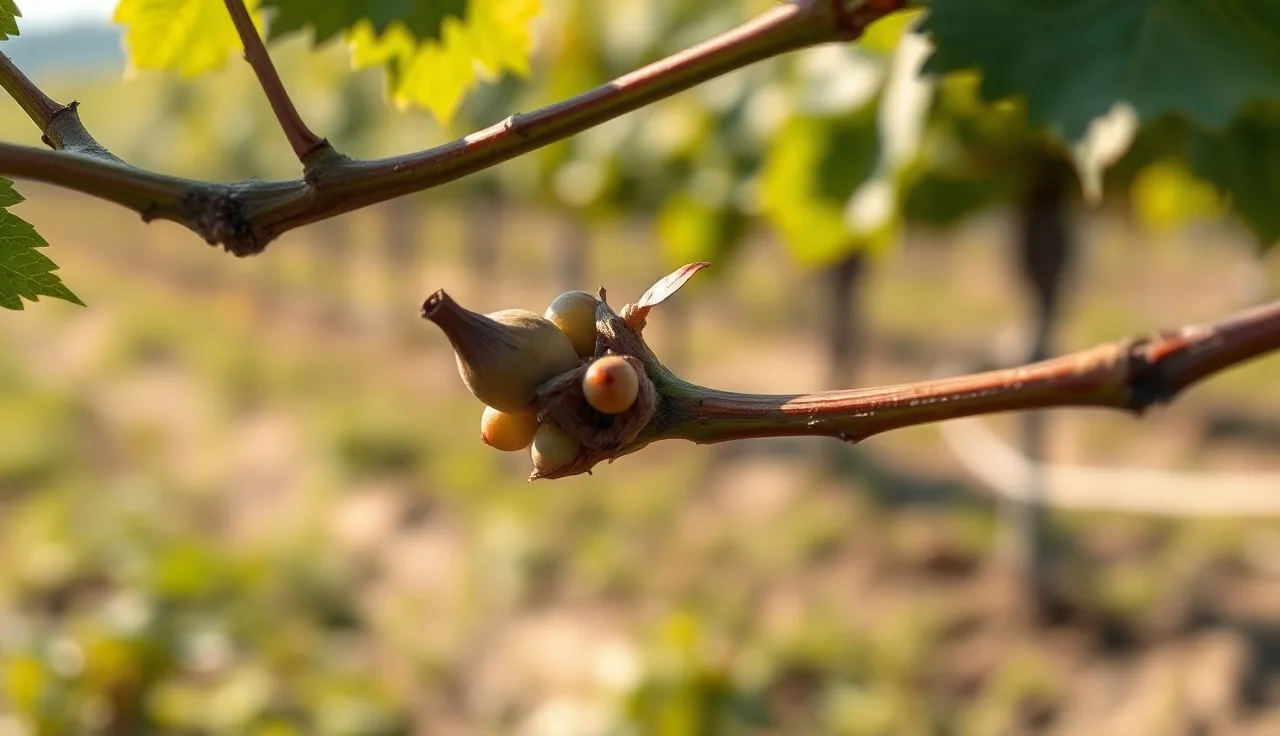
A healthy bud break gives you a small leafy shoot first, with a flower cluster tucked in above the second or third node. What you're looking at instead is a cluster spout: a flower cluster that comes out with no real leaf growth attached. The shoot meristem is dead or so damaged it can't run leaves, but enough floral primordia lived to push out the reproductive tissue before the whole thing collapses.
Read this as a clue, not a bill. Floral primordia in a grapevine bud are tougher than the vegetative growing tip. They handle cold better and shrug off a bit more disease pressure. So when only the cluster shows, something killed or stunted the shoot apex while leaving the reproductive tissue next door alive, or mostly alive.
Three things cause it. Fungal pathogens that colonize the bud or the base of the primary shoot. Freeze injury to the primary bud's vegetative tissue. And viral diseases that warp early shoot development. Each one leaves a fingerprint if you know where to look.
Which diseases most commonly cause only cluster shoots from buds?
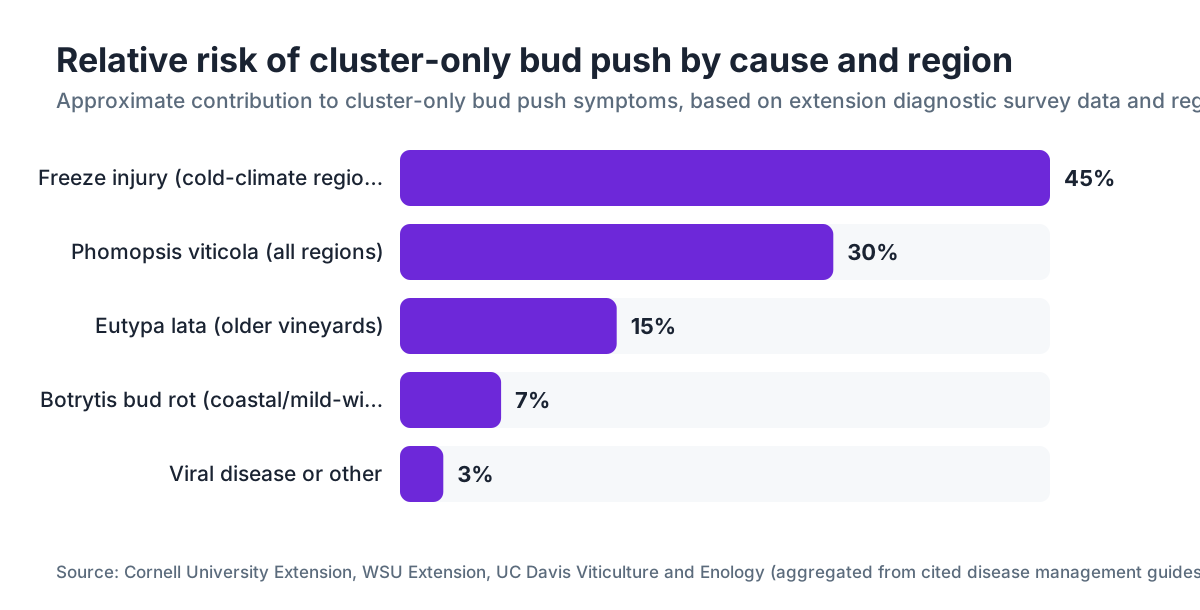
Phomopsis viticola is the pathogen you check first. It causes what old-timers call dead arm, and it's the most frequently cited cause of cluster-only push in the eastern U.S. and Pacific Northwest. The fungus overwinters in infected canes and in pycnidia (small black fruiting bodies) that release spores during wet spring weather. Those spores infect young green tissue, and heavy cane infection can kill the basal internodes right at or just above the bud. Kill the primary shoot meristem early enough and the bud may still push a cluster spout before dying back. Cornell's extension viticulture program describes this as one of the pathogen's 'less recognized' symptoms, separate from the more obvious bleaching of basal internodes [1].
Botrytis cinerea is the second big fungal cause. Botrytis isn't only a ripe-berry problem. It infects dormant buds during mild, wet winters, especially in humid regions or blocks where dense, poorly dried wood held moisture. The primary bud dies. If the secondary bud also takes a hit, you get only the floral remnant pushing from the tertiary bud, which has almost no vegetative capacity.
Powdery mildew (Erysiphe necator) can infect inflorescences and young shoot tissue at bud swell, but it rarely produces the cluster-only symptom by itself. It usually gives you stunted shoots with distorted leaves alongside the cluster, not a clean separation.
Eutypa dieback (Eutypa lata) belongs on the list because it produces a symptom called stunted shoot syndrome, where infected cordons push weak, distorted shoots with small leaves and a visible cluster but almost no internode elongation. It looks like cluster-only push, but the shoot is technically there, just tiny [2]. If you see 1 to 2 cm of shoot growth with a healthy-looking cluster on one side of a cordon and dead wood on the other, Eutypa is high on the list.
Grapevine fan leaf virus (GFLV) and grapevine leafroll-associated viruses can cause abnormal bud development and distorted early shoot growth. Fan leaf in particular throws a double flower or malformed cluster. But viruses rarely give you the clean cluster spout without other vine-wide signs, so they rank low for a block that was clean last season.
How does winter freeze injury produce cluster-only bud push?
Freeze injury is probably the single most common cause in cold-climate regions, and it's the one growers miss because they write it off as a bad winter. A compound grapevine bud holds a primary shoot meristem and, separately, a cluster primordium. Those two structures have different cold hardiness. Work from Cornell and WSU has documented that floral primordia survive a few degrees colder than the vegetative apex in some varieties [3].
When temperatures drop hard and fast, especially after a warm spell that pulled cold hardiness back down, the vegetative growing point dies while the cluster primordium hangs on. At bud break, the bud pushes a cluster with vestigial leaf growth or none. You'll see this pattern spread across a whole block after a documented freeze, and it runs worse on early-pushing varieties, on south-facing slopes where vines de-hardened sooner, and on young vines short on carbohydrate reserves.
Here's a fast triage. Before bud break, cross-section ten dormant buds from the affected block with a razor blade. Live tissue is green or off-white and firm. Dead tissue is brown or black and soft. If the primary bud center is brown but the outer tissue is green, you're looking at freeze kill of the meristem with surviving floral tissue, which pushes exactly as described.
Don't bank on those clusters. Winter-injured clusters set poorly or shatter before harvest because the cluster started stressed. They're rarely worth counting toward yield.
How do you tell Phomopsis from freeze injury in the vineyard?
This is the question that decides your April and May. Here's a working field key.
| Feature | Phomopsis (dead arm) | Freeze injury |
|---|---|---|
| Pattern in block | Spreads from cane ends inward; worse near trellis wires and in low spots | Often uniform across a block or variety; worse where cold air pools |
| Cane symptoms | Bleached, cracked basal internodes; visible black pycnidia | Canes look normal outside; brown when cross-sectioned |
| Cluster appearance | Cluster spout, then shoot dies back at base; dark lesion at base | Cluster spout with no basal lesion; clean bud scar |
| Secondary buds | May also be infected, no reliable backup | Usually alive; push normal shoots |
| History | Wet springs; prior bleached cane symptoms | Documented freeze; warm spell before the cold snap |
| Lab confirmation | Culture from infected wood yields Phomopsis spores | Not applicable; send to extension lab only if the pattern is ambiguous |
Phomopsis shows on the cane before bud break if you go look. The base of infected one-year-old canes (roughly internodes 1 through 5) turns tan to bleached gray and often cracks lengthwise. Look for tiny black dots (pycnidia) in that bleached tissue. Freeze-injured canes look fine from the outside.
Still unsure? Take twenty 6-inch cane sections from affected areas, seal them in a plastic bag with a damp paper towel, and hold them at room temperature for 5 to 7 days. Phomopsis pycnidia exude pale spore tendrils (cirri). No cirri, no Phomopsis [1].
What role does Eutypa dieback play, and how is it different?
Eutypa lata is a wood pathogen that creeps through perennial wood, usually 3 to 8 years after the original pruning-wound infection before you see anything. When it finally shows, the symptomatic sector of the cordon pushes stunted, chlorotic shoots with small cupped leaves and clusters that look oversized next to the shoot. Growers call these cluster-only, but technically there's a shoot, just a very short one [2].
The dead sector is the tell. Follow the symptomatic arm back to the trunk and cut across it. You'll find a wedge-shaped discoloration in the wood. That brown or gray wedge is Eutypa's signature. The pathogen gives you no reliable external cane symptom the way Phomopsis does, so the wood section is your only field-reliable method.
Eutypa is harder to beat than Phomopsis. Nothing cures wood that's already infected. UC Davis viticulture and enology extension advises cutting well into clean wood, at least 10 cm past any visible discoloration, and treating the wound right after cutting with a registered protectant like a boric acid paste or a Trichoderma-based product [4]. Wounds left open more than a few hours during wet weather are at high infection risk.
How does Phomopsis spread and what conditions make it worse?
Phomopsis viticola overwinters in infected canes, trunk wood, and pycnidia on dead wood left on the trellis. In spring, once temperatures pass 5 degrees Celsius and rain wets wood for 12 hours or more, pycnidia release alpha-spores (conidia) that infect newly emerged green tissue. The window from bud swell to about 10 cm of shoot growth carries the most risk, because young tissue is the most susceptible and infection here decides whether basal internodes get colonized [1].
What makes it worse: infected pruning brush left in the rows, overhead irrigation that soaks the vine base, varieties with dense slow-drying cane structure, and blocks with poor air drainage. Chardonnay, Merlot, and Concord run among the more susceptible. Thompson Seedless and some Riesling clones are relatively tolerant, though nobody should read tolerant as immune.
Spore release tracks rainfall more than humidity. WSU extension viticulture notes that a single rain event of 10 mm or more during bud swell can drive economically significant infection when inoculum pressure is high [5].
What spray programs protect against Phomopsis at bud swell?
UC Davis, Cornell, and WSU all land on the same timing: put the first fungicide on at 1 to 2 cm of shoot growth (sometimes called bud swell plus a few days), then repeat at 5 to 7 cm and again at 10 to 15 cm to cover the basal internode infection window [1][5].
Mancozeb (a dithiocarbamate, FRAC code M3) at label rates has decades of efficacy data behind it and does the heavy lifting in most programs. Ziram (also FRAC M3) works too. Captan (FRAC M4) is a fine alternative. These multi-site fungicides carry low resistance risk, which matters because growers skip early sprays and then try to make it up with single-site products. That's a bad trade.
Blocks with a heavy Phomopsis history sometimes get a lime sulfur application at dormant to late dormant, before any green tissue shows, to knock down inoculum on the canes. Lime sulfur is corrosive and demands real PPE. The EPA Worker Protection Standard sets a restricted entry interval for many early-season fungicides; lime sulfur runs a 48-hour REI under most state labels, and you have to post the treated block and keep handler records [6].
Certified organic operations can run fixed copper at dormant and sulfur-based materials at bud swell. Copper hits Phomopsis but fades fast against Botrytis. Keep any copper within the cumulative loading limits your organic certifier allows.
One field note. If you're timing sprays by calendar date instead of growth stage, you'll miss the window in a warm spring and over-spray in a cool one. Tie the schedule to a degree-day model, or just walk the block every 3 to 4 days starting at tight cluster.
Does Botrytis really infect dormant buds, and how would you know?
Yes, and it's underappreciated. Botrytis cinerea survives as sclerotia and mycelium in dead plant material and infects dormant buds during long stretches of wet, mild weather (roughly 5 to 15 degrees C with sustained leaf wetness). The primary bud is the most vulnerable target. When infection kills the primary bud meristem before budbreak, the dead bud may still push its cluster briefly before it folds. Less-affected secondary and tertiary buds may push normally.
Telling Botrytis bud kill from Phomopsis is usually about the fuzz. Botrytis leaves gray sporulation (the obvious gray mold) on or inside the dead bud tissue when you pull it apart. Phomopsis gives you tan discoloration and eventually pycnidia. Pry a dead bud open with a thumbnail and hold it to a bright light.
Botrytis bud infections cluster in regions with mild wet winters (coastal California, western Oregon) and in blocks where organic matter built up on the vine or the prior season's canopy went un-hedged and dense. Removing dead cluster material and mummy berries during dormant pruning is the single most effective move, and it costs nothing but time.
How do you estimate crop loss from cluster-only bud push?
Walk the block at 90 to 100% budbreak. Count a 50-node sample (or work from your vine spacing and node count per spur or cane) and record how many pushed a normal shoot, how many pushed a cluster spout only, and how many didn't push at all. Turn each category into a percentage.
Cluster-only nodes are usually a total loss at that node. The cluster might set a few berries, but they'll be small and the cluster will likely die back or come in at maybe 10 to 20% of normal berry weight. Nodes that never pushed (dead primaries and secondaries both) are absolute losses unless a secondary or tertiary bud fires from the same compound bud.
Running VSP (vertical shoot positioning) with spur pruning? At 20 to 30% cluster-only push, the block earns a full rethink of pruning strategy and inoculum reduction for next season. Above 40%, you're facing a vintage with real economic impact, and you should document everything for crop insurance (if you carry it). The USDA Risk Management Agency runs the Whole-Farm Revenue Protection program and some commodity-specific policies that can cover disease loss, but they need contemporaneous records [7].
Keeping those records digitally pays off here. VitiScribe lets you log bud push counts, tag them to block and row, and tie the data to your spray records, so you can trace whether timing gaps in early fungicide applications lined up with the worst blocks.
What's the correct approach to pruning infected wood?
For Phomopsis: prune infected canes back to healthy wood. On spurs, if the spur base is infected (bleached, pycnidia showing), pull the whole spur and pick a new one from a healthy shoot lower on the cordon. Don't leave infected stubs; they sit there as inoculum. Burn or bury the debris, or chip it and haul it out of the block. Leaving brush in the row is basically seeding the soil surface with spore packets for next spring.
For Eutypa: run the cut-back protocol above. Cut well past the visible wood discoloration and treat the wound right away. Some growers reach for orange shellac or a sealant, but extension research (UC Davis in particular) generally finds microbial wound protectants (Trichoderma products) outperform sealants alone against Eutypa [4].
For freeze injury: pruning strategy depends on severity. With good secondary bud survival, you may leave more nodes per spur or cane than usual to make up for dead primaries. Know your variety's secondary bud fruitfulness, because in some varieties (Pinot Noir, Grenache) secondary buds carry a fraction of the primary's clusters. In others (Concord, some Riesling clones) secondaries are reasonably productive.
Don't prune early in a block you suspect took freeze damage. Wait for 90%+ budbreak so you can see which nodes are viable before you make permanent cuts.
How do you prevent cluster-only bud push in future seasons?
Prevention depends on which cause is driving your losses.
For Phomopsis: three pillars. Cut inoculum by removing infected wood and brush. Time early-season fungicide applications starting at 1 to 2 cm shoot growth. Manage the summer canopy for air flow and cane maturity. Dense canopies grow immature, high-moisture canes that take Phomopsis infection more readily the following spring.
For freeze injury: site selection is the long game. If you're already stuck in a freeze-prone block, varietal choice, training height (higher cordons keep buds above the coldest air layer), and late pruning (delaying pruning delays bud break and shrinks the window for early freeze damage) all help. Some growers in marginal climates run double pruning: a rough pruning that leaves extra nodes in winter, then a final pruning at late dormant. That delays bud break on the remaining nodes by a week or two [3].
For Botrytis bud rot: pull mummy berries, prune thoroughly during dormancy, and keep canopies open so they dry fast. Fungicide programs aimed at Botrytis at bloom (where the money is) give some early-season bud protection too, but don't lean on them for dormant bud protection specifically.
For Eutypa: pruning wound management is the whole ballgame. In California, the driest part of winter (roughly December through January) is the lower-risk pruning window for Eutypa infection [4]. In wetter regions, some growers push pruning to just before bud break to cut wound exposure time, taking the tradeoff of later, busier work.
Write down what you do and what you see. Operations that keep good block-level disease notes tend to catch problems a season or two ahead of the ones that don't. No experienced vineyard manager will find that surprising.
When should you send samples to a diagnostic lab?
Send samples when the pattern won't fit a clean diagnosis, when losses are high enough to touch a crop insurance claim, or when you're confirming a disease for the first time in a block.
Most state extension services run diagnostic labs that handle grapevine samples. Cornell's Plant Disease Diagnostic Clinic, UC Davis, and WSU's Plant Pest Diagnostic Lab all take submissions [11][4][12]. Prep matters. Collect actively symptomatic material with a transition zone (healthy tissue right next to diseased tissue), wrap it in dry paper toweling (not plastic, which speeds decay), and ship overnight in a rigid container. Include timing, symptoms, block history, and any spray records.
Turnaround is usually 1 to 3 weeks. For Phomopsis and Eutypa, a positive culture ID is definitive. For Botrytis, PCR-based testing can catch low-level infection in bud tissue before visible sporulation. For virus confirmation, ELISA or PCR is standard, and UC Davis Foundation Plant Services runs those panels for California growers [8].
Be honest about what you'll do with the answer. If the diagnosis won't change your management, skip the $50 to $200 lab fee. But if you're deciding whether to replant a section or overhaul a fungicide program, a confirmed diagnosis is worth every dollar.
What records do you need to keep for disease management and compliance?
Pesticide application records are the legal baseline. Under California's pesticide use reporting system (and most state equivalents), every restricted-use pesticide application has to be recorded within 24 hours and reported monthly to the county agricultural commissioner [9]. The record needs the applicator name and license number, product name and EPA registration number, amount applied, date and time, target pest, and field location. Federal law under FIFRA makes the pesticide label legally binding, so follow it.
The EPA Worker Protection Standard (40 CFR Part 170) makes you keep records of applications that workers and handlers could be exposed to, post field-specific information at a central spot every worker can reach, and provide safety training every year. EPA rewrote the WPS in 2015 and enforcement has picked up [6]. A restricted entry interval posted on the treated block is not optional.
Beyond the regulatory floor, detailed disease records earn their keep: which blocks showed cluster-only bud push, what percentage of nodes were hit, and what spray program you ran. That's the data that improves your program year over year, and it backs a crop insurance claim if you carry coverage.
VitiScribe is built for this field-to-record loop: logging spray events with REI and PHI tracking, recording bud push observations by block, and generating the reports your county ag commissioner or certifier actually asks for.
For organic operations, the National Organic Program (7 CFR Part 205) requires records proving every input is on your certifier's approved list and that you documented your pest management decisions [10]. Cluster-only push from Phomopsis in an organic block is a genuine headache, because the most effective conventional tool (mancozeb) isn't allowed.
Frequently asked questions
Is cluster-only bud push the same as coulure or shatter?
No. Coulure (poor fruit set) and shatter happen after bloom, when flowers fail to fertilize or young berries drop. Cluster-only bud push happens at bud break, when a bud produces a cluster but no functional shoot. They're different problems at different growth stages, though both can trace back to stress. A node showing cluster-only push at bud break won't reach normal bloom and set.
Can nutrient deficiency cause only a cluster to push from a bud?
Severe zinc deficiency can produce small distorted shoots with prominent clusters and poor leaf development, which sometimes gets mistaken for cluster-only push. But true cluster-only push with no vegetative growth is almost always disease or freeze. Check dormant tissue zinc and petiole analysis before you blame nutrition. If the pattern is block-wide after a freeze or a wet spring, cold injury and disease are far more likely.
How do I know if my secondary buds are alive after freeze damage?
Cross-section dormant compound buds with a single-edge razor blade under a loupe at about 30x. The compound bud holds a primary, secondary, and tertiary bud. Live tissue is cream to pale green and firm. Dead tissue is brown or tan and often mushy. Section at least 20 buds per block from several vine positions. Secondary survival at 60 to 70% in a freeze year is workable; below 40% is a serious crop cut.
What varieties are most susceptible to Phomopsis cane and leaf spot?
Chardonnay, Concord, Merlot, and Sauvignon Blanc rate more susceptible. Riesling and some Vitis vinifera by hybrid crosses show moderate resistance. No variety is immune when inoculum pressure is high and spring stays wet. Cornell's grape disease management guides list susceptibility ratings by variety in their viticultural disease fact sheets.
Can I save a vine that's pushing mostly cluster spouts?
Usually yes. The vine below the bud zone is generally fine. If freeze injury or Phomopsis hit at the bud level, the trunk and roots are intact, and the vine pushes secondary or tertiary shoots from surviving buds. You manage the season from there. Severely Eutypa-affected arms are the exception; those need removal and retraining, which takes one to two seasons to recover full production.
How early in spring should I start scouting for cluster-only bud push?
Start at 50% budbreak, when the pattern becomes readable across the block. Waiting for 90 to 100% gives a cleaner picture for node-by-node loss counts. If you're doing bud cross-sections to assess freeze damage, do that before budbreak, ideally 2 to 3 weeks ahead of your expected date. Earlier scouting means more time to adjust pruning decisions.
Do I need to apply fungicide differently in a block with a Phomopsis history?
Yes. Raise application frequency and never skip the first spray at 1 to 2 cm shoot growth. In high-inoculum blocks, some programs add a dormant lime sulfur application before green tissue shows. UC Davis recommends mancozeb or ziram at early growth stages for Phomopsis. Rotating FRAC codes matters less here since these are all multi-site, but don't swap in a DMI or QoI product and expect the same protection.
Is dead arm the same as Eutypa dieback?
The term dead arm gets used loosely for at least two different pathogens. Older literature often meant Phomopsis viticola causing bleaching and dieback of basal cane tissue. More recently, some use dead arm for Eutypa lata infections, which cause stunted shoot syndrome from infected cordon and trunk wood. Different organisms, different management. If someone says dead arm, ask them to be specific or send samples.
What's the restricted entry interval for mancozeb in vineyards?
Mancozeb carries a 24-hour REI under its standard label in most states, but always confirm the specific product label since formulations vary. Under the EPA Worker Protection Standard, you must post the treated area with the REI, application date, and product name. Workers can't enter until the interval expires. Check 40 CFR Part 170 for WPS rules and your county extension office for state-specific restrictions.
How does Botrytis bud rot differ from Botrytis bunch rot?
Botrytis bud rot infects dormant or newly swelling buds during cool wet winter conditions, killing the primary bud meristem before shoot growth starts. Bunch rot (gray mold) hits ripening clusters at or after veraison, especially in dense humid canopies. Same organism, Botrytis cinerea, but the epidemiology, timing, and management differ. Bud rot is prevented mostly through sanitation; bunch rot needs both canopy management and fungicide programs through the season.
Will a vine with cluster-only push recover full yield the following season?
Usually yes, once you fix the underlying cause. For freeze injury or a one-season Phomopsis outbreak, the perennial wood is intact and spur positions re-establish from healthy wood, so full recovery in one to two seasons is typical. For Eutypa, recovery depends on how much cordon or trunk wood is affected; severe cases need retraining and take longer. Viral diseases don't recover without vine removal.
How much does a grapevine disease diagnostic lab test cost?
Fees vary by lab and test. Basic culture and morphological ID (Phomopsis, Eutypa) typically runs $25 to $75 per sample at university extension labs. ELISA-based virus testing runs $30 to $80 per sample depending on the panel. PCR-based detection is more specific and faster but can cost $80 to $200 per sample. Cornell, UC Davis, and WSU labs publish current fee schedules on their extension sites.
Does grapevine fan leaf virus cause cluster-only bud push?
Fan leaf virus (GFLV, spread by Xiphinema index nematodes) can cause distorted early shoot growth, shortened internodes, and abnormal cluster shape, including doubled or malformed flower clusters. It rarely produces the clean cluster-only push. You're more likely to see stunted zigzag shoots, mottled leaves, and vine-wide decline alongside any cluster oddities. Confirm with PCR or ELISA before you assume a viral cause.
Sources
- Cornell University Extension, Grape Disease Management: Phomopsis Cane and Leaf Spot: Phomopsis viticola is a leading cause of basal shoot dieback and cluster-spout symptoms; pycnidia on bleached cane tissue release spores during wet spring weather; mancozeb and ziram are recommended at 1-2 cm shoot growth
- UC Davis Viticulture and Enology, Eutypa Dieback Disease: Eutypa lata causes stunted shoot syndrome with short shoots, small leaves, and prominent clusters on infected cordons; infected sectors show wedge-shaped wood discoloration in cross-section
- Washington State University Extension, Managing Cold Hardiness in Vineyards: Floral primordia in compound buds survive to colder temperatures than vegetative shoot apices; late pruning delays bud break and reduces freeze exposure risk
- UC Davis Viticulture and Enology, Trunk Disease Management: Pruning wounds should be treated immediately with a registered wound protectant; Trichoderma-based products outperform sealants alone against Eutypa; cut at least 10 cm past visible wood discoloration
- Washington State University Extension, Phomopsis Cane and Leaf Spot in Grapes: A single rain event of 10 mm or more during bud swell can drive significant Phomopsis infection under high inoculum pressure; spray timing should follow growth stage not calendar date
- U.S. EPA, Worker Protection Standard for Agricultural Pesticides, 40 CFR Part 170: EPA WPS requires posting treated fields with REI, application date, and product name; annual safety training is mandatory; the standard was updated in 2015
- USDA Risk Management Agency, Whole-Farm Revenue Protection Program: USDA RMA administers Whole-Farm Revenue Protection and commodity-specific crop insurance policies that may cover disease-related yield loss; contemporaneous records are required for claims
- UC Davis Foundation Plant Services, Virus Testing Program: UC Davis Foundation Plant Services offers ELISA and PCR-based virus testing panels for grapevine viruses including GFLV and grapevine leafroll-associated viruses
- California Department of Pesticide Regulation, Pesticide Use Reporting: California requires pesticide use records to be completed within 24 hours of application and reported monthly to the county agricultural commissioner
- USDA Agricultural Marketing Service, National Organic Program, 7 CFR Part 205: NOP requires certified organic operations to document all pest management inputs and demonstrate they are on the certifier's approved materials list
- Cornell University Plant Disease Diagnostic Clinic: Cornell's clinic accepts grapevine samples for culture, morphological ID, and molecular testing; diagnostic fees vary by test type
- WSU Plant Pest Diagnostic Lab: WSU's diagnostic lab accepts grapevine tissue samples and performs culture-based and molecular identification of fungal pathogens including Phomopsis and Eutypa
Last updated 2026-07-09