Orchard and vineyard sprayer: how to choose, use, and buy right
TL;DR
- Orchard and vineyard sprayers range from $3,000 pull-behind airblast units to $80,000-plus self-propelled rigs.
- The right choice depends on your row spacing, canopy architecture, and annual spray hours.
- Airblast sprayers dominate wine country because they move spray into dense canopy; boom sprayers don't.
- Calibration and worker protection standard compliance matter as much as the hardware itself.
What types of orchard and vineyard sprayers actually exist?
The market breaks down into three real categories: airblast (axial-fan) sprayers, boom sprayers, and electrostatic or air-assisted boom sprayers. A fourth niche, mist blowers (handheld or backpack), covers spot treatments but isn't a production tool for anything over a few acres.
Airblast sprayers are the workhorse of commercial vineyards and orchards. A centrifugal fan moves a high-velocity air stream that carries fine droplets into the canopy from both sides simultaneously. Most pull-behind units mount on a three-point hitch or tow behind a standard tractor. Tank sizes run from roughly 50 gallons on small orchard rigs to 600 gallons on large-vineyard models [1]. Self-propelled airblast sprayers, made by companies like Gregoire, Nobili, and Gama, can exceed 800-gallon capacity and steer themselves through tight rows.
Boom sprayers work on young vines with open canopies, low-growing crops, or pre-emergence herbicide applications in the vine row. They don't penetrate a mature, closed-canopy block well. That's not an opinion, it's physics: without the air column to carry droplets into the interior, the outer leaf surface intercepts most of the spray before it reaches disease pressure zones.
Air-assisted booms are a middle path. A low-volume air curtain backs the nozzles, improving penetration over a flat boom but still falling short of a full axial-fan unit in dense canopy situations. They're popular for young vines and for growers who want uniform low-volume application with reduced drift.
Electrostatic sprayers charge droplets so they wrap around leaf surfaces. They've shown real promise in trial settings, but adoption in commercial vineyards remains limited and the technology carries a significant price premium. The closest honest assessment is that for most small and mid-size operations, the performance advantage doesn't yet justify the cost gap over a well-calibrated airblast unit.
How does an airblast sprayer actually work in a vineyard row?
An airblast sprayer creates a moving wall of air, typically 80 to 180 mph at the fan outlet depending on fan diameter and tractor PTO speed, and injects liquid through nozzles positioned around that air stream [1]. As the tractor moves through the row, the air column pushes outward in both directions, carrying droplets into the canopy on each side. The droplets follow the air, not gravity, so coverage reaches interior leaves and shoot tips that a boom nozzle simply can't see.
PTO speed is everything. Most airblast sprayers are rated at 540 RPM PTO. Running them at 1,000 RPM, or at an incorrect gear ratio, collapses the droplet spectrum either toward drift-prone fine mist or toward coarse drops that run off and waste chemical. Cornell's extension materials on sprayer calibration put it plainly: you need to match your tractor's PTO output to the sprayer's rated input before you do anything else [2].
Tractor speed affects application rate directly. If your label rate calls for 50 gallons per acre (GPA) and you calibrated at 3 mph, running the block at 4.5 mph because you're behind schedule cuts your actual rate to something closer to 33 GPA. That's under-application on a fungicide, which is both an agronomic failure and, if the label specifies minimum volumes, a compliance problem.
Row configuration changes the calculation. In a standard 10-foot row spacing, both sides of the sprayer treat adjacent vine walls simultaneously, so you're covering two rows per pass. In lyre or divided canopy systems, that geometry shifts and you may need a single-side deflector or tower sprayer to target the interior faces separately.
How much does an orchard or vineyard sprayer cost?
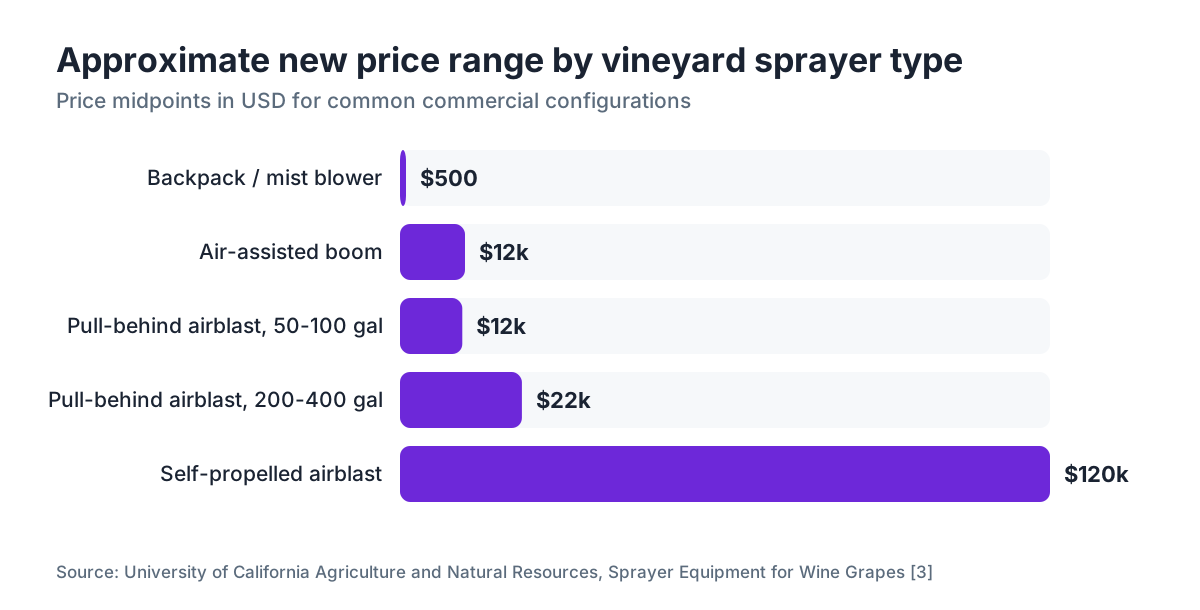
New pull-behind airblast sprayers from established manufacturers (Rears, FMC, Proptec, Durand-Wayland) run roughly $8,000 to $30,000 depending on tank size, nozzle configuration, and whether the unit has a hydraulic tower kit [3]. A 100-gallon vineyard-specific unit with tower nozzles might come in near $12,000 to $15,000. A 400-gallon orchard model with stainless components and a hydraulic fan adjustment will push $25,000 to $30,000.
Self-propelled sprayers are a different tier entirely. Purpose-built self-propelled vineyard sprayers from European manufacturers typically land between $60,000 and $180,000 new, depending on features like GPS section control, variable-rate capability, and cab comfort. Very few small operators can justify that on pure hours-per-year math.
Used equipment is where most small and mid-size operations actually buy. A used orchard or vineyard sprayer in decent condition, meaning pumps rebuilt, hoses pliable, nozzle bodies not corroded, can be found in the $3,000 to $12,000 range depending on age, brand, and tank size [3]. Budget an additional $500 to $2,000 for a pump rebuild kit, new hose sections, and a full nozzle replacement if you're buying anything more than a few seasons old. Nozzles are cheap. Skimping on them after paying $8,000 for a used unit makes no sense.
| Sprayer type | New price range | Used price range | Best fit |
|---|---|---|---|
| Pull-behind airblast, 50-100 gal | $8,000, $15,000 | $2,500, $6,000 | Small vineyard, 5 to 20 ac |
| Pull-behind airblast, 200-400 gal | $15,000, $30,000 | $5,000, $14,000 | Mid-size, 20 to 80 ac |
| Air-assisted boom | $6,000, $18,000 | $2,000, $8,000 | Young vines, open canopy |
| Self-propelled airblast | $60,000, $180,000 | $18,000, $60,000 | Large operations, 80+ ac |
| Backpack/handheld mist blower | $200, $800 | $50, $300 | Spot treatment only |
What should you check when buying a used orchard or vineyard sprayer?
A used orchard or vineyard sprayer can be a great buy or a money pit, and the difference often comes down to one hour of inspection before you write the check.
Start with the pump. Diaphragm pumps (most common on vineyard sprayers) lose performance as diaphragms harden and check valves wear. Hook a pressure gauge to the output port and run the PTO. You want consistent, pulsation-free pressure at the rated output. Erratic pressure means worn diaphragms. A rebuild kit for a standard Comet or Annovi Reverberi pump runs $80 to $250, which is manageable, but if the pump housing itself is cracked or the manifold has calcium deposits too thick to clean out, you're looking at a replacement pump, which can run $600 to $1,500 depending on the model.
Look at every hose. Vineyard chemical spray, especially sulfur, is brutal on rubber. Any hose that feels stiff, shows surface cracking, or has been repaired with hose clamps over a split is a liability. Budget to replace all of them.
Check the fan and fan housing. Dents in the fan shroud change airflow patterns. Blade erosion from chemical exposure, especially alkaline materials, reduces air volume meaningfully over time. Spin the fan by hand (with PTO disconnected, obviously) and feel for any bearing drag or roughness.
Inspect every nozzle body and turret for corrosion or warping. Warped turrets don't seat correctly and will leak at pressure. Replacing a full set of nozzle bodies on a 20-nozzle vineyard sprayer can add $300 to $800 to your purchase cost but it's generally worth doing on any used unit just for the calibration baseline.
If you're buying a tower sprayer, test the hydraulic cylinder for the tower itself. Hydraulic cylinder seals fail, and a tower that won't hold its position mid-spray is worse than no tower at all. Ask for a demonstration under real hydraulic pressure, more than a static position hold.
Finally, ask for the maintenance records and the last calibration date. Most serious operators keep these. If the seller has nothing, price accordingly.
How do you calibrate a vineyard or orchard sprayer correctly?
Sprayer calibration is the single most neglected operation in commercial viticulture. A 2018 Penn State extension review found that a significant portion of surveyed spray applicators were operating with application rates that differed from their target by more than 20 percent. That kind of error, compounded over a season, means either excessive chemical cost or inadequate disease control [4].
The basic calculation for a ground-speed sprayer is: GPA = (GPM x 5,940) / (nozzle spacing in inches x mph). For an airblast sprayer treating two rows simultaneously, you also divide by your effective swath width in feet rather than nozzle spacing. WSU extension has published a clean calibration worksheet specifically for airblast vineyard sprayers that walks through the catch-test method step by step [5].
The catch-test method is the most reliable field approach. Place a graduated cylinder under each nozzle and collect output for 30 seconds at your operating pressure. Average the outputs. Any nozzle delivering more than 10 percent above or below the average is a candidate for replacement. Then drive a measured course at your target field speed with the PTO engaged, measure actual distance covered in a set time, and calculate true ground speed rather than relying on tractor speedometer readings.
Pressure gauges on most sprayer manifolds are inaccurate after a season or two of use. A digital pressure gauge in the $40 to $80 range is worth keeping in the spray shed and swapping in during every calibration cycle.
Calibrate at the start of each season and any time you change nozzle types, PTO speed settings, or target application volume. That's three or four calibrations per year in a typical program, not once and forget it.
What are the EPA Worker Protection Standard requirements for vineyard sprayers?
The EPA Worker Protection Standard (WPS), revised in 2015 and enforced under 40 CFR Part 170, sets the legal floor for how agricultural workers and pesticide handlers are protected when pesticides are applied in vineyards and orchards [6].
For spray applicators specifically, the WPS requires that handlers receive pesticide safety training before handling any pesticide. The regulation states that agricultural employers must ensure that "each handler is informed of the location of the pesticide safety information" and related emergency contact materials before the handler enters any area where they may be exposed to pesticides [6]. That's not optional and it applies to every person who operates, loads, or assists with a vineyard sprayer.
Personal protective equipment (PPE) requirements come from the pesticide label, not from the WPS directly. The WPS requires that the employer provide and maintain the PPE that the label specifies. For most fungicide applications in vineyards, that means chemical-resistant gloves, long-sleeved shirt and long pants, and eye protection at minimum. Organophosphate insecticides carry more extensive requirements, including respirators rated for pesticide vapor.
Restricted Entry Intervals (REIs) apply after every application. The WPS prohibits workers from entering a treated area during the REI except for narrow exemption activities. Your spray records need to document the application time and date so supervisors can tell field workers when the REI ends. No documentation means no way to demonstrate compliance if a CalOSHA or EPA inspection happens. California has its own enforcement layer through the County Agricultural Commissioner system, with requirements that often exceed federal minimums.
Training records under the WPS must be kept for two years. Application records, including the pesticide name, EPA registration number, application date, location, rate, and the name of the applicator, are typically required to be kept for two years at the federal level, though some states require longer retention.
How do row spacing and canopy architecture affect which sprayer you need?
Row spacing and canopy shape are the two variables that most directly determine whether an airblast sprayer delivers even coverage or just blows chemical past your vines.
Standard California wine country row spacing runs 8 to 10 feet. Most pull-behind airblast sprayers are designed around that geometry. In tighter 6-foot rows, which you see in some cool-climate Pinot Noir blocks designed for hand harvesting, standard sprayers can't physically fit between the rows. Some growers in tight-row blocks use hand-held or backpack sprayers for low-volume sulfur applications during early canopy closure, then shift to airblast when row clearance allows. That's not ideal but it's honest field practice.
Vertical shoot positioning (VSP) is the dominant trellis system in wine grapes, and a well-managed VSP canopy at full shoot development presents a vertical wall roughly 2 to 4 feet tall. Tower nozzle kits that redirect spray upward from the standard horizontal fan pattern were specifically designed for VSP. Without the tower, your airblast unit puts most of its volume at the bottom of the vine and under-treats the fruiting zone and upper canopy.
High-wire Gobelet and head-trained systems, common in old-vine Zinfandel and some Central Valley blocks, have a different challenge: the canopy is open and irregular, so the airblast passes through gaps. Slow travel speeds and higher water volumes help compensate.
For orchards, canopy architecture matters even more. Tall traditional apple or pear trees require different fan configurations than modern high-density plantings on vertical axis training. Vertical spindle and tall spindle orchard systems behave more like VSP vineyards than like traditional orchard canopies, and many growers in those systems are successfully adapting vineyard-style tower sprayers.
If you're managing a vineyard with mixed blocks and multiple canopy types, the honest answer is that you may need to adjust your nozzle configuration by block, or accept that some blocks will be better served by a different spray rig entirely.
How do you reduce spray drift in vineyards and orchards?
Spray drift is an agronomic waste, a neighbor relations problem, and in some cases a legal liability. Fields adjacent to schools, residences, or certified organic blocks create situations where drift incidents carry real financial consequences.
Wind speed is the primary factor. UC Davis extension recommends not spraying when wind speeds exceed 10 mph, and below that threshold, spraying with the wind at your back rather than blowing toward sensitive areas [7]. In practice, many experienced vineyard managers won't spray above 5 mph if a sensitive receptor is within 300 feet.
Droplet size is the second factor. The physics: smaller droplets (under 150 microns) are far more prone to off-target movement than medium or coarse droplets (200 to 400 microns). Most airblast sprayer nozzles, at standard operating pressures of 150 to 250 PSI, produce a mix that includes a meaningful fine-droplet fraction. Reducing pressure to the minimum effective level reduces the fine fraction. Air induction nozzles, which entrain air into each droplet, can reduce the drift-prone fraction significantly.
Travel speed affects both coverage and drift. Slow travel speed increases application volume at a given pressure and nozzle configuration, reducing the need to run high pressure to hit target GPA rates. High pressure to compensate for fast travel speed pushes droplet size down and drift up.
Turn management at row ends is the most commonly ignored drift source. Most operators leave their sprayer running while turning. A 30-foot turn at the end of a row, with the fan pointed in various directions, can put a meaningful drift cloud into the air. Turning the PTO off at the row end, or using an electronic section control if your rig has one, cuts that substantially.
California's Department of Pesticide Regulation maintains the most detailed state-level drift rules in the country. Their guidance on spray adjuvants and drift-reduction labels is worth reviewing even if you're outside California, because it represents the current best practice baseline.
What spray records do you legally need to keep for vineyard applications?
Federal requirements under FIFRA (the Federal Insecticide, Fungicide, and Rodenticide Act) require that commercial applicators keep records of restricted-use pesticide applications for a minimum of two years [8]. Many states require the same period for general-use pesticides applied commercially.
At a minimum, a legally sufficient spray record includes: the application date and time, the location (field block or APN), the pesticide product name and EPA registration number, the pest or condition being treated, the application rate per acre and total volume applied, the method of application (ground airblast, etc.), and the name and certification number of the applicator. If you're in California, the County Agricultural Commissioner requires a Notice of Intent (NOI) before applying any pesticide requiring restricted material permits, and the completed application record goes to the CAC within a set reporting window.
The REI must be on the record. So must any re-entry requirements for field workers. If an OSHA or EPA inspector shows up, they're going to ask to see those two pieces of information specifically, because that's where WPS violations most commonly hide.
Paper records work. But they're hard to search when a buyer's compliance auditor asks you to pull all applications of a specific active ingredient over the past three years, or when a certifier needs proof that no prohibited materials were applied to a transitioning organic block. That's exactly where a dedicated field operations tool earns its keep. VitiScribe, for example, structures spray records to capture all the required data fields in a searchable format from the start, so compliance pull requests don't require digging through binders from three seasons ago. A free trial is worth running before harvest, when spray activity peaks and record-keeping discipline tends to slip.
Keep your original product labels and SDS sheets on file for every product you've used, for the same two-year minimum. If a label changes mid-season, which does happen with re-registrations, note the label version you were working from at time of application.
How do you maintain a vineyard sprayer between seasons?
End-of-season maintenance is the clearest predictor of whether your sprayer works reliably in the first week of the next spray season or whether you lose three days chasing a pressure problem when you can least afford it.
Flush the entire system thoroughly after the last application of the season. Triple-rinsing with clean water and running the rinsate through the nozzles is the minimum. For sulfur programs specifically, a dilute ammonia rinse (1 cup household ammonia per 25 gallons of water) helps break down sulfur deposits that will harden in pump passages and hose interiors over winter storage. Check your product labels, since not all tank materials are ammonia-compatible, and never mix ammonia with chlorine-based products.
Drain every hose and pump passage completely if you're storing in a climate where freezing is possible. Trapped water expanding in a pump manifold can crack castings that cost more to replace than a full pump rebuild.
Spray the fan shaft bearings with marine-grade grease and spin the fan manually a few times to distribute it. Remove nozzle bodies, soak them in clean water, and inspect each one with a nozzle cleaning kit. Discard any that show visible wear at the orifice. Nozzle output drift of more than 10 percent from rated is a standard calibration failure threshold, and worn nozzles cause uneven application that no calibration calculation can fully correct.
Replace all O-rings in the pump and check valve assemblies if the unit is more than two seasons old since the last rebuild. An O-ring kit costs $30 to $80 and is an hour of bench work. A pump failure mid-season costs you far more in timing than it does in parts.
Document what you did and what you found. When you're troubleshooting in the field next May, a record that says "replaced all hoses, rebuilt pump diaphragms, replaced 4 nozzle bodies" from October is far more useful than memory.
Is a self-propelled vineyard sprayer worth the investment for a small operation?
Honest answer: probably not for most operations under 50 acres, and definitely not as a first sprayer. The economics just don't close.
A new self-propelled vineyard sprayer at $80,000 to $120,000 requires something like 800 to 1,200 spray hours per year to reach a reasonable cost-per-hour compared to a $15,000 pull-behind plus tractor time. Most small vineyards have 6 to 12 spray events per year. At 2 to 4 hours per event on a 20-acre block, that's 12 to 48 annual spray hours. The math doesn't close.
Where self-propelled units genuinely earn their cost is in large operations (80 acres or more under a single management umbrella), operations where the spray calendar is very tight (high-pressure disease years in humid climates, where missing a 24-hour window matters a lot), and operations where operator skill variance is high enough that consistent automated travel speed materially improves coverage uniformity.
Used self-propelled units are a more interesting calculation. A 10-year-old Gregoire or Gama with 2,000 hours, properly maintained, at $20,000 to $35,000 might make sense for a 40 to 60-acre operation that's currently renting spray equipment or hiring custom applicators. The break-even math against custom application fees at $40 to $80 per acre per pass is worth running explicitly before you buy.
For most small vineyard operations, the right answer remains: buy a well-spec'd pull-behind airblast unit, learn to calibrate it correctly, and put the capital difference into other parts of the operation that actually limit your output.
How do orchard sprayers differ from vineyard sprayers, and can you use one for both?
Orchard and vineyard airblast sprayers share a basic architecture but diverge in important ways once you look at fan configuration, nozzle placement, and tower geometry.
Orchard sprayers, designed for mature apple, pear, peach, or walnut trees, typically have a large single-outlet fan that throws a wide, high-volume air column upward and outward to reach canopy heights of 10 to 25 feet. The nozzle manifold usually wraps around the entire fan outlet, distributing spray 270 to 360 degrees. That geometry works beautifully for a 15-foot semi-dwarf apple but it's overkill and poorly targeted for a 4-foot VSP wine grape canopy.
Vineyard sprayers typically have a bifurcated or tower configuration designed to put spray into a narrow horizontal band at vine height, with many models using separate left and right manifolds that can be adjusted independently for single-sided application or targeted by height.
Can you use one for both? Sometimes. If you manage both a small orchard block and a vineyard on the same property, a mid-sized orchard airblast unit with an adjustable nozzle manifold can be reconfigured for vineyard work. You'll sacrifice some efficiency and coverage precision in the vineyard compared to a purpose-built vineyard tower sprayer, but it can work adequately for low-to-medium disease pressure years. Conversely, a vineyard tower sprayer applied to a mature tall-canopy orchard will under-treat everything above about 6 feet.
If you're shopping for used equipment that covers both use cases, look specifically for orchard/vineyard combo units, which several manufacturers offer, with adjustable tower sections, variable-rate manifolds, and a wide enough PTO horsepower range to run efficiently behind whatever tractor you're using.
Frequently asked questions
What size airblast sprayer do I need for a 20-acre vineyard?
For a 20-acre vineyard running 50 to 75 gallons per acre, a 200 to 300-gallon tank capacity lets you cover roughly 3 to 5 acres per fill without interruption. Most growers at that scale run a pull-behind unit in the 200 to 300-gallon range with a tower nozzle kit. This size also pairs well with 50 to 75 HP tractors, which is a common vineyard tractor tier.
How often should vineyard sprayer nozzles be replaced?
Replace nozzles when output deviates more than 10 percent above or below the rated flow rate at standard operating pressure. In practice, a busy vineyard running sulfur, copper, and captan programs often reaches that wear threshold in one season of moderate use. Check every nozzle at least twice per season with a graduated cylinder. Nozzle tips are cheap, usually $2 to $8 each, and calibration accuracy is worth far more than the savings from running worn tips.
What horsepower tractor do I need to run a vineyard airblast sprayer?
Most pull-behind vineyard airblast sprayers rated for 100 to 300-gallon tanks require 40 to 80 PTO horsepower. Smaller 50 to 100-gallon units can run adequately on 30 to 40 HP tractors. Larger orchard sprayers with 400 to 600-gallon tanks and high-volume fans may need 80 to 100 HP or more. Always check the manufacturer's PTO requirement, more than the drawbar horsepower rating, since fan loads pull from PTO output specifically.
Can I use a used orchard vineyard sprayer for organic production?
Yes, but you need to clean it thoroughly. Sprayers previously used with synthetic pesticides must be triple-rinsed and documented before use in certified organic production. Your certifier may require written cleaning protocols and may ask to inspect equipment. Some certifiers want evidence of a specific water-only flush volume. Check with your organic certifier before assuming a clean equipment record is sufficient. Sulfur and copper, both OMRI-listed materials, leave their own residue challenges, particularly with rubber hose compatibility.
What is the EPA Worker Protection Standard training requirement for sprayer operators?
Under 40 CFR Part 170, all pesticide handlers (including sprayer operators) must receive EPA-approved pesticide safety training before performing handler tasks. Training must cover pesticide hazards, how to read a label, PPE use, and decontamination procedures. Training must be repeated every 12 months. Employers must keep training records for two years. UC Davis and WSU both publish WPS-compliant training materials in English and Spanish for vineyard handler training programs.
How do I know what gallons per acre to apply in my vineyard?
Your target GPA depends on canopy density, vine spacing, and the pesticide label's minimum volume requirements. Most fungicide labels in vineyards specify a range of 20 to 100 GPA by ground application. Start with the label minimum, then use a water-sensitive paper test to verify actual canopy penetration at that volume. WSU extension's vineyard sprayer calibration guide outlines a tissue paper penetration test that works well for dialing in both GPA and nozzle placement.
What is the best way to clean a vineyard sprayer after sulfur applications?
After sulfur applications, flush with clean water first, then run a dilute ammonia solution (roughly 1 cup household ammonia per 25 gallons) through the system. Ammonia breaks down sulfur residue that hardens in pump passages and hose interiors. Run the solution through all nozzles for several minutes. Triple-rinse with clean water after the ammonia flush. Check your tank material compatibility, since ammonia can damage some polymer liners, and confirm the product label doesn't prohibit ammonia cleaning.
Are there grants available to help buy a vineyard sprayer?
USDA EQIP (Environmental Quality Incentives Program) has historically included spray equipment upgrades as eligible conservation practices, particularly for drift-reduction equipment and precision application technologies. Payment rates and eligible practices vary by state and fiscal year. Contact your local USDA Natural Resources Conservation Service (NRCS) office for current program availability. Some state departments of agriculture also run separate cost-share programs for reduced-risk pesticide application equipment.
How does travel speed affect spray coverage in a vineyard?
Every mph of travel speed increase reduces application volume per acre proportionally, assuming the same pump output. If you calibrate at 3 mph for 50 GPA and run the field at 4.5 mph, actual delivery drops to roughly 33 GPA. In disease pressure situations, under-application on fungicides costs you canopy protection. Set your field speed before calibrating, not after, and use a measured course and stopwatch to verify actual speed rather than trusting the tractor speedometer.
What's the difference between a tower sprayer and a standard airblast sprayer for vineyards?
A standard airblast sprayer delivers most of its air volume and spray in a roughly horizontal plane from a single fan outlet. A tower sprayer adds a vertical extension with independently aimed nozzle sections that redirect spray upward and inward along the full height of a VSP canopy. For mature VSP wine grapes, a tower kit dramatically improves upper canopy coverage. Without it, most spray volume hits the lower vine and tractor tire zone, leaving the fruiting wire and upper shoots under-treated.
How long should a well-maintained vineyard sprayer last?
A pull-behind airblast unit with regular pump rebuilds, annual hose replacement, and proper off-season storage can realistically run 15 to 25 years. The limiting components are the pump (rebuild every 3 to 5 years), hoses (replace every 2 to 4 seasons), and fan bearings (inspect annually). Tank integrity is usually not the failure mode on fiberglass or stainless units. Budget roughly $500 to $1,500 per year in consumable maintenance parts for a working vineyard sprayer.
What spray records does California require for vineyard pesticide applications?
California requires that all pesticide applications be reported to the County Agricultural Commissioner within specific timeframes, which vary by product category. Required data includes the operator's pesticide license number, application date, product name and EPA registration number, site (APN or field ID), acres treated, amount of product used, and the REI. Restricted material permits require an advance Notice of Intent. Records must be kept for at least two years. California's requirements exceed federal minimums in several areas.
Can you spray a vineyard with a boom sprayer?
Yes, in limited situations. A boom sprayer works adequately for pre-emergence herbicide applications in the vine row, dormant spray programs on young vines with minimal canopy, and some growth regulator applications on low-canopy blocks. It does not work well for fungicide programs on mature VSP or other closed-canopy systems, because the boom can't penetrate the canopy interior where Botrytis, powdery mildew, and downy mildew pressure actually develops.
Sources
- Cornell Cooperative Extension, Sprayer Technology for Vineyards: Airblast sprayer fan velocity, tank size ranges, and canopy coverage principles for vineyards
- Cornell Cooperative Extension, Vineyard Sprayer Calibration: PTO speed matching requirements and calibration methodology for vineyard airblast sprayers
- University of California Agriculture and Natural Resources, Sprayer Equipment for Wine Grapes: New and used price ranges for pull-behind, self-propelled, and boom vineyard sprayers
- Penn State Extension, Sprayer Calibration and Application Accuracy for Vineyards: Survey finding that a significant portion of applicators operated with more than 20 percent rate deviation from target
- Washington State University Extension, Airblast Sprayer Calibration for Vineyards: Step-by-step catch-test calibration methodology and GPA calculation worksheet for airblast sprayers
- EPA, Worker Protection Standard, 40 CFR Part 170: WPS handler training requirements, REI documentation obligations, and employer PPE provision duties
- University of California Agriculture and Natural Resources, Pesticide Application and Drift Management: Wind speed thresholds and drift-reduction recommendations for vineyard spray applications
- EPA, FIFRA Pesticide Record-Keeping Requirements: Two-year minimum record retention requirement for commercial pesticide applicators under FIFRA
- California Department of Pesticide Regulation, Pesticide Use Reporting: California pesticide application record requirements including County Agricultural Commissioner reporting timelines
- WSU Extension, Canopy Management and Spray Coverage in Wine Grapes: VSP canopy geometry and tower nozzle configuration recommendations for uniform spray coverage
Last updated 2026-07-10