OSHA vineyard employer requirements and the small farm exemption

TL;DR
- Federal OSHA can't enforce most safety standards against farms with 10 or fewer employees that kept no labor camp in the past 12 months.
- That exemption stops there.
- It does nothing for the EPA Worker Protection Standard, FLSA child labor rules, or the 22 states running their own OSHA plans.
- Know what still applies before you count on it.
What is the OSHA small farm exemption and who qualifies?
Congress has attached a small farm rider to OSHA's annual appropriations bill every year since 1976. The rider blocks OSHA from spending any funds to enforce its standards on farms that (1) employed 10 or fewer workers at all times during the previous 12 months, and (2) kept no temporary labor camp during that same period [1]. That's the whole test. A headcount and a camp question.
The count captures everyone on your payroll who worked the farm at any point in the prior 12 months, not the number working on a given day. Hire an 11th worker for one week of harvest and you lose the exemption for the following compliance year. Family members employed on the farm count toward that number under federal OSHA's reading, though a separate and narrower exemption exists for farms where the only workers are the operator's immediate family [1].
The exemption covers the core OSHA general industry and agriculture standards: field sanitation, hazard communication for non-pesticide chemicals, lockout/tagout on equipment, tractor rollover protection, and the rest. It does not make those standards vanish. It only means federal OSHA is legally barred from spending money to inspect you and write a citation. That gap matters in a state-plan state, because state agencies are not bound by the congressional rider.
Does the small farm exemption apply in every state?
No. This is the biggest trap for small vineyard operators, and it catches people every harvest.
Twenty-two states and two territories run their own occupational safety and health programs approved by federal OSHA under Section 18 of the OSH Act [2]. A state plan must be at least as effective as federal OSHA, but it's free to go further. California, Washington, and Oregon, which together hold most of the country's wine grape acreage, all run state plans that cover small farms with no exemption at the federal floor [2].
California's Cal/OSHA, administered by the Division of Occupational Safety and Health (DOSH), covers agricultural employers regardless of size. A vineyard with two employees in Paso Robles owes the same field sanitation, heat illness prevention, and pesticide safety obligations as a 500-person operation [3]. Washington's WISHA (Washington Industrial Safety and Health Act) applies to farm employers regardless of headcount, with a few nuances for family farms. Oregon OSHA covers agriculture employers with one or more employees.
Here's the practical read. If your vineyard sits in California, Washington, Oregon, Michigan, North Carolina, or any other state-plan jurisdiction, the congressional rider gives you nothing. Check your state's specific rules, not federal OSHA's website.
| State | State OSHA Plan? | Small farm exemption honored? |
|---|---|---|
| California | Yes (Cal/OSHA) | No |
| Washington | Yes (WISHA) | No |
| Oregon | Yes (OR-OSHA) | No |
| New York | Yes (PESH for public; federal OSHA for private) | Federal exemption applies to private farms |
| Texas | No (federal OSHA) | Yes, if 10 or fewer employees |
| Florida | No (federal OSHA) | Yes, if 10 or fewer employees |
| Virginia | Yes (VOSH) | Partial; check VOSH ag rules |
| Pennsylvania | No (federal OSHA) | Yes, if 10 or fewer employees |
What safety rules still apply even if you qualify for the exemption?
Qualifying for the OSHA small farm exemption does not drop you into a regulatory vacuum. Several federal requirements live entirely outside OSHA's authority and apply no matter how few people you employ.
The EPA Worker Protection Standard (WPS) is the big one for vineyards. The WPS, codified at 40 CFR Part 170, covers any agricultural employer whose workers use or handle pesticides on farms, forests, nurseries, or greenhouses [4]. It requires pesticide safety training for all agricultural workers and handlers, posting of pesticide application information (the safety poster plus application-specific details at a central location), access to labeling and safety data sheets, decontamination supplies at application sites and equipment cleaning areas, and emergency medical procedures. EPA revised the WPS in 2015 and the revised rule took effect in January 2017 [4]. There is no small-farm carve-out. A one-person vineyard that applies any EPA-registered pesticide has to comply.
Child labor rules under the Fair Labor Standards Act (FLSA) also stand apart from OSHA. Agriculture gets different treatment than other industries under the FLSA, but age restrictions and hazardous-order prohibitions still apply to minors on farms, including family members once the farm employs other workers [5].
State environmental and pesticide agencies stack more on top of the WPS. California's Department of Pesticide Regulation, for one, makes growers file a Notice of Intent before applying many restricted materials, keep pest control records for three years, and follow county agricultural commissioner rules that can run stricter than the federal WPS [6].
Workers' compensation is a state matter and sits entirely apart from OSHA. Nearly every state requires agricultural employers to carry coverage once they cross a minimum payroll or headcount, and those thresholds swing widely from state to state.
What are the OSHA field sanitation requirements and do they cover small vineyards?
OSHA's agricultural field sanitation standard at 29 CFR 1928.110 requires employers with 11 or more workers in hand-labor operations to provide toilet facilities, handwashing water, and drinking water in the field [7]. The standard sets its coverage threshold at 11 workers outright. So with 10 or fewer workers, you fall outside 29 CFR 1928.110 under federal OSHA.
State plans override that. Cal/OSHA's field sanitation regulation at Title 8, Section 3457 covers agricultural employers with one or more employees doing hand-labor operations. In a vineyard that means nearly everything: hand harvesting, suckering, shoot positioning, leaf pulling, tying. Cal/OSHA also runs a separate Heat Illness Prevention standard (Title 8, Section 3395) covering all outdoor workers with no farm-size exemption [3].
Washington's field sanitation rules under WAC 296-307-09705 likewise apply to all agricultural employers regardless of size.
In federal OSHA states the situation gets awkward. OSHA can't enforce field sanitation against you at 10 or fewer workers, but the standard still exists on the books. Some attorneys argue the unenforced standard creates tort exposure if a worker gets hurt and you didn't provide what it requires. That's not settled law. Either way, I'd be careful about treating the exemption as license to skip water and toilets in the field. Providing them is cheap. A heat-illness lawsuit is not.
How does OSHA's hazard communication standard apply to vineyard chemicals?
OSHA's Hazard Communication Standard (HazCom), at 29 CFR 1910.1200, makes employers keep Safety Data Sheets (SDS) for hazardous chemicals on site and train workers on chemical hazards. Under federal OSHA, the small farm exemption blocks HazCom enforcement for farms with 10 or fewer employees.
The EPA WPS's labeling and SDS access rules overlap heavily with HazCom for pesticides. Use any registered pesticide and the WPS already requires you to make the product label and SDS available to workers and handlers. So the real difference between being covered and not covered by HazCom in a vineyard comes down to non-pesticide chemicals: sulfur dust, equipment cleaning agents, refrigerants in the winery. Those fall under HazCom but not the WPS.
Winery operations change the picture. Winery production areas are usually classified as general industry, not agriculture, by OSHA. That pulls in the full set of OSHA general industry standards, including HazCom, confined space entry for tanks, lockout/tagout for presses and conveyors, and forklift safety, all keyed to general industry employee-count thresholds that differ from the agricultural ones. A five-person winery still owes its crew a complete HazCom program for the non-pesticide chemicals in the production building. The agricultural small farm exemption stops at the winery door.
What counts as a 'temporary labor camp' that disqualifies the exemption?
The congressional rider strips the exemption from any farm that "maintained a temporary labor camp" in the prior 12 months [1]. OSHA defines a temporary labor camp as any establishment that houses migratory workers, including housing on or near the farm [8]. That covers housing you own, lease, or control.
Provide any form of seasonal worker housing, a bunkhouse on your property, a rented apartment, a trailer parked on the farm, and you've almost certainly maintained a temporary labor camp under OSHA's definition. That disqualifies the small farm exemption for your whole operation, no matter how few workers you employ.
The camp standards themselves sit in 29 CFR 1910.142 and cover structural soundness, potable water, sewage disposal, and sleeping space per occupant. None of it is trivial. If you're weighing worker housing to attract harvest labor, talk to your attorney and read 29 CFR 1910.142 before you hand anyone a key.
How do you count employees to determine if you meet the 10-person threshold?
Federal OSHA counts every worker employed on the farm at any time during the 12 months before the compliance date in question, not the number employed at once or on a peak day [1]. This is not a full-time-equivalent math problem. It's a headcount of distinct individuals.
Run a 6-person permanent crew and add 8 seasonal pickers for a 3-week harvest, and your 12-month total is 14. You've cleared the threshold and lost the exemption for the year.
A few points are honestly contested or fuzzy:
Labor contractors. If a farm labor contractor (FLC) employs the workers directly, whether those workers count toward your headcount turns on whether they're joint employees. OSHA has long applied a joint-employment analysis, and the answer depends on how much control you exercise over daily work. Direct when, where, and how they work, and they'll likely count. Cornell's ILR School has published guidance on agricultural joint employment worth reading if you use FLCs often [9].
Family members. OSHA's position: employed family members count unless the operation employs only immediate family, which triggers a separate narrow exemption. "Immediate family" in the OSHA context usually means spouse, parent, and children, not extended relatives.
Off-farm workers. Workers who never set foot on the farm (office staff, delivery drivers, winery retail staff) generally don't count toward the agricultural threshold, which turns on employees on the farm.
What OSHA standards are most commonly cited in vineyard inspections?
Even with the exemption in your pocket, knowing what inspectors actually cite tells you where the real risk lives. OSHA's agricultural inspection data, pulled from its own enforcement records, points to the same violations as the usual repeat offenders in agriculture [10]:
- Field sanitation (29 CFR 1928.110): inadequate toilet facilities or drinking water in the field.
- Hazard communication (29 CFR 1910.1200): missing SDS, no written HazCom program, no worker training.
- Tractor and machinery guarding: missing power takeoff (PTO) shaft guards, unguarded belt drives.
- Rollover protective structures (ROPS): older tractors without ROPS.
- Respiratory protection (29 CFR 1910.134): workers in respirators without a written program or fit testing.
For vineyards, heat illness is the most dangerous issue, and Cal/OSHA's enforcement record confirms it. California issued 479 heat-related citations to agricultural employers between 2010 and 2020, with fines reaching $25,000 per serious violation [3]. Even in federal OSHA states, heat illness can trigger an inspection under the general duty clause (Section 5(a)(1) of the OSH Act), which reaches all employers regardless of the small farm exemption.
The general duty clause is the hardest piece of the law to dodge. It requires every employer to provide a workplace free from recognized hazards likely to cause death or serious harm. Federal OSHA can cite under this clause even against exemption-covered employers if the hazard is recognized (known to the industry) and a feasible fix exists. Heat illness, falls from ladder-assisted canopy work, and tractor overturns have all been cited under the general duty clause in agriculture.
How does the EPA Worker Protection Standard actually work for vineyard pesticide applications?
The EPA Worker Protection Standard applies to any employer who uses, or has workers or handlers perform tasks tied to the use of, an EPA-registered pesticide on an agricultural establishment [4]. In a vineyard that pulls in fungicide sprays, herbicide applications, insecticide treatments, and in most cases sulfur dust, since sulfur registered as a pesticide falls under the WPS.
The 2015 revised WPS, in full effect by January 2, 2017, added several requirements that hit small vineyards [4]:
Application exclusion zones (AEZ). During any application, no workers or bystanders may be within a set distance of the equipment, whether or not they're part of the application.
Central posting. Application-specific information (product name, EPA registration number, active ingredient, location treated, date and time, and restricted-entry interval) must be posted in a central location for at least 30 days after the application.
Training. Every agricultural worker and pesticide handler must be trained before working in treated areas or handling pesticides. The training has to cover the revised 2015 WPS content and be delivered by an EPA-approved trainer or with EPA-approved materials. UC Cooperative Extension publishes WPS training resources in English and Spanish that meet the requirement [11].
Recordkeeping. Employers must keep application records (or copies of records received from the handler or handler employer) for at least two years.
The WPS has no small-farm exemption and no small-employer exemption. A vineyard with one employee who works around treated areas owes that worker the full WPS package.
State lead agencies pile on more. California's DPR requires growers using restricted materials to hold a valid permit from their county agricultural commissioner and to file a Notice of Intent at least 24 hours before each application [6]. Washington's Department of Agriculture runs a comparable system. If you keep spray records by hand or in a spreadsheet, a purpose-built system like VitiScribe can tie application records straight to your WPS posting and training logs, which cuts down audit prep considerably.
What records should every vineyard employer keep regardless of exemption status?
Exempt or not, certain records protect you legally and operationally, and several are required by agencies that don't care about your OSHA status.
Pesticide application records. Required by the EPA WPS (2 years) and by state pesticide agencies in most states (California requires 3 years under Food and Agriculture Code Section 12981) [6]. Include date, time, location, product name, EPA registration number, active ingredient, application rate, acres treated, and any REI.
WPS training records. Required by the WPS. Keep dated records of who got trained, what materials you used, and who ran the session.
Injury and illness records. OSHA's injury and illness recordkeeping rule (29 CFR 1904) covers establishments with more than 10 employees in most industries. Agriculture uses the same threshold with one wrinkle: small farms meeting the 10-or-fewer test skip routine recordkeeping, but they still must report any worker fatality to OSHA within 8 hours and any in-patient hospitalization, amputation, or loss of an eye within 24 hours [1]. That applies even to exempt farms, and OSHA says so plainly in its recordkeeping guidance.
Personnel records. Not an OSHA requirement, but the thing that proves your headcount stayed at or below 10 across the prior 12 months if you're claiming the exemption. Keep dated hire and termination records for every worker.
Equipment inspection records. Not universally required for small farms, but I'd keep them for anything with ROPS, PTO shields, or electrical systems. An undated inspection record is nearly worthless when liability comes up.
WSU Extension has a solid farm record-keeping template that hits several of these categories and is free [12]. Cornell's Farmworker Safety resources offer WPS record templates built for northeastern grape growers [9].
If you want spray logs, WPS training records, and worker counts living in one place, VitiScribe was built for vineyard compliance tracking. Even a well-organized binder of paper forms beats nothing, and the UC and Cornell templates cost you nothing.
How should a small vineyard handle harvest labor spikes without losing the exemption?
This is the real operational question for most small vineyard owners. You run a crew of 4 to 8 most of the year, then you need 15 to 20 hands for three weeks of harvest. Every added picker can push you past the 10-person threshold for the year.
A few approaches exist, each with tradeoffs.
Use a licensed farm labor contractor. If a properly licensed FLC employs the harvest workers directly and exercises real day-to-day control (which a legitimate FLC does), those workers may not be your employees for OSHA headcount purposes. It's not a guaranteed shield. Joint-employment doctrine can collapse the distinction if you direct the work too closely. But a legitimate FLC arrangement, documented carefully, is the most common and most defensible route. The FLC then carries primary OSHA employer responsibility for those workers.
Accept the exemption loss and comply. For many vineyards, a harvest season of OSHA compliance costs less than running labor through a contractor. If you're in a federal OSHA state and you already provide water, toilets, and basic training, you may be functionally compliant already. The compliance cost isn't always as high as people fear.
Plan the timeline to limit worker-days. Tempting, but it doesn't work. Bring in short overlapping windows where simultaneous headcount never tops 10, and you're still stuck with the 12-month cumulative count. Simultaneous headcount isn't what the exemption measures. Don't build your workforce around scheduling tricks.
For paso robles wineries and other operations in federal OSHA states, the marginal cost of losing the exemption for one harvest year often runs below the fees a labor contractor charges. Run the numbers honestly before you structure your workforce around the exemption.
What are the penalties for OSHA violations in agriculture?
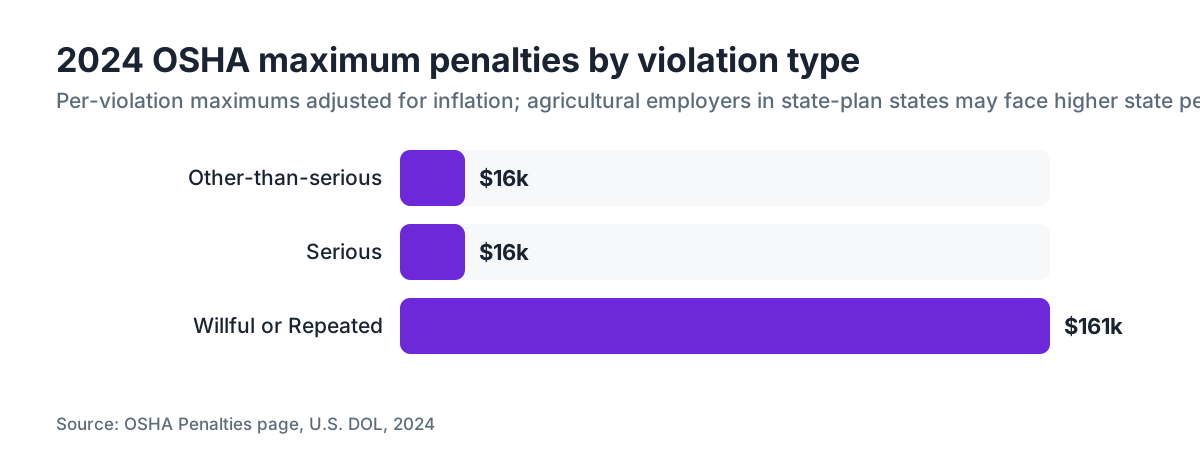
Federal OSHA adjusts its maximum penalties for inflation every year. As of 2024, the structure looks like this [10]:
- Other-than-serious violation: up to $16,131 per violation
- Serious violation: up to $16,131 per violation
- Willful or repeated violation: up to $161,323 per violation
OSHA usually reduces penalties for small employers (25% off for employers with 25 or fewer workers, plus another 10% for good-faith efforts) and through the informal conference process. Real-world agricultural penalties land well below the maximums, but repeat and willful violations climb fast.
State-plan states set their own penalty schedules, which must stay at least as high as the federal level. Cal/OSHA's heat illness penalties can reach $25,000 per serious violation, and the agency has used that power hard in agricultural cases [3].
For farms exempt from federal enforcement under the rider, the OSHA penalty risk is effectively zero, since OSHA can't spend money to inspect and cite you. What's left is civil liability. An injured worker can still sue, and the existence of an unenforced OSHA standard (or a state WPS obligation or the general duty clause) can come in as evidence of negligence.
Frequently asked questions
Does the OSHA small farm exemption apply if I use a farm labor contractor for harvest?
It depends on the employment relationship. If the labor contractor is the employer of record, controls daily work, and you can document that, those workers may not count toward your 10-person threshold. But OSHA uses a joint-employment test, and if you're directing the workers closely, they'll likely count. A well-structured FLC contract with clear employer-of-record terms is the safest route, and you should document how the FLC controls the work.
Do family members working on the vineyard count toward the 10-employee threshold?
Under federal OSHA's interpretation, yes, employed family members count toward the 10-person threshold. The only carve-out is for farms where the only workers are the operator's immediate family, which triggers a separate, narrower exemption. Extended family, or family on the payroll alongside non-family workers, count like any other employee.
If I'm exempt from OSHA enforcement, do I still need to provide drinking water in the field?
Legally, federal OSHA can't cite you for it at 10 or fewer employees. But the EPA Worker Protection Standard separately requires decontamination supplies including water near treated areas, and your state's health or agriculture agency may have its own rules. Beyond the legal question, heat illness is a recognized hazard and the general duty clause can reach exempt farms. Providing water is cheap; a heat-stroke incident is not.
Are winery production areas covered by the agricultural small farm exemption or general industry rules?
Winery production areas (the crush pad, barrel room, tanks, bottling line) are usually classified as general industry by OSHA, not agriculture. The agricultural small farm exemption does not reach them. Full OSHA general industry standards apply to winery employees, including HazCom, confined space entry for tanks, lockout/tagout, and forklift safety, keyed to general industry employer-size thresholds.
What happens if I have a worker fatality on an exempt small farm?
You must report any worker fatality to OSHA within 8 hours, and any in-patient hospitalization, amputation, or eye loss within 24 hours, whether or not you're exempt from routine recordkeeping and inspections. This reporting duty applies to all employers under the OSH Act. OSHA may inspect the incident even on an otherwise exempt farm when a fatality is involved.
Does the EPA Worker Protection Standard have a small farm exemption?
No. The WPS at 40 CFR Part 170 applies to any agricultural employer who uses, or has workers or handlers perform tasks tied to, an EPA-registered pesticide on an agricultural establishment. There is no minimum employee count. A vineyard with a single employee who works around sprayed areas owes that worker the full WPS training, posting, decontamination, and recordkeeping package.
How long do I need to keep pesticide application records for WPS compliance?
The EPA WPS requires pesticide application records to be kept at least two years from the application date. California's state pesticide law requires three years. Washington and Oregon also require multi-year retention. Keep records for the longest period your state demands. Records should include product name, EPA registration number, active ingredient, application date, location, rate, acres treated, and re-entry interval.
Can OSHA inspect my small farm even if I qualify for the exemption?
Under the congressional rider, OSHA cannot spend funds to enforce standards against farms with 10 or fewer employees and no labor camp, so in practice they won't inspect for standard violations. OSHA can still investigate a fatality or catastrophe under its reporting rules, and state-plan agencies aren't bound by the federal rider at all. In California, Washington, Oregon, and other state-plan states, small farms are fully open to inspection.
What is the general duty clause and can it apply to exempt small vineyard farms?
Section 5(a)(1) of the OSH Act requires every employer to provide a workplace free from recognized hazards likely to cause death or serious physical harm. Federal OSHA has cited the general duty clause against small farms for heat illness and tractor overturn hazards. Whether the congressional rider blocks general duty clause enforcement against exempt small farms is legally contested, but OSHA has used it in fatality investigations even on small operations.
What pesticide safety training is required for vineyard workers under the WPS?
Every agricultural worker who enters treated areas and every pesticide handler must get WPS safety training before working in those situations. Training must cover the 2015 revised WPS content, including pesticide hazards, routes of exposure, protective equipment, and emergency procedures. It has to be delivered by an EPA-approved trainer or with EPA-approved materials. UC Cooperative Extension and Cornell Extension both offer free, WPS-compliant materials in English and Spanish.
Does providing on-farm worker housing eliminate my OSHA small farm exemption?
Yes. Maintaining a temporary labor camp, which OSHA defines as any employer-owned, leased, or controlled housing for migratory or seasonal workers, disqualifies your farm from the small farm exemption regardless of how few workers you employ. Provide any form of seasonal worker housing on or near your farm and you're subject to OSHA's temporary labor camp standards at 29 CFR 1910.142 and to full agricultural OSHA enforcement.
How do state OSHA plans in California and Washington affect small vineyard compliance?
Cal/OSHA and Washington WISHA both cover agricultural employers of any size, with no small farm exemption like the federal rider. In California, a vineyard with even one employee must meet field sanitation, heat illness prevention (Title 8 Section 3395), and WPS requirements. In Washington, WAC 296-307 agricultural rules apply to farms with one or more employees. Operators in these states can't lean on the 10-employee threshold at all.
Where can I get free help understanding OSHA requirements for my vineyard?
OSHA's On-Site Consultation Program provides free, confidential workplace safety consultations to small and medium-sized employers, kept separate from enforcement. Your state farm bureau, UC Cooperative Extension, Cornell's Farmworker Safety program, and WSU Extension all publish free agricultural OSHA compliance guides. Your county agricultural commissioner is also a good starting point for pesticide-specific WPS questions.
Sources
- OSHA, U.S. Department of Labor, Agricultural Operations page: Congressional rider exempts farms with 10 or fewer employees and no temporary labor camp from most OSHA enforcement; fatality and catastrophic incident reporting still required of all employers
- OSHA, State Plans page: 22 states and 2 territories operate OSHA-approved state plans that may cover small farms without the federal exemption
- California Department of Industrial Relations, Cal/OSHA Heat Illness Prevention: Cal/OSHA covers all agricultural employers regardless of size; heat illness violations in agriculture can reach $25,000 per serious violation
- U.S. EPA, Agricultural Worker Protection Standard (40 CFR Part 170): Revised WPS effective January 2, 2017 applies to all agricultural employers using EPA-registered pesticides regardless of farm size; requires training, posting, decontamination, and recordkeeping
- U.S. Department of Labor, Wage and Hour Division, Child Labor page: FLSA child labor rules and hazardous order prohibitions apply to agricultural employers independently of OSHA size thresholds
- California Department of Pesticide Regulation, Laws and Regulations: California Food and Agriculture Code Section 12981 requires pesticide application records to be kept for three years; Notice of Intent required before restricted material applications
- OSHA, Field Sanitation Standard 29 CFR 1928.110: Field sanitation standard applies to agricultural employers with 11 or more workers engaged in hand-labor operations; requires toilet facilities, handwashing water, and drinking water in the field
- OSHA, Temporary Labor Camps Standard 29 CFR 1910.142: Temporary labor camp defined as any establishment providing housing for migratory workers; operating one disqualifies the small farm exemption regardless of employee count
- Cornell University, ILR School: Cornell ILR has published guidance on agricultural joint employment and WPS training records for northeastern grape growers
- OSHA, Penalties page: 2024 OSHA penalty maximums: serious and other-than-serious violations up to $16,131 per violation; willful or repeated violations up to $161,323 per violation
- University of California, Agriculture and Natural Resources (UC ANR): UC Cooperative Extension publishes EPA-approved WPS training materials in English and Spanish available free to growers
- Washington State University Extension, Agriculture: WSU Extension publishes free farm record-keeping templates covering pesticide records, training logs, and safety documentation for agricultural employers
Last updated 2026-07-10