Overtime exemption documentation for agricultural workers in California
TL;DR
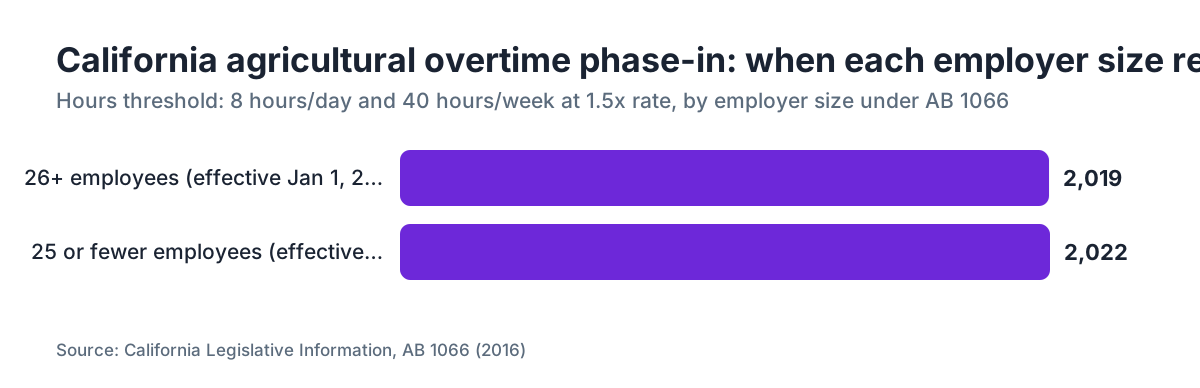
- California now requires overtime pay for farmworkers at 8 hours a day and 40 hours a week under AB 1066, fully phased in by January 1, 2022.
- To claim any remaining exemption, you need time records, piece-rate logs, and a written exemption memo made at the time you classified the worker.
- Missing documentation is the top reason growers lose wage claims.
What is California's agricultural overtime law, and what changed recently?
California's farmworker overtime rules are the strictest in the country. Assembly Bill 1066, signed in 2016, phased in standard overtime for ag workers over six years, and the last step landed on January 1, 2022. Since that date, agricultural workers in California get 1.5x their regular rate after 8 hours in a day and 40 hours in a week, and 2x after 12 hours in a day or after 8 hours on the seventh straight day of work in a workweek [1].
Before 2022, California Labor Code Section 554 exempted most ag workers from daily overtime. That history is why the old federal FLSA farm exemption still trips people up. The FLSA does exempt many farmworkers from federal overtime, but California's law is more protective, and state law controls for workers here [2]. Federal minimums are a floor, not a ceiling.
This hits vineyards hard. Harvest routinely runs crews six or seven days a week at 10 to 12 hours a day. Under the old rules that was legal at straight time. Now those extra hours carry premiums that reshape your labor budget.
The growers who got burned worst after 2022 were the ones who never adjusted their payroll systems, then faced back-pay claims covering two or three harvest seasons at once.
Which agricultural workers are still exempt from California overtime?
Fewer workers qualify than most vineyard managers assume. After the AB 1066 phase-in, California's remaining ag overtime exemptions are narrow [1].
The ones you'll actually run into:
Family members of the employer. A parent, spouse, child, or legally adopted child of the employer is exempt under California Labor Code Section 1191.5. The relationship has to be real and documented.
Small operations. This used to matter during the phase-in: an employer with fewer than 26 employees in any workweek of the prior calendar year got extra time to comply. That window is closed. As of 2022 there is no small-employer exemption from California ag overtime [1].
Executive, administrative, and professional exemptions. A vineyard manager or winemaker who meets the salary and duties test for a white-collar exemption under California Wage Order 14 (which covers agricultural occupations) can be exempt. The salary threshold as of January 1, 2025 is $1,320 per week, or $68,640 a year [3]. The duties test is fact-heavy and gets litigated constantly. Paying someone a salary does not create the exemption by itself.
Outside salesperson exemption. An employee who spends more than half their working hours away from your place of business, selling, can be exempt. Rare in field operations, but it comes up for tasting room sales reps who also work the vineyard.
What does not create an exemption: being seasonal, being paid by the piece, working on an H-2A visa, or being a working supervisor who also picks. Those are all common misreads. Piece-rate workers get overtime, calculated on a regular rate derived from their piece earnings [4].
What documentation do you need to support an exemption claim?
Exemption fights are won or lost on paper. If you claim an exemption and the Labor Commissioner or a plaintiff's attorney comes knocking, you need records that prove the exemption was valid when you applied it, not reconstructed after the fact.
For the family member exemption, keep government-issued documents showing the relationship: birth certificate, marriage certificate, tax filings showing dependent status. A note in the file that says "this is my son" won't hold up.
For a white-collar (executive or administrative) exemption, keep:
- A written job description that accurately states the employee's primary duty
- Payroll records showing the salary was paid every week without improper deductions
- Time records (yes, even for exempt staff in California, because of meal and rest break rules)
- Documentation that the employee customarily and regularly exercises independent judgment and discretion [3]
California's default is that the employer carries the burden of proving an exemption applies. The Labor Commissioner and the courts start from the assumption that the worker is non-exempt. You're proving your way out of that, which is why your documentation has to be specific and affirmative, not a shrug.
For piece-rate workers, keep records showing total pieces completed, the piece-rate paid, total hours worked (including nonproductive time), and the regular-rate calculation. Under California Labor Code Section 226.2, effective July 1, 2015, piece-rate workers must be paid separately for rest and recovery periods and other nonproductive time, at their average hourly rate or minimum wage, whichever is higher [4]. Your records have to show that math on its own line.
What time records are legally required for California agricultural employees?
California Industrial Welfare Commission Wage Order 14-2001 governs agricultural occupations. Its recordkeeping section requires you to keep the hours each employee works each day and week, the employee's full name and address, birth date if under 18, occupation, straight-time and overtime hours, and total wages paid [5].
Keep those records at least three years. The Labor Commissioner can audit back three years for wage violations, and the look-back can stretch further if fraud shows up.
For vineyards specifically, your time records should capture:
- Clock-in and clock-out with real precision (minute-level, not rounded to the nearest hour)
- The date and location of work (field block or ranch name helps when workers split across parcels)
- Any split shifts, which trigger a premium under Wage Order 14
- Meal period start and end times, because a missed or short meal period triggers a one-hour premium
Plenty of California vineyard operators still run paper timesheets signed by workers. That's legal, but paper carries real audit risk: sheets get lost, signatures get disputed, and handwriting gets argued over. Digital systems that timestamp entries and export clean logs make audits far less painful. Tools like VitiScribe tie time records straight to field task logs, which matters when a piece-rate worker's records have to reconcile across multiple sources.
One more thing worth knowing. If you don't keep time records and a worker gives a reasonable estimate of hours worked, California courts often accept the worker's estimate and put the burden of disproving it on you [2]. Good records protect you. Missing records actively hurt you.
How do you calculate overtime for piece-rate and H-2A workers?
Piece-rate overtime is genuinely confusing, and it catches experienced operators. Here's the mechanics.
A worker paid entirely by piece rate who works 10 hours in a day still earned overtime for hours 9 and 10. The premium is calculated on the regular rate for that workday, which is total piece earnings divided by all hours worked (all hours, more than productive ones, under California's 2015 amendment). The premium owed is 0.5x that regular rate for hours 9 through 12, and 1.0x for hours over 12, on top of the straight-time piece earnings you already paid [4].
Work the example. A worker earns $180 in piece-rate over 10 hours. Regular rate is $180 divided by 10, or $18 an hour. The overtime premium for hours 9 and 10 is 0.5 x $18 x 2 hours, or $18. Total pay is $198.
H-2A workers are not exempt from California overtime. H-2A sets a floor through the Adverse Effect Wage Rate, which was $19.75 an hour in California for 2024 [6], but California overtime rules stack on top of it. Track their hours and pay overtime just like any domestic worker.
For workers on a day-rate or job-rate (a flat amount per day regardless of hours), California treats the day rate as straight-time pay for all hours worked, and you owe overtime premiums on top. The regular rate there is the day rate divided by total hours worked. The DLSE enforcement manual covers this calculation directly [2].
What are the penalties for failing to document exemptions or pay overtime correctly?
The penalties are steep and they stack. Here's the exposure when a wage claim goes against you.
Unpaid wages: the full amount going back three years, or four under a Unfair Competition Law claim, which plaintiff attorneys tack on regularly.
Liquidated damages: an amount equal to the unpaid wages, so your liability roughly doubles, unless you can show a good-faith, reasonable belief the pay practice was lawful [1].
Waiting time penalties: if the underpayment was willful and the worker's employment has ended, you owe their daily wage rate for each day the wages went unpaid, up to 30 days. For someone earning $200 a day, that's $6,000 per claimant.
Civil penalties under the Private Attorneys General Act (PAGA): $100 per employee per pay period for an initial violation, $200 per employee per pay period after that. In a 20-person crew across a 16-week harvest, misclassified for two years, those numbers get ugly fast.
Wage statement penalties: $50 for the first failure to give an accurate itemized wage statement, $100 for each one after, up to $4,000 per employee.
Nobody has clean published data on average California ag wage-claim settlements. What we do have: the California Department of Industrial Relations' enforcement reporting consistently puts agriculture and food processing near the top for wage violations [7]. The exposure is real, and the plaintiff's bar is busy in the Central Valley and the North Coast wine regions.
How does Wage Order 14 interact with federal FLSA exemptions for vineyard workers?
This is where a lot of growers get tangled up, because federal and state law use the same words to mean different things.
The federal FLSA still exempts most agricultural workers from overtime entirely, under 29 U.S.C. Section 213(b)(12) [8]. If an employer uses fewer than 500 "man-days" of agricultural labor in any calendar quarter of the prior year, those workers are exempt from federal overtime. Many small vineyards and most family operations would clear that federal bar.
It doesn't matter for California workers. California Labor Code Section 1171.5 makes clear that state wage and hour protections are not preempted by federal law when the state standard is more protective. California's overtime rule beats the FLSA exemption, so the exemption gives you no cover here.
The practical read: if you farm in California, you cannot rely on the FLSA agricultural overtime exemption. You analyze each worker under California's own exemption categories, spelled out in Wage Order 14 and the Labor Code [5]. The University of California's Division of Agriculture and Natural Resources publishes labor-cost guidance that accounts for exactly this gap [9].
What does a compliant agricultural payroll record look like in practice?
A compliant payroll record for a California vineyard worker has to include specific elements under Labor Code Section 226. The wage statement (pay stub) must show [10]:
- Gross wages earned
- Total hours worked (except for exempt salaried employees)
- All deductions
- Net wages earned
- The inclusive dates of the pay period
- The employee's name and last four digits of SSN or an employee ID
- The employer's legal name and address
- All applicable hourly rates in effect during the period and the hours worked at each rate
- For piece-rate workers: the number of pieces completed and the applicable piece-rate for each type of work
For piece-rate workers, Section 226.2 requires the wage statement to also show total hours of compensable rest and recovery periods, the rate for those periods, gross wages for them, total hours of other nonproductive time, the rate for that time, and the gross wages for it [4]. That's a lot of line items. Most payroll software can generate them, but only if it's set up with California-specific configurations.
On the recordkeeping side, keep a separate file for each worker holding their signed acknowledgment of the pay stub (or a log showing it was provided), their I-9, their W-4 or DE-4, any written exemption memo if you're claiming one, and their time records for the three-year window.
How should you document the exemption decision itself, more than the hours?
Most growers document hours and payroll but skip the step of documenting why a worker got classified as exempt. That gap is what sinks exemption claims under audit.
For every worker you classify as exempt, write a one-page memo when you make the call, not later. The memo should state:
- The specific exemption claimed and its statutory basis (cite the code section)
- The facts supporting it at that moment. For the executive exemption, describe the supervisory duties in concrete terms: "supervises 8 to 12 field workers, has authority to hire and discipline without higher approval, spends under 20% of time on non-supervisory tasks"
- The salary or wage rate and why it clears the threshold
- The date of the decision and the name of the manager who made it
Re-read that memo at least once a year, and any time the employee's duties or pay change in a real way. Someone legitimately exempt when hired as a field supervisor can lose the exemption if they later spend most of their time picking alongside the crew.
Washington State University Extension publishes farm management resources covering similar documentation habits for Pacific Northwest operations, and California managers have adapted them [11]. The logic holds everywhere: a memo written the day you decided beats a memory reconstructed two years later.
What records do you need for rest periods, meal periods, and split shifts?
Overtime is one piece of the wage compliance picture. Meal and rest period violations are the other big source of liability, and the records overlap.
California requires a 30-minute unpaid meal period for every shift over five hours, and a second meal period for every shift over 10 hours. Workers can waive the first meal period if the shift is six hours or less, and the second if the shift is 12 hours or less and the first wasn't waived, but the waiver has to be written and voluntary [5].
For every shift, your records should show when each meal period started and ended. If you can't show a meal period was provided, you owe a one-hour premium per missed meal. Across a harvest season with a 20-person crew, sloppy meal records can generate $20,000 to $50,000 in premium liability before you even touch overtime.
Rest periods are paid and run 10 minutes for every four hours worked, or major fraction of it. California doesn't require you to log rest period times, but if a worker claims rest breaks were denied, you'll wish you had something: a supervisor log, a crew schedule showing breaks built into the day.
Split shifts show up in harvest when crews work early morning, break, and come back for an evening pick. They trigger a premium equal to one hour at minimum wage above the employee's regular pay for the day. Note split shifts explicitly in the time records.
How does the EPA Worker Protection Standard affect your field record system?
The EPA's Worker Protection Standard (WPS) is a separate regulatory layer, and vineyard operators often keep it in the same system as their wage records. That's sensible, but it means a failure in one area can surface problems in the other during an inspection.
The WPS, at 40 CFR Part 170, requires ag employers to train workers, provide personal protective equipment, keep pesticide application records, and post Safety Data Sheets [12]. The 2015 revision tightened the rules on application exclusion zones and record retention. Pesticide application records must be kept two years. Training records must be kept two years after the worker leaves.
During a California Department of Pesticide Regulation or county agricultural commissioner inspection, inspectors sometimes share information with the Labor Commissioner. If your WPS records show workers entering fields during restricted entry intervals, that raises questions about hours worked and supervision that can bleed straight into a wage inquiry.
Here's the practical move. Keep your WPS records, your time records, and your pesticide application records in one organized system, cross-referenced by date and worker. If a WPS inspection asks who was in Block 7 on June 14, you should pull both the spray record and the time record for that day in under five minutes. VitiScribe was built around that kind of cross-referenced field log, where spray records and crew time entries share the same date and block structure.
For more on how vineyards fold WPS compliance into the operations calendar, the UC Davis Agricultural Sustainability Institute publishes practical guides for free [13].
What are the best practices for building an audit-ready compliance file?
"Audit-ready" doesn't mean a cabinet stuffed with paper. It means you can produce accurate, complete, chronological records on short notice. In practice:
One worker file per employee, holding their signed acknowledgment of California's required workplace postings, their signed piece-rate or wage-rate disclosure (required before work begins under Labor Code 2810.5), their time records, their wage statements, their exemption memo if you have one, and their WPS training records.
A separate payroll summary log that shows total hours worked, regular rate, overtime hours and premiums, and piece-rate calculations by pay period. This is the single most useful document in an audit because it shows the math on one page.
A block-level work log that ties workers to specific field tasks and dates. It defends against claims that workers were never paid for certain days, and it cross-references naturally with your pesticide spray records.
Keep everything at least four years, not three, because the UCL claim adds a year to the possible look-back. Digital storage is fine. California doesn't require original paper for wage records.
Run an internal audit every January. Pull three or four random workers' files and check them for completeness. Confirm the exemption memos are current. Verify your payroll system is still calculating overtime right, especially after a minimum wage change (California's statewide minimum is $16.50 an hour as of January 1, 2025, with some cities higher [10]). A one-hour review in January beats a six-month lawsuit in October.
Frequently asked questions
Are H-2A visa workers entitled to California overtime?
Yes. H-2A status does not exempt anyone from California's overtime law. The H-2A Adverse Effect Wage Rate (which was $19.75 an hour in California for 2024) sets a minimum hourly floor, but California's overtime rules at 8 hours a day and 40 hours a week apply on top of it. Track H-2A worker hours and pay overtime exactly as you would for any domestic farmworker.
Do I have to pay overtime to workers who are related to me?
Not if they're your parent, spouse, child, or legally adopted child, under California Labor Code Section 1191.5. That exemption is narrow. It doesn't cover siblings, in-laws, cousins, or unrelated co-owners. Keep time records for family members anyway, because the employment relationship can be challenged and you want documentation showing they actually did the work.
How long do I have to keep California agricultural wage records?
Wage Order 14 and the Labor Code require at least three years. As a practical matter, keep four, because a California Business and Professions Code Section 17200 (UCL) claim can extend the look-back by a year. Pesticide records under the WPS require two years. If you keep everything in one system, four years covers all of it.
Can I round employee clock-in and clock-out times?
California is stricter on rounding than federal law. The FLSA permits rounding to the nearest five or ten minutes if it averages out neutrally. California's Court of Appeal held in See's Candy Shops v. Superior Court (2012) that rounding is fine only if it favors workers or stays neutral over time. Minute-level records are much safer, and many Labor Commissioner auditors are skeptical of any rounding at all.
What happens if I underpay a piece-rate worker on overtime?
You owe the unpaid wages, potentially equal liquidated damages, waiting time penalties if employment ended, and PAGA civil penalties that can run $100 to $200 per pay period per employee. California courts have been active in piece-rate class actions, particularly for vineyard and ag operations. The calculation must also account for the separate pay owed for rest periods and nonproductive time under Labor Code Section 226.2.
Does the federal small-farm FLSA exemption protect California grape growers?
No. The FLSA exempts farms using fewer than 500 man-days of agricultural labor per quarter from federal overtime, but California's protections are more protective and can't be preempted under Labor Code Section 1171.5. California's own exemptions apply, and after the AB 1066 phase-in finished in January 2022, there is no small-farm carve-out from California daily overtime.
What's the salary threshold to classify a vineyard supervisor as exempt in California?
The minimum salary threshold for a white-collar exemption in California is $1,320 per week as of January 1, 2025, which works out to $68,640 a year. The old two-tier structure based on employer size has phased out, so the threshold is the same regardless of headcount. A salary alone isn't enough. The supervisor also has to meet California's duties test under Wage Order 14.
Is there a California-specific agricultural overtime poster or notice I have to post?
Yes. California employers must post IWC Wage Order 14, which covers agricultural occupations, somewhere employees can read it. Post it in English and Spanish where Spanish-speaking workers are employed. The Department of Industrial Relations offers free downloadable versions. Failing to post is a civil violation, and it lets workers claim they were never told their rights, which weakens any exemption defense.
Can I use an app or software to keep time records, or does California require paper?
California doesn't require paper. Electronic time records are fully acceptable as long as they're accurate, accessible, and can be produced in a readable format during an audit or lawsuit. The key: entries can't be edited retroactively without a transparent audit trail, and records have to be kept for the required period. Digital systems with automatic timestamps and exportable reports are generally more defensible than handwritten sheets.
What does a piece-rate wage statement have to show in California?
Under Labor Code Section 226.2, the wage statement must separately itemize total hours of rest and recovery periods and gross wages for them, total hours of other nonproductive time and gross wages for that time, the number of piece-rate units earned, the applicable piece-rate, and the regular rate used to derive the overtime premium. Standard stubs that don't break these out are non-compliant and carry civil penalties.
How does UC Davis or another extension service help with California ag labor compliance?
UC Davis Agricultural and Resource Economics and the UC Agriculture and Natural Resources (UC ANR) Cooperative Extension both publish free guides on California farm labor law, labor cost modeling, and recordkeeping. UC ANR farm advisors do one-on-one consultations in some counties. The material is public at ucanr.edu and is especially useful for small and mid-sized vineyards without a dedicated HR function.
What is the regular rate of pay and why does it matter for overtime?
The regular rate of pay is the weighted average hourly rate for all hours worked in a workday or workweek, including piece-rate earnings and most non-discretionary bonuses. Overtime premiums are calculated on this rate, not the base hourly rate. If a worker earns a harvest bonus, that bonus usually has to be folded into the regular rate, which raises the premium owed. It's a common source of underpayment errors in vineyard payroll.
Does California require me to give workers a written notice of their pay rate before they start?
Yes. Labor Code Section 2810.5 requires you to give each non-exempt employee a written Notice to Employee at hire that includes the pay rate and basis (hourly, salary, piece-rate), allowances claimed, regular payday, the employer's legal name and address, and workers' compensation carrier information. For piece-rate workers, the notice must state the piece-rate and any other applicable rates. The DLSE provides a free template.
Sources
- California Legislative Information, AB 1066 (2016), adding California Labor Code Section 857: AB 1066 phased in agricultural overtime protections culminating January 1, 2022 at standard 8/40 overtime thresholds
- California Labor Code Section 226.2, Piece-Rate Compensation: Piece-rate workers must be separately compensated for rest and recovery periods and other nonproductive time; wage statements must itemize these separately
- U.S. Department of Labor, Employment and Training Administration, H-2A Adverse Effect Wage Rates: California H-2A Adverse Effect Wage Rate was $19.75/hour for 2024
- U.S. Department of Labor, FLSA Exemptions for Agricultural Workers, 29 U.S.C. 213(b)(12): FLSA exempts agricultural employers using fewer than 500 man-days of labor per calendar quarter from federal overtime requirements
- University of California Division of Agriculture and Natural Resources (UC ANR), Farm Labor Resources: UC ANR publishes guidance on California farm labor cost modeling and compliance for vineyard and ag operations
- Washington State University Extension, Farm Business Management: WSU Extension publishes farm labor documentation and management resources applicable to Pacific Northwest and adapted by California operations
- U.S. EPA, Worker Protection Standard, 40 CFR Part 170: WPS requires agricultural employers to keep pesticide application records for two years and worker training records for two years after employment ends
- UC Davis Agricultural Sustainability Institute: UC Davis ASI publishes practical compliance guides for vineyard WPS and integrated pest management record integration
Last updated 2026-07-10