Section 18 emergency exemption documentation process for vineyard use

TL;DR
- A Section 18 emergency exemption lets a state lead agency ask EPA to authorize an unregistered pesticide, or an unregistered use of a registered one, when an emergency pest condition exists.
- Vineyard operators don't apply directly.
- Their state department of agriculture does.
- You document the emergency on the ground and keep application, WPS, and post-use records.
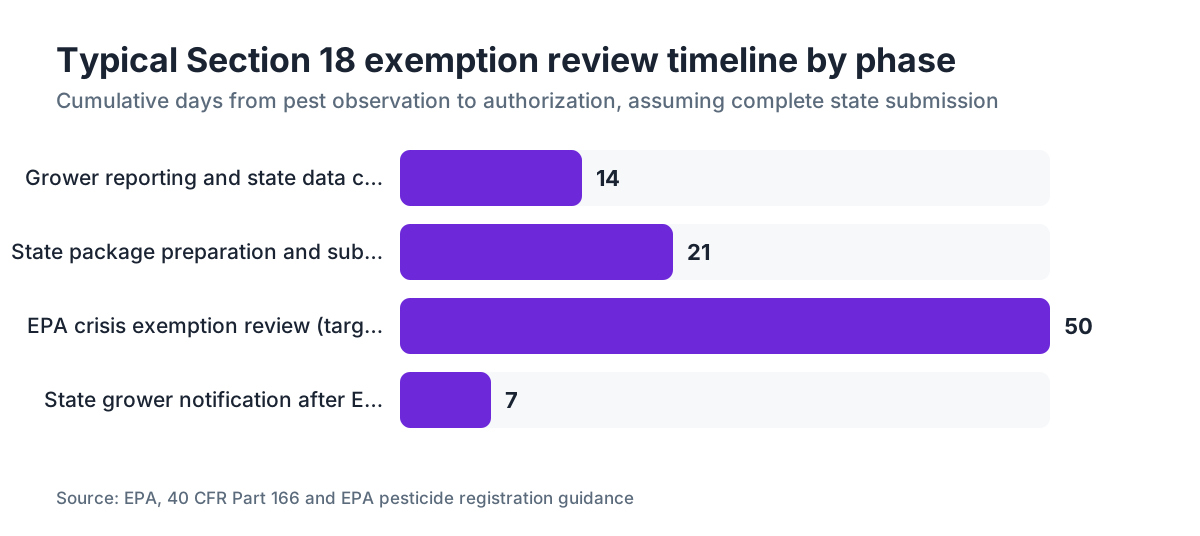
- A crisis exemption review targets 50 days.
What is a Section 18 emergency exemption and when does it apply to vineyards?
Section 18 of the Federal Insecticide, Fungicide, and Rodenticide Act (FIFRA) lets EPA authorize an unregistered pesticide use when an emergency pest condition exists and no registered alternative works well enough [1]. For vineyards, this matters most when a new disease or pest shows up faster than the registration pipeline can respond. Spotted wing drosophila (Drosophila suzukii) caught Pacific Coast berry and wine grape growers flat-footed in the early 2010s. New Xylella fastidiosa strains are the current worry.
There are three subtypes. Knowing which one fits your situation sets the clock you're racing.
| Exemption Type | Who Requests | Typical Timeline | Use Case |
|---|---|---|---|
| Specific (crisis) | State lead agency | 50-90 days | Imminent, well-documented pest threat |
| Quarantine | State or federal agency | 50-90 days | Federally or state-regulated quarantine pest |
| Public health | State or federal health agency | 50-90 days | Human health emergency |
You almost never file a Section 18 yourself. The request moves state-to-EPA, from your state department of agriculture (or a comparable lead agency) to the EPA Office of Pesticide Programs [1]. Your job is two parts. Document the emergency on the ground well enough to back the state's case. Then keep records proving you used the authorization correctly once it lands.
Who actually submits the Section 18 request, and what role do growers play?
Your state department of agriculture (or equivalent lead agency) is the legal petitioner. EPA's rules at 40 CFR Part 166 say only a federal or state agency may request an emergency exemption [2]. That single fact is the misconception most growers carry into a conversation with their PCA.
But you're not a bystander. States build their requests on grower-reported data. Extension offices at places like UC Davis, Cornell, and WSU usually run that data collection, pulling together field observation reports, economic loss estimates, and documented control failures. The stronger that evidence, the faster the state moves and the more complete its submission.
Suspect your vineyard faces an emergency pest condition? The practical sequence is short: call your county agricultural commissioner, call your state department of agriculture pest management division, then reach your nearest extension viticulture advisor. UC Davis Cooperative Extension, Cornell Cooperative Extension, and WSU Extension all run active viticulture programs that have worked on past Section 18 submissions [3][4][5]. They can translate your observations into the language EPA reviewers want, meaning economic damage thresholds, documented failure of registered alternatives, and the time pressure on the crop.
What documentation does the state need to build a Section 18 request?
EPA judges state submissions against criteria in 40 CFR 166.20 through 166.28 [2]. The package must identify the pest, the geographic scope, the acreage affected, the economic impact, the reason no registered product handles the situation, and the proposed use pattern for the exempted product.
Your field records feed several of those sections. Have this ready:
- Dated pest scouting records: when the pest was first seen, population counts or symptom severity ratings, and the blocks affected.
- Application records for registered products you tried, with honest notes on whether they worked.
- Economic estimates: dollar value of the crop at risk, projected yield loss if the pest runs unchecked, treatment cost against potential loss.
- A certified pest control adviser recommendation, especially in states like California where a PCA sign-off is required for restricted-use materials [6].
The state builds this into a formal package: cover letter, draft label, safety data sheets for the proposed pesticide, toxicology data, and environmental fate data where it exists. EPA's Office of Pesticide Programs reviews it. For a clean crisis exemption, the agency aims for a 50-day review, but real timelines swing with workload and submission quality.
What are the specific record-keeping requirements once a Section 18 is granted?
Once EPA grants the exemption and the state authorizes growers, the record-keeping is real and not optional. It comes from two directions at once. The conditions written into the Section 18 authorization itself, and the federal and state pesticide record rules that already apply.
FIFRA Section 8 requires commercial applicators to keep records of restricted-use pesticide applications for two years [1]. Many states demand three to five years for all pesticide records, and Section 18 authorizations often pile on extra requirements. Read the authorization letter closely. It spells out exactly what you have to capture.
At a minimum, every application under a Section 18 should record:
- The Section 18 authorization number issued by EPA.
- Product name, EPA registration number, and lot number.
- Application date, start time, and end time.
- The specific field or block by name or ID number, with acreage.
- Application method (airblast sprayer, ground rig, aerial), equipment used, and calibration records.
- Target pest.
- Rate per acre and total quantity applied.
- Applicator name and license number.
- Pre-harvest interval (PHI) observed.
- The restricted entry interval (REI) and the date and time workers may re-enter.
- Weather at application: temperature, wind speed, direction.
That REI line matters because Worker Protection Standard requirements under 40 CFR Part 170 apply to Section 18 uses exactly as they apply to registered products [7]. There is no emergency carve-out. You post the application-specific information on your WPS central display, you hold the no-entry through the REI, and you give early-entry workers the PPE and training the label requires.
Most vineyard managers find that one system beats paper logs scattered next to spreadsheets. Tools like VitiScribe are built around field-by-field application logs, with room to capture authorization-specific identifiers like a Section 18 number right beside the standard data.
What does the EPA-required post-use report include?
This is the part most growers don't see coming. Section 18 authorizations almost always require the state to send EPA a post-use report after the exemption period ends [2]. The report sums up how much product went out, on how many acres, in which counties, and what the observed efficacy and any adverse effects were.
The state leans on growers for that application data. If you can't produce clean records of how many gallons you applied, on which blocks, on which dates, the state's report gets thin. A thin post-use report can hurt the odds of a future exemption being granted or renewed.
Post-use reports usually cover total acreage treated, total product used, pest control efficacy (qualitative or quantitative), any phytotoxicity or off-target effects, and any worker incident reports. Keep those records separate and labeled. The post-use report is also how EPA tracks whether exemptions are used honestly, which keeps the whole program credible over time.
How does Worker Protection Standard compliance work under a Section 18?
The Worker Protection Standard (WPS), 40 CFR Part 170, applies in full to agricultural pesticide uses made under Section 18 exemptions [7]. EPA's WPS rule, updated in 2015 with training requirements phased in through 2018, requires agricultural employers to give workers specific information for every pesticide application.
For a Section 18 application, you post the pesticide application information on your WPS central display within 24 hours of the application, or before early entry if workers will be in the treated area before the REI expires. The posting has to include product name, EPA registration number, active ingredient, application dates, location and description of treated areas, REI, and the safety data sheet.
The detail that trips people up is the labeling. A product label under an emergency exemption can look nothing like a standard registered label. It might be a supplemental label or a special labeling document issued with the authorization. Workers must have access to that document. Both the SDS and the Section 18 label language need to sit at your central display.
EPA's Worker Protection Standard requires that agricultural employers ensure workers and handlers are informed about and protected from pesticide exposures, and that duty does not depend on the pesticide's registration status [7]. The 2015 rule also added an anti-retaliation provision and strengthened the right of designated representatives to access exposure records. If you're unsure your current WPS protocols cover Section 18 applications, UC Davis Cooperative Extension publishes WPS compliance guidance for California vineyard operators [3].
How long does the Section 18 process take from start to finish?
In an emergency pest situation, timing is the whole game, and the honest answer is that it depends on how complete the state's submission is and what EPA's workload looks like.
EPA guidance targets 50 days for a crisis exemption review when the submission is complete and well-documented [1]. A quarantine exemption can move faster with a federal co-sponsor. But if the state's package is missing toxicology data, lacks a clear proposed label, or arrives while OPP is buried in exemption requests, 50 days stretches to 90 or more.
Here's the part growers get wrong. The clock doesn't start when you call your county ag commissioner. It starts when the state submits a complete package to EPA. So your field documentation has to be ready to hand over on the spot. Wait to organize your scouting records, efficacy logs, and economic estimates until after the state asks, and you add weeks the crop may not have.
Once granted, Section 18 authorizations are time-limited, usually one season or one year. They can be renewed if the pest condition persists and the state shows the emergency still qualifies, but renewal means a new submission and another review cycle. Renewals backed by clean post-use reports from the prior authorization tend to move faster.
Can a Section 18 be denied, and what are the common reasons for rejection?
Yes, EPA denies Section 18 requests. The reasons tell you exactly how to frame your documentation up front.
Common rejection grounds: registered alternatives exist that EPA considers adequate (even when growers disagree), the submission lacks enough economic impact data, the proposed use doesn't meet the emergency definition because the pest was foreseeable with adequate lead time, or the toxicology or environmental data for the proposed product won't support safe use [2].
The "registered alternative exists" denial is the most contested one. Growers often feel the registered option falls short in their specific case, but EPA judges adequacy at a program level. If you want the state to argue a registered alternative is inadequate, your records need to show real applications of it, at the labeled rate, under proper conditions, with documented failure. Anecdotes don't move the agency.
When a request is denied, the state can resubmit with more data, or look at whether a registered product can go in a tank mix or at a different rate under its existing label. Your extension viticulture advisor is the first call there. WSU Extension, for one, publishes guidance on spray program alternatives for Washington wine grape growers under pest and disease pressure [5].
How do Section 18 records affect pesticide residue compliance and TTB reporting?
For a winery, a Section 18 application isn't only a field issue. It can touch residue testing, Alcohol and Tobacco Tax and Trade Bureau (TTB) records, and export eligibility.
If you sell grapes or wine into the European Union, Canada, Japan, or other markets running Codex Alimentarius or market-specific MRL frameworks, a pesticide applied under a Section 18 may have no established maximum residue limit (MRL) in those markets [8]. Wine made from that fruit can be turned back at customs, even though the application was fully legal in the US under the exemption.
Call your export broker or importer before applying any Section 18 product on fruit bound for export accounts. This isn't hypothetical. US-authorized uses have failed to match EU MRLs more than once, and it bites hardest with Section 18 products, where international registration often doesn't exist at all.
For domestic production, keep the Section 18 authorization number and application records with your crush and production files. If TTB or a state wine regulator audits you, tracing a specific lot of fruit through the spray records back to a valid Section 18 authorization is the difference between a clean audit and a long compliance conversation. Vineyards using software-based spray logs, like VitiScribe, can link block-level application records straight to harvest lots, which makes that tracing simple.
For a wider look at vineyard compliance and operations, see the vineyard resource hub on this site.
What's the difference between a Section 18 and a Section 24(c) special local need registration?
These two get mixed up constantly, and they work in genuinely different ways.
A Section 24(c) Special Local Need (SLN) registration is a state registration of an added use for a product that's already federally registered [10]. The product itself is registered. The state is adding a crop, pest, rate, or method the federal label doesn't cover. An SLN is not an emergency tool. It takes longer to set up, but once it's in place it behaves like a permanent label addition with no time limit. The use becomes part of the state's regulatory framework.
A Section 18 emergency exemption covers cases where either the product isn't federally registered at all, or no registered use pattern fits the emergency. It's time-limited, demands proof of an emergency, and requires post-use reporting. It's a one-season tool, not a long-term fix.
A successful Section 18 use often becomes the data foundation for a later Section 24(c) SLN, or even a full Section 3 federal registration, if the product proves effective and safe. That path is baked into the system. Section 18 data informs future registration decisions, which is why your post-use documentation matters well past the current season.
Where do you keep Section 18 authorization documents and for how long?
The EPA authorization letter and any supplemental label issued with it are legal documents. Treat them like a PCA recommendation: filed, reachable, and held for at least the regulatory minimum.
FIFRA Section 8 sets a two-year floor for restricted-use pesticide records [1]. Many states go three to five years. California requires three years for pesticide use reports filed with county agricultural commissioners [6]. If your state's window is longer, that longer window governs.
For Section 18 documentation specifically, keep:
- The original EPA authorization letter.
- The special labeling issued with the exemption.
- The state's authorization or notice to growers.
- All application records for each use under the exemption.
- Any worker exposure records or WPS documentation tied to those applications.
- Your contribution to the post-use report, including field efficacy observations you sent the state.
Store these together, not blended into your general spray records. When an audit or a post-use report request lands, you want to pull the whole Section 18 file as one unit.
Are there state-specific requirements beyond what EPA mandates?
Yes, and they differ enough that one state's process won't map onto another's.
California requires any pesticide application, including one under a Section 18, to carry a written recommendation from a licensed PCA if the material is restricted-use [6]. California also requires pesticide use reports (PURs) filed with the county agricultural commissioner within one month of each application. A Section 18 use goes on the PUR like anything else, with the product name and EPA registration number as they appear on the Section 18 label.
Washington requires growers to keep pesticide application records for two years, with data fields that mostly overlap federal requirements but also include groundwater advisory information for certain products [9]. WSU Extension puts out annual spray guides for wine grapes that note current Section 18 authorizations in effect for Washington [5].
New York, through Cornell Cooperative Extension, coordinates Section 18 submissions for Hudson Valley and Finger Lakes wine grape production, and Cornell publishes annual pest management guidelines for grapes that flag active Section 18 materials [4].
Know your state's requirements separately from the federal ones. Call your county agricultural commissioner's office if you're unsure. That office processes your PURs and can tell you the exact fields they need.
Frequently asked questions
Can a vineyard operator apply directly to EPA for a Section 18 emergency exemption?
No. Only a federal or state agency can petition EPA for a Section 18 exemption under 40 CFR Part 166. Your role as a grower is to report the pest emergency to your county agricultural commissioner and state department of agriculture, supply field documentation backing the emergency, then comply with the authorization conditions if one is granted. Your extension viticulture advisor at UC Davis, Cornell, or WSU can help frame that documentation.
How do I find out if an active Section 18 is in place for my state and crop?
EPA keeps a publicly searchable list of active Section 18 exemptions on its website. Your state department of agriculture also issues grower notices when an exemption is granted. County agricultural commissioners receive those notices and can tell you whether a current authorization covers your pest situation and whether your vineyard sits inside the geographic scope.
Does a Section 18 exemption override state pesticide registration requirements?
No. A Section 18 is a federal exemption from FIFRA's federal registration requirement. Your state may still require the product to meet state registration criteria, and in California, Proposition 65 and other state laws apply on their own. Always check with your state lead pesticide regulatory agency before applying a Section 18 product. The authorization letter usually spells out any state-level requirements that apply.
What happens if I apply a product under a Section 18 after the authorization has expired?
Applying after expiration is an illegal pesticide use under FIFRA. It carries the same exposure as any unlawful application: civil penalties, and potentially criminal penalties for willful violations. Track the expiration date and stop applications before it hits. Don't assume the authorization will be renewed in time for a last application of the season. Check EPA's enforcement guidance for the current penalty figures, which change over time.
Do Section 18 applications have to be reported on California pesticide use reports?
Yes. California's pesticide use reporting system requires a report for every pesticide application, and Section 18 uses are not exempt. File your PUR with the county agricultural commissioner within one month of the application. Use the product's name and EPA registration number as printed on the Section 18 label or the EPA authorization letter. The county forwards the data to the California Department of Pesticide Regulation.
How long does EPA have to decide on a Section 18 request?
EPA targets a 50-day review for a complete crisis exemption submission. That clock starts when EPA receives a complete, adequate package from the state. Incomplete submissions reset it, because EPA returns them for more information. Complex requests or those needing extra toxicology review run longer. There's no statutory hard deadline forcing EPA to decide inside a fixed window.
Are pre-harvest intervals different for Section 18 products compared to registered pesticides?
The PHI for a Section 18 product is set by the authorization itself, based on the toxicology and residue data submitted with the request. It can be longer, shorter, or the same as a similar registered product, depending on what the data support. The PHI is printed on the special labeling issued with the authorization. Follow it strictly. It's a legal condition of the authorization, not a suggestion.
What worker protection postings are required for a Section 18 pesticide application?
The same WPS central information display requirements that apply to any pesticide application apply to Section 18 uses. Post the product name, active ingredient, EPA registration number, application date and location, REI, and the SDS or equivalent safety information within 24 hours. Workers cannot enter the treated area during the REI without the PPE specified on the Section 18 label.
Can the same Section 18 authorization be renewed for multiple seasons?
Yes, states can request a renewal, but each one needs a new submission to EPA and a new review. EPA weighs whether the emergency still exists and whether registered alternatives have become available since. A strong post-use report from the prior season, with appropriate use and efficacy data, materially helps a renewal. Some Section 18 authorizations have run for several consecutive seasons while a full registration is pursued.
How is a Section 18 different from a tolerance exemption under FFDCA?
A Section 18 is the authorization to use the pesticide. A tolerance or tolerance exemption under the Federal Food, Drug, and Cosmetic Act is the allowable residue level in food or feed. EPA typically sets a time-limited tolerance or tolerance exemption when it grants a Section 18, so there's a legal basis for residues in the harvest [11]. Without a tolerance, any detectable residue makes the commodity adulterated under FFDCA.
What should I include in my field observations to help the state's Section 18 request?
Focus on four things: documented pest presence (photos, lab identification where possible, GPS coordinates), severity and affected acreage, economic impact estimates (crop value at risk, cost of inaction), and a record of registered products tried with their observed efficacy or failure. Date every entry. Report it to your county ag commissioner and extension advisor the moment you see the condition, not after the damage is done.
Do Section 18 records need to be available for farm worker or handler inspection?
Certain records do. Under the WPS, workers and their designated representatives can access central display information, including the application-specific information posted there. They can also request records of their own pesticide exposure. The Section 18 authorization number and label should sit at the WPS central display during and after applications, and the full application record must be reachable by authorized state and federal inspectors.
Are organic vineyards ever involved in Section 18 exemptions?
Rarely, but it happens. An organic vineyard could face a pest emergency where no OMRI-listed product works. Using a Section 18 conventional pesticide would almost certainly jeopardize the operation's certified organic status. USDA National Organic Program rules run separate from FIFRA, and applying a synthetic pesticide not on the National List triggers a compliance issue with the certifier. Consult your certifying agency before considering any Section 18 use on certified acres.
Sources
- EPA, FIFRA Section 18 Emergency Exemptions overview: Section 18 of FIFRA authorizes EPA to exempt any federal or state agency from FIFRA registration requirements for unregistered uses when an emergency pest condition exists; records of restricted-use pesticide applications must be kept for two years under FIFRA Section 8
- EPA, 40 CFR Part 166, Exemption of Federal and State Agencies: Only federal or state agencies may submit Section 18 exemption requests to EPA; 40 CFR Part 166.20 through 166.28 sets submission requirements including pest identification, economic impact data, and proposed use pattern
- UC Cooperative Extension, UC Davis Viticulture and Enology: UC Davis Cooperative Extension coordinates grower data collection and pest management guidance for California wine grape growers including WPS compliance resources
- Cornell Cooperative Extension, Integrated Pest Management Program: Cornell Cooperative Extension coordinates Section 18 submissions for New York wine grape regions and publishes annual pest management guidelines for grapes flagging active Section 18 materials
- Washington State University Extension, Viticulture and Enology Program: WSU Extension publishes annual spray guides for wine grapes that include notes on current Section 18 authorizations in effect for Washington state and alternative spray program guidance
- California Department of Pesticide Regulation, Pesticide Use Reporting: California requires PCA written recommendations for restricted-use pesticide applications and pesticide use reports filed with county agricultural commissioners within one month; records must be kept three years
- EPA, Worker Protection Standard 40 CFR Part 170: The Worker Protection Standard applies to pesticide uses made under Section 18 emergency exemptions; agricultural employers must inform and protect workers from pesticide exposures regardless of registration status; the 2015 WPS rule added anti-retaliation provisions
- USDA Foreign Agricultural Service, Maximum Residue Limits Database: Pesticides applied under U.S. Section 18 exemptions may have no established MRL in the EU, Canada, Japan, or other export markets, potentially making wine or fruit from treated lots ineligible for export
- Washington State Department of Agriculture, Pesticide Management Division: Washington state requires pesticide application records for two years with specific data fields including groundwater advisory information for certain products
- EPA, Pesticide Registration: Section 24(c) Special Local Needs: A Section 24(c) Special Local Need registration allows states to register additional uses for already-federally-registered pesticide products; it is not an emergency mechanism and functions as a semi-permanent label addition distinct from a Section 18 exemption
- EPA, Establishing Tolerances for Pesticide Residues under FFDCA: EPA typically establishes a time-limited tolerance or tolerance exemption under FFDCA concurrent with granting a Section 18; without a tolerance, any detectable residue makes the commodity adulterated under FFDCA
Last updated 2026-07-10