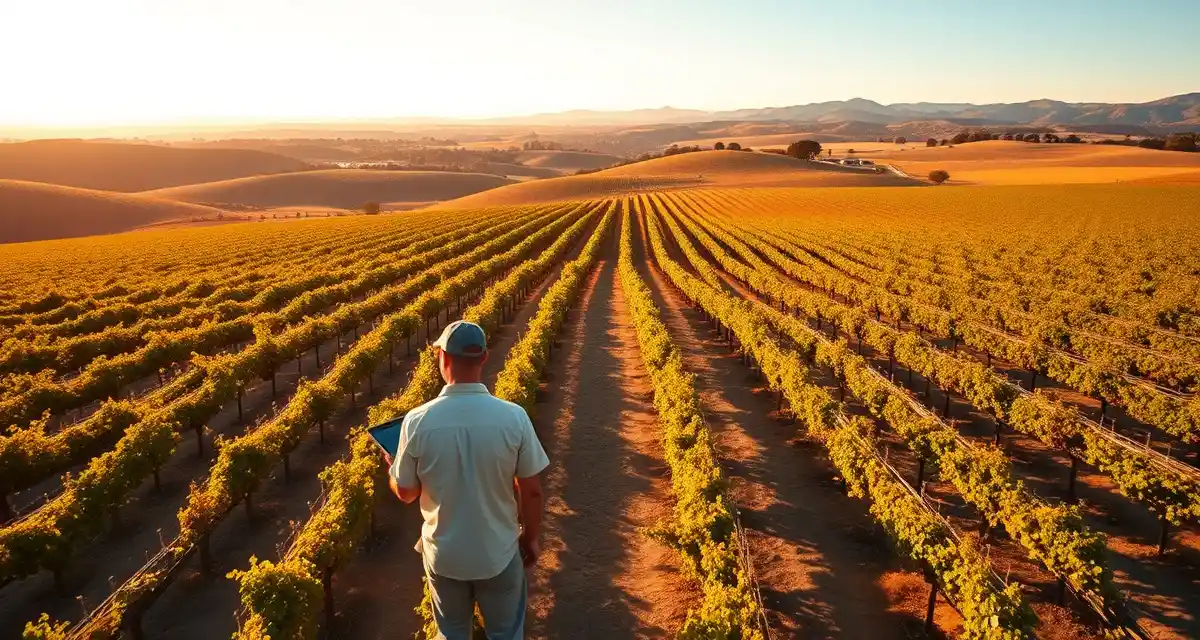
Vineyard Management Software for Paso Robles
Paso Robles has over 200 wineries with summer temperatures regularly exceeding 100°F -- and that heat creates spray program constraints that don't exist in coastal California growing regions. Paso Robles' extreme heat requires adjusted spray windows and fungicide selection compared to cooler California wine regions. Sulfur applications at 95°F+ risk phytotoxicity. Spray timing shifts to early morning to avoid heat stress applications. Application windows that work in the Russian River Valley don't work in summer Paso Robles.
VitiScribe's weather-triggered spray windows use your local Paso Robles weather station data for spray timing recommendations calibrated to the region's specific heat and aridity pattern rather than applying coastal California models to a fundamentally different climate.
TL;DR
- Sulfur phytotoxicity risk begins at 90°F -- Paso Robles Eastside AVA regularly exceeds this threshold through summer, requiring summer powdery mildew programs to rely on DMI (FRAC Group 3), SDHI (Group 7), and quinoxyfen (Group 13) rather than sulfur during heat events
- California DPR's 24-hour filing requirement applies to all Paso Robles restricted-use pesticide applications filed with the San Luis Obispo County Agricultural Commissioner -- records must include temperature, wind speed and direction, and humidity at time of application
- West Side AVA (marine-influenced, cooler) and East Side AVA (continental, hotter) have distinct disease pressure profiles -- disease management programs built for one zone don't automatically apply to the other
- Grape leafhoppers are the primary insect concern in Paso Robles, with second-generation monitoring in mid-July at 20+ nymphs per leaf threshold -- spider mites typically build to damaging populations in July-August during the hottest summer stretch
- Powdery mildew is the dominant disease management concern -- 10-14 day intervals through the season tightening to 7 days at bloom, with the critical complication that high heat temporarily reduces mildew reproduction but days flanking heat events remain at high infection risk
- Botrytis and downy mildew priority is substantially lower in Paso Robles than in coastal California, due to lower humidity and the 10-10-24 downy mildew infection criteria rarely being met during dry summers
Paso Robles' Climate and Its IPM Implications
Paso Robles sits inland from the Pacific Ocean, separated from the marine influence that moderates coastal San Luis Obispo County. The result is a continental range -- warm to hot days, cool to cold nights -- with summer temperatures that regularly exceed 100°F in the Eastside AVA and the broader Paso Robles wine district.
West Side vs. East Side: Paso Robles is divided into West Side (closer to the Santa Lucia Range, with more marine influence, cooler temperatures, and higher diurnal swings) and East Side (more continental, hotter days, broader range of heat events). Disease pressure differs between these zones.
Powdery mildew in Paso Robles: The dominant disease management concern. Paso Robles' warm days and cool nights create morning conditions favorable for powdery mildew infection even as the afternoon heat exceeds fungal infection thresholds. Programs need 10-14 day intervals through the growing season, tightening to 7 days at bloom and during cooler periods. High summer heat events above 105°F temporarily reduce powdery mildew reproductive rates -- but the days on either side of heat events maintain optimal infection conditions.
Botrytis: Lower priority than in coastal California growing regions due to Paso Robles' lower humidity. Relevant for premium red variety programs with dense clusters in years with late summer humidity events, but typically not as intensive a program as in Napa or Sonoma.
Downy mildew: Low priority in Paso Robles' arid conditions. The 10-10-24 infection criteria is rarely met during Paso Robles' dry summers. Copper programs may be minimal to absent compared to coastal programs.
Sulfur application constraints: Sulfur should not be applied when temperatures will exceed 90°F within 24 hours. In Paso Robles' summer heat, this constraint effectively limits sulfur applications to morning windows (before 10 AM) or cooler periods in spring and fall. Summer powdery mildew management in the hottest part of the season typically relies more on DMI and SDHI materials than on sulfur.
For the full FRAC group rotation framework that matters during Paso Robles' sulfur-restricted summer windows, see the fungicide FRAC groups guide.
Primary Insect Pests in Paso Robles
Grape leafhoppers: Both western grape leafhopper and variegated grape leafhopper are present in Paso Robles. Warm summer temperatures can accelerate leafhopper development and population buildup. Second-generation monitoring in mid-July at 20+ nymphs per leaf threshold.
Spider mites: European red mite and two-spotted spider mite can build to damaging populations during Paso Robles' hot summers. July-August peak pressure period with predator-to-pest ratio monitoring.
Grape berry moth: Present in Paso Robles vineyards. Three-generation management with degree day tracking from biofix.
Vine mealybug: Present in established vineyards with prior history. Crawler timing monitoring with Movento applications at peak crawler activity.
Varieties in Paso Robles Vineyards
Paso Robles' warm climate suits a broad range of varieties including many that struggle in cooler California regions:
- Red: Cabernet Sauvignon (dominant), Zinfandel, Petite Sirah, Merlot, Cabernet Franc, Grenache, Syrah, Mourvèdre, Tempranillo
- White: Chardonnay (West Side), Viognier, Roussanne, Grenache Blanc
The Rhône varieties (Grenache, Syrah, Mourvèdre, Viognier, Roussanne) thrive in Paso Robles' warm conditions and are increasingly prominent in regional production.
California DPR Compliance in San Luis Obispo County
Paso Robles vineyards fall under California DPR compliance requirements, administered locally through the San Luis Obispo County Agricultural Commissioner.
24-hour filing requirement: All spray applications must be entered in records within 24 hours. This is California's most demanding compliance timeline requirement.
County Agricultural Commissioner filing: California requires restricted-use pesticide (RUP) applications to be reported to the county agricultural commissioner within specified timeframes. San Luis Obispo County's commissioner office oversees this reporting for Paso Robles operations.
Required DPR record fields: Operator name and certificate number; application date and time; location and section/township/range (or GPS); crop; pest target; product name, EPA registration number, and active ingredient; rate and amount used; acres treated; application equipment; weather conditions (temperature, wind speed and direction, humidity).
Certified Crop Adviser (CCA) and PCA (Pest Control Adviser): California requires a licensed PCA to sign spray recommendations for restricted-use pesticides. Most Paso Robles commercial vineyard operations work with a PCA for RUP recommendations.
For the full California DPR compliance framework and county agricultural commissioner filing requirements, see the California DPR spray record requirements guide.
Building a Paso Robles Spray Program
Dormant (January-February): Dormant oil for mite control. Pruning wound protection in blocks with trunk disease history.
Budbreak (February-March): Earlier budbreak than Napa or Sonoma due to warmer climate. First powdery mildew application at 2-4 inch shoot growth. Begin with sulfur or DMI material.
Shoot elongation (March-April): 10-day intervals for powdery mildew. Begin FRAC rotation. GBM pheromone trap deployment.
Bloom (April-May): 7-day intervals. High-efficacy systemics. GBM first generation at 100-150 DD50.
Berry development (May-July): Heat monitoring for sulfur phytotoxicity risk. Powdery mildew 10-14 day intervals. Spider mite monitoring begins in June. Leafhopper second generation in mid-July.
Veraison through harvest (July-October): PHI management dominant. Late-season powdery mildew with 0-day PHI materials. Early harvest for some varieties (Chardonnay West Side as early as late July). Late harvest for Cabernet Sauvignon East Side (October in some years).
VitiScribe for Paso Robles Operations
VitiScribe connects to weather stations in the Paso Robles wine district for spray window assessment that accounts for Paso Robles' heat events. Sulfur phytotoxicity alerts notify you when forecast temperatures will make sulfur applications inadvisable in the next 24 hours. 24-hour DPR filing compliance is supported through mobile spray entry at time of application.
California vineyard management software and California DPR spray record requirements cover the broader California compliance framework.
Frequently Asked Questions
What vineyard management software works for Paso Robles heat conditions?
Paso Robles vineyards need software with local weather station integration that monitors for the heat thresholds that affect sulfur applications, spray window timing, and product efficacy in high-temperature conditions. Most vineyard management software documentation focuses on coastal California or Pacific Northwest disease challenges -- Paso Robles' extreme summer heat and semi-arid conditions require region-specific calibration. VitiScribe's Paso Robles weather station connection monitors your local conditions for heat event alerts, sulfur phytotoxicity warnings, and powdery mildew infection risk calibrated to Paso Robles' specific temperature and humidity patterns.
How should spray programs differ for Paso Robles vs. cooler California wine regions?
The primary difference is sulfur management. In coastal California (Sonoma, Santa Barbara, Monterey), sulfur can be used throughout the summer growing season because temperatures rarely exceed 90°F for extended periods. In Paso Robles, summer heat events regularly exceed the 90°F sulfur phytotoxicity threshold, requiring that summer powdery mildew management rely more on DMI (Group 3), SDHI (Group 7), and quinoxyfen (Group 13) materials that don't carry temperature restrictions. Application windows also shift -- in Paso Robles, summer spraying must happen in early morning hours before heat builds. Late morning or afternoon applications during summer heat events risk both phytotoxicity and reduced efficacy from rapid product volatilization.
How does VitiScribe handle Paso Robles weather-triggered spray windows?
VitiScribe connects to local weather stations in the Paso Robles wine district and monitors temperature, humidity, and wind forecasts continuously. The spray window planner shows 7-day conditions with flags for days when temperatures will exceed sulfur application thresholds, wind speeds are above application limits, or humidity conditions favor or limit fungicide efficacy. California DPR's 24-hour filing requirement is supported through mobile spray entry at time of application -- records entered in the field during or immediately after the application automatically satisfy the 24-hour window without requiring office follow-up.
How should Paso Robles vineyard managers document late-season PHI management when early-harvest and late-harvest blocks are in the same operation?
Paso Robles harvest windows span from late July for West Side Chardonnay through October for East Side Cabernet Sauvignon -- a range of 2 or more months in a single operation. PHI management in this context requires block-level harvest date tracking so that late-season applications are cleared for each block against its specific planned harvest date, not an average operation harvest date. A 14-day PHI material applied to Syrah on September 15 may be fine for an October 1 harvest, but not for a Chardonnay block harvested September 20 in the same sprayer run. VitiScribe tracks harvest dates by block and generates harvest clearance alerts per block when any open spray event has a PHI that extends into the planned harvest window.
What documentation should Paso Robles vineyard managers keep to support a DPR audit if sulfur phytotoxicity damage is observed?
If sulfur phytotoxicity is observed after an application, the documentation that matters most is the weather record at time of application -- specifically, the temperature forecast for the 24-hour window after application. California DPR records require weather conditions at the time of application, including temperature. If your records show you applied sulfur at 7 AM when the temperature was 68°F but the forecast reached 97°F later that day, the documented weather conditions support an understanding of the event. VitiScribe's spray records include both the weather at application time (pulled from your weather station) and the forecast conditions, providing the complete weather context that a DPR or CAC audit review would want to see. Records that show only a post-application temperature observation without context for the full-day conditions create more ambiguity than records with the full weather record.
What is Vineyard Management Software for Paso Robles?
[FAQ_ANSWER_PLACEHOLDER: This answer needs to be generated by AI with specific data, examples, and actionable advice relevant to Vineyard Management Software for Paso Robles. Target 50-150 words.]
How much does Vineyard Management Software for Paso Robles cost?
[FAQ_ANSWER_PLACEHOLDER: This answer needs to be generated by AI with specific data, examples, and actionable advice relevant to Vineyard Management Software for Paso Robles. Target 50-150 words.]
How does Vineyard Management Software for Paso Robles work?
[FAQ_ANSWER_PLACEHOLDER: This answer needs to be generated by AI with specific data, examples, and actionable advice relevant to Vineyard Management Software for Paso Robles. Target 50-150 words.]
What are the benefits of Vineyard Management Software for Paso Robles?
[FAQ_ANSWER_PLACEHOLDER: This answer needs to be generated by AI with specific data, examples, and actionable advice relevant to Vineyard Management Software for Paso Robles. Target 50-150 words.]
Who needs Vineyard Management Software for Paso Robles?
[FAQ_ANSWER_PLACEHOLDER: This answer needs to be generated by AI with specific data, examples, and actionable advice relevant to Vineyard Management Software for Paso Robles. Target 50-150 words.]
How long does Vineyard Management Software for Paso Robles take?
[FAQ_ANSWER_PLACEHOLDER: This answer needs to be generated by AI with specific data, examples, and actionable advice relevant to Vineyard Management Software for Paso Robles. Target 50-150 words.]
Sources
- California Department of Pesticide Regulation (CDPR)
- UC Cooperative Extension Viticulture
- San Luis Obispo County Agricultural Commissioner
- American Vineyard Foundation
- Wine Institute
Get Started with VitiScribe
Paso Robles powdery mildew programs require FRAC rotation across Groups 3, 7, and 13 during summer heat-restricted sulfur windows, California DPR's 24-hour filing with weather conditions including temperature and wind, and block-level PHI tracking across a 2+ month harvest window -- compliance obligations that generic spray logs handle poorly for a region with Paso Robles' specific heat constraints. VitiScribe's Paso Robles weather station connection alerts you to sulfur phytotoxicity risk before applications, auto-populates weather conditions for DPR records, and tracks harvest clearance per block across the extended harvest window. Try VitiScribe free and build your first Paso Robles-calibrated spray program today.