Petiole sampling records and how to link results to fertilization decisions

TL;DR
- Petiole sampling measures nutrient concentrations in grapevine leaf stems at two growth stages: bloom and veraison.
- Labs report results in parts per million or percent dry weight.
- You compare those numbers against published sufficiency ranges, then adjust fertilizer timing, rate, and product.
- Accurate records of samples, results, and applications are required for most state nutrient and pesticide programs.
What is petiole sampling and why does it matter for vineyard nutrition?
A petiole is the small stem that connects a grape leaf to the cane. Send petioles to a lab and the analysis tells you the actual nutrient status of the vine the moment you sampled, not a guess pulled from soil type or last year's application rates. That distinction matters. Grapevine nutrient uptake is shaped by soil pH, rootstock, irrigation scheduling, and organic matter, none of which you can fully predict from a bag of soil.
The most-used reference framework in the western United States comes from UC Davis and UC Cooperative Extension, which publish sufficiency ranges for bloom-stage and veraison-stage petioles covering nitrogen, phosphorus, potassium, calcium, magnesium, boron, zinc, manganese, iron, and copper [1]. WSU Extension publishes similar tables for Washington and Oregon growing conditions [2]. Cornell Cooperative Extension covers eastern varieties and hybrid-specific adjustments [3]. These are peer-reviewed thresholds built from field trials, not vendor recommendations.
Petiole testing does not replace soil testing. It adds a layer. Soil tests tell you what is in the ground. Petiole tests tell you what the vine is actually absorbing. Some growers skip soil testing entirely, which is a mistake, but if you can only afford one test type a year, petiole sampling gives you a more direct window into vine health.
When should you collect petiole samples from grapevines?
There are two standard collection windows, and mixing them up makes your data useless.
The first is at bloom, defined as when 50 percent of the flower caps have fallen, typically 60 to 70 days after budbreak depending on variety and region [1]. You collect the petiole from the leaf opposite the basal cluster. Bloom-stage samples are best for diagnosing nitrogen, potassium, and zinc status.
The second window is at veraison, when berries begin to soften and color. You use the same leaf position: opposite the basal cluster. Veraison samples read potassium, magnesium, boron, and calcium better because some nutrients shift a lot between bloom and fruit set.
Sample outside these windows and your numbers won't match published thresholds, so comparisons become meaningless. A few labs will run mid-season samples if you ask, but they'll tell you the same thing: the sufficiency ranges don't apply unless you hit the right phenological stage.
Sample size matters too. UC Davis recommends a minimum of 60 to 75 petioles per sample block, collected from representative vines spread across the block, avoiding vines near roads, irrigation system endpoints, or known soil anomalies [1]. That 60-to-75 number is not arbitrary. It gives the lab enough material for a statistically meaningful composite.
How do you collect and submit petiole samples correctly?
Collection technique affects results more than most growers expect. Strip the leaf blade cleanly from the petiole with a sharp sideways pull. Do not send the blade. The blade dilutes the nutrient signal in ways the lab can't fully correct for [1].
Put the petioles into a clean paper bag, never plastic. Moisture trapped in plastic causes rapid decomposition and inflated nitrogen readings. Label each bag right away with the block ID, variety, rootstock, date, and collection time. Sampling several blocks in one morning? Keep them completely separate from first cut to mail drop.
Ship samples the same day you collect. If you can't, store them in a refrigerator overnight, not a freezer. Most university-affiliated labs and commercial labs (Midwest Laboratories, A&L Western Laboratories, and similar) accept petioles and turn results in five to ten business days. Some offer a rush option for around double the standard fee, which currently runs roughly $30 to $60 per sample for a standard panel [4].
Log the chain of custody in your records at the time of collection, not later. Record who sampled, the exact block boundaries used, vine count, GPS coordinates if your operation tracks those, and the lab confirmation number when it comes back. This detail is what connects your result to a specific block and a specific year, which matters when you look back three seasons later trying to understand a potassium trend.
How do you read a petiole lab report?
Labs report macronutrients like nitrogen, phosphorus, and potassium as percent dry weight. Micronutrients like zinc, boron, manganese, and iron come back as parts per million (ppm). A typical bloom-stage report might show nitrogen at 1.20 percent, potassium at 2.10 percent, and zinc at 28 ppm.
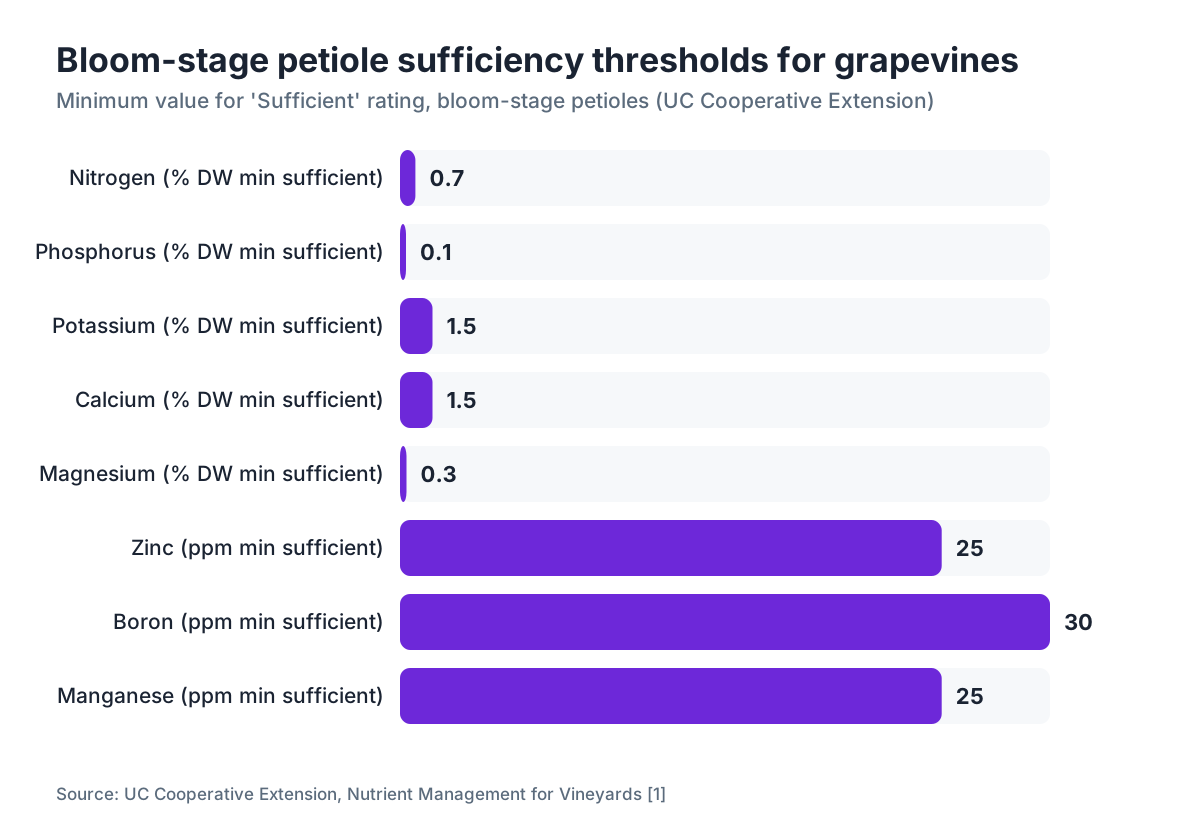
Here is a condensed reference table for bloom-stage petiole sufficiency ranges based on UC Cooperative Extension guidelines [1]:
| Nutrient | Deficient | Low | Sufficient | High | Excess |
|---|---|---|---|---|---|
| Nitrogen (% DW) | <0.50 | 0.50-0.70 | 0.71-1.10 | 1.11-1.40 | >1.40 |
| Phosphorus (% DW) | <0.10 | 0.10-0.14 | 0.15-0.40 | 0.41-0.60 | >0.60 |
| Potassium (% DW) | <1.00 | 1.00-1.49 | 1.50-2.50 | 2.51-3.50 | >3.50 |
| Calcium (% DW) | <1.00 | 1.00-1.49 | 1.50-3.50 | 3.51-4.50 | >4.50 |
| Magnesium (% DW) | <0.20 | 0.20-0.29 | 0.30-0.80 | 0.81-1.00 | >1.00 |
| Zinc (ppm) | <15 | 15-24 | 25-50 | 51-70 | >70 |
| Boron (ppm) | <20 | 20-29 | 30-60 | 61-80 | >80 |
| Manganese (ppm) | <20 | 20-24 | 25-200 | 201-500 | >500 |
These are general ranges. Your lab's printed ranges may differ slightly because they use different reference datasets or regional calibrations. When in doubt, ask the lab which source population their thresholds come from.
Don't react to a single result in isolation. One year's bloom sample at the low end of sufficient for potassium is not an emergency. Two years running at deficient, combined with visible symptoms, is a different situation. The record-keeping system you use needs to make multi-year comparison easy, not something you reconstruct from scattered spreadsheet tabs.
How do you link petiole results directly to fertilization decisions?
This is where most operations fall short. The lab sends a PDF, you look at it, and then you either panic and apply everything at once or file it and forget it. Neither approach is sound.
Start with the nutrient that is most deficient relative to sufficiency. If nitrogen sits at 0.60 percent at bloom (low) but potassium reads 2.10 percent (sufficient), address nitrogen first. Applying more potassium when it's already sufficient risks pushing calcium and magnesium down through antagonistic uptake competition.
For nitrogen specifically, most UC and WSU guidelines for wine grapes suggest that bloom-stage petiole nitrogen below 0.70 percent calls for a soil-applied nitrogen correction the following spring, or a split application in the current season via fertigation if you have drip [1][2]. Yeast-assimilable nitrogen (YAN) targets in the winery factor in here too. Some winemakers push for higher vine nitrogen to improve YAN. Others, particularly for high-end Pinot Noir, actively want low vine nitrogen to hold back vegetative growth. Get that conversation with your winemaker on record before you act.
For potassium deficiency (below 1.50 percent at bloom), soil pH and cation exchange capacity both shape your response. On high-pH soils above 7.5, potassium availability drops even when soil reserves are decent. A foliar potassium application at bloom or shortly after corrects an in-season deficiency faster than soil applications because of uptake speed. WSU Extension notes that potassium sulfate is generally preferred over potassium chloride in vineyards because chloride accumulation can affect wine quality [2].
Zinc deficiency is one of the most common micronutrient problems in California and Pacific Northwest vineyards, particularly on sandy or high-pH soils [1]. Bloom-stage zinc below 25 ppm usually warrants a zinc sulfate or zinc chelate foliar application the following season, timed at budbreak or early shoot growth before bloom, not at bloom itself when you're reading the deficiency. The gap between detection and correction is a real management challenge, which is exactly why multi-year records matter.
Boron deficiency (below 30 ppm at bloom) correlates with poor fruit set and shatter. A single foliar boron application at early bloom, using sodium borate or solubor at label rates, often corrects the problem. But boron has one of the narrowest margins between deficiency and toxicity of any micronutrient in grapevines, so don't apply it speculatively. Let the petiole data tell you before you apply.
Record every decision: which nutrient was outside range, what product you chose, what rate, what date you applied it, and how the equipment was calibrated. This closes the loop between the petiole result and the field action. Without that record, you have no way to judge whether the application worked when you run next year's samples.
What records do you need to keep for petiole sampling and fertilization?
A complete petiole and fertilization record should contain, at minimum: block ID and acreage, variety and rootstock, sample date and phenological stage at collection, lab name and sample ID, test results by nutrient with units clearly noted, the sufficiency range used as the comparison standard, the fertilizer or amendment product name and EPA registration number if applicable, application rate and method, applicator name, and date applied.
Fertilizer applications generally don't trigger federal pesticide record-keeping under FIFRA unless the product carries a pesticide label. Many states require nutrient management records under their own water quality programs, though. California's Irrigated Lands Regulatory Program (ILRP), administered by the State Water Resources Control Board, requires growers in many regions to document fertilizer nitrogen applications and may require a Farm Nutrient Management Plan depending on your region and water body [5]. Oregon and Washington run similar programs under their agricultural water quality acts [6].
The EPA Worker Protection Standard (WPS) does not directly govern fertilizer applications, but it does apply to any pesticidal nutrient product (a product registered as both a fertilizer and a pesticide). If you're applying copper-based fungicides for disease control and counting it as a micronutrient amendment, that product falls under the WPS and requires training records for any handler or early-entry worker [7].
Keep records for at least three years. Some state programs require five. If you're in an organic certification program, the National Organic Program requires records sufficient to demonstrate compliance for five years [8]. Your certifier will ask for them.
Operations using a digital field records platform, like VitiScribe, can link petiole result uploads directly to block records and flag out-of-range nutrients against stored thresholds, which cuts the time between lab report and application decision from days to hours.
How do multi-year petiole records change how you make fertilization decisions?
One year of data tells you where you are. Three years of data tells you where you're going.
A single bloom-stage nitrogen reading at 0.68 percent (low) might mean the vine was under stress that week from a heat event or a temporary soil moisture deficit. Three consecutive years at 0.65 to 0.70 percent is a pattern that needs correction. Multi-year records also let you judge whether your fertilizer applications are actually working. Apply 20 pounds of actual nitrogen per acre via fertigation in June two years ago, watch the following bloom reading climb from 0.66 to 0.82 percent, and you've got a measurable response you can use to calibrate future rates.
Potassium is the one to track hardest over time in high-yielding blocks. Potassium removal in harvested fruit runs between 1 and 3 pounds per ton depending on variety and cluster weights, which adds up fast in a block producing 6 to 8 tons per acre [2]. Without replacement, you'll see a slow downward trend in veraison-stage potassium readings across five to ten years even if bloom readings look fine.
Some growers graph their petiole data by block and year in a simple spreadsheet. Others use field records software with built-in charting. Either works, as long as you're actually reading the trend and doing more than archiving PDFs.
How does petiole sampling differ from tissue testing and soil testing?
These three test types measure different things, and none fully substitutes for the others.
Soil testing measures nutrient stocks and availability potential in the root zone. It's the baseline. A soil test showing adequate potassium doesn't guarantee the vine is absorbing it, because pH, moisture, and rootstock uptake efficiency all intervene. Soil tests earn their keep for planning lime or gypsum applications and for reading cation exchange capacity before you adjust a nutrient program.
Tissue testing is a broad term that includes petiole sampling but also blade (leaf lamina) testing and, in some contexts, whole-shoot or berry analyses. Petiole samples concentrate the transport stream of the vine, so they tend to show nutrient deficiencies more clearly and sooner than blade samples for most macronutrients. Iron is the exception. Blade chlorosis and visual symptoms often show up before the petiole reading drops below the deficient threshold, because the vine moves iron inefficiently under high-pH stress regardless of soil iron content.
Use all three in combination for the best picture: soil tests every two to three years, petioles every year at bloom and at least periodically at veraison, and blade visual assessment throughout the season as a fast early-warning system.
What are the most common mistakes growers make with petiole sampling?
Sampling at the wrong phenological stage is the single most common problem. A grower sampling two weeks before bloom, or two weeks after, generates numbers that don't map to any published sufficiency range. The result is confusion, not insight.
Collecting the wrong plant part is second. Sending blades instead of petioles, or mixed blade-and-petiole material from a rushed collection, contaminates the sample. Some labs flag this on the report if organic matter or mineral composition looks off, but most won't catch it.
Sampling near atypical vines is a frequent source of misleading results. Vines next to a road, downhill of a repair excavation, or near the start of a drip line see different soil conditions than the block as a whole. Skip them on purpose.
Acting on a single nutrient without checking antagonistic relationships is a real management risk. Large amounts of potassium sulfate can suppress magnesium and calcium uptake. Excessive phosphorus can tie up zinc. The UC Davis nutrient management guidelines for grapevines address these interactions directly [1].
And then there's the classic: not recording the application that follows the diagnosis. Skip that and you can't tell whether your program is working. The sampling and the application record have to exist as a linked pair.
How do organic and conventional fertilization decisions differ based on petiole results?
The interpretation of petiole results is identical regardless of your production system. A zinc reading of 18 ppm at bloom is deficient whether you're certified organic or conventional. What changes is the product menu you can reach for.
For organic operations, nitrogen sources are limited to products on the National Organic Program's National List of Allowed and Prohibited Substances, which includes feather meal, blood meal, fish emulsion, composted manure, and certain other materials [8]. None of these release nitrogen as fast as urea or calcium nitrate, so the timing math is different. If your bloom-stage nitrogen reading is low, a soil-applied organic nitrogen source in early spring the following year is your main lever, because in-season correction with fast-release nitrogen is mostly off the table.
For zinc, both organic and conventional programs can use zinc sulfate foliar sprays, which are allowed under organic certification when other practices aren't sufficient [8]. Chelated zinc forms (EDTA-chelated) are generally not allowed for organic use. Zinc chelated with lignosulfonate or citrate may be allowed depending on your certifier's interpretation.
Copper is allowed as a fungicide in organic systems but is subject to accumulation limits in many certifying programs and some state environmental regulations. If you're counting copper as a micronutrient input, track cumulative applications carefully and keep those records with your petiole data so you can see whether copper petiole levels are climbing toward excess (above 30 to 40 ppm at bloom) [1].
How should you store and organize petiole records for compliance and audit readiness?
Audits and inspections rarely give much notice. Records you can actually find in under five minutes are not a luxury. They're basic operational competence.
Organize records by year, block ID, sample type (bloom vs. veraison), and application event linked to each sample. A folder structure on a shared drive works if everyone uses it consistently. Field records software with block-level data attachment works better, because results and applications stay tied to a specific geographic unit rather than a filename you have to remember.
For state pesticide record requirements, most states require that pesticide application records (which may include pesticide-registered nutrient products) be available for inspection on request and kept for a minimum of two years, though some states require three or more. California's DPR requires licensed pest control advisers (PCAs) to retain written recommendations for two years [9]. Oregon's pesticide record-keeping rule requires growers to keep records for two years after application [6].
For organic certification, the National Organic Program expects records kept for five years and made available to the certifier on request [8]. If you're working with a CCOF, Oregon Tilth, or OTCO certifier, they'll spell out their specific expectations during your annual inspection.
VitiScribe was built around this exact compliance need: linking the lab result to the block, the block to the application record, and making the whole chain exportable for a state inspector or organic certifier who shows up in the morning.
Frequently asked questions
How many petioles do you need to collect per vineyard block?
UC Davis recommends a minimum of 60 to 75 petioles per sample block, pulled from representative vines spread across the block. More vines sampled means a better composite. For large or variable blocks, some advisors split the block into zones and submit separate samples, which gives you more spatial resolution on nutrient status.
Can you do petiole sampling yourself or do you need a certified consultant?
Most growers collect their own petioles without a licensed consultant. The technique is straightforward as long as you hit the right phenological stage, collect the right plant part, and use clean paper bags. A licensed PCA or certified crop adviser (CCA) adds value in interpreting marginal results and designing the corrective fertilization plan, particularly when multiple nutrients are out of range at once.
How long does it take to get petiole lab results back?
Standard turnaround at most commercial labs runs five to ten business days from sample receipt. Rush service, available at some labs for roughly double the fee, can return results in two to three business days. Ship samples the same day you collect them to avoid degradation, and account for shipping time when planning your collection date relative to when you need results.
What does a petiole test cost?
A standard petiole analysis panel covering major macro and micronutrients runs roughly $30 to $60 per sample at most commercial labs, based on 2024 pricing from labs including A&L Western and Midwest Laboratories. Rush processing adds approximately $20 to $40. If you're sampling ten blocks at two timings per year, budget $600 to $1,200 for lab fees alone.
How do petiole nitrogen results connect to yeast-assimilable nitrogen (YAN) targets?
High vine nitrogen at veraison generally correlates with higher YAN in juice, though the relationship is not perfectly linear. Winemakers targeting YAN above 200 mg/L for fermentation safety sometimes push for bloom-stage petiole nitrogen in the upper-sufficient range. Growers making premium low-intervention wines may deliberately keep nitrogen low. Align with your winemaker before the growing season, and document that agreed-upon target in your records alongside the petiole results.
What is the difference between bloom-stage and veraison-stage petiole sampling?
Bloom-stage samples, collected when 50 percent of flower caps have fallen, are best for diagnosing nitrogen, phosphorus, zinc, and overall nutrient status early enough to act in-season. Veraison samples track potassium, magnesium, calcium, and boron better as the berry fills. Many operations run both. If you can only afford one, bloom-stage samples give you more management options because there's still time to act.
Can you apply foliar fertilizers based on petiole results and still fix a deficiency in the same season?
For some nutrients, yes. Zinc and boron deficiencies identified at bloom can be partially corrected with foliar applications in the same season, though full correction usually shows up in the following year's results. Nitrogen foliar applications have limited practical effect on petiole nitrogen readings. Potassium foliar sprays can modestly lift mid-season potassium levels. In general, soil-applied corrections take one to two seasons to fully appear in petiole data.
Do petiole records need to be kept for organic certification?
Yes. The USDA National Organic Program requires certified operations to keep records that fully disclose all activities and transactions for five years. This includes input applications tied to petiole-based decisions. Your organic certifier will review application logs, product labels, and the rationale for inputs, so connecting petiole results to fertilization decisions in writing strengthens your audit file significantly.
What happens if your petiole potassium is too high?
Excess potassium (above 3.50 percent at bloom by UC Davis standards) can suppress calcium and magnesium uptake through cation competition, which can contribute to poor fruit set or uneven ripening. If you're already high, stop all potassium inputs and let vine demand draw it down over one to two seasons. High potassium in grapes also raises juice pH, a wine chemistry concern worth flagging with your winemaker.
How do rootstock differences affect petiole interpretation?
Rootstock genotype affects nutrient uptake efficiency, particularly for potassium, phosphorus, and iron. SO4 and 5BB rootstocks are known for high potassium uptake relative to 110R or 140Ru, which have deeper root systems better suited to dry conditions. When comparing petiole results across blocks with different rootstocks, the same application rate can produce very different readings. WSU and UC Davis extension publications both note rootstock-specific uptake differences [1][2].
What state programs require grapegrowers to document fertilizer applications?
California's Irrigated Lands Regulatory Program (ILRP) requires many growers to document nitrogen applications and may require a Nutrient Management Plan. Oregon and Washington run agricultural water quality programs with similar documentation requirements. These programs vary by region, water body proximity, and operation size. Check with your local agricultural commissioner or state Department of Agriculture for the rules specific to your county and water quality coalition.
Is there a right way to track petiole results across multiple vintages?
Use a consistent format every year: block ID, sample date, phenological stage, lab ID, results by nutrient, and the sufficiency range used for comparison. A simple spreadsheet with one row per sample-event works if you actually maintain it. Software that links results to block records and lets you graph trends over time is better for operations with more than five or six blocks, because manual cross-referencing gets unwieldy fast.
Sources
- UC Cooperative Extension, Nutrient Management for Vineyards: Bloom-stage and veraison-stage petiole sufficiency ranges for grapevines including N, P, K, Ca, Mg, Zn, B, Mn; minimum 60-75 petioles per sample; collection technique guidance
- Washington State University Extension, Grapevine Nutrition: Potassium removal in harvested fruit runs 1-3 lbs per ton; potassium sulfate preferred over potassium chloride in vineyards; rootstock uptake differences noted
- Cornell Cooperative Extension, Viticulture and Enology: Eastern variety and hybrid-specific petiole interpretation guidance for northeastern growing conditions
- A&L Western Laboratories, Agricultural Testing Services: Commercial petiole analysis panel pricing range of approximately $30-$60 per sample for standard nutrient panel
- California State Water Resources Control Board, Irrigated Lands Regulatory Program: California ILRP requires growers in covered regions to document fertilizer nitrogen applications and may require a Farm Nutrient Management Plan
- Oregon Department of Agriculture, Pesticide Record-keeping and Agricultural Water Quality: Oregon pesticide record-keeping rule requires growers to maintain application records for two years after application
- U.S. EPA, Worker Protection Standard for Agricultural Pesticides: EPA Worker Protection Standard applies to pesticidal products including copper-based products registered as both fungicides and micronutrient amendments; handler and early-entry worker training records required
- USDA Agricultural Marketing Service, National Organic Program: NOP requires certified operations to retain records for five years; National List governs allowed nitrogen sources including feather meal, blood meal, fish emulsion; zinc sulfate foliar sprays allowed when other practices insufficient
- California Department of Pesticide Regulation, Pesticide Use Reporting: Licensed pest control advisers in California must retain written pesticide recommendations for two years
Last updated 2026-07-10