Petri disease in grapevines: causes, symptoms, and what actually works
TL;DR
- Petri disease is a nursery-transmitted vascular disease of grapevines caused mainly by Phaeomoniella chlamydospora and Phaeoacremonium species.
- It stunts and kills young vines, usually within one to three years of planting.
- There is no cure once infection is systemic.
- Hot-water treatment of cuttings and clean pruning practices are the only tools that consistently work.
What exactly is Petri disease and why does it matter so much for young vines?
Petri disease is a wood disease of grapevines named after Lionello Petri, the Italian plant pathologist who first described it in 1912. A complex of fungi causes it. The two you'll hear most are Phaeomoniella chlamydospora (Pa. chlamydospora) and several Phaeoacremonium species, with Pm. minimum (formerly Pm. aleophilum) showing up most often in California and other big wine regions [1].
The disease goes after young vines hard. Infected planting material usually looks fine at establishment. Then, within one to three growing seasons, the vine collapses from internal vascular damage. That delay is the trap. You may not know your block went in with compromised material until you've already paid for establishment, trellis, and two years of irrigation.
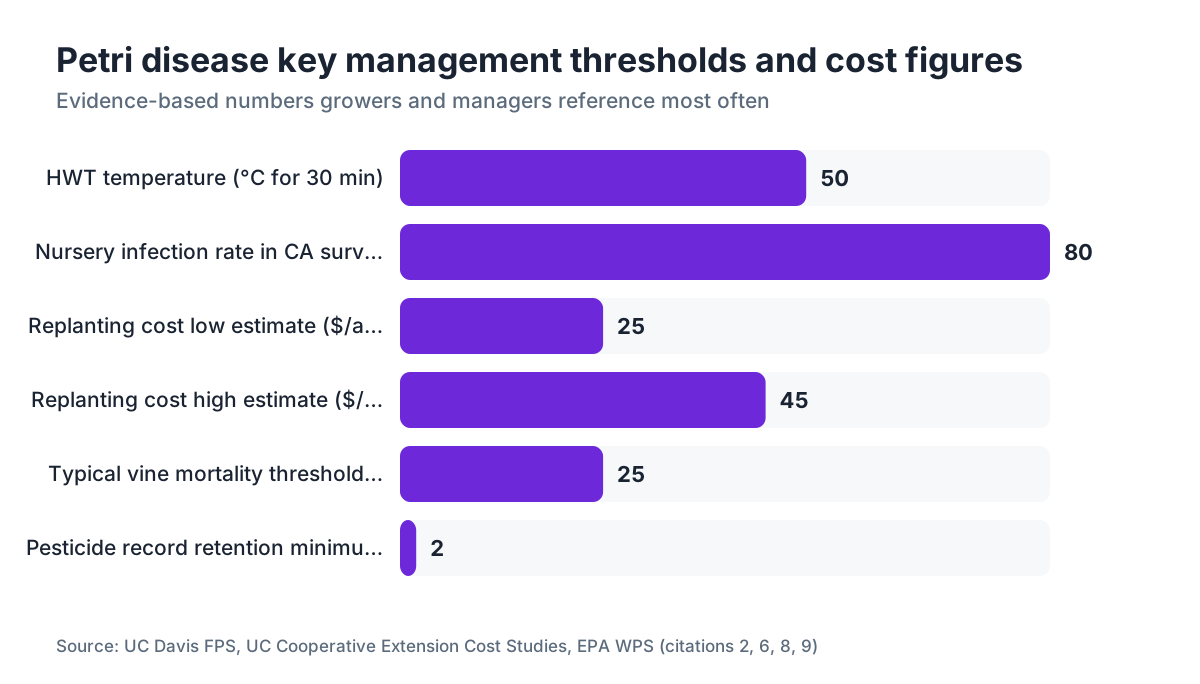
Loss estimates swing by region and survey method. A 2001 UC Davis survey of California nurseries found Pa. chlamydospora in 80% of grapevine planting material examined [2]. That number has probably dropped as clean plant programs grew, but nobody has reliable current national infection rates. What holds across studies: Petri disease is the leading cause of young vine decline worldwide, ahead of even Phytophthora root rot in many regions.
Petri disease sits inside the esca disease complex, alongside esca proper and black measles, which all involve related wood-rotting and vascular fungi. What sets it apart is age. Petri disease hits vines under five years old, not mature vineyards.
What fungi cause Petri disease in grapevines?
Two pathogens do most of the damage: Phaeomoniella chlamydospora and Phaeoacremonium minimum. Both are slow-growing ascomycete fungi that colonize the xylem vessels and stain the wood dark brown to black [1].
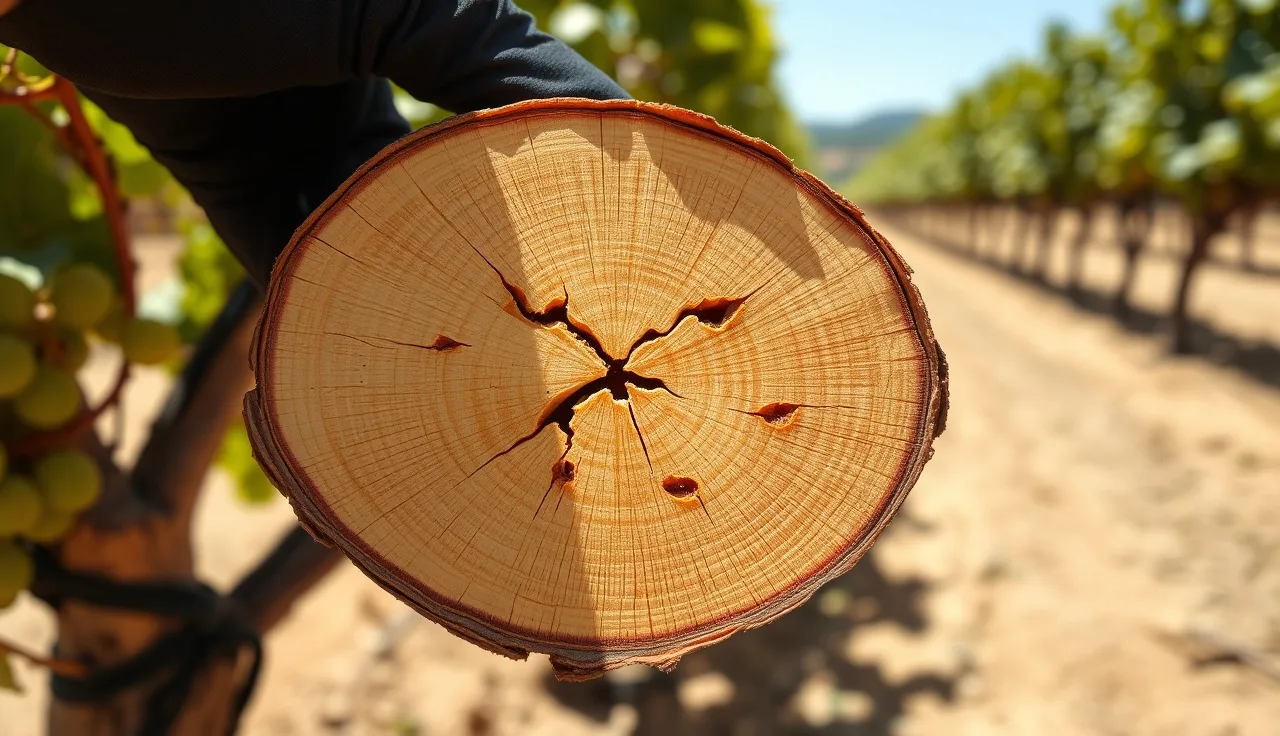
Pa. chlamydospora produces gummy exudates that physically plug water transport through the xylem. Cross-section infected wood and you'll see the dark discoloration. Pm. minimum goes with wood necrosis and a reddish-brown to dark streaking pattern that runs the length of canes and rootstock.
At least a dozen other Phaeoacremonium species have been recovered from symptomatic vines across various studies, and their virulence varies a lot. Inoculated alone in controlled trials, Pa. chlamydospora consistently causes the worst vascular dysfunction [3]. Pm. minimum tends to drive more leaf symptoms once it reaches systemic levels.
Both pathogens make conidia (spores) that spread by water splash and airborne dispersal. Pruning wounds are the main infection court, but grafting cuts and root wounds during nursery propagation are just as important as entry points. The fungi survive in wood debris in the soil for years. That's why replanting a block that had Petri disease, with no soil management, is genuinely risky.
A third genus, Cadophora luteo-olivacea, sometimes turns up alongside the two primary pathogens and may add to symptom severity in co-infections. It's considered secondary.
What are the symptoms of Petri disease, and how do you tell it apart from other young vine problems?
The above-ground symptoms are frustratingly generic. Affected vines show stunted growth, small chlorotic leaves, short internodes, and wilting that moves from shoot tips downward. A vine may push growth in spring, then collapse mid-season. That pattern looks a lot like Phytophthora root rot, nutrient deficiency, or plain graft failure.
The telling sign is internal. Cut the trunk or a cane cross-sectionally and look for dark brown to black vascular discoloration, often a ring or sector of staining in the wood. In Pa. chlamydospora infections you'll usually see dark gummy spots where xylem vessels are blocked. Pm. minimum infections tend to show longer streaks running with the grain rather than the symmetric ring [3].
In some vines you'll find tiny black pycnidia (spore-producing structures) on the surface of infected nursery cuttings or dormant wood. They're hard to see without magnification, but they confirm active colonization.
Here's how the common causes of young vine decline sort out:
| Cause | Trunk cross-section sign | Roots | Confirmation method |
|---|---|---|---|
| Petri disease (Pa. chlamydospora) | Dark vascular ring/spots, gummy exudate | Usually intact | Isolation on PDA or PCR |
| Petri disease (Pm. minimum) | Brown-red longitudinal streaking | Usually intact | Isolation or PCR |
| Phytophthora root rot | Little or no wood staining | Brown, rotted | Baiting or ELISA |
| Graft union failure | Callus tissue dead or absent | Normal | Visual inspection |
| Crown gall | Galls at union or crown | Normal | Visual/PCR for Agrobacterium |
| Nutrient deficiency | No staining | Normal | Tissue and soil test |
Get lab confirmation the first time you see a suspected case in a block. UC Davis Cooperative Extension provides diagnostic services, and UC Davis plant pathology has published PCR protocols for telling Pa. chlamydospora apart from Phaeoacremonium species [2]. Washington State University Extension offers regional diagnostic support in Pacific Northwest appellations [4].
How does Petri disease spread and get into a vineyard?
Infected nursery stock is the most common source. Propagation facilities that use infected mother vines or contaminated equipment can turn out cuttings carrying the pathogen before a single bud breaks [1]. The fungi live inside the wood, so they're invisible at planting. Hot-water treatment (HWT) of dormant cuttings before grafting was built specifically to deal with nursery contamination.
Once vines are in the ground, natural spread runs through pruning wounds. Rain splash and probably airborne conidia carry spores from infected debris to fresh cuts. Timing matters here. Cuts made during dry weather that dry quickly get infected less often than cuts left wet and open during cool, moist conditions [5]. California research points to a simple guideline: don't prune during rain events, and prune when vines can be expected to callus over within a few days.
Root contacts and soil carryover from earlier infected plantings are possible routes, but they're less well documented than nursery transmission and pruning-wound infection. The practical takeaway is blunt. Even a well-run vineyard can get Petri disease through legally purchased planting material.
Cross-contamination on pruning equipment is real. Shears moving between symptomatic and healthy vines can deposit viable conidia, though Petri disease pathogens are generally less aggressive on shears than Eutypa lata or Botryosphaeria species. Sterilizing shears between vines is good practice but hard to pull off at scale. A reasonable compromise: sterilize between rows or blocks, especially where you know infected vines exist.
Which treatments actually work for Petri disease, and which are mostly wishful thinking?
Start with the honest answer. No systemic fungicide eliminates an established Petri disease infection. Once Pa. chlamydospora is colonizing the xylem, you're not curing that vine. Management is about prevention and slowing progression.
Hot-water treatment of dormant cuttings before grafting has the most evidence behind it. The standard protocol is 50°C for 30 minutes, which cuts pathogen load without killing the cutting [6]. UC Davis has published detailed HWT protocols, and the UC Foundation Plant Services program uses HWT as part of its certified clean plant pathway. This is the single most important control point in the whole disease cycle.
Pruning wound protectants are the second tier for established vineyards. Products based on Trichoderma harzianum (biological) or registered fungicides like thiophanate-methyl have shown partial efficacy in trials at cutting new pruning-wound infections [5]. Partial is the operative word. Wound paint applied after every cut reduces incidence. It doesn't zero it out. Cornell University's viticulture extension team has field trial data from New York showing Trichoderma-based products reduced infection frequency at pruning wounds versus untreated controls [7].
For already-infected young vines, remedial surgery (cutting below the visible staining and regrafting or retraining a sucker) can save a vine if you catch it early and the infection hasn't reached the rootstock. It's labor-intensive and only pencils out if the vine is in year two and you'd otherwise replant. In practice, vines with severe symptoms usually get pulled and replaced.
Growing-season fungicide spray programs do nothing for Petri disease. The pathogens are inside the wood, not on the surface. This is a common misunderstanding and a real waste of money if someone is running preventive sprays aimed at Petri disease.
Soil fumigation before replanting gets used when Petri disease is suspected to have soil carryover, but the evidence for efficacy against these specific pathogens in soil is weak. The main payoff from fumigation in replant situations usually runs to nematodes and Phytophthora, not Petri disease fungi.
What does hot-water treatment involve and what are the nursery sourcing steps growers should take?
Hot-water treatment means immersing dormant cuttings or grafted vines in a temperature-controlled bath at 50°C for 30 minutes before they're callused and rooted in the nursery [6]. The treatment kills or suppresses Pa. chlamydospora and Phaeoacremonium species without hurting bud viability when it's done right. Temperature control is the whole game. 49°C is less effective; 51°C starts injuring the cutting.
In California, the Foundation Plant Services (FPS) program at UC Davis runs a certified clean plant program that includes HWT and indexing for multiple pathogens. Requesting cuttings from FPS-registered sources is the most direct way to reduce nursery transmission risk [2]. Similar programs exist in other major wine states.
For growers, the sourcing checklist looks like this:
- Ask your nursery specifically whether cuttings were hot-water treated and what protocol they used.
- Request nursery inspection records or certification documentation.
- Source from FPS-registered nurseries or equivalent state-certified clean plant programs when the variety is available.
- Inspect a sample of incoming material by cross-sectioning several canes before planting.
This is one area where homework before you sign the nursery contract actually changes the outcome. Asking for documentation isn't being difficult. It's standard practice in regions that have learned from high-incidence events.
When you're tracking planting material provenance, certification numbers, and compliance records across multiple blocks, a purpose-built record system keeps those details retrievable for compliance and future block diagnostics. VitiScribe's field operations platform includes planting material documentation fields for exactly this reason, because nursery source traceability matters years later when you're trying to work out why a block is underperforming.
How should you manage pruning practices to reduce Petri disease infection risk?
Pruning timing is the most controllable factor you have. Research from UC Davis and other Mediterranean-climate institutions consistently shows lower infection rates when cuts are made during dry conditions and can dry within 24 to 48 hours [5]. In wet climates like Oregon's Willamette Valley or New York's Finger Lakes, that's genuinely hard to arrange, but even delaying pruning a few days after rain shortens the wound's wet window.
Delayed pruning, also called late pruning or double pruning, is a two-pass approach. You make rough cuts early, leaving long canes, then come back with precise cuts closer to bud swell. The long canes dry and callus partially, so your final cuts land on material that's closer to pushing. The wound sits exposed for a shorter stretch before callus formation kicks in. Cornell Extension covers this method in its wood disease management guidance [7].
Wound protection products applied right after cutting add another layer. Registered options include:
- Thiophanate-methyl-based wound paints (several registrations exist; check current EPA registration status for your state)
- Trichoderma harzianum products (e.g., Vintec in some markets)
- Latex-based sealants (some evidence for physical exclusion, less for biological effect)
Application logistics are the real barrier. Painting every cut in a mature vineyard during mechanized operations is nearly impossible. A tiered approach makes more sense. Protect cuts on high-value varieties and newly established vines religiously, and focus on large pruning wounds (spurs removed, cordon restructuring) where wound surface area is greatest.
Equipment sterilization between infected and healthy vines matters more for Eutypa lata than Petri disease specifically, but it does no harm and the habit is good. A 70% ethanol or 1% sodium hypochlorite solution works for shears [8].
What does Petri disease cost economically, and how bad can a vineyard outbreak get?
Replanting a single acre of California wine grape vineyard costs $25,000 to $45,000, depending on variety and trellis system, based on UC Cooperative Extension cost-of-production studies [9]. That figure leaves out the three-to-five-year revenue gap while the replanted block comes into production.
Petri disease rarely wipes out a whole block at once. More often you get a diffuse pattern of failing vines scattered through the planting, often 10 to 30% of vines in a heavily infected block. That patchwork loss can cost more than a single catastrophic event, because it's hard to justify pulling the whole block while some vines still produce.
A 2006 study in the journal Plant Disease put the cost of trunk diseases, including Petri disease and esca, at roughly $260 million a year for California grape growers [10]. That number gets cited everywhere and should be read as an order-of-magnitude estimate. Method details move the figure a lot, and it's now nearly two decades old.
In young blocks the math is straightforward. If more than 20 to 25% of vines show Petri disease symptoms by year two or three, replanting the whole block usually beats spot replacements, because the survivors may carry subclinical infections that surface later. The 25% threshold is a practitioner rule of thumb, not a published breakeven analysis. Your real number depends on per-vine establishment cost and expected longevity.
If you run block-by-block yield and cost records, tracking vine mortality by cause is how you eventually build the case for a nursery claim or a replanting decision. Cornell's viticulture extension has published field observation forms handy for this kind of systematic monitoring [7].
Are there any resistant rootstocks or varieties, and does variety selection matter?
No commercial Vitis vinifera variety or rootstock is immune to Petri disease. Inoculation trials show some tolerance differences, but they're too small to work as a management tool.
Rootstock research has mostly chased nematode resistance, drought tolerance, and vigor, not Petri disease. A few studies screened rootstocks for Pa. chlamydospora susceptibility under controlled inoculation and found variation, but it doesn't translate cleanly to field conditions [3]. 101-14 Mgt and 3309C show up in some trial data as moderately less susceptible, but the findings aren't consistent enough to make rootstock choice a Petri disease strategy.
Scion variety susceptibility matters less than nursery hygiene and propagation practices. The fungus colonizes wood indiscriminately. Cabernet Sauvignon, Chardonnay, Pinot Noir, and Zinfandel all show up in disease surveys at similar frequencies relative to their planting prevalence.
Breeding programs aimed at esca complex resistance run at INRAE in France and at UC Davis, but no commercial resistant varieties have been released as of this writing. This is a long-term research track, not a tool you can order next season.
What worker safety and pesticide compliance requirements apply to Petri disease treatments?
Most fungicides used for pruning wound protection in Petri disease management fall under the EPA Worker Protection Standard (WPS), 40 CFR Part 170, which governs agricultural worker safety for pesticide applications [8].
Key WPS requirements for growers applying wound protectants: provide pesticide safety training to workers and handlers, post pesticide application information at a central location, and keep application records covering the product name, EPA registration number, application date, location, and restricted entry interval (REI). For most wound protectants, REIs are short (4 to 24 hours) because the products go on wood rather than crops, but you still have to check the label.
Thiophanate-methyl-based products carry different label requirements by formulation. Some require a respiratory protection statement for handlers. Always work from the current product label. That's the legal document.
In California, pesticide applications must also be reported to the county agricultural commissioner under the California Food and Agricultural Code, section 11501 and related regulations. Washington State has similar county-level reporting under the Washington Pesticide Application Act [4].
Application records should include block identification, GPS location or ranch map reference, applicator name, equipment used, and weather conditions at the time of application. These records are subject to inspection and must be kept at least two years under most state rules, though three to five years is common practice.
If you're using a biological product like Trichoderma harzianum, read the label closely. Some formulations carry full WPS requirements; others have reduced handler requirements because of their low toxicity. Never assume a biological product has no regulatory strings.
How should you monitor a vineyard block for Petri disease and what records should you keep?
Vine-by-vine monitoring starting in year one of establishment is how you catch Petri disease early enough to act. In practice that means walking rows at green stage (growth 6 to 12 inches) and flagging any vine with delayed bud break, stunted shoots, or chlorotic leaves. Flag it, record the row and vine number, then come back at midsummer to reassess [7].
For any vine in persistent decline, cross-section a cane at the base and check for vascular staining. A pocketknife does the job. If you see staining, cut lower, into the rootstock. Staining in the rootstock means the vine is almost certainly a loss.
Disease monitoring records should capture block ID and planting date, vine-by-vine observations with GPS or grid coordinates, observation date, symptom description, cross-section findings if done, and disposition (flagged for recheck, pulled and replanted, sampled for lab confirmation).
That documentation earns its keep three ways. It tracks disease progression rate within the block. It gives you the paper trail for a nursery warranty or claim. And it grounds your conversation with your PCA or farm advisor about whether to replant.
VitiScribe's block and vine record templates are built around this kind of longitudinal vine-level tracking, which matters more for wood diseases than foliar ones because the timeline runs years, not days. Having your planting material source, lot number, and annual health observations in one place makes a replanting or warranty decision much cleaner.
WSU Extension has published scouting protocols for grapevine trunk diseases with standardized symptom severity ratings, handy for keeping your monitoring records consistent across seasons [4].
What research is currently happening and what's actually coming that growers should watch?
The most active research areas as of 2024 and 2025 are biological control, better HWT protocols, and clean plant certification expansion.
Biological control using Trichoderma-based products has moved from proof-of-concept to limited commercial availability in some markets. European researchers, particularly groups in Spain and Italy, have published multi-year trial data showing 30 to 50% reductions in new pruning-wound infections with consistent Trichoderma application, though results vary by climate and product [10]. Here's the catch. Biological agents need living conditions (moisture, temperature) to establish, and the dry pruning conditions that reduce Petri disease risk also cut Trichoderma efficacy.
HWT optimization research keeps refining the time and temperature tradeoffs. Some groups have tested 50°C for 45 minutes or 52°C for shorter periods to improve pathogen kill without cutting damage. The 50°C for 30 minutes standard stays the recommended practice for now, but it may shift.
DNA-based diagnostics have improved a lot. Multiplex PCR assays that separate Pa. chlamydospora from multiple Phaeoacremonium species in a single test are now available from commercial labs and some extension diagnostic services. That tells you exactly which pathogen you're facing, which shapes prognosis and management.
Further out, CRISPR-based resistance work and rhizosphere microbiome manipulation are being explored, but these are research-stage concepts, not near-term grower tools. To stay current, the International Council on Grapevine Trunk Diseases publishes proceedings from its biennial symposium, and Plant Disease journal is the best peer-reviewed source for new trial results [1].
Frequently asked questions
Can a vine recover from Petri disease on its own?
No. Once Pa. chlamydospora or Phaeoacremonium species are systemically colonizing the xylem, the vine cannot clear the infection. Mild cases where infection stays localized to cane wood can be managed by cutting well below the staining and retraining a healthy sucker, but full systemic infections are terminal. There is no documented case of spontaneous recovery from confirmed Petri disease.
How is Petri disease different from esca?
Petri disease and esca share some fungal pathogens but hit different age classes of vines. Petri disease primarily kills vines under five years old. Esca proper, sometimes called black measles or tiger stripe, affects older vines and involves additional wood-rotting fungi like Fomitiporia mediterranea. Petri disease is often considered a precursor to esca in vines that survive early infection.
What temperature does hot-water treatment need to reach to kill Petri disease fungi?
The standard protocol is 50°C (122°F) for 30 minutes. UC Davis Foundation Plant Services uses this as the baseline for dormant cutting treatment. Temperature control is the whole game. Below 49°C is much less effective against Pa. chlamydospora, and above 51°C raises the risk of heat damage to bud tissue. A calibrated, thermostat-controlled bath is required for consistent results.
How long do Petri disease fungi survive in soil after infected vines are removed?
Survival data is limited, but Pa. chlamydospora and Phaeoacremonium species can persist in buried wood debris for several years. The practical guidance: remove as much infected wood as possible before replanting, let the soil rest for at least one season, and treat wood debris as the main risk rather than bulk soil inoculum. Soil fumigation has limited proven efficacy against these pathogens.
Should I test incoming nursery stock for Petri disease before planting?
Yes, if you can do it practically. Cross-sectioning a random sample of 10 to 20 cuttings per lot before planting is a fast, free first screen. Vascular staining in incoming dormant wood is a red flag. For higher-value plantings, sending a sample to a diagnostic lab for PCR testing gives you confirmation before you invest in site prep, trellis, and establishment costs.
Can I apply fungicides during the growing season to prevent Petri disease?
No. Growing-season foliar fungicide applications do nothing for Petri disease because the pathogens live inside the wood, not on leaf or berry surfaces. The only fungicide window that matters is wound protectant applied directly to pruning cuts immediately after pruning. Spending money on foliar sprays aimed at Petri disease wastes both product and application cost.
How do I distinguish Petri disease vascular staining from normal wood aging?
Normal aged heartwood in older grapevines browns, but it's diffuse and symmetric. Petri disease staining is typically dark brown to black, often asymmetric, and may appear as discrete spots matching individual blocked xylem vessels, especially in Pa. chlamydospora infections. The staining is most diagnostic in wood under three years old, where any discoloration is abnormal. When in doubt, send a sample to a diagnostic lab.
Do I need to report Petri disease to any state or federal authority?
Petri disease is not a federally regulated or quarantine pathogen in the United States, so there's no mandatory federal reporting requirement. Some states with active clean plant programs may want to know about nursery-sourced infection for traceability. If you suspect your planting material came infected from the nursery, documenting and reporting to the nursery and your state department of agriculture helps with potential warranty claims and disease tracking.
What pruning wound protectants are actually registered for grapevines in the US?
Registered options include thiophanate-methyl-based wound paints and some Trichoderma harzianum biological products. Registrations vary by state, so check the current EPA registration status and your state's pesticide registration list before buying. Always read the label for REI, PPE requirements, and application method. Some products marketed as wound sealants are not registered pesticides and carry no efficacy claims.
How do I find clean plant certified nurseries for grapevine planting material?
UC Davis Foundation Plant Services maintains a list of nurseries offering FPS-registered planting material in California, searchable at their website. For other regions, contact your state's department of agriculture or local cooperative extension office. WSU Extension serves Pacific Northwest growers; Cornell Cooperative Extension covers New York. Ask any nursery specifically whether material was hot-water treated and certified under a recognized clean plant program.
What's the earliest age at which Petri disease symptoms appear?
Symptoms can show as early as the first growing season in heavily infected material, but they more often surface in years two or three. Vines with high pathogen loads at planting often push only one or two weak shoots in their first season. Any vine showing stunted growth and chlorosis in year one should be cross-sectioned for vascular staining before you assume a nutritional or soil cause.
Is Petri disease a problem in all grape-growing regions or mostly in specific climates?
Petri disease occurs in every major grape-growing region worldwide. It's documented in California, Washington, Oregon, New York, France, Italy, Spain, South Africa, Australia, and Argentina. Climate affects pruning wound risk: wetter, cooler regions have longer wound exposure periods and potentially higher natural infection pressure. But nursery transmission is the dominant pathway globally, which makes it a universal problem regardless of local climate.
What records should I keep to support a warranty claim if nursery stock was infected?
Keep the original purchase invoice with variety, lot number, and nursery name. Document arrival condition with photos. Record any sampling you did at arrival. Log first-season vine performance by vine position. Get lab confirmation of the pathogen from symptomatic vines, ideally a diagnostic report naming Pa. chlamydospora or the specific Phaeoacremonium species. Contact the nursery and your state department of agriculture early; most warranty windows are short, often 30 to 90 days after delivery.
Sources
- Plant Disease journal (American Phytopathological Society), overview of Petri disease and esca complex: Petri disease is caused primarily by Phaeomoniella chlamydospora and Phaeoacremonium species; named after Lionello Petri who described it in 1912
- UC Davis Foundation Plant Services, Grapevine Pathogen Testing and Clean Plant Program: Pa. chlamydospora found in approximately 80% of California nursery grapevine planting material surveyed; FPS runs certified clean plant program with hot-water treatment
- UC Agriculture and Natural Resources, Trunk Diseases of Grapevines publication: Pa. chlamydospora produces gummy exudates blocking xylem; causes most severe vascular dysfunction in controlled inoculation trials; dark ring or spot pattern in cross-section
- Washington State University Extension, Grapevine Trunk Diseases management guide: WSU Extension provides Pacific Northwest diagnostic support and scouting protocols for grapevine trunk diseases including Petri disease
- UC Agriculture and Natural Resources, Pruning Practices to Reduce Trunk Disease in Grapevines: Pruning during dry conditions and double-pruning reduce new infections through wounds; wet pruning conditions increase Petri disease and Eutypa infection risk
- UC Davis Foundation Plant Services, Hot Water Treatment Protocol for Grapevine Cuttings: Standard hot-water treatment for dormant grapevine cuttings is 50°C for 30 minutes; significantly reduces Pa. chlamydospora and Phaeoacremonium species without killing bud tissue
- Cornell College of Agriculture and Life Sciences, Grapevine Trunk Disease Management in the Northeast: Cornell field trial data shows Trichoderma-based products reduced infection frequency at pruning wounds versus untreated controls; delayed pruning method described for wet climates
- U.S. EPA, Worker Protection Standard for Agricultural Pesticides, 40 CFR Part 170: EPA Worker Protection Standard governs pesticide application records, training, REI posting, and handler requirements for agricultural pesticide applications including wound protectants
- UC Davis Department of Agricultural and Resource Economics, Sample Costs to Establish a Vineyard and Produce Wine Grapes: Replanting costs for California wine grape vineyards range from approximately $25,000 to $45,000 per acre depending on variety and trellis system, excluding revenue loss during non-production years
- Plant Disease journal (American Phytopathological Society), 2006 assessment of economic impact of grapevine trunk diseases in California: Trunk diseases including Petri disease and esca complex estimated to cost California grape growers approximately $260 million annually as of 2006 survey; European Trichoderma trials show 30-50% reduction in wound infections
Last updated 2026-07-09