Soil pH variation across a vineyard: what it means and what to do
TL;DR
- Soil pH in a single vineyard commonly varies by 1.5 to 3.0 units across blocks, driven by parent material, organic matter, topography, and irrigation history.
- Below 5.5, phosphorus locks up and aluminum turns toxic to root tips.
- Above 7.5, iron and manganese deficiency shows fast.
- Grid or zone sampling every 2 to 4 years, then variable-rate lime or sulfur, is the only reliable fix.
Why does soil pH vary so much within a single vineyard?
Soil pH swings inside one vineyard because geology, biology, and years of management decisions all show up in the same block at once. A single 20-acre planting can hold three or four distinct pH zones, some of them a stone's throw apart. That's not a measurement error. It's the ground telling you it was never uniform to begin with.
Parent material is the biggest driver. If your vineyard sits over a ridge where calcareous shale outcrops meet alluvial sandy loam in the draw, you're already looking at a pH range that could span 6.5 to 7.8 from the underlying rock alone [1]. Granite-derived soils tend to run acidic (5.0 to 6.0). Marine sedimentary soils, common along California's Central Coast and in parts of New Jersey's Outer Coastal Plain, lean alkaline.
Organic matter decomposition acidifies soil over time. That's why the ground under your vine rows, especially older plantings with years of cover crop residue tilled in, often tests lower than the interrow spaces [2]. Nitrogen fertilizers pile onto that: ammoniacal forms (ammonium sulfate, urea) acidify the soil around the application zone. If you've been fertigating through drip, you may have a pH bull's-eye around each emitter that never shows up unless you sample for it.
Topography matters too. Acids leach downhill. Hollows and toe slopes collect carbonate minerals washed from higher ground, so they often test more alkaline than the ridgeline above them. And irrigation water quality is chronically underrated: water with high bicarbonate (above 150 mg/L) raises soil pH over seasons, and the effect concentrates wherever that water pools or runs off [3].
What is the optimal soil pH range for grapevines?
The target range for Vitis vinifera is 6.0 to 6.5, with 5.5 to 7.0 considered workable by most university extension programs [4]. Grapevines tolerate a wide pH band, which is part of why they grow on everything from Mosel slate to Barossa ironstone. Field performance still degrades once you leave that practical window.
UC Davis, Cornell, and Washington State University all publish similar ranges. WSU adds a useful caveat: Pacific Northwest basalt soils often let vines perform fine at 6.5 to 7.0 because the mineral composition offsets what the pH number alone would suggest [5].
Below 5.5, aluminum and manganese turn soluble and reach concentrations that poison root tips directly. Phosphorus, molybdenum, and calcium availability drop off a cliff. Vine growth slows, shoot internodes shorten, and leaf margins sometimes go necrotic in a way that's easy to mistake for spray burn.
Above 7.5, the trouble flips. Iron, zinc, manganese, and boron tie up in insoluble forms. The clearest sign is lime-induced chlorosis: interveinal yellowing on young leaves, veins staying green. It's common in high-carbonate soils across Paso Robles, parts of Texas Hill Country, and the limestone pockets of New York's Finger Lakes. The frustrating part is that the soil may hold plenty of iron. The vine just can't pull it out.
Somewhere between 6.0 and 6.5, the nutrient availability curves for the major elements collectively peak. You're not trading one nutrient off against another. That's the real reason extension programs land there, and it's not because vines are fragile outside the range.
How do you accurately sample soil pH across a vineyard?
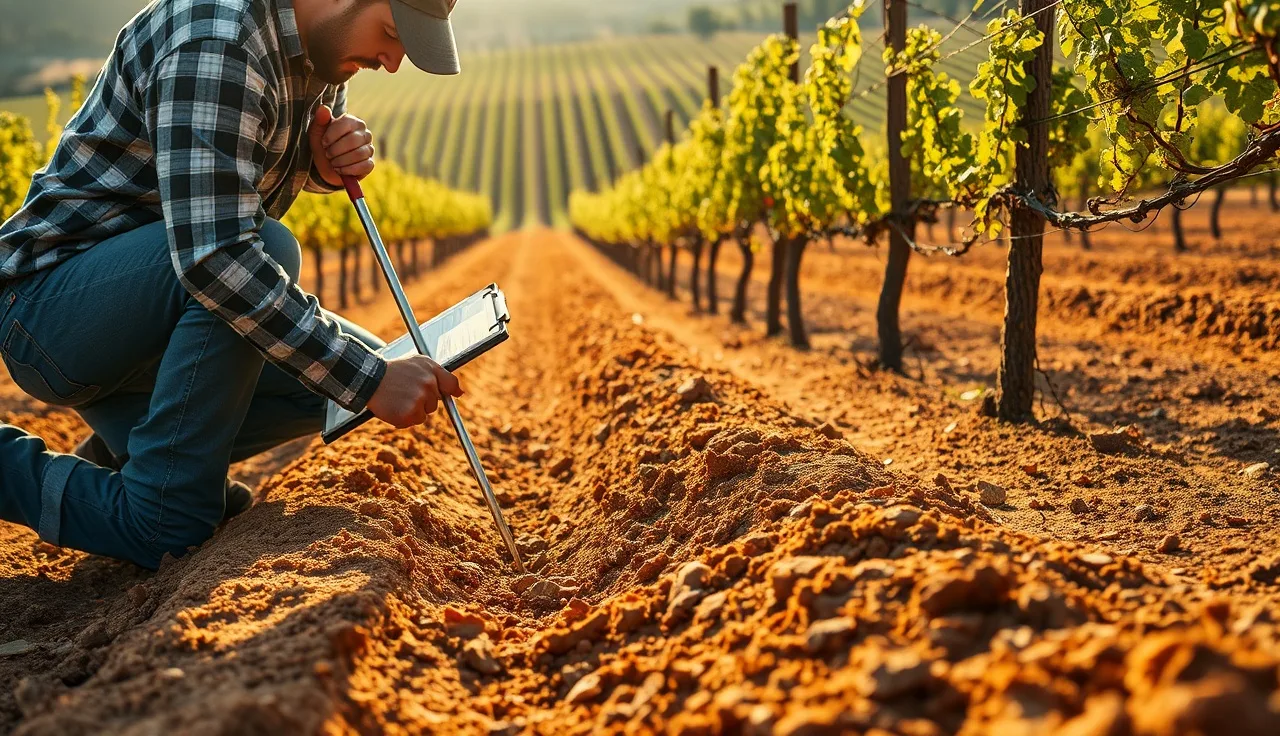
Grid sampling and management zone sampling are the two methods that actually work. Random sampling wastes lab money. Pull five cores from a 10-acre block, average them, and you've built a single number that's wrong for nearly every spot in the block.
Grid sampling is the more rigorous method. You lay out a systematic grid, usually 1-acre or 2.5-acre cells, and take a composite of 8 to 10 cores per cell at your target depth (0 to 12 inches for the plow layer, plus a separate 12-to-24-inch pull if you suspect subsoil alkalinity). At that density a 20-acre vineyard gives you 8 to 20 sample points, enough to build a real map. Cost runs $15 to $35 per sample through most commercial labs, so a full grid on 20 acres might run $300 to $700 before you count GPS and time [6].
Management zone sampling is cheaper and works well if you already know your soils from an NRCS Web Soil Survey map or from historical yield data. You define zones by soil series, vine performance, or both, then composite within each zone. You lose spatial precision but cover more ground for less money.
A few notes on technique. Use a stainless steel or chrome-plated tube probe, not a galvanized one, because zinc contamination is real. Sample before irrigation if you're on drip, since wet soil around emitters gives a local reading that doesn't reflect the bulk soil. Take vine-row cores separate from interrow cores when your management has differed between them. Label everything. The lab result is only useful if you can map it back to the exact spot.
Depth matters more than most growers realize. A soil that reads 6.2 at 0 to 6 inches might be 5.0 at 12 to 18 inches from base cation leaching in wet climates, or flip to 7.8 in the 18-to-24-inch zone over a buried carbonate horizon [1]. By their third year, vine roots are pulling from all of those depths at once.
What are the symptoms of pH-related nutrient problems in vines?
pH symptoms almost never show up with a clean label. They mimic spray damage, virus expression, rootstock incompatibility, or plain water stress. Reading them takes soil data, more than a walk through the rows.
At low pH (below 5.5), aluminum toxicity is the most common hidden problem. It kills root tips, so affected vines carry stunted, stubby root systems that can't reach water or nutrients well. Aboveground you'll see slow growth, small clusters, poor berry set, and foliage that's slightly off-color but not dramatically chlorotic. Phosphorus deficiency from low pH shows as reddish-purple leaf coloring, especially on young leaves, though potassium and magnesium deficiency look nearly identical. Soil testing paired with petiole analysis is the only way to tell them apart [2].
At high pH (above 7.5), iron deficiency chlorosis is loud and easy to spot: bright yellow leaves with green veins on the newest growth. If it's manganese, the pattern looks similar but shows on slightly older leaves. Zinc deficiency from high pH gives you the classic "little leaf" or mottle pattern with stunted shoot tips. Boron deficiency, also tied to alkaline ground, causes poor fruit set and misshapen berries.
Here's the part worth saying plainly. Symptoms show up late. By the time a vine looks chlorotic, it has already run at reduced photosynthetic capacity for weeks. Testing before symptoms appear, every two to three years in blocks with known pH variability, is the only way to get out in front of it.
How do you correct soil pH that is too low (acidic)?
Lime raises acidic pH, and it works well, but the details decide whether you get the shift you paid for. Agricultural limestone (ground calcium carbonate) is the most common amendment. It dissolves slowly, taking 6 to 18 months to fully react in moist soil, so timing is the whole game: apply it before planting, or at least one full growing season before you need the pH to move.
The rate depends on your soil's buffer pH (more than its water pH), texture, and organic matter, because heavier soils resist pH change harder than sandy ones. Your lab should hand you a lime requirement, more than a pH number. If they only report pH, ask for the buffer pH too.
A rough benchmark from Cornell extension: raising a silt loam from 5.5 to 6.5 often takes 2 to 4 tons of calcium carbonate per acre, while a sandy loam may need only 1 to 1.5 tons [4]. Those are ballpark figures. The buffer pH method (Sikora or SMP) gives you the site-specific rate.
Dolomitic limestone (calcium magnesium carbonate) does the same job and corrects magnesium deficiency at the same time, which is common in acidic eastern vineyard soils. If your petiole test shows low Mg, dolomitic lime is a clean two-for-one [12].
Calcium oxide (burnt lime) and calcium hydroxide (hydrated lime) react faster but are more caustic and have a narrow application window. Wood ash raises pH and adds potassium, but its composition is all over the map and it's impractical at scale. Oyster shell is real calcium carbonate and works fine for pH 5.5 to 6.0 corrections if you have access and can stomach the shipping.
In established vineyards, incorporating lime into the profile is hard because you can't till without shredding roots. Surface applications do move pH over time, faster in wet climates, but slowly. Acidic subsoils in mature blocks are genuinely tough to fix without deep-band or slit application gear. That's a capital cost worth thinking hard about before you plant a new block, not after.
How do you correct soil pH that is too high (alkaline)?
Lowering pH is slower and pricier than raising it. Most acidifying materials work through biological or chemical processes that take multiple seasons to land. Elemental sulfur is the most practical amendment. Soil bacteria (mainly Thiobacillus) oxidize it to sulfuric acid, which drops pH. The process wants warm, moist soil and an active microbial population, and it stalls below 55°F.
A rate of 300 to 600 lbs of elemental sulfur per acre can pull pH down by roughly 0.5 to 1.0 unit in a moderate-texture soil, but plan on 6 to 12 months for the full effect and re-test before you apply more [5]. Dump too much sulfur too fast, then irrigate heavily, and you can crater pH in the top few inches while doing nothing to the subsoil carbonate.
Ferrous sulfate (iron sulfate) works faster because it acidifies through a direct chemical reaction rather than a microbial one, and it supplies iron to the soil directly. It costs more per unit of pH shift. In soils with active free lime (they fizz when you add a drop of hydrochloric acid), iron sulfate treats the symptom while the carbonate keeps buffering pH right back up. You're fighting a system, not a number.
Where high pH comes from irrigation water bicarbonate, injecting acid (phosphoric, sulfuric, or citric) through the drip system is sometimes the move. It needs careful equipment and trained operators. The EPA Worker Protection Standard applies to acid injection [7], and many state ag departments have specific rules on injection chemistries. Check your local regulations before you install anything.
If an active carbonate layer in the subsoil is driving your high pH, amendment is mostly a holding action. Picking rootstocks that tolerate calcareous ground (SO4, 5BB Kober, 140 Ruggeri) usually beats trying to chemically neutralize a geological feature [5].
How does pH variation affect your rootstock and variety choices?
pH variation across a vineyard is a zoning problem, not one uniform issue you fix once. Each zone may want a different answer, and the most durable answer is often matching the biology to the soil instead of forcing the soil to match the biology.
For acidic zones (pH 5.5 or below), rootstocks from the riparia-rupestris family (3309 Couderc, Riparia Gloire) hold up reasonably well against moderate acidity and aluminum, though true aluminum toxicity below pH 5.0 will damage most commercial rootstocks. If you're planting into a zone that won't budge above 5.5 even with lime, talk to a viticulture advisor about Teleki selections or treat the soil more aggressively before planting [4].
For alkaline zones, 5BB Kober and 41B are the standard picks in French viticulture for high-carbonate ground, and they've seen wide use in the limestone pockets of Napa and Paso Robles. 140 Ruggeri pairs calcareous tolerance with good drought tolerance, which matters on dry-farmed sites in limestone-heavy areas [1].
Variety sensitivity varies too. Pinot Noir is notoriously touchy about lime-induced chlorosis. Cabernet Sauvignon shrugs it off better. Among whites, Chardonnay handles moderately alkaline soils if you pair it with the right rootstock. Plant a new block in a zone above 7.5 that you can't reliably amend down, and your rootstock choice matters at least as much as your amendment plan.
Growers with sites spread across mixed geology know this cold. In Paso Robles with its carbonate-heavy soils, or coastal sites in Southern California (many of them in South Coast Winery appellations), block-by-block rootstock decisions are the rule, not the exception.
What does a good pH monitoring and record-keeping system look like?
A good system ties every result to a GPS coordinate, a date, and the amendment you made in response, so the data compounds in value across seasons. Most vineyards sample inconsistently, dump results into a spreadsheet that loses spatial context, and can't compare year to year. That's fixable, and fixing it pays off every season you keep it up.
Start with the minimum: link each sample result to a GPS point and a dated soil report. Reuse the same sampling points every cycle so you can see whether your amendments are working and how fast. Keep the lab reports in a system that connects the data to the block and to any amendment you applied after reading them. That builds a documented rationale chain, useful for compliance reviews and, if you're USDA organic or chasing a sustainability certification, for proving your practices [8].
If you want field records, lab results, and amendment logs in one place instead of a hand-built spreadsheet, VitiScribe's record-keeping tools are built for exactly this: soil test results tied to blocks, amendment inputs logged with rates and dates, and a pullable history for any zone when you're planning the next amendment cycle.
For a vineyard with real pH variation, the working system is short: sample every 2 years in high-variability blocks (or after any major amendment), keep the lab sheet with the GPS grid overlay, and log every lime or sulfur application with product, rate, date, and method. It doesn't need to be fancy. It needs to be consistent.
How does soil pH affect nutrient management and fertilizer choices?
Soil pH and fertilizer decisions are locked together. The form of nitrogen you apply shifts soil pH. The pH of your soil decides which forms of phosphorus, potassium, and micronutrients your vines can reach. Get one right and ignore the other, and it costs you either way.
Ammonium-based nitrogen (ammonium sulfate, ammonium nitrate, urea) all acidify soil as they nitrify. The effect is slow, but over a 10-year fertigated block it stacks into a measurable pH drop, often 0.3 to 0.5 units against an unfertilized check block. If you're already fighting low pH, switching to calcium nitrate (pH-neutral to slightly basic) in alkaline injection systems makes sense [3].
Phosphorus availability peaks between pH 6.0 and 7.0. Above 7.5, phosphate ions react with calcium and precipitate as calcium phosphate that roots can't touch. Below 5.5, they bind to iron and aluminum. If your soil test shows adequate total phosphorus but the petiole test reads deficient, check pH before you add more phosphate [11].
Micronutrient management is where pH variation really punishes growers who treat the vineyard as one unit. A foliar iron spray across the whole vineyard fixes the pH 7.8 zone and gets wasted on the pH 6.2 zone. Variable-rate application, even with a simple handgun and a zone map, almost always beats broadcasting at a rate set for the worst-case zone.
Zinc deficiency from high-pH soils is common, usually corrected with zinc sulfate applied to soil or as a foliar. Boron leaches in acidic soils, so low-pH blocks may need periodic boron even without a visible deficiency, especially in wet years [2].
How often should you test soil pH in a vineyard, and what do labs actually measure?
Test every 3 to 4 years in a stable block, and every 1 to 2 years in a block you're actively liming, acidifying, or one that showed high variability last time. Frequency tracks how fast your pH moves and how hard you're pushing it with amendments.
What the lab measures is worth understanding. Standard soil pH is read in a 1:1 or 1:2 soil-to-water suspension. Some labs report pH in 0.01 M CaCl2 solution, which reads 0.5 to 0.7 units lower than the water method on the same sample. Always check which method your lab uses, and stay with the same lab year over year so the numbers are comparable [6].
Buffer pH (also called lime buffer pH) is a separate measurement that tells you how hard your soil resists pH change, not what the current pH is. A soil with a buffer pH of 6.5 might need twice the lime of a different soil at the same water pH, purely because of its cation exchange capacity. Plenty of growers read only the water pH, under-apply lime, and then wonder why the number won't move [12].
Lab turnaround runs 3 to 10 business days for standard analysis, longer for micronutrient panels. Rush fees usually add $15 to $25 per sample. Send samples in fall or winter to dodge the spring rush and give yourself room to apply amendments before the season starts.
For growers running established vineyards like Gervasi Vineyard or multi-block estates, a lab history with consistent methodology over years is the single most useful dataset you can build.
What are the legal and compliance considerations for pH amendment applications?
Lime and elemental sulfur applied to soil for pH adjustment aren't regulated as pesticides in most states, but a few situations still put compliance on your plate. Knowing which ones apply to you saves an audit headache later.
If you're USDA National Organic Program (NOP) certified, every material has to sit on your certifier's approved list. Elemental sulfur is allowed for soil pH correction under NOP. Standard agricultural limestone is allowed. Some treated or pelletized lime products carry additives that aren't. Check the product label and your certifier before you buy [8].
If you inject acid through a drip system, the EPA Worker Protection Standard covers any worker in the field during or after injection of a pesticide or restricted-use chemical. Sulfuric acid injected for pH control is handled differently state to state: some require a pesticide applicator license, some don't. California's Department of Pesticide Regulation has specific rules on this. The EPA Worker Protection Standard states that agricultural employers must provide workers and handlers with information about pesticide applications, including the location of treated areas [7]. Even where your state doesn't require a license for acid injection, that worker safety framework still covers employees working near the injection points.
For any amendment applied above standard label rates, or where you hire a custom applicator, keep records with the date, product, rate per acre, and the soil test that justified it. That documentation protects you in a reentry-interval question, an organic certification audit, or a state ag department inspection. VitiScribe's amendment logging captures exactly these fields so you can produce a complete record on demand.
State water quality rules may require reporting if you're applying large quantities of sulfur near a watercourse, especially in states running active groundwater monitoring. Check with your local Resource Conservation District or state water board before a big application.
Can precision viticulture technology help manage pH variation in the vineyard?
Yes, and the tools are accessible now, more than to large corporate operations. Used right, they cut sampling costs and stop you from over-applying lime where you don't need it. Used wrong, they're expensive hardware sitting on data you never collected properly.
Electromagnetic induction (EM38) sensors pulled behind a quad or tractor give you a proxy map of soil apparent electrical conductivity (ECa), which tracks texture, clay content, and salinity. ECa isn't pH, but it predicts where pH is likely to vary, because the same factors that drive texture (parent material, drainage class) drive pH. Run an EM38 pass, use it to stratify your sampling zones, then sample targeted zones instead of a blind grid. That can cut sampling costs by 30 to 50% while sharpening spatial resolution [9].
Variable-rate application technology for dry amendments (lime, sulfur granules) is available on modern spinner spreaders and some pneumatic applicators. You build a prescription map from your pH zone data, load it into the GPS controller, and the spreader changes rate as it crosses zone boundaries. The upfront cost is real: variable-rate spreader controllers run $8,000 to $20,000 on their own, though some custom applicators offer VR as a service. In a vineyard with strong pH variation, skipping over-application in already-adequate zones pays back in the re-acidification work you avoid [9].
Soil sampling robots and dense sensor arrays are still in the research phase. UC Davis has ongoing work on soil sensor networks for grapevine production. These aren't commercial-scale tools yet, but the direction suggests continuous or near-continuous pH monitoring at zone level will be practical within this decade.
For most growers right now, the highest-return precision investment is accurate zone sampling with GPS coordinates and a steady lab relationship, not sensor hardware. Get the data right before you buy technology to act on it.
Frequently asked questions
What is the ideal soil pH for grapevines?
Most extension programs, including UC Davis and Cornell, recommend 6.0 to 6.5 as the target range for grapevines. Values between 5.5 and 7.0 are workable. Below 5.5, aluminum toxicity and phosphorus lockup become real problems. Above 7.5, iron, zinc, and manganese deficiency (especially lime-induced chlorosis) becomes the dominant issue. Rootstock selection can extend the practical range in either direction.
How much can soil pH vary within a single vineyard?
Variation of 1.5 to 3.0 pH units within one vineyard is common where parent material is heterogeneous. A vineyard straddling a geological transition, say sandstone ridges meeting alluvial flats, can run pH 5.0 on one end and 7.8 on the other. Even vineyards on apparently uniform soils often show 0.5 to 1.0 unit variation from irrigation water quality, organic matter distribution, and fertilizer placement.
How do I test soil pH in my vineyard accurately?
Use a systematic grid (1 to 2.5 acres per cell) or a management-zone approach. Take 8 to 10 cores per zone at 0 to 12 inches, composite them into one sample per zone, and send it to a certified agricultural lab. Request both water pH and buffer pH. Record GPS coordinates for every sampling point so you can return to the same spot on future tests and track change over time.
How much lime do I need to raise soil pH in a vineyard?
It depends on your soil's buffer pH, texture, and the size of shift you need. Cornell extension data suggests raising a silt loam from 5.5 to 6.5 typically takes 2 to 4 tons of calcium carbonate per acre. Sandy soils need less, roughly 1 to 1.5 tons per acre for the same move. Always use the buffer pH result to get a site-specific rate, not the water pH alone.
How long does it take for lime to change soil pH in a vineyard?
Ground agricultural limestone takes 6 to 18 months to fully react in moist soil, depending on particle size and soil moisture. Finely ground lime reacts faster than coarse lime. Hydrated and calcitic lime react within weeks but are more caustic to handle. Apply lime at least one full season before you need the pH shift, and re-test the same zone 12 months after application to verify the response.
What causes high soil pH in vineyards and how do you fix it?
High pH (above 7.0) usually comes from calcareous parent material, high-bicarbonate irrigation water, or both. Elemental sulfur is the most practical fix, at 300 to 600 lbs per acre to lower pH by roughly 0.5 to 1.0 unit, but results take 6 to 12 months and the soil's carbonate keeps buffering pH back up. Rootstock selection (5BB Kober, 140 Ruggeri) is often more durable than trying to chemically overcome a geological carbonate layer.
What rootstocks work best in high-pH or calcareous vineyard soils?
5BB Kober, 41B, and 140 Ruggeri are the standard choices for calcareous or high-pH soils in both French and California viticulture. 41B is widely planted in France's chalk and limestone regions. 140 Ruggeri adds drought tolerance, which matters on the dry limestone sites common in Paso Robles and parts of Texas. SO4 also handles moderate alkalinity reasonably well, though it's less vigorous than 5BB on strongly calcareous ground.
How does soil pH affect nutrient availability for grapevines?
pH controls which nutrients are soluble and reachable by roots. Phosphorus availability peaks at 6.0 to 7.0 and drops sharply on either side. Iron, zinc, manganese, and boron become unavailable above 7.5. Below 5.5, aluminum and manganese reach toxic concentrations and phosphorus binds to iron and aluminum oxides. Keeping pH near 6.0 to 6.5 holds the nutrient availability curves for major and minor elements collectively at their best.
Can I use sulfur to lower soil pH in an organic vineyard?
Yes. Elemental sulfur is approved under the USDA National Organic Program for soil pH correction. The sulfur must be on your certifier's approved materials list, and the product label should carry no prohibited additives. Document the soil test that justified the application, the product used, the rate, and the date. Biological oxidation of sulfur to sulfuric acid takes 6 to 12 months in warm, biologically active soil.
Does irrigation water quality affect soil pH over time?
Yes, and by a lot. Irrigation water with high bicarbonate (above 150 mg/L HCO3) raises soil pH gradually, concentrating carbonate in the root zone over multiple seasons. It's a chronic issue in arid regions drawing from carbonate aquifers. Acid injection (phosphoric or sulfuric acid) through drip neutralizes bicarbonate before it enters the soil, but it needs careful management and a compliance review in your state.
What are the symptoms of aluminum toxicity in grapevines from low soil pH?
Aluminum toxicity below pH 5.0 to 5.5 damages root tips, producing short, stubby root systems that can't efficiently reach water or nutrients. Aboveground symptoms are non-specific: slow growth, small clusters, poor berry set, and slightly off-color foliage. No leaf symptom cleanly identifies aluminum toxicity, so soil testing paired with petiole analysis is the only reliable diagnostic approach.
How do I record and track soil pH data for compliance and certification audits?
Store each lab report with the GPS coordinates of the sampling points, the date sampled, the lab method used (water pH vs. buffer pH), and any amendment applications made in response. Link amendment records to the soil test that justified them. This chain of documentation is required for USDA organic audits and strongly recommended for sustainability certifications. Digital field record systems that tag data to specific blocks make retrieval and audit prep much faster.
Is grid sampling or management zone sampling better for vineyard pH mapping?
Grid sampling gives you more spatial precision but costs more. Management zone sampling is cheaper and works well if you have good prior knowledge of your soil variability from Web Soil Survey maps, historical yield data, or an EM38 conductivity scan. For a new block or one with no sampling history, grid sampling (1 to 2.5 acre cells) is worth the investment once. After you have a baseline map, shift to zone-based monitoring of the highest-variability areas.
How does topography affect soil pH distribution across a vineyard?
Acids leach downhill, so ridgelines and upper slopes in wet climates tend to run more acidic than the hollows and toe slopes below. At the same time, carbonate minerals wash down from parent material and accumulate at lower elevations, often creating a more alkaline zone in the draw. Steep vineyards with active water movement show this most clearly. Flat sites with impeded drainage can develop localized acidity from organic matter piling up in wet spots.
Sources
- Cornell Cooperative Extension, Viticulture and Enology, Vineyard Soil Health: Organic matter decomposition acidifies soil over time; petiole analysis paired with soil testing is recommended for diagnosing aluminum toxicity vs. phosphorus deficiency. Zinc and boron may leach in acidic soils requiring supplementation.
- UC Cooperative Extension, Irrigation Water Quality for Agriculture: Irrigation water with bicarbonate content above 150 mg/L raises soil pH gradually in the root zone. Calcium nitrate is pH-neutral compared to ammonium-based fertilizers which acidify soil over time.
- Cornell University Cooperative Extension, Cornell Viticulture: Grapevine Nutrition: Target soil pH range for Vitis vinifera is 6.0 to 6.5; raising a silt loam from pH 5.5 to 6.5 typically requires 2 to 4 tons of calcium carbonate per acre. Aluminum toxicity is documented below pH 5.5. Riparia-based rootstocks have moderate acid tolerance.
- Washington State University Extension, Viticulture and Enology Program, Soil Management for Vineyards: Pacific Northwest basalt soils often allow adequate vine performance at pH 6.5 to 7.0. Elemental sulfur at 300 to 600 lbs per acre can lower pH by 0.5 to 1.0 unit; full effect takes 6 to 12 months. 140 Ruggeri and 5BB Kober recommended for high-pH calcareous soils.
- USDA Agricultural Research Service, Soil Survey Technical Note 8: Soil Sampling for Precision Agriculture: Grid sampling at 1 to 2.5 acre cells with 8 to 10 cores per cell is recommended for accurate spatial pH mapping. Commercial lab soil pH testing costs range from $15 to $35 per sample. Buffer pH measurement (Sikora or SMP method) gives site-specific lime requirement.
- U.S. Environmental Protection Agency, Agricultural Worker Protection Standard (40 CFR Part 170): The EPA Worker Protection Standard requires agricultural employers to provide workers and handlers with information about pesticide applications, including the location of treated areas. Applies to acid injection systems used for drip irrigation pH control.
- USDA Agricultural Marketing Service, National Organic Program, Allowed and Prohibited Substances: Elemental sulfur is approved under the USDA National Organic Program for soil pH correction. Standard agricultural limestone is allowed. Treated or pelletized products with prohibited additives are not allowed under NOP certification.
- UC Davis, Department of Viticulture and Enology, Precision Viticulture Research Group: EM38 electromagnetic induction sensors provide proxy maps for soil electrical conductivity that predict pH variability. Variable-rate amendment application equipment with GPS-based controllers can cut amendment over-application costs by 30 to 50% in variable-pH blocks. Variable-rate spreader controller systems cost $8,000 to $20,000.
- USDA NRCS, Web Soil Survey: NRCS Web Soil Survey provides soil series maps and typical pH ranges by horizon that can be used to define preliminary management zones for vineyard soil sampling and pH management.
- UC Cooperative Extension, Nutrient Management in Vineyards: Phosphorus availability peaks between pH 6.0 and 7.0. Iron, zinc, manganese, and boron become unavailable above pH 7.5. Lime-induced chlorosis is common in California's Paso Robles region and other high-carbonate vineyard soils.
- WSU Extension, Soil pH and Lime Requirements for Washington Vineyards: Buffer pH methods (Sikora, SMP) are required for accurate lime rate calculation; water pH alone leads to under-application. Dolomitic limestone corrects both pH and magnesium deficiency simultaneously in acidic eastern vineyard soils.
Last updated 2026-07-09