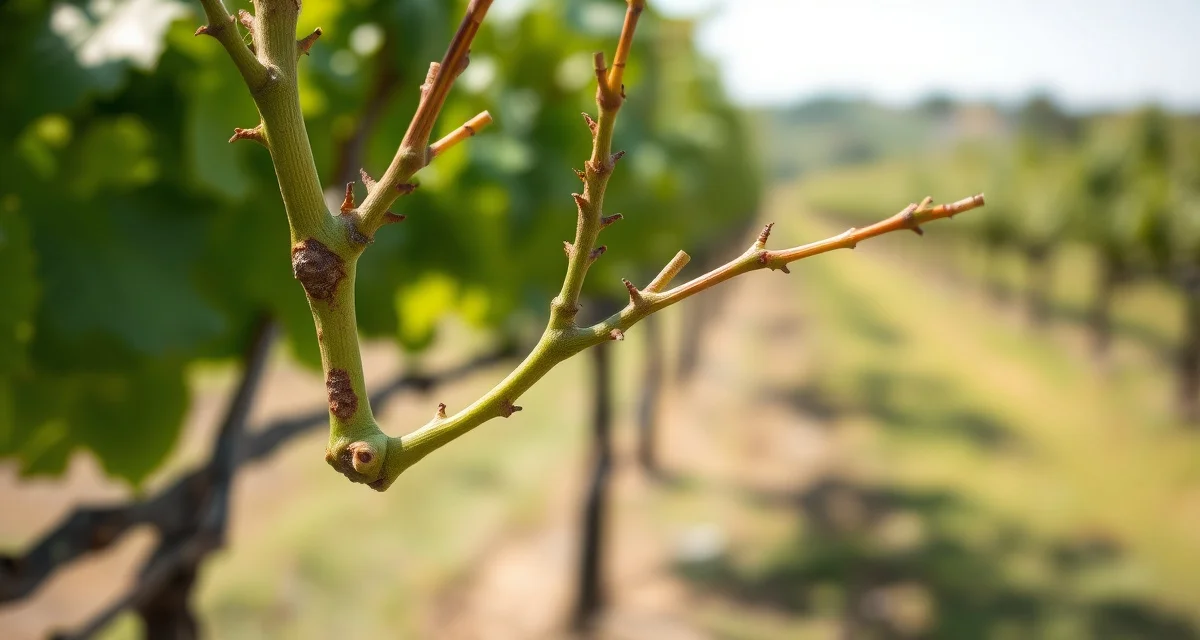
Phomopsis Vine Disease Management for Vineyards
Phomopsis is most damaging at budbreak and 1-inch shoot growth stage, requiring precise timing that VitiScribe's budbreak alerts help you hit in variable springs. Early season Phomopsis timing is critical -- most growers who have chronic Phomopsis problems in their vineyards have them because the early-season applications that matter most get delayed during busy spring periods when equipment and labor are stretched thin.
This guide covers Phomopsis identification, biology, and the specific early-season timing that controls this disease before it establishes in your block.
TL;DR
- The Phomopsis infection window is budbreak through 4-6 inch shoot growth -- infections possible at temperatures as low as 40°F when tissue is wet, which means early cool spring rains are high-risk events that often get underestimated
- Chronic Phomopsis problems in established blocks almost always trace to consistently missing the budbreak application, not to fungicide selection -- arriving at 6-8 inch shoot growth for the "first" spray of the season means the critical protection window has already closed
- Mancozeb (FRAC Group M3) is among the most effective contact materials at budbreak; thiophanate-methyl (FRAC Group 1) provides systemic activity that penetrates developing tissue; using both at the two-application budbreak window provides both protective and systemic coverage
- Once Phomopsis cane infections establish in basal shoot tissue, the fungus spreads into the cane as the shoot matures -- infected canes become the following season's inoculum source, so a missed early-season application in one year compounds into higher pressure the next
- Spray records for Phomopsis applications should include "Phomopsis vine disease -- Phomopsis viticola" as the target pest and growth stage at application (budbreak, 1-inch shoot growth, etc.) to document the IPM timing rationale that certifiers require
- Eastern US wine regions (New York, Pennsylvania, Virginia, Michigan) face higher Phomopsis pressure than California's dry spring conditions because rainfall frequency during the budbreak window is substantially higher
What Phomopsis Vine Disease Is
Phomopsis vine disease is caused primarily by Phomopsis viticola, with some contributions from related species. It infects shoots, leaves, rachises, and berries, with shoot and cane infections being the most economically damaging in most operations.
The disease cycle:
Phomopsis viticola overwinters in infected cane tissue, where it produces pycnidia (spore-producing structures) within bark lesions. In spring, rainfall dissolves the pycnidial matrix and releases conidia. These conidia are spread by rain splash to developing buds, young shoots, and leaves during budbreak and early shoot growth.
The fungus infects through wounds and natural openings during wet periods. Infections are most successful when temperatures are 40-85°F and tissue remains wet for several hours. Young tissue at budbreak and 1-2 inch shoot growth is far more susceptible than mature tissue -- this is why the early-season timing window is so critical.
Once infections establish in shoot basal tissue, the fungus can spread into the cane as the shoot matures. Infected canes overwinter and serve as the following season's inoculum source, perpetuating the cycle.
For the full disease program calendar that connects Phomopsis timing to your broader powdery mildew and downy mildew schedule, see the vineyard IPM pillar guide.
Identifying Phomopsis in Your Vineyard
Shoot and cane symptoms:
The most diagnostic early symptom is basal shoot bleaching -- a pale yellow or white discoloration of the first few internodes of infected shoots. By late spring or summer, you see dark brown to black cankers at the base of infected shoots, often with a bleached central area.
Infected canes in dormant season have dark, water-soaked lesions and characteristic brown to black discoloration of the wood under the bark. Pycnidia appear as small dark dots embedded in the bleached cane surface.
Leaf symptoms:
Circular to irregular yellow spots on leaves, often with a dark center. The spots may merge in highly infected vines. Leaf symptoms are less economically damaging than cane infections but indicate active disease.
Fruit (berry) symptoms:
Infected berries develop a soft, light brown rot. Pycnidia are visible as black dots on infected berry skin. Berry Phomopsis is typically less common than cane infections but can cause crop loss in severely infected blocks during wet harvest conditions.
Diagnostic tip: Collecting a bleached dormant cane section and placing it in a moist chamber (wet paper towel in a sealed bag) for 24-48 hours will cause the pycnidia to extrude creamy white spore tendrils, confirming Phomopsis.
When Phomopsis Infections Occur
The Phomopsis infection window is narrow: budbreak through 4-6 inch shoot growth. This is the window you're protecting with early-season applications.
Infection requires:
- Rain or dew sufficient to wet vine tissue
- Temperature between 40-85°F (infection is possible at quite cool temperatures)
- Susceptible tissue (young shoots and leaves at budbreak through early elongation)
In most eastern US wine regions, this window occurs during April and early May when spring rainfall is common and temperatures are frequently in the infection range. A single extended wet period during budbreak in a vineyard with high Phomopsis inoculum can establish infections that develop into cane lesions visible by summer.
After shoot growth exceeds 6-8 inches, the base of the shoot has begun to mature and is substantially less susceptible. Applications made after this point provide diminishing returns for shoot protection.
Fungicide Selection for Phomopsis
Effective materials:
FRAC Group M3 (mancozeb): Dithane, Manzate. Highly effective contact material for Phomopsis. Apply at budbreak and 1-inch shoot growth. PHI limits late-season use.
FRAC Group M4 (captan): Good Phomopsis activity. Useful alternative to mancozeb where restricted-use certification is a constraint.
FRAC Group 1 (thiophanate-methyl -- Topsin-M): Systemic activity against Phomopsis. Effective at budbreak through 4-inch shoot growth. Be aware of potential for Botrytis resistance if Topsin is used heavily across your program.
FRAC Group 3 (DMI -- myclobutanil, tebuconazole): Some DMI materials show activity against Phomopsis. Rally (myclobutanil) has a labeled claim for Phomopsis on grapes.
Fungicide timing:
- First application: at budbreak (when bud tip shows green tissue)
- Second application: at 1-2 inch shoot growth
- Third application: at 4-6 inch shoot growth if wet conditions continue
In most years, 2-3 applications during this early window provide adequate season-long Phomopsis protection. In unusually wet springs with extended wetting periods during budbreak, a fourth application may be justified.
When Phomopsis Becomes a Chronic Problem
Chronic Phomopsis in a block indicates that early-season timing is consistently missing the critical window, that inoculum levels are high, or both. If you're seeing Phomopsis cane lesions every season despite early-season applications, evaluate:
Application timing: Are you getting an application at budbreak, or is the first application typically at 4-6 inch shoot growth? The difference between these timing points is the difference between protecting the most susceptible tissue and arriving after the infection has already occurred.
Inoculum level: Blocks with heavy Phomopsis inoculum (visible pycnidia on dormant canes throughout the block) need earlier and more consistent early-season protection than blocks with low inoculum.
Pruning as sanitation: Removing infected cane tissue during dormant pruning reduces the inoculum that produces conidia in spring. This doesn't eliminate the need for early-season fungicide protection, but it reduces the pressure your program has to manage.
Recording Phomopsis Applications in VitiScribe
Your Phomopsis spray records should include the target pest (Phomopsis vine disease -- Phomopsis viticola) and the spray timing rationale: "budbreak application for Phomopsis protection" or "1-inch shoot growth stage -- Phomopsis protection window." This connects your application to the biological justification that IPM documentation requires.
VitiScribe's spray window planner integrates budbreak stage monitoring with spray timing reminders, so your first Phomopsis application reminder fires when your blocks reach the right growth stage rather than on a calendar date that may not align with actual vine development. The complete IPM pillar guide for your region connects Phomopsis management to your full-season disease program.
Frequently Asked Questions
How do I identify Phomopsis vine disease in my vineyard?
The earliest and most diagnostic symptom is basal shoot bleaching -- a pale, whitish discoloration of the first 1-3 internodes of infected shoots appearing in late spring. By summer, you see brown to black cankers at shoot bases with central bleaching. Dormant cane lesions are dark, water-soaked sections with pycnidia (tiny black dots) embedded in bleached bark. Leaf symptoms are circular yellow spots with dark centers. Berry symptoms are soft brown rot with pycnidia on berry surface. Confirm by moist-chamber incubation of dormant cane sections -- Phomopsis pycnidia extrude characteristic creamy white spore tendrils within 24-48 hours in humid conditions.
When is the critical spray timing for Phomopsis in vineyards?
The critical Phomopsis spray window is budbreak through 4-6 inch shoot growth -- typically a 3-4 week period in early spring. The most important single application is at budbreak or 1-inch shoot growth, when young tissue is at peak susceptibility. A second application at 4-inch shoot growth completes the protective window. In unusually wet springs where wetting periods are frequent during this window, a third application may be warranted. Applications after 6-8 inch shoot growth provide diminishing protection because basal shoot tissue is maturing and becoming less susceptible. This is a narrow, phenologically defined window -- missing it by waiting for the 6-8 inch growth stage that many growers associate with "starting the spray program" means the critical protection opportunity has passed.
What fungicides are most effective against Phomopsis in eastern US vineyards?
Mancozeb (FRAC Group M3) is among the most effective and widely used materials for Phomopsis management at budbreak and early shoot growth. Captan (Group M4) is a good alternative where mancozeb access or restricted-use certification is a constraint. Thiophanate-methyl (Group 1 -- Topsin-M) provides systemic activity and is often used at the budbreak application for its penetrating activity on newly expanding tissue. Some DMI fungicides (Group 3 -- Rally) have labeled Phomopsis activity. In most eastern US programs, mancozeb or captan at budbreak through 4-6 inch shoot growth, combined with a DMI or Topsin-M at one of those early windows, provides the protection that prevents chronic cane lesion problems.
How should Phomopsis monitoring and spray decisions be documented for a CCOF or Oregon Tilth organic certification audit?
Organic certification audits require documentation connecting pest observations to spray decisions -- not just records of what was applied. For Phomopsis, the observation record should capture: dormant cane visual assessment (percent of canes showing pycnidia or bleached lesions, by block), budbreak date for each block, and whether extended wet periods occurred during the early shoot growth window. The application decision then references: budbreak stage reached (date), wet periods present during 40-85°F temperature range, observed inoculum level from dormant inspection. Allowed organic materials for Phomopsis include OMRI-listed copper and sulfur products (though efficacy against Phomopsis is lower than mancozeb), and some biological products. For organic operations managing Phomopsis, the documentation chain of observation-to-decision is particularly important since the material options are limited and certifiers want to see that management decisions are threshold-based rather than calendar-based.
How does Phomopsis management in California's dry-spring North Coast regions differ from eastern US vineyards, and what documentation differences follow?
California's North Coast (Napa, Sonoma) has a Mediterranean climate with relatively dry springs compared to eastern US wine regions. The 40-85°F wet-tissue infection conditions that drive Phomopsis risk in the Finger Lakes or Pennsylvania's Lake Erie region during May are much less frequent in Napa Valley in April. California North Coast operations may see little or no Phomopsis infection in most years without early-season protection, while the same program applied in upstate New York would result in significant cane infections in a wet spring. The practical difference is that California operations may not need the 2-3 application early-season Phomopsis program that eastern operations use as standard practice. Spray records documenting a California North Coast operation's Phomopsis decision -- a scouting visit confirming low inoculum levels and no extended wet periods during budbreak -- justify a no-spray decision that would be risky in a wetter eastern climate.
What is Phomopsis Vine Disease Management for Vineyards?
[FAQ_ANSWER_PLACEHOLDER: This answer needs to be generated by AI with specific data, examples, and actionable advice relevant to Phomopsis Vine Disease Management for Vineyards. Target 50-150 words.]
How much does Phomopsis Vine Disease Management for Vineyards cost?
[FAQ_ANSWER_PLACEHOLDER: This answer needs to be generated by AI with specific data, examples, and actionable advice relevant to Phomopsis Vine Disease Management for Vineyards. Target 50-150 words.]
How does Phomopsis Vine Disease Management for Vineyards work?
[FAQ_ANSWER_PLACEHOLDER: This answer needs to be generated by AI with specific data, examples, and actionable advice relevant to Phomopsis Vine Disease Management for Vineyards. Target 50-150 words.]
What are the benefits of Phomopsis Vine Disease Management for Vineyards?
[FAQ_ANSWER_PLACEHOLDER: This answer needs to be generated by AI with specific data, examples, and actionable advice relevant to Phomopsis Vine Disease Management for Vineyards. Target 50-150 words.]
Who needs Phomopsis Vine Disease Management for Vineyards?
[FAQ_ANSWER_PLACEHOLDER: This answer needs to be generated by AI with specific data, examples, and actionable advice relevant to Phomopsis Vine Disease Management for Vineyards. Target 50-150 words.]
How long does Phomopsis Vine Disease Management for Vineyards take?
[FAQ_ANSWER_PLACEHOLDER: This answer needs to be generated by AI with specific data, examples, and actionable advice relevant to Phomopsis Vine Disease Management for Vineyards. Target 50-150 words.]
Related Articles
Sources
- UC Cooperative Extension Viticulture
- Cornell Cooperative Extension
- Penn State Extension Viticulture
- American Vineyard Foundation
- Wine Institute
Get Started with VitiScribe
Phomopsis management depends on hitting a 3-4 week early-season window at budbreak and 1-2 inch shoot growth -- a window that calendar-based reminders miss in variable springs where budbreak timing shifts by 2-3 weeks year to year. VitiScribe's growth stage alerts trigger your Phomopsis spray reminder when your blocks reach the budbreak stage rather than on a fixed calendar date, and spray records include growth stage at application and pest target specificity for IPM documentation that certifiers require. Try VitiScribe free and set your first Phomopsis budbreak alert today.