Powdery mildew on grapes: the complete management guide
TL;DR
- Powdery mildew (Erysiphe necator) is the most damaging fungal disease in most grape regions worldwide.
- It spreads fastest between 68 and 85°F at humidity as low as 40%, no rain required.
- Effective control combines degree-day forecasting, rotating fungicide FRAC groups to stop resistance, and spray records tight enough to satisfy the EPA Worker Protection Standard and state pesticide rules.
What is powdery mildew and why does it hit grapes so hard?
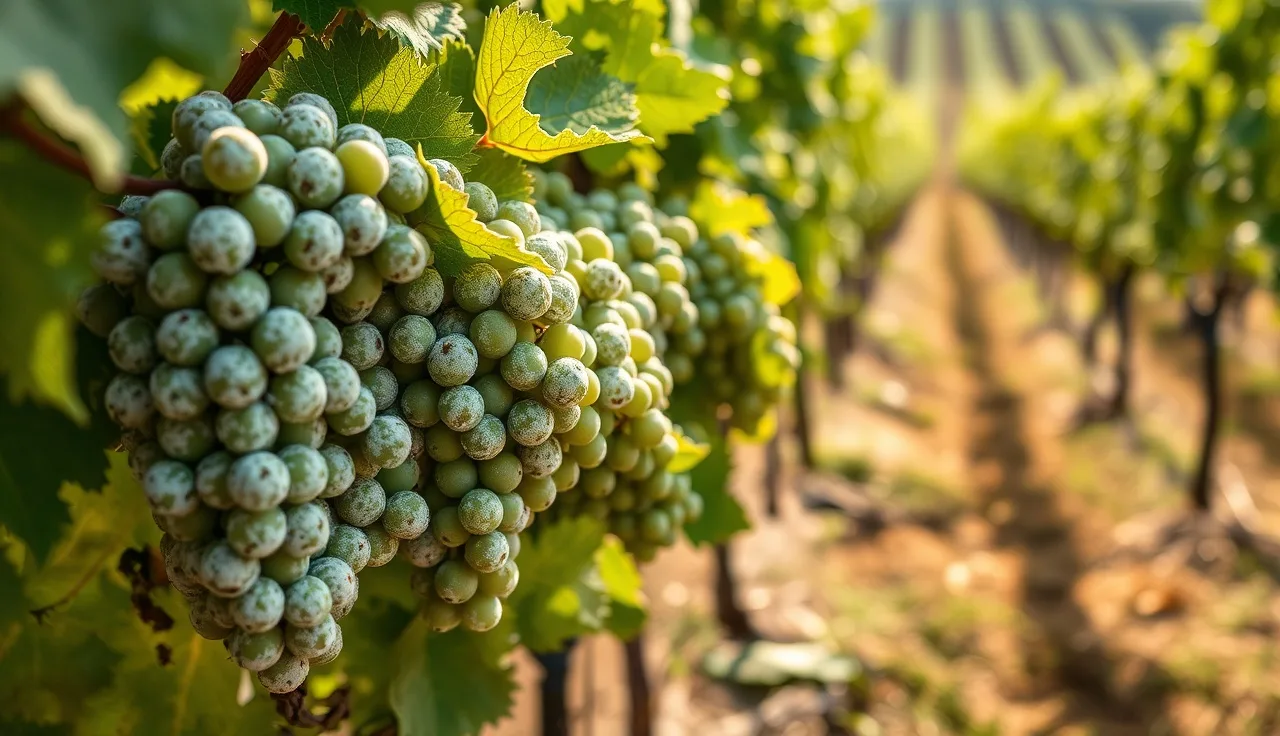
Powdery mildew on grapes is caused by Erysiphe necator (formerly Uncinula necator), an obligate fungal pathogen that lives only on living vine tissue. Unlike most fungi, it doesn't need free water to germinate. That single fact is what makes it so dangerous in California's coastal valleys, the Willamette Valley, and the Finger Lakes, where growers relax because it hasn't rained.
The fungus overwinters two ways. It forms chasmothecia (sexual fruiting bodies) on bark, and it survives as dormant mycelium inside infected buds. Come spring, those infected buds push out tissue that's already colonized, and that's the earliest infection source most growers never see [1]. Ascospore release from the chasmothecia then overlaps with budbreak, so you get a second wave of inoculum right when new tissue is most tender.
Grapes are uniquely vulnerable because E. necator is an obligate biotroph. It pulls nutrients straight out of epidermal cells through haustoria, and it will colonize every green surface on the vine: leaves, shoots, cluster stems, berries. Berry infection before the skin hardens (roughly pea-size through veraison) is where the money leaves. Infected berries crack at veraison, and that crack invites Botrytis and sour rot [2].
Vitis vinifera has essentially no native resistance to E. necator, because the fungus co-evolved with American Vitis species instead. American varieties and many hybrids carry partial resistance. Even those can post an economic loss in a bad year.
What temperature and humidity conditions favor powdery mildew on grapes?
The disease window is narrow enough to forecast with real precision, and that precision is the whole difference between chasing mildew and staying ahead of it. Conidia germinate best between 68 and 77°F, with meaningful germination anywhere from about 50 to 95°F [1]. Humidity as low as 40% is enough. Wet leaves are not required.
That last point is the one growers get wrong. It's the critical break from downy mildew and Botrytis, and it's why powdery mildew models don't bother with leaf wetness sensors.
The fungus quits when it's too hot. Sustained temperatures above 95°F shut down germination, and direct sunlight kills spores within a few hours. That's exactly why outbreaks start in the shaded interior canopy where the sun never reaches. Rainfall above about 0.1 inch can wash spores off leaves and stall an outbreak, but the moment the canopy dries, sporulation picks up again.
The UC IPM powdery mildew risk model, developed at UC Davis and used across California, runs on degree-day accumulation above a 50°F base starting January 1. It flags when about half the chasmothecia have released ascospores (indexed to rain events after budbreak) and then tracks conidial sporulation risk against sustained temperatures in the optimal range [1]. UC IPM publishes the full parameters online, and it's the model I'd anchor a California season to [3].
Cornell's grape program runs a similar system calibrated for the Northeast, built around the more variable spring temperatures of the Finger Lakes and Hudson Valley [4]. Washington State University Extension covers the Columbia Basin, where hot days and cool nights open distinct pressure windows in July and August [5].
How does the disease cycle progress through the season?
Understanding the timeline tells you exactly when a missed spray costs the most.
Dormant to budbreak. Chasmothecia sit on the bark, mycelium sits in infected buds, and there's nothing to spray. This is the time to gauge last year's inoculum load: count flag shoots (the early pale-gray infected shoots) and note where the worst infections landed.
Budbreak through 1-inch shoot growth. Infected buds push flag shoots. The tissue looks grayish or bleached, with powdery growth visible under a hand lens. Each flag shoot is a point-source inoculum factory. Pull and destroy them if you catch them early. This is the one physical control step that actually moves the needle.
1-inch shoot through bloom. This is the critical window. Ascospores are releasing, temperatures are climbing, and cluster tissue is wide open. UC Davis research has consistently shown that infections during this period do the most damage to fruit quality and yield [1]. Miss a spray here and you pay for it.
Bloom through fruit set. The rachis (cluster stem) gets infected here, and rachis infection is permanent. It drives berry drop later [11]. Berries stay highly susceptible from bloom until about 6 to 8 weeks post-bloom, when the skin starts laying down phenolics and cuticular wax that give it some physical resistance [11].
Post-veraison. Berry susceptibility drops off a cliff, but leaf infections keep building canopy disease that feeds next year's inoculum. Growers on a tight budget cut the program after veraison. That's defensible in a low-pressure year and a mistake after a high-inoculum one.
Harvest to dormancy. Chasmothecia form. Sulfur does nothing useful now. Canopy management and sanitation are your only levers.
Which grape varieties are most susceptible to powdery mildew?
Susceptibility varies enormously, and knowing where your variety sits on the spectrum sets how aggressive the spray program has to be.
| Susceptibility level | Examples | Notes |
|---|---|---|
| Very high | Chardonnay, Cabernet Sauvignon, Pinot Noir, Merlot | Standard vinifera; full program required |
| High | Zinfandel, Syrah, Sangiovese | Zinfandel notorious for rachis infection |
| Moderate | Riesling, Gewürztraminer | Still needs consistent coverage |
| Low (partial resistance) | Chambourcin, Marquette, Frontenac | Hybrids; fewer sprays but not zero |
| Very low | Norton/Cynthiana, some hybrids | Native resistance; scout-and-spray only |
Zinfandel deserves a callout. Tight cluster architecture and thin berry skins make it prone to bad rachis and berry infection even when the leaves look modest. Syrah in warm climates will read clean on the leaves into July, then crash suddenly once night temperatures stay warm.
Clone matters less than variety for disease resistance. Some Chardonnay clones (Clone 4 and Clone 6 from Dijon) seem to trap humidity harder because of denser cluster morphology. No published resistance data by clone exists that I know of; that's a field observation, not a controlled trial.
If you farm mixed vineyards, map your spray priorities by block variety in a spreadsheet before the season starts. A Marquette block and the Chardonnay block next to it do not need the same interval.
What fungicide options work best and how do you prevent resistance?
Resistance management is the discipline that separates a working spray program from one that's quietly failing you. Fungicides for powdery mildew sort into several FRAC (Fungicide Resistance Action Committee) groups, and the smart play is rotating them so the fungus never sees the same mode of action twice in a row.
Sulfur (FRAC M2). The oldest material and still one of the best. Protectant only, no resistance risk, cheap, and legal in organic production. It needs good coverage and reapplication every 7 to 14 days depending on temperature. Don't apply when temperatures will top 90°F within 24 hours or you'll cause phytotoxicity. Some growers hold off within 2 to 3 weeks of bloom on sensitive varieties. At $1 to $3 per acre per application at typical rates, it's the cheapest effective option you have [6].
DMI fungicides / sterol biosynthesis inhibitors (FRAC 3). Myclobutanil (Rally) and tebuconazole live here. These are systemics with kick-back activity, meaning they can stop an infection already underway, up to 72 to 96 hours post-infection for some products. Highly effective, but DMI resistance in E. necator is well documented, first reported in California vineyards in the early 2000s [7]. Cap it at 2 to 3 applications per season and always rotate to a different group.
Strobilurins / QoI fungicides (FRAC 11). Azoxystrobin, trifloxystrobin, pyraclostrobin. High efficacy, and QoI resistance in E. necator is also documented. Some products premix a FRAC 3 and a FRAC 11. Convenient, but they still count against your seasonal limits for both groups.
SDHI fungicides (FRAC 7). Fluxapyroxad, penthiopyrad. Newer chemistry, excellent efficacy, and a resistance risk that's real and rising in other pathogens. Save these for high-pressure windows.
Potassium bicarbonate (FRAC NC). Low-toxicity contact material that kills the pathogen with a pH shift at the leaf surface. Works as a standalone in low pressure or as a rotation partner. Kaligreen and MilStop are registered. Apply at early disease stages.
Oil-based products (FRAC NC, various). Neem oil and mineral oil have some activity. Weaker than sulfur or the sterol inhibitors under high pressure, but useful in organic programs.
A practical rotation: sulfur early (budbreak through bloom), a DMI at the first high-risk window post-bloom, a strobilurin or SDHI at the second, then back to sulfur through veraison. Never run the same FRAC group back-to-back. FRAC maintains a current resistance monitoring database online, and "the use of anti-resistance strategies is recommended to minimise the risk of resistance developing" per their guidance [8].
How do you use a powdery mildew forecast model for grapes?
A powdery mildew forecast is not a weather forecast. It's a biological model that tells you how much disease risk has piled up based on temperature history, not what tomorrow looks like.
The most-used model in California is the UC IPM degree-day model out of UC Davis. It accumulates heat units above a 50°F base from January 1, marks the window when ascospore release is likely (indexed to rain events past a degree-day threshold), then flags secondary conidial sporulation risk from sustained temperatures in the optimal range [3].
Here's how to run it:
- Pull degree-day data daily from your nearest CIMIS station (California) or NEWA station (Northeast), starting at budbreak.
- Compare your accumulated degree-days to the UC Davis thresholds for your region.
- Tighten intervals (14-day to 7-day sulfur, or shift to a systemic) when the model puts you in the moderate or high risk window.
- Stretch intervals or drop a spray after 3 or more days above 95°F or an extended dry, sunny stretch. That's your natural knockdown.
Cornell's Network for Environment and Weather Applications (NEWA) gives you free real-time forecasting for powdery mildew and other grape diseases, calibrated for the Northeast [4]. WSU's Decision Aid System covers the Pacific Northwest [5].
One caution. No model is perfect. They're built on research plots, not your site. Dense canopy, north-facing rows, or a fog belt make your microclimate worse than the model assumes. Use the model to set your baseline interval, then adjust for what your feet tell you on scouting walks.
To keep a clean digital record of model outputs next to your spray logs, a tool like VitiScribe can timestamp each risk assessment against the matching application record, which is what you want in hand at audit time.
What scouting methods actually catch early powdery mildew infections?
Catching it early means looking in the right places, at the right growth stage, often enough to get ahead of it. Start at budbreak. Walk every block at least weekly from budbreak through about 8 weeks post-bloom, then drop to every two weeks on most varieties unless the season has been rough.
Where to look:
Flag shoots. At budbreak, hunt for shoots emerging grayish, bleached, and powdery. Earliest visual sign there is. Pull them.
Young leaves. Check the undersides of the first 3 to 5 leaves behind the growing tip for a whitish powdery coating. A 10x hand lens is plenty. Very early infections hide well; sometimes you'll spot a faint chlorotic patch on the upper surface before the powder shows from below.
Cluster stems. The rachis and pedicels are high-value targets from fruit set on. A brown necrotic netting pattern on the rachis is late-stage infection you never want to see. You're hunting the early powder before it gets there.
Interior canopy. Disease starts inside, where humidity is highest and UV lowest. Scout only the perimeter leaves and you're scouting wrong.
Record incidence (percent of shoots, leaves, or clusters infected), more than yes-or-no. Incidence over time tells you whether the program is holding or slipping. A reasonable trigger for escalating the program is roughly 10% shoot incidence pre-bloom or 5% cluster incidence at or after fruit set, though no universally accepted economic threshold for powdery mildew has been published that I'm aware of.
What canopy management practices reduce powdery mildew pressure?
Canopy management is the only lever that actually changes the microclimate the disease lives in. Every spray program works better in a canopy that breathes.
Shoot thinning and positioning. Pulling excess shoots opens up airflow and light in the fruiting zone. Roughly 4 to 6 shoots per foot of row is a fair target for most VSP systems, though it depends on vine vigor and trellis. Shaded, crowded interiors are E. necator's favorite address.
Leaf pulling. Strip 2 to 4 leaves in the cluster zone on the morning side (east-facing for north-south rows) to speed dry-down. UC Davis research has documented that cluster-zone leaf pulling can cut cluster powdery mildew severity, though the effect size swings by season and site [1]. Don't over-strip in hot climates or you'll sunburn the berries.
Hedging timing. Mechanical hedging throws out succulent new growth that's highly susceptible. Hedge in June or July and you've set fresh tissue in front of active inoculum, so apply a protectant right after.
Cover crop management. Dense cover crops trap cool air at night and push up humidity in the vine row. Under high pressure, mowing or rolling to knock down row height is worth doing.
Trellis system. Divided-canopy setups (Scott Henry, GDC, Smart-Dyson) that split the fruiting zones move more air than a dense bilateral cordon with sloppy shoot positioning. Replanting or reworking a block with chronic problems? Factor trellis type into the long-term fix.
What are the spray record and compliance requirements for powdery mildew treatments?
Spray records for vineyard pesticide applications sit where state pesticide rules meet the EPA Worker Protection Standard (WPS). Get this right or the fines and re-entry violations pile up fast.
EPA Worker Protection Standard. The WPS (40 CFR Part 170) requires that agricultural pesticide applications be recorded and that workers get specific protections, including access to label information and central posting of application details [9]. The 2015 revised WPS, in full effect by 2016, requires Pesticide Application and Safety Information posted at a central location workers can reach, with application records kept for two years.
State pesticide use reporting. Most major grape states require pesticide use reports (PURs) to the county agricultural commissioner (California) or the equivalent state agency. California's PUR system requires submission within 30 days after each month's applications, and the reports are publicly searchable [10]. Oregon, Washington, and New York run their own structures with different intervals.
Every powdery mildew application needs, at minimum: date and time, product name and EPA registration number, amount applied, total acres treated, applicator name and license number (if licensed), and target pest.
Pre-harvest intervals (PHI) bite during late-season sprays. Sulfur has a 0-day PHI on grapes. Myclobutanil (Rally) is 7 days. Some SDHIs are 0-day, others up to 14. Check the label. The label is the law.
Restricted-entry intervals (REI) govern when workers can re-enter. Sulfur is 24 hours. Many systemics run 12 or 24 hours [9].
To keep records instantly audit-ready and useful for tracking FRAC rotation by block, a field operations platform like VitiScribe holds it all in one place. A well-built spreadsheet works too. The thing that matters is consistency: same field names, every application, every block, every year.
How much does powdery mildew cost grape growers and what's the economic case for prevention?
Run the numbers and the case for a disciplined program is not close.
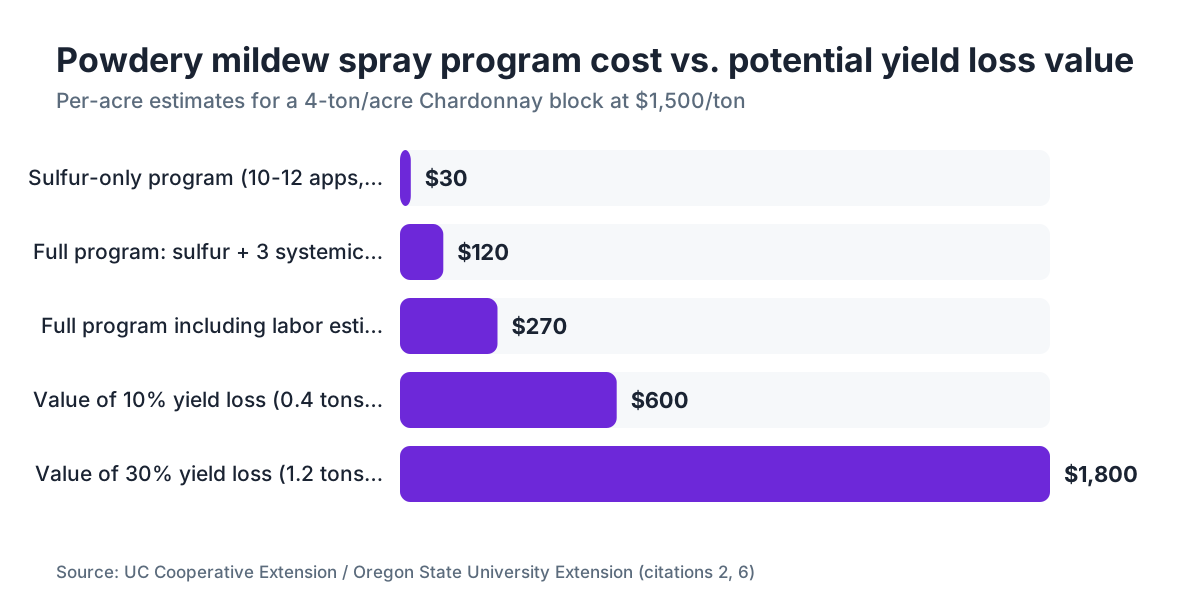
Yield losses from severe outbreaks can reach 30% on susceptible varieties in unmanaged or badly managed programs [2]. Take a 5-acre Chardonnay block at 4 tons/acre and $1,500/ton. That's $9,000 in fruit gone from one season's failure. Add the quality downgrade infected fruit brings and the real revenue hit usually runs higher than the yield-loss percentage alone.
A sulfur-based program in a moderate-pressure season runs 8 to 12 applications at roughly $5 to $15/acre per pass in materials (sulfur's cheap; labor and equipment time are the real cost). A full season using sulfur plus two or three premium systemics might run $60 to $150/acre in materials. Application labor adds roughly $15 to $30/acre per pass depending on equipment and labor rate.
The breakeven isn't complicated. One well-timed systemic at $20/acre in materials that prevents 2% yield loss on a 4-ton/acre block at $1,500/ton returns $120/acre against a $20 spend. A well-designed preventive program beats reactive rescue chemistry every time.
The trap is overspending on premium fungicides in low-pressure years or on resistant varieties. Farming a Marquette block through a dry Minnesota August? Swapping to heavier chemistry adds no protection, just cost and FRAC exposure. Scout honestly and match the spend to the actual risk.
What organic options exist for managing powdery mildew on grapes?
Organic growers have fewer tools than conventional growers, but more than most people assume, and the best organic programs beat plenty of conventional ones on timing discipline alone.
Sulfur. The backbone of organic powdery mildew management. Allowed under OMRI and NOP guidelines when applied to label. No resistance risk after decades of use. Coverage and interval consistency are the variables that decide the outcome. Standard organic programs run 7 to 10 day intervals during high-risk periods.
Copper. Mostly used against downy mildew, with some powdery mildew activity. NOP limits use to 6 pounds of metallic copper per acre per year. Not a primary powdery mildew material.
Potassium bicarbonate (Kaligreen, MilStop). OMRI-listed. Kills fungal cells with a rapid pH shift at the leaf surface. Best applied before or at very early infection; limited curative activity. Effective and underused, in my view.
Plant-based oils (neem, sesame, rosemary). OMRI-listed with mixed efficacy data. Neem oil (azadirachtin formulations) has some published efficacy for powdery mildew, generally weaker than sulfur under high pressure.
Bicarbonate/oil combinations. Some programs stack potassium bicarbonate with a low rate of oil as a spreader-sticker for coverage. Common practice, but I'm not aware of published data comparing it head-to-head with sulfur.
The honest read: sulfur at short intervals plus good canopy management is the organic program that actually works. The rest are rotational tools or low-pressure fixes. Organic growers who underspend on the program and overspend on hope pay for it in August.
How do regional differences affect powdery mildew pressure on grapes?
Where you grow sets how aggressive your baseline program has to be, and being specific matters because generic advice fails regional growers.
California (North Coast, Central Coast). Cool foggy mornings plus warm afternoons hold the canopy in E. necator's optimal range for long stretches. Coastal fog burns off slowly, keeping canopies cool and humid through mid-morning. Historically some of the highest-pressure powdery mildew ground in North America. UC Davis and UC Cooperative Extension have decades of research from here [1][3].
Pacific Northwest (Columbia Basin, Walla Walla, Willamette Valley). The Columbia Basin runs hot and dry in summer, which suppresses disease after July, so the critical window is May and June. The Willamette Valley is wetter and cooler, closer to coastal California in pressure, especially in cool years. WSU Extension is the go-to for Columbia Basin recommendations [5].
Northeast (Finger Lakes, Hudson Valley, Long Island). High humidity, jumpy spring temperatures, and frequent summer rain can keep the whole season under pressure. Cornell's program is built for this, and its degree-day model reflects local inoculum timing better than California-calibrated tools [4].
Mid-Atlantic and Southeast. High summer humidity but temperatures that periodically break 95°F make for mixed-pressure years. Pressure can be severe in June and July, drop under heat, then resume in August. Hybrid and muscadine varieties dominate here for disease resistance more than for climate.
High desert and inland (Paso Robles, inland Mendocino). Warm days with low humidity cut pressure compared to coastal zones. Programs can stretch to longer intervals, but the temperature range still hits the E. necator optimum for enough hours a day to cause trouble. Paso Robles wineries face a distinct late-summer pressure window as September temperatures moderate.
Nobody has perfect regional inoculum maps. The best proxy is a neighbor's historical records and your local farm advisor's experience.
Frequently asked questions
At what temperature does powdery mildew stop spreading on grapevines?
Sustained temperatures above 95°F (35°C) inhibit Erysiphe necator germination and spore production, and direct sunlight kills conidia within a few hours. But the disease resumes fast once temperatures drop back into the 68 to 85°F range. A heat spike doesn't reset your program. It's a brief reprieve, not a cure. Hold your scheduled applications.
Can powdery mildew on grapes spread without rain?
Yes, and this is the single most important thing to understand about the disease. Erysiphe necator spores germinate at relative humidity as low as 40% and need no free water on the leaf. Dry, warm conditions are often ideal for spread. Rain can even wash spores off temporarily. Never skip a spray because the forecast looks dry.
What does powdery mildew on grape clusters look like?
Early cluster infection shows as a white to gray powdery coating on berries, cluster stems, or rachis tissue. Infected berries stop expanding normally and can crack at veraison, opening the interior to secondary infections. Rachis infection reads as a brown netting pattern. On leaves you'll see white powder mostly on the upper surface, sometimes with a yellow halo at the margin.
How many powdery mildew sprays do grapes typically need per season?
A full-season program on susceptible vinifera in a moderate-pressure region typically needs 8 to 14 applications. Low-pressure years or resistant varieties may need only 4 to 6. High-pressure coastal California or wet Northeast seasons can push toward 16. The count matters less than timing and coverage. A well-timed 10-spray program beats a poorly timed 16-spray one every time.
Is sulfur safe to use on grapes close to harvest?
Elemental sulfur has a 0-day pre-harvest interval on grapes, so it can legally go on right up to harvest. But residual sulfur can throw off-aromas in wine (hydrogen sulfide) if too much is present at crush. Stop sulfur at least 30 to 40 days before harvest as a winemaking precaution, not a legal one. Confirm the timing with your winemaker.
What FRAC groups should I rotate for grape powdery mildew resistance management?
The primary groups are M2 (sulfur, no resistance risk), FRAC 3 (DMIs like myclobutanil), FRAC 7 (SDHIs like fluxapyroxad), and FRAC 11 (strobilurins like azoxystrobin). Resistance in E. necator to FRAC 3 and FRAC 11 is documented. Cap FRAC 3 and FRAC 11 at 2 to 3 applications each per season, never back-to-back, and anchor the program in sulfur.
How do I use a degree-day model to time my powdery mildew sprays?
Pull cumulative degree-days above 50°F from your nearest weather station, starting January 1 or at budbreak depending on the model. UC IPM's California model and Cornell's NEWA platform both offer free online tools. When accumulation puts you in a moderate or high risk window, tighten the interval. The model doesn't replace scouting. Use both together.
What are the WPS record-keeping requirements for grape powdery mildew sprays?
Under EPA's Worker Protection Standard (40 CFR Part 170), agricultural pesticide application records must be kept at least two years. Records must include product name and EPA registration number, application date and time, site treated, amount applied, and applicator information. WPS also requires application details posted at a central location workers can reach before re-entering treated fields.
Can you use copper fungicide to control powdery mildew on grapes?
Copper works mainly against downy mildew and some bacterial diseases. Its powdery mildew efficacy is limited, and it's not recommended as a primary material there. Organic growers do better with sulfur and potassium bicarbonate for powdery mildew. Reserve copper for its intended targets to avoid soil copper accumulation, which is a real long-term concern in vineyards.
Does leaf pulling help with powdery mildew on grape clusters?
Yes, moderately. Removing 2 to 4 leaves in the cluster zone, especially on the morning sun side of the row, improves air circulation and speeds dry-down. UC Davis research has shown it can cut cluster-level powdery mildew severity. The effect is meaningful but not a substitute for a spray program. Think of it as improving your fungicide's odds, not replacing it.
How do I know if my powdery mildew fungicides are losing effectiveness?
Watch for disease breaking through at labeled rates during what should be your strongest window, control sliding across multiple seasons despite good timing and coverage, and outbreaks on well-covered tissue shortly after a DMI or strobilurin pass. If you suspect resistance, send samples to your state plant diagnostic lab and shift to an all-sulfur or bicarbonate program while you reassess.
What is the economic threshold for spraying against powdery mildew on grapes?
No officially validated economic threshold has been published for grape powdery mildew that I'm aware of. The disease escalates so fast that thresholds built for slower diseases are impractical. Most practitioners treat it as a preventive program through the susceptible window rather than a threshold decision. On highly susceptible varieties from bloom through 8 weeks post-bloom, zero tolerance for disease presence is rational.
Do hybrid grape varieties still need powdery mildew sprays?
Most hybrids carry partial resistance that meaningfully reduces, but doesn't eliminate, the need for fungicide. Varieties like Marquette, Frontenac, and Chambourcin can often be managed with 3 to 6 applications in moderate-pressure years instead of the 10 to 14 Chardonnay or Cabernet need. Scout regularly and scale the program to observed pressure. In wet, warm years even hybrids can post economic losses with no protection.
How soon after rain can I apply sulfur for powdery mildew?
Apply as soon as the canopy is dry enough for good coverage. Rain doesn't reset your spray timer; it may have washed off some inoculum, but the disease resumes the moment conditions turn favorable again. If a rain event pushes you past your intended window and temperatures were in the 70 to 85°F range beforehand, spray as soon as the canopy dries and consider shortening the next interval.
Sources
- UC Davis / UC ANR, 'Powdery Mildew (Erysiphe necator)' in UC IPM Pest Management Guidelines: Grape: Infected buds push out already colonized tissue at budbreak; conidia germination occurs from 50-95°F; leaf pulling in the cluster zone can reduce powdery mildew severity on clusters
- UC Cooperative Extension, 'Grape Powdery Mildew' Disease Notes: Yield losses from severe powdery mildew outbreaks can reach 30%; berry infection before skin hardens leads to cracking at veraison and secondary infections
- UC IPM, Degree-Day Models and Forecasting Tools for Grape Powdery Mildew: UC Davis powdery mildew risk model uses degree-day accumulation above 50°F base from January 1 and rainfall thresholds to flag ascospore release and sporulation risk windows
- Cornell University / NEWA (Network for Environment and Weather Applications), Grape Disease Forecasting: NEWA provides free real-time powdery mildew and other grape disease forecasting tools calibrated for Northeast growing conditions
- Washington State University Extension, Grape Powdery Mildew Management: WSU's Decision Aid System (DAS) covers Pacific Northwest powdery mildew forecasting; Columbia Basin critical window is May through June with suppression in hot July-August
- Oregon State University Extension, Fungicide Costs and Efficacy in Vineyard Disease Management: Sulfur fungicide costs approximately $1-3 per acre per application at typical use rates; remains the lowest-cost effective material for powdery mildew
- Plant Disease (APS), 'Sensitivity of Erysiphe necator to DMI Fungicides in California Vineyards': Resistance in E. necator populations to DMI (FRAC 3) fungicides documented in California vineyards in the early 2000s
- FRAC (Fungicide Resistance Action Committee), FRAC Code List and Resistance Monitoring Database: FRAC maintains a current resistance monitoring database and code list; anti-resistance strategies including group rotation are recommended to minimise resistance risk
- U.S. EPA, Worker Protection Standard (40 CFR Part 170): WPS requires pesticide application records be maintained for two years; workers must have access to application information at a central posting location; REIs and PHIs must be followed
- California Department of Pesticide Regulation, Pesticide Use Reporting (PUR) Program: California requires pesticide use reports submitted to county agricultural commissioners within 30 days of each month's applications; reports are publicly searchable
- Cornell University Cooperative Extension, Grapevine Powdery Mildew Biology and Management: Rachis infection is permanent; berry susceptibility drops significantly approximately 6-8 weeks post-bloom as skin accumulates phenolics and cuticular wax
- UC ANR Publication 3343, 'Grape Pest Management' (Flaherty et al.): Erysiphe necator is an obligate biotroph that overwinters as chasmothecia on bark or dormant mycelium in infected buds; Vitis vinifera has no significant native resistance
Last updated 2026-07-09