Powdery mildew does not survive only on grape clusters: the full life cycle
TL;DR
- Powdery mildew (Erysiphe necator) does not survive only on grape clusters.
- It overwinters as chasmothecia in bark and as dormant mycelium inside dormant buds, then spreads to shoots, leaves, and clusters throughout the season.
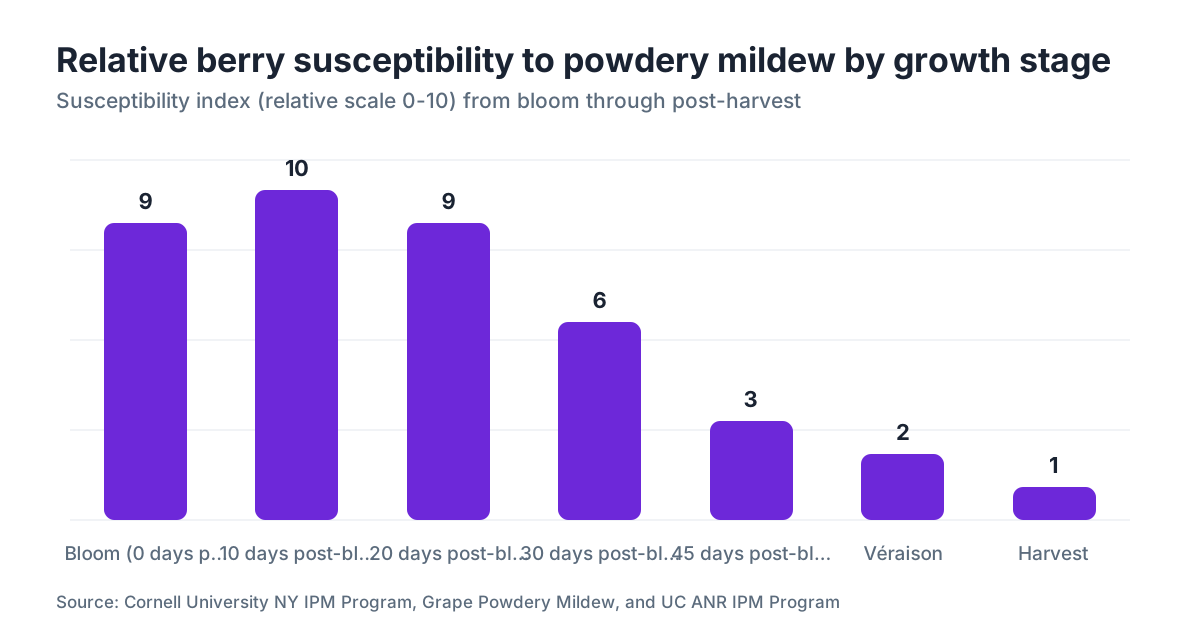
- Clusters are highly susceptible for only about three weeks post-bloom.
- Managing all plant surfaces, more than fruit, is what actually stops the disease.
Where does powdery mildew actually survive on grapevines?
Powdery mildew survives in two places that have nothing to do with clusters: embedded in the bark of mature wood as small, dark, round structures called chasmothecia (the old term is cleistothecia), and as dormant mycelium hiding inside dormant buds [1]. Both are invisible to the naked eye without magnification. The cluster is not a survival site. It is an infection target.
Chasmothecia are the sexual stage of Erysiphe necator. The fungus produces them late in the season, and they lodge in the rough bark of cordons, canes, and trunk. They are tough. They can survive temperatures below freezing and persist for more than one winter in the right conditions [1]. Come spring, when temperatures exceed about 50°F and bark gets wet, chasmothecia release ascospores that ride air currents onto emerging green tissue.
The bud-infecting route is the other one. Mycelium invades compound buds during the growing season, then goes dormant inside the bud scale. When that bud pushes in spring, the fungus wakes up with it. The shoot emerging from an infected bud shows a characteristic powdery gray coating from the first leaf stage, called a flag shoot [2]. Flag shoots are your earliest in-season canary. If you see them, your inoculum load is already high before your first spray even goes out.
So the practical takeaway: if your program focuses only on clusters, you are treating the wrong thing at the wrong time.
What is the actual life cycle of grape powdery mildew through the year?
The life cycle maps onto the vine's annual cycle almost perfectly, which is one reason this pathogen is so good at exploiting grapes specifically.
Dormant period (winter): The fungus sits as chasmothecia in bark crevices or as mycelium in buds. It is not active. Pruning, which removes a lot of bark surface area, can reduce chasmothecia density, but it will not eliminate them from older trunk wood [1].
Early spring (budbreak to 5-inch shoot): Chasmothecia begin releasing ascospores once temperatures hit roughly 50°F and bark is wet for at least a few hours. Ascospore release is the primary inoculum event. Flag shoots also appear now if bud infections occurred the previous year.
Spring into early summer (shoot elongation through bloom): The fungus shifts to asexual reproduction, generating conidia (the white powder you actually see). Conidia spread rapidly in dry, warm weather. Temperature ranges of 65 to 85°F with moderate humidity are ideal, but the fungus does not need rain or wet leaves to spread, which surprises growers used to thinking about Botrytis [2]. Direct sunlight actually kills conidia, which is why infections concentrate inside dense canopies.
Bloom through three to four weeks post-bloom: This is the critical window for berry infection. Berries are highly susceptible from bloom until the seeds become hard, roughly 30 days after bloom depending on variety [3]. After that the cuticle thickens and susceptibility drops sharply.
Mid to late summer: The fungus continues on leaves and shoots but berry infection becomes rare. Late-season chasmothecia form on leaves and bark, setting up next year's inoculum.
Harvest and dormancy: New chasmothecia overwinter. The cycle restarts.
Understanding this arc tells you where spray timing matters most and where you have genuine flexibility.
Why are grape clusters so susceptible right after bloom?
Berries at bloom and shortly after have thin, permeable cuticles and no functional resistance mechanisms yet. The fungus can colonize epidermal cells directly. Cornell University plant pathology research puts the period of maximum berry susceptibility from bloom through the point at which seeds reach full size and berries begin to soften, generally 30 to 45 days post-bloom [3].
After that window the berry cuticle thickens and keratin-like compounds accumulate. Infection still happens, but the fungus cannot establish as easily. Late-season berry infections that occur after véraison are mostly surface-level and less commercially damaging, though they still create problems for wine quality.
The shape of the infection risk also matters. Tight-clustered varieties like Chardonnay, Pinot Noir, and some Italian reds trap humidity and block sunlight inside the cluster. That microclimate is almost perfect for powdery mildew even when the surrounding air is drier. Loose-clustered varieties have less interior surface area shaded from UV and typically show lower berry infection rates under equivalent inoculum pressure.
There is one more wrinkle. A cluster infected before or at bloom can get a phenomenon called early berry infection that causes berries to crack or fail to develop properly, completely separate from late-season surface infection. That early infection is invisible until the damage is done. It is why your pre-bloom and at-bloom sprays matter more than any other timing in the calendar.
Does powdery mildew survive on fallen leaves or vineyard debris?
Yes, but the significance is moderate and often overstated. Chasmothecia do form on leaves and leaf debris. Leaves on the vineyard floor decompose over winter, and the chasmothecia on them tend to lose viability faster than those embedded in rough bark, which are more physically protected [1].
UC Davis plant pathology guidance acknowledges that removing or incorporating leaf debris in fall can reduce inoculum, but points out that bark-borne chasmothecia in the canopy are the dominant survival mechanism in established vineyards [2]. Floor management is a marginal win, not a primary control.
Some growers disk or mow leaf material in fall hoping to bury chasmothecia. It is probably not worth losing sleep over if you have other higher-leverage tasks queued up. Trunk and cordon sanitation, proper canopy management, and well-timed early-season sprays will do more for you than obsessive floor cleanup.
The more useful floor practice is avoiding excessive nitrogen application that promotes dense, shaded canopies. Dense canopies are where secondary spread explodes. That is about nutrition and shoot management, not floor debris.
Can powdery mildew spread from infected clusters to the rest of the vine?
Spread goes in all directions. The fungus does not respect tissue type. Conidia produced on clusters absolutely land on nearby leaves and shoots, and vice versa. The primary movement is via air currents carrying conidia to any green tissue.
What matters practically is which tissues carry the biggest spore load at what time. Early-season leaves and shoots dominate sporulation because there is far more leaf and shoot surface area than cluster surface area, and the early season is when explosive spread happens [3]. By the time heavy cluster infections are visible, the canopy is already carrying massive inoculum.
This is why waiting until you see white powder on berries is a losing strategy. The pathogen moved through the canopy weeks earlier. You are looking at the output, not the input.
Spray programs that hold off until clusters are visible and sized are likely already operating in a deficit. By WSU's integrated pest management recommendations, the critical window for fungicide coverage is the two weeks before bloom through three to four weeks after bloom [4]. Those timings target the infection window before it opens, not after.
What temperature and humidity conditions let powdery mildew spread?
Powdery mildew's comfort zone is 65 to 85°F with relative humidity between 40 and 100 percent [2]. Unlike most fungal pathogens, it does not need free water on the leaf surface. Rain actually inhibits it by washing conidia off surfaces. This surprises growers in wetter regions who associate disease pressure with rain events.
There is a temperature ceiling. Temperatures above 95°F kill conidia and inhibit germination [2]. Sustained heat waves can knock back surface disease temporarily, but chasmothecia and mycelium in bark survive those events and rebound when temperatures drop. Do not count on summer heat as a management tool.
The grape powdery mildew risk model developed by UC Davis uses a degree-day accumulation starting at budbreak to predict the onset of ascospore release, roughly 50 degree-days base 50°F after the first sustained wet weather event [1]. Some advisors use this to time the first fungicide application. Most growers in medium-to-high-pressure regions apply at budbreak or at 1-inch shoot growth regardless of model output, because the cost of the first spray is low and the consequence of missing the ascospore window is not.
Night temperatures between 50 and 77°F are the range where conidia germinate best. Warm days, cool nights, and no rain is the classic California pattern that drives high mildew pressure in coastal and inland valley vineyards every year.
How do you build a spray program around the actual survival biology?
Your spray calendar needs to align with the inoculum sources, more than the symptoms you can see. Here is how that plays out practically.
Dormant oil: Applying a horticultural mineral oil at dormancy targets chasmothecia in bark directly. The oil disrupts the overwintering structures. UC Davis recommends this as a useful low-cost tool in high-pressure sites, applied when vines are dormant and temperatures are above 40°F but before budbreak [1]. It will not eliminate chasmothecia completely, but reducing the starting inoculum load matters.
Budbreak through 1-inch shoot: The first fungicide application goes here. You are targeting newly released ascospores and any flag shoot mycelium. Sulfur remains the workhorse at this timing. At rates of 3 to 5 lb per acre of wettable sulfur or equivalent, it is cheap, effective, and has no resistance concerns [2]. The one caveat is temperature: do not apply sulfur when temperatures are above 90°F or when daytime temperatures will exceed 90°F within 24 to 48 hours, as phytotoxicity risk rises sharply.
Pre-bloom through 3 to 4 weeks post-bloom: This is the highest-priority window. Applications every 7 to 14 days depending on weather and material. Systemic materials like DMI fungicides (myclobutanil, tebuconazole, trifloxystrobin) or SDHI materials (fluxapyroxad) offer longer residual activity and are appropriate here. Rotate modes of action to manage resistance. The FRAC code system, maintained by the Fungicide Resistance Action Committee, is the standard reference for building a rotation [5].
Vegetative period through harvest: After the critical cluster window closes, your focus shifts to leaf health and preventing late chasmothecia formation. Reduce spray frequency but do not abandon the program entirely. A late July or August spray with sulfur or a low-resistance-risk material slows chasmothecia buildup for next year.
All of this depends on accurate field records. Tracking your application dates, materials, rates, and weather conditions at application is not optional if you are a commercial producer. It is required under most state pesticide regulations and under the EPA Worker Protection Standard [6]. If you are managing multiple blocks with different disease histories, a field record system makes the difference between a coherent program and reactive crisis management. VitiScribe was built specifically for this: spray records, product tracking, and compliance documentation in one place growers can actually use in the field.
For operations in established vineyard settings, disease history by block is one of the most valuable inputs you can have. Document it.
Which grape varieties are most susceptible to powdery mildew?
Vitis vinifera is largely susceptible across the board. The pathogen co-evolved with North American Vitis species, which developed some resistance, while European V. vinifera had no co-evolutionary exposure and remained highly vulnerable [3].
Within vinifera, susceptibility varies. Cornell plant pathology ranks varieties roughly like this:
| Susceptibility level | Common varieties |
|---|---|
| High | Chardonnay, Gewurztraminer, Pinot Noir, Cabernet Franc, Muscat |
| Moderate | Cabernet Sauvignon, Merlot, Sangiovese, Tempranillo |
| Lower (still susceptible) | Riesling, Sauvignon Blanc, Grenache |
This is a rough guide, not a firm ranking. Site conditions, canopy density, and microclimate can push any variety into high-pressure territory. A Cabernet Sauvignon block with a dense cordon and poor air circulation can outperform a well-managed Chardonnay block on mildew pressure every year [3].
Hybrid varieties with Vitis labrusca or Vitis rupestris parentage tend to carry more native resistance. Varieties like Chambourcin, Marquette, and Frontenac show meaningfully lower susceptibility in university trial data from Cornell and Minnesota, though they are not immune [7]. If you are in a high-pressure region and variety selection is still on the table, that resistance data is worth reading before you plant.
What does the EPA Worker Protection Standard require for powdery mildew fungicide applications?
The EPA Worker Protection Standard (WPS), codified at 40 CFR Part 170, sets the baseline for agricultural pesticide safety that every vineyard producing commercial grapes must follow [6].
The core requirements relevant to fungicide spray programs include: providing safety training to all agricultural workers and handlers before they enter treated areas or handle pesticides; posting pesticide application information including the product, rate, date, and restricted-entry interval at a central location; maintaining application records; and ensuring handlers have appropriate personal protective equipment as specified on the product label.
Restricted-entry intervals (REIs) on the label are legally binding minimums. For common powdery mildew materials: wettable sulfur typically carries a 24-hour REI; DMI fungicides like myclobutanil have REIs ranging from 24 to 48 hours depending on product; some SDHI materials carry 12-hour REIs. Always check the current registered label, because REIs can change between product registrations [6].
For operations in California, Washington, and Oregon, state pesticide regulations layer on top of WPS. California's Department of Pesticide Regulation requires a licensed pest control adviser (PCA) recommendation for certain restricted-use materials and specific record-keeping formats [8]. Washington State requires annual reporting of pesticide use through the WSDA's pesticide management system [9].
The record-keeping piece is where most small operators fall short. WPS requires that you maintain records of all pesticide applications for at least two years. Those records need to include the product name, EPA registration number, rate applied, date and time, location, and the applicator's name. Missing records are more than an audit risk. They cost you the documentation you need if a worker injury or property dispute ever arises.
Can powdery mildew build resistance to fungicides in your vineyard?
Yes, and it has. Resistance in Erysiphe necator to DMI fungicides (FRAC Group 3) is documented in multiple grape-growing regions, including California and the Pacific Northwest [5]. Populations resistant to strobilurin fungicides (FRAC Group 11) have also been confirmed. This is not a hypothetical risk.
The mechanism is straightforward: if you apply the same mode of action repeatedly across many seasons with high selection pressure, you select for the resistant genotypes already present at low frequency in the population. The first sign is usually an increase in disease severity at labeled rates, which growers sometimes misattribute to weather.
The practical defense is rotation by FRAC code, more than by product name. Rotating from myclobutanil (FRAC 3) to trifloxystrobin (FRAC 11) is not a rotation if both groups are already showing resistance in your region. You need to know which FRAC groups are under pressure locally, which university extension programs track through monitoring surveys.
WSU extension recommends rotating across at minimum three different FRAC groups per season and limiting applications of any single FRAC group to no more than two consecutive applications [4]. Sulfur remains the fallback because it has a multi-site mode of action and resistance has not been documented.
For operations tracking multiple materials across multiple blocks, the FRAC rotation question is genuinely hard to manage on paper. That is exactly the kind of problem that a structured spray record system handles well, which is where VitiScribe can save time that paper logs cannot.
How do you scout for powdery mildew effectively without missing early infections?
Good scouting starts before you can see anything with the naked eye. The flag shoot is your best early warning. Beginning at budbreak, walk rows systematically and look for shoots emerging with a grayish, mealy coating on the first few leaves. One flag shoot per 100 vines in a high-pressure site is reason to question whether your dormant management and early spray timing were adequate [2].
After 6-inch shoot growth, shift your attention to the undersides of young leaves. Powdery mildew often establishes on the lower surface first because it is protected from UV. You are looking for a light, dusty web-like coating, not the thick white powder that shows up on clusters later. Use a hand lens if visibility is marginal.
At bloom, look at flower clusters carefully. Infected rachises (the cluster stem structure) turn dark brown and become brittle, a symptom called rachis infection or cluster stem necrosis. This symptom means berry set will be poor in affected clusters, independent of berry surface infection [3].
Post-bloom through the critical window, inspect 25 to 50 clusters per block on a weekly basis, rotating your scouting locations. Document infection incidence as a percentage of clusters showing any symptom. Most university extension programs use a 5 percent cluster infection threshold as the trigger for reassessing spray timing [2][4]. Below that, you may have headroom to extend your interval. Above it, shorten.
Late-season scouting in August and September is worth 15 minutes per block even when the crop is not at risk. Look at bark and cordon wood for the small black specks of chasmothecia formation. Heavy chasmothecia loads in late summer predict high pressure next spring.
What non-chemical practices actually reduce powdery mildew pressure?
Canopy management is the single highest-return non-chemical practice. Leaf removal in the cluster zone, particularly on the morning sun side, reduces humidity inside the cluster, exposes clusters to UV, and improves fungicide penetration [2]. In a UC Davis trial, early leaf removal in the fruit zone reduced powdery mildew cluster infection by 40 to 60 percent compared to untreated controls in moderate-pressure years. The catch is timing: leaf removal is most effective when done at or shortly after bloom.
Shoot thinning and positioning matters for the same reasons. Shoots growing horizontally and tangling together create dark, humid pockets that are perfect for powdery mildew. Tuck shoots vertically and maintain a clear fruiting zone.
Row orientation influences UV exposure across the day. Rows running roughly north to south in the northern hemisphere get more even sun exposure on both sides of the canopy, reducing the shaded interior microclimate that disease thrives in. You cannot change this in an existing vineyard, but keep it in mind for new plantings.
Copper applications, primarily used for downy mildew, have no meaningful effect on powdery mildew. Do not conflate the two diseases in your program.
Cover crop and floor management under the vine row can influence vine vigor. High-vigor vines produce excessive shoot growth that is difficult to manage and creates dense canopies. Moderate vine balance, where fruit weight and leaf area are proportional, makes canopy management easier and disease pressure lower year over year. This is a multi-year project, not a single-season fix.
Frequently asked questions
Does powdery mildew survive winter on grape clusters left on the vine?
Clusters left on the vine after harvest are not the primary overwintering site for powdery mildew. The fungus survives primarily as chasmothecia in bark and as dormant mycelium inside compound buds. Mummified clusters may carry some viable fungal material, but their contribution to spring inoculum is small compared to bark-borne chasmothecia. Removing leftover clusters is good vineyard hygiene but will not meaningfully change your spring inoculum load.
Can powdery mildew infect grapevine roots?
No. Erysiphe necator is an obligate foliar pathogen. It requires living green, above-ground tissue, specifically epidermal cells on leaves, shoots, tendrils, and berries. Roots are not a host tissue for this pathogen. The fungus cannot survive in soil either. Its survival is entirely dependent on above-ground vine structures, which is why dormant-season canopy management and dormant oil applications are relevant control options.
How long can powdery mildew chasmothecia survive in bark?
Chasmothecia in bark can remain viable for at least one full winter and possibly two under protected conditions. UC Davis research confirms they are cold-hardy and resistant to desiccation when lodged in bark crevices. Their longevity is one reason a single year of poor disease control can elevate pressure for multiple subsequent seasons, because you are adding to an inoculum reservoir that does not reset after harvest.
What is a flag shoot and why does it matter for mildew management?
A flag shoot is a shoot that emerges already infected because the bud it grew from contained dormant powdery mildew mycelium from the previous season. The shoot looks white or grayish from the first leaf stage. Flag shoots are your earliest in-season indicator of high overwintering inoculum. If you find flag shoots, your early spray timing is critical because the fungus is already producing conidia before most growers begin their programs.
Does rain kill powdery mildew on grapevines?
Rain physically washes conidia off surfaces and inhibits germination, which temporarily reduces spread. It does not kill established infections or eliminate chasmothecia. Unlike Botrytis or downy mildew, powdery mildew does not require wet weather to spread. Its ideal conditions are warm, dry, and moderately humid, which is why California's Mediterranean climate creates persistent high-pressure years regardless of winter rainfall levels.
How do I know if my DMI fungicides are losing effectiveness against powdery mildew?
The clearest sign is disease progression at labeled rates that you would not have seen in earlier seasons using the same product. You can also submit leaf samples to university plant diagnostic labs for fungicide sensitivity testing. UC Davis and Cornell both offer these services. Regional resistance surveys from university extension programs publish current data on which FRAC groups are under pressure in specific winegrowing regions. Check those before designing your rotation.
Is sulfur still effective for grape powdery mildew or has resistance developed?
Sulfur remains effective. Resistance to sulfur in Erysiphe necator has not been documented, because sulfur has a multi-site mode of action that makes resistance development far more difficult than single-site fungicides. Wettable sulfur at 3 to 5 lb per acre per application is still the backbone of most economical mildew programs. The only firm constraints are temperature (avoid above 90°F) and application timing relative to oil applications.
When during the growing season is it too late to stop powdery mildew from damaging the crop?
If you have visible white sporulation on berries after they are the size of a small pea, the opportunity to prevent that specific infection has passed. You can still slow further spread with fungicides, but infected tissue does not recover. The practical cutoff for protecting fruit is roughly four weeks post-bloom. After that, your spray program is about vine health, leaf retention, and reducing next year's inoculum load rather than saving the current crop.
Do cover crops in the vineyard increase or decrease powdery mildew pressure?
Cover crops do not directly affect powdery mildew, which is an obligate pathogen of the vine itself. They can indirectly influence disease pressure by moderating vine vigor. High-vigor vines from excess nitrogen produce dense canopies that favor disease. A well-managed cover crop that competes with vine roots moderately can help balance vigor and make canopy management easier, which reduces the humid, shaded microclimate that mildew thrives in.
What records do I legally need to keep for powdery mildew fungicide applications?
Under the EPA Worker Protection Standard and most state pesticide regulations, you must record the product name, EPA registration number, application date and time, location, rate, and applicator name for every pesticide application. Records must be kept for at least two years. California requires a licensed PCA recommendation for restricted-use materials. Washington requires annual use reporting to WSDA. Check your state's specific requirements because they vary and often exceed federal minimums.
Can organic vineyards control powdery mildew without synthetic fungicides?
Yes, with more frequent applications and tighter timing. Wettable sulfur is OMRI-listed and approved for organic production. Potassium bicarbonate products are also registered and effective at knockback of surface infections. Kaolin clay has shown some protective effect in trial data. The program requires roughly 7 to 10 day intervals during the critical window compared to 10 to 14 days for some synthetics. Canopy management becomes even more important as a complement to the spray program.
How does powdery mildew affect wine quality even when berry damage looks minor?
Even low levels of powdery mildew infection on berries contribute musty, fungal off-aromas to wine, often described as earthy, mushroom-like, or leathery. The compounds responsible include C8 and C9 aldehydes and some terpene oxidation products from infected tissue. University sensory research has shown that as little as 3 to 6 percent infected berries in a lot can produce detectable off-character in finished wine. This is why a cluster that looks mostly clean can still cause winemaking problems.
Should I apply a dormant oil before budbreak to reduce powdery mildew?
Yes, if you are in a moderate to high-pressure site it is a worthwhile low-cost tool. Horticultural mineral oil applied at dormancy degrades chasmothecia in bark. Apply when vines are fully dormant, temperatures are above 40°F, and budbreak is still at least a few weeks away. Do not apply oil within 14 days of a sulfur application or vice versa; the combination can cause phytotoxicity. Rates typically run 1 to 2 percent solution.
Does powdery mildew survive on grape posts, trellises, or vineyard equipment?
No. Erysiphe necator is an obligate biotroph, meaning it can only survive on living host tissue. Wood posts, metal wires, and equipment are not hosts and carry no viable inoculum. You do not need to sanitize trellis hardware to manage powdery mildew. The chasmothecia found in bark are in the bark of the living vine, not in dead wood materials used for vineyard infrastructure.
Sources
- UC Statewide IPM Program, UC ANR, Powdery Mildew of Grapes: Mycelium overwinters in dormant buds producing flag shoots; optimal temperature range 65 to 85°F; UV inhibits conidia; leaf removal in fruit zone reduces cluster infection
- Cornell University, New York State IPM Program, Grape Powdery Mildew: Berry susceptibility is highest from bloom through seed hardening, roughly 30 to 45 days post-bloom; V. vinifera is highly susceptible due to lack of co-evolutionary resistance
- Washington State University Extension, Grape Powdery Mildew Management: Critical spray window is two weeks before bloom through three to four weeks after bloom; limit any single FRAC group to no more than two consecutive applications
- Fungicide Resistance Action Committee (FRAC), FRAC Code List: DMI (FRAC Group 3) and strobilurin (FRAC Group 11) resistance documented in Erysiphe necator populations in multiple regions
- U.S. EPA, Worker Protection Standard, 40 CFR Part 170: WPS requires application records retained at least two years including product name, EPA registration number, rate, date, time, location, and applicator name; REIs on labels are legally binding minimums
- Cornell University, Midwest Grape Production Guide, Variety Disease Resistance: Hybrid varieties with native Vitis parentage such as Marquette and Frontenac show meaningfully lower powdery mildew susceptibility in trial data
- California Department of Pesticide Regulation, Pesticide Use Reporting: California requires licensed pest control adviser recommendation for restricted-use materials and specific record-keeping formats
- Washington State Department of Agriculture, Pesticide Management Division: Washington State requires annual reporting of pesticide use through WSDA pesticide management system
- Cornell University Plant Disease Diagnostic Clinic: Fungicide sensitivity testing available for growers to detect DMI resistance in local powdery mildew populations
Last updated 2026-07-09