Powdery mildew on grapes in the Pacific Northwest: what actually works
TL;DR
- Powdery mildew (Erysiphe necator) is the most damaging fungal disease in Pacific Northwest vineyards.
- Warm days, cool nights, and shade favor it even without rain.
- Control depends on tight spray intervals (7 to 14 days) starting at bud break, rotating FRAC code groups to slow resistance, and scouting weekly.
- Left alone, it destroys entire crops.
Why is powdery mildew such a big problem in Pacific Northwest vineyards?
Powdery mildew is the most economically damaging grape disease in Washington, Oregon, and Idaho vineyards, and it does its worst work in dry weather that most growers assume is safe [1]. The pathogen is Erysiphe necator (formerly Uncinula necator), an obligate fungus that lives only on living grape tissue. Rain brings other diseases, so eastern Washington wine country feels protected. It isn't.
Powdery mildew doesn't need free water to infect. It runs in relative humidity anywhere from 40% to 100% and does its heaviest damage between 70°F and 85°F, which is a Columbia Valley summer afternoon almost exactly [2].
The Pacific Northwest's swing from warm days to cool nights is a textbook disease environment. Conidia (spores) germinate best around 68°F and die above 95°F, but the temperature a few inches from a shoot tip sits well below the mid-day air reading. Shaded interior canopy stays cool and moist for hours after sunrise. That's where infections start, out of sight, before you've noticed anything.
Western Oregon and western Washington get a different version of the same problem. Maritime skies stay overcast and mild for most of the season, so the humidity is there even without the heat. Willamette Valley Pinot Noir is genetically susceptible to begin with, and it faces open infection windows from bud break through veraison.
WSU Extension's plant pathology program estimates unmanaged powdery mildew can cause up to 100% crop loss in susceptible varieties in high-pressure years [1]. That number isn't theoretical. Growers who skip early sprays or let a 14-day window slide to 21 days in late May have watched it happen to a full block.
What is the biology of Erysiphe necator and when does the infection cycle start?
Erysiphe necator overwinters two ways, and the first spores hit your canopy before most growers have sprayed anything. Knowing the life cycle is the fastest route to understanding why timing beats product choice in most seasons.
The primary overwintering form is chasmothecia, the sexual fruiting bodies, tucked into bark and dormant canes. The second is mycelium living inside dormant buds, which pushes out what growers call "flag shoots" in spring. Flag shoots are whitish, stunted, and already infected when they emerge. They erupt with conidia early, and they are the main source of early-season inoculum in established vineyards [2].
Chasmothecia release ascospores once temperatures reach 50°F and enough wetting events pile up. In the Columbia Valley that's usually late March or early April. In the Willamette Valley it can be earlier. The standard extension approach is to track degree days from January 1 at a base of 50°F (base 10°C) and put down the first fungicide by 1-inch shoot growth or when you hit roughly 20 to 30 Fahrenheit degree days, whichever comes first [3].
After primary infection, the asexual cycle takes over and runs all season. Infected tissue produces conidia continuously, and wind carries them a long way. The latent period, from infection to visible symptoms, is about 5 to 7 days in ideal conditions.
That's short. One missed spray at bloom can set off a chase that eats the rest of your season, because berries are most susceptible from just before bloom through 3 to 5 weeks after [2].
Berries infected before or during bloom develop a rusty brown webbing under the skin and tend to crack later, which opens the door to Botrytis. Late-season infections on mature berries can still hurt wine quality through raised pH and off-flavors.
Which grape varieties are most susceptible to powdery mildew in the PNW?
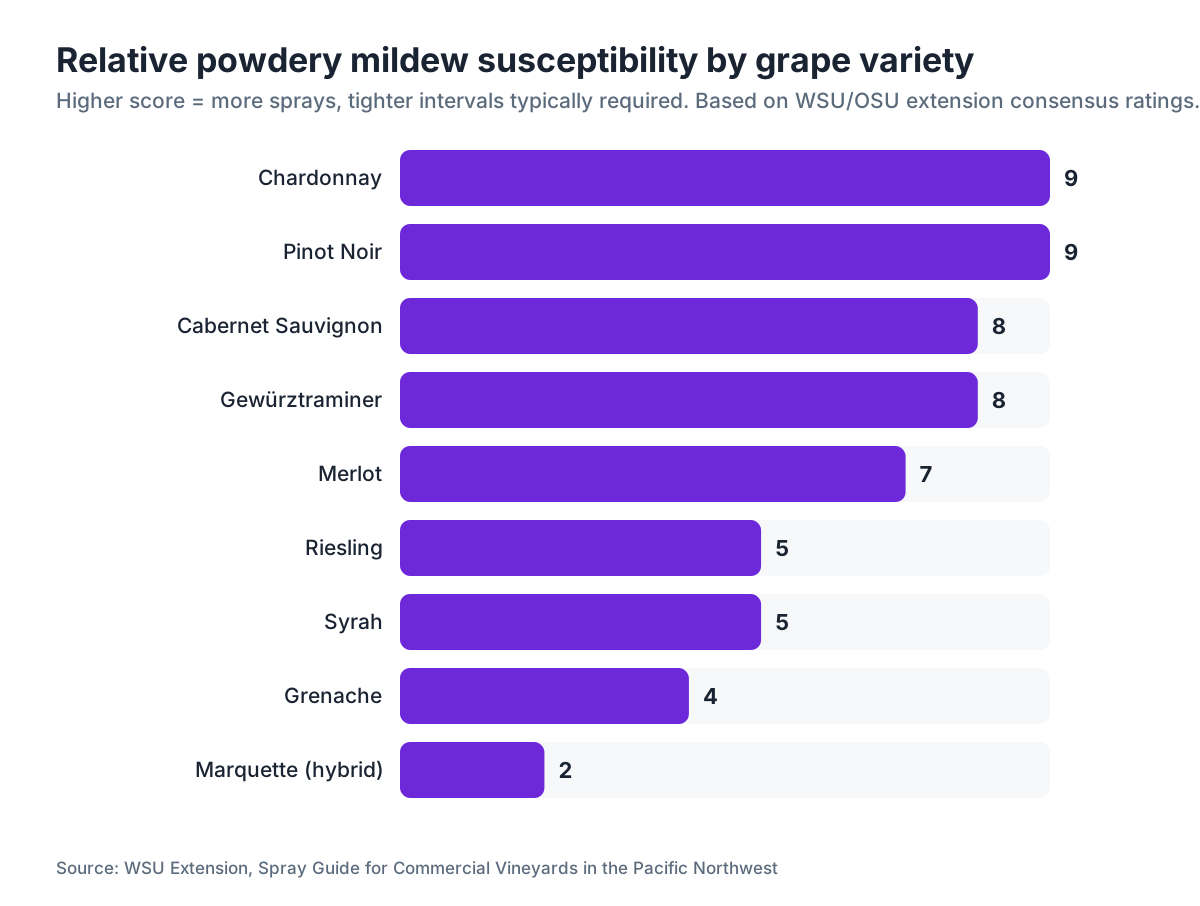
Every classic wine grape is Vitis vinifera, and vinifera has essentially no natural resistance to Erysiphe necator. The pathogen co-evolved with wild North American Vitis species, not the European lineage, so vinifera never picked up resistance genes. Within the species, though, susceptibility does move around.
| Variety | Relative susceptibility | Notes |
|---|---|---|
| Cabernet Sauvignon | High | Dense canopy worsens risk |
| Chardonnay | High | Tight clusters trap humidity |
| Pinot Noir | High | Key concern in western Oregon/WA |
| Merlot | Moderate-High | Often underestimated |
| Syrah | Moderate | Less susceptible than Cab |
| Riesling | Moderate | Open cluster architecture helps |
| Grenache | Moderate-Low | Better heat tolerance limits windows |
| Gewürztraminer | High | Thin skin increases berry infection |
Hybrids bred with North American Vitis parentage, like Marquette, Frontenac, or La Crescent, carry partial resistance genes and generally need fewer sprays. They're a minority in PNW commercial plantings, but worth a look for small operations trying to trim a spray program.
Variety susceptibility runs straight into canopy management. A Cabernet block with a tight, unmanaged canopy on a humid site is a different disease problem than a well-thinned, divided-canopy block with air moving through it. Canopy work won't replace fungicides in a high-pressure year, but it shortens the infection window in a way you can measure.
What symptoms should you look for when scouting for powdery mildew?
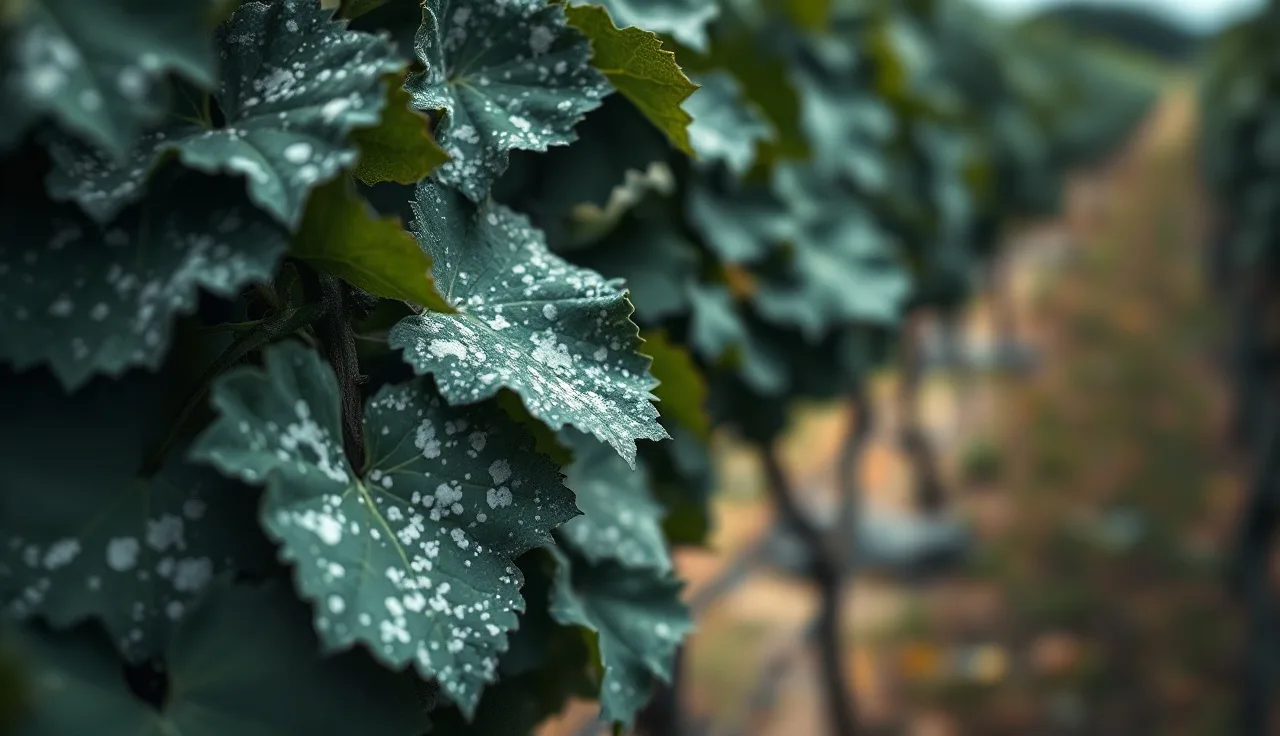
Look for dry, dusty, flour-like white to gray colonies on young leaves, on both surfaces, usually starting near the base of shoots or on flag shoots. This isn't a water-soaked lesion. It's a powder you can rub off with your thumb, and that texture is the tell.
On berries, the first sign during bloom is often a faint russeting or browning under the skin, before any white sporulation shows on the surface. By the time you see obvious powder on fruit, that infection is a week or more old.
So you can't scout berries and react in time. Scout leaves and young shoots instead.
Check the interior canopy. The bottom of the shoot, where the least light reaches, colors up before the shoot tips do. Lift a few clusters at each sample point and inspect the rachis, the main stem of the cluster. Rachis infection means you're already at moderate to severe pressure.
WSU Extension recommends scouting a minimum of 10 vines per block on a W-shaped transect, checking shoots from at least three canopy positions per vine [1]. Do it weekly from bud break through veraison. Drop to every two weeks after veraison if pressure is low. Even 2 to 3% infected shoots tells you to tighten your spray interval now, not next pass.
What fungicides work best against powdery mildew on grapes in the Pacific Northwest?
No single product is the best fungicide, and any program built on one is asking for resistance. The best program rotates across FRAC (Fungicide Resistance Action Committee) codes so the pathogen population never gets strong selection pressure on one mode of action [4].
Sulfur is the oldest thing that works and it's still the spine of most PNW programs, organic or conventional. It's cheap, it works, it has no resistance issues, and it's allowed under the National Organic Program [5]. Wettable sulfur at 3 to 5 lb/acre on a 7-day interval handles most pressure. Two hard limits: don't apply sulfur within 14 days of an oil spray, and don't apply it when temperatures will top 90°F within 24 hours. Sulfur phytotoxicity in heat is real and it can strip leaves.
Sterol inhibitors (FRAC 3), including tebuconazole, myclobutanil, and triadimefon, are systemic and highly effective, which is why they're the most-used class in conventional PNW programs. Resistance in Erysiphe necator to this group is documented. WSU's viticulture program has found reduced sensitivity in some Columbia Valley populations, so don't lean on FRAC 3 alone [1].
QoI fungicides (FRAC 11), including azoxystrobin and trifloxystrobin, work well but the pathogen builds resistance fast under repeated use. Many labels now cap QoI at 2 to 3 applications per season for that reason.
Succinate dehydrogenase inhibitors (FRAC 7), like fluxapyroxad, are newer and effective. They're a good rotation partner when FRAC 3 or 11 are near their seasonal cap.
Ampelomyces quisqualis biologicals and potassium bicarbonate (OMRI-listed, FRAC NC) add rotation options, especially for organic growers. They're weaker under high pressure but they earn their place in a program.
| FRAC Code | Chemical class | Example products | Resistance risk | Organic? |
|---|---|---|---|---|
| M2 | Inorganic sulfur | Wettable sulfur | Very low | Yes |
| 3 | Sterol inhibitors | Myclobutanil, tebuconazole | Moderate (documented) | No |
| 11 | QoI / strobilurins | Azoxystrobin | High | No |
| 7 | SDHI | Fluxapyroxad | Low-moderate | No |
| NC | Potassium bicarbonate | Kaligreen | Very low | Yes |
| BM02 | Biological | AQ10 (A. quisqualis) | Very low | Yes |
WSU Extension's spray guide for commercial vineyards is updated annually and is the reference for currently registered products in Washington [1]. Oregon State University Extension carries equivalent guidance for Oregon growers [6].
What spray timing and intervals should PNW growers follow?
Start at bud break, at 1-inch shoot growth, and never wait for symptoms. This is where most programs break, and the break is almost always timing, not product. By the time you see mildew, you've already lost infection events you can't take back.
OSU and WSU agree: the protection window opens at bud break and runs through 3 to 5 weeks post-bloom, the stretch field crews call berry set [2][3].
Interval guidance by pressure level:
- Low pressure years or resistant varieties: 14-day intervals during vegetative growth, tighten to 10 days at bloom.
- Moderate pressure: 10 to 14 days through fruit set.
- High pressure or susceptible varieties in warm weather: 7-day intervals from bud break through 4 weeks post-bloom.
After berry set (roughly 4 to 5 weeks post-bloom), you can often ease back to 14-day intervals if pressure has stayed low and coverage has been solid. After veraison, berry susceptibility falls off hard, and leaf infections at that point cause little economic harm unless they're bad enough to cut photosynthesis heading into harvest.
Calibrate your sprayer every year. This sounds obvious and poor coverage is still one of the top reasons programs fail. Interior canopy coverage on a dense block needs enough water (usually 50 to 100 gallons per acre depending on trellis and canopy size) and the right nozzles. A perfectly timed spray with lousy coverage does less than a slightly late spray that actually reaches the fruit [1].
Rain resets the clock, but only partly. Most modern sterol-inhibitor and SDHI fungicides get some rain-fastness after a few hours of drying. Check the label for re-entry timing after rain.
How do you build a powdery mildew spray program that slows fungicide resistance?
Rotate modes of action, don't just alternate products, because resistance in Erysiphe necator is already here. Populations with reduced sensitivity to sterol inhibitors (FRAC 3) and QoI fungicides (FRAC 11) are confirmed in multiple PNW wine regions [1]. A program built on one mode of action is borrowing time it won't get back.
The FRAC committee's core message is to rotate across classes. Rotating myclobutanil with tebuconazole is not resistance management. Both are FRAC 3. Rotating FRAC 3 with FRAC 11 with sulfur and FRAC 7 is [4].
A practical 12-spray season in a high-pressure block might run: sulfur at bud break, FRAC 7 at 3-inch shoot growth, FRAC 3 at 6-inch shoot growth, sulfur at pre-bloom, FRAC 11 at bloom (max twice per season), FRAC 3 at fruit set, sulfur at 2 weeks post-set, FRAC 7 at 4 weeks post-set, then a sulfur-based rotation through veraison. That's an example, not a prescription.
Logging the product name, FRAC code, date, rate, and interval for every spray is the only way to know if you're actually rotating or just think you are. Vineyard software that links spray records to blocks and flags FRAC repetition helps a lot, especially across several blocks or farms. VitiScribe's spray log module tracks FRAC codes by block and flags consecutive same-code applications, which is the kind of small automation that stops resistance drift caused by sloppy paperwork. If you're keeping the pesticide records your state already requires, a digital log is worth the setup time.
What are the EPA Worker Protection Standard requirements for fungicide applications in vineyards?
Any vineyard using pesticides with an agricultural-use label falls under the EPA's Worker Protection Standard (WPS), heavily revised in 2015 [7]. Here are the parts that hit spray programs hardest.
Restricted-Entry Intervals (REIs) on fungicide labels are law, not suggestions. Sulfur usually carries a 24-hour REI. Many sterol inhibitors run a 12 to 24 hour REI. QoI products vary. Read the specific label every time. Under WPS, workers can't enter a treated area during the REI unless the task qualifies for early entry and the grower follows early-entry procedures, including PPE and a 4-hour minimum.
Application Exclusion Zones (AEZs) came in with the 2015 revision. For ground-based applications, a 25-foot AEZ must stay clear of workers during spraying. That matters when a crew is doing hand work in nearby rows while a sprayer runs.
Central posting of pesticide information, safety data sheets, and the WPS safety poster is required at a visible, accessible spot on the operation. Growers must give annual pesticide safety training to every worker who could be exposed, and that training has to happen before work starts, not after.
The EPA's pesticide worker safety page at epa.gov has the current standard, training materials, and compliance resources in English and Spanish [7]. WSDA and ODA both run routine WPS compliance inspections, and violations carry civil penalties. The most common findings in vineyard audits are missing central posting and incomplete training records. Those are paperwork failures, not spray failures, which is a frustrating way to earn a fine.
How does canopy management reduce powdery mildew pressure in the PNW?
Fungicides do the killing. Canopy management changes the environment so the fungicides work better and the infection windows get shorter.
Fruit-zone leaf removal is the single highest-impact canopy practice for disease. Pulling 2 to 4 leaves on the east-facing side (morning sun) right after fruit set opens up air movement, gets spray to the clusters, and cuts the time clusters stay wet from dew or light rain. A UC Davis study found fruit-zone leaf removal cut powdery mildew severity by 30 to 50% versus no removal in susceptible varieties, under the same spray program [8].
Shoot thinning to 4 to 6 shoots per foot of cordon drops canopy density enough to shift the microclimate. A dense, unmanaged canopy can sit 10 to 15°F cooler and 15 to 20% more humid at cluster level than a thinned one, which directly stretches out the daily infection window.
Trellis systems that lift the fruit off the ground and expose it to airflow beat sprawling or low-wire setups for disease, and VSP (vertical shoot positioning) is the most common of these in PNW blocks. That said, VSP with poor shoot thinning still builds a solid green wall. The system only helps if you manage it open.
Timing matters. Early leaf removal (before or at bloom) does the most for fruit infection but raises sunburn risk on exposed eastern Washington sites. The compromise most growers land on is partial removal at bloom and the rest at fruit set.
What does powdery mildew cost PNW grape growers, and how do you calculate your economic threshold?
There's no single published economic injury level for powdery mildew in PNW grapes the way there is for some insects. The math is site-specific: it depends on your variety price, your market (bulk versus estate wine), and how bad the infection gets.
Here's what we do have. A Washington State University estimate puts significant infection in susceptible blocks, above 10 to 15% berry infection at harvest, at a return loss of $200 to $800 per acre depending on grape price [1]. At Washington's 2023 average of roughly $1,000 per ton for wine grapes, losing even 20% of yield plus a quality downgrade on price makes a $150 to $250 per acre spray program the obvious call.
For small estate wineries growing their own fruit, the calculus tilts, because lost crop hits wine production directly, more than revenue per ton. A 500-case winery that loses 30% of one block can't buy that volume back at harvest. Prevention almost always costs less than a real disease event, even counting the full program with labor and product.
Want a rough threshold? WSU guidance suggests that finding more than 2% incidence on shoots or 1% on clusters during the susceptible period (bloom through 5 weeks post-bloom) means tighten your interval immediately and consider a curative application [1]. After fruit set the concern threshold rises, since berry susceptibility drops, but rachis infection at any point is a serious signal.
For operations tracking spray costs by block, see vineyard for a broader look at the record-keeping systems that pull spray cost data together with yield records.
Are there organic powdery mildew control options that actually work in the Pacific Northwest?
Yes, and organic programs in the PNW hold up fine as long as your interval discipline matches what a conventional program would run. The tools are fewer and usually need tighter intervals. They still work.
Sulfur is the backbone. At 3 to 5 lb/acre wettable sulfur on a 7 to 10 day interval, organic programs match conventional control in most years. The cost is labor and spray volume, because sulfur is contact-only, no systemic activity, so it needs full coverage every single pass.
Potassium bicarbonate (OMRI listed, FRAC NC) is a contact material with some curative kick, and it plays well with most biological inputs. It's typically weaker than sulfur alone but useful in rotation and in late-season programs.
Neem oil (azadirachtin-based) is OMRI listed and has some effect on powdery mildew, but performance under high PNW pressure is inconsistent. I wouldn't build a program around it. It's a fair add in a low-pressure year.
Copper is registered and OMRI listed for many diseases, but its effect on powdery mildew specifically is limited. Save it for downy mildew and Botrytis prevention if those are on your radar, which is more likely in western Oregon and Washington.
A practical organic program for a high-pressure eastern Washington site: sulfur every 7 days from bud break through 4 weeks post-bloom, dropping potassium bicarbonate into alternating sprays to cut total sulfur load. After fruit set, stretch to 10 to 14 days with sulfur if scouting shows low incidence. The one thing you can't do is miss the early window. Organic programs fail at bloom, not at veraison.
How do WSU, OSU, and UC Davis extension programs approach powdery mildew management guidance?
All three publish annual or regularly updated crop protection guides, they agree on the biology, and they differ mostly on regional specifics. Use your own state's program for product registrations and timing, since registrations vary by state and updated guidance tracks resistance patterns in local pathogen populations.
WSU Extension (extension.wsu.edu) publishes the spray guide for commercial vineyards covering Washington, Oregon, and Idaho [1]. It's the primary reference for PNW growers, refreshed with new registrations and resistance data. WSU's viticulture program at the Irrigated Agriculture Research and Extension Center in Prosser has monitored fungicide resistance in Erysiphe necator populations for more than a decade.
OSU Extension (extension.oregonstate.edu) publishes the Pacific Northwest Plant Disease Management Handbook, which carries detailed grape sections [6]. It's a joint Oregon, Washington, and Idaho publication, free online. For Willamette Valley growers, OSU weights maritime conditions more than WSU's Columbia Valley materials do.
UC Davis and its Foundation Plant Services program (fps.ucdavis.edu) sit further from PNW conditions, but they publish foundational work on Erysiphe necator biology, resistance mechanisms, and variety susceptibility that most extension guidance nationwide leans on [8]. Their IPM guidelines live at ipm.ucanr.edu.
Both WSU and OSU keep the PNW Handbook free online, and it updates more often than most printed guides. That's the one I'd bookmark first.
Frequently asked questions
When should I make the first powdery mildew spray application in a Pacific Northwest vineyard?
Start at 1-inch shoot growth, usually late March to mid-April in eastern Washington and mid-April to early May in western Oregon. Don't wait for visible symptoms. By then you've already missed primary infection events. WSU and OSU both set bud break as the start of the protection window, with the most critical period running through 3 to 5 weeks post-bloom.
Can powdery mildew spread without rain in dry wine country like the Columbia Valley?
Yes. Erysiphe necator doesn't need free water to infect. It germinates and spreads in relative humidity as low as 40% and thrives between 70 and 85°F. Eastern Washington's warm, dry summers are close to ideal for it. The pathogen is actually killed by rain splash, which is one reason humid western Oregon vineyards face different management challenges than the dry east.
What FRAC codes should I rotate to prevent fungicide resistance in grapes?
Rotate across FRAC 3 (sterol inhibitors like myclobutanil), 11 (QoIs like azoxystrobin), 7 (SDHIs like fluxapyroxad), and M2 (sulfur). Don't treat rotation within the same FRAC group as meaningful. Resistance to FRAC 3 and 11 is documented in PNW Erysiphe necator populations. Limit QoI use to 2 to 3 applications per season as stated on most product labels.
Is powdery mildew worse for Pinot Noir than for Cabernet Sauvignon?
Both are highly susceptible vinifera with no natural resistance. Cabernet Sauvignon's dense canopy often builds worse microclimate conditions, making it harder to control in practice. Pinot Noir's thin-skinned berries are highly vulnerable to infection and quality loss. In humid western Oregon sites, Pinot Noir programs should treat bloom through fruit set as the maximum-risk period.
What temperature kills powdery mildew spores on grapevines?
Conidia die above 95°F and below about 50°F. Brief heat events in the canopy can cut viable spore loads, but PNW canopy temperatures rarely hold 95°F at cluster level even on hot days. Don't rely on heat as control. The stretch after a heat spike, when temperatures fall back into the 70 to 85°F range, can actually see a surge as surviving spores germinate fast.
Can I use sulfur as my only powdery mildew fungicide in the Pacific Northwest?
In organic programs, sulfur is the primary tool and controls well on a 7 to 10 day interval with thorough coverage. In conventional programs, sulfur alone is fine in low-pressure years or on moderately resistant varieties. For high-pressure sites or susceptible varieties like Chardonnay or Pinot Noir in warm years, adding systemic fungicides at key windows (bloom, fruit set) beats sulfur alone.
What are the EPA Worker Protection Standard rules I need to follow for vineyard fungicide sprays?
Post pesticide application information centrally, give annual WPS safety training to all agricultural workers before they enter treated areas, honor Restricted-Entry Intervals on product labels, and keep a 25-foot Application Exclusion Zone clear during ground-based spraying. Violations carry civil penalties. The most common vineyard compliance failures are incomplete training records and missing central posting, not spray errors.
How do I tell powdery mildew apart from Botrytis on grapevines?
Powdery mildew shows as a dry, white to gray powdery coating on leaves and green tissue. Botrytis (gray mold) shows as a brown, water-soaked rot that turns to fluffy gray sporulation on clusters, usually post-veraison in cool humid weather. Powdery mildew on berries earlier in the season can cause cracking that lets Botrytis in later, so the two often show up together at harvest.
How much does a complete powdery mildew spray program cost per acre in Washington or Oregon?
Costs vary widely by scale and product choices. A conventional program with 10 to 14 applications typically runs $150 to $300 per acre in product cost alone. Add contract spray application at $15 to $40 per acre per pass and the full-season cost lands around $300 to $800 per acre. Organic programs using sulfur-heavy rotations can run lower in product cost but higher in spray frequency and labor.
Does leaf removal actually reduce powdery mildew in the vineyard?
Yes, meaningfully. Research cited by UC Davis's IPM program found fruit-zone leaf removal cut powdery mildew severity by 30 to 50% on susceptible varieties versus no removal under equivalent spray programs. The mechanism is better air circulation, better spray penetration into clusters, and faster drying of the fruit zone. Early leaf removal at or just before bloom captures the most benefit.
Are there powdery mildew-resistant grape varieties suited to PNW growing conditions?
Hybrid varieties carrying North American Vitis genetics, including Marquette, Frontenac, La Crescent, and Brianna, have partial resistance and need far fewer sprays. They're in limited commercial use in the PNW. Within vinifera, no variety is resistant, though Grenache and Riesling are relatively less susceptible than Chardonnay, Pinot Noir, or Cabernet Sauvignon. Breeding programs at Cornell and Minnesota are developing resistant vinifera crosses, but none are widely available yet.
How often should I scout for powdery mildew in my vineyard?
Weekly from bud break through veraison, minimum. Check 10 vines per block on a W-shaped transect. Examine the interior canopy and base of shoots, more than shoot tips. Lift clusters and check the rachis. Every-two-week scouting after veraison is fine if incidence has stayed low and your spray program is current. Any finding above 2% shoot incidence during the susceptible period should trigger a tighter spray interval.
What records am I legally required to keep for pesticide applications in PNW vineyards?
Washington and Oregon both require commercial pesticide records including product name, EPA registration number, application date, location, rate, total product used, applicator name or license number, and target pest. Records must be kept at least two years in Washington and are subject to WSDA or ODA inspection. Federal WPS also requires training records. Digital spray logs make audits far simpler and cut the risk of missing required fields.
Sources
- Washington State University Extension, Spray Guide for Commercial Vineyards in the Pacific Northwest: WSU Extension estimates unmanaged powdery mildew can cause up to 100% crop loss in susceptible varieties; FRAC 3 resistance documented in Columbia Valley populations; 2% shoot incidence threshold guidance
- Oregon State University Extension, Pacific Northwest Plant Disease Management Handbook, Grape Powdery Mildew section: Erysiphe necator infection conditions (40-100% RH, 70-85°F optimum), berry susceptibility window (bloom through 3-5 weeks post-bloom), flag shoot inoculum role
- UC Davis Integrated Pest Management Program, Grapes: Powdery Mildew: Degree-day model for spray initiation: first spray by 1-inch shoot growth or approximately 20-30 degree days base 50°F from January 1
- Fungicide Resistance Action Committee (FRAC), FRAC Code List: FRAC code classification for fungicide resistance management; guidance to rotate across FRAC codes, not within the same group
- USDA Agricultural Marketing Service, National Organic Program regulations (7 CFR Part 205): Wettable sulfur is allowable for organic certification under the National Organic Program
- Oregon State University Extension, Pacific Northwest Plant Disease Management Handbook (PNW Handbook): Joint Oregon, Washington, and Idaho publication covering grape disease management; freely available online; updated annually
- U.S. Environmental Protection Agency, Worker Protection Standard for Agricultural Pesticides: WPS 2015 revisions: Restricted-Entry Intervals are legally binding, 25-foot Application Exclusion Zone for ground-based applications, annual worker training required
- UC Davis Integrated Pest Management Program and Foundation Plant Services, grape powdery mildew research: Fruit-zone leaf removal reduced powdery mildew severity by 30-50% on susceptible varieties versus no removal; foundational Erysiphe necator biology and resistance research
- WSU Irrigated Agriculture Research and Extension Center, Prosser, fungicide resistance monitoring in Erysiphe necator: WSU viticulture program has monitored fungicide resistance in PNW Erysiphe necator populations for over a decade; reduced sensitivity to FRAC 3 confirmed
- Washington State University Extension, economic impacts of powdery mildew in Washington vineyards: Significant powdery mildew infection (greater than 10-15% berry infection) can reduce returns by $200-800 per acre depending on grape price and market
Last updated 2026-07-09