Powdery mildew grape hyphae: how the fungus grows and what stops it
TL;DR
- Powdery mildew (Erysiphe necator) lives on the leaf surface and sends haustoria into epidermal cells to steal sugars.
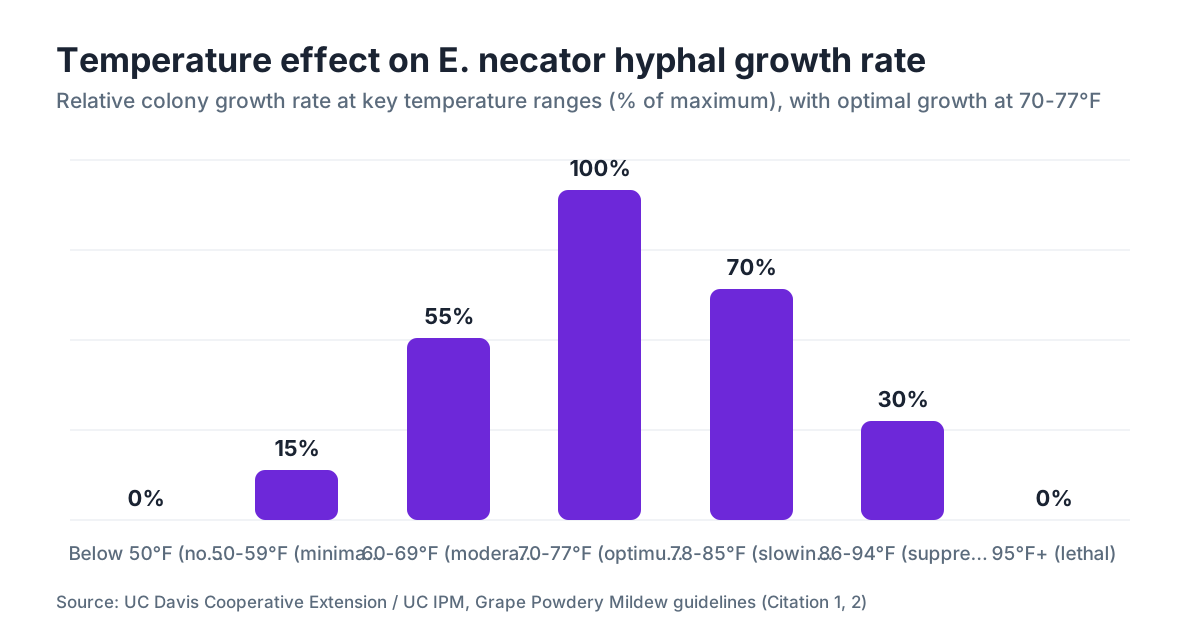
- Hyphae grow fastest at 70 to 77 degrees F, and free moisture actually slows spore germination.
- Infections set before bloom do the most damage.
- Sulfur, DMI fungicides, and timed bicarbonate sprays (dilute milk included) each hit the colony at a different growth stage.
What exactly are grape powdery mildew hyphae?
Erysiphe necator is an obligate biotrophic fungus, meaning it only grows on living plant tissue. That one fact explains almost everything about how you manage it. The fungus builds two kinds of hyphal structures that behave in completely different ways, and confusing them will wreck your control decisions.
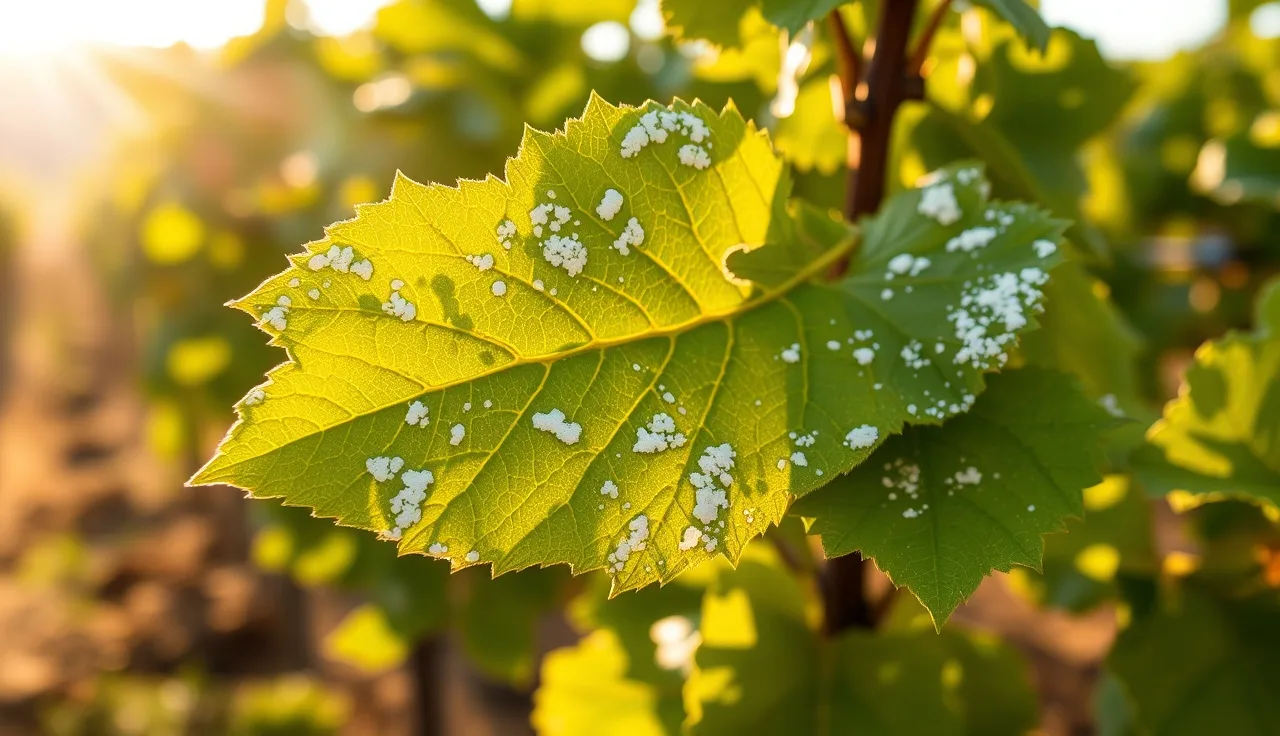
The external hyphae are the white, cottony threads you can see with your naked eye on leaves, shoots, and berries. They run along the surface of the plant. They never enter the tissue. What enters is the haustorium, a penetration organ that pokes through the outer epidermal cell wall, invaginates the plasma membrane, and pulls out sugars and amino acids without killing the cell. Keeping the cell alive is the whole strategy. A dead cell is worthless to the fungus.
This surface-only lifestyle has one enormous practical consequence. Powdery mildew does not need free moisture to germinate or spread. Rain and heavy dew can actually suppress spore germination. Colony growth prefers relative humidity between 40% and 100%, but conidia germination is inhibited when leaf surfaces are wet [1]. That is the opposite of downy mildew. Mixing up those two diseases is a common mistake that costs growers real money.
The hyphae also produce conidiophores, short upright stalks that release chains of conidia (asexual spores). Under warm conditions, a single colony throws off millions of conidia a day. Wind carries them to new tissue. The full cycle from germination to spore production takes as little as 5 to 7 days at 77 degrees F [2].
How do hyphae colonize grapevine tissue through the season?
The first inoculum of the season comes from two places: cleistothecia (sexual fruiting bodies that overwintered in bark crevices) releasing ascospores in spring, and infected buds carrying mycelium internally from the previous year. Those flag shoots you see early in the season, the pale, stunted, white-dusted ones, are the bud infection pathway. Cornell researchers found that buds with internal mycelium are the more dangerous primary inoculum source in many eastern vineyards because the infection timing is harder to catch [3].
Once primary infection lands on a young shoot or leaf, the hyphae spread radially from the initial point. At this stage the colony is invisible. You won't see white powder until the colony has grown for several days and the conidiophores start producing spores. By the time the infection is obvious, the fungus has been feeding for most of a week.
The most expensive window runs from two weeks before bloom through three to four weeks after bloom. Berries stay highly susceptible from just after fruit set until they hit about 8 Brix, roughly when the skins start accumulating sugar and shifting chemistry [1]. Hyphae that colonize berry skin during this window stop the epidermal cells from expanding normally. The skin stiffens while the interior keeps growing, and you get splitting, russeting, and cracked skins that invite Botrytis. Infection on berries past 15 Brix does far less damage to fruit quality, though it still adds to the overwintering inoculum load.
On leaves, hyphae cause chlorosis and cut photosynthesis. On shoots, they can slow lignification and raise winter cold injury risk. None of this is subtle once an infection runs unchecked for two to three weeks.
What temperature and humidity conditions accelerate hyphal growth?
E. necator hyphae grow fastest between 70 and 77 degrees F, and above 95 degrees F conidia die outright. Germination starts around 50 degrees F, accelerates through the 60s, and peaks in that low-70s band. That lethal ceiling is why hot inland regions get a natural mid-summer lull before disease pressure returns in fall [2].
WSU Extension publishes a degree-day model (the Gubler-Thomas model, developed at UC Davis) that adds up heat units above a base temperature to predict when the high-risk window opens each season [4]. The model uses base 50 degrees F. Once 50 cumulative degree-days above base 50 have accumulated after January 1, risk is considered elevated. The model doesn't predict infection events directly. It tells you when conditions are warm enough to push colony growth fast enough to matter.
Growers with a general horticulture background trip over the no-moisture requirement. You do not need wet weather to justify a spray. A dry, warm week in June is a perfect powdery mildew building week, and skipping a spray because "it hasn't rained" is a reliable way to lose canopy control.
Here is a number to hold onto. More than three straight days above 85 degrees F can suppress the fungus, but don't count on it to bail you out. Night temperatures dropping back into the 60s and 70s let the colony recover and keep growing. Coastal and mountain vineyards with those cool nights carry higher risk for sustained season-long hyphal growth than hot valley floors do.
Which fungicide modes of action actually disrupt hyphal growth?
Five main chemical classes hit E. necator in meaningfully different ways, and knowing how each one works tells you when in the infection cycle it earns its keep.
Sulfur (FRAC M2) works by direct contact toxicity. It volatilizes, and the vapor disrupts mitochondrial electron transport in fungal cells, killing surface hyphae and conidia on contact. It has no systemic movement, so anything the spray doesn't physically reach stays alive. It is still the backbone of organic programs and a solid resistance-management tool in conventional ones, at roughly $2 to $6 per acre per application at typical label rates. The catch: do not apply sulfur when temperatures will top 90 degrees F within 24 hours, or you risk phytotoxicity [1].
DMI fungicides (FRAC 3) are the sterol biosynthesis inhibitors like tebuconazole and myclobutanil. They move into plant tissue with systemic and translaminar activity and block ergosterol production in the fungal cell membrane, stopping hyphal elongation. They work best as protectants but carry a narrow kickback window of 72 to 96 hours after infection. This is where resistance builds fastest. Many E. necator populations in California and the eastern US now show reduced sensitivity to DMIs [5].
SDHI fungicides (FRAC 7), such as fluxapyroxad and boscalid, block succinate dehydrogenase in the fungal mitochondrial respiratory chain. They have strong systemic activity. Rotate them hard against other modes of action, because resistance has already been documented in other powdery mildew pathogens.
Quinoxyfen (FRAC 13) is a highly specific inhibitor that acts in early infection, blocking appressorium development before haustoria form. It does nothing to established hyphae, which makes timing everything and makes it a strong fit for the pre-bloom window.
Potassium bicarbonate and sodium bicarbonate (FRAC BM02) raise the pH on the leaf surface fast, which disrupts the osmotic balance in hyphal cells and collapses them. They are contact materials with no systemic action, but they carry some eradicant activity on young colonies because the pH shift physically damages surface hyphae. That is the same mechanism behind the milk spray discussion below.
| Mode of action | FRAC code | Systemic? | Eradicant window | Resistance risk |
|---|---|---|---|---|
| Sulfur | M2 | No | None | Low |
| DMI (triazoles) | 3 | Yes | 72-96 hrs | High (widespread) |
| SDHI | 7 | Yes | 48-72 hrs | Moderate |
| Quinoxyfen | 13 | Partial | Pre-infection only | Moderate |
| Potassium bicarbonate | BM02 | No | 12-24 hrs (limited) | Low |
Does milk actually work against powdery mildew hyphae on grapes?
It comes up in every organic viticulture conversation, and the honest answer is yes, to a real but limited degree, through the same pH and protein chemistry that makes bicarbonate work.
The foundational study is Wagner Bettiol's 1999 paper in Crop Protection, which found that weekly applications of 10% fresh milk suppressed powdery mildew on zucchini by up to 90% versus untreated controls, with performance comparable to fenarimol at high milk concentrations [6]. That paper launched the whole discussion. Later work in ornamentals and some vegetable crops has generally confirmed that skim milk and whey-based sprays have real suppressive activity.
The proposed mechanisms include a surface pH rise from the lactate compounds, direct contact effects of casein proteins on hyphal membranes, and possibly the triggering of plant defense compounds. Nobody has pinned it to one clean mechanism, and the grape-specific milk literature is thin next to the vegetable studies.
So what does that mean in the block? Dilute milk (10% to 20% fresh milk in water, sprayed to runoff) on a 7 to 10 day schedule during the primary risk window is worth considering in certified organic programs where your chemical options are narrower. It is not a replacement for sulfur, and it has essentially no activity on colonies more than a few days old. Timing matters as much as it does with conventional materials. Use it as a protectant, never as a rescue treatment.
One handling note. Skim milk or reconstituted nonfat dry milk performs about the same as whole milk in the vegetable studies, and it is easier in a tank mix. Use it within a few hours of mixing. The residue can turn sour in hot weather, which is worth a thought if you have vineyard visitors or tasting room guests nearby.
How do you scout for hyphal colonies before they become visible?
Look for white powder on shoots, leaves, and clusters, and you are already identifying an established colony rather than a new infection. By the time you see powder, you have missed the most cost-effective spray timing.
A better protocol: run a 10x hand lens over young leaves near the cluster zone starting at budbreak. Watch for a faint oily or water-soaked look on the upper (adaxial) leaf surface, then a very fine network of surface hyphae that is nearly transparent under magnification. Flag shoots from overwintered bud infections show bleached, stunted growth with powder visible right at bud emergence, and those are your sentinel points for timing the first spray.
In blocks with a powdery mildew history, UC Davis plant pathologists recommend scouting the most susceptible varieties and the highest-risk parts of the block (north-facing slopes, dense canopy zones, spots where overhead irrigation wets the leaves) on a 7-day interval from budswell through veraison [1].
The economic threshold people cite is 3% of clusters infected at or before bloom. Past that, eradication gets much harder and fruit quality loss speeds up. Nobody has clean data on a precise threshold for hyphae before visible powder shows. The closest guidance is simple: don't let any infection establish between two weeks pre-bloom and four weeks post-bloom.
What spray intervals actually prevent hyphal colonization?
The 7 to 14 day interval is not arbitrary. It comes straight from the incubation math: at optimum temperatures a new infection produces spores in 5 to 7 days. A 7-day interval with a contact material means you are refreshing the protective barrier before the first-generation colony can produce inoculum. Real-world canopy growth, rain, and temperature swings compress or stretch that window.
UC Davis Cooperative Extension recommends this interval logic [1]:
- 5 to 7 days during the bloom to fruit set window (highest risk)
- 7 to 10 days from fruit set to roughly 8 Brix
- 10 to 14 days after 8 Brix if pressure stays moderate
WSU Extension adds a degree-day trigger. When the Gubler-Thomas model shows degree-days above base 50 climbing fast, shorten intervals. When a heat event pushes temperatures above 90 degrees F for three or more straight days, you can briefly stretch intervals, but confirm the canopy is actually suppressed before you do [4].
Systemic materials (DMIs, SDHIs) give you more slack because the product sits inside the plant and doesn't wash off immediately. Even so, rotating modes of action every two to three applications beats interval precision for resistance management. Cornell's IPM guidelines recommend no more than two consecutive applications of any single FRAC code [3].
How does keeping spray records help with powdery mildew hyphae management?
Managing E. necator well means knowing what you sprayed, when, and what you saw afterward. That is not paperwork for its own sake. It is the only way to tell whether a program actually worked or whether you got lucky with the weather.
At minimum, your spray records should capture the application date, product and FRAC code, rate, timing relative to growth stage, and scouting observations before and after. When a program fails, the records tell you whether you ran two straight applications of the same mode of action (a resistance setup), whether your intervals stretched past 14 days during a risk window, or whether the failure lined up with a spray that landed right before rain.
The EPA Worker Protection Standard (WPS) under 40 CFR Part 170 requires pesticide application records be available to workers and handlers, but the WPS requirements are a floor, not a ceiling [7]. California, Washington, and New York each layer more on top, and many pest control advisers (PCAs) want records to back their recommendations. The practical payoff is a format that makes FRAC rotation visible at a glance, so you can catch yourself before you stack three triazole applications in a row.
VitiScribe was built for exactly this: spray records that flag repeated FRAC codes and interval gaps, so the compliance paperwork and the agronomic decisions stop being two separate chores.
For vineyard operations of any size, that record-keeping discipline is also your legal cover if a neighbor asks about drift or a certification audit wants proof of IPM compliance.
What does resistance to fungicides mean for hyphal control long-term?
Resistance in E. necator is not theoretical. UC Davis researchers documented DMI resistance in California vineyard populations as early as the mid-2000s, and monitoring since then has found many populations carrying mutations in the CYP51 gene (the sterol demethylase target) that reduce DMI binding [5]. In plain terms: a triazole application that gave 14 days of protection in 2000 might give 7 days or less in a resistant population today.
The FRAC (Fungicide Resistance Action Committee) recommends no more than 3 to 4 applications of any single FRAC code per season, and alternating or tank-mixing with multi-site materials (mainly sulfur, FRAC M2) slows selection pressure a lot [8]. The guidance is old news, and programs that default to the same two-product rotation year after year still ignore it.
No fully resistant E. necator population that shrugs off every mode of action at once has ever been documented. Resistance is mode-of-action specific. A population with reduced DMI sensitivity is usually still fully susceptible to SDHI and quinoxyfen. That is why FRAC code rotation is a genuine management tool and not box-checking.
Growers ask about biologicals as resistance-management pieces. Products based on Bacillus subtilis (Serenade, Regalia) have some suppressive activity and sit in FRAC codes BM01 or BM02, so they add diversity to a rotation. The evidence for their standalone efficacy on grapes is weaker than for some vegetable crops, but as rotation fillers in a broader program they are reasonable.
Are there varietal differences in how hyphae colonize grapevine tissue?
Yes, and the differences are big enough to change your spray program. Vitis vinifera varieties are generally highly susceptible to E. necator. Pinot noir, Chardonnay, Cabernet Franc, and Zinfandel rate highly susceptible in UC Davis and Cornell trials [3]. Cabernet Sauvignon is moderately susceptible. Riesling and Gewurztraminer land in the middle.
Some North American species and interspecific hybrids carry real resistance. Vitis rotundifolia (muscadine grapes) are largely immune. Several French-American hybrids, Marquette, Frontenac, and Traminette among them, carry partial resistance that can cut fungicide requirements substantially. Cornell's grape breeding program has quantified resistance QTLs in hybrid material, and several newer varieties are released specifically with powdery mildew resistance as a trait [3].
The resistance runs on two tracks. Physical leaf surface traits (thicker cuticle, more trichomes) make hyphal establishment harder. Biochemical responses, including stilbene compounds like resveratrol that are toxic to the fungus, do the rest. Resveratrol is the same compound that gets attention in wine and human health talk. The plant makes more of it under stress, which is one reason lightly stressed vines in organic programs sometimes show surprisingly decent resistance.
For growers in regions like Paso Robles or the South Coast of California (see paso-robles-wineries and south-coast-winery for regional context), variety selection is a 20-year decision. Knowing where your current block sits on the susceptibility spectrum should be setting how tight your spray intervals run right now.
What are the EPA and state regulatory requirements for powdery mildew sprays in vineyards?
The EPA Worker Protection Standard applies to any pesticide application on a vineyard that requires a label. Sulfur, despite its long history and OMRI listing, has a pesticide label and falls under WPS [7]. That means workers must stay out of the treated area during the restricted entry interval (REI) on the label, the application must be recorded, and the Safety Data Sheet must be accessible at the central display location.
Sulfur's REI is usually 24 hours for most formulations, though wettable sulfur and dust formulations vary. Read the actual label. Under FIFRA, the label is the law [12].
DMI fungicides vary widely. Myclobutanil (Rally) carries a 24-hour REI. Tebuconazole products are typically 12 hours. Some SDHI combinations run 12-hour REIs.
California adds the Pesticide Use Reporting (PUR) requirement: every application must be reported to the county agricultural commissioner within one month [9]. Washington has similar requirements under the Washington Pesticide Application Act. New York requires records under the Agricultural Districts Law and DEC regulations.
If you are pursuing USDA Organic certification, your spray records need to prove every material applied was OMRI-listed or otherwise compliant with your certifier's standards. Sulfur is generally approved. Potassium bicarbonate products (Kaligreen, MilStop) are generally approved. Most synthetic DMIs and SDHIs are not. Check with your certifier before assuming any material qualifies.
If you manage multiple blocks or work with a compliance consultant, keep your records in a format that exports cleanly and carries a date stamp. Audits go faster that way. Tools like VitiScribe can pay for themselves quickly against a paper binder.
Can you eradicate an established hyphal colony, or only prevent new ones?
Short version: you can suppress an established colony with systemic fungicides and bicarbonate materials, but true eradication of dense mycelium on fruit is essentially impossible once you are past early infection.
The systemic DMIs and SDHIs do have kickback activity on very young infections, the ones that started within the past 72 to 96 hours. That window is real and useful, especially after a missed spray or a surprise weather event. It is not the same as erasing a colony you have watched grow for a week.
High-rate sulfur kills surface hyphae and conidia on contact. Spray a developing colony on a leaf in the early cottony stage with good sulfur coverage, and you will see it go gray and stop sporulating within 24 to 48 hours. Whether the haustoria in the epidermal cells survive, and whether the colony recovers, depends on how deep the colonization runs. On young, soft tissue, good sulfur coverage can knock back a visible colony a lot. On mature tissue with deep hyphal establishment, it is largely cosmetic.
For berries past 8 Brix, the job shifts to keeping conidia off healthy tissue. You are not rescuing berries that already have colonies causing russeting. You are protecting the rest of the cluster and keeping the infected berries from becoming a late-season inoculum reservoir.
Frequently asked questions
What do powdery mildew hyphae look like on grape leaves?
Early colonization looks like a faint gray-white, powdery film on the upper surface of young leaves. Under a 10x hand lens, individual hyphae appear as fine, translucent threads radiating from a central point. The first visible sign is often a slight oily or water-soaked patch before the white powder shows. On older tissue, the colony turns grayish and less distinct as conidia shed.
Can grape powdery mildew hyphae survive on dead plant material over winter?
The external hyphae die with the tissue they were on. E. necator overwinters two other ways: cleistothecia (sexual fruiting bodies) on bark surfaces, which survive harsh winters and release ascospores the following spring, and internal mycelium inside infected buds, which produce flag shoots early in the next season. Sanitation (removing and destroying infected canes) reduces but rarely eliminates inoculum.
Does rain actually suppress powdery mildew hyphae on grapes?
Rain can wash conidia off leaf surfaces and inhibit germination while leaves are wet, but the effect is temporary. Once the canopy dries, sporulation resumes. Heavy rain does not eradicate established hyphal colonies. Unlike downy mildew, E. necator does not need wet tissue to spread, so you cannot count on summer rain to manage it. Monitor conditions after rain rather than assuming suppression.
How does the Gubler-Thomas model predict powdery mildew risk from hyphae?
The Gubler-Thomas degree-day model adds up heat units above base 50 degrees F starting January 1. Once 50 degree-days accumulate, the risk window opens. The model classifies daily risk as low (below 63 degrees F average), moderate (63 to 79 degrees F), or high (above 79 degrees F). It tells you when conditions favor rapid hyphal growth and spore production, so you can decide whether to shorten intervals or spray at the tight end of your range.
Is milk spray effective against grape powdery mildew in the vineyard?
Milk sprays (10% to 20% fresh or reconstituted skim milk in water) have documented efficacy against powdery mildew in vegetable crops, most notably in Bettiol's 1999 Crop Protection study. Grape-specific published data is thinner. The mechanism involves surface pH disruption and casein protein contact on hyphae. Milk is worth using in organic programs as a protectant on a 7 to 10 day schedule during high-risk periods, but it has little eradicant activity on established colonies.
What FRAC codes should I rotate to manage E. necator resistance?
Rotate among FRAC codes 3 (DMIs like myclobutanil), 7 (SDHIs like fluxapyroxad), 13 (quinoxyfen), and M2 (sulfur). Do not apply the same FRAC code more than two to three straight applications. FRAC recommends including multi-site materials (sulfur, FRAC M2) regularly since they carry no documented resistance risk. Bicarbonate products (FRAC BM02) add diversity in organic programs.
Which grape varieties have the most resistance to powdery mildew hyphae?
Vitis rotundifolia (muscadine) varieties are largely immune. Many French-American hybrids, including Marquette, Frontenac, and Traminette, carry partial resistance. Among V. vinifera, Cabernet Sauvignon is moderately susceptible, while Pinot noir, Chardonnay, Zinfandel, and Cabernet Franc are highly susceptible. Cornell's grape breeding program has released several varieties with quantified powdery mildew resistance QTLs that can cut fungicide needs substantially.
What is the most critical timing window to prevent hyphae from damaging grape berries?
Two weeks before bloom through four weeks after bloom is the highest-risk window. Berries stay highly susceptible until they reach about 8 Brix, after which the changing chemistry of the skin cuts colonization risk substantially. Missing sprays during this six-week window is the single most common cause of fruit quality loss from powdery mildew in warm, dry wine regions.
Do I still need to spray for powdery mildew during hot weather above 90 degrees F?
Temperatures above 95 degrees F kill conidia outright and suppress hyphal growth, but the effect is temporary. Night temperatures dropping into the 60s and 70s let the fungus resume colonization. Stretching spray intervals during heat is reasonable only if the forecast shows sustained highs above 90 degrees F for three or more straight days and the nighttime lows also stay elevated. In coastal and mountain vineyards with cool nights, never rely on heat suppression.
What records do I need to keep for powdery mildew fungicide applications under the EPA Worker Protection Standard?
WPS under 40 CFR Part 170 requires application records to include the product name, EPA registration number, application date, location, and restricted entry interval. Records must be retained for two years. Many states layer on more: California requires Pesticide Use Reports filed with the county ag commissioner within 30 days of application. Organic programs require records documenting that all materials were certifier-approved.
Can powdery mildew hyphae be present in the vineyard without any visible symptoms?
Yes. From the moment a conidium germinates on a leaf surface through several days of hyphal growth, there is no visible symptom. The incubation period at optimum temperatures is 5 to 7 days. White powder (conidia) only shows after the colony matures. This is why calendar- and degree-day-based spray programs beat symptom-triggered ones: by the time you see it, you are already behind.
How does sulfur kill powdery mildew hyphae and what are the phytotoxicity risks?
Sulfur volatilizes above roughly 70 degrees F, and the vapor disrupts the electron transport chain in fungal mitochondria, killing hyphae and conidia on contact. It has no systemic activity. Phytotoxicity risk climbs sharply above 90 degrees F: plant tissue absorbs excess sulfur under heat stress and can bleach or drop leaves. Do not apply sulfur if temperatures will top 90 degrees F within 24 hours, and avoid application in direct afternoon sun during hot weather.
What scouting threshold should trigger a powdery mildew spray in a wine grape vineyard?
UC Davis Cooperative Extension recommends a practical action threshold of 3% of clusters showing infection at or before bloom. Before bloom, any flag shoot (a shoot with early powdery mildew from overwintered bud infection) in a susceptible variety block justifies tightening your interval to 5 to 7 days. After bloom, the threshold for adding a spray is lower in high-value blocks or ones with a resistance history.
Are there any biological fungicides that affect powdery mildew hyphae on grapes?
Bacillus subtilis-based products (Serenade Optimum, for example) suppress powdery mildew and are OMRI-listed. Their standalone efficacy on grapevines is weaker than in some vegetable crops, but they work as rotation partners in organic programs or as fillers between stronger materials. Regalia (extract of Reynoutria sachalinensis) also has some activity, mostly through induced plant resistance rather than direct hyphal toxicity.
Sources
- UC Davis Cooperative Extension, Grape Powdery Mildew (Erysiphe necator) management guidelines: Optimal relative humidity for colony growth, conidia germination inhibition by free moisture, berry susceptibility window to 8 Brix, sulfur phytotoxicity above 90 degrees F, and scouting interval recommendations
- UC Davis, UC Integrated Pest Management Program, Powdery Mildew biology: Temperature range for E. necator growth (50 to 77 degrees F optimum, kill above 95 degrees F), incubation period of 5 to 7 days at 77 degrees F, and conidia production rates
- Cornell University College of Agriculture and Life Sciences, Grape Breeding and Enology Program and IPM guidelines: Bud-borne internal mycelium as primary inoculum in eastern vineyards, no more than two consecutive applications per FRAC code, varietal susceptibility ratings, and quantified powdery mildew resistance QTLs in hybrids
- Washington State University Extension, Gubler-Thomas grape powdery mildew risk model: Degree-day model using base 50 degrees F, 50 cumulative degree-days after January 1 marking elevated risk, and interval adjustment logic tied to heat accumulation
- UC Agriculture and Natural Resources, fungicide resistance in Erysiphe necator California populations: DMI resistance documented in California E. necator populations in the mid-2000s, CYP51 gene mutations reducing triazole binding activity
- Bettiol, W. (1999). Effectiveness of cow's milk against zucchini squash powdery mildew. Crop Protection, 18(8), 489-492.: 10% fresh milk applied weekly suppressed powdery mildew on zucchini by up to 90% compared to untreated controls, with efficacy comparable to fenarimol at high concentrations
- EPA, Worker Protection Standard for Agricultural Pesticides, 40 CFR Part 170: WPS requires pesticide application records be available to workers and handlers, records retained two years, REI compliance requirements apply to sulfur and other labeled pesticides
- FRAC (Fungicide Resistance Action Committee), Powdery Mildew Fungicides Working Group recommendations: Recommendation of no more than 3 to 4 applications per season of any single FRAC code, alternating or tank-mixing with multi-site materials (sulfur) to slow resistance selection
- California Department of Pesticide Regulation, Pesticide Use Reporting Program: California requires all pesticide applications to be reported to the county agricultural commissioner within one month of application under the state Pesticide Use Reporting system
- EPA, Federal Insecticide, Fungicide, and Rodenticide Act (FIFRA), pesticide registration: Under FIFRA, the pesticide label is the law; restricted entry intervals listed on labels are legally binding requirements
Last updated 2026-07-09