Powdery mildew chasmothecia on grapevines: what they are and why they matter
TL;DR
- Chasmothecia are the sexual overwintering structures of Erysiphe necator, the fungus that causes powdery mildew on grapevines.
- They survive on bark and dormant canes, release ascospores after winter rain events, and start primary infections in spring.
- Their lifecycle tells you exactly when your first spray needs to go out, which is earlier than most growers assume.
What are chasmothecia and what do they have to do with powdery mildew on grapes?
Chasmothecia are the closed, spherical fruiting bodies that the powdery mildew fungus Erysiphe necator produces late in the growing season. They're the fungus's survival capsule. Tiny, roughly 70 to 200 micrometers across, they start yellow-orange and turn dark brown to black as they mature through summer and fall. (Older literature calls them cleistothecia.) [1]
The mycelium on a leaf surface isn't built to last through a cold, wet winter. The chasmothecium is. It has a thick outer wall, appendages that grip bark, and inside it sits one to six asci, each packing up to eight ascospores. Those spores are the primary inoculum for next season.
The grape powdery mildew fungus is an obligate biotroph. It only grows on living plant tissue. That single constraint is why chasmothecia matter so much: they're basically the only way the pathogen gets from one season to the next in most temperate wine regions. [2] There is a second overwintering pathway, dormant mycelium inside buds, but chasmothecia are the dominant inoculum source across most of North America and Europe.
Ever looked at heavily infected clusters in late August and seen tiny dark dots embedded in the white felt? Those are immature chasmothecia. By harvest you can often spot them on cane surfaces with a hand lens.
How does the chasmothecia lifecycle connect to spring infection risk?
The lifecycle makes sense once you map it against the calendar. Through the growing season, E. necator reproduces asexually with conidia, the airborne spores that cause the explosive spread everyone recognizes as powdery mildew. Toward the end of summer, sexual reproduction starts: two compatible mating types fuse, and chasmothecia form on infected tissue. [1]
Through dormancy, chasmothecia sit on bark, on pruned canes left in the row, and on the soil under the canopy. They're tough. Freezing doesn't kill them. Rain doesn't wash them off because the appendages grip.
The event that matters is chasmothecia maturation. Work out of UC Davis confirmed that maturation in California accelerates through winter and that a threshold of moisture and temperature has to be met before asci are ready to discharge. [2] In practice, the first real spring rains, once vine tissue has pushed past roughly two to four inches of shoot growth, trigger ascospore release. The spores land on expanding tissue, germinate best at high humidity without free water, and start primary infections. [3]
That last point trips up growers every year. Rain matters because it releases ascospores from chasmothecia. The infection that follows happens during the dry spells after rain, when humidity is high and temperatures run between roughly 50 degrees F and 90 degrees F (optimal near 77 degrees F). A rainy spring does drive powdery mildew pressure through chasmothecia discharge. Just not the way most people picture it.
Where exactly do chasmothecia overwinter on the grapevine?
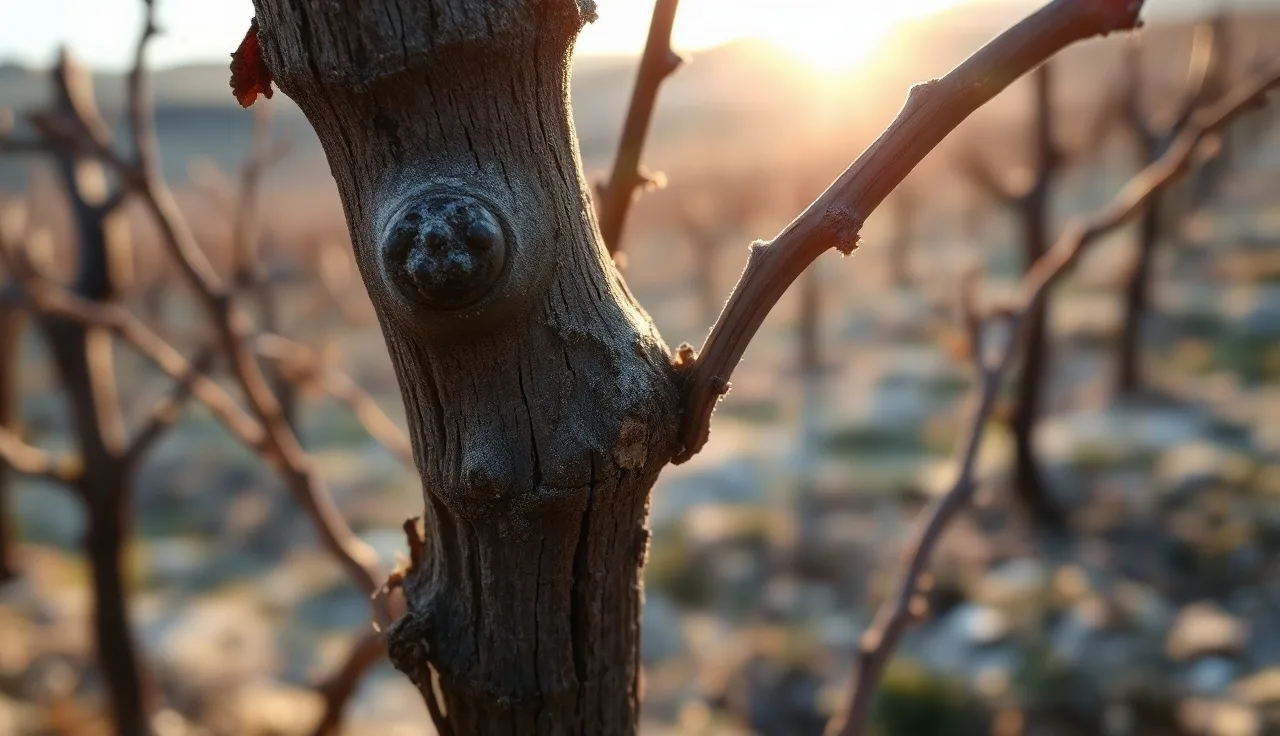
The bark of the permanent structure is the main reservoir. Two-year-old and older wood, especially in the cordon and trunk, collects chasmothecia year over year in the rough, furrowed surface. [4] That's why old-wood surfaces are worth inspecting at pruning time.
One-year-old canes carry chasmothecia too, and that matters epidemiologically because cane material moves. Run canes through a mechanical harvester or leave infected pruning brush in the row, and you're redistributing inoculum. UC Davis extension flags pruning brush management as an underrated lever for cutting primary inoculum. [2]
Chasmothecia also land on cluster rachises. Infected clusters left on the vine through dormancy contribute inoculum at exactly the canopy level where you least want it. In vineyards with chronic cluster-zone infections, that source can be surprisingly dense.
Soil under the canopy holds chasmothecia that fell or washed off, but soil-borne inoculum ranks lower because it's mostly shaded and less likely to reach the airstream. Nobody has great data on the exact proportional contribution of each reservoir. The closest studies focus on bark versus cane tissue, and most extension guidance ranks permanent wood as the dominant source.
How do you detect chasmothecia in your vineyard before dormancy?
You don't need a lab. A 10x to 20x hand lens is enough to see mature chasmothecia on infected surfaces. Look for small dark spheres embedded in or next to the white or gray powdery growth on leaves, shoots, and clusters from about July onward in most regions. By late season they're black and roughly the size of a ground pepper flake. [1]
For a systematic read, WSU extension suggests collecting infected canes or bark after dormancy and checking them for chasmothecia density. [4] Soak a small piece of cane bark in water for a few minutes, then tease it apart under magnification. Large numbers of dark spheres mean inoculum pressure going into next season is high.
Some extension programs have tested spore traps to catch ascospore release events in real time, which lets you calibrate first spray timing. Cornell's work on powdery mildew forecasting has included spore trapping in its disease warning systems. [5] This isn't practical for most individual growers. But if your local farm advisor or PCA runs a regional weather station network with disease models, that data is often available to you.
Photos help. Shoot a few consistent images of the same bark panels or cluster tissue each season, and you get a rough year-over-year comparison of chasmothecia density. That's a decent proxy for inoculum load.
When do ascospores release, and what does that mean for your first spray timing?
Ascospore release needs two things: mature chasmothecia and a wetting event. Maturity builds over winter as a function of temperature (researchers model it as degree-day accumulation, though thresholds vary by model). [2] The wetting event can be small. As little as 0.1 inches of rain can trigger discharge once chasmothecia are ready.
In California's North Coast, primary season often gets going around budbreak while soils are still wet from winter rain. In the Pacific Northwest and the eastern US, it may lag a few weeks. Practically, WSU and UC Davis both say start a spray program no later than the one-inch shoot growth stage, and plenty of growers in high-pressure regions start at budbreak. [3][4]
The Gubler-Thomas powdery mildew risk index, developed at UC Davis, is the most widely used forecasting tool in the western US. It uses growing-season temperature accumulation to estimate risk, and it accounts for the fact that early-season ascospore release lines up with the most susceptible tissue: shoots and flower clusters. [2] Cornell built complementary models for the northeast through the NEWA (Network for Environment and Weather Applications) platform. [5]
Here's the punchline. Wait for visible symptoms before your first spray and you've already lost the primary infection window. Chasmothecia-sourced ascospores infect tissue that shows nothing for seven to ten days (the incubation period under warm conditions). By the time you see the white felt, you're managing secondary spread, not primary inoculum.
Does rain cause powdery mildew infections directly on grapevines?
No. Rain doesn't cause the infections. It triggers the inoculum that does.
E. necator conidia germinate poorly in free water. A wet leaf surface during a rain event is not a good infection site. [3] This is the opposite of botrytis or downy mildew, both of which need free water to infect. Powdery mildew does best during dry spells with moderate to high relative humidity, roughly 40 to 100 percent RH, with optimal infection near 95 percent RH and no water film on the tissue.
So why do growers tie rainy springs to bad powdery mildew years? Because rain events release ascospores from chasmothecia, and those spores infect during the warm, humid, dry days that follow. Wet springs stack up repeated discharge events, loading the canopy with primary inoculum through the early-season window again and again. [2]
The rain-disease link is real. The mechanism is just indirect. That distinction changes your spray schedule: you're not racing to spray before the rain, you're getting protectant material on tissue before the dry weather afterward, when infection actually happens. Some growers tighten spray intervals after a big spring rain for exactly this reason.
What spray programs actually target chasmothecia and primary season inoculum?
Primary season management is about suppressing that first wave of ascospore infections before conidia start their exponential secondary spread. The materials differ somewhat from mid-season programs.
Dormant oil (petroleum or mineral oil at 1 to 3 percent) applied before budbreak is a traditional way to hit chasmothecia and overwintering mycelium directly on bark. Research support is mixed, but growers use it widely and the mode of action is physical: it suffocates or disrupts the fruiting bodies. [4] Some growers apply lime sulfur during dormancy too. Timing is everything. These go on before green tissue emerges because they'll damage it.
Once the season starts, protectant fungicides with good early-season performance include:
| Material class | Example active ingredients | FRAC code | Resistance risk | Notes |
|---|---|---|---|---|
| Sterol inhibitors (DMIs) | Myclobutanil, Tebuconazole | 3 | Medium-high | Resistance common in older vineyards |
| Quinone outside inhibitors (QoIs/Strobilurins) | Azoxystrobin, Trifloxystrobin | 11 | High | Limit applications; alternate |
| SDHI fungicides | Fluxapyroxad, Penthiopyrad | 7 | Medium | Relatively newer class |
| Potassium bicarbonate | Kaligreen, Milstop | M | Low | Contact, no systemic; good in organic |
| Sulfur | Various | M2 | Very low | Excellent early-season, phytotoxic above 90 degrees F |
| Mineral oil | Various | M | Very low | Primarily dormant use |
Sulfur is worth a special mention. It's cheap, it has essentially zero resistance risk, and it works well against primary infections. Cornell and UC Davis both use it as a backbone early-season material in their spray recommendations. [5][2] The constraints are the temperature ceiling (avoid above 90 degrees F, 85 degrees F in sensitive varieties) and incompatibility with certain other pesticides.
Fungicide resistance is a real problem in vineyards with a history of heavy DMI or QoI use. UC Davis has documented field resistance to myclobutanil in California vineyard populations of E. necator. [6] In those situations, rotating FRAC codes is not optional.
For growers keeping digital spray records, tools like VitiScribe connect spray events to weather-triggered risk windows. That makes it easier to document not only what you applied but why, which matters for compliance and audits under certifications like CCOF or SIP.
How do chasmothecia affect resistance management in your spray program?
Resistance management starts with one idea: you're selecting on a population. The E. necator population in your vineyard has genetic diversity, and heavy pressure from one FRAC group narrows it toward resistant genotypes. Chasmothecia matter here because they're the sexual stage, and sexual reproduction mixes new genotype combinations, including new resistance combinations. [1]
Here's what that means in practice. If your population has picked up resistance to FRAC 3 (DMI) fungicides through years of use, chasmothecia-mediated recombination can spread and compound that resistance. This is why resistance guidance focuses on total applications per season more than alternation within a season. Most labels for at-risk FRAC codes cap applications at two or three per season for exactly this reason.
The FRAC (Fungicide Resistance Action Committee) guidelines for grape powdery mildew recommend no more than two consecutive applications of any single FRAC group before switching. [7] That's the floor. Rotating across three or four modes of action through the season, including low-risk materials like sulfur and bicarbonates, is better practice.
Growers often overlook this: the chasmothecia forming at the end of this season carry the resistance genetics of whatever population dominated this season. Run heavy QoI pressure mid-season, and the chasmothecia heading into bark for next year reflect that selection. You're banking next year's inoculum with whatever resistance profile you created.
What are the worker safety requirements when spraying for powdery mildew?
The federal Worker Protection Standard (WPS), run by the EPA, covers agricultural pesticide applications and sets minimum requirements for restricted-entry intervals (REIs), personal protective equipment (PPE), and worker training. [8] State rules layer on top and are often stricter, California most of all.
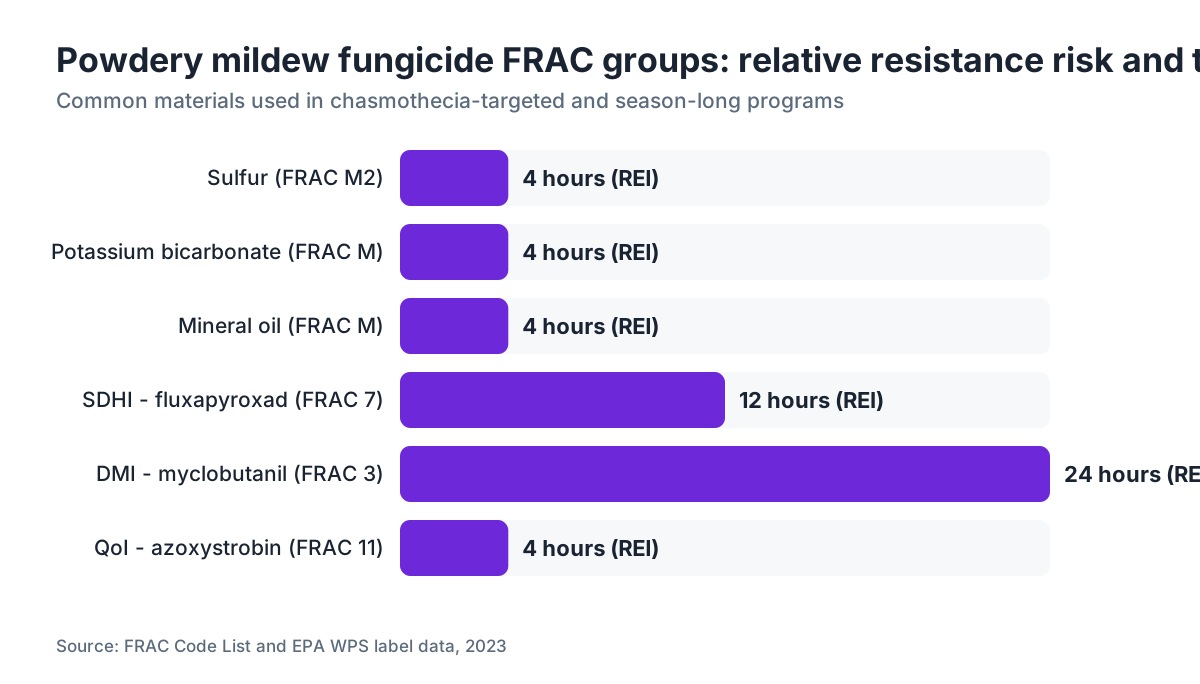
For the fungicides common in powdery mildew programs, the REIs vary. Sulfur typically carries a four-hour REI. Sterol inhibitors like myclobutanil (Eagle, Rally) commonly run 24-hour REIs. Some SDHI materials carry 12-hour REIs. Read the specific label. It is the legal document.
The EPA's 2015 revised WPS (effective 2017) added a minimum age (18 for handlers), mandatory pesticide safety training, an application exclusion zone (AEZ) of 25 to 100 feet depending on application method and equipment, and a centrally posted pesticide safety information requirement. [8] The AEZ affects when workers in adjacent rows can be present during spraying.
California goes further through CDPR regulations. Restricted materials require county permits, and applications over a certain size or involving certain materials need a licensed Pest Control Adviser (PCA) recommendation. [9] Growers elsewhere should check their state department of agriculture for parallel requirements.
PPE during chasmothecia-targeting dormant oil or lime sulfur applications is not optional. Sulfur dust in particular is a serious respiratory and eye irritant. A NIOSH-approved particulate respirator (N95 or P100) is the minimum for dust formulations; liquid applications still require eye protection and chemical-resistant gloves per the label.
Can vineyard sanitation actually reduce chasmothecia inoculum next season?
Yes, and it's one of the most undervalued tools in chronic-pressure vineyards. The logic is simple. Fewer chasmothecia going into dormancy means fewer ascospores released in spring.
Shredding and incorporating pruning brush beats leaving it in rows or windrows. The surface of shredded wood dries faster, and chasmothecia viability drops. [4] Some growers burn infected brush where burning is legal; that eliminates inoculum effectively but isn't allowed or practical everywhere.
Cluster-zone leaf removal done early (around pre-bloom to shortly after fruit set) has a double payoff. It improves spray penetration during the season, and it cuts the infected leaf area available for chasmothecia formation, especially in the cluster zone where later cluster infections do the most damage. [3]
Post-harvest canopy management almost never comes up in this context. Leaves that stay after harvest keep supporting chasmothecia formation. A late-season fungicide application (if the label allows, and check pre-harvest intervals carefully) or even thorough post-harvest leaf pulling can trim the crop of chasmothecia heading into bark for winter.
Nobody will tell you sanitation alone controls powdery mildew. In a region with widespread vineyard pressure, airborne inoculum from neighbors matters. But in isolated or semi-isolated vineyards, cutting your own chasmothecia bank genuinely shifts the inoculum curve.
How do you keep spray records and compliance documentation for chasmothecia-targeted applications?
Every commercial pesticide application in a vineyard requires documentation. At minimum, federal law requires handlers to receive and follow label instructions. Many states require written application records: date, location, product, EPA registration number, rate, total applied, target pest, and applicator information. California's requirements under CDPR are among the most detailed in the country, with reporting due within specified timeframes. [9]
For organic operations, chasmothecia management brings specific documentation needs. Sulfur, potassium bicarbonate, and mineral oils appear on the OMRI list or NOP allowed list, but the specific formulation has to be verified, and records must show no prohibited materials were used. [10]
Tying spray timing to documented disease risk is showing up more in third-party audits. Sustainability certifications like SIP (Sustainability in Practice) and CCOF increasingly ask growers to show that spray decisions followed threshold-based monitoring or forecasting models rather than calendar schedules. A record showing a spray that followed a real rain event at a documented shoot growth stage is exactly the IPM documentation those audits want.
VitiScribe is built for this field-to-record workflow. You log the spray event, attach the weather data and phenology observation, and the system generates the compliance record. For growers running multiple blocks or multiple certifications, that integration saves real time.
Keep spray records for at least two years, preferably three. Some certifications require a three-year history, and if a neighbor dispute or worker complaint triggers a regulatory review, your documentation is your protection.
Frequently asked questions
What are chasmothecia on grapevines?
Chasmothecia are the sexual, overwintering fruiting bodies of Erysiphe necator, the fungus causing powdery mildew on grapevines. They're tiny dark spheres, roughly 70 to 200 micrometers across, visible with a hand lens on bark and infected cane surfaces. They hold ascospores that survive winter and release during spring rain events to start primary infections on young shoot tissue.
Does powdery mildew on grapes spread because of rain?
Rain doesn't directly cause powdery mildew infections on grapevines. E. necator germinates poorly on wet leaf surfaces. But rain events release ascospores from chasmothecia, and those spores infect tissue during the warm, humid, dry days that follow. Rainy springs drive higher primary-season pressure through repeated discharge events, which is why they line up with bad powdery mildew years.
When should I apply the first powdery mildew spray in spring?
Most university extension programs say start no later than one-inch shoot growth, and in high-pressure regions, at budbreak. The Gubler-Thomas risk index from UC Davis is the most widely used timing tool in the western US. Waiting for visible symptoms means you've already missed the primary infection window, because the incubation period runs seven to ten days before symptoms show.
How do I tell if my vineyard has high chasmothecia pressure going into winter?
Check infected canes and bark with a 10x to 20x hand lens in late summer or early fall. Chasmothecia look like tiny black specks embedded in or near the white mycelial growth. Post-dormancy, soak a bark sample in water for a few minutes and examine under magnification. Dense chasmothecia mean high inoculum pressure for next season and support a more aggressive early-season spray program.
Can dormant oil sprays reduce chasmothecia before the season starts?
Dormant oil at 1 to 3 percent applied to bark before budbreak can physically disrupt chasmothecia and overwintering mycelium. Evidence for efficacy is reasonable but not conclusive; WSU and other extension programs include it as an option in high-pressure situations. Timing is critical because oil applied after green tissue emerges risks phytotoxicity. Lime sulfur is another dormant option used similarly.
How many times can I spray the same FRAC group fungicide for powdery mildew?
FRAC guidelines for grape powdery mildew recommend no more than two consecutive applications from a single FRAC group before switching modes of action. Many individual product labels for high-resistance-risk materials like QoIs (FRAC 11) cap total applications at two or three per season. Confirm with the specific label, which is the legal standard, and rotate across at least three FRAC groups through the season.
What temperature range does powdery mildew need to infect grapevines?
E. necator can infect between roughly 50 degrees F and 90 degrees F, with the optimal range around 68 degrees F to 77 degrees F. Conidia germination and infection are suppressed but not eliminated below 50 degrees F and above 90 degrees F. High relative humidity (above 40 percent, optimal near 95 percent) favors infection even without free water on tissue. These thresholds form the basis of forecasting models like the Gubler-Thomas index.
Is organic powdery mildew management effective against chasmothecia?
Sulfur is the backbone of organic powdery mildew management and works well against primary infections from chasmothecia-released ascospores. Potassium bicarbonate is effective against conidial spread. Dormant-season mineral oil applications can target chasmothecia directly. The limit is sulfur's temperature ceiling: avoid applying when temperatures will top 85 to 90 degrees F, which can leave timing gaps during heat spikes that need other OMRI-listed materials.
Do chasmothecia survive winter cold and can they overwinter in cold climates?
Yes. Chasmothecia are quite cold-hardy and survive typical winter temperatures in temperate wine regions, including the continental winters of the eastern US and the Pacific Northwest. They're built for overwintering survival. Extremely cold winters (below roughly minus 10 degrees F sustained) may reduce viability, but the fungal population is large enough that meaningful inoculum typically survives even severe winters in established vineyard bark.
What are the worker safety requirements for powdery mildew fungicide applications in vineyards?
The federal Worker Protection Standard requires minimum training, application exclusion zones of 25 to 100 feet during spraying depending on equipment, posted safety information, and label-mandated PPE and restricted-entry intervals. Sulfur carries a typical 4-hour REI; sterol inhibitors commonly require 24 hours. California adds county permits and PCA sign-off for restricted materials. Always follow the specific product label, which takes legal precedence over general guidelines.
Can vineyard sanitation reduce powdery mildew pressure the following season?
Yes, meaningfully so in isolated or semi-isolated vineyards. Shredding and incorporating infected pruning brush reduces chasmothecia viability compared to leaving it in rows. Early cluster-zone leaf removal during the growing season limits chasmothecia formation on the most damaging infected tissue. In vineyards surrounded by other infected blocks, airborne inoculum from neighbors limits how much sanitation can accomplish on its own.
How do chasmothecia relate to fungicide resistance in my vineyard?
Chasmothecia are the sexual stage of E. necator, and sexual reproduction generates new genetic combinations including new resistance profiles. Heavy selection pressure from one FRAC group during the growing season produces a chasmothecia population carrying that resistance into next season's primary inoculum. This is why resistance management must account for total seasonal applications, more than in-season alternation, because you're banking next year's inoculum with this year's selection pressure.
What records do I need to keep for powdery mildew spray applications in a vineyard?
State requirements vary, but at minimum most states require date, location, product name, EPA registration number, application rate, total quantity applied, target pest, and applicator identity. California's CDPR requires reporting within specific timeframes and county-level permits for restricted materials. Organic operations need records showing only approved materials were used. Keep records at least two to three years; sustainability certifications often require a three-year history for audits.
Sources
- UC Davis Plant Pathology, Erysiphe necator (powdery mildew of grape): Chasmothecia are 70 to 200 micrometers in diameter, turn from yellow-orange to black as they mature, and contain one to six asci each with up to eight ascospores.
- UC Davis Cooperative Extension, Gubler et al., powdery mildew management and the Gubler-Thomas risk index: Chasmothecia maturation requires threshold moisture and temperature accumulation over winter; ascospore release occurs with spring wetting events coinciding with vine budbreak; dormant brush management is an underappreciated inoculum reduction lever.
- UC Davis IPM Program, Grape Powdery Mildew pest management guidelines: Free water inhibits E. necator conidial germination; infection occurs at high relative humidity without water films; early cluster-zone leaf removal improves spray penetration and reduces inoculum formation.
- Washington State University Extension, Powdery Mildew of Grapes: Two-year-old and older wood is the primary chasmothecia reservoir; dormant oil at 1 to 3 percent can target overwintering structures; shredding pruning brush reduces chasmothecia viability.
- Cornell University NEWA (Network for Environment and Weather Applications), Grape Powdery Mildew forecasting: Cornell's NEWA platform provides real-time disease risk models for grape powdery mildew in the northeast, including spore trapping and degree-day-based forecasting tools.
- University of California Agriculture and Natural Resources, Fungicide resistance in Erysiphe necator: Field resistance to myclobutanil (FRAC 3/DMI) has been documented in California vineyard populations of E. necator.
- FRAC (Fungicide Resistance Action Committee), FRAC Code List for grape pathogens: FRAC guidelines recommend no more than two consecutive applications from the same FRAC group before rotating modes of action for powdery mildew management on grapes.
- U.S. EPA, Worker Protection Standard (WPS) for agricultural pesticides: The 2015 revised WPS (effective 2017) requires minimum applicator age of 18, mandatory safety training, application exclusion zones of 25 to 100 feet, and centrally posted pesticide safety information.
- California Department of Pesticide Regulation (CDPR), pesticide use reporting and restricted materials permitting: California requires county permits for restricted materials, licensed PCA sign-off for certain applications, and detailed application record reporting within specified timeframes.
- USDA National Organic Program (NOP), allowed and prohibited substances for organic production: Sulfur, potassium bicarbonate, and certain mineral oils are on the NOP allowed substances list for organic crop production; specific formulations must be verified for compliance.
- UC Davis Plant Pathology, Erysiphe necator mating type and sexual reproduction in vineyards: E. necator sexual reproduction via chasmothecia generates new genotype combinations including resistance combinations; both mating types must be present for sexual reproduction.
Last updated 2026-07-09