Powdery mildew in grapes: a practical IPM guide
TL;DR
- Powdery mildew (Erysiphe necator) is the top fungal threat in most vineyards worldwide.
- An IPM program combines canopy management, disease-forecasting models like UC Davis Powdery Mildew Risk Index, targeted fungicide applications on a 7-14 day schedule during high-risk periods, and strict FRAC-group rotation to delay resistance.
- Yield losses reach 50 percent in severe years if early infections are missed.
What is powdery mildew and why does it devastate grapes so fast?
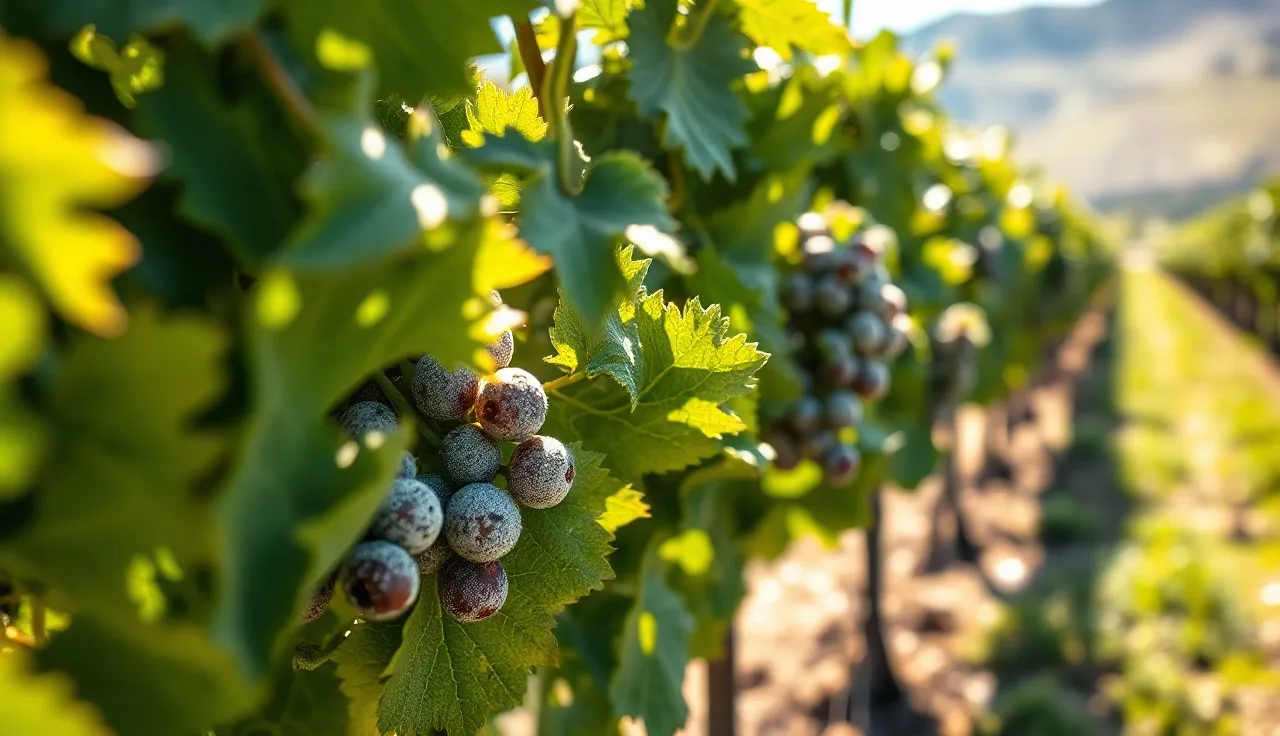
Powdery mildew on grapes is caused by the obligate biotrophic fungus Erysiphe necator (formerly Uncinula necator). It is the most economically damaging fungal disease in vineyards globally, and nearly every region that grows Vitis vinifera deals with it every season. [1]
The pathogen has a clever survival trick: it overwinters as both chasmothecia (sexual spores) in loose bark and as dormant mycelium inside infected buds. When spring temperatures stay between 50°F and 86°F (10-30°C) and humidity is moderate, the fungus wakes up and begins releasing ascospores. The critical insight most growers miss is that free water is NOT required for germination. Powdery mildew thrives in dry weather with moderate humidity, which is exactly why it outcompetes downy mildew in continental and Mediterranean climates.
Infection cycles run fast. A single germinated spore can produce a visible colony in 5-7 days under ideal conditions, and that colony starts releasing conidia within another week. [1] Left alone, one infected shoot tip can generate millions of spores by bloom. The exponential nature of the epidemic is why the first 6-8 weeks after budbreak set the outcome for the entire season.
Berry infection is the worst outcome. Green berries are highly susceptible from just after fruit set through about 3-4 weeks later (roughly when they reach about 8 Brix). After that window, the skin suberizes and becomes resistant, but any established infection continues spreading under the surface. Infected clusters produce off-flavors, crack during ripening, and invite Botrytis as a secondary pathogen. Infected fruit is rejected at most commercial wineries.
What are the key risk factors and how do disease models help predict infection?
Temperature is the master variable. Conidia germinate across a wide range, but the sweet spot is 68-77°F (20-25°C). Below 50°F germination stalls; above 95°F the fungus is killed. This temperature sensitivity is the foundation of the two major forecasting tools used in North America.
The UC Davis Powdery Mildew Risk Index, developed by Doug Gubler and colleagues, assigns a daily risk score based on hours the temperature stays between 70°F and 85°F. A cumulative index above 30 triggers a spray recommendation. Below 20, you can safely extend your interval. This model has been field-validated across California wine regions and is available through UC IPM. [2]
WSU's Decision Aid System (DAS) takes a similar temperature-accumulation approach adapted for Pacific Northwest conditions, including the cooler seasons typical of Washington and Oregon. [3]
Ascospore maturity is another timing marker. At UC Davis, 50 percent ascospore maturity typically lands around 1 inch of shoot growth, which is why many advisors recommend starting protective sprays at that growth stage regardless of weather. Missing that window means chasing the disease instead of preventing it.
Varietal susceptibility is real and should factor into spray scheduling. Chardonnay, Cabernet Sauvignon, Merlot, Pinot Gris, and Zinfandel are all highly susceptible. Riesling is intermediate. Some hybrid varieties (Chambourcin, Marquette, and others developed at Cornell and Minnesota) carry meaningful partial resistance, which lets growers extend spray intervals without sacrificing control. [4]
In New Zealand, powdery mildew pressure intensifies in Hawke's Bay, Gisborne, and Nelson during warm dry springs following wet winters that push vigorous canopy growth. Plant & Food Research has documented that season-long conidia dispersal from bud-latent inoculum is the primary source in NZ vineyards, not ascospore release, which shifts the timing emphasis slightly earlier than US models suggest. [5] Growers using NZ-adapted scheduling should begin programs at 5 mm shoot growth rather than waiting for the full 1-inch mark.
How should you structure a powdery mildew IPM program from budbreak to harvest?
IPM is not a single spray. It is a season-long decision framework that sequences cultural controls, monitoring, biological options, and chemistry in the right order. Here is how a practical program runs.
Budbreak to 6-inch shoots: Start with cultural pressure reduction. Prune out infected wood from the previous season. Many growers skip this step, but overwintering mycelium in mummified clusters and infected canes is a real primary inoculum source. Apply a single dormant or early-season sulfur application if your disease index is building early. Wettable sulfur at 3-4 lb/acre (or the label rate) remains the most cost-effective early-season tool, with zero FRAC resistance concern.
6-inch shoots through bloom: This is the highest-risk window and where IPM programs either succeed or fail. Maintain 7-day spray intervals during warm, dry spells if your risk index is high. DMI (FRAC Group 3) fungicides like myclobutanil or tebuconazole are very effective at this stage and offer kick-back activity up to 3 days post-infection. Do not rely on DMIs alone; the resistance history of E. necator to Group 3 chemistry is long and well-documented. [6] Alternate or tank-mix with a FRAC Group 11 (strobilurin) or Group 7 (SDHI) product.
Fruit set through veraison: Protect the berry susceptibility window hard. After clusters close, spray penetration drops sharply, so canopy management (see below) becomes as important as chemistry. You can extend intervals to 10-14 days once berries pass the susceptible window, assuming pressure stays moderate per your risk model.
Veraison to harvest: Focus shifts to preventing late-season buildup of overwintering inoculum. A late-season sulfur application helps reduce chasmothecial development. Avoid applying sulfur within 3-4 weeks of harvest if temperatures will exceed 90°F, as sulfur phytotoxicity can damage fruit. [2]
Keeping accurate spray records is non-negotiable from both a resistance management and a regulatory standpoint. Every application should log the product name, FRAC group, rate, timing, and conditions. Tools like VitiScribe make this easier by attaching spray entries directly to block records, which helps when you need to demonstrate rotations to a third-party auditor or produce records under the EPA Worker Protection Standard.
Which fungicide groups work for powdery mildew and how do you rotate them?
FRAC (Fungicide Resistance Action Committee) group rotation is the single most important chemical management decision you make. E. necator has demonstrated resistance to FRAC Group 1 (MBCs), Group 3 (DMIs), and Group 11 (QoIs/strobilurins) in multiple regions. [6] Resistance to Group 7 (SDHIs) is emerging in some populations.
Here is a reference table for the main fungicide groups used against grape powdery mildew:
| FRAC Group | Mode of Action | Example Active Ingredients | Resistance Risk | Notes |
|---|---|---|---|---|
| M2 | Multi-site (sulfur) | Sulfur | Low | Excellent resistance buffer; phytotoxic above 90°F |
| M4 | Multi-site | Copper (some label use) | Low | Limited efficacy vs PM; mainly downy mildew |
| 3 | DMI / Sterol inhibitor | Myclobutanil, Tebuconazole, Trifloxystrobin | Medium-High | Strong kick-back; rotate strictly |
| 7 | SDHI | Fluxapyroxad, Benzovindiflupyr | Medium | Often premixed with Group 11 |
| 11 | QoI / Strobilurin | Azoxystrobin, Trifloxystrobin | High | Do not use alone; always mix or rotate |
| 13 | Amine / Morpholine | Spiroxamine | Low-Medium | Less common in US; used in EU and NZ |
| U8 | Unknown (lipid biosynthesis) | Cyflufenamid | Low | Reserve for rescue situations |
| BM02 | Biological | Bacillus subtilis (Serenade) | Very Low | Excellent resistance buffer; curative activity limited |
The practical rule: never apply the same FRAC group more than twice in a row. Ideally, alternate between a single-site synthetic and a multi-site (sulfur or copper) every other application. Most extension programs recommend no more than 2-3 applications per season of any single FRAC group. [3][6]
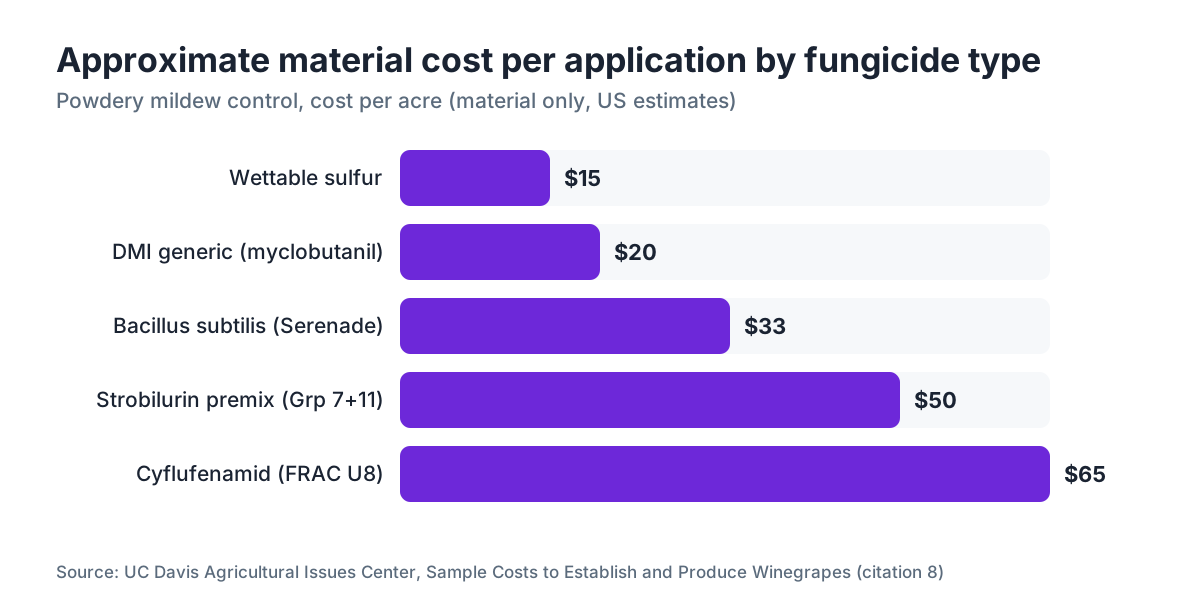
Sulfur deserves more respect than it gets. At full label rates, wettable sulfur matches DMI products in efficacy during the early season, costs $10-20/acre per application versus $25-60/acre for premium single-site products, and faces zero resistance risk. The UC IPM program is explicit that sulfur forms the backbone of any sound resistance management program. [2]
How does canopy management reduce powdery mildew pressure without sprays?
Dense canopies are disease factories. When shoots crowd together and cluster zones get less than 30 percent direct light exposure, you get slower drying, higher humidity near the fruit, and poor fungicide penetration. All three of those conditions favor powdery mildew.
The Cornell research standard for canopy evaluation is the point-quadrat method developed by Smart and Robinson. The target for most VSP-trained vinifera is a canopy density that leaves 20-30 percent of point-quadrat insertions open (gap percentage). [4] If your gap percentage is below 10 percent, you have a canopy problem that no spray program will fully compensate for.
Shoot positioning and hedging before bloom is the highest-leverage cultural practice. Getting shoots upright and tied by the time clusters are visible improves spray coverage and reduces the humid microclimate around fruit. Leaf removal on the cluster zone (one to two leaves removed from the east or morning-sun side) improves air circulation and spray contact dramatically without overexposing fruit to afternoon heat stress.
AVA and terroir matter here. In warmer regions like Paso Robles or the Napa Valley, aggressive cluster-zone leaf removal risks sunburn; in cooler coastal regions or higher-elevation sites, the same practice pays off big in both disease control and fruit quality. You have to read your own microclimate.
Row orientation and trellis design are long-term levers. North-south row orientation maximizes afternoon sun exposure on both canopy sides and generally reduces disease pressure compared to east-west rows, all else being equal. Vertical shoot positioning (VSP) outperforms untrellised or sprawl systems for air circulation, though Geneva Double Curtain (GDC) can work well in high-vigor sites when managed correctly.
What biological and organic options actually work for powdery mildew in grapes?
Organic growers have a real toolbox, though it requires tighter timing discipline than conventional chemistry because most bio-options lack the kick-back activity of DMIs.
Sulfur is still the cornerstone of organic powdery mildew programs and is OMRI-listed. Wettable sulfur, micronized sulfur (Microthiol Disperss being a common formulation), and liquid flowable sulfur products all work. The key is getting good coverage. In dense canopies, sulfur application rates may need to increase by 25-30 percent compared to more open vine architecture.
Kaolin clay (Surround WP) creates a physical barrier and can reduce spore germination, but efficacy data on powdery mildew specifically is weaker than for insects. Some growers use it as a buffer application between primary fungicide applications during low-pressure periods.
Bacillus subtilis products (Serenade Optimum, Rhapsody) have a consistent record as suppressive agents, not eradicants. The EPA registration data supporting Serenade is real, and field trials from Cornell and UC Davis show 60-75 percent control in moderate-pressure seasons when used on 7-day intervals. [10] In high-pressure seasons, they should be paired with sulfur or other OMRI materials.
Potassium bicarbonate (MilStop, Kaligreen) disrupts the fungal cell membrane and provides good contact activity. It has some curative properties (1-2 days post-infection) and works best as a knockdown tool when you have a rain event and spotty early infections. Rates are typically 2.5-5 lb/100 gal. [2]
The honest assessment: organic programs demand 7-day intervals during peak susceptibility periods. Stretching to 10-14 days in a warm dry April or May is how organic vineyards lose control of mildew. The biology simply does not give you the forgiveness window that a DMI tank-mix does.
What are the EPA Worker Protection Standard requirements for fungicide applications in vineyards?
The EPA Worker Protection Standard (WPS), revised in 2015 and in effect for agricultural establishments, sets minimum requirements for pesticide safety in vineyards as in all other agricultural settings. [7] This matters for powdery mildew programs specifically because sulfur and DMI fungicides both have label requirements that intersect with WPS obligations.
The key WPS provisions affecting vineyard spray programs:
Restricted Entry Intervals (REI): Every registered fungicide has an REI on the label. Sulfur fungicides commonly carry a 24-hour REI. Most DMI and strobilurin products have 12-24 hour REIs. Cyflufenamid (FRAC U8) carries a 12-hour REI. You cannot send workers back into treated areas until the REI expires unless they have full PPE as specified on the label. Violating REIs is one of the most common WPS citations issued during pesticide compliance inspections.
Posting requirements: Under the 2015 WPS rule, treated areas must be posted with warning signs (or in some cases by oral/written notification) before applications begin in certain circumstances. The details depend on whether you use a closed system, an enclosed cab sprayer, or a hand-operated application.
Application exclusion zones (AEZ): The 2015 WPS rule created AEZs requiring that no one other than appropriately trained and equipped handlers be within 25 feet (for ground equipment) or 100 feet (for aerial) during applications. This has real implications for how you schedule work in adjacent blocks.
Training: All agricultural workers and handlers who are on your establishment must receive annual WPS safety training from a WPS-approved trainer. Training records must be kept for 2 years. [7]
The practical takeaway: before your first spray of the season, confirm that all workers have current WPS training, your safety data sheets are accessible, and your spray records document product names, REIs, and treated areas precisely enough that you can demonstrate compliance during an inspection.
How is powdery mildew IPM different in New Zealand vineyards?
New Zealand presents a specific set of conditions that make importing US or European IPM programs directly a risky move. The primary inoculum in NZ vineyards is bud-latent mycelium rather than airborne ascospores released from overwintered chasmothecia on bark, according to research from Plant & Food Research Ltd. [5] This shifts the practical consequence: the epidemic can already be rolling before you see the first external symptoms, and the traditional US cue of waiting for ascospore release is less reliable.
NZ seasons are also compressed relative to northern hemisphere viticulture. The spring window from budburst to 20 percent flowering can run as short as 6-7 weeks in warm years in Hawke's Bay, meaning late starters have almost no recovery room.
Stewardship of fungicide groups matters acutely in NZ because the range of registered fungicides is narrower than in the US or EU. DMI resistance in the E. necator population has been documented in several NZ regions. The New Zealand Winegrowers Integrated Winegrape Production (IWP) manual specifies strict FRAC group rotation requirements and classifies sulfur as the primary resistance management tool, matching FRAC recommendations globally. [5]
Botrytis interaction is another NZ-specific concern. Wet autumns common in Gisborne and some parts of Marlborough mean that powdery mildew-cracked berries become Botrytis entry points at a rate that can destroy otherwise well-managed blocks. Tight season-end control of powdery mildew (including a late sulfur or potassium bicarbonate application before bunch closure) reduces secondary Botrytis losses.
For NZ growers, the start-date shift is the single biggest IPM adjustment. Begin your program at 5 mm shoot growth, not the traditional 1-inch mark used in California. That one calendar change can mean 1-2 fewer rescue sprays later in the season.
How do you set spray thresholds and decide when to skip or extend an interval?
This is where growers make or lose their season. A rigid calendar program (spray every 14 days no matter what) is almost certainly wrong in both directions: too frequent in cool wet springs when PM is suppressed, and too infrequent in warm dry spells when the risk index is spiking.
The UC Davis Powdery Mildew Risk Index gives concrete numbers: cumulative index below 20, low risk, you can extend your interval safely. Between 20 and 30, moderate risk, maintain your standard interval. Above 30, high risk, shorten to 7 days and consider adding a kick-back material. [2] This framework has been validated in California wine country and is the most evidence-based threshold system available in the US.
Scouting supports model-based decisions. Walk your most susceptible blocks (Chardonnay, Zinfandel, Cabernet) weekly during the critical period and assess incidence on 100 shoots or clusters. The WSU extension threshold for initiating or intensifying a program is 5 percent shoot incidence before bloom, or any detectable cluster infection. [3] Once you see infected clusters, you are 10-14 days behind and your options narrow to kick-back chemistry and aggressive canopy work.
Spray equipment calibration is underappreciated as a threshold decision factor. A properly calibrated sprayer that achieves full cluster penetration at 7-day intervals outperforms a poorly calibrated sprayer on a 5-day schedule. Studies from UC Cooperative Extension show that droplet size, application speed, and air volume all interact with fungicide efficacy. Getting a spray consultant to check your airblast settings before the season starts is money well spent.
Record keeping ties all of this together. Logging your risk index reading on the day you make the spray decision, alongside the weather data and scouting result, creates an audit trail that shows you were managing by evidence rather than calendar. For growers working toward sustainable certification or third-party audit requirements, that paper trail is often required. Spray record software that links weather data to block records, like VitiScribe, makes this easier to maintain consistently across a multi-block operation.
What does powdery mildew IPM actually cost per acre and what's worth spending on?
Nobody has clean multi-region cost data on this. The closest rigorous source is the UC Davis Cost and Return Studies series for wine grapes, which estimates total fungicide costs (all diseases) in the range of $150-400 per acre per season for California North Coast wine grapes, depending on variety, pressure, and organic versus conventional program. [8] Powdery mildew chemistry accounts for roughly half to two-thirds of that total in most programs.
Here is a rough per-application cost breakdown based on common product types:
| Product Type | Approx. Cost per Acre | Applications per Season | Season Total |
|---|---|---|---|
| Wettable sulfur | $10-20 | 6-10 | $60-200 |
| DMI (myclobutanil generic) | $15-25 | 3-4 | $45-100 |
| Strobilurin premix (Group 7+11) | $35-65 | 2-3 | $70-195 |
| Cyflufenamid (FRAC U8) | $50-80 | 1-2 | $50-160 |
| Bacillus subtilis (Serenade) | $25-40 | 3-5 | $75-200 |
Costs above are material only; application labor and equipment run another $15-30/acre per pass for airblast sprayers, depending on operation size.
What is worth the money: a solid risk model subscription or extension service, and at least one FRAC U8 or U13 product held in reserve for rescue situations. What I would skip: premium strobilurin-only products used as the primary workhorse, since resistance makes their solo use questionable in most regions where E. necator populations have been under selection pressure for years.
The real cost of doing nothing, or doing too little too late, is a 20-50 percent yield reduction and potential rejection of infected fruit. At $500-2000 per ton of wine grapes, even a 10 percent yield loss on 10 acres wipes out several years of fungicide savings.
How do you build a vineyard record system that satisfies spray compliance requirements?
Spray record requirements vary by state, but federal Worker Protection Standard compliance requires that application records include: product name, EPA registration number, location of application, date and time, amount applied, and the name of the person who made the application. [7] California's DPR requires similar records, mandates they be kept for 2 years, and makes them available for county agricultural commissioner inspection. [11]
Beyond the legal minimum, a good spray record system for powdery mildew management should capture the FRAC group for every product applied, the reason for application (scouting observation, risk index reading, or calendar timing), the weather conditions at application, and the REI expiration time for worker re-entry logging.
For vineyards with 5 or more blocks, paper logbooks become a liability. They are hard to search, easy to lose, and make FRAC rotation audits tedious. A spreadsheet-based system works but requires discipline to maintain field-side entry rather than after-the-fact reconstruction. Block-level digital records that capture applications at the point of decision produce the most accurate data.
See our overview of how vineyard record systems connect spray data to field maps and compliance exports for a fuller look at building that infrastructure.
Frequently asked questions
When should I start my first powdery mildew spray of the season?
Start at 1 inch of shoot growth (about 5 mm in New Zealand conditions where bud-latent inoculum dominates). That timing matches 50 percent ascospore maturity in most California regions per UC Davis guidance. Waiting until you see visible symptoms means you are already 10-14 days behind the infection curve. A protective wettable sulfur application at this stage is the highest-value single spray of your season.
What temperature kills powdery mildew spores on grapevines?
Erysiphe necator conidia are killed at temperatures above 95°F (35°C) if sustained for several hours. Germination is also suppressed below 50°F. This is why hot, dry summers provide natural pressure breaks. Relying on heat alone is unreliable, though, because vine canopies create microclimates that stay cooler than ambient air, and even brief temperature drops can let new infection cycles restart.
Can powdery mildew spread from grapes to other plants in my garden?
Grape powdery mildew (Erysiphe necator) is host-specific to Vitis species. It does not infect roses, squash, or other garden plants that carry their own powdery mildew pathogens. Those plant mildews will not spread to your vines either. Cross-contamination between grape varieties within the vineyard is real and significant, but cross-species spread is not a concern.
How do I know if my powdery mildew fungicide program is developing resistance?
Signs of developing resistance include a previously effective product at full label rate failing to suppress visible colonies within 5-7 days, or an epidemic continuing to build on a correct-interval program with a formerly reliable DMI or strobilurin. Formal resistance testing is available through university labs. The practical response is immediate FRAC group rotation and a sulfur application as a resistance buffer while you assess.
Is sulfur safe to use close to harvest for powdery mildew on grapes?
Avoid sulfur applications within 3-4 weeks of harvest if temperatures will exceed 90°F, as phytotoxicity risk rises sharply. At cooler temperatures, a sulfur application 14-21 days before harvest is generally considered safe. Always check the specific product label. Some winemakers flag sulfur residue concerns on fruit; if your winery has residue requirements, confirm their tolerance threshold before any late-season sulfur applications.
What are the best powdery mildew resistant grape varieties?
No Vitis vinifera variety is fully immune, but Riesling and some Grenache selections show intermediate susceptibility. Hybrid varieties bred at Cornell (Marquette, Frontenac) and the University of Minnesota carry meaningful partial resistance genes and can tolerate extended spray intervals in moderate-pressure environments. For commercial vinifera production, susceptibility management through canopy and chemistry stays necessary regardless of variety.
How is powdery mildew different from downy mildew in grapes, and does it need a different spray?
Powdery mildew (Erysiphe necator) produces white powdery colonies on the upper leaf surface and does not need free water to germinate. Downy mildew (Plasmopara viticola) produces oily spots on upper leaf surfaces with white sporulation on the underside, and requires rain or heavy dew for infection. They need different fungicide classes: sulfur and DMIs for powdery, copper and phosphonates for downy. Many programs run dual coverage during bloom.
How many powdery mildew spray applications do I need per season in a high-pressure year?
In a high-pressure year, most commercial programs run 8-14 total applications from early shoot growth through early ripening, including sulfur-only applications as interval fillers. UC Davis IPM guidelines suggest that during extended high-risk periods (risk index consistently above 30), a 7-day interval with a DMI or strobilurin as the primary product is standard. Fewer than 6 applications in a susceptible variety block during an average California or NZ season is a significant risk.
Does powdery mildew affect wine quality even if the fruit looks okay at harvest?
Yes. Even 3-6 percent infected berries in a lot can produce detectable off-flavors described as musty, moldy, or earthy in finished wine. Research published in the American Journal of Enology and Viticulture found that low-level powdery mildew infection significantly reduces total anthocyanins and tannin concentration in red wines. Most quality-focused wineries reject loads above a 2-5 percent visual incidence threshold.
What is the UC Davis Powdery Mildew Risk Index and how do I use it?
The UC Davis Powdery Mildew Risk Index accumulates daily risk points based on hours the temperature stays between 70-85°F. A cumulative score below 20 suggests low risk and allows extended spray intervals; 20-30 is moderate, maintain standard intervals; above 30, shorten to 7 days and consider kick-back materials. The index resets to zero after temperatures exceed 95°F for extended periods. UC IPM provides the index calculator and decision tables online.
Can I spray powdery mildew fungicides during flowering?
Yes, but with care. Bloom is the highest-priority spray window for powdery mildew control, and skipping it to avoid disturbing pollinators is a common and costly mistake. Apply in the early morning or evening to minimize bee exposure. Sulfur is generally considered lower risk to pollinators than some synthetics. Check your specific product label for any bloom timing restrictions and avoid application directly onto open flowers if possible.
How does powdery mildew IPM work for small or hobby vineyards?
Small vineyards need the same rotation discipline as commercial operations, just fewer total gallons. A practical small-vineyard program: start with wettable sulfur at 1-inch shoot growth, alternate with a homeowner-labeled DMI (myclobutanil is available as Immunox for homeowners), and add a bicarbonate knockdown if you see early colonies. Canopy management matters even more at small scale because hand-application sprayers struggle with dense canopy penetration.
What records do I need to keep for powdery mildew spray applications under EPA WPS?
EPA WPS requires recording: product name, EPA registration number, application location, date and start/end time, amount applied, and the applicator's name. Records must be kept for 2 years and made available to workers and their designated representatives within 15 days of a request. Some state programs (California DPR, Washington) add supplemental requirements including restricted entry interval documentation and field posting records.
Sources
- UC ANR Publication 3389, Grape Pest Management, Erysiphe necator biology chapter: Erysiphe necator is the causative agent of grape powdery mildew; infection cycles complete in 5-7 days under optimal conditions
- UC IPM, Powdery Mildew of Grape, UC Davis Risk Index guidance: UC Davis Powdery Mildew Risk Index thresholds (below 20 low risk, 20-30 moderate, above 30 high); sulfur phytotoxicity warning above 90°F
- Washington State University Extension, Grape Powdery Mildew Management, WSU Decision Aid System: WSU DAS temperature-accumulation model for Pacific Northwest conditions; 5 percent shoot incidence threshold for intensifying program
- Cornell Cooperative Extension, Pest Management Guidelines for Grapes, canopy and varietal susceptibility: Point-quadrat canopy evaluation target of 20-30 percent gap percentage; partial resistance in Marquette and Cornell hybrid varieties
- Plant & Food Research New Zealand, Powdery Mildew Management in NZ Vineyards, IWP Manual: Bud-latent mycelium is primary inoculum in NZ vineyards; spray programs should begin at 5 mm shoot growth; DMI resistance documented in NZ E. necator populations
- FRAC (Fungicide Resistance Action Committee), FRAC Code List 2024: Erysiphe necator has documented resistance to FRAC Groups 1, 3, and 11; Group 7 resistance emerging in some populations
- U.S. EPA, Worker Protection Standard (WPS) for Agricultural Pesticides, 40 CFR Part 170: WPS requires application records including product name, EPA registration number, location, date/time, amount applied, and applicator name; records kept 2 years; application exclusion zones of 25 feet for ground equipment
- UC Davis Agricultural Issues Center, Sample Costs to Establish and Produce Winegrapes, North Coast: Total fungicide costs for North Coast California wine grapes estimated at $150-400 per acre per season depending on variety and program type
- American Journal of Enology and Viticulture, powdery mildew infection effects on wine anthocyanin and tannin concentration: Low-level powdery mildew infection at 3-6 percent of berries significantly reduces anthocyanin and tannin concentration in red wines
- EPA, Serenade (Bacillus subtilis QST 713) Registration Documents: Field trials supporting EPA registration of Serenade Optimum show 60-75 percent disease control in moderate-pressure powdery mildew conditions
- California Department of Pesticide Regulation, Pesticide Use Reporting requirements, California Code of Regulations: California DPR requires spray records be kept for 2 years and be available to county agricultural commissioner inspection
Last updated 2026-07-09