Powdery mildew on grapes in Oregon: a practical control guide
TL;DR
- Powdery mildew (Erysiphe necator) is the most damaging disease in Oregon vineyards.
- Control depends on four things: start sprays at 1-inch shoot growth, cover the window from budbreak through veraison, rotate FRAC groups so the fungus never builds resistance, and keep accurate records for Oregon Department of Agriculture compliance.
- No single material carries the whole season.
Why is powdery mildew such a big problem in Oregon vineyards?
Oregon's Willamette Valley, Umpqua Valley, and Columbia Gorge AVAs share one inconvenient trait. Cool nights, warm afternoons, and just enough humidity to make Erysiphe necator feel completely at home. The pathogen doesn't need rain to spread. It needs temperatures between 50 and 90°F and a grape surface with no free water, which describes most of western Oregon from May through September [1].
Left alone, powdery mildew cuts Pinot Noir yield by 20 to 80 percent in a single season, and that's before you count the flavor damage [2]. Infected berries crack, invite Botrytis, and in Pinot Noir specifically, mildew damage during berry development has been linked in at least one study to changes in terpene accumulation. Rotundone, the sesquiterpene behind the peppery note in many Oregon Syrah and some Pinot clones, sits mostly in the berry skins. Any disease that wrecks skin integrity during the lag phase hits it directly [3].
The eastern Oregon AVAs (Walla Walla, Snake River Valley) run hotter and drier, so disease pressure is lower. It's never zero. A late-June cool snap during bloom can set off an epidemic in any part of the state.
What does powdery mildew look like on grapevines?
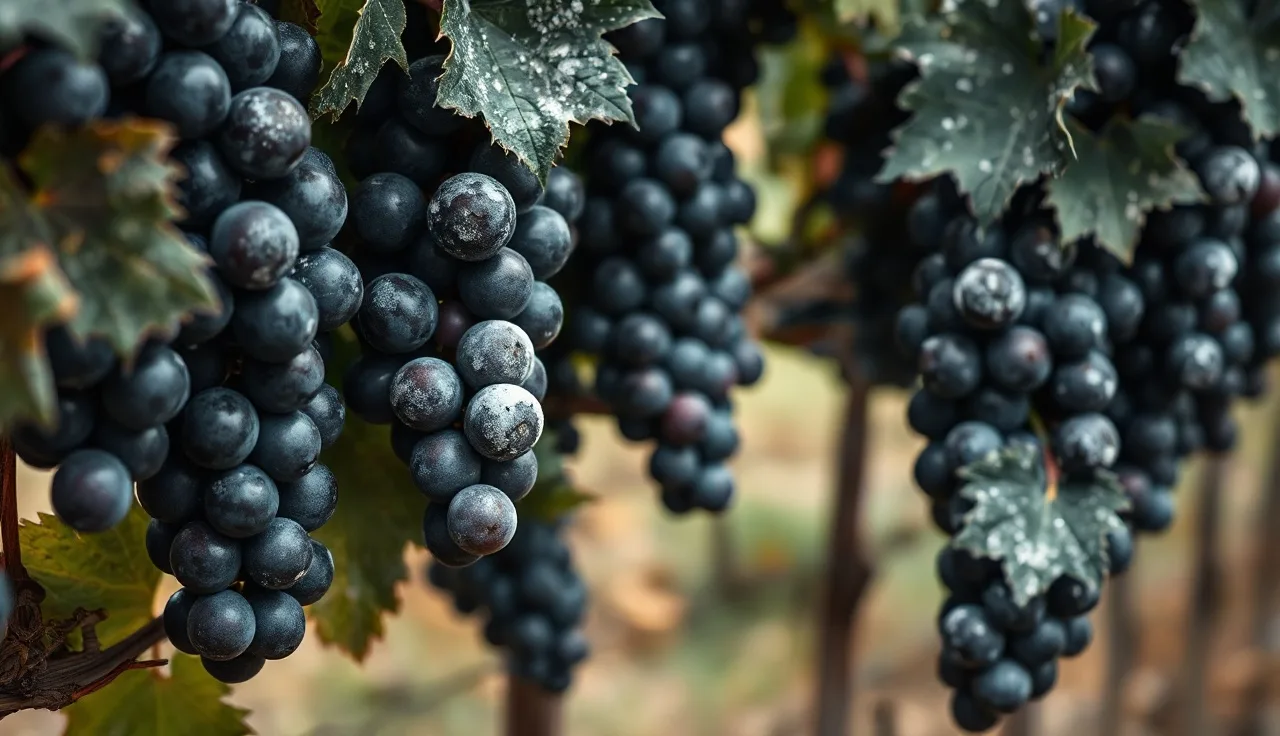
Early symptoms are easy to miss. Look for a faint white or gray powdery coating on the upper and lower leaf surfaces, shoot tips, and cluster stems. The fungus is an obligate biotroph. It lives on the surface of living tissue and pushes haustoria into epidermal cells to feed. It doesn't kill tissue outright, which is part of why growers shrug it off early.
Berry infections are the expensive ones. Infection before berry set causes shot berries. Infections during rapid cell division stop berries from expanding while the skin hardens, then those berries crack when growth resumes. On red varieties, infected berries sometimes show a faint web-like russet pattern before any white mycelium appears. By the time you see white powder on clusters, you've already lost those berries [1].
On young shoots, the fungus shows up as dark, irregular patches that turn gray-brown by midsummer. Those shoot lesions are called flag shoots, and they're your best early warning. Washington State University's extension plant pathology team keeps good photos of each symptom stage on their small fruit pages [4].
Cleistothecia, the overwintering structures, look like tiny black pepper flecks on dormant canes. Scout after harvest. If you see them, expect a heavy primary inoculum load next spring.
When does powdery mildew season start in Oregon and how do you time the first spray?
The pathogen overwinters two ways: as mycelia inside dormant buds and as cleistothecia on bark. Both release spores in spring. Research summarized by UC Davis IPM puts the first critical spray window at 1-inch shoot growth, which in the Willamette Valley usually lands between late March and mid-April depending on clone and elevation [2].
Degree-day models sharpen your timing a lot. The UC Davis powdery mildew risk model, now built into several commercial weather services and the UC IPM website, uses base 50°F accumulations. Once you've accumulated 20 degree-days after budbreak, primary infections are possible. Hit 140 degree-days and you're in peak ascospore release. Most Oregon viticulture advisors start a 10 to 14 day spray program at or before 20 degree-days [2].
Bloom is the other hard anchor. The window from 10 percent bloom through 4 weeks after full bloom is when developing berries are most open to infection. Miss a spray here and it costs you. If weather forces a gap during bloom, reach for a systemic material (a DMI or a QoI) instead of a contact-only material like sulfur, because you need residual activity working inside the cluster.
The critical window closes at veraison, when berry skins toughen and drop most of their susceptibility. Most programs run from 1-inch shoot through 3 to 4 weeks past veraison, with the applications packed into the bloom-to-berry-touch period [1] [2].
Which fungicides work best against powdery mildew on Oregon grapes?
Five FRAC groups carry most Oregon wine grape programs. Here's how they compare:
| FRAC Group | Active Ingredient Examples | Mode of Action | Resistance Risk | Typical Spray Interval |
|---|---|---|---|---|
| 3 (DMI) | Tebuconazole, Myclobutanil | Sterol biosynthesis inhibitor | Moderate | 14 days |
| 11 (QoI/Strobilurin) | Azoxystrobin, Trifloxystrobin | Mitochondrial respiration inhibitor | High | 14 days |
| 7 (SDHI) | Fluxapyroxad, Penthiopyrad | Succinate dehydrogenase inhibitor | Moderate-High | 14 days |
| 3+11 (Premix) | Metconazole+Pyraclostrobin | Multiple | High | 14 days |
| M2 (Sulfur) | Elemental sulfur | Multi-site | Very Low | 7-10 days |
| U8 (Mineral oil) | JMS Stylet Oil | Physical | None | 7-10 days |
Sulfur is still the backbone of most Oregon programs. It's cheap (roughly $2 to $4 per acre per application at typical rates), has no practical resistance risk, and works well between 60 and 90°F. The catch: sulfur phytotoxicity is real above 90°F, and it can burn if applied within 2 weeks of an oil application. Western Oregon rarely tops 90°F before July, so the burn risk is mostly a summer problem [2].
DMIs (Group 3) are your best curative tool. Myclobutanil (Rally) and tebuconazole carry 3 to 4 day kickback, meaning they can stop infections that started up to 96 hours before you sprayed. That's the material you want when bloom weather blows up your target interval. Resistance to DMIs already exists in Oregon populations, so don't lean on them alone [5].
QoIs (Group 11) hit a single site, and resistance builds fast. No more than two consecutive applications per season, and most programs limit Group 11 to one or two total in the early-season high-pressure window [5].
Bicarbonates and potassium phosphonate show up in organic programs. Potassium phosphonate has decent efficacy data from PNW trials. Sodium bicarbonate alone is weaker and mostly useful as a supplement. OMRI-listed sulfur and copper remain the primary organic tools [4].
How do you build a spray program rotation to prevent fungicide resistance?
Resistance management is where a lot of small Oregon operations cut corners, and it catches up with them. The rule is simple: never run more than two consecutive applications from the same FRAC group, and rotate to a different FRAC group or to multi-site sulfur between single-site applications [5].
A practical 12-application Willamette Valley program might look like this. Open with sulfur at 1-inch shoot. Keep sulfur going every 10 days through 10 percent bloom. Switch to a DMI at 10 percent bloom, follow with sulfur, then a QoI at full bloom (check your label, and never spray during bloom if bee activity is high), then sulfur again, then an SDHI, then back to sulfur through veraison. Close the season with sulfur.
That structure spaces the single-site materials apart, caps any one FRAC group at two applications in the critical window, and uses sulfur's multi-site activity to reset selection pressure between each group.
The Fungicide Resistance Action Committee (FRAC) publishes annual guidelines on high-risk groups for each pathogen. As of the most recent FRAC Monograph 1 update, Group 11 materials carry a high resistance risk for Erysiphe necator in populations with documented G143A mutations, which have turned up in Pacific Northwest vineyards [5].
What are the Oregon spray record-keeping requirements for pesticide applications?
Oregon requires commercial pesticide applicators, and that includes employees working under a licensed applicator at a commercial vineyard, to keep spray records for at least two years from the date of application. The Oregon Department of Agriculture (ODA) Pesticides Division enforces this under ORS 634.146 [6].
Each record has to include the date of application, the pest treated, the product name and EPA registration number, the rate and total amount used, the location or field description, the applicator's license number, and the crop treated. Wind speed and direction at application time are required if the product label demands them, and many restricted-use materials do.
Worker Protection Standard (WPS) records sit on top of that as a separate federal layer. Under the EPA's revised WPS rule (effective 2017), agricultural employers must keep records of each pesticide application for two years, post application information at a central location (the WPS central posting), and give workers access to pesticide safety information and application-specific records [7]. Oregon splits WPS enforcement between Oregon OSHA and ODA.
Growing for a winery with third-party sustainability certification (LIVE, Salmon-Safe, or CCOF for organics) adds more. You'll document pre-harvest intervals, REI compliance, and often whole-farm pesticide load scores. Those programs audit spray records directly.
Paper records are legal, but they're slow to audit and easy to lose. Tools like VitiScribe capture spray data in the field, pull EPA registration numbers automatically from a product database, and export ODA-compliant records without reformatting. Worth a look once your program runs more than 8 to 10 applications a season.
What application equipment and timing mistakes hurt coverage in Oregon vineyards?
Coverage failure causes more powdery mildew escapes than product choice ever does. The fungus infects the underside of leaves and the interior of clusters. If your airblast sprayer isn't putting material into the canopy, your fungicide choice is beside the point.
Speed is the usual culprit. Most airblast sprayers need to run at 1.5 to 2 mph to deliver enough volume and penetration in a VSP canopy. Plenty of operators run 3 to 4 mph to finish faster. At that speed you're painting the outside of the canopy and leaving the cluster zone dry [4].
Time of day matters more than people admit. Spore germination in E. necator peaks during daylight when relative humidity sits between 40 and 100 percent and temperatures climb above 60°F. Spraying sulfur in the early morning before the temperature rises gives you the best contact kill. Spraying after 4 PM in summer risks leaving wet deposits that burn when temperatures spike the next day.
Pinot Noir makes coverage harder because of cluster architecture. The tight-clustered Dijon clones (115, 667, 777) are far more susceptible than loose selections, because the inside of the cluster is nearly unreachable with a standard airblast program by the time berries hit pea size. Canopy management, meaning aggressive shoot thinning and leaf removal in the cluster zone, does more to knock down mildew pressure in those clones than any fungicide [2].
Does powdery mildew affect wine quality and rotundone levels in Oregon Pinot Noir?
Short answer: yes, and the rotundone piece is still being worked out.
Rotundone gives certain Pinot Noir and Syrah wines their black pepper aroma. It builds up mostly in berry skins during the lag phase, the stretch between berry set and the start of veraison. Concentrations run highest in cooler sites with slower ripening. Oregon's cooler Willamette Valley sites tend to carry more rotundone than warmer California Syrah, though the compound shows up in both [3].
Powdery mildew damages the epidermis and disrupts the metabolic work happening in epidermal cells. A 2016 study in the Journal of Agricultural and Food Chemistry found that terpene accumulation in infected berries was altered compared to healthy tissue, with real effects on monoterpene and sesquiterpene profiles [3]. The study didn't isolate rotundone in a mildew-infection model, but the mechanism lines up with what we know about rotundone biosynthesis, which depends on healthy skin cells.
Beyond rotundone, the flavor effects of mildew are well documented. Infected juice carries elevated glycerol from secondary Botrytis, off-aromas from fatty acid oxidation, and in bad cases a flat or vegetal character. Oregon winery crush protocols often build in mildew load assessments at intake precisely because even 5 to 10 percent infected berries can shift wine style.
So in a rotundone-expressing site or clone, protecting skin integrity through veraison is a yield argument and a quality argument at once.
How does powdery mildew control differ between organic and conventional Oregon vineyards?
Oregon has a real organic wine grape sector, concentrated mostly in southern Oregon and parts of the Willamette. USDA National Organic Program rules (7 CFR Part 205) hold you to OMRI-listed materials, and the approved options for powdery mildew are narrower: sulfur, copper (with total application limits), potassium bicarbonate, mineral oils, and a few biologicals like Bacillus subtilis (Serenade) and Bacillus amyloliquefaciens (Double Nickel) [8].
Organic programs generally run shorter intervals, usually 7 to 10 days against 10 to 14 days for programs anchored by DMIs or SDHIs. That means more applications and more labor. Sulfur at 3 to 4 lb per acre per application is the core. Potassium bicarbonate (Kaligreen, Armicarb) adds some curative activity and tank-mixes with sulfur at appropriate rates.
The hardest organic stretch in Oregon is the 2 to 3 week wet spring that often runs mid-April through early May. Sulfur washes off. If it rains and you can't get back in the vineyard for 10 days, your coverage gap grows. Some organic growers add pre-bloom copper as a supplement, though copper builds up in vineyard soils over time and Oregon LIVE certification limits copper applications.
Biologicals like Serenade have inconsistent efficacy data in PNW trials. WSU's small fruits program found Bacillus subtilis QST 713 knocked powdery mildew severity down 30 to 50 percent in some trials but performed inconsistently against sulfur [4]. Worth including in a rotation. Not worth relying on alone.
What do Oregon vineyard managers actually spend on a powdery mildew program per acre?
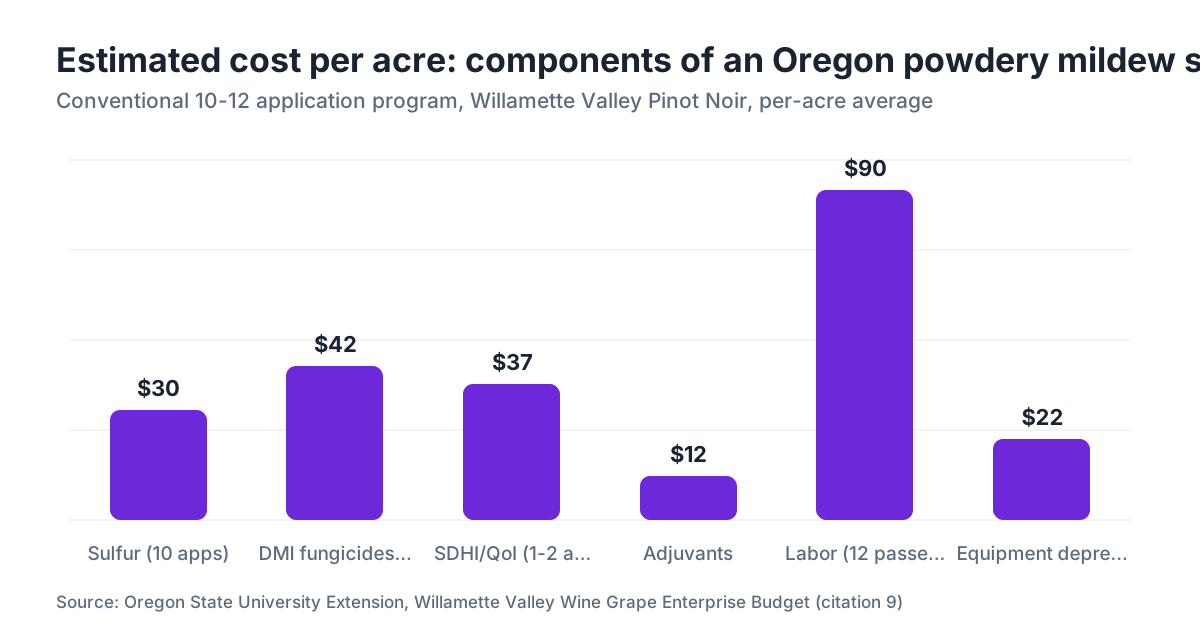
Real costs turn on your operation size, whether you own your equipment, and how many applications you run. Here's a realistic breakdown for a 10 to 20 acre Willamette Valley Pinot Noir operation running a 10 to 12 application conventional program:
| Cost Item | Range per Acre | Notes |
|---|---|---|
| Sulfur (10 apps at 3 lb/A) | $20-40 | Varies by formulation, WDG vs. dust |
| DMI fungicide (2 apps) | $30-55 | Myclobutanil cheaper than newer DMIs |
| SDHI or QoI (1-2 apps) | $25-50 | Premixes at the higher end |
| Adjuvants and spreaders | $8-15 | Silwet L-77 or similar |
| Labor (tractor + operator) | $60-120 | 12 passes at $5-10/acre/pass |
| Equipment depreciation | $15-30 | Prorated on a $30K airblast sprayer |
| Total per acre | $158-310 | Organic programs run 20-30% higher |
These numbers line up with Oregon State University Extension budgets for Willamette Valley wine grapes, which show total disease management costs (mildew, Botrytis, downy) running $180 to $350 per acre depending on the pressure year [9].
Cutting applications during bloom to save money is the single most expensive false economy in Oregon viticulture. One skipped bloom spray in a high-pressure year can cost more in lost yield and quality than an entire season's spray budget.
How do you scout for powdery mildew and decide when to spray in Oregon?
Scouting gets skipped in small Oregon operations, mostly because it takes time and the results feel obvious in hindsight. But in a season where spring runs dry and pressure looks low, scouting lets you stretch intervals and save 2 to 3 applications without real risk.
The standard protocol from Cornell's integrated disease management program has you examine 100 shoots per vineyard block (or 100 per variety or clone if the block is mixed), scoring each for mildew on leaves and shoot tips. Anything above 10 percent incidence at shoot emergence means you hold maximum-intensity coverage [10]. Below 5 percent, you can usually push intervals out 2 to 3 days on either side of a spray date.
Degree-day tracking beats calendar scheduling for deciding when to start sprays in spring. Oregon State University Extension pulls degree-day accumulations for many Willamette Valley locations through the Agrimet and Oregon Climate Service networks [9].
Flag shoots, those shoot tip infections from overwintering bud mycelium, are the earliest thing you can see. Walk your vineyard at 2-inch shoot growth and count them for a direct read on primary inoculum load. More than 1 to 2 flag shoots per 100 shoots means a high-inoculum season. Start your first spray right away and plan to stay on a 10-day calendar through bloom no matter the weather [1].
For operations juggling multiple blocks or varieties with different susceptibility, a simple scouting log tied to your spray records makes compliance reviews much easier. That's the kind of task where a field operations platform like VitiScribe saves real time, linking scouting notes to spray decisions in the same record.
What pre-harvest interval and re-entry interval rules apply to mildew sprays in Oregon?
Pre-harvest intervals (PHIs) and re-entry intervals (REIs) are set by the EPA on each product label and are legally binding under FIFRA. Oregon doesn't set its own PHIs for registered materials, but ODA can cite you for a label violation, which is a state pesticide law violation regardless of any federal action [6].
Common PHIs and REIs for powdery mildew materials used in Oregon wine grapes:
| Active Ingredient | PHI (days) | REI (hours) |
|---|---|---|
| Elemental sulfur | 0 | 24 |
| Myclobutanil (Rally) | 7 | 24 |
| Tebuconazole (Elite) | 14 | 12 |
| Azoxystrobin (Abound) | 0 | 4 |
| Pyraclostrobin (Cabrio) | 0 | 12 |
| Fluxapyroxad (Merivon) | 7 | 12 |
| Potassium bicarbonate | 0 | 4 |
Always check the current product label. PHIs and REIs can change between registrations, and generic formulations may carry different label requirements than the branded original.
Under the EPA Worker Protection Standard, agricultural employers must post REI information at the WPS central location before each application and make sure that workers who entered a treated area during an REI have access to decontamination supplies and emergency medical information [7]. Oregon OSHA has inspected vineyards for WPS violations. Fines start at $100 per violation and can reach $7,000 per willful violation for repeated failures [7].
Frequently asked questions
At what temperature does powdery mildew stop spreading on grapevines?
Erysiphe necator spore germination slows sharply below 50°F and above 95°F. The sweet spot for infection is 68 to 77°F with low to moderate humidity. In Oregon, temperatures rarely hold above 95°F long enough to suppress the disease on their own, so you can't count on summer heat to end your spray season. Keep applying through veraison regardless of temperatures.
Can I use copper to control powdery mildew on Oregon grapes?
Copper controls downy mildew and Botrytis but does very little against powdery mildew. The two pathogens need different fungicides. Some growers tank-mix copper for downy mildew control while hitting powdery with sulfur or a DMI, but don't swap copper in for an approved powdery mildew material and expect results.
How long does sulfur remain effective after application?
Elemental sulfur's residual runs roughly 7 to 10 days in dry conditions. Rain over about a quarter inch removes most of it. In western Oregon's wet springs, you may need to reapply within 5 to 7 days after a significant rain event. Wettable dispersible granule formulations hold up slightly better than dusts under light rain, but neither survives a heavy event.
What's the difference between powdery mildew and downy mildew on grapes?
They're different pathogens that need different fungicides. Powdery mildew (Erysiphe necator) is a fungus that lives on the surface, doesn't need free water, and puts white powder on upper leaf surfaces and berries. Downy mildew (Plasmopara viticola) is an oomycete that needs free water, sporulates on the underside of leaves, and is controlled by phosphonates and copper, not the standard powdery mildew fungicides.
Does powdery mildew affect Pinot Noir more than other Oregon varieties?
Yes. Pinot Noir, especially tight-clustered Dijon clones (115, 667, 777), ranks among the most susceptible Vitis vinifera varieties to powdery mildew. The tight cluster traps humidity and blocks fungicide penetration. Chardonnay and Pinot Gris are also quite susceptible. Riesling is moderately susceptible. Some hybrid varieties have much better resistance, but they're rarely grown for Oregon premium wine programs.
What Oregon state agencies oversee vineyard pesticide compliance?
The Oregon Department of Agriculture (ODA) Pesticides Division handles pesticide licensing, record-keeping enforcement, and label compliance under ORS 634. Oregon OSHA shares jurisdiction for Worker Protection Standard enforcement. ODA inspectors can request spray records at any time for commercial operations. A WPS violation can also trigger an OSHA investigation independent of ODA action.
How does powdery mildew affect rotundone in Oregon grapes?
Rotundone, the sesquiterpene behind peppery aromas in Pinot Noir and Syrah, builds up in berry skin cells during the lag phase. Powdery mildew damages epidermal tissue and disrupts the metabolic activity in those cells. Research in the Journal of Agricultural and Food Chemistry found disease-related disruptions to terpene accumulation in infected berries, which points to a likely negative effect on rotundone in infected fruit, though direct field studies are limited.
How many spray applications does a typical Oregon wine grape program use for powdery mildew?
Most Willamette Valley programs run 10 to 14 applications a season for powdery mildew specifically, with the heaviest concentration between 10 percent bloom and 4 weeks post-bloom. High-pressure years or tight-canopy clones push toward the upper end. Organic programs often run 12 to 16 applications because sulfur's shorter residual demands more frequent coverage, especially during wet spring weather.
Are there resistant grape varieties that reduce the need for powdery mildew sprays in Oregon?
Some PIWI (Pilzwiderstandsfähig) hybrid varieties bred in Europe carry real powdery mildew resistance. Varieties like Marquette and Regent have reduced susceptibility. But these aren't commercially viable for Oregon's premium Pinot Noir, Pinot Gris, or Chardonnay programs. Within Vitis vinifera, no variety has enough resistance to eliminate a spray program.
What records do I need to keep for Oregon LIVE certification and powdery mildew sprays?
Oregon LIVE certification requires documentation of every pesticide application: product name, EPA registration number, rate, area treated, date, and applicator. LIVE also calculates a pesticide environmental impact score, and high-load synthetic fungicides count against you. Spray records must be available for third-party audit. Check the LIVE certified requirements page for the current scorecard methodology, since it's updated periodically.
Can powdery mildew spread to Oregon wine grapes from wild or ornamental plants nearby?
The powdery mildew strain that infects grapevines (Erysiphe necator) is largely host-specific to Vitis. Nearby ornamental or wild Vitis species can act as reservoirs, but powdery mildew from roses, oaks, or other plants won't infect your grapes. The real concern is wild Vitis riparia or abandoned vineyard blocks nearby, which hold inoculum and add to early-season pressure.
When should I stop spraying for powdery mildew in Oregon?
Most programs apply the last spray 3 to 4 weeks post-veraison. By then, berry skins have toughened enough that new infections don't cause cracking or quality damage. Spraying past that point returns little. The exception: if you're seeing active leaf infections late in the season in a dense canopy, where late mildew can reduce carbohydrate storage and hurt vine health going into dormancy.
Sources
- UC Davis IPM Program, Grape Powdery Mildew management guidelines: Powdery mildew does not need free water to infect; critical infection window runs from 1-inch shoot growth through veraison; cleistothecia and bud mycelium serve as primary inoculum sources.
- UC Davis IPM, Grape Powdery Mildew degree-day model and spray timing guidance: UC Davis degree-day model recommends initiating sprays at 20 DD base 50°F after budbreak; bloom window is most critical susceptibility period; sulfur phytotoxicity occurs above 90°F.
- Journal of Agricultural and Food Chemistry, terpene accumulation in diseased grapevine berries, 2016: Terpene accumulation including sesquiterpenes was altered in mildew-infected berries compared to healthy tissue, with implications for aroma compound profiles including rotundone-related pathways.
- Washington State University Extension, Small Fruit Horticulture, grape powdery mildew: WSU extension documents flag shoot scouting, Bacillus subtilis QST 713 efficacy trials (30-50% reduction inconsistent vs. sulfur), and application speed recommendations for airblast sprayers.
- Fungicide Resistance Action Committee (FRAC), Monograph 1, Erysiphe necator resistance risk by group: FRAC classifies Group 11 QoI materials as high resistance risk for Erysiphe necator; G143A mutations documented in Pacific Northwest populations; recommends no more than two consecutive applications per FRAC group.
- Oregon Department of Agriculture, Pesticides Division, ORS 634.146 record-keeping requirements: Oregon requires commercial pesticide applicators to retain spray records for minimum two years from application date, including EPA registration number, rate, pest treated, location, and license number.
- EPA Worker Protection Standard, 40 CFR Part 170, revised rule effective 2017: EPA WPS requires agricultural employers to maintain pesticide application records for two years, post application-specific information at a central location, and provide workers access to safety information and records.
- USDA National Organic Program, 7 CFR Part 205, allowed materials for organic crop production: NOP rules restrict organic programs to OMRI-listed materials; approved powdery mildew materials include elemental sulfur, copper, potassium bicarbonate, mineral oils, and certain biological fungicides.
- Oregon State University Extension, Willamette Valley Wine Grape Enterprise Budget: OSU Extension enterprise budgets show total disease management costs of $180-350 per acre per season for Willamette Valley wine grapes depending on pressure year; degree-day data available through Oregon Climate Service and Agrimet networks.
- Cornell University Integrated Crop and Pest Management, Grape IPM Disease Scouting: Cornell protocol recommends examining 100 shoots per block; incidence above 10% at shoot emergence warrants maintaining maximum-intensity spray coverage intervals.
Last updated 2026-07-09