Wine grape varieties least susceptible to powdery mildew
TL;DR
- Interspecific hybrids carrying Ren1, Ren2, Ren4, or Run1 resistance genes show the lowest powdery mildew susceptibility.
- Regent, Marquette, Crimson Cabernet, and Muscadine-derived crosses lead the list.
- Among Vitis vinifera, Chardonnay and Cabernet Sauvignon are moderately susceptible while Merlot and Pinot Noir run high-risk.
- No vinifera variety is truly resistant.
Why does powdery mildew resistance matter for grape variety selection?
Powdery mildew, caused by Erysiphe necator (formerly Uncinula necator), is the most economically damaging fungal disease in most of the world's vineyards. [1] A single bad season on a susceptible block can cut yield by 30 percent or more. Berry infections in the early cluster window, roughly 1 to 3 weeks after bloom, can wipe out an entire crop on tight-clustered varieties. [11]
The chemistry bill compounds the pain. A vinifera block with no varietal resistance might need 8 to 12 fungicide applications per season, depending on climate, canopy density, and the spray interval you run. A genuinely resistant hybrid gets through on 2 to 4 targeted applications, sometimes fewer. Multiply that gap across dozens of acres and it reshapes the economics of a whole estate.
Variety selection is the one defense layer that costs nothing every year after you plant it. Spray programs, canopy work, and timing all matter, but they work harder when the variety itself is not handing the pathogen an open door.
If you're planting new acres or replanting a failing block, put the resistance rating in the same conversation as flavor profile and market price. It belongs there.
What makes a grape variety resistant to powdery mildew?
Resistance to E. necator comes from a handful of quantitative resistance loci, called Ren loci, plus one major dominant gene called Run1. [3] Run1 was first identified in Muscadinia rotundifolia (Muscadine grapes) and gives near-immunity when it's present. Because Muscadine is a different species from Vitis vinifera, moving that gene into wine-quality varieties took decades of crossing and backcrossing. [3]
The Ren genes (Ren1 through Ren9 and counting, as researchers keep mapping the genome) turn up across multiple Vitis species including V. romanetii, V. piasezkii, and Central Asian V. vinifera subpopulations. Ren1 and Ren2 were the first documented in European germplasm. Kishmish Vatkana, an old Central Asian grape, carries Ren1 and shows measurably lower disease severity. [4]
Here's the practical upshot. Varieties labeled "resistant" in university trial data usually carry one or more of these loci in a genetic background that still makes drinkable wine. Varieties labeled "tolerant" may slow sporulation or delay the epidemic without stopping infection.
Pure Vitis vinifera, no matter how carefully you farm it, has essentially no known major resistance gene from this set. Some vinifera are less bad than others, which is why UC Davis ratings show a spectrum, but the floor is nowhere near true resistance.
Which wine grape varieties are rated least susceptible to powdery mildew?
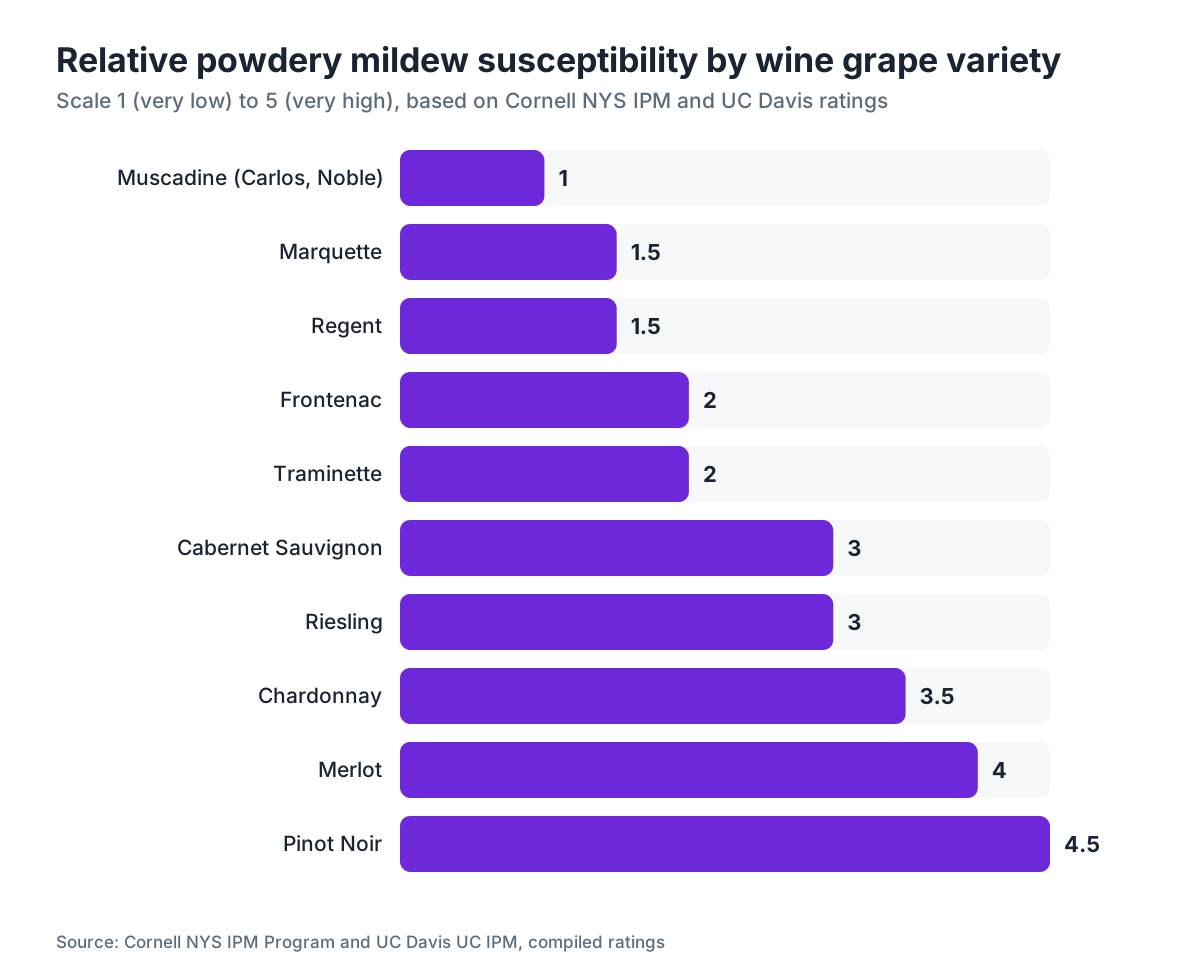
Cornell's New York State IPM Program and the National Grape Registry at UC Davis both publish disease resistance ratings, and WSU Extension has evaluated varieties in Pacific Northwest trials. The table below pulls the consensus across those sources. [2][4][5]
| Variety | Type | Powdery Mildew Resistance Rating | Notes |
|---|---|---|---|
| Marquette | Hybrid (V. vinifera x V. riparia) | Low susceptibility | Red, cold-hardy, Minnesota bred |
| Regent | Hybrid (complex Vitis cross) | Low susceptibility | Red, widely planted in Germany |
| Crimson Cabernet | Hybrid (UC Davis, Ren4 carrier) | Low susceptibility | Red, warm-climate focused |
| Traminette | Hybrid (Joannes Seyve 23-416 x Gewurztraminer) | Low-moderate susceptibility | White, aromatic |
| Frontenac | Hybrid (V. riparia x vinifera) | Low-moderate susceptibility | Red, cold-hardy |
| La Crescent | Hybrid | Low-moderate susceptibility | White, cold-hardy |
| Muscadine types (Carlos, Noble, etc.) | Muscadinia rotundifolia | Very low susceptibility / near-immune | Warm-climate South US only |
| Chardonnay | V. vinifera | Moderate-high susceptibility | Baseline vinifera reference |
| Pinot Noir | V. vinifera | High susceptibility | Tight clusters amplify risk |
| Merlot | V. vinifera | High susceptibility | Canopy density key |
| Cabernet Sauvignon | V. vinifera | Moderate susceptibility | Loose clusters help |
| Riesling | V. vinifera | Moderate susceptibility | Thin skin, still needs coverage |
Cornell's summaries put Marquette and Frontenac in the lowest susceptibility tier, though they stress that "no North American hybrid variety is completely immune." [2] UC Davis researchers found that Crimson Cabernet (FPS 09) carries the Ren4 locus and showed significantly reduced E. necator sporulation in controlled inoculation trials. [4]
Among pure vinifera, Cabernet Sauvignon's loose, open clusters give it a real practical edge over Pinot Noir and Merlot even when the genetic susceptibility scores look similar on paper. Architecture is not resistance. But it slows spread inside the cluster and gives fungicide coverage a better shot at reaching inoculum.
How do the resistance genes Ren1, Ren4, and Run1 differ in the vineyard?
Run1 is the heavy hitter. It's a single dominant gene that stops E. necator at the hypersensitive response stage, where the plant kills its own cells to deny the fungus a living substrate. [3] Varieties carrying Run1 from Muscadinia show disease incidence near zero in most field settings.
The catch: Run1 alone creates strong selection pressure, and there are already documented E. necator isolates that can partly overcome it. Researchers at UC Davis and INRAE in France have been stacking Run1 with Ren loci precisely to make that harder to beat. [3]
Ren4, found in V. romanetii and moved into UC Davis breeding lines including Crimson Cabernet, works through a different pathway and holds up under moderate inoculum pressure. Ren1, from Central Asian vinifera germplasm, cuts sporulation density rather than blocking infection outright. It buys time and stretches spray intervals without erasing the need for a program.
For a manager reading trial data: look for varieties documented with two or more of these loci. Stacked resistance lasts meaningfully longer than single-gene resistance. Even Ren4 alone changed spray economics sharply in UC Davis field plantings. [4]
Do resistant varieties still need a fungicide program?
Yes, with an asterisk. Varieties carrying major resistance genes like Run1 or stacked Ren loci have been managed with zero to two fungicide applications in low-to-moderate pressure years without measurable yield or quality loss. [3] That is not the same as zero risk forever.
Three real-world complications push most growers back toward at least a reduced program. First, you rarely know your background inoculum load. A neighboring block of susceptible vinifera, one old infected vine at the property edge, even equipment moved from another site, all bring spores. Second, resistant varieties can carry low-level infections that look like nothing but still sporulate and build local inoculum for next season. Third, wine quality thresholds cut fine. Even 1 to 2 percent cluster infection you'd shrug off on a commercial crop can matter on ultra-premium fruit.
WSU Extension recommends that even resistant hybrids in the Pacific Northwest get at least one pre-bloom application in high-risk years, meaning cool wet springs that keep clusters moist and stretch the susceptibility window. [5] Cornell's New York program similarly favors scouting-triggered applications over a calendar, which can drop total sprays from 8 down to 2 or 3 on resistant varieties in a typical season. [2]
The sweet spot: use a resistant or low-susceptibility variety to escape the calendar spray trap, then run the rest on scouting data. That's where tracking becomes the job. Clean spray records tied to scouting notes, weather events, and growth stages are what a platform like VitiScribe is built for, so you can prove to a certifier or buyer that your reduced program was justified by real field data, not a hunch.
What does powdery mildew susceptibility look like by growth stage?
The risk window isn't flat across the season, and reading the curve matters more than the variety's average rating. Young, actively growing tissue is the most susceptible tissue there is, at every point in the year.
The highest-risk periods are shoot tips from budbreak through about 6 inches of growth, and clusters from immediate prebloom through 3 to 4 weeks after fruit set. [11] E. necator needs no free water to germinate, unlike downy mildew, so it thrives exactly when dry warm weather lulls growers into skipping a spray.
On a resistant variety like Marquette, the same growth-stage curve applies biologically, but the magnitude at each stage is lower. The high-susceptibility fruit window is shorter because hyphal colonization runs into resistance responses earlier. On Pinot Noir, that window runs from immediate prebloom through roughly 6 weeks after bloom, which in a northern climate can put your whole June and most of July at elevated risk.
Calendar spray schedules ignore this curve. The UC IPM Powdery Mildew Risk Index estimates infection periods from temperature and wetness duration and gives you a more rational trigger. [1] Run that model even on resistant varieties. Skipping it on a "resistant" block during a weird weather year is exactly how you get surprised.
Which vinifera varieties are relatively less susceptible compared to others?
Nobody has clean ranked data for all vinifera, because susceptibility swings on local E. necator population genetics, climate, and canopy work. The closest thing to a consensus picture comes from UC Davis, INRAE France, and Cornell trials.
Cabernet Sauvignon, Cabernet Franc, and Grenache sit at the lower end of the vinifera spectrum across multiple sources. Cluster architecture is part of the story. Cabernet Sauvignon's loose, winged clusters let air move and let spray penetrate. Grenache's thick skin and open cluster help too. Chardonnay lands in the middle. Pinot Noir, Pinot Gris, Merlot, and Muscat varieties land at the high end, consistently. [1][2]
In Paso Robles and other warm, dry regions where E. necator can explode early, growers among the paso robles wineries have long leaned on Cabernet Sauvignon and Grenache partly because those varieties tolerate a compressed, back-weighted spray program better than a Merlot-heavy planting does. That's no accident. Disease management economics have quietly shaped variety choice in warm inland regions for generations.
Riesling sits in an interesting middle zone. It's thin-skinned and should read as high-risk, but Central European selection has historically favored individuals with somewhat better tolerance, and loose-cluster clones move air well. Riesling programs in New York and Washington still need solid coverage. Experienced growers there will tell you it's more manageable than Pinot Noir.
What are the best fungicide active ingredients for managing powdery mildew on low-susceptibility varieties?
Even on resistant varieties, if you're spraying, use the right chemistry. Mode of action matters differently here because you're managing residual inoculum, not fighting a full epidemic.
Sulfur (elemental and wettable formulations) is the baseline for organic and conventional programs. It works by direct toxicity to E. necator and has no known field resistance after more than 150 years of use. The limits: sulfur loses efficacy above about 95 degrees Fahrenheit and can burn some sensitive varieties. [1] Apply at 7 to 14 day intervals depending on temperature and pressure.
Sterol inhibitors (DMI class, FRAC group 3, including myclobutanil and tebuconazole) offer systemic and protectant activity. Cornell IPM data shows these deliver better control at high inoculum pressure than sulfur alone. [2] Resistance to DMI fungicides is documented in California and New York E. necator populations, so rotation is not optional.
Quinone outside inhibitors (QoI, FRAC group 11, including azoxystrobin and trifloxystrobin) carry well-documented resistance concerns. WSU Extension warns against relying on FRAC 11 as a primary tool without tight rotation to other groups. [5]
For a grower running a minimal program on a low-susceptibility hybrid, the practical answer is simple. Use sulfur as your backbone for 1 to 2 applications around bloom. If conditions push you to a third, rotate to a DMI. Cheap, and it keeps resistance pressure low.
EPA's Worker Protection Standard (40 CFR Part 170) applies to every pesticide application in the vineyard. The WPS requires application-specific training, decontamination supplies, posted restricted-entry intervals (REIs), and a pesticide safety training record for each worker. [6] Even a two-application season on a resistant variety generates WPS paperwork you have to keep.
How do I evaluate powdery mildew resistance when choosing a new variety for my site?
Start with regional trial data, not marketing copy. The three most reliable US sources are UC Davis Foundation Plant Services and the UC IPM program [1], Cornell's NYSAES and NYS IPM program [2], and WSU Extension viticulture publications. [5] All three post disease resistance summaries, and some publish multi-year trial data with actual severity scores.
Look for data from a climate close to yours. A hybrid that shines in Minnesota winters may never have been evaluated in Southern California's coastal fog belt. Climate similarity matters more than state lines.
Ask your nursery source pointed questions. Does this variety carry a documented Ren or Run locus? Has it been inoculated in controlled trials? What spray program did the trial site run? A variety that looks resistant on a 10-application background can look very different on two.
If you manage a vineyard with multiple blocks and varieties, run your own side-by-side severity ratings. Use the percent cluster infection scale (0, 1, 5, 10, 20, 40, 80, 100 percent classes) on each variety for two to three seasons. That beats any university table, because it's your inoculum, your microclimate, your canopy.
At high-risk sites with established vinifera, look at rootstock and training system too. Rootstocks that hold vigor to a balanced, moderate level produce canopies with better air movement. That doesn't change genetic susceptibility, but it lowers epidemic intensity in field observations from multiple extension programs.
Are there resistant wine grapes suitable for warm climates like California and the Southeast?
Yes, and the options are getting better fast.
For California, UC Davis's breeding program has released several interspecific varieties with documented Ren loci cleared for commercial production. Crimson Cabernet (FPS 09) is the most discussed, with published resistance data and wine quality assessments from Davis. [4] It's a red targeting warm inland climates. Early evaluations look promising enough that some trial plantings have gone commercial, though it's still rare on the market as of 2025.
For the Southeast, Muscadine varieties have always been the low-pressure option from Virginia to Florida. Noble, Carlos, and Muscadinia-based hybrids grow with minimal fungicide input in regions where V. vinifera would demand 12 or more applications. [7] The Muscadine wine market is regional but real, particularly across south coast winery and coastal Southern markets. The flavor is distinctly unlike vinifera, which caps crossover appeal, but for a small operation in a high-humidity climate, the economics of minimal-spray Muscadine farming are hard to argue with.
Cornell's Geneva grape program and the University of Minnesota cold-climate program have also released varieties suited to mid-Atlantic and transitional climates, well south of the frozen north. Frontenac Gris and La Crescent both perform reasonably in Virginia and North Carolina trial plantings, where pressure runs high but not quite as punishing as the deep-humidity coastal zones. [10]
How should spray records for powdery mildew management be kept to stay compliant?
Spray record rules for commercial vineyards in the US come from stacked regulatory layers, and they don't always line up neatly.
At the federal level, EPA's Worker Protection Standard (40 CFR Part 170) requires pesticide application records to include product name, EPA registration number, active ingredient, amount applied, date, time, application method, location, and the REI. Keep those records for two years after the application. [6] The WPS also requires a central posting of application information accessible to workers before they enter treated areas.
Many states pile their own record-keeping on top of WPS. California's Department of Pesticide Regulation requires pesticide use reports (PURs) filed monthly with the county agricultural commissioner for any restricted-use pesticide and some general-use pesticides applied commercially. [8] Washington and New York run similar state-level reporting for commercial applicators.
Organic certification adds the USDA National Organic Program requirement that every material be listed on your organic system plan and that application records prove compliance. Sulfur is generally NOP-compliant. Most synthetic fungicide actives are not.
The practical problem for a small manager running multiple blocks with different varieties and different programs is that this paperwork multiplies fast. If you're tracking resistant hybrids on a reduced program alongside conventional vinifera on a full program, the records diverge by block, and you need clean traceability between the field application and the compliance record. Platforms like VitiScribe exist to close the gap between what you scribbled on a clipboard in the field and what has to appear on a PUR or WPS posting by morning.
What does the research actually say about yield and quality on resistant hybrid varieties?
The honest answer: quality data is improving but still thinner than vinifera data, because most resistant hybrids have far fewer commercial years behind them.
On yield, Cornell's multi-year Marquette data shows yields comparable to Cabernet Franc under good management in New York and Minnesota, typically 3 to 5 tons per acre in established plantings without pushing for overcrop. [2] Frontenac and La Crescent run similar profiles. Regent, planted widely in Germany, has decades of documented commercial yield data and consistently outperforms vinifera in disease-challenged seasons because it doesn't take the crop loss from berry splitting and cluster infection that hits Pinot Noir and Spatburgunder hard. [9]
On wine quality, the picture gets more nuanced. Marquette makes wines with real tannin structure, dark fruit, and workable pH, which is unusual for a cold-climate hybrid. [12] Several New York wineries now produce Marquette as a premium tier red, well beyond a blending component. Regent holds QbA and Pradikat designations in Germany. [9]
Flavor compounds in resistant hybrids can differ from vinifera. Some carry higher methyl anthranilate (the "foxy" compound tied to labrusca hybrids), though breeding programs have largely selected it out of recent releases. Crimson Cabernet's UC Davis sensory panels show a profile reasonably close to Cabernet Sauvignon with less greenness, though those evaluations use small samples. [4]
The direction of travel is clear. Programs that started 30 to 40 years ago are now producing fourth and fifth generation crosses where resistance comes packaged with wine quality that holds up in demanding markets. In another decade, the quality gap that kept vinifera growers from switching will be smaller.
Frequently asked questions
Is there any pure Vitis vinifera wine grape that is truly resistant to powdery mildew?
No. All commercially grown Vitis vinifera varieties lack the major resistance genes (Run1, Ren4) that give meaningful field resistance to Erysiphe necator. Some vinifera show lower susceptibility than others, with Cabernet Sauvignon and Grenache frequently cited, but that reflects cluster architecture and moderate tolerance, not genetic resistance. Every vinifera vineyard needs a real fungicide program.
What is the most powdery mildew resistant red wine grape?
Among varieties that make commercial-quality red wine, Marquette and Regent carry the best-documented low-susceptibility ratings, from Cornell and European trials respectively. Muscadine-based varieties are technically more resistant but produce a very different wine style. Among pure vinifera reds, Cabernet Sauvignon and Grenache are the least bad options, mostly because of their loose cluster architecture.
Can I reduce my fungicide program to just sulfur if I plant a resistant variety?
Possibly, depending on your site. On varieties with stacked resistance genes at low-to-moderate inoculum sites, some growers in Cornell and WSU trials ran effective programs with 2 to 3 sulfur applications around bloom and fruit set. High-humidity sites, heavy neighboring vinifera inoculum, or an unusual weather year can push that number up. Scout before you skip an application.
Which white wine grape varieties have the lowest powdery mildew susceptibility?
Traminette and La Crescent are consistently rated low-to-moderate susceptibility in Cornell and Minnesota trial data. Among vinifera whites, Chardonnay falls in the middle and Riesling is somewhat better in loose-cluster selections. Muscat varieties and Pinot Gris tend toward high susceptibility. Riesling in cool climates still needs solid early-season coverage despite its moderate rating.
Does powdery mildew resistance affect wine flavor or quality?
The genetics that confer resistance don't directly cause off-flavors. Earlier hybrid crosses sometimes co-inherited labrusca traits including methyl anthranilate, giving foxiness, but modern breeding selects hard against this. Marquette and Regent wines reviewed in sensory panels show acceptable to good quality. UC Davis sensory work on Crimson Cabernet found its profile broadly similar to Cabernet Sauvignon.
How do I know what resistance genes a variety carries before I buy plants?
Ask your nursery for the variety's pedigree and cross-reference it against published locus documentation from UC Davis Foundation Plant Services or Cornell's variety pages. Breeding program papers in journals like the American Journal of Enology and Viticulture or Vitis document which loci are confirmed in each named release. Don't rely on marketing descriptions using words like 'resistant' without a documented locus.
What spray interval should I use on a low-susceptibility hybrid variety?
Cornell and WSU both recommend the UC IPM Powdery Mildew Risk Index or a similar degree-day and temperature model rather than a fixed calendar interval on resistant varieties. In low-pressure years on resistant varieties, some growers run 21-day intervals between bloom and veraison with sulfur only. In high-pressure years, 10 to 14 days with a DMI rotation fits better.
Are Muscadine grapes actually immune to powdery mildew?
Not immune, but very close in the field. Muscadinia rotundifolia carries the Run1 gene, which triggers a hypersensitive response that effectively stops Erysiphe necator colonization. Documented field infections in healthy Muscadine plantings under high inoculum pressure are rare. The practical limit is that Muscadine is only agronomically viable in USDA hardiness zones 6 through 9 and makes a distinctly different wine style.
Do powdery mildew resistant grapes also resist downy mildew?
Not automatically. Powdery mildew resistance genes target Erysiphe necator specifically. Downy mildew comes from Plasmopara viticola, a different pathogen that needs different resistance genetics. Some hybrids like Regent happen to carry resistance to both, but check each disease rating separately. Never assume a variety resistant to one is resistant to the other.
What records do I need to keep for powdery mildew fungicide applications?
At minimum, EPA's Worker Protection Standard (40 CFR Part 170) requires product name, EPA reg number, active ingredient, amount applied, date, time, method, location, and the restricted-entry interval, kept for two years. California commercial applicators also file monthly pesticide use reports with the county ag commissioner. Organic certifiers need records tied to your organic system plan. State requirements vary, so confirm with your local ag department.
Which powdery mildew resistant varieties are best for cold climates?
Marquette, Frontenac, La Crescent, and Frontenac Gris are all rated both cold-hardy and low powdery mildew susceptibility by the University of Minnesota and Cornell programs. All four survive temperatures below minus 20 degrees Fahrenheit in dormancy and show meaningful resistance in field trials. Marquette is the most praised for red wine quality in this group across multi-year evaluations.
How does canopy management interact with variety susceptibility?
Open canopy systems (vertical shoot positioning, leaf removal in the cluster zone) reduce humidity in the fruiting zone and improve fungicide coverage regardless of variety. On a susceptible variety, good canopy work can meaningfully cut disease severity. On a resistant variety, it makes an already manageable situation easier. Resistant variety plus open canopy is where growers report the lowest spray inputs in real operations.
Is Regent wine grape commercially viable in North America?
Regent is commercially viable, with decades of production history in Germany, where it holds official Pradikat approval and covers over 2,000 hectares per recent German wine data. In North America, plantings are small but growing, mostly in New York, Virginia, and British Columbia. Its wine quality and disease resistance profile make it a reasonable commercial choice in similar climatic zones.
Where can I find variety-specific powdery mildew trial data for my region?
UC Davis UC IPM (ipm.ucanr.edu) and Foundation Plant Services (fps.ucdavis.edu) cover California conditions. Cornell's NYSAES and NYS IPM program publish disease resistance summaries for eastern varieties. WSU Extension (extension.wsu.edu) covers the Pacific Northwest. University of Minnesota Extension covers cold-hardy hybrids. All are publicly accessible and updated periodically with multi-year trial data.
Sources
- UC IPM, University of California Agriculture and Natural Resources, Powdery Mildew of Grape: Erysiphe necator is the most economically damaging fungal disease in most vineyards; growth-stage susceptibility curve and temperature thresholds for sulfur efficacy above 95 degrees Fahrenheit
- Cornell University, New York State IPM Program, Grape Disease Management: Disease resistance ratings for hybrid varieties including Marquette and Frontenac; Cornell data showing spray reduction from 8 to 2-3 applications on resistant varieties; statement that no North American hybrid is completely immune; Marquette yield of 3-5 tons per acre
- Feechan A et al., Molecular Plant Pathology, 2008, A functional genetic marker for downy mildew and powdery mildew resistance in grapevine; UC Davis Run1 gene research: Run1 gene from Muscadinia rotundifolia confers near-immunity to E. necator via hypersensitive response; stacking Run1 with Ren loci to resist pathogen adaptation documented
- UC Davis Foundation Plant Services, Crimson Cabernet (FPS 09) variety release notes: Crimson Cabernet carries the Ren4 locus and showed significantly reduced E. necator sporulation in controlled inoculation trials at UC Davis; sensory profile close to Cabernet Sauvignon with less greenness
- Washington State University Extension, Grape Powdery Mildew Management: WSU recommends at least one pre-bloom application even on resistant hybrids in high-risk Pacific Northwest years; warning against relying on FRAC 11 fungicides without tight rotation
- US EPA, Worker Protection Standard, 40 CFR Part 170: WPS requires application records including product name, EPA reg number, active ingredient, amount, date, time, method, location, and REI kept for two years; central posting and worker training requirements
- NC State Extension, Muscadine Grapes for Home Use: Muscadine varieties including Noble and Carlos grow with minimal fungicide input in high-humidity southeastern US conditions due to Run1-derived resistance
- California Department of Pesticide Regulation, Pesticide Use Reporting: California commercial applicators must file monthly pesticide use reports with the county agricultural commissioner for restricted-use and certain general-use pesticides
- Deutsches Weininstitut (DWI), German Wine Statistics and Regent varietal plantings: Regent is planted on over 2,000 hectares in Germany and holds official QbA and Pradikat approval; decades of commercial production history
- University of Minnesota Extension, Cold-Hardy Grape Varieties: Marquette, Frontenac, La Crescent, and Frontenac Gris rated cold-hardy and low powdery mildew susceptibility; Marquette survives below minus 20 Fahrenheit in dormancy
- Gadoury DM et al., Plant Disease, 2012, Grapevine powdery mildew review: Cluster infection window from pre-bloom through 3-4 weeks after fruit set is the highest-susceptibility period; tight-clustered varieties at highest risk for complete crop loss
- American Journal of Enology and Viticulture, Marquette wine sensory evaluation: Marquette produces wines with real tannin structure and dark fruit characteristics comparable to quality red vinifera in multi-year sensory evaluations
Last updated 2026-07-09