Powdery mildew of grapes: the causal organism explained
TL;DR
- Powdery mildew of grapes is caused by the obligate biotrophic fungus Erysiphe necator (formerly Uncinula necator), an ascomycete in the family Erysiphaceae.
- It infects only living grape tissue, overwinters in dormant buds or as chasmothecia on bark, and triggers disease whenever temperatures fall between 50°F and 90°F with no free moisture required.
- Sulfur, DMI fungicides, and canopy management are the primary controls.
What organism causes powdery mildew of grapes?
The causal organism of powdery mildew of grapes is Erysiphe necator Schwein., an obligate biotrophic ascomycete fungus [1]. You'll still see the old name Uncinula necator in older UC Davis, Cornell, and Washington State University extension publications, but the International Code of Nomenclature reclassified it into genus Erysiphe in 1999, and that's what modern literature uses [2].
The word 'obligate biotroph' is the key piece of biology to understand. This fungus cannot grow on dead organic matter. It needs living plant cells to complete its life cycle, which is why all of your cultural controls, from canopy opening to shoot thinning, actually work. Kill or remove the tissue, and the pathogen loses its food supply.
Erysiphe necator is native to North America. That matters historically because European Vitis vinifera cultivars evolved with zero exposure to this pathogen before the mid-1800s, when infected American vines were shipped to Europe and triggered epidemic losses. Today, V. vinifera remains the most susceptible host, while most American species (V. labrusca, V. riparia, V. rotundifolia) carry partial to full resistance. Hybrid cultivars vary all over the map, so you have to look up each variety individually rather than assuming.
Taxonomically, the organism sits in Order Erysiphales, Family Erysiphaceae, the same family that causes powdery mildew on cucumbers, wheat, and roses. Every species in this family shares the no-free-water requirement for infection, which is what makes grape powdery mildew behave so differently from Botrytis or downy mildew.
What are the distinguishing biological features of Erysiphe necator?
Erysiphe necator produces two very distinct spore types, and understanding both tells you when and why you're losing the battle.
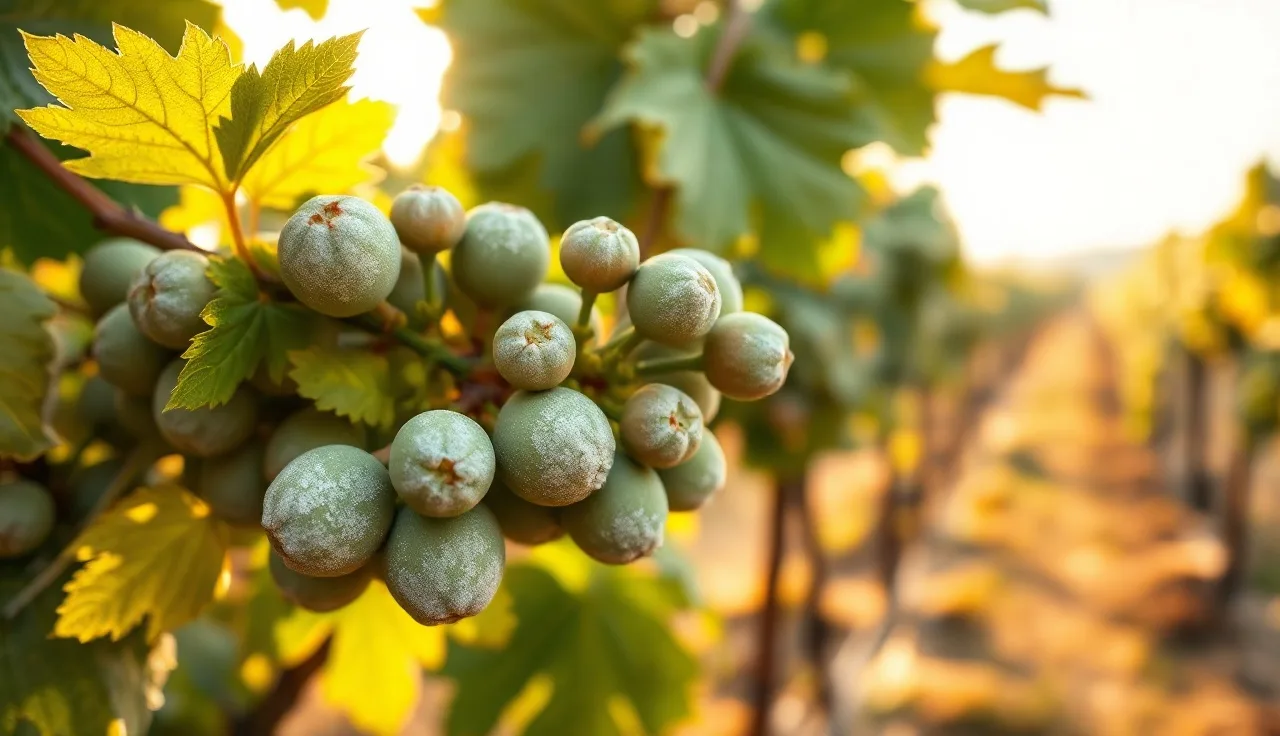
The first type is conidia: asexual spores produced in chains from upright structures called conidiophores. Under a hand lens you can see these chains as the classic powdery white coating on infected leaf surfaces, shoot tips, and grape clusters. Conidia drive epidemic spread during the growing season. They germinate and infect new tissue in as little as 12 hours at 77°F [3]. Each generation takes about 7 days to produce new sporulating colonies, which means a single missed spray window can turn into exponential spread within two weeks.
The second type is chasmothecia (previously called cleistothecia): sexual fruiting bodies that form late in the season, appearing as small black or dark brown spherical structures embedded in the powdery mycelium on infected shoots and leaves. This is the overwintering stage. Chasmothecia produce ascospores in spring, and these are the primary inoculum that starts infection each new season [4]. You can actually see them on dormant canes if you look closely, and scouting for them during winter pruning gives you a rough sense of how heavy your inoculum pressure will be in spring.
Erysiphe necator also overwinters as mycelium inside dormant buds. This is the more dangerous mechanism, because infected buds push out already-infected shoot tissue in spring. These 'flag shoots' sporulate heavily while they're still small and before many growers start their spray programs. UC Davis plant pathology research has documented that flag shoot infections can account for significant early-season inoculum spread if not managed aggressively in the first 2 to 3 weeks after budbreak [11].
The fungus grows external to the grape tissue, which is another distinguishing feature. Hyphae spread across the leaf surface and send haustoria (feeding structures) into epidermal cells, extracting nutrients without fully penetrating deep tissue. This external growth is why contact fungicides like sulfur can work well if coverage is good: the target is on the surface, not inside the leaf.
What environmental conditions does Erysiphe necator need to infect?
This is the section that matters most for building your spray schedule, so get comfortable with these numbers.
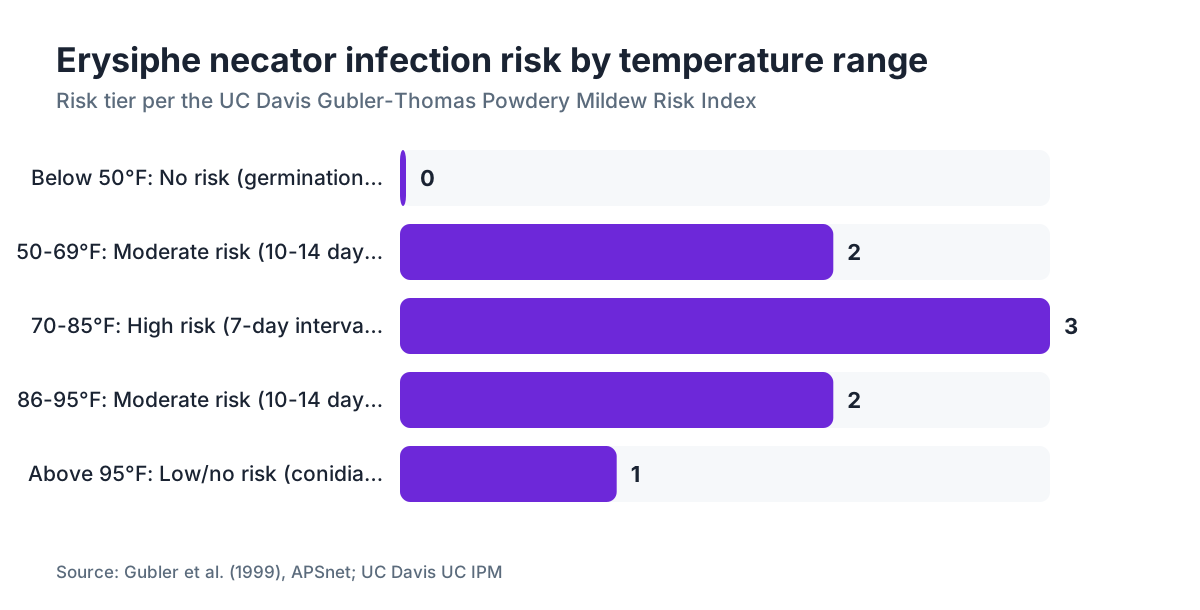
Temperature is the main driver. Erysiphe necator germinates and infects between 50°F and 90°F (10°C to 32°C), with the optimum around 68°F to 77°F (20°C to 25°C) [3]. Below 50°F, germination slows to a crawl. Above 90°F, conidia die off quickly, which is why you sometimes see powdery mildew pressure drop during a heat wave, only to explode again once temperatures moderate.
No free water required. This is the critical difference from downy mildew and Botrytis. Erysiphe necator does not need rain or surface wetness to germinate and infect. High relative humidity (above 40%) helps but isn't essential. This is why powdery mildew thrives in the dry summers of California's Central Valley and why growers in arid regions can't treat dry weather as protection.
Light actually inhibits sporulation. Conidia production is suppressed by direct UV radiation, which explains why shaded interior canopy positions have heavier powdery mildew pressure than sun-exposed outer leaves. Opening your canopy is a genuine disease management tool, more than a fruit quality move.
The 'degree-day' models developed by UC Davis and refined at Cornell track cumulative heat units after the first infection event (typically timed at 50% budbreak or first flag shoot appearance) to predict secondary infection cycles [5]. The UC Davis UC IPM model is available free online and is calibrated specifically for wine grape regions in California. WSU has its own validated model for Pacific Northwest conditions [6]. Both are worth bookmarking if you're managing more than a few acres.
| Condition | Effect on E. necator |
|---|---|
| Temp below 50°F (10°C) | Germination essentially stops |
| Temp 50-90°F (10-32°C) | Active infection range |
| Temp optimum 68-77°F (20-25°C) | Fastest germination, shortest incubation |
| Temp above 95°F (35°C) | Conidia mortality increases significantly |
| Relative humidity < 20% | Spore viability declines |
| Free water on surface | Not required for infection |
| UV light exposure | Suppresses sporulation; favors shaded tissue |
How does Erysiphe necator overwinter and what does that mean for spring timing?
Powdery mildew survives the dormant season two ways, and the relative importance of each shifts by region and by how bad the previous season was.
In most California wine regions and other mild-winter areas, bud infections are the dominant overwintering pathway. The fungus colonizes the inside of dormant buds in late summer or early fall and then emerges with the shoot in spring. These flag shoots, which look like a whitened, deformed primary shoot on an otherwise normal vine, are the first sign the overwintered inoculum is active. They typically appear within the first 3 to 4 weeks after budbreak. A review in Molecular Plant Pathology notes that infected buds can produce flag shoots even after fungicide programs that controlled later-season disease, because bud penetration happens before most fungicides can reach that tissue [7].
In regions with colder winters, chasmothecia on pruned cane debris and on the vine's bark provide the primary inoculum source. Chasmothecia release ascospores during spring rains, typically when temperatures exceed 50°F and rainfall exceeds 0.1 inch. The ascospores land on young tissue and start the first primary infections of the season.
The practical takeaway is the same regardless of your region: you need protection on young tissue from the moment of budbreak, not after you see symptoms. The critical window in most risk models runs from 0 to 12 inches of shoot growth, roughly from budbreak through bloom [5]. Grapes are most susceptible in the 2 to 3 weeks surrounding bloom, and berry infection in that window causes the skin russeting and cracking that ruins fruit quality even if you clean up visible mycelium later. Cornell's extension guidance flags the period from just before bloom through 3 weeks post-bloom as the highest-priority spray window for powdery mildew [2].
What symptoms does Erysiphe necator cause on vines and fruit?
Symptoms vary by tissue type, and knowing each one helps you catch infections earlier.
On leaves, the classic sign is a white to grayish powdery coating on the upper surface, sometimes with chlorotic patches on the underside. Young leaves curl or distort when infected early. On older, more mature leaves the fungus may colonize without obvious distortion, which makes scouting slower if you're only checking leaf shape.
On shoots, look for white mycelial growth on green tissue and, later in summer, a network of dark brown or rusty streaks on the bark surface once the infected tissue matures. These dark patches can persist on canes through winter and are a useful scouting indicator during pruning.
On clusters, berry infection before the berries reach about 8 to 10 Brix (roughly 3 to 5 weeks post-bloom) causes the most lasting damage. The fungus penetrates the developing berry skin, and as the berry expands rapidly through the summer, the infected epidermis doesn't stretch properly. This causes skin cracking and russeting, which exposes the pulp to secondary Botrytis infection and speeds up bunch rot [1]. Anyone who has seen a heavily infected cluster knows how it looks by harvest: a jumble of split, shriveled, and rotted berries, and a total loss.
On rachises (the cluster stem), infection causes a dry, dark brown necrosis that can girdle the stem and drop entire clusters, or cause uneven sugar development across the cluster.
Late-season infections on leaves and canes are obvious to the eye but do less economic damage to current-year fruit. They still feed chasmothecia formation and bud infection for the following season, so they're worth managing even after harvest if you're running a resistant cultivar or trying to cut next year's inoculum pressure.
Which grape varieties are most susceptible to Erysiphe necator?
Susceptibility maps to genetic background much more than to anything the grower does.
All Vitis vinifera cultivars are considered susceptible to highly susceptible, though there's meaningful variation within the species. Chardonnay and Cabernet Sauvignon tend to show higher disease pressure in most published observations. Carignan and Gewurztraminer are also frequently listed as particularly susceptible. Grenache and Tempranillo show somewhat lower susceptibility in some trials, though 'lower' still means they need a regular spray program.
American species show much higher natural resistance. Vitis rotundifolia (Muscadine) has the strongest resistance and is essentially immune in most conditions. V. labrusca cultivars like Concord show partial resistance. This resistance traces to several loci, the most studied being the Run1 resistance gene derived from V. rotundifolia, which has been bred into some programs to produce resistant hybrid cultivars [7].
Powdery mildew-resistant hybrids are now commercially available and increasingly relevant for organic and low-input programs. Cornell's breeding program has released varieties like Aromella and Arandell with strong resistance. USDA-ARS and various European programs have additional releases. If you're planting new blocks on a site with chronically high powdery mildew pressure, look hard at resistant varieties before you pour any concrete for new trellis posts.
The vineyard site itself, particularly aspect, air drainage, and canopy architecture, also interacts with varietal susceptibility. A susceptible variety in an open, well-ventilated site with good sun exposure will still need fungicides, but the pressure runs lower than the same variety in a dense, shaded canopy on a fog-prone, low-drainage block.
What fungicide modes of action work against Erysiphe necator?
There are four main chemical classes you'll rotate through, and the resistance story matters a lot here.
Sulfur is the oldest and still works. It's protectant only, meaning it prevents new infections rather than curing existing ones, and it's effective up to about 2 to 4 days pre-infection. The standard timing is every 7 to 10 days during high-pressure periods. One hard limit: don't apply sulfur when temperatures exceed 95°F (35°C) or within 2 weeks of a horticultural oil application, because both combinations cause phytotoxicity. Sulfur costs roughly $1 to $5 per acre per application depending on formulation and rate, making it the cheapest tool in the box. Resistance to sulfur has not been documented in Erysiphe necator, which is a genuine advantage.
DMI (demethylation inhibitor) fungicides, FRAC Group 3, include tebuconazole, myclobutanil, and others. These are locally systemic and have both protectant and curative (kickback) activity up to about 72 to 96 hours post-infection. They're your best option when weather has moved ahead of your spray window. Resistance in Erysiphe necator to DMIs has been documented in California, particularly in Napa and Sonoma counties, so rotating them with other groups is not optional [8].
QoI (quinone outside inhibitor) fungicides, FRAC Group 11, include azoxystrobin, pyraclostrobin, and trifloxystrobin. QoI resistance in powdery mildew is widespread globally and significant in some California regions. Many advisors now treat Group 11 as supporting chemistry rather than a primary control [12].
SDHI (succinate dehydrogenase inhibitor) fungicides, FRAC Group 7, are more recent tools with strong activity against powdery mildew. Rotating across groups through your season is the standard resistance management recommendation from both UC Davis and Cornell extensions [5][2].
Biological products, including potassium bicarbonate, Bacillus subtilis-based materials, and plant extract products, have real efficacy data but are generally less consistent than synthetic chemistry under high pressure. They're worth including in a rotation, especially for certified organic programs, but treating them as your only control on a high-susceptibility variety is a plan that will fail in a bad year.
For any pesticide application on a commercial vineyard, you have to comply with the EPA Worker Protection Standard (WPS), which covers re-entry intervals (REIs), personal protective equipment requirements, and posting of treated field boundaries [9]. Your state agricultural department may add label requirements on top of federal rules.
How do disease forecasting models for Erysiphe necator work in practice?
The two most widely used models in US viticulture are the UC Davis Risk Assessment Model and the Gubler-Thomas model, which is the same thing and often used interchangeably in California extension literature [5].
The model runs on three tiers of risk. When the 7-day average temperature is between 70°F and 85°F, you're at high risk and should spray every 7 days. When it's between 55°F and 70°F or between 85°F and 95°F, you're at moderate risk and can extend intervals to 10 to 14 days. When average temperatures sit outside the 50°F to 95°F infection range for the whole 7-day window, risk is low and you can extend or skip. The model resets after a 7-consecutive-day stretch with average temperatures above 95°F.
WSU's powdery mildew risk model runs on a similar degree-day framework calibrated for cooler Pacific Northwest seasons, where the main concern is maximizing protection during the shorter warm windows rather than managing a long mid-summer high-risk period [6].
Using either model well means you need accurate on-site temperature data, which means a decent weather station in the vineyard, not a regional airport reading from 12 miles away. Temperature gradients within a single vineyard can run 5°F to 10°F on calm nights, and that difference is enough to push you into the wrong risk tier.
This is where field data management gets genuinely useful. Track spray dates, products, rates, PHIs, and REIs alongside your weather records, and you can see whether your program is actually tracking with risk or whether you're on a calendar schedule that over- or under-applies. Tools like VitiScribe can pull spray records and compliance data into one place so you're not working from three separate spreadsheets when the PCA or county ag commissioner asks to see your records.
How does Erysiphe necator affect wine quality beyond visible berry damage?
The most economically significant impact past visible cluster damage is the production of off-flavor compounds.
Infected berries and must from heavily infected fruit carry elevated levels of 1-octen-3-ol and other volatile compounds tied to 'mushroom' or 'fungal' off-flavors in wine. Research published in the Australian Journal of Grape and Wine Research found detectable sensory defects in wine made from fruit with as little as 3% cluster infection, a threshold most growers wouldn't consider alarming based on visual inspection alone [10]. The actual economic threshold for perceptible wine quality impact sits lower than the level at which you'd declare a spray program a failure.
Beyond off-flavors, powdery mildew infection of berries before veraison reduces anthocyanin accumulation in red varieties because the infected epidermis colors abnormally. Late infections raise susceptibility to bunch rots that elevate volatile acidity in finished wine. Winemakers in regions with chronic pressure know which vintages were 'musty years' without needing to look at a log.
For growers supplying fruit to wineries under contract, many purchase agreements now include mold and rot deduction schedules that explicitly penalize powdery mildew damage at the crush pad. Knowing your spray records are complete and defensible matters when a winery's quality control team disputes fruit condition at intake. A clean, timestamped spray log is often the difference between a deduction fight and a clean invoice.
Growers in established appellations like Paso Robles, where paso-robles-wineries operate at varying scales with varying spray philosophies, often share informal benchmarks about acceptable cluster infection rates for different wine styles. Table wine production tolerates slightly more than ultra-premium, but 'slightly' is a small number.
What is the history of Erysiphe necator and how did it spread globally?
Where this pathogen came from explains a lot about current susceptibility patterns.
Erysiphe necator originated in eastern North America, where it co-evolved with native American Vitis species over millions of years. Native American vines developed real tolerance and resistance over that stretch of evolutionary time. European winemakers were blissfully unaware of it until the 1840s.
The pathogen was first formally described in England in 1845 by Berkeley on greenhouse-grown vines. Within a decade it had spread across France, where it devastated V. vinifera vineyards that had zero evolutionary experience with it. French production dropped by roughly 80% in some years during the epidemic of the 1850s. The crisis drove rapid adoption of sulfur as a fungicide, which is why sulfur has more than 170 years of use data behind it as a powdery mildew control.
DNA analysis of Erysiphe necator populations published in the early 2000s confirmed a single introduction event into Europe from a North American source, and subsequent spread to Australia, South Africa, and other wine regions from Europe [7]. Every major wine-producing region of the world now deals with the same pathogen.
The genetic uniformity of the European and international populations, compared to the more diverse North American populations, has one practical implication for resistance management: the pathogen carries a narrower genetic base outside North America, but it's still very capable of developing resistance to fungicides under selection pressure, as the documented DMI resistance in California shows [8].
How should you structure a spray program around Erysiphe necator's biology?
A biology-based program beats a calendar program almost every time. Here's what that means in the field.
Start at budbreak, not at bloom. The highest-risk tissue is young, expanding tissue from the moment it emerges. Flag shoots in the first few weeks are your warning signal that bud infections overwintered successfully. If you see flag shoots in more than 5% of shoots in any block, assume high inoculum pressure for the season and plan accordingly.
Protect through bloom aggressively. The 10 to 14 days bracketing bloom is the single most important spray window of the season for fruit protection. Miss it with a susceptible variety in a moderate-to-high risk year, and that's where most berry infections that later cause fruit quality problems originate. Use a systemic DMI or a systemic-plus-protectant tank mix during this window, not sulfur alone.
After veraison, berry susceptibility to new infection drops substantially because the epidermis matures and gets much harder for haustoria to penetrate. This doesn't mean you stop: shoot and leaf infections keep building inoculum for chasmothecia and bud colonization that will hit next year. But your economic math shifts, and if you're managing a lower-value block with already-clean clusters, you can justify extending intervals post-veraison.
Rotate FRAC groups every application or every other application at minimum. UC Davis resistance management guidance recommends no more than 2 consecutive applications of any one FRAC group during the season [5]. Mixing sulfur with systemic chemistry in the same tank doesn't count as rotation: it can reduce efficacy of the systemic by altering pH in some formulations and doesn't contribute to resistance management in any meaningful way.
Keep your records. REIs, PHIs, product names, FRAC codes, rates, weather at application, and field identification. This isn't paperwork for its own sake. It's the data you need to evaluate whether your program actually worked and to prove compliance to your certifier, county ag commissioner, or winery contract administrator. If you want a clean way to track all of it in the field without a desk job, VitiScribe was built for exactly this kind of vineyard record-keeping.
Tank agitation and water volume matter for coverage. Powdery mildew lives on the surface, so getting the spray onto interior canopy positions is where coverage fails. Most extension guidelines recommend a minimum of 50 gallons per acre in a mature, dense canopy. Less than that and you're leaving gaps the fungus will find.
Frequently asked questions
What is the scientific name of the organism that causes powdery mildew of grapes?
The causal organism is Erysiphe necator Schwein., an obligate biotrophic ascomycete fungus in the family Erysiphaceae. It was previously classified as Uncinula necator, and you'll still see that name in older extension publications from UC Davis, Cornell, and WSU. The reclassification into Erysiphe happened in 1999 and is now the accepted name in current scientific and extension literature.
Does grape powdery mildew need rain or wet conditions to infect?
No. This is the most important practical distinction between Erysiphe necator and pathogens like downy mildew or Botrytis. Erysiphe necator does not require free water on leaf or berry surfaces to germinate and infect. Moderate relative humidity (above roughly 40%) helps but isn't essential. This is why dry-summer climates like California's Central Valley and southern France still have serious powdery mildew problems.
What temperature range does Erysiphe necator infect grapes in?
Infection occurs between 50°F and 90°F (10°C to 32°C), with the fastest germination and shortest incubation times at 68°F to 77°F (20°C to 25°C). Above 95°F, conidia die rapidly. Below 50°F, germination slows to negligible levels. The UC Davis Gubler-Thomas risk model uses these thresholds to assign daily risk tiers that guide spray interval decisions.
How does Erysiphe necator survive winter dormancy?
The fungus overwinters two ways: as mycelium inside dormant infected buds, and as chasmothecia (sexual fruiting bodies) on the surface of infected bark and pruning debris. In mild-winter regions like coastal California, bud infections are often the dominant inoculum source, producing 'flag shoots' in spring. In colder regions, chasmothecia releasing ascospores during spring rains are typically more important.
When in the season is the grapevine most susceptible to Erysiphe necator?
Young, rapidly expanding tissue is always most susceptible. The single highest-risk window for fruit infection is the 2 to 3 weeks surrounding bloom, roughly from pre-bloom through 3 weeks post-bloom. Berry infections during this period cause lasting structural damage: the infected epidermis can't stretch properly as the berry expands, leading to russeting and cracking. After veraison, berry susceptibility drops substantially, though shoot and leaf infections continue.
Are all grape varieties equally susceptible to powdery mildew?
No. All Vitis vinifera cultivars are susceptible to varying degrees, with Chardonnay and Cabernet Sauvignon often showing high pressure in field observations. American species like V. rotundifolia (Muscadine) are essentially immune. Partial resistance in V. labrusca cultivars like Concord is well-documented. Cornell and USDA-ARS breeding programs have released several powdery mildew-resistant hybrid cultivars, including Aromella and Arandell, suitable for low-input programs.
What is the difference between conidia and chasmothecia in Erysiphe necator?
Conidia are asexual spores produced in chains on the surface of infected tissue. They drive epidemic spread during the growing season and can cause new infections within 12 hours at optimal temperatures. Chasmothecia are sexual fruiting bodies that form late in the season, appear as tiny black spheres in the mycelium, and survive winter to release ascospores the following spring. Chasmothecia are the primary overwintering and initial inoculum structure in colder regions.
What fungicide groups work against Erysiphe necator and how do you rotate them?
The main chemical classes are sulfur (no resistance documented), DMI fungicides (FRAC Group 3, systemic, some resistance in California), QoI fungicides (FRAC Group 11, widespread resistance in some regions), and SDHI fungicides (FRAC Group 7). Biological options include potassium bicarbonate and Bacillus subtilis-based products. UC Davis recommends no more than 2 consecutive applications of any single FRAC group to manage resistance development.
Can Erysiphe necator infection affect wine flavor even if the visible damage looks minor?
Yes. Research published in the Australian Journal of Grape and Wine Research found that wine made from fruit with as little as 3% cluster infection showed detectable sensory defects, including 'mushroom' or 'moldy' off-flavors attributed to volatile compounds like 1-octen-3-ol from infected tissue. This threshold is lower than most growers would consider economically significant based on visual inspection of clusters at harvest.
How do I identify flag shoots from Erysiphe necator bud infections?
Flag shoots emerge from infected dormant buds within the first 3 to 4 weeks after budbreak. They appear as stunted, whitened or pale primary shoots covered in white powdery mycelium, while surrounding shoots on the same vine look normal. They sporulate heavily while still small. Scout for them actively from budbreak onward, particularly in blocks with a history of high powdery mildew pressure in the previous season.
What does the EPA Worker Protection Standard require for powdery mildew fungicide applications in vineyards?
The EPA WPS (40 CFR Part 170) requires that workers re-entering treated vineyard areas observe the re-entry interval (REI) listed on the fungicide label, that treated areas be posted with warning signs during the REI, and that workers receive pesticide safety training and have access to water, soap, and clean towels for decontamination. Sulfur typically carries a 24-hour REI; many systemic fungicides have REIs of 12 to 24 hours depending on the label.
Why is Erysiphe necator worse in shaded, dense canopy areas?
Direct UV light suppresses conidial production and viability. The interior of a dense, shaded canopy blocks UV radiation and holds higher relative humidity, creating conditions that favor sporulation and spread. This is a well-documented reason why canopy management, including leaf removal in the fruit zone and shoot thinning, is a legitimate disease management tool and more than a fruit quality practice.
How did powdery mildew reach European vineyards historically?
Erysiphe necator is native to eastern North America, where it co-evolved with American Vitis species. It arrived in England around 1845 on imported greenhouse vines and spread rapidly across European wine regions within a decade. European V. vinifera cultivars had no evolutionary exposure to the pathogen and were devastated. The epidemic of the 1850s drove adoption of sulfur as a fungicide, which remains a primary control tool more than 170 years later.
What on-site data do I need to run the UC Davis or WSU powdery mildew risk models?
Both models require accurate on-site temperature data, ideally from a weather station in or immediately adjacent to the vineyard block being managed. The UC Davis Gubler-Thomas model uses the 7-day average temperature to assign risk tiers that determine recommended spray intervals. Using regional airport or CIMIS station data from more than a few miles away introduces enough temperature error to push you into the wrong risk tier on marginal days.
Sources
- UC Davis UC IPM, Powdery Mildew of Grape: Erysiphe necator (syn. Uncinula necator) is confirmed as the causal organism of grape powdery mildew; all V. vinifera are susceptible
- Cornell Cooperative Extension, Grape IPM in the Northeast: Bloom through 3 weeks post-bloom is the highest-priority spray window; DMI and protectant fungicide rotation recommendations
- Delp CJ (1954) Effect of temperature and humidity on the grape powdery mildew pathogen, Phytopathology 44:615-626: Erysiphe necator infects across 50-90°F with optimum at 68-77°F; germination can occur in as little as 12 hours at optimum temperature
- Halleen F & Holz G (2001) An overview of the biology, epidemiology and control of Uncinula necator on grapevine, South African Journal for Enology and Viticulture: Chasmothecia are primary overwintering structure in cold-winter regions; bud infections produce flag shoots in mild-winter regions
- Gubler WD, Rademacher MR, Vasquez SJ, Thomas CS (1999) Control of powdery mildew using the UC Davis Powdery Mildew Risk Index, APSnet: Description and validation of the Gubler-Thomas risk index model for scheduling powdery mildew sprays based on 7-day average temperature
- Washington State University Extension, Grape Powdery Mildew Management: WSU-calibrated powdery mildew degree-day risk model for Pacific Northwest vineyard conditions
- Gadoury DM et al. (2012) Grapevine powdery mildew (Erysiphe necator): a fascinating system for the study of the biology, ecology and epidemiology of an obligate biotroph, Molecular Plant Pathology 13:1-16: DNA analysis confirms single North American introduction of E. necator to Europe; Run1 resistance gene from V. rotundifolia described; bud infections produce flag shoots despite later-season control
- Lybrand DB et al., UC Davis Plant Pathology, DMI Fungicide Resistance in Erysiphe necator: DMI fungicide resistance documented in Erysiphe necator populations in Napa and Sonoma counties, California
- EPA Worker Protection Standard, 40 CFR Part 170: WPS requirements for re-entry intervals, posting of treated fields, personal protective equipment, and worker training
- Stummer BE et al. (2005) Effects of powdery mildew on the sensory properties and composition of Chardonnay wine, Australian Journal of Grape and Wine Research 11:143-151: Detectable sensory defects in wine made from fruit with as little as 3% cluster infection by E. necator; 1-octen-3-ol implicated
- UC Davis Department of Plant Pathology, Grape Powdery Mildew: Flag shoot infections can account for significant early-season inoculum; first 2-3 weeks after budbreak critical management window
- USDA National Agricultural Library, Fungicide Resistance Action Committee FRAC Codes: FRAC group classifications for DMI (Group 3), QoI (Group 11), and SDHI (Group 7) fungicides used in powdery mildew management
Last updated 2026-07-09