Powdery mildew of grapes life cycle: how the fungus survives, spreads, and when to stop it
TL;DR
- Grape powdery mildew (Erysiphe necator) overwinters as chasmothecia on bark or as mycelium inside dormant buds.
- Spring rain and warmth above 10°C release ascospores that infect new tissue.
- Asexual conidia then spread the disease by wind all season.
- The dangerous window runs from budbreak through 4 to 6 weeks after bloom.
- Miss it and you play catch-up for the rest of the year.
What exactly is grape powdery mildew and why does its life cycle matter for your spray program?
Grape powdery mildew is caused by Erysiphe necator (formerly Uncinula necator), an obligate biotrophic fungus. That means it only grows and reproduces on living plant tissue. It doesn't need free water to infect, which sets it apart from most fungal diseases you deal with in the vineyard. That single fact drives everything about how you manage it.
The life cycle isn't academic background. It maps directly onto when your sprays need to be in place, when your scouting needs to intensify, and when you can back off. Understanding the disease cycle is what separates managers who catch infections early from those who spray on the calendar and hope, according to grape powdery mildew guidance from the UC Statewide IPM Program [1].
The fungus runs through two phases each year. A sexual stage drives primary infection in spring. An asexual stage drives secondary spread through the rest of the season.
Both matter, but primary infection sets the trajectory for the whole year. Get a big primary infection and you'll spend the summer trying to contain growth that doubles roughly every week.
How does powdery mildew survive winter in the vineyard?
The fungus overwinters two ways. It sits out the cold as dormant mycelium inside infected buds, or it forms sexual resting structures called chasmothecia (the old name was cleistothecia) on bark, infected canes, or leaf debris.
Flagshoot infections are the more damaging overwintering route. When a bud gets colonized by mycelium before it goes dormant in fall, that infected bud pushes a flagshoot in spring: a shoot covered in white powdery growth from essentially the day it emerges. Flagshoots appear before any rain event triggers ascospore release, so they can generate conidia and infect neighboring tissue before most growers are even thinking about mildew. The UC IPM program describes flagshoots as a primary source of early-season inoculum in many California vineyards [1].
Chasmothecia are the sexual structures. They're tiny, round, and dark brown to black. You can sometimes spot them on infected wood or old leaf material as small black dots, though a hand lens helps. Each chasmothecium holds multiple asci, and each ascus carries ascospores. They're built to last. Drought, cold, and UV don't kill them easily. They anchor to bark with specialized hyphae and persist through most Pacific Northwest winters intact.
Winter temperature affects chasmothecium viability. Extended exposure below about -15°C (5°F) can reduce it, but that's colder than most wine grape regions see in a typical winter. For most of California, Oregon, Washington, and the eastern regions, assume viable chasmothecia heading into spring every single year.
When do ascospores release and cause primary infection in spring?
Chasmothecia need moisture, warmth, and a maturation period before they release ascospores. The trigger is rainfall combined with temperatures above about 10°C (50°F). Most research puts the primary release window between budbreak and roughly 5 to 6 weeks after budbreak, which in practice runs from late March through late May or early June depending on your region [1][6].
Ascospore release is not one event. It's episodic, tied to individual rain events. Each wetting triggers a fresh wave of release from mature chasmothecia. That's why a rainy spring lines up with high primary infection pressure even in dry-summer regions like the Central Valley or eastern Washington. The disease gets a running start.
The temperature range that drives infection by ascospores mirrors what drives conidia. Moderate temperatures from about 15°C to 28°C (60°F to 82°F) are best for germination and penetration. Temperatures above 35°C (95°F) suppress germination, which is why you see a mid-summer lull in hot inland regions [5]. That doesn't mean pressure disappears. Temperatures drop at night, canopies shade tissue, and infections that started at moderate temperatures keep growing even when daytime highs spike.
Ascospores germinate without free water on the leaf, but they need humidity above roughly 40% relative humidity. This is a real difference from downy mildew: powdery mildew ascospores can infect on dry but humid days. The incubation period from infection to visible symptoms runs 7 to 14 days depending on temperature, per Cornell plant pathology resources [9].
The 5 to 6 weeks after budbreak is when your fungicide program must run on schedule. There is no catching up after a missed primary infection event.
What is the secondary infection cycle and how fast does it move through a vineyard?
Once primary infection establishes, the fungus switches to asexual reproduction. Infected tissue produces conidiophores, finger-like structures that generate chains of asexual spores called conidia. These are the white powdery masses you see on leaves, shoots, and clusters. Conidia travel on wind, not water, so dry breezy conditions speed spread rather than slowing it.
The generation time is short. At optimal temperatures (around 25°C/77°F), a single infection goes from spore landing to new conidia in as little as 5 to 7 days [5]. That's a new generation roughly every week. The math is unforgiving. One missed shoot in early season can seed hundreds of infections by veraison.
Conidia keep coming as long as conditions stay favorable. There's no single seasonal pulse the way ascospores work. An infected cluster at bunch closure, with the dense humid microclimate inside the berry zone, becomes a conidia factory that coats every berry surface and drives berry-to-berry spread fast. This is why bunch architecture matters. Tight-clustered varieties like Chardonnay, Pinot noir, and Merlot let cluster infection run further than loose-clustered varieties do.
Wind speed drives dispersal distance. Most conidia fall within meters of their source, but a wind event can carry them clear across a block. Row orientation relative to prevailing wind affects how fast a local infection travels. In high-pressure seasons, scouting and flagging the windward rows first pays off.
The secondary cycle doesn't stop at harvest. As long as green tissue is present, the fungus keeps reproducing. Late-season infections on leaves and canes feed chasmothecia production for the following year, which is exactly why end-of-season canopy work and sometimes a post-harvest sulfur application cut the inoculum heading into dormancy.
What plant growth stages are most susceptible to powdery mildew infection?
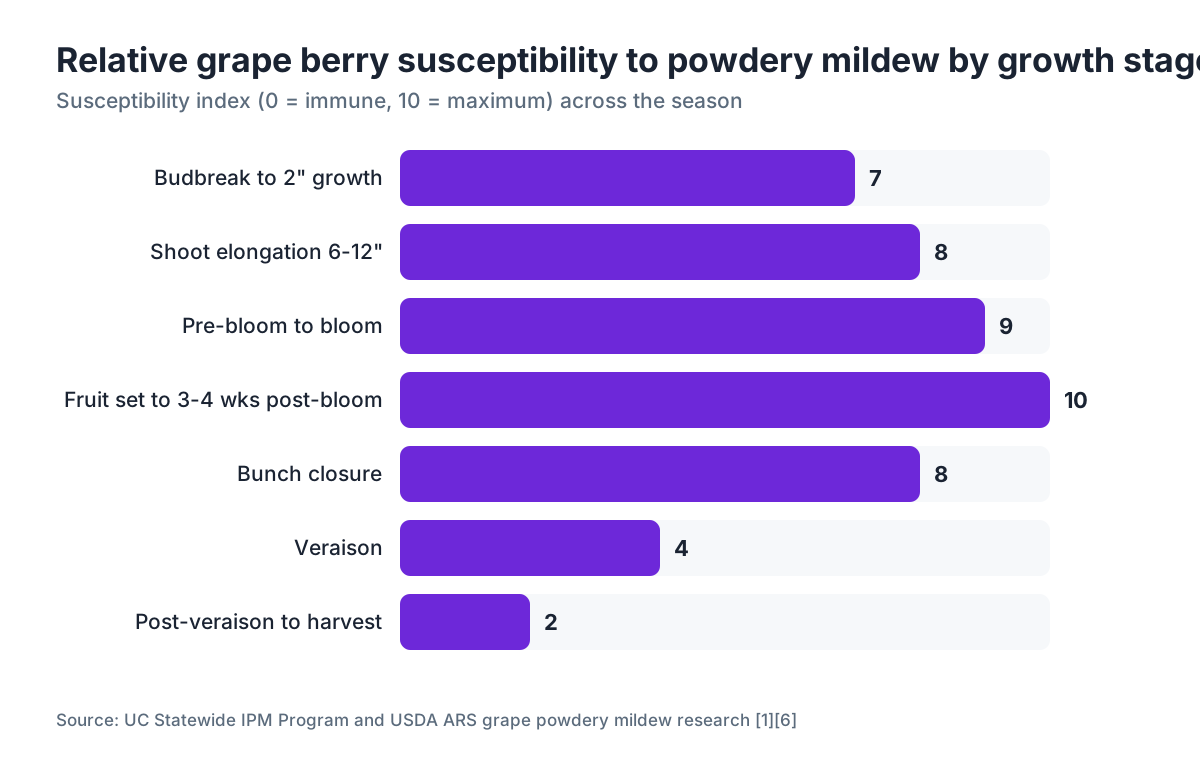
Young, fast-growing tissue is most susceptible. The grape berry has a well-documented susceptibility window: from just before bloom through roughly 3 to 4 weeks after bloom, the berry surface is highly vulnerable. After berry skin lignification (about 6 to 8 weeks post-bloom depending on variety and conditions), berries become much more resistant to new infections, though berries infected before that point still develop severe symptoms [1][6].
Leaves are most vulnerable young and expanding. Mature leaves have thicker cuticles that resist germ tube penetration, though they're never fully immune under heavy inoculum.
Shoots stay susceptible through elongation, peaking during rapid cell division.
Here's a rough susceptibility calendar by growth stage:
| Growth stage | Approximate timing (Northern Hemisphere) | Susceptibility |
|---|---|---|
| Budbreak to 2 inches growth | Late March to April | High (flagshoots emerge) |
| Shoot elongation (6-12 inches) | April to May | Very high |
| Pre-bloom to bloom | May to early June | Very high (cluster susceptibility starts) |
| Fruit set to 3-4 weeks post-bloom | June | Extremely high (berries most vulnerable) |
| Bunch closure | Late June to July | High (cluster microclimate intensifies) |
| Veraison | July to August | Moderate (berry skin lignifying) |
| Post-veraison | August to September | Low-moderate (leaf/cane still susceptible) |
This table covers general timing for California and Pacific Northwest regions. Shift it 2 to 4 weeks later for cooler climates like the Finger Lakes or western Oregon.
How does temperature affect each stage of the powdery mildew life cycle?
Temperature is the master switch for this disease. The fungus has a narrow band where it works efficiently and clear boundaries where it shuts down.
Minimum temperature for germination is roughly 6°C (43°F). Below that, conidia and ascospores can be present but won't germinate even with enough humidity [5].
The optimum range is 20°C to 27°C (68°F to 80°F). Infection, colonization, and sporulation all move fastest here.
Above 35°C (95°F), germination drops sharply. Above 40°C (104°F) for more than a few hours, surface mycelium can die. That explains the mid-summer lull in San Joaquin Valley vineyards, but it's not a reliable management tool. Temperature fluctuates, and shaded canopy tissue stays cooler than the ambient air.
Night temperatures matter more than most growers realize. Warm nights (above 15°C/59°F) allow continuous sporulation through the dark hours. Cool nights slow sporulation but don't stop it in established infections.
WSU Extension's powdery mildew resources describe a degree-day model where roughly half of the seasonal ascospore release happens after 35 to 50 degree-days (base 10°C) accumulate past budbreak [3]. Some disease risk forecasting tools use this model to predict primary infection windows more precisely than calendar date alone.
Frost after budbreak doesn't kill established infections inside vine tissue. The mycelium in a colonized bud is protected.
What does powdery mildew damage actually look like at each stage?
Knowing what you're looking at in the field speeds up every decision. The white powdery coating is the classic symptom, but it presents differently by tissue type and infection age.
Flagshoots: whole shoots emerge under a white-gray dusty layer. They can look like frost damage at first glance. Leaves are often distorted and curl down at the margins. Find one and there are almost certainly more nearby in the same block.
Leaf infections start as pale yellow or chlorotic patches on the upper surface, with white sporulation on the underside. In heavy infections both surfaces get coated. Badly infected leaves turn necrotic and drop early, cutting the photosynthetic area going into ripening.
Cluster infections before bloom turn rachis tissue brown-black, and infected flowers often fail to set. This is where the big yield loss happens in high-pressure years.
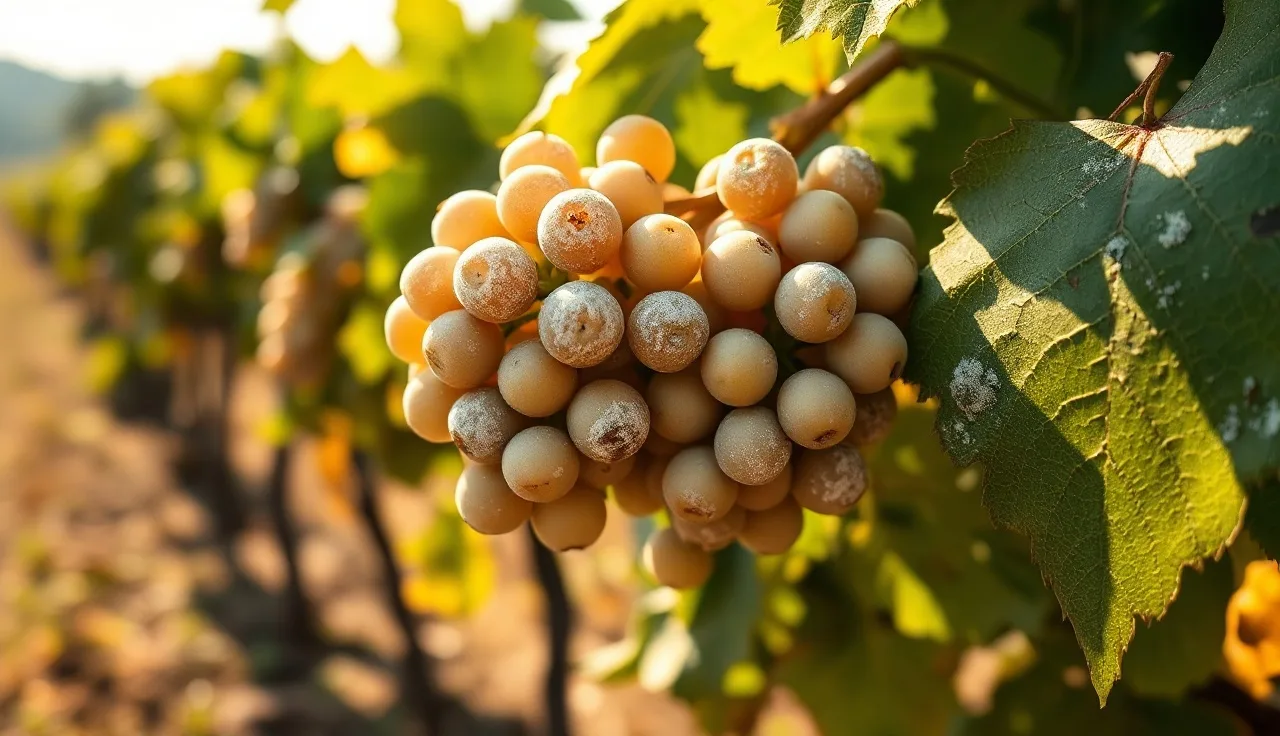
Berry infections start as the classic white powdery coating on young berries. As they expand, the fungal network can't stretch with the skin, so the skin cracks and opens the door to secondary rots like Botrytis cinerea. In a heavy year on susceptible varieties, the powdery mildew and Botrytis combination is what wipes out a crop.
Late-season symptoms show up as brown-black web-like scarring on berry surfaces, left by earlier infections that are no longer actively sporulating. That scarring hurts fruit quality and can cause problems in winemaking if infected berries reach the must.
Chasmothecia at season's end look like small black dots on infected canes and the undersides of leaves. Finding them tells you next year's inoculum is present and maturing.
How do you use the powdery mildew disease cycle to build a spray program?
The life cycle hands you four decision points that are genuinely actionable.
Start with a dormant-season assessment. Count flagshoots in a representative sample of rows to estimate your overwintering inoculum load. WSU Extension recommends scouting at least 30 shoots per block at budbreak for a reliable flagshoot incidence rate [3]. High incidence (above 2 to 3%) means heavy chasmothecial load and infected buds, so start your program at or before budbreak instead of waiting.
Next, the primary infection window. Start sprays at budbreak if that block has a disease history. The 7 to 10 day early-season interval isn't arbitrary. It's tied to the incubation period and the residual activity of most fungicides. Extend intervals only when temperatures sit consistently above 35°C or below 10°C. Rain doesn't trigger powdery mildew the way it triggers downy mildew, but a spring rain signals ascospore release, so the day after a spring rain is a high-risk day, not a quiet one.
Third, bloom through fruit set. Run your best materials here: DMI (sterol-inhibiting) fungicides, strobilurins, or SDHI-class products where resistance hasn't taken hold. USDA ARS research supports a 7-day interval through this window at minimum, tightening to 5-day intervals in high-pressure years or on susceptible varieties [1][6]. Sulfur works here too, but watch the label above 32°C (90°F) to avoid phytotoxicity.
Fourth, post-veraison and end of season. Plenty of operations drop mildew sprays after veraison, and for clean, low-pressure blocks that's defensible. If you've had active infections through bunch closure, late sprays protect remaining leaf area and cut chasmothecial production heading into next year.
Keeping accurate, timestamped spray records tied to disease observations is where compliance and management meet. Scatter your records across notebooks and phone photos and you lose the feedback loop that makes the disease cycle useful. Tools like VitiScribe log spray applications against growth stage and observation data so you can see the correlation year over year.
Under the EPA Worker Protection Standard, pesticide applications including sulfur and synthetic fungicides in your mildew program require records retained for 2 years, with fields including product name, EPA registration number, application date, and rate [7]. California adds requirements under CDFA and county agricultural commissioner reporting for restricted materials [11].
What fungicides work at which stages of the life cycle, and where is resistance a real problem?
Fungicide chemistry has to match the stage you're trying to interrupt. Pick the wrong tool for the moment and you waste the pass.
Protectant fungicides (sulfur, copper, oils) sit on the plant surface and kill germinating spores before they penetrate. They have no kick-back against established infections. Time them to be in place before infection events.
Sulfur is cheap, effective, and widely used. The standard effective rate is 2 to 4 pounds of elemental sulfur per acre depending on formulation, on a 7 to 10 day interval. Don't apply when temperatures top 32°C (90°F) on the day of application or the day after. The phytotoxicity risk is real. UC IPM guidance treats sulfur as the backbone of most California organic and conventional programs through the primary infection window [1].
Sterol-inhibitor (DMI) fungicides (myclobutanil, tebuconazole, metconazole, and others) have protectant plus limited curative activity, effective up to about 72 hours post-infection. They're the workhorses of the bloom-to-fruit-set window. Resistance to DMIs has developed in E. necator populations in many wine regions. Cornell's resistance monitoring found reduced sensitivity in a meaningful share of isolates tested from New York vineyards [9]. Rotate chemistries.
Strobilurin (QoI) fungicides (azoxystrobin, trifloxystrobin) also carry both modes. Resistance is well-documented. Parts of the European and Australian grape industries have seen near-complete loss of strobilurin efficacy. WSU Extension advises capping strobilurins at two applications per season and always tank-mixing with a different mode of action [3].
SDHI fungicides (fluopyram, fluxapyroxad) are newer and effective, but resistance management applies here too. Labels typically cap total applications per season.
Kaolin clay and potassium bicarbonate round out the options with different modes of action, useful in organic programs and as rotation partners.
The resistance trap in practice: if the previous management team hammered the same chemistry for years without rotation, you may inherit resistant populations before you ever walk the field. That's another reason to track more than your own spray history and dig up what was used before you.
How do vineyard design and variety choice interact with the powdery mildew life cycle?
Variety matters enormously. European Vitis vinifera varieties are, as a group, highly susceptible. Within vinifera, Chardonnay, Cabernet Franc, Merlot, Syrah, and Zinfandel run high to very high. Cabernet Sauvignon and Sauvignon Blanc rate moderate. American native grapes and most hybrids carry meaningful resistance, and breeding programs at Cornell and UC Davis have produced wine-quality hybrids with genuine mildew resistance built in [9].
Canopy management changes the microclimate around clusters and leaves, which changes how fast the secondary cycle moves. Dense, shaded canopies hold humidity, buffer temperature extremes, and block air movement, all of which the fungus loves. The same shoot thinning, leaf removal, and hedging that improves fruit quality also cuts mildew pressure by drying out the microclimate and opening the canopy to spray coverage.
Leaf removal in the cluster zone, especially on the eastern (morning sun) side of rows, is one of the better-supported cultural practices for reducing cluster infection. It drops humidity, improves coverage, and speeds drying. Oregon State University extension found leaf removal significantly reduced powdery mildew cluster incidence in Pinot noir when done before or at bloom [8].
Row orientation affects sun exposure and air drainage. Rows oriented toward the prevailing wind push more air through the canopy, which lowers humidity and can slightly reduce infection risk. This matters most in cool, maritime climates.
Spacing and trellis design set canopy density. High-density plantings with narrow rows can create persistent shade and choke off spray access, both of which raise disease pressure over the life of the vineyard. These are site-design decisions that are hard to reverse later. If you're planning a new block, build powdery mildew pressure into your spacing and trellis choices from day one.
How do you scout and time decisions based on the disease cycle?
Scouting rhythm has to match the pace of the disease. In the primary infection window, scout at least weekly. After bloom, scout every 7 to 10 days. After bunch closure, ease off but don't quit.
At each scouting event, walk the block in a Z or W pattern that covers all areas. Check shoot tips (most susceptible), both leaf surfaces, and cluster surfaces. At bloom and fruit set, peel open a few clusters on tight-clustered varieties and look inside.
Record incidence (percent of shoots or clusters infected) and severity (rough estimate of percent tissue covered). This data drives the spray decision, not the calendar date alone.
For flagshoot scouting at budbreak, mark 100 consecutive shoots in a representative row. Count the ones with white powdery coating on emergence. Above 2% incidence means high pressure. Start your full program immediately [3].
Degree-day models help. Several western states run online tools that pull temperature data and model ascospore maturation and release timing. Oregon State's Integrated Plant Protection Center and WSU's Decision Aid System both offer powdery mildew risk models fed by weather station data [8][12]. If you have a weather station in or near your block, these give you far better timing than a calendar schedule.
Log scouting data alongside spray records and you build a usable feedback loop. After two or three seasons of linked observations and applications, you can see which blocks respond to your program and which stay problematic. That's the foundation for block-level management instead of running one uniform program across the whole vineyard.
Under the EPA Worker Protection Standard, pesticide application records must include the date, time, location, product, and applicator [7]. Keeping scouting records in the same system makes compliance easier and the data more useful.
Does the powdery mildew life cycle differ significantly by region (California, Pacific Northwest, New York)?
The biology is the same everywhere. The practical expression differs because climate decides which parts of the life cycle dominate.
California's dry summers mean rainfall rarely triggers ascospore release after May or June. Primary infection from chasmothecia still matters, but flagshoot-origin infections from colonized buds are often the bigger continuous early-season inoculum source. The secondary conidial phase drives most summer pressure in dry years. In wet El Niño springs, ascospore loads climb and primary infection turns severe [1].
The Pacific Northwest (Washington, Oregon) gets more spring rain, so chasmothecial ascospore release is a larger part of the picture. WSU and Oregon State extension programs both point to the degree-day models for ascospore maturation timing as especially valuable in their region [3][8].
New York and the eastern regions add more summer rainfall, which drives secondary spread harder, plus higher canopy humidity most seasons. Cornell resources recommend tighter spray intervals through the secondary season than comparable West Coast guidance [9]. Eastern growers also fight Botrytis at the same time as powdery mildew through much of the season, which shapes product choice and timing.
Any vineyard, in any region, benefits from knowing whether its block runs hotter or cooler than the regional average. Valley floors with cold air drainage can sit 3 to 5°C cooler at night than a hillside vineyard in the same county, which stretches the fungal activity window and shifts the whole season's timing.
Frequently asked questions
What causes powdery mildew on grapes in the first place?
Grape powdery mildew is caused by the fungus Erysiphe necator, an obligate biotroph that grows only on living tissue. It's present in virtually every wine grape region on earth. The fungus overwinters as chasmothecia on bark or as mycelium in dormant infected buds, then resumes growth and spore production when spring temperatures rise above about 10°C (50°F).
Can powdery mildew spread without rain?
Yes, and this is one of the defining facts about the disease. Conidia (asexual spores) are dry-dispersed by wind and germinate at relative humidity above roughly 40% without free water on leaf surfaces. Warm, dry, breezy afternoons spread secondary infections fast. Rain triggers primary ascospore release in spring, but the secondary conidial phase runs entirely on humidity and wind.
What temperature kills powdery mildew on grapes?
Surface mycelium and conidia are suppressed above about 35°C (95°F) and can be killed at 40°C (104°F) with several hours of exposure. But mycelium inside colonized buds survives cold winters in most wine regions. Summer heat spikes cut visible symptoms temporarily; they don't eliminate established infections or the overwintering inoculum.
When is the best time to spray for grape powdery mildew?
The most effective window runs from budbreak through 4 to 6 weeks after bloom. UC IPM guidance recommends starting at or before budbreak in blocks with disease history and holding 7 to 10 day intervals through fruit set. Protectant sprays must be in place before infection events, not after. Post-bloom intervals can extend to 10 to 14 days once berry skin begins to lignify and pressure drops.
What are flagshoots and why do they matter for powdery mildew management?
Flagshoots are shoots that emerge from buds infected with dormant powdery mildew mycelium. They show up at budbreak covered in white powdery growth and produce conidia before any ascospore release from chasmothecia. They matter because they're an early-season inoculum source independent of rainfall, and high counts (above 2 to 3% of shoots) mean a heavy overwintering load that calls for immediate protective spraying.
How long does the powdery mildew incubation period last on grapes?
From spore landing to visible symptoms takes roughly 7 to 14 days depending on temperature. At optimal temperatures around 25°C (77°F), incubation runs closer to 5 to 7 days and new conidia form shortly after. This is why spray intervals of 7 to 10 days are standard during the primary infection window: you want residual protection covering the full period between application and when a new infection could become visible.
Which grape varieties are most susceptible to powdery mildew?
All European Vitis vinifera varieties have meaningful susceptibility. Within vinifera, Chardonnay, Merlot, Cabernet Franc, Zinfandel, and Syrah rate consistently high. American native species and bred disease-resistant hybrids (from programs at Cornell, UC Davis, and European institutions) carry genetic resistance. No commercial vinifera variety is immune, so management is required regardless of variety.
Is sulfur effective against powdery mildew at all stages of the life cycle?
Sulfur is an effective protectant and can knock back very early infections, but it has no curative activity against established colonies. It kills germinating spores on contact. Standard rates are 2 to 4 pounds elemental sulfur per acre on a 7 to 10 day interval. The key limitation: applying sulfur when air temperatures exceed 32°C (90°F) risks phytotoxicity, including fruit russeting and defoliation. Check the label and forecast before each pass.
How do I know if my fungicide program has lost effectiveness due to resistance?
Resistance shows up as rising disease severity despite correct timing, rates, and intervals, on the same block where a product used to work. DMI and strobilurin resistance in Erysiphe necator is well-documented in California, New York, and the Pacific Northwest. If you suspect it, contact your local UC Cooperative Extension, Cornell Cooperative Extension, or WSU Extension office. Some run resistance monitoring programs and can test local isolates.
What records am I required to keep for powdery mildew spray applications?
Under the EPA Worker Protection Standard (40 CFR Part 170), you must retain pesticide application records for a minimum of 2 years. Required information includes product name and EPA registration number, active ingredient, application date and time, location, amount applied, and the name of the person responsible for the application. California, Washington, Oregon, and New York may add state-level reporting requirements. Verify with your county agricultural commissioner.
Does powdery mildew affect wine quality even if berry appearance looks okay?
Yes. Even low-level infections that never cause visible splitting or obvious rot can hurt wine quality. Infected berries can add off-aromas described as musty, earthy, or mushroom-like. Research has identified compounds including 1-octen-3-ol and geosmin as potential contributors from infected fruit. The threshold for detectable sensory impact is debated, but most winemakers prefer zero infected fruit. Cluster inspection at harvest isn't enough; prevention is the only reliable approach.
Can cultural practices alone control grape powdery mildew without fungicides?
In low-pressure years and mild climates, aggressive canopy management (shoot thinning, leaf removal, hedging) plus resistant variety selection can meaningfully reduce severity. But for susceptible vinifera in most commercial regions, cultural practices alone rarely reach acceptable control at commercial yield targets. The evidence from UC Davis and Cornell extension shows integrated programs combining cultural work with fungicides outperform either approach alone.
When should I stop powdery mildew sprays in the fall?
Most programs wind down after veraison, when berry skin lignification cuts susceptibility and temperatures moderate. In blocks with low pressure and clean canopies, stopping at veraison is reasonable. In blocks with active late-season infections, sprays through harvest protect remaining leaf area and cut chasmothecial production heading into winter. A post-harvest application in problem blocks can reduce next year's overwintering inoculum, though the research support is stronger in theory than in field trial data.
What is the disease cycle of powdery mildew of grapes in simple terms?
The fungus overwinters as chasmothecia on bark or as mycelium in infected buds. Spring rain and warmth trigger ascospore release from chasmothecia, causing primary infection on new growth. Infected buds push flagshoots that spread the disease too. Once established, the fungus reproduces asexually via windborne conidia all season, spreading fastest from bloom through bunch closure. At season's end, new chasmothecia form to restart the cycle next spring.
Sources
- UC Statewide Integrated Pest Management Program, Grape Powdery Mildew: Flagshoots are a primary source of early-season inoculum; bloom through 4-6 weeks after bloom is the critical management window; sulfur backbone for California programs
- Washington State University Extension, Powdery Mildew of Grapes: Degree-day model: ~50% ascospore release after 35-50 degree-days base 10°C after budbreak; flagshoot scouting threshold 2-3%; strobilurin resistance management recommendation
- UC Agriculture and Natural Resources, Statewide IPM Program, Temperature and Powdery Mildew: Minimum infection temperature ~10°C (50°F); optimum 20-27°C; germination suppressed above 35°C; minimum humidity ~40% RH for germination
- USDA Agricultural Research Service, Grape Powdery Mildew Research: 7-day minimum spray interval through bloom-to-fruit set window recommended in high-pressure years; berry skin lignification reduces susceptibility 6-8 weeks post-bloom
- EPA Worker Protection Standard, 40 CFR Part 170: Pesticide application records must be retained for 2 years and include product name, EPA registration number, date, time, location, and amount applied
- Oregon State University Extension Service, Integrated Plant Protection Center, Grape Disease Management: Leaf removal before or at bloom significantly reduced powdery mildew cluster incidence in Pinot noir; OSU degree-day models for ascospore timing
- Cornell Cooperative Extension, Finger Lakes Grape Program, Fungicide Resistance in E. necator: Reduced DMI sensitivity found in meaningful percentage of E. necator isolates from New York vineyards; strobilurin resistance well-documented; incubation 7-14 days
- UC Davis Department of Plant Pathology, Erysiphe necator on Grapevine: Chasmothecia identified on bark and infected cane material; sexual resting structure viability through most Pacific Coast winters
- California Department of Food and Agriculture, Pesticide Use Reporting: California state-level pesticide use reporting requirements additional to federal WPS for restricted materials
- WSU Decision Aid System (DAS), Powdery Mildew Risk Model: Weather-station-driven degree-day models for powdery mildew ascospore maturation and release timing used in Pacific Northwest management
Last updated 2026-07-09