Powdery mildew of grapes: symptoms, stages, and what to do
TL;DR
- Powdery mildew (Erysiphe necator) starts as faint white or gray powder on young shoot tissue, then spreads to leaves, clusters, and berries.
- Infected berries develop a brown netlike scar, crack as they grow, and can drop early.
- Symptoms run from budbreak through veraison.
- Warm days, cool nights, and no rain speed it up.
What does powdery mildew look like on grapevines?
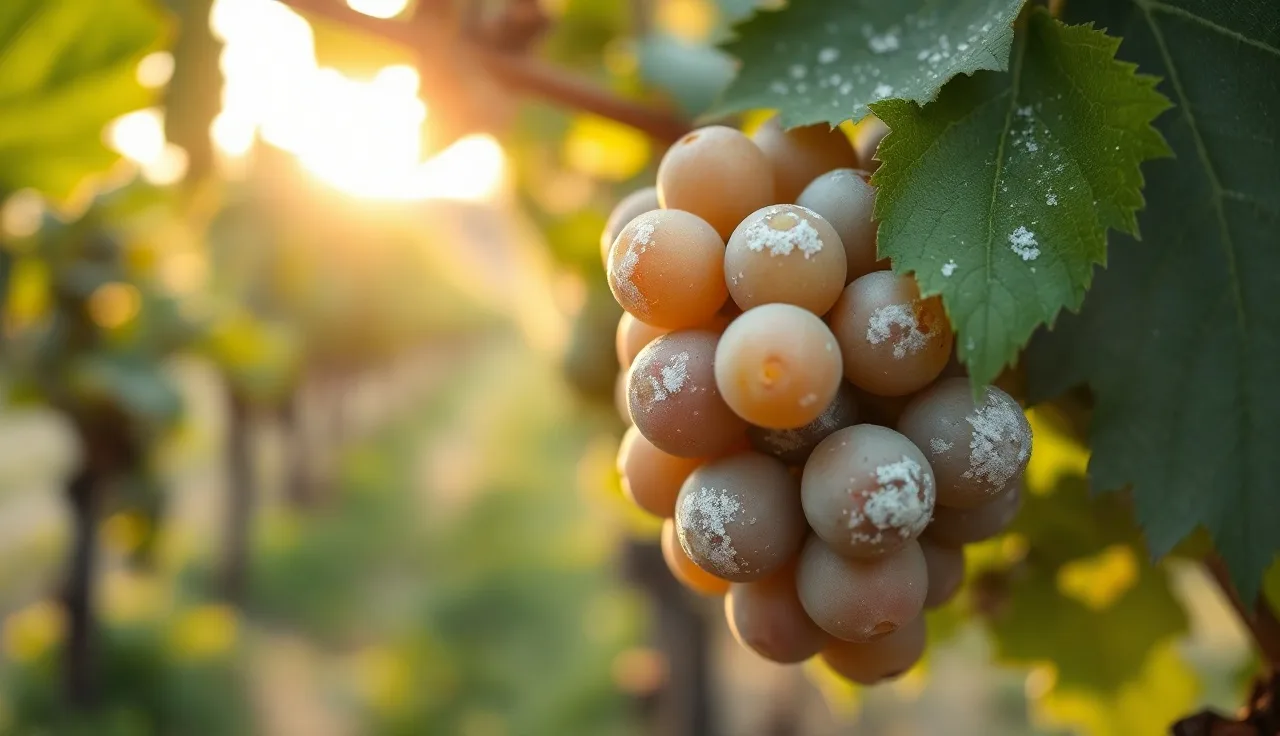
The first thing most people notice is a white to light gray powdery coating on young tissue: shoot tips, the undersides of young leaves, or the surface of a cluster right after bloom. That powder is the fungus itself, a mat of mycelium and chains of asexual spores called conidia. It's not subtle once you know the look. Early in the season, though, plenty of growers write it off as dust or spray residue.
On leaves, look for circular white colonies that start small and then merge. The affected tissue often turns yellow or pale green on the upper leaf surface, while the powder sits mostly on the underside. Heavily infected leaves may curl downward at the edges. Downy mildew is different: it needs free water on the leaf, and it pairs a yellow "oil spot" on the upper side with a downy sporulation below. Powdery mildew does neither. Knowing that distinction saves a lot of misdiagnosis.
On shoots, the white coating is most visible near the tips in early spring. As those shoots mature, infected tissue can turn brown to reddish-purple, and that color shift gets confused with cold injury or a mineral problem. Run your finger across it. If the powder smears, it's powdery mildew. If the surface is clean underneath, look elsewhere.
The single most diagnostic symptom on a bunch grape is the brown netlike pattern on berries, called webbing or netting. The fungus infects the berry skin early, and as the berry expands, the infected epidermal cells fail to stretch with the fruit. You get a brown scar network across the berry surface, often with cracking that opens the pulp to secondary rot. UC Davis IPM guidelines describe berry infection as most damaging when it happens within three to four weeks after bloom. [1]
What are the earliest symptoms of powdery mildew on grapes?
The earliest symptoms show up right after budbreak, sometimes before most growers are scouting for anything. The fungus overwinters two ways: as dormant mycelium inside infected buds, and as closed fruiting bodies called chasmothecia (formerly cleistothecia) on the bark of canes and cordons. Buds carrying internal mycelium push out what growers call flag shoots. That's the symptom that tells you you've got a real problem.
Flag shoots are easy to spot once you've seen one. The whole young shoot looks stunted, the leaves curl and distort, and the entire surface carries a dense white powder. Sometimes the shoot tip looks gray-white, like somebody dusted it with flour. Cornell's grape disease guidance names flag shoots as the primary early-season indicator and recommends pulling and destroying them rather than treating them in place. [2]
Flag shoot incidence swings hard by vineyard history and cultivar. In a block that's been clean for years you might see zero. In a block with chronic pressure you might see five to twenty percent of shoots come up infected, and every one of those is a sporulation source that kicks off the season's epidemic early.
The second early symptom comes from chasmothecia releasing ascospores in spring. That usually happens once temperatures climb above about 50 degrees F and vines are near budbreak or pushing small shoots. You won't see the spores. You'll see new white colonies on the youngest tissue within 7 to 14 days after a rain event that triggers spore release. If your winters are wet and your summers dry, like coastal California, this primary infection cycle matters a lot. WSU Extension notes that chasmothecia on bark surfaces can stay viable for more than one season. [3]
How does powdery mildew progress through the growing season?
The disease moves through four rough phases, and what you see on the vine changes at each one.
Phase 1 runs from budbreak to about 2 to 3 inches of shoot growth. You're looking for flag shoots and early white colonies on very young leaves. Control here sets the tone for the whole season. Miss it and you're playing catch-up all summer.
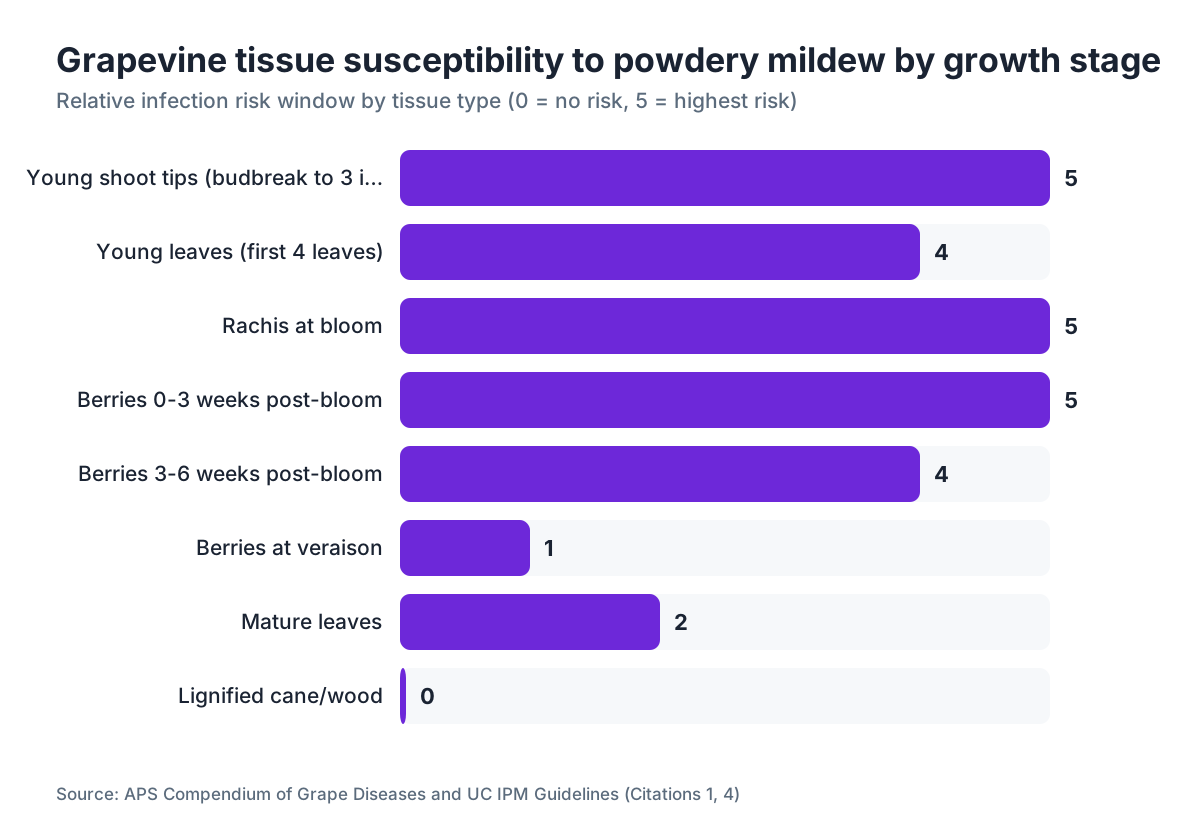
Phase 2 covers shoot elongation through bloom. White colonies expand on leaves and shoots. Rachis infection (the cluster stem) starts here and does real damage, because a mildewed rachis can dry down or abort the entire cluster. Infected rachis tissue turns brown and brittle. Bend it and it snaps instead of flexing. That snap isn't always mildew, but it's a red flag worth checking.
Phase 3 is the six-week window after bloom, when berries are small and their epidermal cells are dividing fast. This is the highest-risk window for berry infection. [1] The APS Compendium of Grape Diseases notes that berries grow more resistant as they mature, with resistance effectively complete once sugar accumulation begins at veraison. [4] But if the fungus gets in early, the damage is already done.
Phase 4 runs from veraison through harvest. Berry surface infection rarely starts new damage this late, but existing infections keep developing. Cracked berries invite Botrytis cinerea and other secondary rots. In wine grapes, even low-level powdery mildew at harvest hits fermentation and wine quality. Research from UC Davis found infected grapes produced wines with off-aromas at infection levels as low as three percent of clusters. [1]
| Growth stage | Primary symptom | Secondary risk |
|---|---|---|
| Budbreak to 2 in. | Flag shoots, white colonies on shoot tips | Initiates season epidemic |
| Shoot elongation to bloom | Leaf colonies, rachis infection | Cluster loss, reduced set |
| 3-6 weeks post-bloom | Berry surface infection, netting begins | Skin cracking, rot entry |
| Veraison to harvest | Cracked berry skin, secondary rot | Wine quality, crop loss |
What causes the white powder, and is it actually dangerous to touch?
The white powder is a mass of conidiophores holding chains of conidia, the asexual spores the fungus uses to spread through the season. Each conidia chain can hold 10 or more spores. Wind carries them to new tissue where they germinate in 4 to 6 hours under favorable conditions and start new infections with no free water on the surface at all. [6] That's why powdery mildew runs hard in dry, warm weather that would shut down most other fungal pathogens.
The spores aren't dangerous to touch for most people. Growers and workers handle infected plant material all the time without protective gear for that reason. The sulfur fungicides used to control the disease are another story. Sulfur and sulfur-based products carry worker protection requirements under the EPA Worker Protection Standard, which requires that applicators and workers entering treated fields follow restricted-entry intervals (REIs) and wear the right personal protective equipment. [5] The plant's disease? Not hazardous. The sprays? Watch them closely.
A common question is whether you can eat powdery mildew-infected grapes from a home garden. Yes, the fungus itself isn't toxic. But the berry quality is poor and cracked berries spoil fast. Don't bother.
Which grapevine parts are most vulnerable to powdery mildew infection?
Young, fast-growing tissue is the most susceptible. The fungus needs living epidermal cells to build a feeding structure called a haustorium, which it pushes into those cells to pull nutrients. Fully lignified tissue and mature berry skin resist penetration.
Clusters are the most economically damaging infection site for wine grapes and table grapes alike. The rachis and pedicels (the individual berry stems) can be infected from bloom through about six weeks post-bloom. Berries stay susceptible from shortly after fruit set through about 50 percent berry diameter expansion, which is a rough visual check you can make in the field without measuring anything.
Leaves matter as sporulation sites more than as direct economic victims. A heavily mildewed canopy pumps out huge numbers of conidia that then land on clusters. Managing leaf mildew matters even when the leaves themselves don't look badly hit.
Roots and mature woody tissue don't get infected. American Vitis species, including V. rotundifolia (muscadine), show much greater resistance than V. vinifera cultivars. Among V. vinifera, Chardonnay, Cabernet Sauvignon, Gewurztraminer, and Riesling rate as highly susceptible. Certain hybrid cultivars like Marquette and Frontenac carry resistance genes from wild Vitis parents. WSU's variety susceptibility tables are one of the more reliable regional references for the Pacific Northwest. [3]
How do temperature and humidity affect powdery mildew symptoms?
Grape powdery mildew thrives in a climate window that's different from most other fungal diseases, and that window explains a lot about where and why symptoms develop the way they do.
Optimal temperature for conidial germination and colony growth is roughly 65 to 77 degrees F (18 to 25 degrees C). The fungus can still infect from about 50 to 95 degrees F, but infection rates drop off sharply above 90 degrees F and below 50 degrees F. A single day above 104 degrees F can kill surface mycelium, which is why vineyards in very hot inland valleys sometimes see the disease slow or stall during heat waves, then resume once things cool. [4]
Here's where people get confused. Powdery mildew doesn't need rain or leaf wetness to spread. It's an obligate biotrophic fungus that actually does better in dry conditions with moderate humidity (40 to 70 percent relative humidity suits it fine). Prolonged rain and bright sun are somewhat suppressive. That's the opposite of downy mildew, which flat-out requires leaf wetness for infection.
Night temperatures are part of the picture too. Cool nights after warm days push conidia germination rates up. The classic powdery mildew region is a Mediterranean climate: warm dry summers with mild nights. Coastal California, Southern Oregon, parts of the Willamette Valley, and much of the Mid-Atlantic all fit. Cornell's IPM program has degree-day infection models built into its disease prediction tools that account for exactly these temperature interactions. [2]
Shade inside dense canopies speeds up disease because it drops light intensity and raises humidity right where clusters hang. That's a structural argument for leaf removal in the fruiting zone, more than an airflow argument.
How do powdery mildew symptoms on grapes differ from other common diseases?
Get the diagnosis right before you commit to any treatment program. Four things get confused with powdery mildew all the time.
Downy mildew (Plasmopara viticola) produces yellow "oil spots" on the upper leaf surface and a white to gray cottony sporulation on the underside in humid conditions. It requires free water for infection and sticks to actively growing tissue. The sporulation is fluffier and more irregular than powdery mildew's smooth powder, and it won't show up in dry weather. Downy mildew doesn't hit berry skin the same way and doesn't make the brown netting.
Botrytis bunch rot (Botrytis cinerea) shows up as gray fuzzy sporulation on berries and rachis, often starting from a wound or crack. The gray is darker and more irregular than powdery mildew white. Botrytis usually starts at or after veraison, while powdery mildew berry damage happens earlier.
Sunburn produces bleached, papery skin on the sun-exposed side of berries, sometimes with a sharp line where shade started. No powder, no netting, no spreading colonies. It's on the outer sun-facing side only.
Spray residue from kaolin or sulfur can coat tissue white, but it dusts off completely, it's uniform instead of in discrete colonies, and there's no sporulation pattern underneath. When you're not sure, seal a sample in a bag with a moist paper towel overnight. Powdery mildew grows fresh sporulation; spray residue won't.
The brown berry netting, when it's there, is essentially diagnostic for powdery mildew in grapes. Nothing else makes that particular russeting-and-crack pattern. The APS compendium lists webbing as a pathognomonic symptom. [4]
What do powdery mildew symptoms mean for yield and wine quality?
Direct yield loss comes from three places: berry drop after early infection, cluster shatter from rachis infection, and berry shrinkage or rot in infected fruit that hangs on the vine. Severe seasons with no spray program can hit 50 to 100 percent crop loss in highly susceptible cultivars in the right climate. That's not an exaggeration. It's documented in unmanaged trial plots.
Wine quality effects show up at levels far below visible crop loss. The threshold for detectable off-aromas in wine is roughly three percent of clusters showing any powdery mildew symptoms at harvest. [1] The off-aromas run to mushroom, earthy, and dusty notes. Fermentation can also stall when mildew-infected fruit brings in high levels of laccase enzyme and other compounds that stress yeast.
Table grapes headed for fresh market are functionally unmarketable with any visible berry symptom. The netted, cracked, or discolored surface fails packinghouse sorting.
Tracking the link between symptom levels at each growth stage and eventual harvest quality is the kind of field record that pays off at season end, especially when you're setting spray timing for next year. Growers who rate symptoms in a structured way often find they were spraying more or less than the actual pressure called for. Tools like VitiScribe keep that structured field record straight across multiple blocks without losing data to a rained-on paper form.
For the vineyard blocks most at risk, a pre-harvest walk with a written severity rating is worth doing every year, even in years that look clean.
How do you scout and rate powdery mildew symptoms in the vineyard?
Scouting for grape powdery mildew takes a structured approach, not a casual walk-through. The disease isn't evenly spread. It concentrates in shaded interior canopy, at row ends near tree lines, and in low frost pockets where cool nights push infection.
For a practical field assessment, UC Davis recommends examining at least 100 shoots or clusters per block per scouting date, drawn from at least 10 locations that cover the block's range of exposure and vine age. [10] You record the percentage of shoots showing any symptom (incidence) and, if you want, a severity estimate (percentage of surface affected) on the positive shoots.
A simple five-point severity scale works in research and holds up in the field:
| Rating | Description |
|---|---|
| 0 | No symptoms |
| 1 | 1-10% of tissue surface affected |
| 2 | 11-25% affected |
| 3 | 26-50% affected |
| 4 | 51-75% affected |
| 5 | >75% affected |
Shoot incidence above five percent at any growth stage between budbreak and three weeks post-bloom should trigger an immediate fungicide response in susceptible cultivars, per Cornell IPM guidance. [2]
Leaf scouting is easiest on young tissue in the upper canopy. Cluster scouting is the priority after bloom. Use a hand lens (10x is plenty) to check young berries for the first signs of colonization: a faint white bloom or early superficial netting that's easy to miss at arm's length.
Record your scout dates, locations, incidence, and severity every single time. That record is your spray decision justification and your input for next year's timing.
What do university extension programs recommend for managing powdery mildew symptoms before they spread?
The three programs most US growers lean on are UC Davis, Cornell University, and Washington State University, and they line up on the core principles even where their specific fungicide picks vary by region and registration.
All three agree: start sprays at or before budbreak in blocks with a disease history, and don't wait for symptoms. By the time you see white powder, the fungus has been growing for a week or more and has already sporulated. Preventive timing is the whole game. Cornell's guidance states that the most critical spray window runs from budbreak through three to four weeks after bloom. [2]
Sulfur is still the workhorse. It's cheap, organic-approved, effective, and has no documented resistance in Erysiphe necator. Rates and intervals matter: sulfur needs reapplying every seven to fourteen days depending on temperature and rain. Above 90 degrees F, sulfur can cause phytotoxicity, especially on Concord and other sensitive cultivars. That same heat sensitivity means it works less well as a contact fungicide right when you need it most in summer.
Sterol inhibitor fungicides (SI, FRAC group 3, including myclobutanil and tebuconazole) are systemic and can run on a 14-day interval in moderate-pressure years. Resistance to SI fungicides has been documented in E. necator populations in California and elsewhere. [8] Rotating FRAC groups to delay resistance is standard practice recommended by all three programs. [1][2][3]
QoI fungicides (strobilurin, FRAC group 11) are effective, but the resistance risk is high with repeated use. Most programs cap QoI use at two applications per season.
The EPA Worker Protection Standard governs how fast workers can re-enter a treated block after applications. REIs vary by product from 4 hours on some formulations to 24 hours for more hazardous materials. [5] Make sure anyone going into the vineyard after a spray knows the REI for whatever was applied, and keep it in your spray records.
Cultural management matters too. Shoot positioning, leaf removal in the fruiting zone, and canopy work to open up air and light all cut disease pressure by changing the microclimate where clusters hang. None of it replaces a fungicide program in high-pressure vineyards, but it genuinely trims the number of sprays you need.
How do you document powdery mildew symptoms for compliance and spray records?
Spray records for pesticide applications are a legal requirement in most US states, not optional. The EPA WPS and state ag departments require records that capture the product, rate, date, location, and REI. [5] In California, the county agricultural commissioner requires a permit for most pesticide applications plus monthly use reporting. [9] Other states vary, but nearly all require written spray records kept for at least two years.
Beyond compliance, scouting records that document symptom severity at each growth stage are the practical foundation for defending your spray program if a question ever comes up from a buyer, a certifier, or an insurance adjuster. "We sprayed because we saw early symptoms on shoots in Block 4 on April 28" is a defensible record. "We spray every two weeks all season" is not.
A good powdery mildew symptom record holds, at minimum: block ID, date, vine growth stage (use the BBCH scale or at least a plain description), tissue scouted (shoots, leaves, clusters), number of samples examined, number positive, estimated severity, and the scout's initials. That's it. It doesn't have to be complicated.
Digital records kill the rained-on-notebook problem and make seasonal summaries easy to pull. VitiScribe was built for this field-to-compliance record chain in vineyard operations, including linking scout observations to spray decisions and application records. Managing more than two or three blocks on paper gets messy fast.
Keep records at least three years even if your state requires only two. Audits and buyer verifications sometimes reach back farther than the legal minimum.
Frequently asked questions
What does powdery mildew on grape leaves look like?
Powdery mildew on grape leaves shows as circular white to gray powdery colonies, usually most visible on the undersides of young leaves. The upper surface of affected leaves often turns pale yellow or bleached in the infected area. Severely affected leaves may curl downward at the margins. The colonies expand and merge as the season goes on. Unlike downy mildew, there are no oil spots and no cottony sporulation in wet weather.
Can powdery mildew on grapes spread to other plants in my garden?
Grape powdery mildew (Erysiphe necator) is host-specific to Vitis species. It won't infect tomatoes, roses, squash, or other garden plants that have their own powdery mildew species. Cross-infection between plant families doesn't happen with these fungi. If you see powdery mildew on nearby vegetables or ornamentals, those come from entirely different Erysiphales species and need separate management.
What is the brown netting or webbing I see on my grape berries?
That brown netting is the most recognizable powdery mildew symptom on berries, and it's essentially diagnostic. The fungus infects young berry skin while the fruit is small, damaging the epidermal cells. As the berry expands, those infected cells can't stretch normally, so they form a brown scarred network across the surface. The APS Compendium of Grape Diseases identifies this webbing pattern as a pathognomonic sign of powdery mildew infection.
When in the season am I most likely to see powdery mildew symptoms on clusters?
Cluster symptoms appear earliest on the rachis and pedicels around bloom. Berry surface infection is most likely and most damaging in the three to six weeks after bloom, when berry skin is still expanding fast. By veraison, berry skin resistance is effectively complete and new infections rarely establish. But early-season infections keep developing through harvest, causing cracking, secondary rot, and wine quality problems.
What are flag shoots and how do I identify them?
Flag shoots emerge from buds that carried dormant powdery mildew mycelium through winter. The entire shoot looks stunted and covered in dense white powder from the tip down. Leaves on flag shoots are often distorted and curled. They appear right after budbreak and are an important early-season symptom that flags a historically infected block. Cornell University recommends removing and destroying flag shoots rather than leaving them as a sporulation source.
Does powdery mildew on grapes need rain to spread?
No. This is one of the most important things to understand about grape powdery mildew. The fungus spreads by airborne conidia that don't require free water on leaf surfaces to germinate. Warm, dry conditions with moderate humidity (40 to 70 percent) actually favor it. Prolonged rain and bright sunlight are somewhat suppressive. That makes it fundamentally different from downy mildew and explains why it's a major problem in dry summer climates like coastal California.
How do I tell powdery mildew apart from downy mildew on grapevines?
Look at where the sporulation appears and under what conditions. Powdery mildew produces a white powder on upper or lower leaf surfaces in dry weather, and it doesn't need wetness to spread. Downy mildew produces oil spots on the upper leaf surface paired with a cottony white sporulation on the underside, but only during or after wet conditions. Berries cracking with brown netting points to powdery mildew. Berries turning brown and mummifying points to downy mildew.
At what percentage of infected clusters does powdery mildew affect wine quality?
Research from UC Davis found detectable off-aromas in wine at infection levels as low as three percent of clusters showing visible powdery mildew symptoms at harvest. Off-aromas include earthy, mushroom, and dusty notes. Fermentation can also run sluggish. This is a low threshold, which is why winemakers are strict about accepting mildew-infected fruit, and why late-season scouting and harvest assessments are worth doing even in years that look mostly clean.
Which grape varieties are most susceptible to powdery mildew?
Vitis vinifera cultivars are generally highly susceptible. Among them, Chardonnay, Cabernet Sauvignon, Riesling, and Gewurztraminer rate as particularly vulnerable. American Vitis species and many hybrid cultivars bred from them carry greater resistance. Cultivars like Marquette, Frontenac, and many interspecific varieties bred for cold climates were developed with disease resistance in mind, including resistance to powdery mildew from wild Vitis parent species.
Is there any powdery mildew symptom specific to the grape rachis?
Yes. Infected rachis tissue (the main cluster stem) and pedicels turn brown and brittle, and the tissue won't flex normally when bent. In severe cases the entire cluster stem dries down and the berries fail to develop or drop. Rachis infection is especially damaging because it can cause complete cluster loss regardless of what happens to the berries. This symptom shows up from bloom through about three weeks after, which is why that's the highest-priority spray window.
What records do I need to keep for powdery mildew spray applications?
Federal EPA Worker Protection Standard requirements and most state pesticide regulations require records including product name, EPA registration number, application date, location, rate, and REI for each application. California requires additional permit and reporting steps through the county agricultural commissioner. Most states require records kept for at least two years. Scouting records documenting the symptom levels that prompted each spray decision aren't legally required but are extremely valuable for audit and certification purposes.
Can I use the same fungicide all season for powdery mildew?
You can, but resistance develops quickly if you do. Erysiphe necator populations resistant to sterol inhibitor (FRAC group 3) fungicides have been documented in California and elsewhere. University extension programs including UC Davis, Cornell, and WSU all recommend rotating between FRAC groups across the season to delay resistance. Sulfur, which shows no documented resistance, is a sound rotation partner and is approved for organic programs.
What temperature kills powdery mildew colonies on grapevines?
A single day above 104 degrees F (40 degrees C) can kill surface mycelium and conidia, causing visible disease setback in the canopy. But the fungus rebounds as soon as temperatures drop back into the favorable range. Temperatures above 90 degrees F slow infection rates a lot. The optimal growth range is roughly 65 to 77 degrees F. The heat suppression is temporary and not a substitute for a spray program in susceptible blocks.
How does canopy management affect powdery mildew symptoms?
Dense canopies create shaded, humid pockets around clusters that favor powdery mildew. Leaf removal in the fruiting zone, shoot thinning, and proper shoot positioning all increase light penetration and airflow, cutting the conditions the fungus prefers. These cultural practices genuinely reduce disease severity in research trials and can trim the number of fungicide applications needed, though they don't replace a spray program in high-pressure vineyards or susceptible cultivars.
Sources
- UC Statewide Integrated Pest Management Program, Grape Powdery Mildew Pest Management Guidelines: Berry infection most damaging within three to four weeks of bloom; wine off-aromas detected at three percent infected clusters at harvest
- Cornell University College of Agriculture and Life Sciences, Grape Powdery Mildew Management guidance: Flag shoots named as primary early-season indicator; most critical spray window is budbreak through three to four weeks after bloom
- Washington State University Extension, Grape Powdery Mildew: Chasmothecia on bark surfaces can remain viable for more than one season; variety disease susceptibility tables for Pacific Northwest
- American Phytopathological Society, Compendium of Grape Diseases, Disorders, and Pests: Berry webbing identified as pathognomonic symptom; berries become resistant at veraison; optimal temperature range 65-77 degrees F
- U.S. Environmental Protection Agency, Agricultural Worker Protection Standard: WPS requires applicators and workers to follow restricted-entry intervals and use appropriate personal protective equipment for pesticide applications
- UC Statewide Integrated Pest Management Program, Erysiphe necator biology and epidemiology: Conidial germination occurs in 4 to 6 hours under favorable conditions without free water on leaf surface
- Cornell University College of Agriculture and Life Sciences, FRAC resistance management guidance for grape powdery mildew: Rotating between FRAC groups recommended to delay resistance in Erysiphe necator populations
- Washington State University Extension, Fungicide resistance in Erysiphe necator: SI fungicide (FRAC group 3) resistance documented in E. necator populations in California and other regions
- California Department of Pesticide Regulation, Pesticide Use Reporting: California requires county agricultural commissioner permit and monthly pesticide use reporting
- UC Statewide Integrated Pest Management Program, scouting thresholds for grape powdery mildew: Minimum 100 shoots or clusters per block recommended for statistically meaningful scouting assessment
Last updated 2026-07-09