Pruning grape vines in Colorado: a complete grower's guide
TL;DR
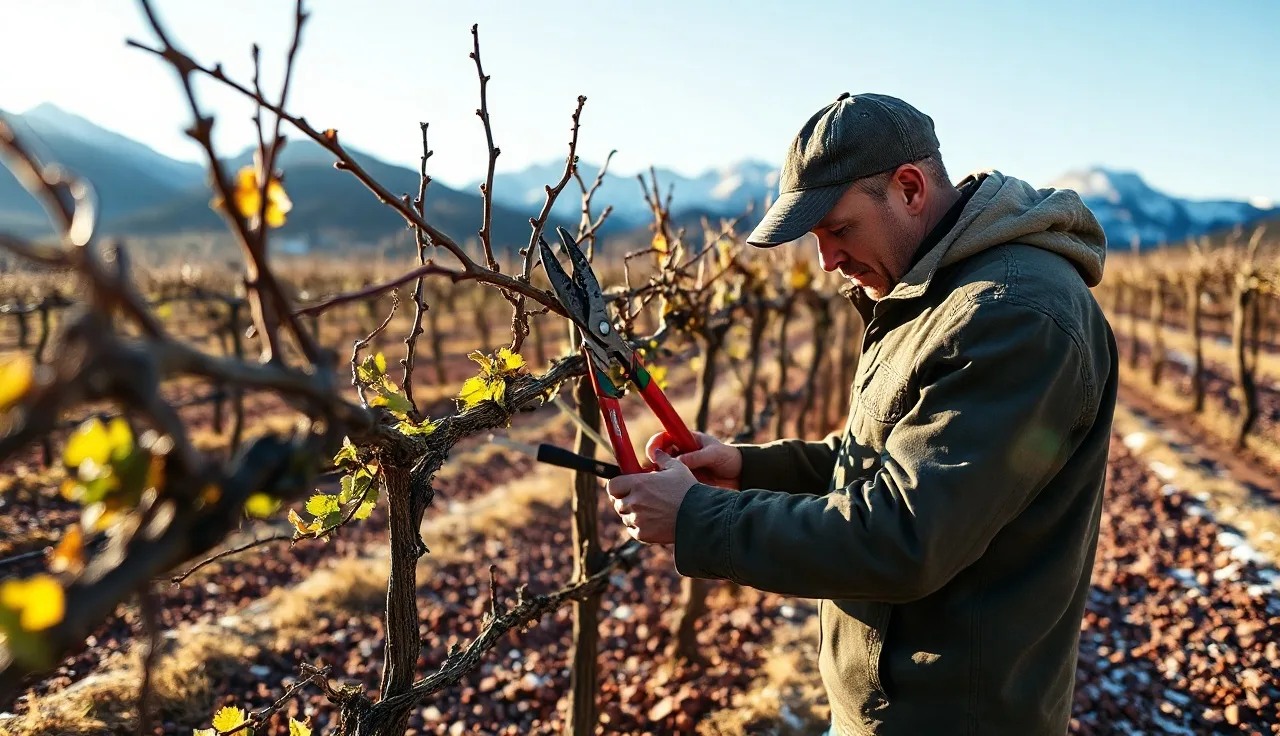
- In Colorado, prune dormant grape vines between late January and late March, and finish before buds swell past the 0.5-inch green tip stage.
- Sites above 6,500 feet should aim for the later end of that window to dodge late frost.
- Spur-prune Marquette, Frontenac, and other cold-hardy varieties; cane-prune Chardonnay and Riesling where the site allows.
- Leave 2 to 4 buds per spur, 8 to 12 buds per retained cane.
Why does pruning grape vines in Colorado require a different approach than other states?
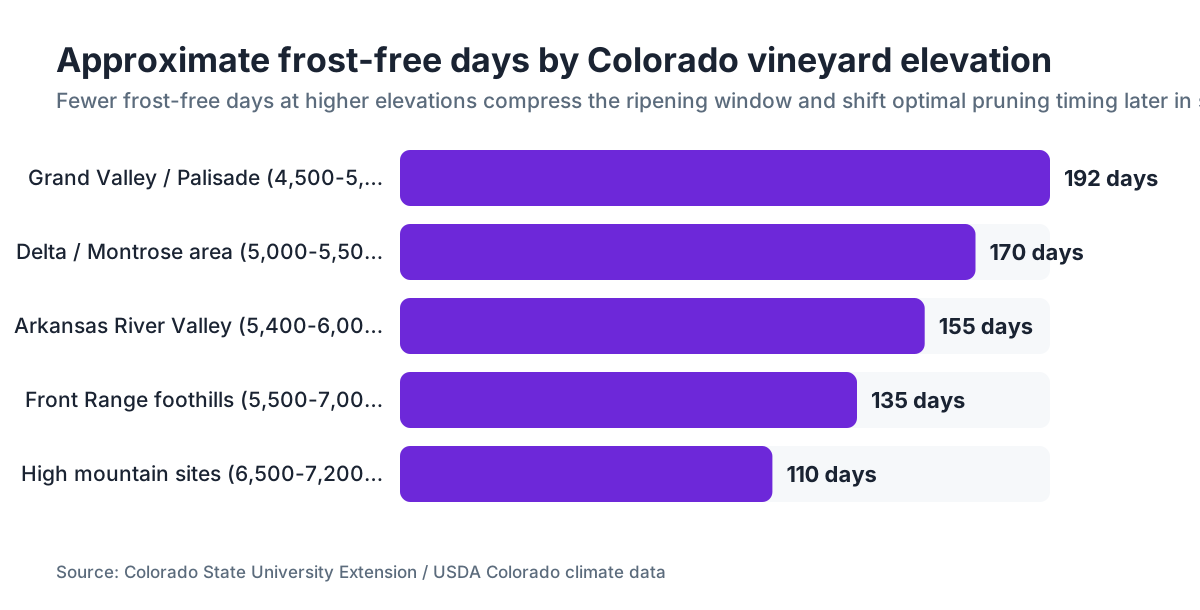
Colorado is not one growing region. It's a patchwork of microclimates sitting between 4,500 and 7,200 feet, crossing five major drainage systems, and subject to temperature swings that would read like instrument error anywhere else. The Grand Valley around Palisade averages about 192 frost-free days, workable for Cabernet Franc and even Cabernet Sauvignon in warm years [1]. The Arkansas River Valley near Canon City runs shorter, around 150 to 170 days. Mountain vineyards above 6,500 feet can take a hard frost in any calendar month.
That variability is the whole game.
Prune too early at a low-elevation Front Range site and you pull the vine toward bud break at exactly the wrong moment, March, when cold air from the Rockies still drains east with enough force to kill green tissue. Prune too late at a warm Grand Valley site and you cost the vine recovery time and invite wood disease. Neither mistake sinks you once. Repeat it across seasons and the yield gaps add up fast.
Colorado State University Extension notes that "late pruning, which delays bud break, is one of the most effective cultural tools for reducing frost damage in Colorado vineyards" [2]. Most California growers never need that advice. Here it's close to a first principle. The state's intense solar radiation, low humidity, and wide diurnal swings also mean cut surfaces dry fast (good for disease resistance) while vines push water and nutrients hard in spring (bad if you've pruned into the wrong bud zone).
Treat Colorado pruning timing as its own decision. Not an adaptation of what the California or Oregon bulletins say.
When is the right time to prune grape vines in Colorado?
The working window is late January through late March, with the target shifting by elevation and variety. Most Colorado growers finish dormant pruning within two to three weeks of their last average hard freeze, which means working backward from frost data for your own site rather than from a date on the wall.
Here's a rough framework:
| Site type | Elevation (approx.) | Target pruning window | Notes |
|---|---|---|---|
| Grand Valley / Palisade | 4,500-5,000 ft | Mid-Feb to mid-March | 192 frost-free days; earliest viable window in state [1] |
| Delta / Montrose | 5,000-5,500 ft | Late Feb to late March | Slightly shorter season; watch March cold air drainage |
| Arkansas River Valley | 5,400-6,000 ft | Early to late March | Hard freezes common into April; push timing late |
| Front Range foothills | 5,500-7,000 ft | Mid-March to early April | Cold air pooling in valleys is the main risk |
| High mountain vineyards | 6,500-7,200 ft | Late March to mid-April | Marginal sites; consider whether vinifera is worth the frost gamble |
The bud itself is a better signal than any calendar. Stop dormant pruning before buds reach the 0.5-inch green tip stage (BBCH scale stage 05 to 07) [3]. Once green tissue shows, a hard frost below 28 degrees F can kill that year's primary bud and cost you the fruit-bearing shoot. Secondary and tertiary buds will still push shoots, but they typically yield 30 to 50 percent less fruit than primaries on most vinifera [4].
One trick worth knowing: if a late frost is forecast after you've already pruned, you can slow bud break by running overhead irrigation that holds bud temperature near 32 degrees F through the event. Not every site has the infrastructure. If yours does, it buys real insurance.
What training systems work best for Colorado vineyards?
Two systems dominate Colorado commercial and serious hobby vineyards: the high-cordon spur-pruned system (sometimes called High Wire) and the Guyot single- or double-cane system. Each has real trade-offs here.
High cordon with spur pruning keeps permanent wood high on the wire, usually 36 to 48 inches, which lifts dormant buds above the worst of the cold air that settles near the ground on still nights. That one fact makes it the most popular system in the Grand Valley [1]. You leave 2 to 4 buds per spur, spaced 6 to 8 inches apart along the cordon. Mechanization is easier, and the system forgives you when you lose a spur or two to cold. The catch: it takes 3 to 4 years to establish a full cordon, and a severe winter event (sustained temperatures below minus 10 degrees F, which Colorado does see) can kill the permanent cordon wood and set you back to retraining.
Cane pruning (Guyot) replaces all above-trunk wood every year. Sounds like more labor, and it is, but a severe winter then costs you one season's canes instead of years of cordon. It's the pick for higher-elevation sites and cold-sensitive vinifera like Chardonnay, Riesling, and Pinot Noir. You select one or two vigorous, pencil-thick canes from the head each year, retain 8 to 12 buds each, and leave a two-bud renewal spur to set up next year's cane [3].
For cold-hardy interspecific varieties like Marquette, Frontenac, and St. Croix, spur pruning is fine. These varieties break late enough that frost risk drops, and they push secondary buds well enough that losing a few primaries doesn't crater your crop the way it does with Cabernet Franc.
One practical note. Whatever system you choose, keep the trunk low enough to bury under soil mounds if you're at an elevation where winter burial makes sense (above about 6,200 feet, or on sites that regularly hit minus 10 degrees F). The mountain winery context matters here. Sites above 7,000 feet may need full vine burial or hilling to survive Colorado winters reliably.
How many buds should you leave when pruning grape vines for fruit production?
Pruning for fruit means matching bud count to what the vine can actually ripen. Too many buds gives you a big canopy and watery, under-ripe fruit. Too few drops yield below what pays the bills. This balancing act is called balanced pruning, and the most common formula is the count-and-weigh method tied to the Ravaz Index [4].
The method is simple. Weigh your pruning brush. For every pound of cane material you cut off, leave 20 to 30 buds (the "1 pound, 20 to 30 buds" rule). A vine that yields 0.5 lb of prunings gets 10 to 15 buds total. A vine that yields 2 lbs gets 40 to 60. The formula self-corrects for vine size and keeps a small vine from carrying a crop it can't finish.
In Colorado's short season, lean toward the low end (closer to 20 buds per pound) for better fruit quality. Target is 2 to 4 tons per acre on most high-elevation sites, and many growers aim at the bottom of that band to hit their sugars before the fall frosts arrive in September and October [1].
For spur-pruned cordons, a working shortcut is 2 buds per spur with spurs every 6 to 8 inches. A 6-foot bilateral cordon might carry 16 to 18 spurs, so 32 to 36 buds per vine. Reasonable for a mid-vigor site. For cane-pruned vines, 8 to 10 buds per cane on two canes gives 16 to 20 count nodes, conservative but right for short-season Colorado.
Pruning after fruit set is a different job entirely. That's green pruning: shoot thinning, leaf removal, and cluster thinning to steer the vine's energy into fewer, better clusters. You pull shoots that carry no fruit (water shoots off the trunk or cordon) and thin clusters to one per shoot in years when frost cut your set and you're concentrating quality in what survived.
What tools do you need and how do you keep them from spreading disease?
Bypass hand pruners (not anvil) and loppers cover most of the job. For older, thicker cordons or trunks, add a folding handsaw. Skip electric shears unless you're working more than 5 acres alone. The weight and cord management slow you down more than the speed helps in most Colorado vineyard layouts.
Sanitation is where small operations cut corners and pay later. Eutypa lata and the Botryosphaeriaceae fungi that cause trunk disease enter almost entirely through pruning wounds [5]. Both are present in Colorado vineyards. Eutypa dieback can kill a cordon arm within 3 to 5 years of infection; Botryosphaeria species cause dead-arm and canker symptoms that cut yield unpredictably.
The practical protocol:
- Dip or spray pruner blades with 10% bleach solution or 70% isopropyl alcohol between vines in infected blocks. Neither is perfect (bleach corrodes tools; alcohol evaporates fast in Colorado's dry air), but both cut transmission enough to matter.
- Apply a wound protectant to cuts larger than 0.5 inches across. UC Davis researchers have tested several products; Topsin-M (thiophanate-methyl) at label rates and commercial sealants carrying Trichoderma species showed statistically significant reductions in Eutypa infection in their trials [5].
- Burn, or chip and remove, large pruning brush instead of leaving it in the row. Eutypa spores release from infected wood during wet weather and ride the wind.
Colorado's low humidity helps here. The wet-winter, rain-on-fresh-cuts spore release that drives Eutypa spread in California is less common on the Western Slope. But an irrigation event right after pruning in early spring recreates the same conditions, so factor that into your timing.
How do cold-hardy varieties change your pruning decisions?
Roughly 35 to 40 percent of Colorado's commercial vineyard acreage is planted to cold-hardy interspecific varieties, with Marquette, Frontenac, St. Croix, and a handful of others from the University of Minnesota breeding program making up most of it [1]. These were selected for survival at USDA hardiness zone 4b and colder, which covers most of Colorado's mountain sites.
The pruning implications are real. Cold-hardy varieties run more vigorous than vinifera, so they need slightly harder pruning to stay balanced. They also break secondary and tertiary buds more readily, which means your exact bud count matters less than it does with Cabernet Franc, where losing primaries to a late frost is a disaster.
Marquette in particular throws vigorous lateral shoots. Spur prune it too lightly, leaving 4 or 5 buds per spur, and you end up with a tangle of laterals that shades the fruiting zone, raises disease pressure, and makes harvest miserable. Two buds per spur, consistent spacing, and hard summer shoot thinning is the better road.
Frontenac grows differently. It sends out long, draping shoots that do better on a higher wire (42 to 48 inches) to keep fruit off the ground. Double-cane Guyot suits Frontenac on sites where the trellis supports it.
St. Croix is the most frost-tolerant of the three and the least interesting for serious wine. It's easy to prune (spur prune, 2 buds, done) and hard to kill, which makes it a fair choice for new growers learning vine management before they take on more demanding varieties.
What are the specific frost risks after pruning and how do you manage them?
The most dangerous setup in Colorado viticulture is an early warm spell in late February or early March that wakes the buds, followed by a sharp return to winter. The Palisade area sees this often: a week of 60-degree days in late February pushes buds to woolly bud or green tip, then a cold front drops nights to 22 to 25 degrees F for two nights running. At green tip, primary bud tissue dies around 27 to 28 degrees F. At half-inch green tip, the threshold rises to about 30 degrees F [3].
Wind machines give real frost protection and show up on larger Grand Valley operations. One machine covers roughly 8 to 12 acres, mixes warmer air aloft with cold air near the surface, and can lift canopy-level temperature 3 to 5 degrees F during a radiation frost. They do nothing against advective frost (wind-driven cold fronts). Colorado springs bring both.
Overhead sprinkler frost protection runs on latent heat. Water freezing releases 80 calories per gram, which holds the ice-water interface at 32 degrees F as long as water keeps flowing. The rule is to run continuously from the moment temperature drops toward the threshold until it climbs back above freezing the next morning. Stop mid-freeze and you can cause more damage than not running at all, because you get ice without the warmth of continued freezing.
Row covers and fabric frost blankets make sense for very small plantings. A single layer of Reemay or similar floating row cover adds 2 to 4 degrees F. Drape it over the cordon wire the evening before a forecast frost, pull it the next morning once temperatures rise. The labor gets steep above a quarter acre.
Keep pruning records, and you should, so log the date of first green tissue, the bud phenology stage at each frost event, and a simple percentage estimate of damage. Three to five seasons of that data draws a real picture of your site's frost risk window. A tool like VitiScribe makes phenology logging fast enough that growers actually do it instead of meaning to.
How do you record and document pruning work for compliance and insurance?
Colorado has no state-mandated pruning record requirement the way it has pesticide application records under Colorado Department of Agriculture rules. Keep thorough pruning records anyway. Three reasons.
Crop insurance is the first. The USDA Risk Management Agency's Whole Farm Revenue Protection and its perennial crop policies both ask for production history and cultural practice records when you file a claim. A vineyard that was pruned badly (too many buds for the vine's capacity, or no documented frost response) can hit claim trouble. RMA requires that insured crops be grown according to "good farming practices," and pruning records are evidence of that [6].
Disease tracking is the second. Find Eutypa symptoms in a block five years from now, and knowing which rows you pruned during a wet week in March (and never sealed) is genuinely useful. That data lives in your pruning log, nowhere else.
Labor compliance is the third. If you employ H-2A or other agricultural workers for pruning, the field activity records tie into your wage and hour paperwork. The EPA Worker Protection Standard also requires employers to keep records of pesticide applications and restricted-entry intervals, so if you're applying wound protectants or dormant sprays during or right after pruning, those records are required [7]. Washington State University Extension publishes a WPS compliance summary that applies just as well to Colorado operators [8].
The simplest pruning log has four fields per block: date, crew size, rows completed, and notes (variety, phenology stage, wound treatment). Paper works. A spreadsheet works better. A system that ties it to your spray records and block maps works best, which is where VitiScribe earns its keep for operations running more than a few acres across multiple blocks.
For any operation selling grapes or wine commercially, hold pruning records at least five years. That covers the window for most crop insurance disputes and most vineyard lease arguments.
What are common pruning mistakes Colorado growers make?
The most common one is pruning on the same calendar date every year no matter the season. A warm El Nino winter can have Colorado vines at swelling bud by mid-February; a cold La Nina year holds dormancy until early April. The calendar doesn't know this. Your eyes do. Read the bud, not the date.
Second mistake: leaving stubs when you remove cordon arms or old spurs. A clean cut back to the base of the arm, flush with the trunk or the next living wood, heals faster and gives disease fungi fewer doors. Stubs left 2 to 3 inches long are open wounds that dry, crack, and turn into Eutypa nurseries.
Over-pruning young vines usually comes from impatience. A vine in its first three years needs leaf area to build root carbohydrate reserves. Cut a young vine back hard to a few buds and you slow establishment. Cornell Cooperative Extension's standard guidance is to let young vines grow relatively freely in years one and two, then impose the final training system in year three [9]. Chasing fruit in year two by leaving more buds just delays when you get a sustainable full crop.
Under-pruning is just as common, especially among hobby growers who hate cutting what they grew. A vine loaded with hundreds of buds gives you a jungle of shoots, poor fruit, high disease pressure through the humid summer monsoon, and drained reserves heading into next dormancy. If you're unsure how hard to cut, the count-and-weigh method is your safety net.
And then there's ignoring trunk renewal. Eutypa and Botryosphaeria are endemic in most established vineyards worldwide. Colorado's dry air slows the spread but doesn't stop it. Every 10 to 15 years a cordon or trunk may need replacing by training up a sucker from below the infection point. Growers who never plan for trunk renewal end up with blocks producing steadily less fruit as the permanent wood dies from the inside out.
How does elevation specifically affect pruning strategy in Colorado?
Every 1,000 feet of elevation in Colorado costs you roughly 3 to 5 frost-free days and drops your average daily temperature about 3.5 degrees F [2]. That feeds straight into variety selection and pruning strategy.
Below 5,500 feet (Grand Valley, Delta, Montrose, lower Arkansas Valley), you have enough season to grow most vinifera with reasonable confidence. Pruning timing tracks the traditional late-February to mid-March window, and cane counts can run slightly higher because the vine has more time to ripen a full crop.
Between 5,500 and 6,500 feet, the Front Range foothills and upper valleys, vinifera turns into a gamble. Lemberger (Blaufrankisch), Zweigelt, and cold-adapted Pinot Noir clones can work. Lean your pruning later (late March into early April) to push bud break past the worst frost window, and plan bud count toward the low end of the balanced range to give a shorter-season vine its best shot at ripening.
Above 6,500 feet, you're growing grapes because you love growing grapes, not because the economics pencil out easily. Cold-hardy varieties are close to mandatory unless you have a south-facing slope with exceptional heat accumulation. Pruning here can push into mid-April. Some growers practice delayed spur release: leave extra buds, then rub off the excess shoots after the last frost date passes, using the vine's dormant bud bank as frost insurance.
Colorado State University Extension's Viticulture program has published elevation-specific growing degree day data for most of the state's established regions, and that data is the most reliable tool for calibrating your local season length before you commit to a pruning date or a bud count strategy [2].
What does good pruning look like across a full Colorado vineyard season?
Dormant pruning is one act in a year-round sequence. Here's how the pieces connect on Colorado's calendar.
January through early March: dormant pruning. Assess winter damage as you cut. Note dead cane tissue (brown pith instead of green) and track which varieties or blocks took the worst hit. That shapes your bud count. If 20 percent of your buds are cold-killed, your normal count leaves you under-cropped, so leave 20 to 25 percent more buds to compensate.
March through April: bud break. Watch phenology stages closely. Frost protection decisions live here. Log first bud break date by variety and block.
May through June: shoot thinning and positioning. Remove duplicate shoots from spurs (keep the best-positioned one, drop the rest), pull water shoots from the trunk, and tuck shoots into the trellis wires. Hobby-grower literature sometimes calls this "pruning grape vines after fruit set," though technically shoot thinning both precedes and follows fruit set.
June through July: flower and fruit set. Thin clusters if the set is heavy. Pull leaves in the fruit zone to move air during the Colorado monsoon (July and August bring real humidity and disease pressure).
August through September: veraison and ripening. Top shoots if vigor runs high. Aim for 14 to 18 leaves per shoot above the top fruit cluster so the fruit gets enough photosynthate.
October: harvest, then post-harvest. Leave enough leaf area after harvest for 3 to 4 weeks of continued photosynthesis to rebuild root carbohydrate reserves before dormancy. Don't prune right after harvest; wait for the first hard freeze and leaf drop.
November through December: true dormancy. High-elevation sites may mound soil around trunks for insulation. Collect cane samples for cold hardiness testing if you have access to a lab that runs differential thermal analysis (CSU Extension has facilitated this for commercial growers in the past [2]).
For the broader vineyard management picture, including spray programs and trellising decisions that interact with pruning, the Colorado Vineyard Notes published by CSU Extension is the most useful single-state resource.
Frequently asked questions
When should I prune grape vines in Colorado?
The general window is late January through late March, but the right date depends on your elevation and variety. Finish before buds reach the 0.5-inch green tip stage (BBCH 05 to 07). Higher-elevation sites, above 6,000 feet, should prune later, aiming for mid-March into early April, to push bud break past the worst spring frost. Use bud phenology as your primary cue, not the calendar.
Can I grow Cabernet Sauvignon in Colorado and how should I prune it?
Cabernet Sauvignon is viable in the Grand Valley (Palisade area) below 5,000 feet with 185-plus frost-free days. Elsewhere in Colorado it's a gamble. Where you do grow it, cane-prune to 8 to 10 buds per cane and prune as late as possible in spring to reduce primary bud loss to late frost. Cabernet's secondary buds are nearly fruitless, so protecting primaries is non-negotiable for any commercial yield.
How many buds should I leave per vine when pruning?
Use balanced pruning: weigh your cane brush and leave 20 to 30 buds per pound of prunings removed. For spur-pruned vines, 2 buds per spur is the standard starting point. In Colorado's short season, lean toward the low end (20 buds per pound), because the vine ripens a smaller crop more completely before October frosts arrive.
What is the difference between spur pruning and cane pruning for Colorado grapes?
Spur pruning keeps permanent cordon wood and cuts back to 2-bud spurs each year. It's simpler and suits cold-hardy varieties like Marquette and Frontenac. Cane pruning removes all above-trunk wood annually, selecting one or two new canes with 8 to 12 buds. Cane pruning is better for cold-sensitive vinifera at marginal sites, because a severe winter costs one season's canes rather than years of cordon development.
How do I protect grape vines from frost after pruning in Colorado?
Wind machines, overhead sprinkler irrigation (run continuously through the freeze), and row covers are the main tools. Once buds pass green tip, damage occurs at 28 to 30 degrees F. If a late frost is forecast after you've pruned, overhead irrigation is the most effective option on sites with that infrastructure. Log all frost events and observed damage by variety and block for insurance documentation and future planning.
Should I use different pruning techniques for high-elevation Colorado vineyards above 6,500 feet?
Yes. At high elevation, cold-hardy varieties are close to essential. Prune later, mid-March through mid-April, to delay bud break past the worst frost risk. Some growers use delayed spur release: leave extra buds at pruning, then rub off the excess shoots after the last hard frost. Consider cane pruning even for cold-hardy varieties so a severe winter doesn't wipe out years of cordon development.
What diseases can spread through pruning cuts and how do I prevent them?
Eutypa lata and Botryosphaeriaceae fungi are the main risks. They enter through pruning wounds and can kill cordon arms within 3 to 5 years of infection. Sanitize pruner blades with 70% isopropyl alcohol or 10% bleach between vines in infected blocks. Apply wound protectants (thiophanate-methyl or Trichoderma-based sealants) to cuts larger than 0.5 inches across. Remove and burn infected pruning brush rather than leaving it in the row.
How do I prune cold-hardy grape varieties like Marquette or Frontenac differently than vinifera?
Marquette and Frontenac run more vigorous than most vinifera, so prune harder: 2 buds per spur, consistent spacing, and summer shoot thinning to control laterals. Both varieties break secondary buds readily, so a late frost hurts less than with vinifera. Frontenac benefits from a higher cordon wire (42 to 48 inches) and works well with double-cane Guyot to manage its long, draping shoot growth.
Do I need to keep pruning records for compliance purposes in Colorado?
Colorado has no state-mandated pruning record law, but USDA crop insurance policies require evidence of good farming practices including cultural records. If you apply wound protectants or dormant sprays during pruning, those pesticide applications fall under EPA Worker Protection Standard recordkeeping. Keep pruning logs with date, block, crew, phenology observations, and treatments applied for at least five years.
What tools do I need to prune a small Colorado vineyard?
Bypass hand pruners handle most cuts. Add loppers for canes thicker than 0.75 inches and a folding handsaw for old cordon wood. Bring a sanitizing solution (70% isopropyl alcohol is practical in Colorado's dry air; bleach corrodes tools faster), a wound sealant for large cuts, and a small scale if you use the count-and-weigh method. Electric shears aren't worth it under 5 acres.
Can I prune grape vines in the fall in Colorado?
Fall pruning, meaning right after harvest, is generally a bad idea. The vine needs 3 to 4 weeks of continued photosynthesis after harvest to rebuild root carbohydrate reserves before dormancy. Wait until after the first hard freeze and natural leaf drop, typically November in most Colorado regions. Early dormant pruning in late November through December is fine at low elevations but raises frost-damage risk at high-elevation sites where January cold still kills cane tissue.
How do I know if my grape vines suffered winter damage and should I adjust my pruning because of it?
Cut a cross-section of a cane. Green pith means living tissue; brown or black pith means dead. Check buds the same way: a healthy primary bud is green inside, a killed one brown. If more than 20 to 25 percent of your primary buds are dead, leave extra buds at pruning to compensate. If primary cane wood is mostly dead, cut back to the nearest healthy spur or retrain from a trunk sucker.
What is balanced pruning and why does it matter in Colorado's short growing season?
Balanced pruning matches bud count to vine capacity, using cane weight as a proxy for vine size. Weigh the brush you remove and leave 20 to 30 buds per pound. In Colorado's short season, overloading a vine with too many buds means it can't ripen all the clusters before October frost. Balanced pruning at the low end of the range, closer to 20 buds per pound, consistently produces better fruit at high-elevation sites.
How does pruning timing affect Colorado grape quality more than yield?
Later pruning delays bud break by a week or more, which cuts primary bud loss to spring frost and gives a cleaner crop set. But very late pruning on warm sites can push harvest so late that October cold arrives before sugars and phenolics finish developing. The sweet spot is late enough to dodge the worst frost, early enough to allow full ripening. Tracking growing degree days from bud break each season, rather than from a fixed date, gives the most accurate ripening forecast.
Sources
- Colorado State University Extension, Colorado Viticulture program: Grand Valley averages approximately 192 frost-free days; cold-hardy varieties make up a significant share of Colorado commercial acreage; high-cordon spur-pruned systems are most common in the Grand Valley
- Colorado State University Extension, Viticulture Notes: Late pruning to delay bud break is one of the most effective cultural tools for reducing frost damage in Colorado vineyards; elevation-specific growing degree day data available for state regions
- Washington State University Extension, Grape Phenology and Frost Protection: BBCH scale stages 05-07 (0.5-inch green tip) used as pruning completion benchmark; cane pruning typically retains 8-12 buds per cane plus a 2-bud renewal spur
- University of California Agriculture and Natural Resources, balanced pruning and Ravaz Index guidance: The count-and-weigh balanced pruning method (20-30 buds per pound of cane prunings); secondary and tertiary buds typically yield 30-50% less fruit than primary buds on vinifera varieties
- University of California Agriculture and Natural Resources, grapevine trunk disease research (Eutypa and Botryosphaeria): Eutypa lata and Botryosphaeriaceae fungi enter through pruning wounds; Topsin-M and Trichoderma-based wound sealants showed statistically significant reductions in Eutypa infection in University of California trials
- USDA Risk Management Agency, Whole Farm Revenue Protection and Perennial Crop policies: Insured crops must be grown according to good farming practices; cultural practice records including pruning support crop insurance claims
- EPA Worker Protection Standard (40 CFR Part 170): WPS requires employers to maintain records of pesticide applications and restricted-entry intervals when wound protectants or dormant sprays are applied during or after pruning
- Washington State University Extension, Worker Protection Standard Compliance Guide: WPS compliance guidance applicable to commercial grape growers including record-keeping requirements for pesticide use during vine management operations
- Cornell College of Agriculture and Life Sciences, viticulture and enology program, training system recommendations: Allow young vines to grow relatively freely in years one and two; begin imposing final training system in year three to allow root carbohydrate reserve development
Last updated 2026-07-09