Pruning grape vines in Arizona: a state guide for vineyard managers
TL;DR
- Most Arizona wine grapes get pruned between late December and late February, and January is the sweet spot across elevations from Willcox (4,200 ft) to Prescott Valley (5,100 ft).
- Spur pruning suits warm-climate reds.
- Cane pruning fits Riesling and cooler sites.
- Wait until vines are fully dormant and night temperatures sit consistently below 32°F.
What makes Arizona vineyard pruning different from other states?
Arizona pruning runs on elevation, not the calendar. The state has three wine regions at very different heights, and that vertical spread drives your whole pruning schedule. Willcox sits around 4,200 feet. Sonoita-Elgin sits around 4,800 to 5,000 feet. Verde Valley and Prescott span roughly 3,300 to 5,500 feet. Elevation compresses the season at the top and stretches it at the bottom.
The real hazard is spring frost after bud push. Arizona gets warm spells in February that tempt early bud burst, and then a hard frost rolls down from the north in late March. That pattern has burned more than a few vineyards that pruned too early. Holding pruning to the first week of February on higher-elevation sites is a defensible strategy, not a sign of laziness.
Arizona also has a summer monsoon. Powdery mildew and bunch rot pressure spike in July and August. That's downstream from pruning, but your canopy decisions in January set how exposed the fruit zone is when the monsoon rains hit. A crowded, poorly-built cordon made during a rushed pruning week costs you in August.
Intense sun, low humidity outside the monsoon, and warm nights in the lower AVA blocks all push growers toward heat-tolerant varieties on adapted training systems. The University of Arizona Cooperative Extension and Washington State University Extension have both documented this reality in their semi-arid viticulture work [1][2].
When should you prune grape vines in Arizona?
The working window for Arizona wine grapes is late December through late February, and January is where most of the actual cutting happens [1]. A few specifics by region:
Willcox AVA, at roughly 4,200 feet, usually gets cold enough by December that vines are fully dormant by Christmas. Pruning from January 5 through February 10 works for most red varieties. Go much earlier and you risk waking up latent growth that a warm December stretch triggered.
Sonoita-Elgin AVA sits higher and colder. Bud push there runs 2 to 3 weeks later than Willcox, so growers can push pruning into the second half of January and early February without losing anything. Fewer late-frost casualties is the payoff.
Verde Valley, especially lower blocks near Cottonwood (around 3,400 feet), is warmer. Those vines can start moving in late February on a warm year, so some growers start pruning in late December to stay ahead of the wood. That's a calculated trade-off, not a best practice.
Table and juice grapes at lower desert elevations (Tucson, Phoenix metro) shift earlier still, but that's a different game from commercial wine production.
The University of Arizona Cooperative Extension advises waiting until vines are truly dormant and night temperatures have been consistently below 32°F before pruning, because fresh cuts on a vine with any active vascular flow are more open to winter wood diseases [1]. January pruning in Arizona lines up cleanly with that guidance.
Spur pruning vs. cane pruning: which is right for Arizona conditions?
This is probably the most consequential decision you make each winter, and Arizona has no universal answer.
Spur pruning (leaving 2-bud spurs on a permanent cordon) is the default for most Rhône and Spanish red varieties in Willcox and Sonoita. Grenache, Tempranillo, Mourvèdre, Syrah, and Malbec are all reasonable spur candidates. Spur pruning is faster, easier to train a crew on, and the permanent cordon gives you a strong perennial structure that holds up in Arizona's wind events.
Cane pruning (removing the entire fruiting cane each year and leaving a fresh cane picked from last year's growth) is better for varieties where basal nodes carry few fruitful buds. Riesling is the textbook case. Chardonnay often does better cane-pruned, and some growers in cooler Arizona blocks cane-prune Viognier with good results. Spur-prune a low-basal-fruitfulness variety and you get a pretty cordon and a light crop.
Crew skill decides the outcome more than the theory in most small Arizona operations. A clean spur-pruned vine beats a cane-pruned vine butchered by untrained labor every time. Cornell's viticulture extension makes the point directly: the right system is the one your team can execute the same way every row [3].
One Arizona-specific wrinkle is heat. In Willcox's warmest blocks, fruit zone exposure matters. Cane pruning with a slightly higher wire and some leaf retention on the east side of the canopy can moderate afternoon heat load on clusters. That's a site-specific call, not a statewide rule.
How many buds should you leave per vine in Arizona?
Bud load is where growers get into trouble. Too many buds and the vine can't ripen its crop in Arizona's short season. Too few and you throw away tonnage on varieties that could carry more.
A common starting point for spur-pruned vines in Willcox is 40 to 60 buds per vine on established vines with trunk diameters above 2 inches. Younger vines (year 3 to 5) should sit closer to 20 to 35 buds while the root system builds out. These are rough norms, not hard rules.
The 30-bud rule is a useful anchor: prune to about 30 buds for a balanced vine in years 3 to 4, then adjust for vigor by weighing the cane wood you removed last year. This is the Ravaz Index idea, adapted for the field. Nobody in Arizona runs formal Ravaz math on every block, but the concept behind it (match bud load to vine vigor) holds up [3].
The fastest field check is shoot length from last season. Six-foot canes tell you the vine had more resources than it needed to ripen. Weak, under-8-inch shoots tell you it was overcropped or stressed. Aim for average internode spacing that reads healthy but not rank across most Arizona sites.
Soil matters here too. The high-elevation volcanic and limestone soils around Willcox tend to run low-vigor, which means you may land on a lower bud count than you'd use on a loam-heavy California coastal site.
What training systems work best for Arizona vineyards?
Vertical shoot positioning (VSP) is the default across Arizona, paired with a bilateral cordon for spur pruning or a replacement cane system for cane pruning. VSP wins because contract labor already understands it, standard trellis hardware fits it, and the local equipment supply chain can service the canopy it makes.
High-wire cordon (sometimes called sprawl, or Geneva Double Curtain in its divided form) shows up on more vigorous sites and on some warm Willcox blocks where growers want to shade the fruit zone. The cost is harder spray penetration in the denser canopy.
Head training (own-rooted vines grown as free-standing goblet or bush vines) is uncommon in Arizona but not unheard of, mostly on old-vine Zinfandel and a handful of heritage Grenache blocks. Head-trained vines handle drought well by design. They also resist mechanization and demand very skilled hand pruning. Don't start new blocks in head training unless you have a long-term skilled labor plan.
One system getting more attention here is the divided canopy (Scott Henry or Smart-Dyson). Some Verde Valley growers use it on vigorous, deep-soil sites to tame excess shoot growth. It costs more labor at pruning but can meaningfully open up the fruit zone on problem blocks.
WSU's viticulture research program has deep documentation on VSP and canopy management in semi-arid climates, and those publications translate reasonably well to Arizona's higher-elevation conditions [2].
How does Arizona's elevation and climate affect bud burst timing after pruning?
Bud burst in Arizona wine country runs from late February at lower Verde Valley elevations to mid-March in Sonoita-Elgin and Willcox. At Willcox's 4,200 feet, the average last frost date lands somewhere in the April 15 to April 30 range depending on the block, which means the gap between bud burst and last frost is a live risk every single year [4].
Here's the core tension. Prune January 15, get a warm run, and you might have half-inch green tips by February 20. A frost on March 28 at that stage can wipe out a crop. The most exposed varieties are Chardonnay, Sauvignon Blanc, and early-budding reds like Merlot and Pinot Noir (rarely planted in Arizona anyway).
Some growers use delayed pruning on frost-sensitive varieties. You leave the vine unpruned through January, then start spur or cane selection around February 10 to 15. The idea is that apical dominance in the long, unpruned shoots holds back the basal buds and pushes bud burst later. The effect is real but modest, roughly 5 to 10 days in most studies.
Vineyards with frost protection (wind machines, overhead micro-irrigation) can skip the worry and prune on the standard January schedule. Dryland vineyards at elevation with no protection should treat delayed pruning as a real risk-management tool.
NOAA's Climate Data Online is where you pull your own station's frost probability curves before you commit to a pruning calendar [4].
What tools and equipment do you need for pruning in Arizona vineyards?
The basics are the same everywhere: bypass hand pruners, loppers for older wood, and a pruning saw for trunk work. The Arizona wrinkle is grit. Willcox and Sonoita are high desert. Blowing dust dulls blade edges faster than in coastal California or Oregon, so budget for more frequent sharpening and blade replacement than you'd expect.
For crews of four or more, powered pruning shears earn their keep. Infaco Electrocoup (electric) and pneumatic systems are the two setups you see most in Arizona vineyards. A powered shear lets a skilled pruner move well faster than hand shears alone, and it cuts down the repetitive-motion strain that adds up over a 6-week pruning season.
Sanitation matters. Eutypa lata (Eutypa dieback) and Botryosphaeria species are both present in Arizona vineyards, and cutting through infected trunk wood without disinfecting your blades is how you spread trunk disease through a block. Standard practice is a dilute bleach solution (1 part bleach to 9 parts water) or a commercial disinfectant between vines or rows. At scale this is tedious. It just is. Some operations compromise by sanitizing between rows instead of between every vine, which still cuts real risk even if it's not textbook protocol.
Wound sealants (Topsin paste or a dilute Bordeaux paste) are common on large pruning cuts in California and Oregon, and several Arizona wineries have picked up the habit. The efficacy data is mixed but leans positive for cuts above 1 cm in diameter [3].
Worker protection and recordkeeping requirements for Arizona pruning operations
Pruning itself triggers no pesticide requirements, but the weeks around it usually involve dormant sprays (lime-sulfur, copper, oil), and those fall under the EPA Worker Protection Standard (WPS) if you have agricultural workers on site [5].
Under WPS you must post pesticide application information in a central spot workers can reach, provide annual pesticide safety training for all agricultural workers, and keep application records covering the product, EPA registration number, application date, location, rate, and restricted-entry interval [5]. EPA's WPS guidance states that these records must be kept for at least two years. The Arizona Department of Agriculture enforces WPS at the state level, and its inspectors look at application records during early-season vineyard work [6].
For Arizona commercial vineyards, Arizona Revised Statutes Title 3, Chapter 2 governs pesticide use regulation, and anyone applying restricted-use pesticides must hold a valid Arizona pesticide applicator license [6].
Keeping clean records of what you applied around pruning, and when workers re-entered treated blocks, is not optional. It's also not hard once it's a habit. A field notebook works. A digital log works better when you need to pull records for an audit or a crop insurance claim.
This is where a tool like VitiScribe saves real time: logging dormant sprays, restricted-entry intervals, and worker training dates in one record you can export for an ADA or EPA audit beats hunting through paper binders in August [7].
Field sanitation practices (blade disinfection, tool handling, disposal of diseased cane material) also fall under general agricultural worker safety rules in OSHA 29 CFR 1928, the agricultural standard [8].
How do you handle pruning wound diseases common in Arizona?
Trunk diseases are the slow-motion emergency in Arizona wine country. Eutypa dieback, Botryosphaeria dieback, and Esca are all documented in the state. Hot, dry summers followed by wet monsoon conditions build a disease complex that differs from California's coastal Eutypa problem but does just as much damage.
The infection window is the concept that matters. Fresh pruning cuts stay open to Eutypa lata spore infection for roughly 2 to 4 weeks, and spore dispersal happens mostly during wet weather [3]. Arizona's January-February pruning season is generally dry, which is an advantage. Eutypa spore load peaks during rain, and you get far fewer rain events in a high-desert January than in Napa or Santa Barbara.
Don't get complacent, though. Limestone-heavy soils in Willcox and the Verde Valley drain well up top but hold moisture in lower horizons, and there's enough winter precipitation at elevation to keep spore populations alive. Aridity doesn't give you a free pass.
Mitigation is straightforward. Cuts larger than about half an inch should get a wound sealant. Some Arizona growers also apply a fungicide paste (Topsin-M in its paste formulation shows up often in UC Davis trunk disease protocols) right after large cuts [3][9]. That's most justified on retraining cuts or old-cordon removal, not routine spur selection.
Cane disposal matters. Infected pruning wood left on the row middles is a spore reservoir. Burning (where county rules allow) or chipping and composting infected material both beat letting it sit. Check Maricopa County Air Quality and your local county rules before burning, because regulations vary.
What are the most common pruning mistakes Arizona growers make?
Pruning too early is the most expensive mistake. The February warm spell is seductive. Bud swell starts, the crew is available, and you want to get ahead. But early-pruned vines in Willcox and Sonoita have taken hard hits from late-March frosts more than once. Hold to mid-January at the earliest on high-elevation sites.
Leaving too many spurs on young vines is the second big error. Growers coming from California coastal viticulture sometimes bring load targets that are too high for Arizona's shorter season and lower base vigor at elevation. A Tempranillo vine in its fourth year on Willcox clay-loam does not need 50 buds.
Poor spur placement is chronic in blocks that have cycled through rotating crews or inconsistent management. Spurs pointing inward, downward, or toward the middle of the wire create canopy crowding that compounds year over year. Every pruning season is a chance to fix spur angle, and 20 extra seconds per spur to get the geometry right pays back.
Missing early trunk disease is another pattern. A yellow, stunted shoot cluster at one spur position is early trunk disease waving at you. Most crews prune right past it. Train yourself and your workers to flag those vines for a closer look instead of cutting them on the standard pass.
Not recording what you did is the quiet killer. Pruning records (date, block, bud count, any trunk work, dormant spray applied) are the baseline data you need to diagnose yield swings, plan next year, and satisfy WPS recordkeeping. Paper or digital, keep them.
How do pruning practices differ across Arizona's main wine regions?
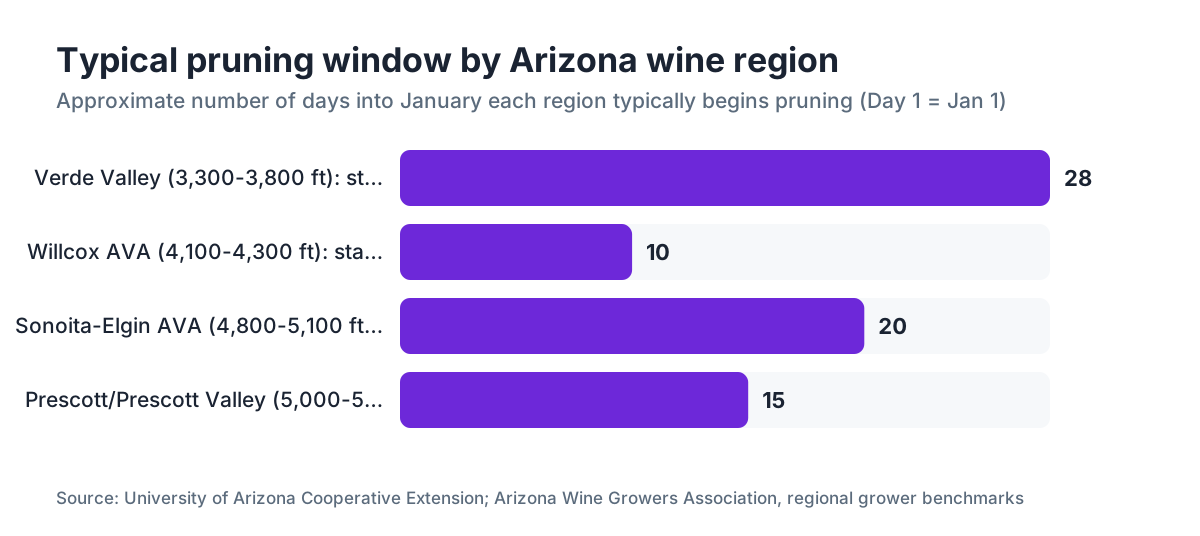
| Region | Elevation (ft) | Typical Pruning Window | Common System | Key Risk |
|---|---|---|---|---|
| Willcox AVA | 4,100-4,300 | Jan 10 - Feb 10 | VSP spur, bilateral cordon | Late frost after early bud push |
| Sonoita-Elgin AVA | 4,800-5,100 | Jan 20 - Feb 15 | VSP spur or cane | Spring frost, lower vigor |
| Verde Valley AVA | 3,300-3,800 | Dec 28 - Feb 1 | VSP spur, some high-wire | Wind events, warmer early season |
| Prescott/Prescott Valley | 5,000-5,500 | Jan 15 - Feb 20 | VSP cane, some spur | Short season, higher frost risk |
Willcox has the most planted acreage and the most settled pruning norms. Most of what gets written about Arizona viticulture is really about Willcox. Sonoita-Elgin's cooler, windier conditions favor slightly later pruning and cane-pruning of whites. Verde Valley is warmer and can get ahead of itself in a mild winter, which nudges some growers to start earlier than they'd like.
Prescott and Prescott Valley are the newest at commercial scale. Above 5,000 feet, the season is short enough that growers are still testing training systems and pruning dates. There's no long-term local data set for Prescott the way there is for Willcox.
Across every region, the Arizona Wine Growers Association is the primary industry group tracking regional data, and its member resources are a reasonable place to start for current benchmarks [10]. The federal TTB maintains the official AVA boundaries and petition data for Willcox, Sonoita, and Verde Valley if you need the formal geography [11].
Resources for Arizona vineyard pruning guidance
Start with your own extension office. The University of Arizona Cooperative Extension's Yavapai County program has produced the most locally relevant viticulture material for the Verde Valley and Prescott regions, and its publications run through the UA Extension portal [1]. They cover site selection, training systems, and dormant-season management for Arizona-adapted varieties.
WSU's extension viticulture program is the strongest English-language research resource for semi-arid viticulture in the western U.S. Its canopy management and pruning publications carry over well to Arizona's higher-elevation AVAs, and WSU's research work on heat-stress management and bud fruitfulness applies directly to Willcox conditions [2].
Cornell's viticulture extension at the New York State Agricultural Experiment Station has deep material on cane vs. spur decisions, bud fruitfulness by variety, and trunk disease wound management that is variety-specific and immediately usable [3].
UC Davis Viticulture and Enology keeps detailed trunk disease management protocols that are the closest thing the industry has to a standard reference for Eutypa and Botryosphaeria wound care [9].
For compliance around dormant-season pesticide applications, EPA's Worker Protection Standard pages are the authoritative federal source [5], and the Arizona Department of Agriculture's Pesticide Compliance program handles state-level enforcement questions [6].
Managing multiple blocks and tracking dormant spray records alongside pruning data is exactly the workflow VitiScribe's vineyard operations log handles, with WPS-friendly export built in [7].
For regional benchmarking on yields and bud loads, Arizona Wine Growers Association survey data is the most locally grounded source available to members [10].
Frequently asked questions
When is the best time to prune grape vines in Arizona?
Mid-January through early February is the optimal window for most Arizona wine grape AVAs. Willcox growers typically prune January 10 to February 10. Sonoita-Elgin and Prescott sites run a week or two later thanks to higher elevation and greater late-frost risk. Pruning before January risks waking bud activity that a late-February or March frost can kill. Wait until the vine is fully dormant.
Can you prune grape vines in January in Arizona?
Yes, January is the sweet spot for most Arizona wine regions. Vines are fully dormant by then, temperatures are reliably cold at elevation, and you get ahead of any early bud push a February warm spell can trigger. January pruning in Willcox, Sonoita, and Verde Valley is standard practice. Higher sites like Prescott sometimes stretch into February to cut frost exposure after pruning.
What is the biggest frost risk for Arizona vineyards after pruning?
Late-spring frost in March and April after bud push is the primary risk. Willcox's average last frost falls in the April 15 to April 30 range, so bud burst (which can start in late February on a warm year) overlaps with hard frost events. Pruning too early speeds bud push. Delayed pruning, frost protection equipment, and cold-tolerant varieties all reduce exposure. No technique eliminates it entirely at high-desert elevations.
How many buds should I leave when pruning Arizona wine grapes?
A common starting point is 40 to 60 buds per established vine for spur-pruned reds in Willcox. Young vines in years 3 to 5 should carry 20 to 35 buds while the root system develops. Adjust to prior-season vigor: if average shoots ran under 8 inches, cut bud load; if canes hit 6 feet, you may be under-loading. Soil type and irrigation both shift these numbers.
Is spur pruning or cane pruning better for Arizona conditions?
Spur pruning suits most heat-adapted reds in Willcox and Sonoita: Tempranillo, Grenache, Syrah, and Mourvèdre all have enough basal bud fruitfulness for it. Cane pruning is better for Riesling, Chardonnay, and some Viognier blocks where basal nodes carry fewer fruitful buds. If crew skill is limited, spur pruning is more forgiving. Cane pruning on varieties that need it beats spur pruning regardless of skill level.
How do I prevent trunk diseases when pruning Arizona vineyards?
Sanitize cutting tools between vines or rows with a 10% bleach solution or commercial disinfectant. Apply wound sealant (Topsin paste or a dilute Bordeaux paste) to cuts larger than half an inch across. Dispose of infected cane material by burning or chipping rather than leaving it on the vineyard floor. January pruning in Arizona's dry winter lines up with low Eutypa spore dispersal, a natural advantage over wetter pruning seasons elsewhere.
What are the pesticide recordkeeping rules for dormant sprays applied around pruning time in Arizona?
Dormant sprays (lime-sulfur, copper, oil) fall under EPA Worker Protection Standard rules. You must record the product name, EPA registration number, application date, treated location, application rate, and restricted-entry interval. Records must be accessible to workers and kept for at least two years. The Arizona Department of Agriculture enforces WPS at the state level. Restricted-use pesticide applications require a valid Arizona applicator license.
Do I need a pesticide applicator license to apply dormant sprays in Arizona vineyards?
Yes, if the dormant spray is classified as a restricted-use pesticide (RUP). Arizona Revised Statutes Title 3, Chapter 2 requires a valid Arizona pesticide applicator license for RUP applications. General-use products like dilute copper or mineral oil sprays may be applied without a license, but all applications near workers still fall under WPS training and posting rules. Contact the Arizona Department of Agriculture for current license categories.
How does elevation affect pruning timing in Arizona?
Higher elevation means later bud burst and a longer dormancy window, which gives you more room to prune late and cut late-frost risk. Willcox at 4,200 feet can prune in January. Prescott at 5,200 feet can reasonably push to early February. Lower Verde Valley blocks at 3,400 feet may need to start in late December to stay ahead of early bud push in warm years. Pull site-specific NOAA frost data to anchor your final calendar.
What training systems are most common in Arizona wine country?
Vertical shoot positioning (VSP) with a bilateral cordon on spur-pruned blocks is the most common system across Willcox, Sonoita, and Verde Valley. High-wire cordon shows up on more vigorous, deeper-soil sites. Divided canopy systems like Scott Henry appear on some high-vigor Verde Valley blocks. Head-trained (goblet) vines exist in a few older plantings but stay rare in newer developments because they resist mechanization.
How long does pruning take per acre in an Arizona vineyard?
Hand-pruning VSP-trained vineyards typically runs 25 to 50 hours per acre depending on vine spacing, trellis type, bud load targets, and crew skill. Dense spacing (4x8 or 5x8 feet) and older, complex cordons push toward the high end. Powered shears can cut labor time 30 to 40 percent versus hand shears on a seasoned crew. A typical 6 to 8 acre small commercial block runs roughly 200 to 400 total crew hours per pruning season.
What varieties are most commonly grown and pruned in Arizona?
Tempranillo, Malbec, Grenache, Syrah, and Mourvèdre are the dominant reds across Willcox and Sonoita-Elgin. Viognier and Riesling lead the whites at higher-elevation sites. Sangiovese and Cabernet Sauvignon grow in smaller quantities. Most of these do well with spur pruning. Riesling and Viognier benefit from cane pruning because of lower basal bud fruitfulness. Arizona Wine Growers Association surveys track planted acreage by variety for the state.
Should I use wound sealants after pruning in Arizona?
For cuts larger than about half an inch (roughly 1 cm) across, yes. UC Davis trunk disease research leans positive on wound protectants for large cuts, though the data is mixed and no sealant is a complete fix on its own. Tool sanitation and proper cane disposal matter more than sealant for routine spur selection. Topsin-M paste and dilute Bordeaux paste are the products most referenced in published extension protocols.
Where can I find pruning guidelines specific to the Willcox AVA?
The University of Arizona Cooperative Extension is the primary source for locally adapted viticulture guidance. The Arizona Wine Growers Association keeps member resources and annual survey data for the Willcox AVA specifically. WSU's viticulture extension publications, though not Arizona-specific, carry over well to semi-arid high-elevation conditions. There's no single published Willcox pruning manual, but UA Extension publications and local grower networks fill most practical gaps.
Sources
- University of Arizona Cooperative Extension, Viticulture publications: University of Arizona Cooperative Extension guidance on grape vine dormancy, pruning timing, and variety adaptation for Arizona conditions
- Washington State University Extension, Viticulture and Enology: WSU viticulture extension documentation on canopy management, training systems, and semi-arid vineyard management applicable to Arizona high-elevation sites
- Cornell University, College of Agriculture and Life Sciences, Viticulture and Enology Extension: Cornell extension materials on cane vs. spur pruning, bud fruitfulness by variety, Ravaz Index bud load principles, and trunk disease wound management protocols
- NOAA National Centers for Environmental Information, Climate Data Online: NOAA Climate Data Online frost probability data for Arizona stations; Willcox average last frost date April 15 to April 30
- U.S. EPA, Agricultural Worker Protection Standard: EPA WPS requirements for application records including product, EPA registration number, application date, location, rate, and restricted-entry interval, kept for at least two years
- Arizona Department of Agriculture: Arizona Department of Agriculture enforcement of WPS compliance and restricted-use pesticide applicator licensing under Arizona Revised Statutes Title 3 Chapter 2
- VitiScribe, Vineyard Operations and Compliance Platform: VitiScribe vineyard operations log with WPS-compliant pesticide record export for dormant spray tracking alongside pruning data
- U.S. Department of Labor OSHA, Agricultural Operations Safety Standards, 29 CFR 1928: OSHA 29 CFR 1928 agricultural worker safety standards covering field sanitation and tool handling in vineyard operations
- UC Davis Viticulture and Enology: UC Davis trunk disease management protocols for Eutypa lata and Botryosphaeria, including wound sealant application guidance and Topsin-M paste formulations for pruning cuts above 1 cm diameter
- Alcohol and Tobacco Tax and Trade Bureau (TTB): TTB approved American Viticultural Area boundaries and elevation data for Willcox, Sonoita, and Verde Valley viticultural areas in Arizona
Last updated 2026-07-09