Pruning grape vines in NC: timing, systems, and what actually works
TL;DR
- In North Carolina, prune dormant grape vines between late January and early March, before buds swell past the silver-tip stage.
- Muscadines need spur pruning.
- Most bunch grapes do best with cane pruning.
- Leave 2 to 4 buds per spur, or 8 to 12 buds per retained cane, as a starting point.
- Vine size and training system set the final number.
When should you prune grape vines in North Carolina?
Late January through early March. That's the target for most of the state, with the exact window set by your region and variety. North Carolina runs three viticultural zones, from the Blue Ridge Mountains in the west through the Piedmont and down to the coastal plain, and they don't reach dormancy or break it on the same schedule. Mountain vineyards around Wilkes and Surry counties can stay safely dormant through mid-March in cold years. Coastal plain sites near the Virginia border may see bud swell start in late February.
Watch the vines, not the calendar. Prune after the vine has fully hardened off from fall, meaning after at least 200 to 300 hours below 45 degrees Fahrenheit, but before buds reach the "silver tip" stage where you can see the first green tissue. Once you're past silver tip, mechanical damage to swelling buds becomes a real problem, and you lose your best window to spot winter-killed wood [1].
Delayed pruning, sometimes called "late pruning" or "bleeding pruning," is a legitimate frost-avoidance tactic on sites prone to late spring freezes. NC State Extension work on western NC vineyards shows that delaying pruning by two to four weeks can push full bloom back by seven to ten days. That matters enormously if you're sitting at 2,800 feet and your last frost date is May 10 [1]. The tradeoff is labor scheduling. You have less flexibility when everyone wants to prune at once.
For muscadines, which dominate the eastern and Piedmont regions, the timing is essentially the same. But muscadines bleed sap heavily when cut during active sap flow in late spring. Pruning a muscadine in April feels like cutting a garden hose. It won't kill the vine, but it's unpleasant and the wounds are slower to callus.
What are the main pruning systems used in NC vineyards?
Two systems dominate: cane pruning and spur pruning. Which one you use depends on the variety, the trellis, and honestly, how much patience you have for training.
Cane pruning means you remove almost all of last year's wood and select one or two vigorous canes (the ones with internodes in the 3-to-5-inch range, brown bark, pencil-thick diameter) to become the fruiting wood for the coming season. You tie these canes to the trellis wire and cut each one back to 8 to 12 buds. This is the preferred system for Vitis vinifera varieties like Chardonnay, Cabernet Franc, and Viognier, and for French-American hybrids like Chambourcin, Vidal Blanc, and Norton. Cane pruning gives you more control over bud count per vine and tends to produce better fruit quality when done right [2].
Spur pruning means you leave short stubs (spurs) of last year's growth, each cut back to 2 to 4 buds, spaced 6 to 8 inches apart along a permanent cordon arm. Muscadines are almost universally spur-pruned in the Southeast because their fruiting habit suits it. Concord and other Labrusca types also do fine on spur systems. The advantage is speed. A practiced crew member spur-prunes far faster than they cane-prune.
A third system worth knowing in NC is the High Cordon or "Scott Henry" variation, which splits the canopy vertically to improve light penetration in the humid Piedmont. It's common at larger operations in the Yadkin Valley AVA. The pruning mechanics are essentially spur-based, but the geometry changes how you manage shoot positioning all season.
For newer growers asking about pruning Thompson Seedless grape vines, the same cane-pruning principles apply. Select two to four canes per vine, cut to 8 to 15 buds depending on vine vigor, and keep one or two short renewal spurs near the head to give you good cane options next year. Thompson Seedless is not a common commercial choice in NC because it needs a longer, hotter growing season than most NC sites provide. Home growers on the coastal plain still grow it.
How many buds should you leave per vine in NC?
This is where most new growers make the biggest mistake. They leave too many buds because the vine looks sparse after a hard cut, and they panic. Overcropped vines never fully ripen fruit in NC's humid, often-overcast season.
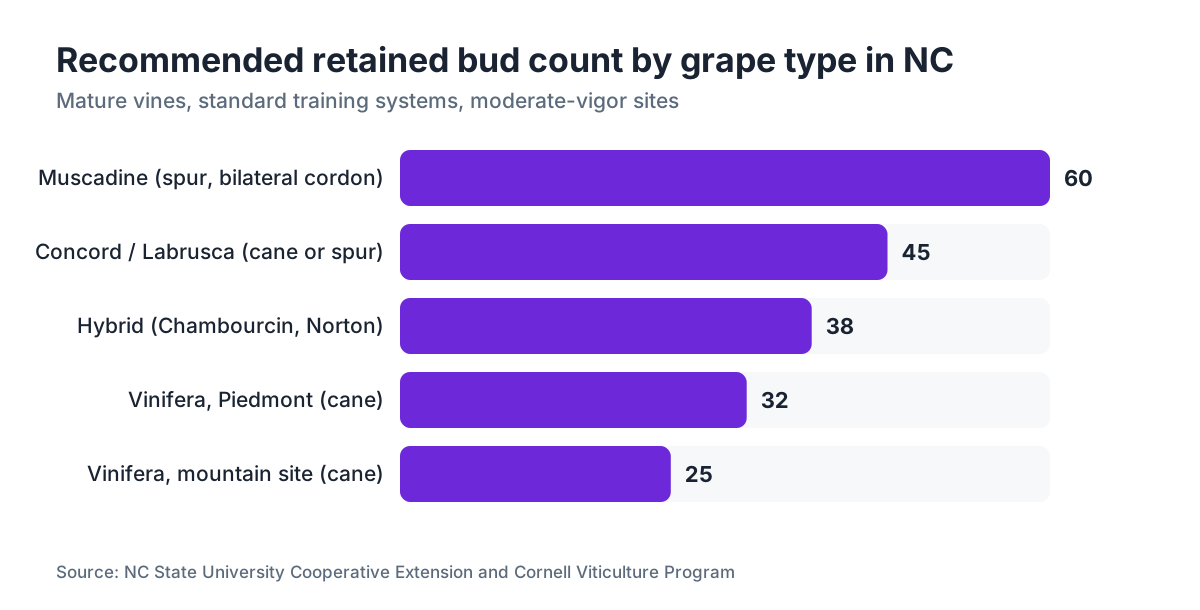
The standard starting framework is "balanced pruning," developed at UC Davis and refined through Cornell and eastern extension systems: retain roughly 20 to 40 buds for the first pound of dormant cane prunings, then add 10 buds for each additional pound [2][3]. In practice, you weigh a sample of trimmings before and after pruning until you develop an eye for it. Most healthy, mature vines in NC Piedmont conditions produce 0.5 to 1.5 pounds of cane prunings, which translates to roughly 20 to 60 retained buds. A vine consistently pushing over 2 pounds of prunings is often too vigorous and may need rootstock or soil management attention.
For muscadines specifically, NC State recommends 2 to 4 buds per spur, with spurs spaced 6 inches apart along the cordon [1]. On a standard 8-foot bilateral cordon, that works out to roughly 40 to 80 buds total per vine. Muscadines are vigorous and outgrow a modest bud count quickly, so err slightly lower if your site has rich soils or irrigation.
For vinifera on high-elevation mountain sites, where vigor runs naturally lower, 25 to 40 buds total per vine is often closer to right. Pushing a Cabernet Franc to 60 buds at 3,000 feet in Mitchell County gives you underripe, thin fruit.
| Variety type | Suggested system | Buds per vine (mature) | Notes |
|---|---|---|---|
| Muscadine | Spur (bilateral cordon) | 40-80 | 2-4 buds per spur |
| Chambourcin, Norton (hybrids) | Cane or spur | 25-50 | Cane preferred for quality |
| Vinifera (Chard., Cab. Franc) | Cane | 20-40 | Lower end on mountain sites |
| Concord, Niagara (Labrusca) | Cane or spur | 30-60 | Vigorous, tolerates more buds |
| Thompson Seedless | Cane | 30-60 | Limited NC commercial use |
How does NC's climate change how you approach pruning compared to California or Washington?
This matters more than most guides admit. NC is not California. It's not Washington State. Extension recommendations from WSU or UC Davis are excellent references, but they assume a semi-arid climate where disease pressure from Botrytis, powdery mildew, and downy mildew stays manageable [4][5]. In NC, especially east of the Blue Ridge, your canopy decisions at pruning time set your spray program all summer.
Leave too many buds and you get a denser canopy, which dries slower after rain, which means more disease pressure. Leave too few buds and you get excessive vegetative vigor (the vine compensates), which produces the same dense canopy. The goal is balance. In NC that balance point is often 10 to 15 percent fewer buds than you'd leave on a comparable western US site.
The other NC-specific factor is late spring frost. The mountain AVAs, Appalachian High Country and Yadkin Valley, see frost events after April 15 often enough that frost protection planning has to happen before you pick up the shears. Without frost fans or overhead irrigation for freeze protection, delayed pruning is your main tool. Some mountain growers prune in two passes: a rough first pass in January to strip the obvious dead and excess wood, then a final bud-count pass in late February or early March once they can read the winter damage.
Humidity also affects when you prune during the day. Making large cuts in the morning, with dew still on the vine, on a site with a history of crown gall (Agrobacterium vitis) or Eutypa dieback, is asking for trouble. Cuts made in dry afternoon conditions callus faster and resist infection better. This sounds like nitpicking. Growers who've lost mature vines to Eutypa on their best blocks will tell you it's worth thinking about [1].
What tools do you need and how should you manage crew safety and records?
A quality pair of bypass hand pruners (Felco No. 2 or equivalent) and a pair of loppers handle most of the work. For canes thicker than about 3/4 inch, a pruning saw saves your hands. Electric and battery-powered pruning shears have caught on at larger operations, particularly muscadine blocks in eastern NC where volumes are high and repetitive-stress injuries are a real workforce concern.
Blades need to be sharp. A dull blade crushes tissue instead of cutting cleanly. That crushed tissue is exactly where Botrytis and Eutypa spores set up shop. Sharpen before the season and touch up every two to three hours of use. Disinfecting between vines (or at least between rows) with a dilute bleach solution or commercial disinfectant is recommended on any site with a history of crown gall or bacterial canker, though the research on how much this helps during dry weather isn't conclusive.
On compliance: if you're managing a crew during pruning, you fall under the EPA Worker Protection Standard [6]. Pruning itself doesn't involve pesticide application. But if you're applying pruning wound sealants that contain fungicide active ingredients (some copper-based sealants qualify), those applications need to follow label requirements and may trigger WPS notification and PPE rules. Keep your pesticide application records current. Many NC vineyards also operate under NC Department of Agriculture pesticide applicator licensing requirements even for in-house applications [7].
Tracking which blocks were pruned on which date, by which crew, and what the bud counts were is the kind of record that pays off at the end of the season when you're trying to explain why Block 4 overcropped and Block 7 didn't. If your operation is past the "notebook in the pickup" stage, a purpose-built field operations tool like VitiScribe can log block-level pruning notes alongside your spray records, so everything sits in one place when you need it for compliance documentation or your own analysis.
For internal link context, a vineyard overview of trellis systems and block mapping helps newer managers see how pruning decisions connect to the rest of the season.
How do you identify and handle winter-damaged wood during pruning?
Winter damage assessment is one of the most valuable things pruning season gives you, and it's genuinely easier to do right before you prune than after.
Before making any cuts, scratch the bark on several canes and count nodes to check cambium color. Healthy cambium is bright green. Lightly damaged cambium looks brownish-green. Dead cambium is brown to black. If the primary bud inside a node is brown, check the secondary and tertiary buds. Vinifera varieties like Cabernet Sauvignon have weak secondary buds that produce little fruit if the primary is lost. Hybrids and native varieties are more resilient, with secondaries that can carry a partial crop.
NC had notable winter damage events in 2014 to 2015 and again in January 2018, when polar vortex temperatures pushed western NC vineyards below minus 5 to minus 10 Fahrenheit in some spots, well past the lethal threshold for most vinifera (-5°F to -15°F for most cultivars) [1]. After those events, a standard practice in mountain NC is to take 50-bud samples from each variety block in late December, bring them inside, force them in water at room temperature, and count how many buds push. If bud survival drops below 60 percent, you raise your retained bud count at pruning to compensate.
For trunks showing Eutypa or Botryosphaeria symptoms (wedge-shaped brown streaking in the wood cross-section, dead spurs, dieback from the cordon tips), the advice from NC State and Cornell is to cut back to clean wood, even if that means losing a cordon arm and starting a replacement shoot [2]. Nursing a heavily infected trunk rarely works past another two or three seasons.
What's different about pruning muscadine grapes compared to bunch grapes?
Muscadines (Vitis rotundifolia) are the native grape of the NC coastal plain and Piedmont, and they're genuinely different animals from bunch grapes. NC is the largest muscadine-producing state in the country, and the management decisions are specific enough to deserve their own treatment.
Muscadines fruit on current-season shoots that arise from one-year-old wood, specifically from buds laid down on last season's shoot growth. Bunch grapes carry their best fruitfulness in the first few nodes of a cane. Muscadines produce evenly across many nodes. That's why spur pruning to 2 to 4 buds per spur works well for them. You're not trying to position a specific number of fruitful nodes close to the cordon. You're maintaining a framework that keeps fruiting wood close to the wire.
The typical muscadine trellis in NC is a single-wire Geneva Double Curtain or a simple two-wire bilateral cordon at 5 to 6 feet. Pruning targets removing the previous year's shoot growth almost entirely, leaving short spurs at each retained position. An unpruned muscadine vine becomes an impenetrable thicket within three seasons. NC State's muscadine production guide recommends finishing pruning before mid-March in the Piedmont and before April 1 in the mountains [1].
Muscadines are also less cold-hardy in their trunk and crown than in their canes, which is counterintuitive. After severe freezes, check the graft union and trunk on grafted varieties carefully. Own-rooted muscadines are more resilient but still warrant a look.
How do you train young vines in their first three years in NC?
The first three years are about building a trunk and getting the permanent structure in place. You are not trying to crop the vine. Let a young vine overcrop in year two or three and you set back the permanent structure by a full season, sometimes two.
Year one: let the vine grow. Select the most vigorous shoot as the trunk and tie it to the stake. Remove all other shoots from the base. At the end of the first season, you may have 3 to 6 feet of growth on a vigorous muscadine, or 1 to 3 feet on a young vinifera in a tough mountain site. Cut the trunk back to 2 to 4 buds above the soil line. Yes, it feels brutal. Do it anyway.
Year two: let two to four buds push, select the strongest as the trunk, and remove the rest. Tie the trunk up to the trellis wire. Pinch or remove laterals below the wire. Allow shoots near the wire to grow and begin forming the cordon arms. By the end of year two, the goal is a trunk that reaches the trellis wire.
Year three: begin forming the cordon arms (for spur systems) or begin identifying potential fruiting canes (for cane systems). You may allow a small crop, perhaps 20 to 30 percent of what a mature vine would carry, but err toward letting the vine invest in structure.
Cornell's viticulture program has documented that vines allowed to undercrop in years one through three reach full production capacity one to two years earlier than vines pushed for early yield [3]. That's real money over the life of a planting.
For growers looking at the mountain winery establishment model with high-elevation sites, the training timelines may stretch an extra year given shorter growing seasons.
What are the most common pruning mistakes NC growers make?
Leaving too many buds is the most common mistake, and it almost always comes from a reluctance to remove wood that looks healthy. More wood does not mean more grapes. It means more leaves, denser canopy, and a disease environment that NC's humidity exploits immediately.
The second mistake is pruning from the same side of every vine, in the same direction, every year. This gradually shifts your permanent structure and creates a one-sided, awkward vine that gets harder to manage. Alternate which side you favor for cane selection year to year.
The third mistake is ignoring renewal spur positioning. When cane pruning, always leave a short spur (1 to 2 buds) near the head of the vine in addition to your fruiting canes. That renewal spur gives you a well-positioned cane option next year. Skip it for a few years and you'll find yourself using canes that originate too far out on the arm, creating long, awkward wood that breaks easily and moves sap poorly.
Fourth: pruning wet vines with dirty tools on a site with crown gall history. Agrobacterium vitis spreads in water and enters through wounds. This isn't theoretical. Growers in the Yadkin Valley have lost entire rows to crown gall spread through sloppy pruning. If you have even a few plants with confirmed gall, change gloves and wipe tools between every vine.
Fifth: not keeping records. You will not remember what you did in Block 6 in February when you're standing in Block 6 in August wondering why half the vines are overcropped. Write it down. Take photos. VitiScribe's block-level logging exists for exactly this, but even a paper field book beats nothing.
How does pruning connect to your spray program and annual compliance records?
Pruning decisions set up your spray program for the whole season. Bud count determines canopy density, which determines fungicide interval. This is not abstract.
A vine pruned to 50 buds in the Piedmont will push 50 shoots by late May. Those shoots overlap and create interior shade by late June. Your Botrytis and downy mildew pressure in that canopy runs higher than on a vine pruned to 35 buds, and you'll likely spray on a shorter interval, adding one to two applications per season, which adds cost and increases worker exposure.
NC pesticide applicator records are required under NC General Statute 143-452 and accompanying rules from the NC Department of Agriculture and Consumer Services [7]. Records must include date, location, pest, product name and EPA registration number, rate applied, and the name of the applicator. These records must be kept for two years. If you sell grapes commercially or operate under a USDA GAP certification, your records may need to reach back further and include field diagrams that connect pruning history to pesticide application blocks.
The EPA Worker Protection Standard (40 CFR Part 170) applies to any agricultural employer with workers in the vineyard, including during pruning if pesticide-treated areas are involved [6]. The WPS requires that workers receive pesticide safety training before they work in treated areas, and that you post pesticide application information at a central location. The 2015 WPS revision tightened several of these requirements and added a minimum age of 18 for workers handling pesticides.
For growers seeking USDA organic certification, the National Organic Program rules [8] require that you document all inputs used on vines, including any pruning wound treatments, and that you maintain audit-ready records. Copper-based wound treatments are allowed under the NOP but carry application rate limits that accumulate over time.
The vineyard record-keeping practices covered elsewhere on this site connect directly to how you structure your block-level pruning and spray documentation.
Are there resources and research programs in NC specifically for grape growers?
Yes, and they're genuinely good. NC State University runs an active viticulture program through its Department of Horticultural Science, with research plots at Raleigh and in the western NC mountains. Their extension publications and the NC Cooperative Extension small fruit pages carry region-specific guidance that outweighs generic national resources for NC growers [1].
The North Carolina Winegrowers Association and the Yadkin Valley Wine Council both maintain lists of consultants and run annual grower meetings where pruning and canopy management come up every year. The Southeast Grape Symposium, held annually and rotated among southeastern states, covers hybrid and muscadine production in depth.
For bunch grape production on mountain and Piedmont sites, Cornell University's viticulture extension program is the most directly applicable outside-state resource. Cornell's climate in the Finger Lakes is the closest analog among major university programs to NC's eastern seaboard humidity and cold-hardiness concerns [3]. WSU's extension work on pruning systems is also excellent for systems-level understanding, though much of its variety-specific guidance assumes the Pacific Northwest climate [5].
UC Davis's Integrated Pest Management program has good resources on Eutypa and trunk diseases that apply directly to NC [4]. The UC Davis Viticulture and Enology department's pruning guides get used as teaching tools even outside California [10].
NC State's Mountain Horticultural Crops Research and Extension Center in Mills River is the closest thing the state has to a dedicated mountain viticulture station. They run variety trials and publish data on bud survival after cold events, which feeds directly into timing your pruning assessments in the western part of the state [9].
Frequently asked questions
When is the best time to prune grape vines in North Carolina?
Late January through early March is the target window for most of NC. Prune after full dormancy but before bud swell reaches silver tip. In mountain counties, you can safely extend to mid-March. On frost-prone sites at elevation, delaying pruning by two to four weeks pushes bud break later and cuts spring frost risk, moving bloom back roughly seven to ten days according to NC State Extension data.
How do you prune muscadine grape vines in NC?
Muscadines use spur pruning on a bilateral cordon. Leave 2 to 4 buds per spur, with spurs spaced roughly 6 inches apart along the cordon wire. Remove the previous season's long shoot growth almost entirely, back to those short spurs. Finish before mid-March in the Piedmont, before April 1 in the mountains. Muscadines bleed heavily if pruned after active sap flow begins in spring.
What is the difference between cane pruning and spur pruning for NC grapes?
Cane pruning keeps one or two full-length canes from last season, tied to the wire with 8 to 12 buds each, and removes almost all other wood. It's preferred for vinifera and most French-American hybrids. Spur pruning keeps short stubs (2 to 4 buds) at fixed positions along a permanent cordon arm. It's faster and it's the standard method for muscadines and some Labrusca varieties.
How many buds should I leave when pruning grape vines in NC?
Use the balanced pruning formula: 20 to 40 buds for the first pound of cane prunings removed, then add 10 buds per additional pound. For muscadines, 40 to 80 buds per mature vine is typical. For vinifera on mountain sites, stay closer to 20 to 40. Leaving too many buds causes dense canopy and worsens disease pressure in NC's humid climate.
How do I prune Thompson Seedless grape vines?
Thompson Seedless responds well to cane pruning: select two to four vigorous canes, cut each to 8 to 15 buds depending on vine size, and leave one or two short renewal spurs near the head for next year's cane selection. Thompson Seedless isn't widely grown commercially in NC because it needs a longer, hotter season, but the cane pruning principles match those for other vinifera varieties.
What happens if you prune grape vines too late in spring in NC?
Pruning after buds reach green-tip or beyond causes direct bud damage from handling the canes, reduces the accuracy of your bud count (swollen buds break off), and cuts into the vine's stored carbohydrate reserves at a less recoverable time. That said, intentional late pruning before full bloom is a legitimate frost-delay tactic used by mountain NC growers on frost-prone sites.
How do you identify winter-killed wood when pruning in NC?
Scratch the bark on a cane and look at the cambium layer just under the surface. Healthy cambium is bright green. Dead tissue is brown or black. Also cross-section a few buds at representative nodes. Brown primary buds mean you'll depend on secondary buds, which on vinifera varieties produce little or no fruit. If primary bud survival is below 60 percent, increase your retained bud count to compensate.
Do NC grape growers need to keep pruning records for compliance?
Pruning itself has no separate state record requirement, but if you apply any pesticide-containing wound treatments at pruning, those applications fall under NC General Statute 143-452, which requires records of date, location, product, EPA registration number, rate, and applicator name, kept for at least two years. GAP certification and USDA organic certification programs have added documentation requirements connecting pruning history to input records.
Should I use a pruning wound sealant on grape vines in NC?
The evidence is mixed. Some university research supports copper-based wound paints for cuts larger than an inch in diameter on sites with confirmed Eutypa dieback history. For routine cuts made in dry conditions, most NC extension guidance doesn't consider sealants necessary. Where they are used, choose a registered product, follow label PPE and WPS requirements if the product contains a pesticidal active ingredient, and document the application.
How does the EPA Worker Protection Standard apply to vineyard pruning?
Pruning itself doesn't trigger WPS requirements, but if workers enter areas where pesticides were recently applied, or if any pesticide-containing products are used during pruning, WPS rules apply. These include worker safety training, central information posting, and restricted-entry interval compliance under 40 CFR Part 170. Workers handling pesticide products must be at least 18 years old under the 2015 WPS revision.
What are the signs that a grape vine was pruned incorrectly?
Overcropped vines with clusters that don't fully ripen by harvest are the clearest sign of leaving too many buds. Long, weak shoot growth with small leaves and poor fruit set can indicate too few buds (excess vigor compensation). Old pruning stubs left too long gradually die back and open entry points for trunk disease. One-sided vine structure often comes from always pulling canes from the same direction year after year.
How early can you start pruning young grape vines in NC?
Year one vines in NC are typically not pruned during the growing season except to select and train the main trunk shoot. The first dormant pruning happens late in year one or early in year two. For young vines, prune hard: cut back to 2 to 4 buds. It feels counterintuitive, but pushing the vine to invest in root and trunk structure rather than top growth in years one through three shortens the time to full production.
What is delayed pruning and does it work for NC vineyards?
Delayed pruning means intentionally waiting four to six weeks past your normal window to push bud break back and reduce spring frost damage risk. NC State data shows this can delay bloom by seven to ten days on mountain sites. It works best on blocks with reliable frost event history and where your labor schedule can absorb a compressed window. The main cost is less pruning flexibility when crews are in demand.
What university extension programs have the best grape pruning guidance for NC growers?
NC State Cooperative Extension is the primary resource, with muscadine and hybrid-specific guides and mountain variety trial data. Cornell University's viticulture extension program is the most applicable outside-state resource given its eastern humidity and cold hardiness parallels. WSU's pruning systems work is useful for systems-level understanding. UC Davis's IPM program has strong trunk disease and Eutypa guidance that transfers directly to NC conditions.
Sources
- NC State University Cooperative Extension: Pruning timing, muscadine spur pruning recommendations, delayed pruning effects on bloom timing, and mountain NC frost management practices
- Cornell University College of Agriculture and Life Sciences: Cane pruning guidelines for hybrids and vinifera, balanced pruning formula, trunk disease management recommendations
- Cornell Cooperative Extension: Balanced pruning bud count formula and documentation that vines undercropped in years one through three reach full production earlier
- UC Statewide Integrated Pest Management Program, Grape Pests: Eutypa dieback management and canopy disease pressure in grape production
- Washington State University Extension: Pruning system comparisons and canopy management for Pacific Northwest viticulture, applicable as reference for NC growers
- U.S. EPA, Worker Protection Standard, 40 CFR Part 170: WPS requirements for agricultural workers including pesticide safety training, minimum age 18 for pesticide handlers, and central information posting requirements
- NC Department of Agriculture and Consumer Services: NC General Statute 143-452 record-keeping requirements: date, location, product, EPA registration number, rate, applicator name, two-year retention
- USDA National Organic Program: NOP requirements for documenting all inputs on certified organic vineyard blocks, including copper-based wound treatments and cumulative application limits
- NC State University Department of Horticultural Science: Variety trials and bud survival data after cold events in western North Carolina vineyards
- UC Davis Department of Viticulture and Enology: Cane versus spur pruning system comparisons, bud fruitfulness by node position, and balanced pruning formula development
Last updated 2026-07-09