Pruning grape vines in spring: the complete field guide
TL;DR
- Spring pruning is the biggest yield and quality decision you make all year.
- For most regions, prune after the hardest freeze risk passes but before shoots reach 1 to 2 inches.
- Cane pruning suits varieties with low basal bud fertility like Pinot Noir and Riesling; spur pruning suits Cabernet and Syrah.
- Young vines need formative cuts, not a crop.
- Miss the window and you lose a season.
Why does spring pruning matter more than any other vineyard task?
Every cluster you pick in October was mostly decided by what you did with your shears in late winter. That's not hyperbole. The number of buds you leave controls shoot number, canopy density, crop load, and fruit composition. Leave too many buds and you get a shaded canopy, more disease, and thin, dilute fruit. Leave too few and you over-stress the vine, miss your yield target, and risk uneven ripening.
Pruning also decides how the vine spends its savings. Grapevines store starch and sugars in their permanent wood over winter, then pull from that pool to push new growth in spring. More canes and spurs means more shoot tips drawing on the same reserve at once. Cornell's viticulture program has documented that over-cropped vines routinely fail to ripen fruit in marginal seasons, a direct result of pruning choices made months earlier [1].
Running multiple blocks makes pruning a logistics problem too. One worker prunes roughly 0.3 to 0.5 acres per day by hand in a trained cordon system, depending on vine age and density [2]. You need to know your acreage, your crew size, and your timing window. That is the whole plan.
When is the right time to prune grape vines in the spring?
Prune after dormancy but before budbreak. That textbook line is correct and almost useless without local detail, so here it is.
WSU Extension gives a usable trigger: finish spring pruning just before Forsythia hits 10% bloom in your area, or when soil temperature at 12-inch depth holds near 50°F [3]. Those are things you can watch without a thermometer.
The real tension is frost. Pruned vines break dormancy faster than unpruned ones because you've removed apical dominance, and earlier budbreak means more exposure to late frost. In regions with frost danger past April, like the Finger Lakes, the high-elevation Sierra Foothills, or the Willamette Valley, delaying pruning two to three weeks is a legitimate frost-avoidance move. The tradeoff is real: you lose the easy, clean cuts you get on fully dormant wood, and the work gets harder.
Cool-climate growers get around this with double pruning. You make a rough cut in early dormancy, leaving extra canes as insurance, then come back for the final cuts once frost danger drops. WSU Extension's frost management guidance describes this and notes it can push budbreak back five to ten days, real insurance in a 28°F frost zone [10].
In frost-safe country like Paso Robles or the Central Valley, the concern flips. You prune early enough that the vine doesn't waste vigor pushing shoots you're about to cut off. Most California coastal growers target late January through mid-March for mature blocks [4].
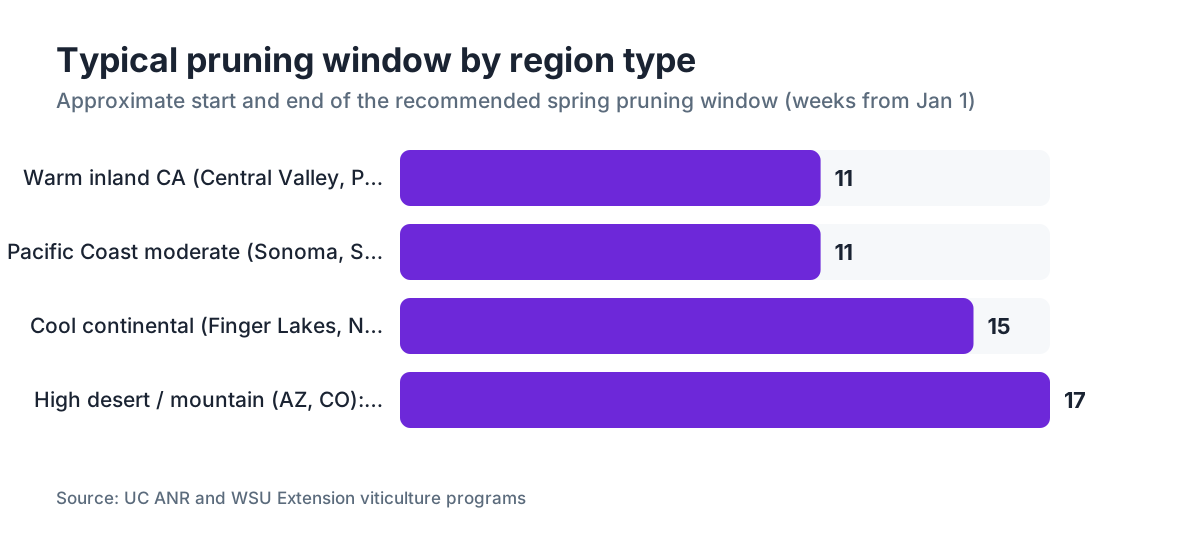
| Region type | Typical pruning window | Primary timing driver |
|---|---|---|
| Cool continental (e.g., Finger Lakes, Willamette) | Late March to mid-April | Late frost risk |
| Pacific Coast moderate (e.g., Sonoma, Willamette south) | February to mid-March | Budbreak proximity |
| Warm inland California (Central Valley, Paso Robles) | Late January to March | Vine vigor, shoot push |
| High desert / mountain (e.g., Arizona, Colorado) | Late March to late April | Hard freeze recurrence |
Cane pruning vs. spur pruning: which system should you use?
The right answer depends on your variety's basal bud fertility, not on what your neighbor does. That's the mistake most new growers make: they copy the block next door and wonder why their fruit set is thin.
Basal bud fertility is how productive the buds are at the base of a one-year-old cane, at positions 1 through 3 counting from where it joins older wood. High fertility there means spur pruning works: leave two to three buds per spur and each carries good cluster potential. Low basal bud fertility means those short spurs mostly throw blind or vegetative shoots. Those varieties need cane pruning, longer canes of 8 to 15 nodes so the productive mid-cane buds carry the crop.
Varieties that need cane pruning include most Pinot Noir clones, Riesling, Grenache, and Chardonnay in most training systems. Varieties that spur prune well include Cabernet Sauvignon, Syrah, Zinfandel, Merlot, and most table grape types. UC's variety-specific pruning guidance lists basal bud fertility scores for major commercial varieties if you need to look yours up [4].
Spur pruning is faster. A skilled pruner works 20 to 30 percent more vine-feet per day on spur-pruned cordons than on cane systems, because there are fewer decisions and less material to handle. Managing both a spur block and a cane block? Schedule your crew around that gap.
Cane pruning on a Guyot or head-trained vine means selecting one or two canes from last season's growth, tying them to a wire, and cutting everything else off. The cane you keep should be pencil-thick, 0.3 to 0.5 inches across, with moderate internode length. Fat "bull canes" tend to grow shoots, not fruit. Spindly canes mean the vine is weak and needs fixing before you ask it for a crop.
How do you prune young grape vines in spring?
Young vine pruning is formative, not about a crop. For the first two to three years the job is one thing: build a strong permanent structure of trunk, arms or cordon, and enough root to carry decades of production. The common mistake is chasing an early crop, which permanently stunts trunk development.
Year one (assuming dormant bare-root planting the previous spring): cut back to one to two buds. Period. Everything else goes. You want one strong shoot to become the trunk. If two emerge, keep the stronger and remove the other by late May.
Year two: extend the trunk shoot to the first cordon wire, or to the head of a head-trained system, and tie it to a stake. Remove all lateral growth below the intended cordon height. Training to a bilateral cordon? Pick two lateral shoots at wire height and start them along the wire in opposite directions. Do not crop this vine.
Year three: with decent vigor from year two, the cordon framework should be set. Spur positions start to form. Leave two-bud spurs at 6-to-8-inch spacing along the cordon. You might allow a very light crop, one cluster per shoot and half your target load, if the vine is vigorous and the trunk is fully established. WSU Extension recommends keeping crop load under 3 to 4 pounds per vine through year three for most wine grape varieties so trunk girth develops properly [3].
Spring pruning on young vines also means aggressive removal of suckers from the root zone and any shoots pushing below the graft union on grafted stock. Those are pure waste in a vine still building its frame. Pull suckers young and soft. Once they lignify you're cutting, not pulling, and every stub is an opening for disease.
How many buds should you leave per vine?
Bud targets are variety-specific and site-specific, but there are workable benchmarks. For most premium wine grape varieties on a bilateral cordon with spur pruning, start at 20 to 40 buds per vine, then adjust by vine size measured from the weight of the prunings you remove. This is balanced pruning, the method Nelson Shaulis developed at Cornell in the 1950s, and still the most defensible framework in use [1].
Here's the math. Weigh the prunings from a sample of representative vines. For the first pound of pruning weight, leave 20 to 30 buds. For each additional pound, add 10 buds. A vine with 1.5 pounds of prunings gets 25 to 35 buds. A vine with 3 pounds gets 40 to 50. The logic is simple: a vigorous vine carries more shoots without crowding, and a weak vine shouldn't be asked to.
The foundational Concord data behind the method found that balanced pruning improved both yield consistency and soluble solids compared to a fixed 60-bud standard across multiple seasons [1]. It has since held up for Vitis vinifera in California and Pacific Northwest trials.
Young vines in third or fourth leaf run much lower. Most wine grape extension guidelines suggest 10 to 20 buds max in year three, scaling up as the vine fills its space. Over-budding a young vine is the most common mistake in spring pruning, and the damage shows up for years.
What tools do you need and how do you make clean cuts?
Hand shears, loppers for canes thicker than 0.75 inches, and a folding hand saw for trunk work. That's the kit. Pneumatic shears speed hand labor by 25 to 40 percent in large operations and earn their keep above roughly 20 acres, but for most small and mid-sized vineyards, bypass hand shears are the standard.
Blade quality matters more than brand. You want a clean bypass cut (not anvil) that doesn't crush the cane. Crushed wood is an open door for Botrytis, Eutypa lata, and Botryosphaeria fungi, all of which colonize pruning wounds. UC Davis research on Eutypa dieback shows the pathogen's spores spread mainly during rain and that wounds stay susceptible for up to two weeks after pruning [5]. Timing your cuts just ahead of a dry stretch is genuinely useful.
Disinfecting blades between vines is debated. For diseases spread mechanically, like Leafroll virus or Grapevine Fanleaf Virus, UC recommends disinfecting with a 10% bleach solution or 70% ethanol between vines [11]. For trunk diseases, where the main infection route is airborne spores landing in wounds rather than blade transfer, the payoff is less clear, but it's cheap insurance on high-value blocks.
Cut placement: cut to a node, not between nodes. Leave a stub about 0.5 inches above the bud you're keeping. That stub dries down over the season and shields the bud from mechanical damage. Cut flush and you risk the bud; cut too high and you leave a dead stub that invites canker.
How does spring pruning affect disease pressure and canopy management?
Pruning sets the canopy architecture for the whole season, and canopy architecture is the biggest lever you have on disease before you ever pick up a sprayer.
A well-pruned vine, with the right bud count and balanced shoot positioning, gives you a canopy where light reaches the fruiting zone and air moves through the cluster zone. Dense, shaded fruit zones are where powdery mildew, Botrytis, and bunch rots thrive. Open canopies dry faster after rain and take spray better, so your fungicide program actually lands on target.
Leaving too many buds is the canopy disease risk. That's the economic cost of over-budding most growers learn only after a bad Botrytis year. When you feel the urge to leave a few extra buds for insurance, know that the instinct usually costs more in summer disease work than it saves in yield.
Wound protection is a separate but related concern. Products with Trichoderma species (a biological fungal antagonist) applied to fresh cuts reduce Eutypa lata and Botryosphaeria colonization by 50 to 70 percent versus unprotected cuts in UC Davis trials [5]. If you're in trunk-disease country (Eutypa dieback shows up in older blocks across California), wound protection is worth the cost. Common commercial options include Vinevax and other registered Trichoderma-based formulations.
If you keep formal spray records, log wound protectant applications. Track them in a system like VitiScribe and they're already in the record when your Pesticide Use Report is due.
What worker protection standard rules apply to spring pruning crews?
Spring pruning usually happens before spray season, but the EPA Worker Protection Standard (WPS) still covers agricultural workers pruning in commercial vineyards [6].
Under WPS (40 CFR Part 170), vineyard workers must get annual safety training before they're allowed to work in the vineyard. The training covers pesticide hazards, how to read a safety data sheet, and what to do in an emergency. The EPA's WPS guidance requires employers to provide workers information about the pesticides they may be exposed to before they enter treated areas [6]. Even if no spray has happened yet this season, baseline WPS training has to be done first.
For pruning crews the practical requirements are three: training records for each worker, decontamination supplies (water, soap, towels) at the work site, and safety information posted at a central spot workers can reach. If any pesticide application overlaps with late pruning, respect the restricted-entry interval on recently treated blocks. WPS REIs for common early-season fungicides on dormant wood run 4 to 48 hours; check the label.
California adds Cal/OSHA heat illness rules that kick in at 80°F. Early spring pruning rarely triggers heat concerns, but warm-climate touch-up pruning later in spring can. Keep your safety training records and hold them for three years, the standard audit window for both WPS and California DPR inspections [7].
How do you prune mature grape vines that have been neglected?
Neglected or over-crowded mature vines need a renovation approach, not a one-season fix. Try to correct years of bad pruning in a single cut and you shock the vine into an unmanageable flush of water sprouts the next season.
The standard approach for pruning mature vines loaded with excess old wood is a multi-year renewal. Year one, remove the worst-positioned old canes and arms, open the center, and select one or two renewal canes from wood close to the trunk. Year two, keep removing old arms that are crowded or showing canker. Year three, you should have a clean framework to work from.
Old, gnarled trunks with visible Eutypa or Botryosphaeria cankers force a harder call: full trunk replacement or removal of infected sections. Trunk replacement means picking a sucker near the base, training it as a new trunk over two to three seasons while the old trunk still carries some crop, then cutting out the diseased trunk. It's slow, and it works. Cutting through infected wood and leaving the stump does not work; the pathogen already lives in the vascular tissue.
For cordon-trained vines with cordon creep (the cordon has lengthened over years, pushing spurs away from the trunk and stacking vigor at the tips), cut back to a replacement spur closer to the trunk and use a new lateral to re-establish position. Two to three years per cordon arm.
Nobody has clean data on exactly how much yield you lose in the renovation years versus how much you gain over the following decade from a healthy frame. The closest reference is extension guidance from UC and Cornell, which consistently recommends accepting a 30 to 50 percent yield reduction for one to two seasons as the price of proper renovation, against the alternative of babysitting a declining vine with rising disease pressure [4] [1].
How do you document spring pruning for compliance and farm records?
Spring pruning records aren't legally mandated the way pesticide records are, but they're the base layer under the rest of your season's compliance paperwork and your own management calls.
At minimum, log this: date pruned, block or vineyard unit, system (cane or spur), average bud count per vine or total buds per acre, crew size and hours for labor tracking, and notes on vine condition, trunk disease, frost damage to buds, or equipment issues. Notes taken at the time of pruning are what let you make sense of yield numbers at harvest.
If you're certified sustainable under CSWA, Lodi Rules, or SIP, your annual audit asks for field operation records that include pruning. Lodi Rules auditors look for evidence that vine balance is being managed, and pruning bud count records are the most direct proof [8].
Want to move past a notebook? VitiScribe captures block-level pruning records alongside your spray log and other field data, which cuts down end-of-season reporting. Software or a well-built spreadsheet, either works. The point is capturing block-level records at the time of work, not rebuilding them from memory in November.
Pesticide use reports, required in California for every licensed pesticide application including dormant sprays applied during or just after pruning, go to the county agricultural commissioner monthly [7]. Those reports have to match your field notes. Gaps between spray records and what's visible in the vineyard are the most common finding in DPR compliance audits.
What are the most common spring pruning mistakes and how do you fix them?
Over-budding is first. It's the most common, the most expensive, and the easiest to avoid if you commit to balanced pruning math before you start instead of adjusting by feel mid-row.
Cutting at the wrong time is second. In frost-prone regions the pull to prune early, when the weather is nice and the crew is around, is strong. But pushing budbreak three weeks early can cost you a whole crop in a late-frost year. Marginal climate? Delay and double-prune.
Ignoring vine health signals is third. Pruning is when you get your clearest look at trunk disease, cordons that callous poorly, and uneven growth across a block. Move too fast and you miss the early warnings that show plainly on dormant wood: brown or wedge-shaped discoloration in cross-sections, cankers with dark margins, dead spur positions.
Poor cane selection on cane-pruned varieties is fourth. The right cane has moderate diameter, good internode spacing (not compressed, not stretched), and started from a position close to the head or trunk. Fat bull canes or weak pencil shoots both guarantee problems.
Leaving pruning brush on the ground is fifth, and it's a disease problem. Brush on the vineyard floor harbors powdery mildew and Botrytis debris that re-infects new growth. Flailing, burning where allowed, or hauling brush out all beat letting it sit. Check county and state burn rules first; many California counties limit burn windows to specific dates [9].
Frequently asked questions
Can you prune grape vines too late in spring?
Yes. Wait until shoots are several inches long and you'll knock off emerging growth during pruning, wasting the vine's stored energy. Cuts on actively growing wood also bleed sap heavily, which weakens the vine a little. Aim to finish before shoots reach 1 to 2 inches. If you're still pruning at 3 to 4 inches, work carefully and accept some loss. Later than that, wait until next dormancy.
Should you seal pruning cuts on grape vines?
For trunk and large arm cuts, yes, a wound protectant pays off in regions with trunk disease pressure. Trichoderma-based products have the best trial data, with UC Davis research showing 50 to 70 percent reduction in Eutypa colonization versus untreated cuts. For small spur and cane cuts, the evidence is much weaker. Vines callous fast on minor cuts, and sealing every cut isn't cost-effective on small wood.
How many buds per vine is standard for Cabernet Sauvignon?
A common starting target for Cabernet Sauvignon on a bilateral cordon is 30 to 50 buds per vine, depending on vigor and row/vine spacing. Balanced pruning (20 to 30 buds per pound of prunings removed, plus 10 buds per additional pound) is more precise than a fixed number. High-vigor Cabernet blocks in Napa or Paso Robles may support 50 buds; low-vigor mountain or hillside sites may target 25 to 35.
Is spring pruning different for grafted vs. own-rooted vines?
The above-ground decisions are the same. The difference is managing suckers. Grafted vines push suckers from the rootstock below the graft union, and those need prompt removal because they're a different (often more vigorous) variety that will eventually take over if ignored. Own-rooted suckers are the same variety, so while you still want to remove excess basal growth, it's less urgent for varietal integrity.
How long does it take to prune one acre of grape vines by hand?
Roughly 2 to 4 days per acre for one experienced pruner, depending on spacing, training system, and how much remedial work is needed. Cane-pruned systems take longer than spur systems because of the extra judgment and tying. At standard California wine grape spacing (6x10 feet, about 726 vines per acre), expect 3 to 6 minutes per vine on a well-trained spur-pruned system. Pneumatic shears cut that by 25 to 40 percent.
What's the difference between dormant pruning and spring pruning?
In practice, most of what growers call spring pruning IS dormant pruning, done in late winter to early spring before budbreak. Dormant pruning technically means any pruning while the vine is fully dormant, from leaf fall through early spring. True spring pruning done after budbreak (green pruning or shoot thinning) is a different job: it removes excess shoots after they emerge to balance the canopy, rather than setting the framework before the season starts.
Do you need a pesticide applicator license to apply wound protectants during pruning?
In most states, biological wound protectants with no restricted-use designation can be applied by any trained worker under the employer's supervision. In California, any commercial pesticide application, including biological products, requires a licensed applicator or a licensed pest control adviser overseeing the program. Check your state department of agriculture rules. The product label is the legal document; if it says for certified applicators only, that governs regardless of state rules.
How does frost damage during budbreak affect pruning decisions?
If frost hits after buds have pushed, assess damage before doing anything drastic. Primary buds may die, but secondary and tertiary buds often survive and can still make a partial crop, though yield drops and fruit may ripen unevenly. Leave extra shoot positions after a frost event and thin later once you can see which shoots are productive. Never re-prune a frost-hit vine to zero buds hoping for a restart; the vine needs green tissue to rebuild carbohydrates.
Can you prune young grape vines in spring if they were planted the same year?
If you planted dormant bare-root vines in late winter of the same year, let them establish and push growth through the first season without in-season pruning beyond removing competing shoots. The one exception is a quick cut at planting: cut the vine to one or two buds to drive all energy into one trunk shoot. After that, the vine does its first-year work undisturbed. Fall or the following dormant spring is when you make the next formative cuts.
What's the WPS training requirement for spring pruning crews in vineyards?
Under EPA's Worker Protection Standard (40 CFR Part 170), agricultural workers in commercial vineyards must get WPS safety training before they work in the vineyard, even if no pesticide application has happened yet. Training covers pesticide hazards, emergency procedures, and how to access safety data sheets. Employers must keep training records. California requires the training be run by a licensed trainer or certified applicator. Annual re-training is required.
How do you prune vines trained on a high wire cordon vs. a low VSP trellis?
High wire systems like Scott Henry or Geneva Double Curtain typically use spur pruning on multiple cordon levels and position shoots both up and down. Low VSP (Vertical Shoot Positioning) uses cane or spur pruning at a single fruiting wire, with shoots trained upward between catch wires. Bud count targets and selection principles are the same; what changes is where you position the wood and how many cordon arms you manage. VSP is the most common premium wine grape system globally.
Is it okay to prune grape vines when it's raining?
Avoid it if you can. Rain is when Eutypa lata and Botryosphaeria spores disperse most actively, so fresh cuts made during or right after rain carry higher infection risk. UC Davis plant pathology guidance recommends timing cuts to dry periods when possible. Large commercial operations can't always wait, but for small blocks of high-value varieties, holding off two to three days after a rain event is worth the delay.
How does spring pruning differ for table grapes versus wine grapes?
Table grapes like Thompson Seedless and Crimson Seedless are often cane-pruned to longer canes (12 to 16 nodes) because they have low basal bud fertility and growers want large, well-filled clusters at set positions along the cane. Bud counts per vine run higher, often 50 to 80 or more, because large cluster size is the goal, not fruit concentration. Timing principles are the same, but table grape growers prioritize cane length and node count over the moderate-vigor, moderate-diameter ideal of wine grape pruning.
Sources
- Cornell University College of Agriculture and Life Sciences (Cornell AgriTech), viticulture and enology research: Balanced pruning method developed at Cornell (Shaulis); over-cropped vines struggle to ripen in marginal seasons; validated formula of 20-30 buds per pound of prunings
- University of California Agriculture and Natural Resources, Grape Pest Management and viticulture publications: Hand pruner productivity of approximately 0.3 to 0.5 acres per day in trained cordon systems
- Washington State University Extension, Viticulture and Enology: Crop load recommendations for young vines (below 3 to 4 pounds per vine through year three); timing guidance using Forsythia phenology and 12-inch soil temperature
- University of California Agriculture and Natural Resources, variety and vineyard management guidance: Variety-specific basal bud fertility data; California coastal growers target late January through mid-March for mature blocks; 30 to 50 percent yield reduction acceptable during renovation
- University of California Agriculture and Natural Resources, Eutypa dieback and grapevine trunk diseases: Eutypa lata spores disperse during rain events; wounds susceptible up to two weeks post-pruning; Trichoderma wound protectants reduce colonization by 50 to 70 percent in UC Davis trials
- U.S. EPA, Agricultural Worker Protection Standard (40 CFR Part 170): WPS requires annual training before workers enter treated areas; employers must provide specific pesticide hazard information; applies to agricultural workers in commercial vineyards
- California Department of Pesticide Regulation, pesticide use reporting: California requires monthly pesticide use reports to county agricultural commissioner; records must be retained and are subject to DPR compliance audits; records kept for 3 years standard audit window
- Lodi Winegrape Commission, Lodi Rules Certified Sustainable Program: Lodi Rules sustainability auditors examine evidence of vine balance management; pruning bud count records are direct evidence for annual audits
- California Air Resources Board, agricultural burning: California counties have air quality restrictions limiting agricultural burn windows; vineyard pruning material burn permits subject to county-specific seasonal and daily restrictions
- Washington State University Extension, grapevine cold hardiness and frost management: Cool-climate frost avoidance strategy of delaying pruning 2 to 3 weeks; double pruning can push budbreak back 5 to 10 days for Finger Lakes and Willamette Valley type regions
- University of California Statewide IPM Program, grape disease management: Trunk replacement approach for Eutypa-infected vines; mechanical transmission risk for virus diseases supports blade disinfection between vines using 10% bleach or 70% ethanol
Last updated 2026-07-10