Pruning grape vines in NZ: the complete practical guide
TL;DR
- In New Zealand, prune grape vines during winter dormancy, roughly June through August.
- The main systems are spur pruning (on VSP and pergola) and cane pruning (on VSP).
- Marlborough, Hawke's Bay, and Central Otago run slightly different timing windows because of frost risk.
- Pick the wrong system and you'll fight it for years.
When should you prune grape vines in NZ?
Prune after leaf fall and before bud burst. In most New Zealand regions that means June through August. [1] Central Otago is the exception growers watch closely, because spring frosts bite hard into September and even October, so many push pruning later, toward late July or August, and the delayed bud burst keeps sensitive tissue out of the frost window. Marlborough and Hawke's Bay run earlier. June or early July is common there, with most commercial vineyards done before August.
The vine's dormancy state matters more than the calendar. You want it fully dormant: no green tissue, sap flow minimal. Prune too early, before the wood has hardened off in May, and you open the door to dieback and fungal entry. Prune after bud burst in September and you knock off the very buds you meant to keep.
There's a rough physiological anchor cited in NZ extension materials: wait until roughly 150 growing degree days (base 10°C) have accumulated since the previous harvest. Don't treat that as gospel. Treat it as a sanity check against pruning purely by date.
Wet weather is the last thing to weigh. Eutypa and Botryosphaeria dieback fungi enter through fresh pruning wounds, and NZ winters are not shy about rain. [2] If you're pruning in a wet window, apply a wound protectant (Topsin, a thiram-based product, or a water-based paint like Greenseal) within four hours of the cut. Research from Plant & Food Research NZ points to a substantial drop in wound infection when protectants go on inside that window rather than the next day.
What pruning systems do New Zealand growers actually use?
New Zealand viticulture isn't one thing. Marlborough Sauvignon Blanc runs mostly on VSP (Vertical Shoot Positioning) with either spur or cane pruning. Head north and you find Scott Henry, Smart-Dyson, and lyre systems in Hawke's Bay, plus the sprawling pergola structures on older Gisborne and Northland blocks.
Here's how the main systems compare:
| System | Training wire height | Pruning method | Best suited to |
|---|---|---|---|
| VSP spur | 90-100 cm | Spur, 2 buds | High-yielding whites, mechanisation |
| VSP cane | 90-100 cm | Replacement cane, 8-12 buds | Pinot Noir, Riesling |
| Scott Henry | 90 cm (lower) + 130 cm (upper) | Cane or spur | High vigour sites |
| Pergola (parral/tendone) | 180-220 cm overhead | Spur on permanent arms | Older NZ blocks, table grapes |
| Lyre/U-system | 90 cm, split canopy | Spur or cane | High vigour, shade tolerance |
Vigour drives the choice, not looks. High-vigour Gimblett Gravels Syrah on deep alluvial soil needs more canopy surface to dodge shading, so Scott Henry or lyre earns its place. A cool, low-vigour Central Otago Pinot Noir block on schist is usually better on plain VSP, where you can see and manage every shoot. [3]
Cane versus spur is a real decision, so make it on purpose. Spur pruning is faster to mechanise and faster by hand. Cane pruning gives you more room to pick healthy wood and shift position year to year. For varieties with poor bud fruitfulness at basal positions, like Grenache or some Chardonnay clones, cane pruning usually wins, because you're keeping buds 3-8 where fruitfulness climbs. [13]
How do you prune grape vines on a pergola structure?
Pergola pruning is its own discipline. Inherit an old NZ block on a parral or tendone structure and it can feel like too much at first. The geometry breaks every VSP habit: permanent arms (cordons) radiate outward horizontally from the top of a central trunk, 180 to 220 cm off the ground, and shoots hang down through wire mesh or train upward depending on the style. [4]
The core principle matches any cordon system. You maintain spur positions along the permanent arms and renew wood progressively, so the cordons don't fatten and die back from Eutypa over time. Scale is the difference. Arms on a full NZ pergola can run 3 to 4 metres in each direction from the trunk. That's a lot of cordon to manage, and Eutypa can quietly hollow out a trunk over 10 to 15 years without showing much until the arm fails.
For established pergola blocks, the sequence goes like this:
- Walk the row before you touch anything. Find the dead or dying arms and flag them for replacement or removal. Eutypa-killed wood shows orange-brown staining in a cross-section cut.
- Remove last year's fruiting canes from each spur position, leaving the base spur (2 buds) you'll grow from this season.
- Where a spur position has turned into a knotty, congested mess after years of overcrowding, drop back to a renewal shoot lower on the arm and tie it in as a replacement spur.
- Apply wound protectant to any cut larger than a 5-cent coin.
- Thin spur positions to open the canopy. On pergola, overcrowding is the enemy, because the canopy sits overhead and you lose the light penetration you'd get on VSP.
Pergola pruning is slower than VSP. The overhead work is part of it, but mostly it's the sheer size of each vine. Budget 10 to 20 minutes per vine on a neglected block, less on well-kept ones. Some Northland growers use platforms or hop-up steps. Most experienced pruners just work by feel at full arm extension.
One trap catches newcomers. Don't leave long canes chasing yield. Pergola vines already carry big canopies and high natural yield. Over-cropping is a real risk in NZ's warmer regions, and leaving extra buds for a bigger harvest usually gets you thin, underdeveloped fruit and a season's worth of catch-up pruning next winter.
How many buds should you leave per vine?
It depends on variety, vine vigour, target yield, and training system. Anyone who hands you a single number without those qualifiers is guessing. There are honest starting points, though.
Take a VSP spur-pruned Sauvignon Blanc vine in Marlborough aiming for 12-14 tonnes per hectare, a common commercial benchmark. You're typically leaving 20-30 buds per vine across 10-15 spur positions, at 2 buds per spur. [5] That scales with spacing. At 3 m x 1.5 m (2,222 vines per hectare), 25 buds per vine puts you around 55,000 retained buds per hectare.
For Pinot Noir on VSP cane in Central Otago aiming for 8-10 tonnes per hectare, you might retain 20-30 buds per vine across 2-3 canes of 8-12 buds each, adjusted for last season's shoot fruitfulness.
Here's the honest version: bud number should be calibrated on pruning weight data. The Ravaz index (crop weight divided by pruning weight) is the standard tool, and most NZ viticulture advisors put a balanced vine between 4 and 10, with 5-8 as the sweet spot for quality-focused fruit. [6] Consistently above 10 means you're over-cropping. Below 4 means you're over-pruning, or the vine is too vigorous for the crop you're setting.
Keep your pruning weight records. Weighing prunings is tedious, no argument. It's also one of the few objective numbers that tells you whether your pruning calls from three years ago were right.
What's the risk of Eutypa and trunk disease in NZ vineyards?
Trunk diseases, mainly Eutypa dieback (Eutypa lata) and Botryosphaeria dieback, are the biggest long-term threat that pruning either causes or prevents. Plant & Food Research NZ has documented them widely across Marlborough, Hawke's Bay, and Central Otago. [2]
Eutypa enters through pruning wounds. The spores travel by air and stay most active in wet conditions, which describes most NZ winters. Infected vines grow a wedge-shaped canker you can see in cross-section, and the disease can kill an arm or the whole vine over 10 to 15 years. In older NZ blocks, some level of Eutypa is close to universal. The real question is how fast it's moving.
Three practical interventions carry most of the weight. Timing: prune late in winter, when spore release drops. Speed: get wound protectant on within 4 hours. Tool hygiene: disinfect secateurs between vines in infected blocks with a 10% bleach solution or a commercial product like F10. [2]
NZ's Integrated Winegrowing programme, which sits under Sustainable Winegrowing New Zealand (SWNZ), makes trunk disease management a formal requirement for certified members. If you're SWNZ certified, your pruning records and wound protection practices need to be documented. [7]
Badly infected blocks can take remedial surgery: cut out the infected wood and train replacement suckers from the base. It sets the vine back 2 to 3 years but can add real years to block life. Growers in older Gisborne blocks have done it successfully. It's hard work with a long payback, but for a block with another 15 years of economic life, it can pencil out.
What equipment do NZ pruners use, and what does it cost?
Hand pruning with quality bypass secateurs is still the standard on most quality-focused NZ vineyards, especially for Pinot Noir and other hand-harvested varieties where wound quality counts. Felco 2 and Felco 8 dominate NZ vineyards, retailing for NZD 90-130 depending on supplier. They're worth the money. Good bypass loppers for older cordon wood cost another NZD 60-120.
Pneumatic secateurs (Infaco, Pellenc, Felco 801) show up in larger Marlborough operations. They cut hand fatigue a lot, which matters when you're pruning 4 to 8 hours a day for 6 to 8 weeks. Purchase price runs NZD 1,500-3,500 per unit, plus compressor infrastructure for pneumatic models or battery packs for electric ones. The payback is real once you're pruning more than 15 to 20 hectares a year.
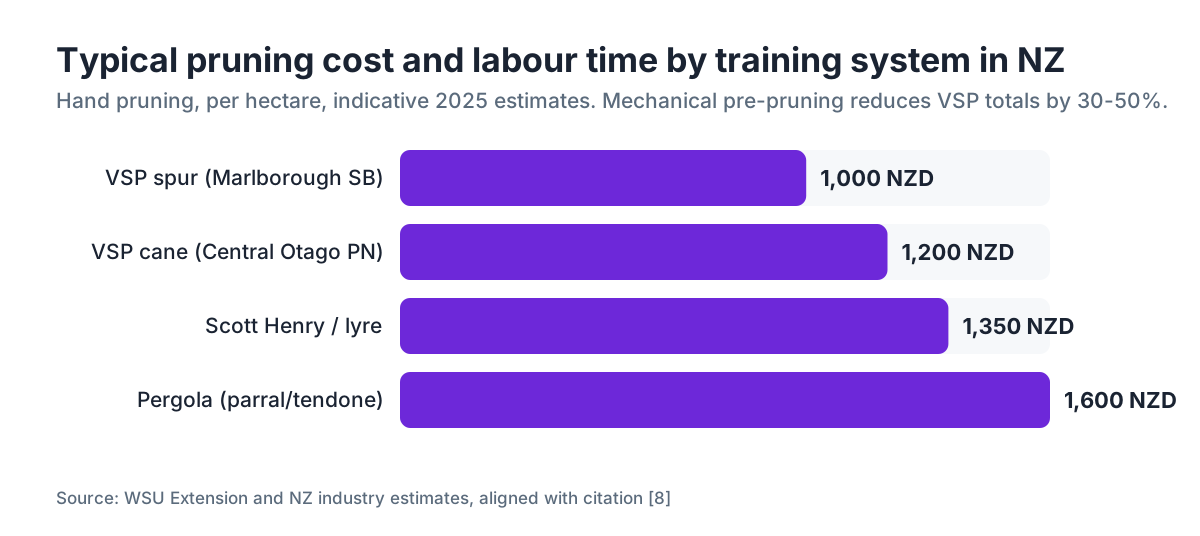
Mechanical pre-pruning (a tractor-mounted hedge-cutter rough-cuts the vine before hand finishing) is standard in big Marlborough Sauvignon Blanc operations. It cuts hand-pruning time by 30-50%, though only on VSP, not pergola. [8]
Full mechanical pruning, with no hand finishing, is uncommon in NZ quality wine and mostly lives in commodity bulk operations. The canopy management trade-offs are real, and most NZ winemakers won't go there.
Keeping track of which blocks are pruned, by whom, and with what wound protection is where field record software earns its keep. VitiScribe is one option NZ operations use to log pruning activity and link it to block maps, which makes SWNZ compliance documentation easier than a folder full of paper.
On labour, hand pruning on VSP typically runs NZD 800-1,400 per hectare, depending on complexity, vine spacing, and condition of the wood. Pergola is slower and costs more per hectare.
How does pruning timing affect frost risk in NZ?
Frost management and pruning timing tie together tightly in cooler NZ regions, especially Central Otago, the Wairarapa, and parts of Canterbury. The logic is simple. Pruning stimulates bud burst, and every week you delay pruning delays bud burst by roughly the same, which trims the number of days bud-sensitive tissue sits exposed to spring frosts. [9]
In Alexandra and Cromwell, spring frosts can hit as late as October, so some growers deliberately delay pruning into August or even early September on frost-prone sites. They take the operational pressure of squeezing pruning into a shorter window in exchange for real frost risk reduction.
Double pruning is another technique on high-value frost-prone blocks. You make an early rough cut in June to knock back bud number (removing 70-80% of wood), then come back in August or September for the final precision cut. The vine responds to the first cut and starts prepping for bud burst, then the second cut resets the clock a little. It costs more labour but can push bud burst by 7 to 14 days. [9]
Frost protection infrastructure changes the equation too. Overhead sprinklers, the most common frost protection in NZ, work on any training system. Wind machines suit larger flat blocks. Neither changes the core pruning decisions, but active frost protection gives you more room to prune earlier without the same exposure.
What does good pruning actually look like year to year?
Good pruning isn't about this vintage alone. It's about the vine you're building for the next 20 years. The frame counts as much as the bud count.
A well-pruned VSP spur vine has a clean, straight trunk with no base suckers, cordons running cleanly along the fruiting wire with spur positions 15-20 cm apart, and each spur carrying 2 healthy buds on last season's wood, not on a knotty 5-year-old base. When spur positions turn knotty and congested (common after 8 to 10 years without renewal), pick a renewal shoot from lower on the cordon, tie it in, and retire the old wood over 2 to 3 seasons.
A well-pruned cane vine has one or two healthy canes from the previous season, each 8-12 buds long, tied down to the fruiting wire, plus a renewal spur (1-2 buds) at the cordon position for next year's cane options. Cane selection is where skill shows. Aim for pencil thickness (roughly 8-10 mm) with moderate internodes, not the long vigorous whips and not the short shaded ones. Canes grown in shade carry lower bud fruitfulness, so favour canes from well-lit positions.
The cordon deserves attention every year. Drooping or mis-angled cordons are common in older NZ blocks as the permanent wood settles under its own weight. Re-tie and straighten them as you prune and you head off compounding problems.
Cornell's viticulture extension materials describe balanced pruning as adjusting retained bud number to vine capacity, with pruning weight per metre of row as the key diagnostic. [6] The formula most common in NZ practice, going back to Nelson Shaulis's work at Geneva, leaves 20-30 buds per kilogram of pruning weight removed, calibrated for variety and target yield.
How do worker health and safety rules affect vineyard pruning in NZ?
NZ vineyard pruning runs into WorkSafe NZ requirements, and any chemical work during pruning (wound protectants, copper fungicides) pulls in the HSNO Act and the relevant handler certificates. [10]
Applying registered fungicide sprays as wound protectants (rather than non-chemical options like Greenseal paint) means handlers need a current Growsafe certificate. The rough US equivalent is the EPA Worker Protection Standard, which Cornell and WSU extension materials reference for American operations. [11] The NZ Agricultural Compounds and Veterinary Medicines (ACVM) Act governs which products are legal and at what label rates.
Repetitive strain from secateurs is a genuine occupational health issue. WorkSafe NZ has guidance on pruning-related musculoskeletal harm, and some larger NZ wine companies run formal rotation and ergonomics policies for pruning crews. Pneumatic and electric secateurs cut grip force a lot, and that's a legitimate health reason to buy them beyond the productivity case.
For SWNZ-certified operations, pruning records have to document wound protection application, product used, and application date. This is another spot where a field record system earns its keep: timestamped, block-level records mean you have the evidence trail if a certification auditor asks. VitiScribe's block-level field log captures exactly that.
If you employ seasonal or RSE (Recognised Seasonal Employer) workers for pruning, keep their training records for chemical handling and tool use. WorkSafe NZ can request them.
How is pruning different for organic and biodynamic NZ vineyards?
The physical pruning decisions (timing, bud number, system) are identical in organic and biodynamic vineyards. The split shows up in wound protection and fungicide choices.
For BioGro or Demeter-certified NZ operations, wound protectants have to come from the approved substances list. Bordeaux paste (copper sulfate and lime) is widely used and approved. Plenty of organic growers use botanical paste products or lean on timing and speed instead of chemical protectants. Synthetic fungicides like Topsin (thiophanate-methyl) are not permitted under organic certification.
Biodynamic operations also factor in the biodynamic calendar, particularly for timing. The calendar splits the year into fruit days, root days, flower days, and leaf days, and some biodynamic growers prefer to prune on fruit days. There's no peer-reviewed evidence that this timing changes vine health outcomes, and I'm not going to pretend otherwise. But it's a real practice in some respected NZ operations, worth knowing if you advise organic growers.
Copper build-up in NZ vineyard soils is a documented concern, and organic and conventional operations alike should track copper application rates across every use, wound protection included. The NZ Ministry for the Environment has guidance on soil copper thresholds. [12]
Should you hire a pruning contractor or train your own crew?
Under 5 hectares, train your own crew (even if that's just you and two others) and do it well. It's almost always the better call. You know your vines, you can make judgment calls on the spot, and you build up block knowledge no contractor can match.
Above 10 to 15 hectares, the maths often flips. Experienced pruning contractors in Marlborough, Hawke's Bay, and Central Otago bring their own tools, their own trained crews, and the speed that comes from doing nothing but pruning for 8 weeks a year. Quality varies enormously. Ask for references and walk a finished block before you commit to a full season.
Pergola blocks are a special case. The pool of experienced contractors is smaller. Overhead pruning on a mature pergola is skilled work, and not every VSP crew is comfortable up there. If you're interviewing contractors for an older pergola block, ask straight out about their experience with that system.
For vineyard operations of any size, contracting versus employing directly also drags in RSE scheme planning, accommodation requirements, and PAYE obligations. Those sit apart from the pruning question but connect to it deeply once you're running the numbers.
Frequently asked questions
When is the best time to prune grape vines in New Zealand?
June through August is the main pruning window across most NZ regions. Central Otago growers often push toward July-August to delay bud burst and cut spring frost exposure. The vine should be fully dormant, no green tissue visible. Pruning before full leaf fall in May risks dieback; pruning after bud burst in September risks losing your best buds. Dormancy state matters more than the calendar date.
How do you prune grape vines on a pergola in NZ?
On a pergola, maintain spur positions (2 buds) along permanent horizontal arms radiating from the trunk at 180-220 cm height. Remove all last season's fruiting wood, renew congested spurs with lower replacement shoots, and apply wound protectant to any cut larger than a 5-cent coin. Budget 10-20 minutes per vine on neglected blocks. Don't leave extra buds chasing yield; pergola vines already carry large canopies.
What is spur pruning vs cane pruning for grapevines?
Spur pruning retains short 2-bud stubs (spurs) on permanent cordons. It's faster and easier to mechanise. Cane pruning retains one or two full canes of 8-12 buds each from the previous season, tied down to the fruiting wire, with a renewal spur left for next year. Cane pruning suits varieties with low bud fruitfulness at basal positions, like Pinot Noir. Spur pruning suits high-yielding varieties like Marlborough Sauvignon Blanc.
How many buds should I leave on a grapevine in NZ?
For VSP spur-pruned Sauvignon Blanc in Marlborough targeting 12-14 t/ha, typically 20-30 buds per vine (10-15 spur positions at 2 buds each). For Pinot Noir on cane, 20-30 buds across 2-3 canes. Calibrate using pruning weight: a balanced vine has a Ravaz index (crop weight divided by pruning weight) of 5-8. Above 10 means over-cropping; below 4 means over-pruning.
How do you prevent Eutypa dieback when pruning NZ grapevines?
Apply wound protectant within 4 hours of pruning. Prune late in winter, when Eutypa spore release drops. Disinfect secateurs between vines in infected blocks using a 10% bleach solution or F10. For infected wood, cut back until cross-sections show no orange-brown staining. In badly infected blocks, remedial surgery (cutting to base and training new trunks) can add years to block life but takes 2-3 years to reset the vine.
Can you prune NZ grapevines mechanically?
Mechanical pre-pruning with a tractor-mounted hedge-cutter is standard in large Marlborough operations and cuts hand-pruning time by 30-50%. It works on VSP but not on pergola structures. Full mechanical pruning with no hand finishing exists in some commodity operations but is uncommon in quality NZ wine because of canopy management trade-offs. Most quality NZ vineyards use mechanical pre-pruning followed by hand finishing.
What records do SWNZ-certified NZ vineyards need to keep for pruning?
SWNZ certification requires documentation of wound protection application including the product used, application date, and block location. Pruning date and method should also be recorded. Growsafe-certified handlers are required for any registered fungicide wound protectants. WorkSafe NZ can request training records for seasonal pruning staff. Block-level field records with timestamps are the cleanest way to meet these requirements at audit.
How do you prune grapevines to reduce frost risk in NZ?
Delay pruning to July-August on frost-prone sites like Central Otago to push bud burst later into spring. Double pruning is another option: a rough first cut in June to reduce wood, then a return in August for final precision pruning. This can delay bud burst by 7-14 days, reducing spring frost exposure. On high-value frost-prone blocks the extra labour cost of double pruning is often justified.
What pruning tools do NZ vineyard workers use?
Felco 2 and Felco 8 bypass secateurs (NZD 90-130) are standard for hand pruning. Pneumatic (Infaco, Pellenc) or electric secateurs cost NZD 1,500-3,500 per unit and cut hand fatigue significantly, which matters on crews pruning 4-8 hours daily for weeks. Bypass loppers handle older cordon wood. Mechanical hedge-cutters on tractors handle pre-pruning on larger VSP operations. Pergola work usually needs ladders or hop-up steps.
How does pruning timing differ between Marlborough, Hawke's Bay, and Central Otago?
Marlborough and Hawke's Bay growers typically prune June to early August, with most commercial blocks finished by August. Central Otago growers often push to late July or August to delay bud burst past peak frost windows in September and October. Northland and Gisborne operations can start slightly earlier in June, as frost risk is minimal. In all regions, the vine's dormancy state should guide the start date more than the calendar month.
What's the Ravaz index and how do NZ viticulturalists use it?
The Ravaz index is crop weight at harvest divided by pruning weight removed that winter, measured per vine. A balanced vine sits between 5 and 8. Above 10 signals over-cropping, which depletes vine reserves and hurts fruit quality. Below 4 signals the vine is too vigorous for the crop set or has been over-pruned. NZ viticulture advisors use it to calibrate bud retention year to year alongside shoot and berry assessments.
Do organic NZ vineyards prune differently?
The physical pruning decisions are identical. The difference is wound protection: synthetic fungicides like thiophanate-methyl (Topsin) are not permitted under BioGro or Demeter certification. Organic growers typically use Bordeaux paste or botanical paste products, or lean on pruning timing and speed to lower infection risk. Some biodynamic operations also time pruning to fruit days on the biodynamic calendar, though no peer-reviewed evidence supports yield or quality benefits from this timing.
How much does pruning cost per hectare in NZ?
Hand pruning on VSP typically costs NZD 800-1,400 per hectare depending on vine spacing, complexity, and condition of the wood. Pergola blocks are slower and cost more per hectare. Mechanical pre-pruning followed by hand finishing lowers total labour cost by cutting hand-pruning time 30-50% on suitable VSP blocks. Pneumatic secateurs pay back in operations pruning 15-20 hectares or more a year, mainly through reduced fatigue and marginally faster rates.
Sources
- New Zealand Winegrowers, Viticulture calendar and growing season guidance: NZ grapevine pruning occurs during winter dormancy, primarily June through August across most regions
- Plant & Food Research NZ, Trunk disease management in grapevines: Eutypa lata and Botryosphaeria enter through pruning wounds; wound protectant applied within 4 hours reduces infection risk substantially
- UC Davis Cooperative Extension, Grapevine training systems and vigor management: Training system selection should be driven by vine vigour; high-vigour sites benefit from divided canopy systems like Scott Henry or lyre
- Cornell Cooperative Extension, Pergola and tendone training for grapes: Pergola/tendone structures carry permanent horizontal arms at 180-220 cm, with spur pruning along the arms
- New Zealand Winegrowers, Annual statistical report on Marlborough yields: Commercial Marlborough Sauvignon Blanc benchmark yields are approximately 12-14 tonnes per hectare
- Cornell Cooperative Extension, Balanced pruning and the Ravaz index: Balanced vines have a Ravaz index (crop weight divided by pruning weight) of 5-8; above 10 indicates over-cropping
- Sustainable Winegrowing New Zealand (SWNZ), Certification programme requirements: SWNZ-certified operations must document trunk disease management practices including wound protection during pruning
- WSU Extension, Mechanical pruning and pre-pruning in wine grapes: Mechanical pre-pruning can reduce hand-pruning time by 30-50% on VSP systems
- Plant & Food Research NZ, Frost risk and vine phenology management: Delayed pruning in Central Otago can push bud burst by approximately 7-14 days, reducing spring frost exposure
- WorkSafe New Zealand, Agricultural health and safety guidance: WorkSafe NZ has guidance on musculoskeletal harm from vineyard pruning and requirements for training records for seasonal workers
- EPA Worker Protection Standard, 40 CFR Part 170: The EPA Worker Protection Standard governs handler training and chemical safety for agricultural workers applying pesticides
- NZ Ministry for the Environment, Soil contamination and copper thresholds guidance: The NZ Ministry for the Environment has guidance on soil copper accumulation thresholds relevant to vineyard copper use
- UC Davis Cooperative Extension, Cane vs spur pruning for wine grapes: Cane pruning suits varieties with low bud fruitfulness at basal positions; spur pruning suits high-yielding varieties where basal bud fruitfulness is adequate
Last updated 2026-07-09