Pruning grape vines while fruiting: what you can and can't do
TL;DR
- You can prune grapevines during fruiting, but only selectively.
- Shoot tipping, leaf pulling, lateral trimming, and hedging are standard summer tasks that improve fruit quality.
- Removing whole canes or making any structural cut while the vine carries a crop is a different animal.
- That kind of hard cut stresses the vine and rarely pays off unless disease is actively spreading.
Can you prune grape vines while they're growing and fruiting?
Yes, and most commercial growers do it every season. The confusion comes from mixing up two very different jobs. Dormant pruning is the big structural work you do in winter. Canopy management is every cut you make once shoots are growing and fruit is developing. The second one is normal, expected, and often essential for fruit quality.
The goal of summer pruning is never to reshape the vine. You're managing light into the fruit zone, reining in vigor, taking out diseased tissue before it spreads, and opening the canopy for airflow. UC Davis Cooperative Extension describes summer pruning as a set of practices that includes shoot thinning, shoot positioning, hedging, leaf removal, and lateral shoot management [1]. Each one has a window when it does the most good.
Growers get into trouble when they treat routine canopy work like structural surgery. Take off a whole arm, remove a cordon, or change the vine's permanent framework while it carries a full crop, and you create a real carbon deficit. The vine is pouring energy into fruit. Break that balance mid-season and you can push it to drop clusters or stall sugar accumulation right when you want the opposite.
What types of pruning cuts are safe during fruiting?
Sort summer cuts into two buckets. Green work is safe almost any time after fruit set. The aggressive cuts have a narrow window or a real tradeoff you need to weigh first.
Safe at almost any time:
- Shoot tipping: cutting the growing tip off a shoot to stop its elongation. Handy when vigorous shoots are shading clusters or reaching into the trellis wires. Do it after bloom, once you can see the crop load the vine is carrying.
- Leaf removal in the fruit zone: pulling or cutting the leaves right around the clusters. Cornell's viticulture program found that early leaf removal (at or just before bloom on the east side of the canopy in eastern U.S. conditions) reduces Botrytis bunch rot by drying the zone around the clusters [2]. Pre-bloom leaf removal also loosens clusters slightly in some varieties, which pays off later.
- Lateral shoot trimming: laterals are the secondary shoots that come off main shoots. Left alone on vigorous vines, they build a wall of leaves that blocks sun and air. Cutting them back to one or two leaves is one of the most routine summer jobs there is.
- Hedging (mechanical or hand): cutting the tops and sometimes the sides of the canopy to a uniform height. Most Napa and Sonoma operations run mechanical hedgers one to three times a season depending on vigor.
- Suckers and water sprouts: pulling non-productive growth from the trunk and below the graft union. Do this the moment you see it.
Cuts that need more thought:
- Shoot thinning at or after fruit set: removing whole shoots now means removing their clusters too. Sometimes that's exactly what you want for crop load. Do the math on your target yield first.
- Removing diseased wood with a lot of canopy on it: cutting out a whole shoot for powdery mildew or a bacterial disease is fine. Cutting out a major structural piece is a different problem.
- Any cut to permanent wood: arms, cordons, trunks. Don't do this during fruiting unless disease is spreading and you have no other option. Even then, call your local farm advisor first [3].
When during the season should each summer pruning task happen?
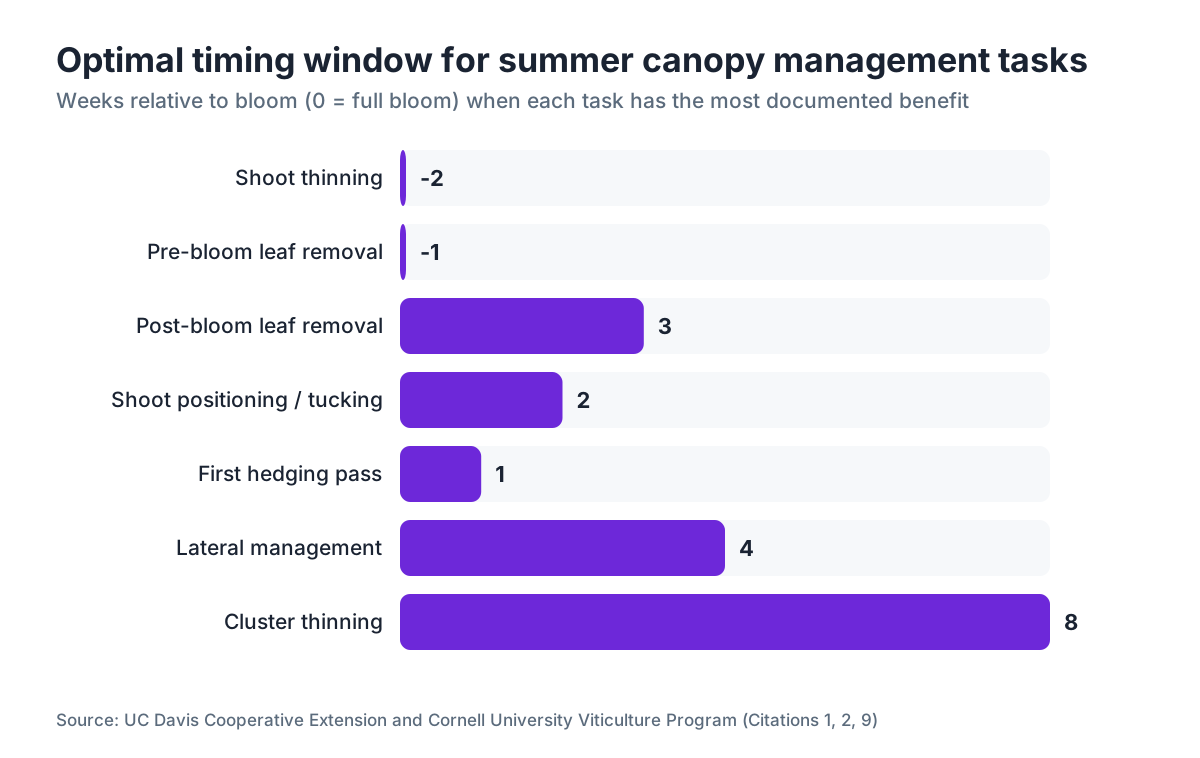
Timing matters as much as the cut itself. Here's the practical window for each task tied to standard phenological stages [1][2].
| Task | Best Timing | Notes |
|---|---|---|
| Shoot thinning | 2-4 weeks after bud break | Before shoots harden; easier and less wounding |
| Pre-bloom leaf removal (fruit zone) | 1-2 weeks before bloom | Tightest window; most effective for Botrytis prevention |
| Post-bloom leaf removal | 2-4 weeks after fruit set | Still good for sun exposure; less effect on cluster compactness |
| Shoot positioning / tucking | As shoots reach wire height | Ongoing through active growth |
| Shoot tipping / hedging | After bloom through veraison | Repeat as needed based on vigor |
| Lateral management | Ongoing from bloom to harvest | Cut back to 1-2 leaves; don't strip entirely |
| Sucker removal | Any time they appear | Don't let them get large; bigger means more wounding |
| Crop thinning (cluster removal) | Pre-veraison preferred | After veraison, diminishing returns on Brix |
The most time-sensitive task on this list is pre-bloom leaf removal in the fruit zone. Miss the window by more than a week and you lose the cluster-loosening benefit entirely, though you still pick up some Botrytis reduction from better airflow. Everything else gives you more room.
Washington State University Extension research on Concord and other juice grapes in eastern Washington found that hedging timing relative to veraison changes juice quality, with earlier hedging showing better color in later seasons than late-season cutting [4]. What you do this season can set up or set back next year.
Does pruning vines in summer stress the plant?
All pruning is a stressor in the technical sense. You're either removing photosynthetic area or wounding tissue. The real question is whether the stress is manageable and whether the tradeoff is worth it.
For routine canopy work, it is. The vine handles it easily. A vine carrying a normal crop has far more leaf area than it needs for maximum photosynthesis in most field conditions. Studies on leaf area to fruit weight ratios put the functional range around 8-14 cm² of leaf area per gram of fruit for most varieties, and heavy canopies blow past that well before you ever pull a leaf [10]. Trim the surplus and you make the leaves that stay more efficient.
Hard structural cuts during fruiting are genuinely different. Remove a large limb or a whole cordon side mid-season and you force the vine to reallocate stored carbohydrates while it's already running high demand to push sugar into the berries. In practice that shows up as slowed sugar accumulation or, in stressed vines, partial cluster abortion. The vine won't die. You just lose meaningful Brix or push harvest later in ways that compound.
Heat complicates everything. If you farm where summer runs above 100°F on the regular (parts of the Central Valley, eastern Washington, the Okanagan in BC), aggressive cuts right before a heat spike can cook the fruit. Berry surface temperatures run 10-15°F above ambient air in direct sun [4]. Think hard before you pull heavy leaf removal ahead of a forecast heat event.
What's the difference between summer pruning and dormant pruning?
Dormant pruning, done between December and March depending on your region, is where you make the structural calls. You pick which canes stay as replacement canes or spurs, set the node count you'll grow to, and cut away last year's fruiting wood. This is where you adjust the vine's permanent framework.
Summer pruning is everything else. It's canopy management, and it doesn't touch the permanent structure. When growers ask whether they can prune grape vines while the vine is growing, they usually mean canopy work, and the answer there is yes, with no big caveats beyond timing.
The distinction matters for a couple of reasons. Labor cost is one. Dormant pruning is skilled, slow work, and often the biggest hand-labor line in the budget, running roughly $200 to $600 per acre for cane-pruned vineyards depending on spacing and trellis [5]. Machine hedging is cheap next to that. Consequence is the other. A bad spur selection or over-cutting cane wood at dormancy isn't fixable until the following winter. A poorly timed hedge or leaf pull mostly costs you the current season.
Records tie it together. Keeping a clean log of what canopy work happened and when, alongside your spray and irrigation records, is worth real money when you're troubleshooting a yield or quality problem two seasons later. Tools like VitiScribe organize those field records so the pattern shows across years instead of getting buried in paper.
Can pruning during fruit development cause disease problems?
Fresh cuts are wound sites, and wound sites are doors for certain pathogens. This is one of the legitimate concerns with summer pruning. Take it seriously.
The main pathogens to watch:
Eutypa lata (the cause of Eutypa dieback, or dead arm) mostly infects through large pruning wounds made during wet weather in late winter and early spring. Summer wounds are less exposed because the spores that spread Eutypa release mainly during dormant-season rain. Still, any wound on permanent wood is a possible entry point.
Botrytis cinerea is almost the reverse. Botrytis moves through the canopy in humid, cool weather, and dense, still air is exactly what it wants. Fruit-zone leaf removal cuts Botrytis pressure by drying the bunch zone. Cornell's research shows pre-bloom leaf removal reduces Botrytis incidence in high-pressure years [2].
Powdery mildew doesn't infect through wounds, but cutting out infected shoot tips and laterals lowers the inoculum load when you do it as part of a responsive plan.
The practical rule: if you're cutting permanent wood in summer (which should be rare), paint larger wounds with an approved pruning sealant, time cuts away from rain, and keep watching. For green-wood canopy work, the risk from the cuts themselves is low. What matters more is whether your spray program is current before and after the canopy gets disturbed.
What do extension programs say about summer canopy management?
UC Davis, Cornell, and WSU Extension all publish guidance on summer pruning, and they line up well despite covering different climates and varieties.
UC Davis Viticulture and Enology, through UC Cooperative Extension, ties leaf removal to the region's climate. In warm inland valleys, more aggressive early leaf removal is often right. In cooler coastal sites, a full fruit-zone leaf pull can burn exposed berries [1]. They also note that hedging two to three times a season is standard in high-vigor vineyards.
Cornell's Viticulture and Enology program draws heavily on Finger Lakes and Hudson Valley conditions and pushes pre-bloom leaf removal for Botrytis control in humid climates [2]. Their research, much of it from Dr. Justine Vanden Heuvel's program, has shown that removing leaves on one or both sides of the canopy before bloom loosens clusters and improves spray penetration into the bunch zone, stacking on top of the airflow benefit [8].
WSU Extension covers both the irrigated, high-vigor vineyards of eastern Washington and the marginal sites in the Cascades and Columbia Gorge [4]. Their guidance stresses that hedging timing has to respect the vine's need for late-season photosynthesis: cut too hard after veraison and you slow sugar accumulation where fall temperatures drop early [9].
All three agree on one thing. Summer pruning doesn't replace dormant pruning. It supplements it. Get the structure and crop load right at dormancy and summer work is mostly fine-tuning.
How does crop load interact with summer pruning decisions?
Crop load is the ratio of fruit weight to shoot or leaf area, and it's the number most summer pruning decisions are really chasing. Overloaded vines make dilute, slow-ripening fruit and store less for next year's crop in the wood. Underloaded vines waste resources and can over-ripen or run pH up faster than you can pick.
The standard research metric is the Ravaz index, which divides the weight of harvested fruit by the weight of prunings removed the following dormant season. Values between 5 and 10 are generally balanced for Vitis vinifera, though it shifts by variety and training system [3].
Summer pruning moves crop load a few ways. Shoot thinning after berry set directly removes clusters. Leaf removal removes no crop but improves the fruit-to-leaf ratio by clearing out non-productive shade leaves. Hedging cuts the growing-tip demand for photosynthate and can nudge sugars toward fruit.
If you over-retained wood at dormant pruning (more nodes than you meant to keep, or the vine pushed harder than expected), a mix of early shoot thinning and cluster thinning in the weeks after fruit set is the practical fix. Pre-veraison, cluster thinning still moves Brix and color in the fruit that stays. After veraison, the evidence for thinning benefits gets weak fast [3].
To know whether your interventions actually move crop load across seasons, you need consistent numbers: shoot counts, harvest fruit weights, and pruning weights the following winter. VitiScribe tracks those field records across seasons, which lets you stop guessing at your Ravaz index and start calculating it.
Are there worker protection rules that apply to summer pruning?
If you're pruning alongside or shortly after a pesticide application, the EPA's Worker Protection Standard (WPS) applies. The WPS, established under FIFRA and codified at 40 CFR Part 170, sets the rules for restricted-entry intervals (REIs), personal protective equipment, training, and decontamination for agricultural workers [6].
Pruning is a contact activity under WPS. Workers doing hand pruning (not purely mechanical operations) are treated as contacting treated surfaces, so they must wait out the product's REI before entering without required PPE. Apply a fungicide with a 4-hour REI, then send a crew in for shoot tipping two hours later, and that's a WPS violation.
The practical steps:
- Know the REI of every product you've applied. It's on the label. The label is the law [11].
- Post the required notice at the entry point to the treated block with the product name, EPA registration number, application date and time, and when the REI expires [6].
- Make sure workers have had WPS safety training (required before entering any WPS-covered area).
- Provide decontamination supplies at or near the treated area.
One common miss in summer: organic sulfur and copper carry REIs too. Sulfur is typically 24 hours. Copper formulations vary and can run 24 to 48 hours. Growers get caught thinking "it's just sulfur" while the crew is out pruning the next morning.
For operations using piece-rate or contracted crews, the employer (the vineyard owner or management company) is the responsible party for WPS compliance, not the labor contractor.
What happens if you skip summer pruning on fruiting vines?
The outcome depends heavily on vigor and variety. Low-vigor vines on a well-set trellis can sometimes coast through a season with minimal canopy work and still make decent fruit. High-vigor sites, warm-climate blocks on heavy irrigation, and varieties prone to vigorous laterals cannot.
Skip leaf removal and canopy work on a vigorous vine and a few problems show up on schedule:
Botrytis and sour rot: tight clusters buried in a thick, still canopy are textbook Botrytis habitat. In humid wine regions this is no minor risk. One bad gray mold year can take 20-30% of your crop [12].
Powdery mildew in the bunch zone: if the spray can't reach through the canopy, the clusters go under-protected. Thick canopies are a big reason coverage fails midseason.
Delayed and uneven ripening: shaded fruit accumulates sugar slowly and, in reds, with less color. Outer clusters may be ready to pick while inner clusters lag.
Reduced return crop: a vine that doesn't set good buds for next year disappoints you twelve months later. Bud fruitfulness depends heavily on light exposure at the point of bud initiation, roughly around bloom of the current season. Shade during that window means lower fruitfulness in those nodes next year.
None of this is theoretical. These are the standard problems documented across every major U.S. wine region [1][2][4].
Should you prune for disease control even mid-season?
Yes, and sometimes you don't get a vote. Trunk diseases, crown gall, and fast-moving fungal infections can spread quickly enough that leaving infected wood in place costs more than the stress of pulling it mid-season.
For powdery mildew, removing infected shoot tips (flag shoots) that slipped past your spray program is a real and effective way to knock down inoculum. Cut them off, bag them or haul them out of the vineyard right away, and never let them sit on the vineyard floor.
For Botrytis on clusters, active gray mold on developing fruit usually means those clusters should go. Botrytis spreads by spore release, and sporulating clusters in a humid canopy re-infect their neighbors.
For trunk diseases (Botryosphaeria, Eutypa, Esca complex), mid-season removal of heavily infected wood is sometimes necessary, especially with the rapid dieback of Esca's apoplexy form. Wound protection matters here: cut back to visibly healthy wood, seal the large cuts, and stay away from making them right before forecast rain [3].
Make sure your spray records show any extra applications tied to disease-driven cuts, and confirm the REI has cleared before workers go back into the block. Current records matter for your state's pesticide reporting rules and for any GAP (Good Agricultural Practices) audit you might face.
How does mechanical vs. hand summer pruning affect fruit quality?
Mechanical hedging is fast and consistent, which are real advantages at scale. A mechanical hedger on a Napa wine grape block runs a fraction of the labor cost of equivalent hand work. It also has limits that hand work doesn't.
Hedgers cut everything above a set height. They can't tell a shoot shading clusters from one giving useful coverage without causing trouble. You get a canopy that looks uniform from the outside and often stays too dense on the inside. Most operations that hedge by machine still follow with some hand work to fix interior problems the machine can't reach.
Hand leaf removal in the fruit zone is more precise and, in most research, beats mechanical options for Botrytis reduction and sun exposure [2]. The tradeoff is cost: hand leaf removal runs roughly $80 to $150 per acre per pass depending on canopy density and labor rates, while mechanical defoliators exist and are faster but come out uneven on rough terrain.
For most small and mid-sized operations, the practical setup is mechanical hedging for shoot-tip management plus hand work in the fruit zone. Large, irrigated, high-vigor blocks can run mechanical defoliation well. Most small-acreage premium blocks still lean on hand crews for the fruit zone.
Whichever method you use, the record of what you did and when is data worth keeping. See the notes above on tracking interventions across seasons.
Frequently asked questions
Can I prune grape vines while they're actively growing shoots in spring?
Yes. Shoot thinning in the 2-4 weeks after bud break is one of the most effective summer canopy tasks. You remove excess shoots before they harden, which wounds the vine less than later cuts and sets the canopy architecture for the season. Don't wait too long. Once shoots reach 12-18 inches, thinning is harder and the tissue you remove represents more wasted vine energy.
Will summer pruning reduce my yield this season?
It depends on what you cut. Leaf removal, shoot tipping, and hedging don't remove clusters, so they don't cut yield directly. Shoot thinning after berry set removes the clusters on those shoots, which does. Cluster thinning reduces yield by design. If cutting yield isn't your goal, stick to canopy tasks that leave cluster-bearing shoots alone.
Is it okay to prune grape vines right before harvest?
Light canopy work like lateral trimming is fine. Aggressive leaf removal close to harvest in hot climates risks sunburn on suddenly exposed fruit. In cool climates with late-ripening issues, opening the canopy a few weeks before harvest can help final sugar accumulation. Structural cuts before harvest are never a good idea. They stress the vine at exactly the wrong time.
What's the best time of day to do summer pruning on grapevines?
Morning is generally better, especially for leaf removal that exposes clusters. Fruit exposed at midday heat in a hot climate faces a higher sunburn risk than fruit exposed gradually through morning light. On very hot days, skip aggressive canopy work altogether. For shoot tipping or hedging that doesn't expose fruit directly, time of day matters much less.
Can pruning spread disease between vines?
Yes. Pruning tools can move certain diseases, especially bacterial pathogens like Pierce's disease (Xylella fastidiosa) and some fungal trunk disease spores. Disinfecting tools between vines is standard practice in blocks with known disease pressure. A 10% bleach solution or commercial disinfectants work, though they corrode tools. Isopropyl alcohol (70%) is easier on equipment but less effective against some pathogens.
Does leaf removal hurt the vine's ability to produce energy?
Not much when you do it right. Grapevines typically carry more leaf area than they need for maximum photosynthesis under field conditions, especially inner-canopy leaves that sit in shade anyway. Removing those shaded leaves barely dents photosynthetic output. The leaves you want to keep are the well-lit ones on the canopy exterior, which are mostly the ones you leave during a fruit-zone leaf pull.
How do I handle summer pruning on young vines in their first or second year?
Young vines (first two years, usually pre-bearing) are different. You're building structure, not managing canopy. Leave as much leaf area as you can afford: every leaf feeds root and trunk development. Pinch or tip shoots headed the wrong way, remove suckers, and position shoots on the trellis. Avoid hard cuts to woody tissue. UC Davis extension puts trunk development ahead of everything else in years one and two.
What's the Ravaz index and why does it matter for summer pruning?
The Ravaz index is the ratio of fruit weight at harvest to pruning weight the following winter. Values between 5 and 10 are considered balanced for most Vitis vinifera varieties. It matters for summer pruning because shoot thinning and cluster thinning decisions are ultimately about moving that ratio toward balance. An overloaded vine (high Ravaz) benefits from crop thinning. An underloaded vine usually doesn't need aggressive intervention.
Do I need to follow pesticide re-entry intervals before sending workers in to prune?
Yes. Under the EPA Worker Protection Standard (40 CFR Part 170), pruning is a contact activity, so the full restricted-entry interval (REI) for any recently applied pesticide must expire before workers enter without required PPE. Sulfur typically carries a 24-hour REI; copper products vary. The REI is printed on the label. Posting the treated area and providing WPS training and decontamination supplies are employer responsibilities.
Can I prune a sick or diseased vine during the growing season?
For shoot-level diseases like powdery mildew or Botrytis, yes. Removing infected tissue mid-season is appropriate and often necessary. For trunk diseases or structural wood problems, removing large amounts of permanent wood during fruiting stresses the vine and should only happen when the disease is actively spreading and delay makes it worse. Always cut back to clean tissue, seal large wounds, and sanitize tools between vines.
How many times should you hedge grapevines in a season?
For high-vigor vineyards, one to three mechanical hedging passes per season is common, with the first around bloom or just after and more passes based on regrowth rate. Low-vigor vineyards may need one pass or none. WSU Extension research suggests timing the final hedge before veraison to avoid cutting photosynthetic capacity when the vine most needs it for sugar accumulation.
Does removing leaves from one side vs. both sides of the canopy matter?
Yes. In hot climates, leaf removal on the morning (east) side is generally safer than the afternoon (west) side, which exposes fruit to the hottest part of the day. Cornell's research in humid eastern U.S. conditions focused on east-side removal for Botrytis control, because that side stays wet longer in the morning. In cooler climates, removing on the west side can help ripening in marginal seasons.
What tools do you need for summer canopy management on grapevines?
Hand shears for shoot tipping and lateral trimming, a hedger (tractor-mounted or hand-held) for shoot-top management at scale, and cut-rated gloves. For leaf removal, most operations hand-pull in the fruit zone for precision, or use mechanical defoliators for large-scale work. Keep disinfectant on hand for blocks with disease pressure. Loppers or a pruning saw are rarely needed for summer work unless you're removing diseased structural wood.
Sources
- UC Davis Cooperative Extension, Viticulture and Enology: Summer pruning in grapevines includes shoot thinning, shoot positioning, hedging, leaf removal, and lateral shoot management as routine canopy practices.
- Cornell University Viticulture and Enology Program: Pre-bloom leaf removal reduces Botrytis bunch rot incidence and cluster compactness in humid eastern U.S. wine grape conditions.
- University of California Agriculture and Natural Resources, Grape Pest Management: The Ravaz index (fruit weight divided by pruning weight) of 5-10 is considered balanced for Vitis vinifera; crop thinning before veraison has documented impact on Brix and color.
- Washington State University Extension, Viticulture: Hedging timing relative to veraison affects juice quality parameters in eastern Washington vineyards; berry surface temperatures can run 10-15°F above ambient air temperature in direct sun.
- UC Cooperative Extension, Sample Costs to Establish and Produce Wine Grapes: Dormant pruning costs for cane-pruned wine grape vineyards range from approximately $200 to $600 per acre depending on vine spacing and trellis system.
- U.S. EPA, Agricultural Worker Protection Standard (WPS), 40 CFR Part 170: Under WPS, pruning is a contact activity requiring compliance with pesticide restricted-entry intervals; employers must post treated areas and provide decontamination supplies and worker training.
- University of California Agriculture and Natural Resources, Grape Sunburn and Heat Damage: Aggressive leaf removal before heat events in hot climates can expose clusters to temperatures sufficient to cause sunburn damage.
- Cornell University, Riesling and Finger Lakes Viticulture Research Publications: East-side canopy leaf removal in humid eastern U.S. conditions improves morning drying of the bunch zone and reduces Botrytis pressure more consistently than west-side removal.
- WSU Extension, Canopy Management in Washington Vineyards: Late-season hedging after veraison can slow sugar accumulation in regions with early fall temperature drops; earlier hedging is recommended for eastern Washington sites.
- UC Davis Viticulture and Enology, Leaf Area to Fruit Weight Ratios: Research on grapevine physiology suggests functional leaf area to fruit weight ratios of approximately 8-14 cm² per gram of fruit for most Vitis vinifera varieties under field conditions.
- U.S. EPA, Pesticide Label Requirements and FIFRA Compliance: The pesticide label is legally binding under FIFRA; restricted-entry intervals listed on labels must be observed before worker contact with treated surfaces.
- Cornell University, Botrytis Bunch Rot Management in Vineyards: Dense, poorly-ventilated canopies are a primary risk factor for Botrytis cinerea infection; Botrytis can account for 20-30% crop losses in high-pressure years in humid regions.
Last updated 2026-07-09