Pruning grape vines: the complete practical guide
TL;DR
- Prune grape vines during full dormancy, usually late January through early March in most U.S.
- wine regions, after the worst freeze risk has passed.
- Remove 70 to 90% of last year's wood.
- Spur prune Cabernet and Syrah.
- Cane prune Pinot Noir and Riesling.
- Sharp cuts at the right node count shape yield and vine life more than almost anything else you do all year.
Why pruning grape vines matters more than any other single task
Vines want to grow wood. Left alone, a mature vine can push 40 or more canes in a season and set so many clusters that none of them ripen. Pruning is how you control crop load, direct energy into the wood you actually want, and shape the vine for the next 20 years.
The number surprises people. A properly pruned vine keeps only 10 to 30% of the previous season's wood by bud count [1]. The rest comes off. That feels brutal the first time you do it, but it's exactly right. Each retained bud is a potential shoot and cluster. Keep more buds than the vine can support and you get thin, late-ripening fruit and a vine that slowly runs itself down.
Bad pruning also cuts vine life short. Large, careless wounds invite trunk diseases like Eutypa lata and Botryosphaeria. Cornell's viticulture program has tracked Eutypa dieback causing real yield losses in New York vineyards, and UC Davis research shows the size and placement of a pruning wound drives infection rates directly [2]. How you cut matters as much as how much you cut.
For anyone running established blocks at a vineyard, this is the task everything else stands on.
When should you prune grape vines?
Prune after the vine goes fully dormant but before budbreak, and ideally after the coldest stretch of winter is behind you. In most U.S. wine regions that means late January through early March. Cut too early and you expose fresh wounds to hard freezes. Cut after green tissue shows and you damage new growth. The window is wide, but where you land inside it has real consequences.
Vines go dormant after a killing frost pulls leaf temperature low enough to trigger cold hardening. On the California coast that's late November or December. In the Finger Lakes or Walla Walla it's October or November. Once dormant, the vine can take a cut any time through late winter.
Here's the catch. Pruning in December or early January leaves wounds sitting through the coldest weeks. Those wounds can dry out and are more open to frost injury at the cut surface. Wait until late January or February and that risk drops. Washington State University's viticulture program advises cold-climate growers to prune as late as they practically can, even holding off until near budbreak in years when a late spring freeze looks likely, to protect the retained buds [3].
Go too far the other way and you're cutting after budbreak, damaging green shoots and pushing the season back. In warmer spots like the San Joaquin Valley or Southern California, February into early March is normal. In the coldest inland blocks, late February through mid-March is safer.
Many frost-prone growers use a simple trick. Prune the most frost-susceptible varieties (Chardonnay, Merlot) last to delay their budbreak by a week or two. Later pruning slows bud development, which buys insurance against a late frost.
Timing ties into disease too. Eutypa spores disperse hard during rain, so cutting in wet December or January weather carries more infection risk than dry-weather cuts in February or March [2].
Spur pruning vs. cane pruning: which system fits your vines?
This is the biggest structural call in your whole pruning program. The two systems build different vine architecture, ask for different labor skills, and suit different varieties.
Spur pruning keeps short spurs, usually 2 to 3 buds each, spaced along a permanent cordon (a horizontal arm trained down the trellis wire). Each spur grows two shoots in the current season. Next winter you cut one back to 2 buds and take the other off entirely. Spur-pruned vines prune fast once the cordon is set, they're easier to train a crew through, and they fit varieties with fruitful basal buds: Cabernet Sauvignon, Merlot, Zinfandel, Syrah, Grenache.
Cane pruning strips off the whole previous year's fruiting wood each winter and replaces it with one or two long canes, each carrying 8 to 15 buds, tied down to the fruiting wire. This works for varieties where the basal buds (buds 1 and 2 on any cane) are less fruitful and the productive buds sit further out: Pinot Noir, Riesling, Gewurztraminer, Concord. It takes more skilled labor and more time per vine, but it puts the buds where those varieties actually fruit.
Here's how the two stack up:
| Factor | Spur pruning | Cane pruning |
|---|---|---|
| Labor time per vine | Lower | Higher (30-50% more per vine typical) |
| Suitable varieties | Cab, Merlot, Syrah, Zin | Pinot, Riesling, Chardonnay (variable) |
| Basal bud fruitfulness needed | Yes | No |
| Trunk disease risk over time | Higher (more wounds, closer together) | Lower (fewer, larger wounds, further apart) |
| Training complexity | Lower | Higher |
| Trellis requirement | Cordon wire | Fruiting wire + cordon wire |
UC Davis viticulture extension recommends spur pruning for most California commercial varieties and cane pruning specifically for Pinot Noir and cool-climate aromatics [1]. WSU's extension makes the same split for Pacific Northwest varieties [3].
There's a hybrid called cane-over-spur or mixed pruning, where you keep a cane alongside spurs for insurance. It adds complexity. Skip it if you've matched the system to the variety correctly.
How to read a grape vine pruning diagram
A standard pruning diagram shows the vine from the side: trunk vertical, cordon horizontal along the trellis wire. Last year's canes fan upward from the spur positions, each labeled with a bud count. Arrows tell you what to remove (most of it) and what to keep. Node numbering runs from the base of the cane outward, and that numbering is the thing you have to get right.
On a spur-pruned diagram, the retained spurs show as short stubs of 2 to 3 nodes off the cordon, spaced 4 to 6 inches apart. The wood coming off shows as longer canes marked with an X or a dotted line at the cut. On a cane-pruned diagram, last year's old cane shows in full with a cut mark near its base, and the new replacement cane shows tied down to the wire with its buds numbered.
Where to find good ones:
- UC Davis Cooperative Extension publishes spur and cane pruning diagrams in its viticulture training materials [1]
- Cornell Cooperative Extension's viticulture resources carry detailed cane-pruning illustrations for New York varieties [2]
- WSU Extension's Pacific Northwest viticulture guides include system-specific diagrams for Riesling and red varieties [3]
Want a print-quality PDF? The UC ANR catalog hosts downloadable pruning diagrams with clear node labeling [9]. Cornell's viticulture and enology site is the other reliable source.
The one thing to burn into memory when you read any of these: nodes count from the base out. Node 1 is the bud closest to the cordon or trunk. On a 2-bud spur, you keep nodes 1 and 2. On a 10-bud cane, nodes 1 through 10. Everything past your target node count comes off at a clean, angled cut just above the retained bud.
What is the 70-90% rule and how do you apply it?
The 70-90% rule is the most widely taught pruning guideline in viticulture: take off 70 to 90% of the previous season's wood, measured by weight or, in the field, by bud count. Decades of yield research back it. Vines left with too many buds overcrop. Vines cut too hard lose vigor over time.
A sharper version of the same idea is the Ravaz Index, the ratio of fruit weight to pruning weight. A Ravaz Index between 5 and 10 reads as balanced: for every pound of prunings removed, the vine should carry 5 to 10 pounds of fruit [4]. Research in the American Journal of Enology and Viticulture shows vines outside that range, below 5 (overcropped) or above 10 (undercropped), lose bud fruitfulness and fruit quality in the seasons that follow [4].
Out in the rows, many pruners use a simpler heuristic called 30 plus 10: keep 30 buds for the first pound of cane prunings, then add 10 buds for each additional pound. Two pounds of prunings gets 40 buds. Three pounds gets 50. This is balanced pruning, formalized by Nelson Shaulis at Cornell and still referenced in Cornell Cooperative Extension materials [2].
To actually use it, you weigh a sample of prunings from representative vines in each block before you finalize bud counts. That means a partial prune, then collect and weigh, then finish. It costs time. It's worth it in young blocks, new varieties, or anywhere yield has been all over the map.
In established blocks you've tracked across several vintages, most seasoned managers trust their eye and their yield records over stopping to weigh. That's fine, as long as you're really reading those records and more than cutting from habit.
What grape vine pruning tools do you actually need?
The core tool is a good pair of bypass hand pruners. Not anvil-style, which crush instead of cut. Bypass pruners shear, leaving a cleaner wound. Felco is the brand most California and Northwest growers swear by, specifically the Felco 2 or the Felco 7 for smaller hands. ARS and Bahco make solid alternatives. Budget $50 to $90 for a pair that lasts years if you maintain it.
For bigger cordons and older wood, add loppers or a pruning saw. Loppers handle wood up to about an inch across. Anything thicker, and a folding pruning saw cuts cleaner and safer. Corona and Silky both make good ones in the $30 to $60 range.
Pneumatic and electric pruners are standard on large acreage. Felco (the Felco 801) and Infaco (the Electrocoup) cut pruning labor time hard on big blocks. The Infaco F3015 is the electric pruner you'll hear cited most in U.S. commercial viticulture. Expect $600 to $1,200 per unit. Managing more than 20 acres with a full crew, the labor savings pay for it fast.
One tool small-scale growers underrate: a sharpening stone or diamond file. A dull pruner tears instead of cuts, leaving ragged edges that callus slowly and open the door to Eutypa. Sharpen every morning before the crew starts. Resharpen midday on hard-wood days.
Tool disinfection gets argued about. UC Davis plant pathology guidance notes Eutypa lata spreads mainly through rain splash onto open wounds, not on contaminated tools, so wiping blades between vines has thin evidence as a primary control [8]. Still, cleaning tools between obviously diseased vines with 70% isopropyl alcohol or a 10% bleach solution is cheap insurance and good practice.
One compliance note on PPE. Under the EPA Worker Protection Standard, workers handling treated vines have to observe the re-entry interval for whatever was sprayed. Dormant pruning usually falls well past any spray REI, but if you put down copper or sulfur in late fall, check your records. The WPS requires that pesticide application records stay accessible to workers [5].
How do you prune a grape vine step by step?
Here's a sequence that works for a spur-pruned VSP (vertical shoot positioning) system, which is what most U.S. commercial vineyards run.
Step 1: Walk the row before you cut anything. Look at last year's cane growth, read the vine's overall vigor, spot the dead wood, and check whether any spurs have walked too far off the cordon. Get a picture of the target structure in your head first.
Step 2: Take off the large wood first. Remove the canes growing straight down, the crossing canes, and any wood coming off the trunk that isn't part of your cordon. That clears the clutter and lets you see the spur positions.
Step 3: Go spur by spur down the cordon. At each spur you should have two or more shoots from last season. Pick the shoot closest to the cordon with the best orientation (upright, not crossing, not angling toward the trunk) and cut it back to 2 buds. Take every other shoot off that spur position.
Step 4: Check spur spacing. You want spurs 4 to 6 inches apart on the cordon. Two adjacent spurs too close? Keep the better-placed one, drop the other. Gap in the cordon with a healthy shoot nearby? Keep a longer piece (3 to 4 buds) to fill the gap next season.
Step 5: Make the cut right. Cut just above the retained bud, angled slightly away from it at roughly 45 degrees, leaving about a quarter inch of wood above the bud. Too close and you damage the bud. Too far and you leave a stub that dies back and opens a decay entry point.
Step 6: Pull and drop or pile prunings as you go. Don't let them build up under the vines if Botrytis or powdery mildew has been a problem. Chip or haul out prunings from disease-prone blocks.
For cane pruning, steps 1 and 2 hold, but step 3 flips. You select one or two long, pencil-diameter canes from wood near the head of the vine, tie them down to the fruiting wire, and remove everything else. You also keep one or two short renewal spurs near the head so you've got replacement wood to pick from next winter.
How many buds per vine should you leave?
There's no single number that works across every variety, rootstock, soil, and climate. But there are ranges to anchor to. On a mature, balanced vine on standard VSP with a cordon span of 3 to 4 feet per side, most spur-pruned systems target 20 to 40 total retained buds. That's roughly 8 to 15 spurs per cordon at 2 buds each [1].
Young vines need fewer. A second-leaf vine should carry no fruit at all, or 1 to 2 clusters at most. Third leaf: start building the cordon, still hold fruit way back. Most viticulture textbooks and extension guides put 4 to 6 buds on a second-year vine and 10 to 20 on a third-year vine, with full cropping starting in year 4 or 5.
Variety matters enormously. High-vigor varieties on deep soils (Zinfandel, Cabernet on loam) can carry more buds than low-vigor varieties on thin or sandy ground. Varieties with heavy natural cluster weight (Merlot in some climates) need fewer buds than small-clustered ones like Pinot Gris.
The Ravaz Index is the most rigorous way to dial this in over time. Log pruning weights and harvest yields for each block, run the ratio, and adjust bud counts the next season if you're consistently outside the 5 to 10 range [4].
This is exactly the block-by-block data that record-keeping software turns into something useful. VitiScribe lets you log pruning weights and bud counts by block, then cross-reference them against harvest yields to watch Ravaz Index trends over time.
How do trunk diseases change your pruning decisions?
Eutypa lata, Botryosphaeria species, and Esca (the complex that includes Phaeomoniella chlamydospora and related fungi) are the three trunk disease groups that kill vines before their time. Pruning is both a risk factor and a management tool for all three. Get the timing and the cut wrong and you feed the disease. Get them right and you slow it down.
Eutypa lata is the best studied. It infects through pruning wounds, mostly during rain when spores disperse. UC Davis plant pathology research in the American Journal of Enology and Viticulture found wounds are most susceptible in the first few days after cutting, with susceptibility dropping off sharply after about 2 weeks as the wound calluses [8]. The takeaway is blunt: pruning right before a forecast rain is the highest-risk move you can make.
Protective wound treatments (Topsin-M, Rally, or a paint-based sealant carrying a registered fungicide) go on right after pruning to cut infection risk. The evidence for them is moderate. UC Davis recommends them specifically for young vineyards where you're making large cuts to build trunk architecture, and for any vine where you're removing a large, established cordon arm [8].
Botryosphaeria works similarly, but its spore release differs. These fungi sporulate in dry, warm weather as well as wet, so there's no single weather window to dodge.
The structural rule for pruning: any time you remove a large limb from an established cordon, or cut back to rejuvenate a vine, make the cut at a clean angle, apply wound protectant right away, and don't leave big stubs. A stub of more than an inch of dead wood next to living tissue is a disease highway.
For blocks already showing symptoms (stunted shoots, yellowing, dead spurs, the classic wood staining you see when you cross-section an arm), a double-pruning or trunk renewal approach may be warranted. You keep a sucker near the base of the trunk and train it as a replacement trunk over 2 to 3 seasons while the diseased trunk comes out in stages.
What are the rules around pruning records and worker safety?
Pruning isn't a regulated activity with its own permit, but it sits inside a compliance framework that touches several programs. The two that reach it most directly are pesticide worker safety and, in California, pesticide use reporting.
The EPA Worker Protection Standard (WPS) covers agricultural workers in vineyards where pesticides have been applied [5]. Spray a copper fungicide or any WPS-covered product in the fall, then send workers back in for dormant pruning before the re-entry interval expires, and you're required to check the label, communicate the REI to workers, and provide the right PPE. The WPS also requires pesticide application records stay accessible to workers and their designated representatives. Most state agriculture departments adopt WPS as the floor and stack their own rules on top.
In California, the Pesticide Use Report requirement under the California Department of Pesticide Regulation means every spray application gets recorded and reported to the county agricultural commissioner, with monthly reporting for production agriculture [6]. Pruning records themselves aren't mandated by DPR, but plenty of growers tie their pruning logs (date, block, bud count, crew) to their spray record system to hold one coherent field history. That integrated record helps at audit time and saves you when you're troubleshooting a yield problem two or three seasons out.
Oregon and Washington run comparable pesticide record-keeping rules through the Oregon Department of Agriculture and the Washington State Department of Agriculture.
Record-keeping software built for vineyards, VitiScribe or a comparable platform, connects pruning activity logs to the rest of your compliance chain. When a county ag commissioner asks about re-entry practices, you pull from one system instead of three binders.
On labor: pruning crews are usually piece-rate or hourly, and piece-rate rules vary by state. California Labor Code Section 226.2 requires that rest and recovery periods get compensated at a separate hourly rate, no matter the piece-rate pay [7]. That has direct implications for how you write pruning contracts and supervise a crew.
How does pruning differ for young vines versus mature vines?
Young vine pruning has one goal: build structure. Mature vine pruning has a different goal: manage crop load while keeping that structure intact. Confusing the two is the most common mistake new vineyard managers make.
In year one, you cut back to 1 to 2 buds on the strongest shoot, no matter how much growth the vine made. You're not building the cordon yet. You're building a strong root system by holding down the shoot count above ground and pushing carbohydrate into storage.
In year two, pick the single strongest, straightest shoot as the future trunk, stake it, and let it run to wire height. Reaches the wire by midsummer? Tip it to force lateral branching that becomes the cordon arms. Falls short? Cut it back by half in winter and try again in year three.
Year three starts cordon establishment. Two shoots near the wire get selected, tied horizontally in opposite directions along the fruiting wire, and all other growth comes off. Those are your future cordon arms.
Years four and five fill in the cordon, set spur positions 4 to 6 inches apart, and start limited fruit production. Cornell's New York training materials recommend carrying no fruit for the first two seasons and only partial crops in years three and four, so the vine develops properly [2].
For mature vines, the job shifts to renewal. Spurs cut season after season build spur clusters (stacks of old stubs at one position) that push poorly and create large combined wounds. Every few years, walk the vines, evaluate the spur positions, and simplify them. Cut out the oldest stub wood and pick a newer shoot closer to the cordon to start a fresh spur.
Very old vines (30 years and up) often need periodic trunk renewal or arm-by-arm replacement to clear accumulated dead wood and disease.
Common pruning mistakes and how to avoid them
Leaving too many buds is the most common error, and it usually comes from pruners hesitant to cut hard. The vine looks bare after a real prune, and new hands instinctively hold back. Push past it. A vine carrying 60 buds when it should carry 30 gives you dilute, late-ripening fruit and burns itself out faster.
Leaving stubs is the second big one. A 2-inch stub of dead wood above the last retained bud looks harmless. It isn't. It dies back, hosts disease, and won't callus. Cut close, about a quarter inch above the bud, at a slight angle.
Pruning every block at once regardless of variety or site is a scheduling error that costs money in cold climates. Delaying frost-sensitive varieties by two weeks against the hardier ones can be the difference between a full crop and a lost one in a late-frost spring.
Skipping tool maintenance is false economy. A dull pruner makes hundreds of cuts a day, each one a little worse than a sharp one. It's harder on your hands and wrists too, and repetitive strain injuries drag down crew efficiency.
And then there's not keeping records. Skip logging bud counts, pruning dates, and which crew did which block, and you lose the feedback loop that lets you improve. Three vintages of integrated pruning and yield records tell you more about your blocks than almost any other dataset you can build.
Frequently asked questions
When is the best time to prune grape vines?
The best time is after full dormancy but as late in winter as practical, usually late January through early March in most U.S. wine regions. Late pruning cuts frost damage to retained buds. In cold climates like the Finger Lakes or Walla Walla, Washington State University extension recommends waiting until close to budbreak in frost-prone years. Avoid pruning during rain events when Eutypa spores are most active.
How much wood should you remove when pruning a grape vine?
Remove 70 to 90% of the previous season's wood, keeping only the buds needed for balanced cropping. Cornell's balanced pruning formula is 30 buds for the first pound of cane prunings, plus 10 for each additional pound. For a typical spur-pruned vine that usually lands at 20 to 40 retained buds total. Keep too many buds and you crowd the canopy and get dilute, late-ripening fruit.
What is the difference between spur pruning and cane pruning?
Spur pruning keeps short 2 to 3 bud stubs on a permanent cordon. It fits varieties with fruitful basal buds like Cabernet, Merlot, and Syrah. Cane pruning replaces the fruiting wood each year with one or two long canes of 8 to 15 buds tied to the wire. It suits varieties where basal buds are less fruitful, including Pinot Noir, Riesling, and Gewurztraminer. Cane pruning takes roughly 30 to 50% more labor per vine.
How do I find a good grape vine pruning diagram?
UC Davis Cooperative Extension, Cornell Cooperative Extension, and Washington State University Extension all publish free pruning diagrams in their viticulture training materials. The UC ANR catalog hosts downloadable, print-quality PDFs with clear node labeling for both spur and cane systems. These sources are the most reliable because they're variety- and region-specific.
What tools do I need for pruning grape vines?
Start with good bypass hand pruners like the Felco 2 or Felco 7, in the $50 to $90 range. Add loppers for wood over half an inch and a folding pruning saw for larger cordons. For commercial acreage, electric or pneumatic pruners like the Infaco F3015 or Felco 801 cut labor time significantly. Sharpen hand pruners daily. A diamond file is cheap and makes every cut cleaner.
Can you prune grape vines too early in the fall right after harvest?
Yes. Fall pruning before full dormancy pulls down the carbohydrate reserves in the vine's roots and trunk, weakening it going into winter. Vines need their leaves to keep photosynthesizing after harvest to build those reserves. Wait until after a killing frost ends leaf function, which signals true dormancy. In most U.S. wine regions that means at least late November or December.
How do you prune an old, neglected grape vine?
Renewal pruning over 2 to 3 years beats hard cutting all at once. Year one, remove the most crowded and dead wood, pick the best-positioned framework canes, and cut back to them. Year two, set spur positions on the selected cordon arms. Year three, normalize the bud count. Cutting everything back to the trunk in one season shocks the vine and triggers a mass of weak regrowth.
Do you need to seal pruning cuts on grape vines?
Wound sealants carrying registered fungicides like Topsin-M or Rally cut Eutypa and Botryosphaeria infection risk on large cuts. UC Davis recommends them for cuts over an inch in diameter, especially on young vines during cordon establishment and when removing large, established arms. For routine 2-bud spur pruning on mature vines, the evidence for sealants is weaker. Focus on timing your cuts for dry weather instead.
How does pruning affect fruit quality in wine grapes?
Bud count sets cluster count, which sets crop load, which is one of the biggest levers on fruit quality. Too many buds means too many clusters, causing shading, poor color, dilute flavors, and late maturity. Too few buds can drive excessive vigor and the same canopy problems from the other direction. The Ravaz Index, fruit weight divided by pruning weight, targets 5 to 10 for balanced, quality-focused production.
What are the worker safety rules for vineyard pruning crews?
Under the EPA Worker Protection Standard, pruning workers entering vineyards where pesticides were applied must observe the re-entry interval from the product label. Spray records must stay accessible to workers. California's DPR requires application records and reporting to the county agricultural commissioner. California also has piece-rate pay rules under Labor Code Section 226.2 that require separate compensation for rest periods regardless of piece-rate earnings.
How many buds per vine is right for Pinot Noir?
Pinot Noir is typically cane-pruned with 8 to 15 buds per cane, usually two canes per vine, for 16 to 30 total buds. Exact counts depend on vine vigor, rootstock, and target yield. Because Pinot's basal buds are less fruitful, spur pruning to 2 buds per spur gives poor results. Cornell and UC Davis both recommend cane pruning for Pinot Noir as the standard commercial approach.
How long does it take to prune one acre of grape vines?
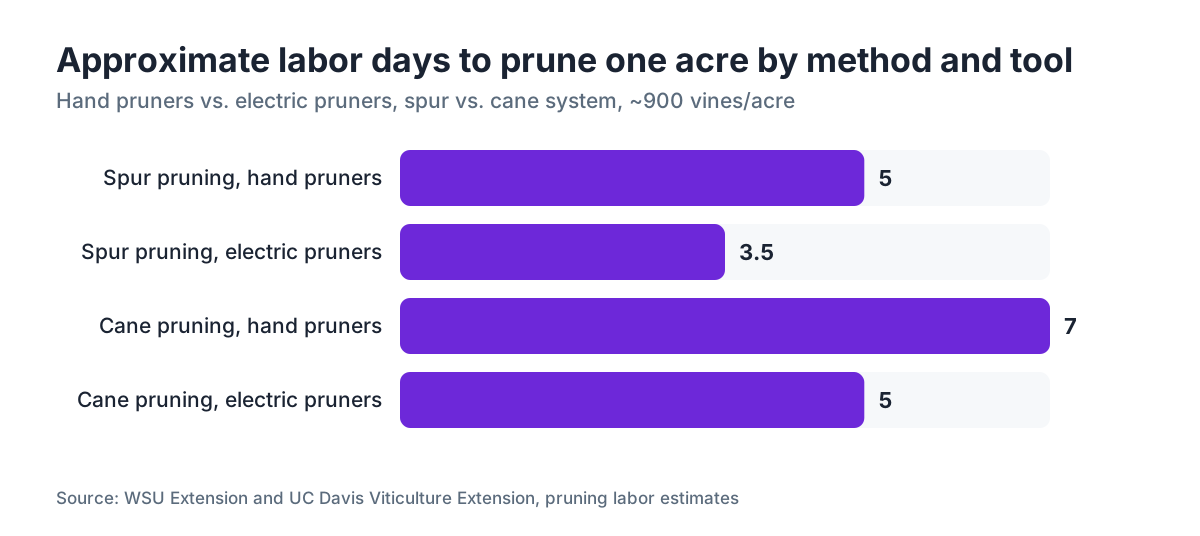
An experienced pruner on spur-pruned vines at standard spacing (about 900 vines per acre at 5x8) can prune roughly 150 to 250 vines per day by hand, so one acre takes 4 to 6 labor days. Cane pruning runs slower, typically 100 to 150 vines per day. Electric or pneumatic pruners raise output 30 to 50%. Crew experience, vine size, and disease pressure all shift the range.
Should you prune grape vines differently for wine grapes versus table grapes?
Table grapes are often cane-pruned to longer canes than wine grapes and trained on overhead trellis systems to maximize large, uniform clusters. Wine grape pruning limits cluster count for quality over quantity. Bud counts per vine for table varieties like Thompson Seedless or Flame Seedless usually run higher than for wine varieties. The core principles of timing, wound management, and balanced pruning apply to both.
Sources
- UC Davis Viticulture and Enology Department: Properly pruned vines retain only 10-30% of previous season's wood; spur pruning recommended for most California commercial varieties; cane pruning for Pinot Noir and cool-climate aromatics
- Cornell Cooperative Extension, Viticulture and Enology Program: Wound size and placement affect Eutypa infection rates; balanced pruning formula of 30 plus 10 buds formalized by Nelson Shaulis at Cornell; cane pruning recommended for New York Pinot Noir and Riesling
- Washington State University Viticulture and Enology: WSU recommends pruning as late as practically possible in cold climates; delaying pruning close to budbreak reduces frost risk to retained buds
- American Journal of Enology and Viticulture, Ravaz Index research: Ravaz Index of 5-10 (fruit weight to pruning weight ratio) indicates balanced vine; vines outside this range show reduced bud fruitfulness and fruit quality in subsequent seasons
- EPA Worker Protection Standard for Agricultural Pesticides: WPS requires workers observe re-entry intervals after pesticide applications and that spray records be accessible to workers and their representatives
- California Department of Pesticide Regulation: California requires pesticide application records and reporting to the county agricultural commissioner, with monthly reporting for production agriculture
- California Labor Code Section 226.2, Piece-Rate Compensation: California Labor Code Section 226.2 requires rest and recovery periods to be compensated separately at an hourly rate regardless of piece-rate pay arrangements
- UC Davis Viticulture and Enology, Grapevine Trunk Diseases (Eutypa lata): Eutypa lata spores spread primarily through rain splash onto open wounds, not via contaminated tools; wounds most susceptible in first days after cutting; protective wound treatments recommended for large cuts on young vines and during cordon establishment
- UC Agriculture and Natural Resources, ANR Catalog: UC ANR publishes downloadable pruning diagram PDFs with clear node labeling for spur and cane pruning systems
- WSU Extension: WSU extension materials include system-specific pruning diagrams for Riesling and red varieties grown in Washington and Oregon
Last updated 2026-07-09