Pruning Marquette grape vines: the complete grower's guide
TL;DR
- Prune Marquette in late dormancy, late February through early April in most cold-climate regions, using bilateral cordon with spurs or cane pruning.
- Retain 40 to 60 buds per established vine, more after a hard winter.
- Do a bud cut-test before final cuts.
- Renovate neglected vines over two or three seasons, never in one hard cutback.
- Marquette's high vigor takes heavier pruning than vinifera.
What makes Marquette different to prune compared to other grape varieties?
Marquette prunes like a vigorous cold-hardy vine, which means two things drive every cut: it grows hard, and its buds can die over winter. Those two traits pull in opposite directions, and reconciling them is the whole job.
Marquette is a University of Minnesota release from 2006, bred from a complex cross that includes Pinot Noir and wild North American species [8]. That parentage is where the cold hardiness and the shoot vigor both come from.
The vine is genuinely vigorous. In University of Minnesota trials, Marquette consistently produced canes of 10 to 18 nodes on well-managed vines, well above lower-vigor vinifera like Riesling [1]. More vigor lets you leave more wood without the imbalance you'd get on a weaker variety. It also means a neglected vine turns into a wall of wood fast.
Cold hardiness is the other lever. Marquette is rated to about -32 degrees F for primary bud survival, but that's not a promise every winter [1]. You'll still get years where a warm spell followed by a hard freeze pushes primary bud damage into 20 to 30 percent of positions. So your pruning plan needs a fallback: leave extra buds to cover expected losses, or hold final spur selection until you can do a cut-test in late February.
This is a different game from pruning Cabernet Sauvignon in California, where cold damage never enters the math. Coming to Marquette from a vinifera background, slow down and read the dormant canes before you cut.
When is the right time to prune Marquette vines?
Prune Marquette in late dormancy, as close to bud swell as you can manage without wrecking your crew's schedule. For most Marquette regions, that window is late February through mid-April, depending on the year and the site. Late is almost never wrong with this variety.
Those regions cover Minnesota, Wisconsin, Michigan, New York, Pennsylvania, and similar cold-climate states. University of Minnesota Extension recommends waiting until temperatures have stabilized above -10 degrees F before making final cuts, because fresh pruning wounds on Marquette can push winterkill slightly into cane tissue that was otherwise fine [1].
Here's the workflow most experienced cold-climate growers run. They do a rough cut in December or January, taking off 80 to 90 percent of the wood but leaving extra canes or spurs standing. Then they come back in late February or March, do the cut-test on primary buds (slice a bud lengthwise and read green versus brown centers), and make the final precision cuts based on what actually lived through the winter.
Timing pays off. University of Minnesota research found Marquette pruned four weeks before bud break showed 12 to 15 percent better primary bud survival after simulated late-frost events, compared to vines pruned earlier in deep dormancy [2]. The reason is plain: later pruning delays bud swell, so the vine doesn't deacclimate during a mid-winter thaw and then get caught by the next freeze.
In a warmer cold-climate region (zone 6 or so, where Marquette is being trialed), you have more slack. Even there, erring late costs you almost nothing.
What training system works best for Marquette: cane pruning or spur pruning?
Both work. Your choice depends more on your labor situation and your winters than on any biological preference Marquette carries. Cane pruning is more forgiving when cold damage hits hard; cordon with spurs is faster once established.
Bilateral cordon with spur pruning is the most common system in commercial Marquette plantings across the upper Midwest. Each vine keeps two permanent arms (cordons) along the trellis wire, with spur positions every 4 to 6 inches. Each spur gets cut back to 2 or 3 buds after harvest. Once the cordon is set, this system is fast per vine, which matters when you're moving through hundreds of vines in a short window.
Cane pruning keeps one or two new canes selected near the head of the vine each year and removes all of last season's bearing wood. Cornell University Extension work in New York found cane-pruned Marquette tended to produce slightly larger clusters and slightly higher yields per vine than spur-pruned vines at equal bud numbers, though the gap narrowed after year five as cordon vines filled their trellis space [3].
The tradeoff is speed against flexibility. Cane pruning runs slower, roughly 3 to 5 minutes per vine versus 1 to 2 minutes for an established spur-pruned vine. But when 40 percent of your primary buds are dead, cane pruning lets you grab the healthiest cane from wherever it grew. A cordon vine with dead buds scattered across fixed positions has to lean on secondary buds to fill the canopy, and those are less fruitful.
My take: for small blocks on high-variance cold sites, cane pruning is the safer bet. For 5 acres or more of Marquette with a reliable hired crew, cordon with spurs saves real money.
| System | Avg. pruning time per vine | Best for | Risk in cold damage years |
|---|---|---|---|
| Bilateral cordon / spur | 1-2 min (established) | Larger plantings, consistent crews | Higher (fixed positions) |
| Cane pruning | 3-5 min | Small blocks, variable winters | Lower (flexible cane selection) |
| Single Guyot | 2-3 min | Hillside sites, limited labor | Moderate |
See the University of Minnesota Extension grape training resources for photo comparisons of each system in cold-climate plantings [1].
How many buds should you leave per Marquette vine?
Leave 40 to 60 buds per established Marquette vine on standard spacing. That's the starting range, not a fixed rule. The right number comes from the vine's own production history, measured through pruning weight, and the biggest first mistake growers make is treating a bud count as a law instead of a calculation.
The tool for that calculation is the Ravaz Index: divide the total fruit weight at harvest by the pruning weight (all the wood you cut off). The target for Marquette is generally 5 to 8. A ratio below 5 means you're overcropping; above 10 means you left too much vegetative growth and undercropped [10].
In practice, most established Marquette vines on a 9-foot trellis at 8x6 or 9x6 spacing carry 40 to 60 buds for a full crop [1]. Young vines get pruned much harder: zero fruiting buds in year one (strip all flowers), then 10 to 15 buds in year two to build trunk and cordon.
If you farm a site that takes cold damage often, raise your retained bud count 20 to 30 percent before final spur selection, then thin the excess green shoots after budbreak. Shoot thinning eats labor. It still beats watching half your crop capacity vanish after a short-crop winter.
Washington State University Extension makes the core point: vine balance, not a fixed bud number, is the most reliable guide to long-term vine health across all Vitis cultivars [4]. That holds for Marquette as squarely as anything.
How do you renovate neglected Marquette grape vines?
Renovate a neglected Marquette vine over two or three seasons, not in one aggressive cutback. Its vigor makes neglect ugly fast: multiple competing trunks, tangled canes, crossing cordons, and dead wood buried in the middle. A single hard cut sets the vine back further than the phased route almost every time.
Here's why one-shot renovation fails. The root system is large and mature. Hit it with a severe cutback and it answers with enormous vegetative growth, giving you long unproductive canes instead of balanced fruiting wood.
A reliable three-season plan:
Season 1: Remove all clearly dead wood and any trunks or cordons with significant cankers or wood disease. Pick the two or three best structural trunks (straightest, youngest, best positioned) and cut out the rest. Shorten the retained structure by about half. Accept a small crop this year.
Season 2: Select and position spurs or new canes from the retained structure. Start enforcing the training system you actually want. Thin shoots hard in spring, aiming for one shoot every 4 to 6 inches on cordon systems. Fruit will still be overcrowded.
Season 3: Land on a balanced vine. This is usually when you can trust your Ravaz Index and manage the vine normally.
Trunk disease changes the math. If the structural wood shows spongy, discolored cross-sections or visible canker lesions, you may need to grow up a new sucker or low shoot as a replacement trunk over two seasons while the old trunk bears a declining crop. UC Davis has published trunk disease identification resources that apply regardless of variety [5].
On a vineyard with multiple acres of neglected Marquette, flag each vine with its renovation stage and track pruning weights and bud counts per vine across the three seasons. This is exactly where digital field records earn their keep.
What tools do you need and how should you sanitize them?
You need a good bypass pruner, loppers, and a pruning saw. Sanitize blades between vines when you're working a block with known trunk disease or crown gall, using 70 percent isopropyl alcohol or a 10 percent bleach solution. The tool list is ordinary. The sanitation question matters more than most growers admit.
A quality bypass pruner handles spurs and young canes. Loppers take canes up to about 3/4 inch. For structural renovation cuts on old cordons or trunks, a folding pruning saw or a reciprocating saw with a pruning blade cuts faster and cleaner.
Sanitation earns its time when a pathogen spreads mechanically on the blade, which is the case for trunk disease and crown gall. A 10 percent bleach solution (1 part bleach to 9 parts water) is the most widely cited option, but it corrodes tools fast. Many growers have moved to 70 percent isopropyl alcohol or quaternary ammonium sanitizers, which are gentler on steel and still work against the bacterial and fungal pathogens vineyards worry about [5].
For large wounds (anything over 1/2 inch across), a wound sealant or pruning paste is a real debate, not settled science. Some research shows sealants cut infection by Eutypa lata when applied right after the cut. Other work finds no meaningful benefit in dry climates. UC Davis Cooperative Extension recommends wound sealant on large cuts made in wet conditions or in regions with known Eutypa pressure [5].
A practical rule for cold-climate Marquette: you're usually cutting in dry, cold late-winter air, so wound sealant is low priority unless you see symptoms in the block. Doing renovation cuts on diseased wood? Use it.
What are the most common Marquette pruning mistakes?
Pruning too early. Growers who rush pruning into December or January to spread labor across a longer window often see more winterkill at the wound sites. The rough-cut approach (leave extra wood, come back for final cuts) costs a bit more labor and protects the vine.
Leaving too few buds after a cold winter. It feels backward, but a vine that already took cold damage needs more bud positions retained, not fewer, because secondary and tertiary buds carry less fruit. Cutting back to a normal bud number after a hard winter almost guarantees a short crop.
Ignoring pruning weight. Most hobby-scale growers toss the brush in a pile and never weigh it. That weight is the single best measure of vine balance you have. A small hanging scale and a tally sheet cost almost nothing and hand you real data to set next year's bud load.
Keeping too many trunks on a neglected vine. More trunks feel like insurance. In reality, four or five competing trunks mean none of them is well positioned or well fed. Pick the best two and cut the rest.
Missing row direction and prevailing wind when selecting canes. Sounds minor. On exposed sites with strong wind, canes pointed into the wind take mechanical damage all season. Choose canes you can tie away from the main wind direction.
Does Marquette respond differently to pruning in different climates?
Yes, and the differences are big enough to change how you manage the block. Cold northern sites push you toward conservative, well-timed pruning and a cut-test. Warmer southern sites shift the whole problem toward vigor and canopy control.
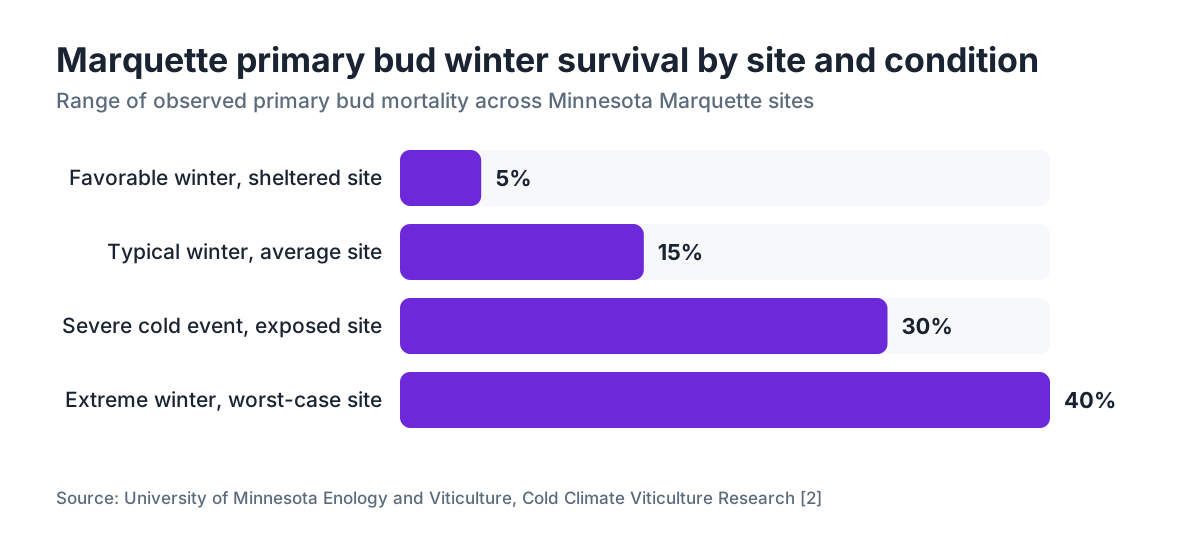
In Minnesota and Wisconsin, the main concern is cold damage to primary buds. That means managing bud load conservatively in spring, adjusting upward after cold winters, and timing dormant pruning carefully. University of Minnesota Extension has documented primary bud mortality of 5 to 40 percent across Marquette sites in the state, depending on winter conditions and site microclimate [2].
In Michigan and New York, growers face more variable winters than Minnesota plus more spring frost risk after budbreak. Some growers in the Lake Ontario AVAs and the Finger Lakes have pushed pruning well into April specifically to delay bud swell on Marquette and cut spring frost exposure. Cornell's viticulture program has published on delayed pruning as a frost mitigation strategy for cold-climate varieties [3].
In emerging plantings further south (Pennsylvania, Virginia, high-elevation Appalachian sites), cold hardiness fades as a worry and vigor takes over. Marquette in warmer climates throws more vegetative growth relative to fruit, so it needs more attention to canopy management through shoot positioning and leaf removal, all of which trace back to the pruning decisions you make in late winter.
Managing Marquette at a small operation and want to calibrate? Visiting a nearby vineyard that has grown Marquette for five years or more teaches you more than any bulletin will.
How should you record Marquette pruning for compliance and farm records?
Record the pruning date, block or row, system used, bud count per vine, pruning weight, and any cold-damage or canker notes. If you employ workers, you also need EPA Worker Protection Standard training records and any Restricted Entry Interval status at the time of entry. Pruning records do two jobs, agronomic and regulatory, and both matter.
On the agronomic side, the minimum useful record per event covers the date, which block or row was pruned, the system, bud count per vine (or per linear foot of cordon), pruning weight if you track Ravaz Index, and cold damage or canker observations. You don't need software for this. A paper field notebook works. Once you're past an acre or two, or tracking multiple vintages, digital records make year-over-year comparison far faster.
On the regulatory side, the EPA Worker Protection Standard requires that any worker or handler activity during a Restricted Entry Interval following a pesticide application be documented [6]. If you applied a fungicide whose REI reaches into your pruning window (this happens with some fall-applied fungicides carrying 24- or 48-hour REIs), you need records showing workers either waited out the REI or wore the right PPE. EPA states the WPS applies to "agricultural establishments" that use pesticides and employ workers, which reaches family farms that hire any outside labor [6].
This is a genuine compliance exposure point. The WPS was revised in 2015, and EPA has kept up enforcement activity in vineyard settings [6].
VitiScribe's field operations platform ties the pruning log directly to the spray record calendar, so it flags any open REI before a crew clocks into a block. That automated cross-check earns its keep during a busy pruning season when crews are moving across multiple blocks.
For general record structure, WSU Extension's vineyard management resources cover what to keep at the block level for GAP compliance [4].
What does a full-season Marquette pruning and canopy management timeline look like?
Pruning is the biggest single event, but it opens a chain of canopy decisions that runs all season and traces straight back to the cuts you made in late winter. Here's the timeline for a cold-climate Marquette block.
Late January to February: Rough cut (optional but recommended for cold sites). Take off 80 to 90 percent of last year's wood, leaving extra canes or spur stubs.
Late February to early April: Primary bud cut-test. Make final cuts. Set spur positions or select and tie canes. Record pruning weights and bud counts.
April to early May: Shoot emergence. Count green shoots per spur or node to read winter damage. Reset your crop expectations.
May (after 6 to 10 inches of shoot growth): Shoot thinning. Remove excess shoots at spur positions, unwanted suckers from the trunk, and double shoots from a single bud. Target one shoot every 4 to 6 inches on cordon systems.
June: Shoot positioning and tucking into trellis wires. Marquette grows fast and wants frequent attention here.
Late June to July: Leaf removal in the fruit zone, usually one or two leaves per cluster on the east or north side of the canopy depending on region. Helps spray penetration and fruit color.
September to October (post-harvest): Hinge canes down, or remove fruit canes if you cane-prune, setting up next year's rough cut.
Every one of those events is a field record entry. A block with clean seasonal records is a block whose patterns you can actually see and learn from.
What worker safety rules apply to pruning crews in vineyards?
Two frameworks cover pruning crews: the EPA Worker Protection Standard and OSHA's agricultural standards. If you use pesticides and employ workers, the WPS requires annual safety training, access to application and safety information, and access to decontamination supplies for anyone entering a treated area [6]. Pruning is physical, repetitive work with real injury and exposure risks.
As the farm employer, if any crew is pruning within 30 days of the last pesticide application, confirm the WPS training and documentation requirements are met before they enter.
OSHA's agricultural standards (29 CFR 1928) address general farm worker safety, including tool handling [9]. Bypass pruners and loppers are a common source of hand injuries during dormant pruning. Requiring cut-resistant gloves (ANSI A4 or higher) for the whole crew is a practical step that cuts injury rates and workers' comp exposure.
Cold adds hazard, given when Marquette pruning happens. When crews work below 40 degrees F, common during late-winter pruning in Minnesota or Michigan, OSHA's cold stress guidance recommends scheduled warm-up breaks and layered clothing [9]. This rarely becomes an OSHA citation on a farm, but it's a real worker welfare issue.
As of the 2015 WPS revisions, farms are required to give workers access to pesticide application and hazard information through a designated representative on request, among other enhanced protections [6]. Small operations with only a handful of workers carry somewhat lighter WPS obligations but are not exempt from the core standard.
Unsure which WPS requirements fit your operation size? The EPA's pesticide worker safety page has an operator obligation checklist [6].
Frequently asked questions
Can you prune Marquette vines in the fall after harvest?
You can remove fruit canes or hinge old wood in the fall, but final pruning cuts should wait until late winter. Cutting into live cane tissue in fall leaves wound sites exposed through the worst of winter and can push winterkill deeper into the vine. Rough-cut in late January or February, then make final cuts in March or April. That protects vine health in cold-climate Marquette regions.
How do you tell if Marquette primary buds survived the winter?
Do a cut-test. Take a dormant cane, slice through a bud with a sharp blade, and read the cross-section under good light. A living primary bud is green or cream-colored inside; a dead bud is brown or black. Cut 10 to 15 representative buds from multiple positions across the block before making final cuts. If primary bud mortality tops 30 percent, plan a lighter crop and keep extra bud positions.
What is the ideal bud load for Marquette per vine?
For established Marquette in balanced condition, most extension recommendations land at 40 to 60 buds per vine on standard spacing (8x6 or 9x6 feet). First-leaf vines get pruned to zero or near-zero fruiting buds. Second-leaf vines carry 10 to 20 buds. After cold winters with heavy primary bud damage, raise retained bud count 20 to 30 percent and thin green shoots after budbreak.
How long does it take to prune an acre of Marquette grapes?
On established, well-maintained vines with cordon-spur pruning, an experienced pruner handles roughly 100 to 150 vines per hour. At 8x6 spacing an acre holds about 900 vines, so one pruner needs 6 to 9 hours per acre. Cane-pruned vines run slower, closer to 60 to 80 per hour. Neglected vines needing renovation can drop to 20 to 30 per hour. Those figures track standard Minnesota Extension labor estimates for dormant pruning.
Should I use a high cordon or VSP trellis for Marquette?
Vertical Shoot Positioning (VSP) is the most common system for cold-climate Marquette and gives the best mix of canopy access and winter protection. High cordon works for mechanically harvested blocks but complicates hand-pruning and makes it harder to protect cordons with hilling or trunk wraps in hard-winter regions. Most Minnesota and Wisconsin commercial plantings run VSP with bilateral cordon at 36 to 42 inches off the ground.
How do you renovate a Marquette vine that has multiple competing trunks?
Select the two best-positioned, healthiest trunks (youngest, best angle, fewest canker sites) and remove the others at ground level or just below the head. On a severely neglected vine, don't do it all at once: cut half the excess trunks in year one and finish in year two after the vine adjusts. The retained trunks fill out faster once competition is gone.
Does Marquette need different pruning than other cold-hardy varieties like Frontenac or La Crescent?
Marquette is more vigorous than Frontenac and much more vigorous than La Crescent, a white variety with a lighter growth habit. Marquette supports a higher bud count per vine and fills trellis space faster. Frontenac is often managed at 30 to 50 buds per vine; Marquette can comfortably take 50 to 70 on high-vigor sites. The timing principles (delayed late-winter pruning, cut-test before final cuts) hold across all University of Minnesota releases.
What records does a small vineyard need to keep for pruning?
At minimum: pruning date, blocks or rows pruned, system and bud counts, pruning weights if you track vine balance, and notes on cold damage or disease. If you employ workers, EPA Worker Protection Standard training records and REI status at time of entry are legally required. Good records also note which vines you flagged for renovation, which becomes your road map for the next season.
Can I use a mechanical pruner or hedger on Marquette?
Pre-pruning with a mechanical hedger is common on large Marquette plantings to cut the volume of wood before hand-finishing. The mechanical pass removes about 70 to 80 percent of cane length, and crews follow to make final spur or cane selections by hand. Fully mechanical pruning without hand follow-up works for some cordon-trained blocks but limits your ability to pick the best wood positions and manage cold damage vine by vine.
What disease risks should I watch for during Marquette pruning season?
The main pruning-season concern is trunk disease, especially Eutypa lata and Botryosphaeria species, which enter through fresh wounds. In wet late-winter conditions, a wound sealant on cuts over half an inch reduces infection risk. Sanitize tools between obviously diseased vines with 70 percent isopropyl alcohol or a 10 percent bleach solution. UC Davis Cooperative Extension publishes trunk disease identification guides that are variety-agnostic and apply directly to Marquette.
How do delayed pruning strategies affect Marquette yield?
Delayed pruning (pushing final cuts to within 2 to 3 weeks of budbreak) delays bud swell and can shrink the spring frost exposure window by several days on some sites. University of Minnesota research found delayed pruning improved primary bud survival after simulated late-frost events compared to early dormant pruning. The tradeoff is compressed labor: fewer weeks to finish pruning, which is a real problem on large operations.
What's the best approach for the first year of pruning newly planted Marquette vines?
In year one, remove all lateral shoots and keep only the single best vertical shoot as the future trunk. Strip any flower clusters that form: no fruit in year one, ever. Tie the main shoot to a stake and top it at your first cordon wire or just above. Year one is entirely about building trunk structure and root mass. Harvesting even a small crop in year one delays long-term vine development by at least a season.
Sources
- University of Minnesota Extension, Marquette Grape: Marquette is a University of Minnesota release rated to approximately -32 degrees F for primary bud survival, and produces canes of 10-18 nodes under well-managed conditions; University of Minnesota Extension recommends waiting until temperatures stabilize above -10 degrees F before final pruning cuts.
- University of Minnesota Enology and Viticulture, Cold Climate Viticulture Research: University of Minnesota research documented primary bud mortality rates of 5-40% across different Marquette sites depending on winter conditions; Marquette pruned four weeks before bud break showed 12-15% better primary bud survival after simulated late-frost events.
- Cornell University Cooperative Extension, Viticulture and Enology: Cornell University Extension work in New York trials found cane-pruned Marquette vines produced slightly larger clusters and higher yields per vine compared to spur-pruned vines at equivalent bud numbers; Cornell's program has published on delayed pruning as a frost mitigation strategy for cold-climate varieties.
- Washington State University Extension, Viticulture and Enology: WSU Extension notes that vine balance, not a fixed bud number, is the most reliable guide to long-term vine health across all Vitis cultivars; WSU Extension vineyard management resources cover what records should be maintained at the block level for GAP compliance.
- UC Davis / UC ANR, Trunk Diseases of Grapevines: UC ANR / UC Davis Cooperative Extension has published trunk disease identification resources and recommends wound sealant on large cuts made during wet conditions or in regions with known Eutypa lata pressure; quaternary ammonium-based sanitizers are less corrosive than bleach and still effective against bacterial and fungal pathogens.
- U.S. EPA, Pesticide Worker Safety (Worker Protection Standard): The EPA Worker Protection Standard requires documentation of worker activity during Restricted Entry Intervals following pesticide applications, annual safety training for all agricultural workers, and access to pesticide application and hazard information; the WPS applies to any agricultural establishment using pesticides that employs workers, and was revised in 2015.
- USDA National Agricultural Statistics Service: USDA NASS tracks planted grape acreage by state; cold-hardy variety acreage including Marquette has expanded in Minnesota, Wisconsin, and Michigan in recent census periods.
- University of Minnesota, Marquette Variety Release Description: Marquette was released in 2006 by the University of Minnesota; its cold hardiness and Pinot Noir parentage are documented in the official variety release description.
- OSHA, Agricultural Operations Safety and Health Topics: OSHA agricultural standards (29 CFR 1928) address farm worker safety including tool handling; OSHA cold stress guidance recommends scheduled warm-up breaks and layered clothing for workers in temperatures below 40 degrees F.
- American Journal of Enology and Viticulture: The Ravaz Index (ratio of fruit weight to pruning weight) is the standard measure of vine balance; target Ravaz Index for most vinifera and cold-hardy cultivars is 5-10, with values below 5 indicating overcropping and above 10 indicating excess vegetative growth.
Last updated 2026-07-09