Pruning new grape vines: a year-by-year guide for the first three seasons
TL;DR
- New grape vines need three years of training before they carry a crop worth keeping.
- Year one, you pick one strong shoot and cut everything else.
- Year two, you build the trunk and lay in the first arms.
- Year three, you set the permanent fruiting system.
- Rush any step and you push establishment back, not forward.
Why does pruning young vines work differently than pruning mature ones?
On a bearing vine, pruning manages crop load and renews old wood. On a young vine, it directs every calorie the plant makes toward one thing: a single straight trunk and a root system big enough to carry decades of production. Different problems entirely.
A newly planted vine has almost no leaf area and roots that are just starting to work the soil. The temptation is to let it grow, let it sprawl, and call it kindness. It isn't. Several shoots fighting over the same small root reserve all come out weak. One focused shoot, trained straight up to your wire, is how you get a vine ready to bear in two or three years instead of four or five.
Washington State University's viticulture program says it plainly: "The goal in the first two years is to grow a straight, strong trunk and fill the trellis, not to produce fruit" [1]. That lines up with what Cornell's extension team recommends for cool-climate sites and what UC Davis teaches in its vine development work [2][3]. The principle holds in the Finger Lakes or the San Joaquin Valley. Only the timeline shifts with season length.
One more thing before we go year by year. Pruning a young vine wrong rarely kills it. It wastes a season. So if you botched something last year, you're not starting over. You're correcting course now.
When is the right time to prune young grape vines each year?
Late dormancy is ideal, but not for the reason most growers assume. Prune after the vine has gone fully dormant and before budbreak, roughly January through mid-March across most of the U.S. wine grape belt. Early-winter cuts leave fresh wounds open to cold damage. Late cuts made near budbreak slow wound healing.
The window matters. Prune too early in winter and you expose fresh wounds to cold damage. Prune very late, after buds start to swell, and you get "bleeding," the loss of xylem sap from cut ends. Bleeding itself doesn't hurt a young plant much, but cuts made at or just past budbreak do slow wound healing [4].
In warmer regions like Paso Robles or the South Coast of California, the window opens earlier. In cold continental climates, it pushes later.
The timing rule specific to young vines: don't prune at planting if the vine is a dormant bare-root cutting. Let it break dormancy, pick the best shoot, and make your first training cut about four to six weeks after shoot emergence. Cutting a bare-root vine before it leafs out strips the carbohydrate reserves that drive early root growth.
What do you actually do in year one?
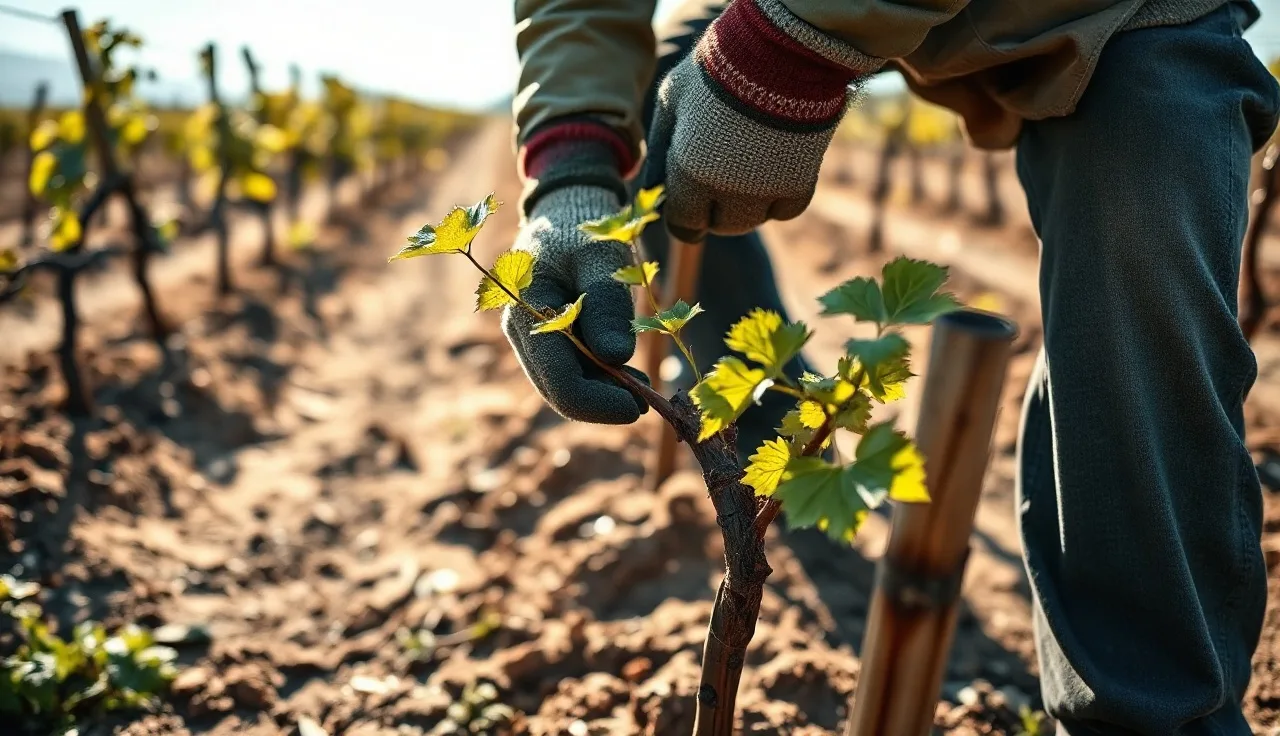
Year one is almost embarrassingly simple. The hard part is trusting it. After the vine breaks dormancy and shoots reach 3 to 4 inches, pick the single strongest, most upright shoot and remove every other shoot flush to the trunk. That's the whole spring operation.
Through summer, tie that one shoot loosely to a training stake every 8 to 12 inches as it climbs. You want it dead vertical. If it throws lateral shoots (side growth off the main shoot), leave them on a vigorous vine because they add leaf area and feed the roots. Pinch or remove them on a struggling vine so all the energy stays in the leader.
At the end of year one, during that January-to-March dormant window, look at what you have. A strong vine on a good site might carry a shoot 4 to 5 feet long. A stressed vine on a tough site might give you 18 inches. Don't panic either way.
If the shoot reached your first training wire (typically 30 to 36 inches off the ground for most VSP systems), cut it at the wire and get ready to build your cordon or cane arms in year two. If it fell short, cut it back to 2 or 3 buds. That forces a stronger shoot next year, which beats fighting with a weak, spindly trunk. Cornell's viticulture extension recommends exactly this cutback for underperforming first-year vines [2].
Here is the one thing you never do in year one: leave fruit. If the vine flowers, strip the clusters by hand. Every cluster you let set in year one costs you six to twelve months of vine development. Numbers vary by study, but a 2018 review in the American Journal of Enology and Viticulture found first-year fruit removal improved trunk diameter by an average of 14% over unfruited controls, and the difference held into year three [5].
How do you handle year two pruning and training?
Year two builds the arms, the permanent woody structure that everything else hangs from for the next twenty years. Your vine should start the season with a trunk reaching at least to the first wire. If it fell short, give it another year of trunk growth using the year-one cutback. If it made it, you face the one decision that shapes every future pruning cut: cane pruning or cordon (spur) pruning.
For a bilateral cordon (the most common setup for Vitis vinifera in the U.S.): when the trunk hits the fruiting wire, pinch the growing tip to stop upward growth. Two laterals will push near the wire. Train one each direction along it. By season's end you want 3 to 5 feet of cordon each way. At dormant pruning, cut each arm back to mature wood, leaving 12 to 18 inches per side if growth was good, less if it wasn't.
For cane-pruned systems (Guyot, common for Pinot Noir and cooler climates): let the trunk grow past the first wire and select two strong laterals near the wire. Cut each to 8 to 12 buds. You'll lay these horizontally and tie them to the fruiting wire. These are your year-three fruit canes.
Scuppernong is its own animal. Scuppernong (Muscadinia rotundifolia) grows hard and gets trained to a single trunk with a bilateral cordon on a high wire, often 5 to 6 feet up [6]. Spur spacing runs wider, around 6 to 12 inches, because the growth is so rampant. Prune scuppernong later in dormancy than vinifera in the same region, late January or February in the Southeast, to cut the risk of cold damage on exposed wounds. The North Carolina Cooperative Extension recommends 2 to 3 buds per spur on mature scuppernong vines [6].
Year two is still not a crop year. You can carry a few clusters (no more than 1 or 2 per shoot) on a vigorous vine, but UC Davis's viticulture faculty recommend keeping fruit load under 50% of a mature vine's typical yield [3].
What changes in year three, and when can you take a real crop?
Year three is when the vine starts to feel like a vine. The cordon or cane structure is in place, you have defined spurs or fresh canes, and for the first time you can carry meaningful fruit. But you still hold back.
For cordon and spur-pruned vines: each spur position should carry 2 to 3 well-placed buds. Rub off any shoot growing downward from the cordon or straight into the trellis. As shoots grow, tuck them into the fruiting zone and tie where needed. Cluster thinning still matters. WSU recommends holding year-three vines to roughly 60 to 75% of target mature yield so you don't stress the still-developing root system [1].
For cane-pruned vines: at the start of year three, pick the best two canes from each arm, one to be the fruit cane, one cut to 2 buds as a renewal spur. Tie the fruit cane to the wire with 6 to 10 buds. Shoots from the renewal spur become next year's canes. That's the repeating cycle of cane pruning.
So when can you take a full crop? Honest answer: year four or five for most varieties on good sites. A vine trained right through years one, two, and three will be genuinely ready by its fourth or fifth leaf. Push it earlier and you don't just risk quality. You can permanently weaken the trunk by forcing fruit before root reserves are deep enough to carry both fruit and continued growth.
Nobody has a clean industry-wide study pinning this down across every variety and climate. The closest data comes from long-term trial work at UC Davis and WSU, both of which consistently find that year-one and year-two fruit removal leads to higher yields by year five than letting young vines fruit freely [1][3].
Cane pruning vs. spur pruning: which system should you choose for young vines?
The choice happens in year two and you're stuck with it, so decide with your eyes open. It comes down to your variety's bud fruitfulness. Spur pruning suits varieties that fruit reliably from basal buds. Cane pruning is required for varieties whose basal buds carry little fruit.
Spur pruning (cordon) is easier to run long-term, needs less skill at the decision step, and works well for varieties that fruit from basal buds (the buds closest to the base of the cane). Cabernet Sauvignon, Merlot, Zinfandel, and Syrah all do well spur-pruned.
Cane pruning is necessary where basal buds are poorly fruitful. Pinot Noir, Riesling, Gewurztraminer, and Concord are the classic cases. Spur-prune these and you get plenty of vegetative growth and little fruit, because the buds near the cordon just don't carry clusters reliably. Cane pruning lets you place the fruitful buds (typically buds 3 through 8 on the cane) in the fruiting zone.
For new growers, spur pruning is the better place to start. The system forgives, the cuts are simple (2 to 3 buds per spur, same call every year), and you can see your mistakes clearly the next season. Cane selection takes real judgment. You're reading cane diameter (pencil-thick is the target, roughly 8 to 12 mm), internode length, and position relative to the renewal spur. That eye takes a few seasons to build.
Match the variety before you pick the system, every time. Know your variety's bud fruitfulness before you commit. Cornell's viticulture team publishes bud fruitfulness data for most major varieties [2].
| Variety | Basal bud fruitful? | Recommended system |
|---|---|---|
| Cabernet Sauvignon | Yes | Cordon/spur |
| Merlot | Yes | Cordon/spur |
| Pinot Noir | No | Cane (Guyot) |
| Riesling | No | Cane |
| Zinfandel | Yes | Cordon/spur |
| Scuppernong | Yes | Cordon/spur (high wire) |
| Concord | No | Cane |
| Chardonnay | Marginal | Either; climate-dependent |
What tools do you need and how do you protect yourself from pesticide exposure during pruning?
The tool list is short. A pair of bypass hand pruners, loppers for wood over half an inch, and a sharpening stone. That covers most young-vine work. Skip anvil pruners. They crush instead of slicing and leave larger wounds you don't want on a young vine.
Sharp tools matter more on young vines than on mature ones. You have less wood to spare, and wound healing at this stage burns energy you'd rather send into growth. Dull cuts tear the cambium and slow callus formation.
On safety and compliance: pruning season overlaps dormant spray applications in a lot of vineyards. If you're putting on dormant oils, copper fungicides, or lime sulfur near pruning time, the EPA's Worker Protection Standard (WPS) applies. Under the WPS (40 CFR Part 170), workers re-entering a treated field must get safety training, have access to decontamination supplies, and be told of any restricted entry intervals (REIs) in effect [7]. Fresh pruning cuts also open the door to wood diseases like Eutypa lata and Botryosphaeria. Applying a wound protectant (bordeaux paste, or a registered wound sealant) to cuts larger than a quarter-inch is standard practice on the West Coast, though the evidence for cuts smaller than that is thin [8].
For record-keeping through this stretch, tracking which blocks got pruned, which got dormant sprays, and what REIs were active, VitiScribe's field operations log lets you tie spray records directly to pruning blocks so your WPS documentation and training records sit in one place. Paper works too. Audits just go faster when records are searchable.
Keep pruning debris in mind. In high-Eutypa regions (most of California, Oregon, and Washington), burying or burning debris instead of leaving it in the row cuts pathogen spread. Some counties restrict burning, so check with your local ag commissioner.
How many buds should you leave when pruning a young vine?
This is the most common practical question, and there's no single universal number, but there is a framework. Match the bud count to the vine's demonstrated ability to grow shoots. Count the healthy shoots the vine grew last season, then leave 50 to 60% of that number as buds going into the next season. A vine that grew 8 solid shoots gets 4 or 5 buds. That keeps it from overextending.
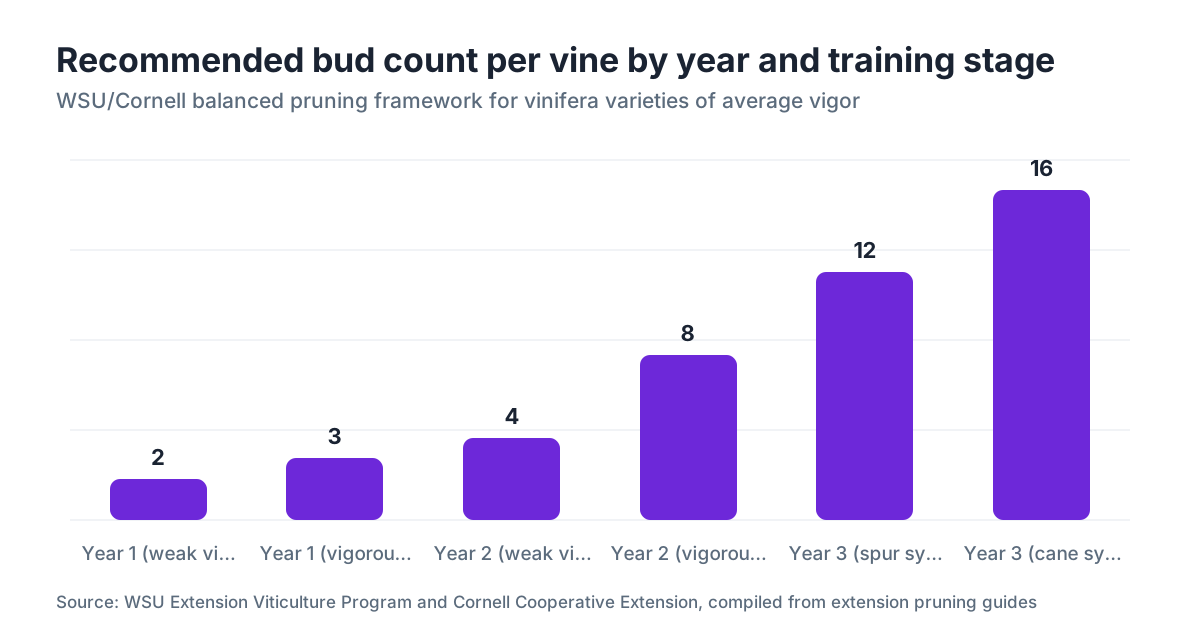
WSU's extension guide uses a formula called balanced pruning, where bud count scales with pruning weight (the weight of wood you cut off). For young vines, the practical version is: year one, leave 2 to 3 buds. Year two, 4 to 8 depending on vigor. Year three, 8 to 12 buds per vine in a spur system, or 2 canes of 6 to 10 buds each in a cane system [1].
Balanced pruning came out of Nelson Shaulis's work at Cornell in the 1950s and it's still the most field-tested way to match bud number to vine capacity. His original trials showed over-budded vines consistently made less total sugar per hectare than properly balanced vines, a result WSU trials replicated decades later [2][9].
For scuppernong and other muscadines, run bud count per spur lower. Two to three buds per spur is standard on mature vines, because the variety's vigor means each shoot carries more clusters than most vinifera [6].
What mistakes do growers make most often with young vine pruning?
Let me name the ones that actually set vineyards back.
Leaving fruit in year one. Covered above, worth repeating: this is the single most expensive mistake in young vine management. The AJEV review found 14% smaller trunk diameter in fruited vines by year two [5]. That's a measurable, lasting structural cost.
Training two shoots into the trunk instead of one. Some growers get nervous about committing, so they keep two and figure they'll pick the winner later. What happens is both get built into the trunk and you end up with a forked, weak trunk that takes mechanical damage easily and is awkward to tie. Pick one. Cut the rest.
Not tying the trunk often enough. An unsupported shoot grows into a winding, crooked form that's a headache to work around for the life of the vine. Tie every 8 to 12 inches with a soft tie, loose enough not to girdle.
Pruning too hard in year two to make up for a weak year one. If year one disappointed, the right move is another cutback to 2 or 3 buds, not trying to build a trunk and set cordons at once. Going too fast leaves you a vine on a weak foundation.
Ignoring disease. Young vines are especially open to Botrytis on fresh cuts in wet climates and to trunk diseases (Eutypa, Esca) where those pathogens are established. Pruning late in dormancy, when healing is fastest, and sealing larger cuts cuts the risk sharply.
For growers in the Southeast running scuppernong or other muscadines, the usual mistake is under-pruning. Muscadines grow so hard that many growers won't cut back enough, leaving a tangle of unproductive wood. With scuppernong especially, be ready to take off 70 to 80% of last year's growth at dormant pruning. The vine can handle it [6].
How does climate and variety affect the three-year pruning timeline?
The three-year framework fits most of the U.S. wine grape belt, but it bends at the edges. In very short-season regions (northern Minnesota, high-elevation Colorado, parts of Michigan), establishment runs four years, not three. The growing degree day accumulation just isn't enough to move a vine from bare root to full-bearing structure in 36 months.
That's normal, not a failure. Cornell's extension work on cold-hardy hybrids like Marquette and La Crescent shows establishment timelines of 4 to 5 years in zone 5 climates [2].
In warm regions with long seasons (California's Central Valley, the Texas Hill Country, the Paso Robles area), vines sometimes establish faster than three years. A vine planted in spring that racks up 3,200 or more growing degree days (base 50 degrees F) in its first season may be ready for a modest crop by year three with no downside. The metric that counts is trunk diameter, not age. A trunk at the fruiting wire measuring at least 12 to 15 mm is generally ready for its first real crop, whatever year the calendar says.
Variety matters too. Vigorous rootstocks (110R, 1103P) push establishment faster than weaker ones (101-14, 420A), and own-rooted vines often establish slower than grafted vines on vigorous stocks, at least through the first two years.
For vineyard work on cool-climate sites, the practical advice: don't chase the three-year target. Chase the structural targets (trunk diameter, cordon fill, root depth) and let the timing fall out of those.
How do you record and track pruning decisions to stay compliant?
Most growers don't think of pruning records as compliance documents, but they are. Apply any pesticides around pruning time (dormant sprays are nearly universal), and your WPS records need to connect spray events to field activities [7]. Run under a state organic certification or a sustainability program like LIVE or SIP, and your pruning decisions and any wound treatments need documenting too.
Beyond compliance, good pruning records earn their keep. Knowing the bud count you left per vine in year two and what the shoot count looked like by July lets you calibrate next year's cuts with real data instead of memory. Most experienced viticulturists keep a running log by block: date pruned, bud count range, pruning weight if measured, disease observed, treatments applied to cuts.
A notebook works. A spreadsheet works. VitiScribe's block-level field log is built for exactly this, tying pruning notes to spray records and harvest data in one searchable record. The point is to write it down somewhere, consistently, at the time you make the cuts.
For operations with several blocks or several varieties at different training stages, keep a simple table: each block's establishment year, current training system, target bud count, and last pruning date. It's easy to lose track of which block is in year two and which is in year three when you're running ten acres of young vines across three planting years.
What do you do if a young vine was damaged and you need to start over?
Frost damage, a tractor clip, disease taking out a trunk, these happen, and recovery is basically a restart. The good news: the root system, the expensive part, usually survives.
If the trunk is damaged at or above the graft union (for grafted vines) or above the soil line (for own-rooted vines), the fix is the same cutback you'd run in a weak year one: cut to 2 or 3 healthy buds just above the damage. The vine sends up new shoots from there. Pick the best one and start training again. You lose 6 to 12 months but keep the roots.
If damage sits below the graft union on a grafted vine, you have two options: nurse the rootstock back and regraft in spring, or pull the vine and replant. Replanting usually wins if the root system is also compromised. Nursing a damaged rootstock wins if the roots are intact and you want to keep the established root depth.
Frost damage is a special case: don't prune frost-hit young vines right away. Wait until you can clearly see which buds and shoots are alive. Secondary and tertiary buds often break from frost-damaged nodes and can rebuild the vine. Cut too early and you throw away viable wood. UC Davis extension recommends waiting at least two weeks after a frost event before assessing damage on young vines [3].
Frequently asked questions
When should you prune grape vines for the first time after planting?
Don't prune at planting if you're working with dormant bare-root vines. Let the vine break dormancy, then wait until 3 to 4 inches of shoot growth appear before making any cuts. Your first real selection cut, removing all shoots except the strongest one, happens about four to six weeks after budbreak. After that, dormant pruning happens annually in late dormancy, typically January through mid-March in most U.S. wine regions.
Should you let a first-year grape vine fruit?
No. Remove all flower clusters in year one by hand as soon as they appear. Research in the American Journal of Enology and Viticulture found first-year fruiting reduced trunk diameter by an average of 14% versus de-fruited vines, and that structural deficit lasted into year three. Letting a young vine carry fruit feels like progress, but it measurably slows establishment.
How many buds should you leave on a second-year grape vine?
For a vigorous second-year vine that grew 6 to 10 feet of shoot in year one, leave 4 to 8 buds at dormant pruning. For a weaker vine that didn't reach the fruiting wire, cut back to 2 or 3 buds and spend year two building the trunk rather than establishing the fruiting system. WSU's extension program uses balanced pruning, scaling bud count to demonstrated vigor, not to a fixed number.
What is the difference between spur pruning and cane pruning for young vines?
Spur pruning sets a permanent cordon (horizontal arm) with short spurs cut to 2 or 3 buds each year. Cane pruning selects one-year-old canes each spring and replaces them annually. Choose by your variety's bud fruitfulness: Pinot Noir and Riesling have poor basal bud fruitfulness and need cane pruning; Cabernet Sauvignon and Zinfandel fruit reliably from basal buds and can be spur pruned. The choice made in year two is permanent.
How do you prune scuppernong grape vines?
Scuppernong (Muscadinia rotundifolia) gets trained to a single trunk with a bilateral cordon on a high wire, typically 5 to 6 feet off the ground. Prune during late dormancy, usually February in the Southeast. Leave 2 to 3 buds per spur, with spurs spaced 6 to 12 inches apart. Be ready to remove 70 to 80% of last year's growth. Muscadines grow aggressively and under-pruning is the most common mistake. The North Carolina Cooperative Extension is the best resource for regional specifics.
Can you prune grape vines in the summer during the first year?
You can, and sometimes you should. Summer pruning in year one means removing lateral shoots (side growth off the main leader) if the vine is struggling, and pinching the main shoot tip if it reaches the fruiting wire mid-season so side shoots start the cordon arms. Aggressive summer hedging of the main shoot is not recommended in year one. You want leaf area driving root development, not less of it.
What tools do you need to prune young grape vines?
Sharp bypass hand pruners are the main tool. Add loppers for any cane thicker than half an inch. Avoid anvil-style pruners, which crush wood instead of making clean cuts and slow healing. A sharpening stone matters more than the brand of pruner: dull cuts on young vines tear the cambium and open larger entry points for wood pathogens. Keep a wound sealant or bordeaux paste on hand for cuts larger than a quarter-inch.
Do WPS rules apply during grape vine pruning season?
Yes, if any pesticides have been applied recently. The EPA's Worker Protection Standard (40 CFR Part 170) requires that workers entering a treated field receive safety training, know any active restricted entry intervals, and have access to decontamination supplies. Dormant sprays of copper fungicides, lime sulfur, and horticultural oils are common around pruning season and all carry REIs. Check product labels and your spray records before sending crews into recently treated blocks.
How does rootstock affect how you prune a young vine?
Rootstock affects establishment speed more than pruning technique. Vigorous rootstocks like 110R and 1103P push more shoot growth in years one and two, which can let you build the trunk and fill the trellis faster. Weaker rootstocks like 101-14 Mgt and 420A establish more slowly. The cuts themselves are the same, but the bud count you can leave and the year you start cropping shift with how hard the rootstock drives growth.
How long does it take for a grape vine to reach full production?
With proper training and no crop in years one and two, most vinifera varieties reach 60 to 75% of mature yield capacity by year three, and full production by year four or five. Cold-hardy hybrids in short-season climates like zone 5 often take an extra year. Rushing early fruit load delays this timeline rather than advancing it. Root system depth, not vine age, is the real limit on production capacity.
What diseases should you watch for when pruning young vines?
Eutypa lata and Botryosphaeria species are the main wood disease concerns, particularly in California, Oregon, and Washington. Fresh pruning wounds are the primary infection route. Pruning late in dormancy (closer to budbreak) and sealing larger cuts reduces infection risk. Esca is present in older European vineyards and turns up increasingly in U.S. plantings. Burning or burying pruning debris instead of leaving it in the row lowers the pathogen load in the block.
What happens if you skip dormant pruning on a young vine for one year?
A skipped year on a young vine isn't catastrophic, but it sets you back. The vine puts out a sprawling mass of thin shoots with little structure, and you'll spend extra time the following year figuring out which wood to keep and building the training system from a messier start. It also usually means a smaller first crop, because fruitful wood isn't positioned where you want it. Prioritize young vine pruning over mature vines if crew time is tight.
Is it better to prune early or late in the dormant season for young vines?
Later in dormancy is generally better for young vines in frost-prone regions. Pruning close to budbreak (late February to mid-March in most of the U.S.) means wounds heal at the same time buds break, which is the fastest healing window. It also shortens the time fresh cuts sit exposed in cold weather. The trade-off is a narrower scheduling window. In warm regions with little frost risk, earlier pruning is fine and gives you more room to schedule crews.
Sources
- Washington State University Extension, Viticulture and Enology Program: WSU states the goal in the first two years is to grow a straight, strong trunk and fill the trellis, not to produce fruit; recommends balanced pruning approach scaling bud count to vigor
- Cornell University Cooperative Extension, Viticulture Program: Cornell recommends cutback to 2-3 buds for underperforming first-year vines, publishes bud fruitfulness data by variety, and documents 4-5 year establishment timelines for cold-hardy hybrids in zone 5
- UC Davis Viticulture and Enology Department: UC Davis recommends keeping fruit load below 50% of mature vine typical yield in year two and waiting at least two weeks after frost to assess damage on young vines
- UC Davis Viticulture and Enology, Pruning and Training publications: Cuts made at or just past budbreak slow wound healing compared to cuts made in mid-to-late dormancy
- American Journal of Enology and Viticulture, fruit removal study review: 2018 AJEV review found first-year fruit removal improved trunk diameter by an average of 14% compared to unfruited controls, with the difference persisting into year three
- North Carolina Cooperative Extension, Muscadine Grape Production Guide: NC State recommends scuppernong trained to bilateral cordon on high wire at 5-6 feet, with 2-3 buds per spur on mature vines and late January/February pruning timing in the Southeast
- EPA Worker Protection Standard, 40 CFR Part 170: Under the WPS, workers re-entering a pesticide-treated agricultural field must receive safety training, be informed of REIs, and have access to decontamination supplies
- University of California Agriculture and Natural Resources, Eutypa Dieback and Trunk Disease Resources: Applying wound protectants to pruning cuts and burning or burying pruning debris reduces Eutypa and Botryosphaeria infection risk; evidence for efficacy is stronger for cuts larger than one-quarter inch
- Cornell University, Nelson Shaulis Balanced Pruning Research and WSU validation trials: Balanced pruning, developed by Nelson Shaulis at Cornell in the 1950s, showed over-budded vines consistently produced less total sugar per hectare than properly balanced vines, replicated in WSU trials
Last updated 2026-07-09