Pruning old grape vines: a complete field guide
TL;DR
- Renovate old grape vines over one to three seasons: strip dead wood, keep the two to four strongest permanent arms, then reset spurs to two buds spaced 4 to 6 inches apart.
- Don't do it all in one year on badly neglected vines.
- Time your cuts after the coldest nights pass but before 50% bud swell.
Why old grape vines need different pruning than young ones
A vine that's been in the ground 20 or 30 years has one big advantage over a young plant: a root system that took decades to build. That root mass can push huge energy into whatever wood you leave behind. The problem is that old vines, especially neglected ones, have often turned that energy into a tangle of dead spurs, mummified clusters, and crossing arms that shade each other out.
Pruning an old vine is not the same job as annual upkeep on a well-trained five-year-old. The goals shift. You're doing more than managing this season's crop load. You're deciding on permanent wood that will shape canopy geometry, disease pressure, and yield for the next decade. Get those calls wrong and you'll spend years fixing them. Get them right and a 40-year-old vine can out-produce a young replacement by a wide margin.
The stakes are different too. On an old vine, every large-diameter cut is an open door for Eutypa lata, Botryosphaeria, and the other trunk disease fungi that have probably already colonized part of the vine's interior. [1] Every saw stroke balances renewal against infection risk. That trade-off barely exists on young vines.
Spur pruning old stock also has to reckon with what's already there. Dead spur stubs pile up year after year and can block vascular flow to healthy positions above them. Clearing those stubs cleanly is often the single most useful thing you do in the first renovation year.
How do you read an old vine before you make the first cut?
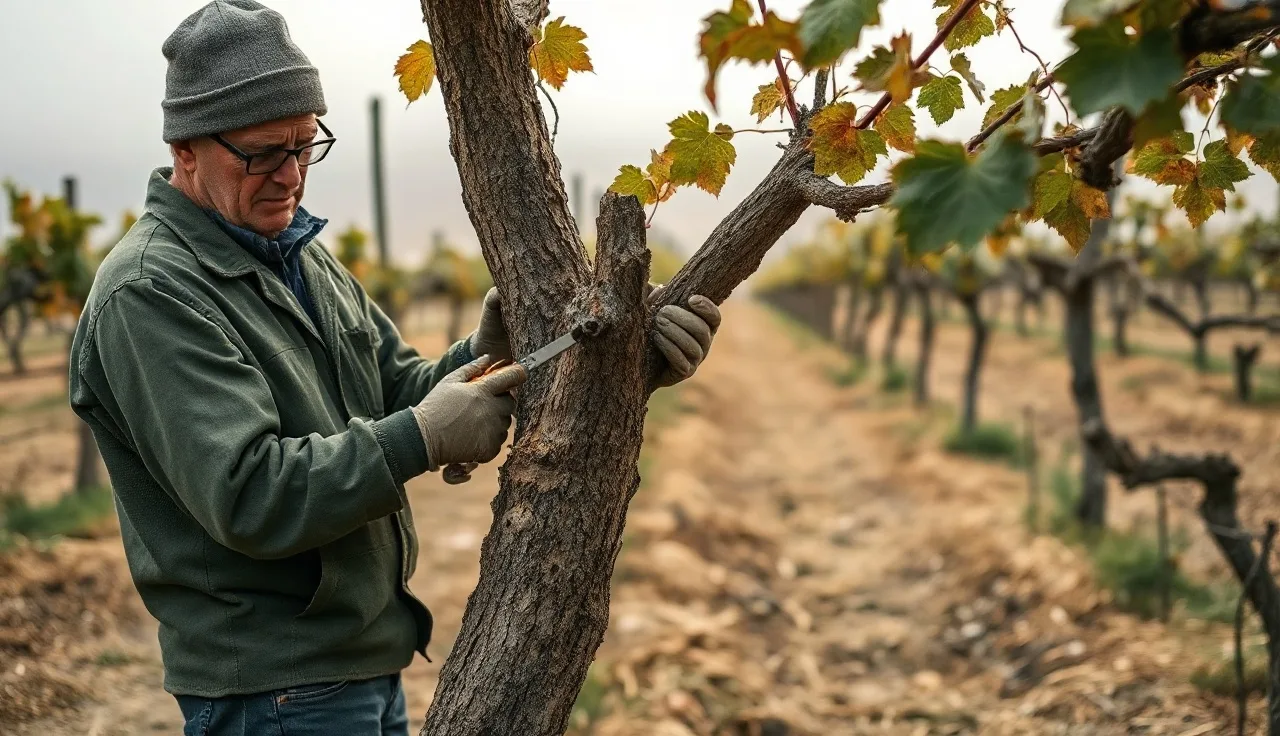
Walk the row in late winter with the leaves down and spend two minutes on each vine before you touch it. You're hunting for three things: the cordon or head positions that are alive and well-attached, the wood with clear vascular continuity back to the trunk, and the dead zones where spur stubs have piled up over several seasons.
Read the pith. Make a small test cut and look at the face. Live wood is green or cream at the cut; dead wood is brown or gray all the way through. [2] On older vines with trunk disease, you'll sometimes find a wedge-shaped brown stain in the cross-section even inside an otherwise living arm. That's internal necrosis from Eutypa or Botryosphaeria, and you need to know where it stops before you commit to keeping that arm.
Mark what you plan to keep before you cut a thing. Surveyor's tape works. The point is that once you're mid-cut on a big old vine, it's easy to lose the thread of the structure and take too much. Decide twice, once from a distance and once up close with the saw in hand. That catches most errors.
Check the base of the trunk too. Old vines sometimes throw suckers or low shoots near the graft union. Those can be your escape route if the top structure is badly diseased, or they can be a drain that's stealing energy from productive positions. Know which one you've got before you start.
What is the right time of year to prune old vines?
Prune old vines in the same window as young ones, after the coldest temperatures of winter have passed and before 50% bud swell. The difference is that mistakes cost more on old wood. Prune too early and fresh cuts sit exposed to killing frosts that damage far more tissue than the cut itself. Prune too late, past heavy bud swell, and you force the vine to throw away energy it already spent.
UC Davis Cooperative Extension advice is to prune when vines are dormant but after the region's average last hard freeze, aiming for the stretch between full dormancy and 50% bud swell. [3] In most of California's coastal valleys that's January through early March. In the Pacific Northwest, WSU Extension says wait until February or later on cold sites and use bud swell stage rather than the calendar as your trigger. [4]
On old or neglected vines, some growers run a "delayed pruning" approach on a subset of vines to cut frost risk. Leave extra canes on selected vines through the cold period to insulate the buds you want, then cut back to final spur positions once frost danger passes. Cornell Cooperative Extension has documented this for Concord and hybrid varieties in New York and found it reduces frost-kill on vulnerable sites. [5]
One practical note. Big cuts on old cordons and trunks callus slower than small cuts on young wood. If you've got heavy structural cuts to make, do them earlier in the dormant window so callusing can begin before the spring flush, shrinking the open-wound period that trunk disease fungi exploit.
How do you prune a severely neglected old grape vine? (the multi-year renovation approach)
Renovating a badly neglected vine in a single year can work, but it carries real risk. A vine that's run wild for years has locked much of its reserve carbohydrate into the standing wood. Take too much at once and you stress it into weak, disorganized shoots that are hard to train and easy to lose to disease or frost. Spread the work over two to three years instead.
Year 1: Pick the best two to four arms that connect cleanly to the trunk, sit well on the wire, and carry at least a few viable spur positions. Cut out all the obviously dead wood and every arm you've decided to abandon long-term. Don't fuss over perfect spur placement yet. Your goal this year is structural clarity. Leave renewal canes wherever you can find them, and remove no more than about 50% of the vine's total wood unless disease leaves you no choice.
Year 2: With a full season of growth on the arms you kept, you can see which positions are actually strong. Set your spurs to two buds at 4 to 6 inch spacing along the cordon. Cut off any shoots that grew from last year's cuts. They rarely have the wood quality you want for permanent structure. Keep a renewal cane or two if the cordon still has gaps.
Year 3: Fine-tune. The vine should be back on a normal annual spur pruning cycle by now. Clean off any dead stubs left from earlier years flush to the cordon surface.
This schedule assumes the trunks are viable. If necrosis in cross-section runs to within a few inches of the graft union, the honest answer is that renovation may not pay. Some old blocks make more economic sense to replant. [6]
For a walkthrough of the cuts, search "pruning old grape vines" on the UC ANR (UC Agriculture and Natural Resources) YouTube channel. Their farm advisor demonstrations show the work in real time, which beats photos for understanding the three-dimensional structure you're dealing with.
Spur pruning old grape vines: how many buds, and where?
Two buds per spur, spurs spaced 4 to 6 inches apart along the cordon. [3] That target is the same as for young spur-trained vines, but on old wood you fight irregular cordon surfaces, dead-stub interference, and fewer good positions to choose from.
When you find a one-year-old shoot coming off a good spot on the cordon, that shoot becomes your spur. Cut it to two buds. The trick is judging what counts as a "good spot." You want the spur base connected cleanly to the cordon, not springing from a dead stub that happens to have one live shoot on it. Push your thumb into the base. If the wood there is spongy, discolored, or plainly dead, the shoot's vascular supply is compromised even when the shoot itself looks fine.
When dead sections leave gaps in the cordon, you have two moves. Fill the gap with a long cane laid along the wire and spur-pruned next year, essentially rebuilding that stretch of cordon. Or accept the gap and manage the vine asymmetrically. On commercial blocks the gap-fill usually pays off. Head-trained old vines on stakes follow the same logic, except you're picking spurs off the head instead of along a wire.
Here's how spur counts should track vine vigor on old vines:
| Vine vigor level | Recommended spurs per vine | Buds per spur | Notes |
|---|---|---|---|
| Low (old, stressed) | 4-6 | 2 | Match bud count to vine capacity; over-cropping weak old vines collapses them |
| Moderate | 8-12 | 2 | Standard range for established bilateral cordons |
| High (old, vigorous) | 12-18 | 2 | Consider a renewal cane or two to redirect energy |
| Unknown/first-year renovation | Start low, assess | 2 | Leave extras; you can always remove in summer |
Over-spurring a low-vigor old vine is one of the most common mistakes people make. The vine can't feed all those positions and you get weak, uneven shoot growth for your trouble. Leave a little room instead. You can always add positions next year.
What tools do you need and how do you prevent spreading disease between vines?
The kit for pruning old vines is short: quality bypass hand pruners (Felco and Bahco dominate commercial viticulture), a folding hand saw for cuts over about 3/4 inch, and loppers for the middle range. For large cordon removal, reach for a pruning saw with a longer blade.
Sharpness matters more on old vines than young ones. A dull blade crushes tissue instead of slicing it, and crushed tissue is far more open to infection by trunk disease pathogens. Sharpen hand pruners before each work day at a minimum.
Tool sterilization between vines is where small operations fall short. Eutypa lata and the Botryosphaeriaceae live in the majority of old vineyards across California and the Pacific Northwest. [1] Cut into an infected vine, move to a healthy one with the same blade, and you've moved the pathogen with it. The field-practical fix used by many commercial operations is a tool dip of 10% bleach or 70% isopropyl alcohol between vines. Bleach is hard on tool metal. Isopropyl is easier on your equipment. Some crews run quaternary ammonium products instead.
For large wounds, anything over about 1 inch across, wound sealants have a mixed record. UC Davis research shows some sealants, especially products carrying Trichoderma spp. biological controls, reduce infection at pruning wounds. [6] Standard paint-style sealants have thinner evidence behind them. If you're going to seal anything, the biocontrol products have the better support in the published literature.
Spraying around pruning brings in the EPA Worker Protection Standard. Pruning is an agricultural activity that can fall under restricted-entry intervals if pesticides went on earlier. The WPS makes employers provide information on applications, personal protective equipment, and access to decontamination supplies. [7] This holds for pruning labor no matter how small the operation.
How do you handle trunk disease when you find it during pruning?
Finding trunk disease during old vine pruning is routine, not unusual. It shows up in most blocks over 15 years old. The real questions are how far the necrosis has spread and what your options are.
If the brown wedge in cross-section stops well below the cordon junction, you likely have viable arms above the disease front. Cut below the necrosis to confirm clean wood, then work back up and build your new structure from there.
If necrosis has reached the graft union or gone past it, the trunk is functionally shot. Some growers try a "retrunk": train a sucker up as a new trunk over two to three seasons while the old trunk stays standing for support. A sucker below the union is own-rooted, which may or may not suit your variety and rootstock. A sucker above the union carries the scion variety, which is usually what you want.
Eutypa lata, the fungus behind Eutypa dieback, is the best-documented trunk disease in California wine grapes. UC Davis research found it in over 80% of older vineyards surveyed across major California appellations. [6] There's no cure once a vine is infected. Management is slowing the spread and cutting out infected wood before it advances.
Timing your big cuts to shrink the infection window is the most practical tool you have. Some California advisors recommend making the heaviest cuts early in the pruning window, December or January, so wounds start callusing before the spring rains that trigger spore release.
What happens to yield and quality after you renovate an old vine?
Expect yield to drop the year after a real renovation. That's the point, not a problem. An old vine carrying too many spurs in too many bad positions was already making inconsistent, shaded, low-quality fruit. Pull the structure back, reset to clean well-lit spurs, and you get fewer clusters but better ones.
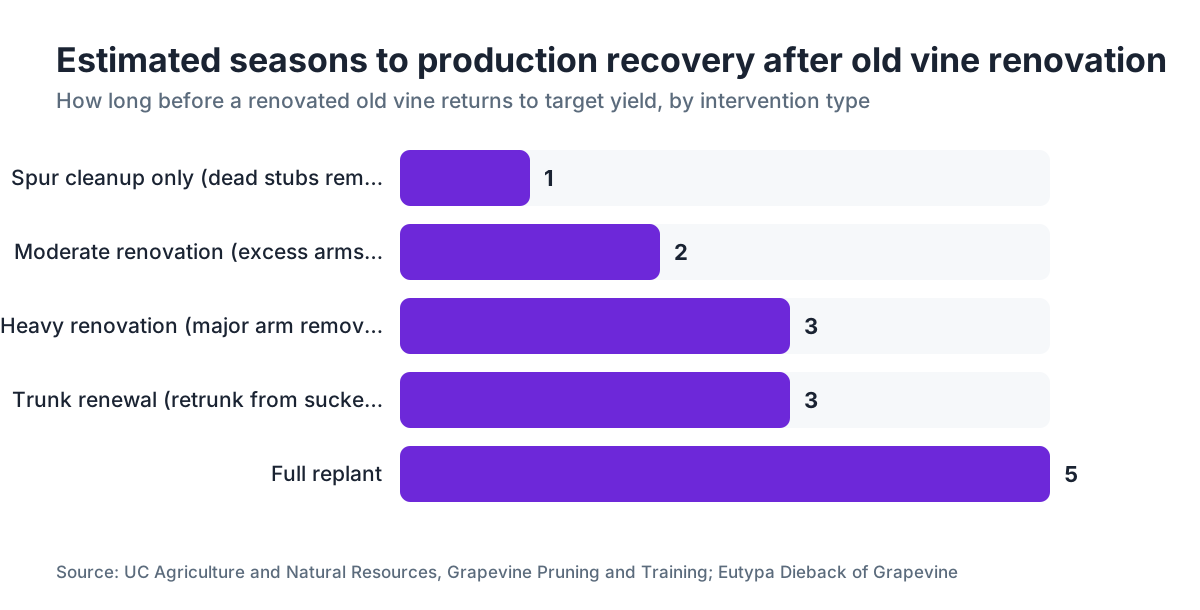
How long until yield comes back? For moderate renovation that keeps the basic cordon and just strips excess wood, most vines are at normal yield within one to two seasons. For heavy renovation where you pull whole arms or reset a head-trained vine from scratch, plan on two to three years before you're back at target production. [2]
Quality, measured as even ripening, color, and flavor concentration, often recovers faster than the yield numbers suggest. Old vine fruit (roughly 25 years and older) has a market reputation for intensity at low yields per vine. Some of that reputation is marketing. But the physiology under it is real: lower crop loads on deeply rooted old vines do produce more concentrated fruit across many varieties and sites.
Tracking this at block level makes the difference. Keeping bud count, shoot count, yield, and Brix by block year over year is how you see whether your renovation strategy is working. That's the kind of field data a system like VitiScribe captures, tying pruning decisions to the harvest outcomes they eventually produce.
For a look at how old vine management runs in high-reputation regions, the Paso Robles wineries area holds some of California's oldest Zinfandel and Mourvèdre, with many producers actively working century-old head-trained vines.
Can you prune an old grapevine back to the trunk and start over?
Yes, and sometimes it's the right call. Called trunk renewal or "stumping," you cut the vine back to a low point on the trunk just above the graft union and train a fresh permanent structure from new shoots. It's a full reset.
Do it when the cordon is so diseased or broken that renovation would only delay the inevitable, or when you want to change the training system outright (say, converting a high-wire cordon to a head-trained vine for hand harvest).
The root system survives the cut. The first season after stumping, growth is often explosive because a massive root system is pushing energy into one or two new shoots. Manage that hard. Pick the best one or two shoots and strip the rest so the vine builds your new trunk instead of twenty disorganized suckers.
Complete trunk renewal costs at least two to three years before the vine is back at full production. That's real money. But on a 40-year-old vine on an otherwise excellent site, with healthy roots and good soil, that investment can buy another 30 productive years. Set that against the cost of replanting, which includes three to five years before a young vine reaches any meaningful production, and trunk renewal often wins on economics alone.
WSU Extension has guidance on training systems for own-rooted and grafted vines that helps when you're deciding what to build on the new growth. [4]
Worker safety and compliance rules for pruning operations
Pruning crews in vineyards fall under the EPA Worker Protection Standard (WPS) once pesticides have gone on the site. The WPS requires that workers get safety training, have access to pesticide application information for the site, and can reach decontamination supplies within a quarter mile of the work area. [7]
For pruning, the compliance question that matters is whether any restricted-entry intervals (REIs) are still in effect from dormant sprays. If you put down a dormant copper spray or an oil-based treatment during dormancy, check the label REI before you send pruners in. Most dormant copper products carry short REIs (4 hours on some formulations), but oil-based sprays and some sulfur products run longer.
In California, the Department of Pesticide Regulation requires spray records to be maintained at the county agricultural commissioner level for all restricted-use pesticides and, in many counties, for all pesticide applications. [8] If pruning crews and spraying overlap, your spray records need to be accurate and current. Under California law, workers have the right to see application records for the fields they work in.
Pruning tool safety is a real issue too. Cuts are common in pruning work, and hand lacerations from shears account for a meaningful share of vineyard injuries. Cut-resistant gloves and basic training on loppers and pruning saws are due diligence, plain and simple. OSHA's general agricultural safety standards apply to hired labor. [9]
If you need to track spray records alongside pruning activity logs, VitiScribe connects those records in one place. That gives you a clean trail from spray application to re-entry to work activity, which matters when a county inspector or auditor asks about a specific block's treatment history.
How does pruning old vines differ by training system?
The principles hold across training systems, but the mechanics change with how the vine was trained.
Head-trained, own-rooted vines, common in old California Zinfandel and some Italian varieties planted before phylloxera drove replanting, are pruned to spurs radiating from a head at the top of the trunk. On old neglected head-trained vines, the head usually carries decades of dead stub wood you have to clear before you can see what's viable. Aim for a clean, open head with four to eight spurs in good positions. You can't re-train these to a cordon without effectively starting over.
Bilateral cordon vines (VSP or high-wire) are more forgiving to renovate because the cordon gives you a linear structure to work from. You can replace dead cordon sections with renewal canes, which head-trained vines won't let you do. Spur spacing follows the same 4 to 6 inch logic, but you have more ways to fill gaps.
Gobelet or bush-trained vines, common in southern France, Spain, and some old California blocks, are basically a low head-trained system with no wire support. Old neglected gobelet vines sprawl and turn chaotic. Renovation means finding the permanent arms radiating from the head and cutting everything else. With no wire for reference, the three-dimensional judgment gets harder.
Old California vineyards with unusual training, including heritage blocks at historic estates and Gervasi Vineyard-style heritage properties in other states, sometimes need custom approaches because the original training logic is hard to reconstruct from what's left standing.
What records should you keep for old vine pruning?
At a minimum: pruning date by block, crew size, bud or spur count per vine (or a representative sample), and notes on disease, dead wood volume, or structural oddities. If you apply wound sealants or biocontrol products, log those as pesticide or biopesticide applications under your state's rules.
Bud count records are worth more than most small operations think. Bud count at pruning, paired with shoot count at bloom and yield at harvest, gives you a vine balance figure (the Ravaz index: kg of fruit per kg of pruning weight) that tells you whether a vine is balanced or over- or under-cropped. [10] On vines you're renovating, tracking Ravaz index year over year shows whether the vine is recovering.
For California operations, the county agricultural commissioner requires pesticide use reports within set timeframes (the number of days depends on the material). If you put down a dormant spray and you're now pruning, those reports need to be filed. [8]
Before-and-after photos of vine structure are cheap to take and worth a lot when you review what you did and why. Phone photos tied to block GPS coordinates and dated properly are usually enough. Some operations use those photos to show due diligence if a vine dies the next season and someone asks whether the pruning caused it.
The vineyard record-keeping page on this site goes deeper on what a compliant field record system looks like for California and Washington operations.
Frequently asked questions
How hard can you prune an old grape vine without killing it?
You can usually remove up to 50% of a vine's total wood in one season without serious stress, assuming the roots are healthy. Beyond that, you risk draining carbohydrate reserves to the point where new growth is weak or fails. On severely neglected old vines, spread heavy renovation over two to three years instead of doing it all at once. Vine health, not a fixed rule, is your real guide.
When is the best time to prune old grape vines?
After the coldest temperatures of winter have passed but before 50% bud swell. In coastal California that's typically January through early March. In cooler climates like Washington or upstate New York, February to mid-March is more common. Pruning after significant bud break wastes energy the vine already committed. Pruning too early in cold-winter sites leaves fresh cuts exposed to damaging frost.
Should I cut old grape vines back to the ground?
Only if the trunk is too diseased to leave any viable structure above the graft union, or if you're deliberately converting to a different training system. Cutting to the ground (trunk renewal) costs two to three productive seasons but can add decades to a vine with healthy roots. For most old vines with reasonable trunk structure, renovation beats complete renewal.
How do I identify dead wood on an old grape vine?
Make a small test cut and look at the face. Live wood is green, cream, or pale at the center. Dead wood is uniformly brown or gray through the whole cross-section. On diseased old vines, watch for a wedge-shaped brown stain inside otherwise live wood, which signals internal trunk disease necrosis. Spongy or dark wood at a spur base also points to poor vascular connection, even when the shoot looks alive.
How many buds should I leave when spur pruning old grape vines?
Two buds per spur is the standard, with spurs spaced 4 to 6 inches apart along the cordon. On low-vigor old vines, err toward fewer spurs total rather than crowding positions the vine can't feed. A weak old vine with 20 spurs makes less and lower-quality fruit than the same vine with 8 to 10 well-lit, well-placed spurs.
Do I need to seal pruning cuts on old grape vines?
For small cuts under about 1 inch across, the evidence for sealants is weak and most commercial operations skip them. For larger cuts on old vines, sealants carrying Trichoderma-based biocontrols have some research support from UC Davis for reducing trunk disease infection at the wound. Standard paint-type sealants have much thinner evidence. The best protection is a clean cut with a sharp tool inside the right timing window.
Can you use video to learn how to prune old neglected grape vines?
Yes, and it's one of the better formats for this skill because three-dimensional vine structure is hard to read in photos. UC ANR (UC Agriculture and Natural Resources) posts pruning demonstration videos on its YouTube channel showing farm advisors working actual commercial vines. WSU Extension has video content for Pacific Northwest varieties and training systems. Both are free and worth watching before your first renovation season.
What diseases should I watch for when pruning old vines?
Eutypa lata (Eutypa dieback) and the Botryosphaeriaceae fungi are the main trunk disease concerns across California and the Pacific Northwest. Both enter through pruning wounds and both live in the majority of vineyards over 15 years old. Sterilize tools between vines with 70% isopropyl alcohol or 10% bleach, make clean cuts with sharp tools, and time large cuts for early in the dormant window when spore release is lower.
How long does it take for an old grape vine to recover after heavy pruning?
For moderate renovation that keeps the cordon and strips excess wood, most vines return to normal yield within one to two seasons. For heavy renovation with arm removal or partial trunk renewal, expect two to three seasons before target production. Complete trunk renewal adds at least three seasons before full production. The root system survives these operations, which is why recovery beats replanting.
What's the difference between spur pruning and cane pruning on old vines?
Spur pruning keeps permanent cordon or head structure and cuts annually to two-bud spurs from one-year-old wood. Cane pruning removes most of the prior year's wood each year and ties one to four new canes along the wire. Old vines with good cordon structure are usually spur-pruned. Cane pruning suits varieties prone to poor spur-position fruitfulness, like Pinot Noir and some Riesling clones, but takes more labor every year.
Do worker protection standard rules apply to pruning crews in vineyards?
Yes. If pesticides have gone on a vineyard and the restricted-entry interval is still in effect, pruning crews can't enter without appropriate PPE. Even outside of REIs, the EPA Worker Protection Standard requires employers to provide safety training, application information, and access to decontamination supplies for all agricultural workers, pruners included. California DPR adds requirements around pesticide use reporting and worker right-to-know for state-restricted materials.
Is aggressive pruning of old neglected grape vines risky?
Yes, if you take too much at once. Removing more than half a vine's wood in one season can drain carbohydrate reserves and lead to weak, disorganized regrowth or vine death in a later stress year. The risk is manageable: spread heavy renovation over two to three seasons, watch new shoot vigor after year one before committing to year two cuts, and confirm the trunk is disease-free enough to support recovery.
How do I know if an old vine is worth renovating or should be replanted?
If trunk disease necrosis in cross-section reaches close to the graft union, the vascular system is too compromised for full recovery. If more than half the cordon spurs are dead stubs with no viable wood above them, rebuilding productive positions gets very difficult. A vine with healthy roots, a sound trunk to within a few inches of the graft union, and at least some viable arm positions is generally worth a renovation attempt first.
Sources
- UC Agriculture and Natural Resources, Grapevine Trunk Diseases: Eutypa lata, Botryosphaeria, and related trunk disease fungi enter through pruning wounds and are present in the majority of older vineyards in California and the Pacific Northwest
- UC IPM, Grape Pest Management Guidelines: Brown or gray pith at the cut face indicates dead wood; green or cream-colored pith indicates living tissue. Recovery timelines after renovation pruning are one to three seasons depending on severity.
- UC Agriculture and Natural Resources, Grapevine Pruning and Training: Standard guidance is to prune after the average last hard freeze and before 50% bud swell; spur spacing target is 4-6 inches with two buds per spur
- Washington State University Extension, Grapevine Pruning and Training: WSU Extension recommends waiting until February or later in cold sites, using bud swell stage as primary timing trigger; guidance on training systems for own-rooted and grafted vines
- Cornell Cooperative Extension, Grape Production and Cold Injury Management: Delayed pruning that leaves extra canes through the cold period reduces frost-kill of buds on vulnerable sites for Concord and hybrid varieties in New York
- UC Agriculture and Natural Resources, Eutypa Dieback of Grapevine: Eutypa lata found in over 80% of older vineyards surveyed in major California appellations; Trichoderma-based biocontrol wound sealants show evidence of reducing infection rates at pruning wounds; trunk disease progression may make renovation uneconomic
- EPA, Agricultural Worker Protection Standard: WPS requires employers to provide safety training, pesticide application information, PPE, and access to decontamination supplies for agricultural workers including pruning crews; restricted-entry intervals must be observed
- California Department of Pesticide Regulation: California requires pesticide use reports to county agricultural commissioners within specified timeframes; workers have the right to see application records for fields they work in
- OSHA, Agricultural Operations: OSHA general agricultural safety standards apply to hired labor in vineyard operations including pruning
- UC Agriculture and Natural Resources, Vine Balance and Ravaz Index: The Ravaz index (kg of fruit per kg of pruning weight) is used to assess vine balance; tracking bud count, shoot count, and yield by block year over year supports renovation monitoring
Last updated 2026-07-09