Pruning pinot noir grape vines: the complete field guide
TL;DR
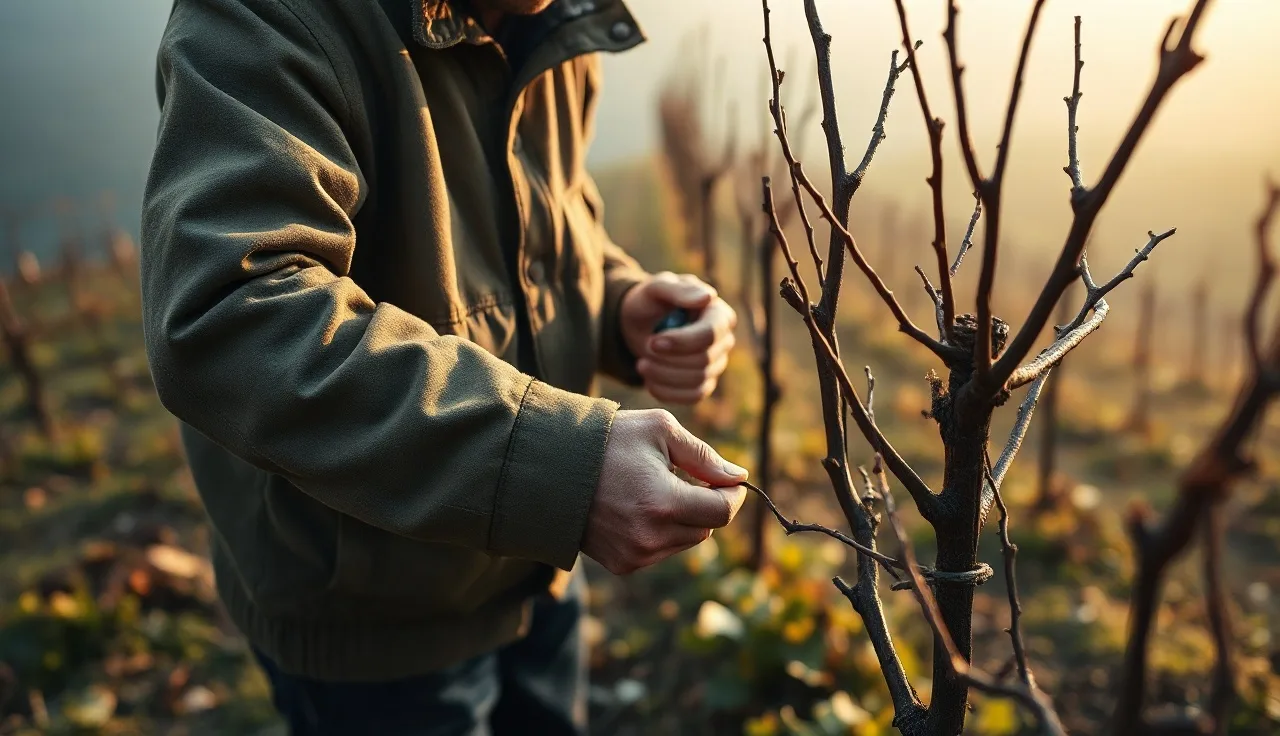
- Prune pinot noir to cane (Guyot) or spur (cordon) systems during full dormancy, roughly December through February in the Northern Hemisphere.
- Aim for 30 to 60 nodes per vine, tuned to vigor.
- Timing, bud count, and wound sealing matter more for pinot noir than for most varieties because it catches trunk disease easily.
- Prune late, seal big cuts, and keep records.
Why does pruning pinot noir require more care than other varieties?
Pinot noir punishes careless pruning faster than almost any variety. It carries thin canes, uneven vigor, and an outsized susceptibility to Eutypa dieback and Botryosphaeria fungi. Those two trunk disease complexes kill cordons and arms slowly, over years, before a grower notices anything at the surface. By the time you see dead spurs or wilting shoots in July, the canker is often already 10 to 20 centimeters up the wood [1].
The variety is genetically restless, and that compounds every pruning decision. Pinot noir has hundreds of documented clones, from Dijon 115 and 667 to Pommard and Swan selections, and they differ in shoot vigor, cluster count per cane, and natural bud fruitfulness. What works for a high-vigor 667 block on a valley floor will overcrop a low-vigor Pommard clone on a hillside. You have to know your blocks.
Pinot noir is also thin-skinned in the literal sense. Overcrop it through sloppy pruning (too many buds, too many clusters) and you get green, thin, forgettable wine. The link between crop load and wine quality is tighter here than in cabernet sauvignon, which shrugs off overcropping better. UC Cooperative Extension work on vine balance has made that point for years [2]. That's not a reason to panic. It's a reason to pay attention.
When is the right time to prune pinot noir vines?
Prune during full dormancy, after the vines have banked enough chilling hours and before budbreak. In most Northern Hemisphere wine regions that window runs from mid-December through late February, sometimes into early March at high-latitude or high-elevation sites. The textbook answer is clean. The practice is messier.
Pruning too early, say November before the vine has hardened off, leaves large wounds open for the longest possible stretch during cool, wet weather. That's exactly when Eutypa and Botryosphaeria spores fly. UC Davis plant pathology research shows Eutypa lata spore release peaks during fall and winter rain events [1], so an early-pruned vine in a rainy December has fresh wounds sitting open for months. Prune later, closer to budbreak, and those wounds get far less exposure. Field trials have shown that shift alone cuts infection rates.
Push it too close to budbreak, though, and you risk knocking off emerging buds and crushing your labor window into a period when wet ground makes tractor access a nightmare. A reasonable compromise for most pinot regions: target the last four weeks before your average budbreak date. That usually means late January through late February in the Willamette Valley, Carneros, and the Central Coast.
Delayed pruning (sometimes called late pruning or the nurse-cane offset) is a specific move for frost-prone sites. Leave one or two nurse canes in place, remove them once budbreak begins, and you delay the shoot on the selected cane by a week or more. Cornell viticulture extension covers this for cool-climate growers [3].
Cane pruning vs. spur pruning: which system fits pinot noir?
The honest answer is that it depends on your clones, your site, your labor, and your trellis. This is the question that starts the loudest arguments at any pinot grower meeting.
Cane pruning (bilateral or unilateral Guyot) selects one or two vigorous one-year-old canes each season, bends them to the fruiting wire, and cuts everything else back to short renewal spurs. You start fresh every year. For pinot noir that pays off. You dodge the cumulative trunk disease buildup that plagues permanent cordons, because you keep selecting new wood. Cane pruning also handles the variety's irregular cane distribution. If a cordon arm has two dead spurs next to each other, you have a problem. With canes, you just pick wood from somewhere else.
The cost is labor. Cane selection, tying, and the eye for quality wood all take time and training. Mechanization is possible but limited next to spur systems.
Spur pruning (cordon-trained, VSP or high-wire) keeps permanent bilateral cordons and cuts each shoot back to two-bud spurs. It's faster, more mechanizable, and in uniform blocks with steady vigor it produces consistent results. The catch for pinot noir is that dead spurs pile up as trunk disease enters through wounds, and a missing spur leaves a gap that's hard to fill. Washington State University extension notes that Botryosphaeria infections are strongly associated with spur-pruned systems, in part because of wound proximity and the age of exposed wood [4].
For most small-acreage pinot producers, cane pruning is the better default. If your block is already on cordons, you don't need to rip it out. You do need aggressive wound protection.
| System | Labor (hours/acre, hand-pruning) | Mechanization potential | Trunk disease risk | Pinot suitability |
|---|---|---|---|---|
| Cane (Guyot) | 40-80 | Low | Lower | High |
| Spur (bilateral cordon) | 25-50 | High | Higher | Moderate |
| Minimal pruning | 5-15 | Very high | Variable | Low |
Labor hour ranges come from extension surveys. Actual times swing widely with block density, terrain, and worker experience [5].
How many buds should you leave per vine?
The standard starting point is the Ravaz Index approach: set a target crop load against measured vine capacity (last year's pruning weight) and back-calculate your bud count. The Ravaz Index is fruit weight divided by pruning weight, and it should land between 5 and 10 for balanced pinot noir, with many premium producers aiming for 5 to 7 [2].
No pruning weight data yet? Here are workable defaults by situation.
Moderate-vigor pinot (most Willamette Valley, Sonoma Coast, Anderson Valley hillsides): 30 to 45 nodes per vine on cane pruning. Leave one or two canes of 8 to 12 buds each, plus one to two two-bud renewal spurs.
High-vigor pinot (valley floor, irrigated, young vines on rich soils): 45 to 65 nodes per vine. More buds spread the vigor and calm shoot competition over time, though you may still need to green-drop clusters in midsummer.
Low-vigor or old-vine pinot (dry-farmed hillsides, shallow soils, Pommard or old Swan selection): 20 to 35 nodes. Overcropping a weak vine speeds its decline. Take less fruit and let it rebuild reserves.
These are entry points, not fixed rules. The real calibration comes from watching crop load play out over two or three seasons and adjusting. Nobody nails bud count in year one. Any advisor who tells you otherwise is selling something simpler than the truth.
What equipment do you need and how do you keep workers safe?
The hand-pruning kit for pinot noir is short: bypass shears (Felco 2 or equivalent), loppers for wood larger than about 2.5 cm across, and a pruning saw for trunk surgery. Sharp shears matter. Dull blades tear instead of cut, and torn wounds are bigger doors for trunk disease pathogens.
Disinfecting tools between vines is worth doing in diseased blocks. A 10% bleach solution or 70% isopropyl alcohol wiped between cuts lowers the odds of carrying Eutypa and other pathogens from a sick vine to a healthy one. Almost nobody does this vine-by-vine in a clean block, and that's fine. In any block with visible trunk disease symptoms, it's standard practice.
Worker safety during pruning falls under the EPA Worker Protection Standard (WPS) and, where treated equipment is involved, your state department of agriculture's pesticide rules. Pruning with no pesticide application carries no WPS exposure interval. But if crews enter recently sprayed fields for early pruning, restricted-entry intervals (REIs) apply. The EPA WPS requires that workers be told about REIs, that safety information be posted at a central location on the establishment, and that first aid and decontamination supplies stay accessible [6].
PPE for pruning: gloves against cuts, eye protection in dense canopies, sturdy footwear. On steep terrain, ankle support and non-slip soles are not optional. California's heat illness prevention standard (Title 8, CCR Section 3395) applies to outdoor agricultural workers even in January when temperatures cross the threshold, which happens in warmer regions [7].
Operations that need to document pruning dates, bud counts, and worker activity for compliance or audit do better with a structured field record than a shoebox of notes. VitiScribe is built for vineyard managers who want digital logs of pruning decisions, spray records, and compliance events without building that system from scratch.
How do you manage trunk disease wounds during pruning?
This is where the science has gotten clearest over the past decade, and where most growers still underinvest. Eutypa lata, the primary cause of Eutypa dieback, infects almost only through pruning wounds, and it travels 2 to 10 centimeters into the wood per year [1]. The fungus is everywhere in established vineyards, so prevention comes down to two things: limit how long wounds stay open, and physically protect the cut surface.
The two practical tools are wound sealants and fungicide applications. UC Davis and UC Cooperative Extension field trials found that thiophanate-methyl (Topsin-M) applied immediately after pruning reduced Eutypa infection rates compared to untreated controls [1]. The current California recommendation often centers on Topsin-M at labeled rates, painted or sprayed onto freshly cut wood the same day as pruning.
Trichoderma-based biopesticides (products like Vinevax or RootShield) have shown mixed results in field trials. They're not useless. They're also not a substitute for synthetic fungicide protection on high-value or disease-prone blocks.
The simplest habit that pays the most: prune as late as you can tolerate, cut large limbs with a two-cut method (a rough cut first, then a clean one), and seal any wound larger than about 2 cm the same day you make it. Don't spray the whole vine. Just the wound.
Doing trunk renewal (cutting back a diseased cordon or replacing an arm with a new shoot) is a multi-year job you plan out. Cut into cankered wood, back to clean white tissue, then train a replacement shoot. It's tedious and it works. WSU extension has illustrated guidance on trunk renewal protocols for spur-pruned systems [4].
Does pinot noir pruning differ in cool vs. warm wine regions?
Yes, in a few ways that matter.
In cool-climate regions like the Willamette Valley, Finger Lakes, or the Sonoma Coast, frost after budbreak is a real threat, so pruning timing gets adjusted to delay budbreak on the vulnerable sites. Late pruning or the nurse-cane technique is common in Oregon and upstate New York [3]. Bud fruitfulness also swings with the previous summer's temperature during flower initiation, so yield forecasts from bud counts get shakier in cool years.
In warmer regions like Paso Robles, the Santa Ynez Valley, or the hotter parts of Napa, the pre-budbreak window is shorter and summers hit harder. Pinot noir struggles in heat, which is why it rarely lands on the valley floor in these places. Where it is grown, heat during set and ripening means you manage canopy density carefully, and that starts at pruning. Leaving slightly fewer buds (and fewer shoots) in warm-climate blocks eases the midseason canopy workload.
Rainfall timing shapes wound management too. The Pacific Northwest and Northern California coast get wet winters, which is exactly when Eutypa spores are flying. In drier inland regions the wound-sealing urgency drops some, but it never hits zero. There's no region where you can safely ignore trunk disease in pinot noir.
What are the signs you pruned wrong and how do you fix it?
The most common mistake is leaving too many buds. It shows up as dense mid-canopy shoots, poor light penetration, botrytis pressure in the cluster zone, and fruit that tastes thin and vegetal. If by late June you're staring at a solid green wall of shoots with no light flecks on the soil below, you overcropped. The midseason fix is shoot thinning and leaf removal, which is slow and expensive. Next season, drop your bud count 15 to 20% and watch what happens to canopy density.
Leaving too few buds shows up as low crop, heavy shoots, and sometimes a vigor response where the vine throws enormous laterals. That can be fine for wine quality, but it's costly in a price-per-ton business. Young vineyards in particular often need more buds than you'd guess to balance growth and keep the vine from pouring all its energy into rank vegetation.
Wound problems often stay hidden for two to four years. Yellow or dead sectors of canes in midsummer, a shoot collapsing off a single spur, or black discoloration when you cross-section an arm all point to trunk disease that entered through a wound made seasons earlier. Once you find it, the only real fix is trunk renewal. Fungicide won't cure an established canker.
Elephant foot (basal swelling with deeply fissured bark, often harboring several rotting fungi) is the end stage of mismanaged trunk disease plus repeated wounding. At that point you're retraining from a sucker or replanting.
How do you train young pinot noir vines in the first three years?
Year one is about establishment, not crop. After planting, cut the new vine back to two buds. Let the shoots grow with no interference beyond basic tying to a stake. Don't crop it.
Year two, pick the straightest, most vigorous shoot from the prior season as your trunk. Tie it to the stake and cut everything else to a single one-bud spur. Heading toward a bilateral cordon? Let the tip grow above the cordon wire and start your first arm selections. Building toward cane pruning? Let the trunk reach the fruiting wire and select the two best canes from shoots that emerge at that height.
Year three you can take a light crop. On cane-pruned systems, select two canes of five to seven buds each. On cordon systems, begin building your cordon arms and leave a few two-bud spurs, but don't expect a full crop. Push yield on a three-year-old vine and you under-build root reserves, which costs you for the life of the vine.
UC Cooperative Extension recommends growers resist the urge to crop young vines heavily even when they look vigorous, because the root-to-shoot balance set during establishment sets the trajectory for decades [2]. That's doubly true for pinot noir, which is slower to build strong trunks than cabernet or merlot.
For vineyard operations of any scale, logging these year-by-year training decisions with dates and bud counts gives you a baseline for reading vine performance five seasons out.
Should you be recording your pruning decisions for compliance or audit purposes?
Yes, and more growers than you'd think get caught without records when it counts.
In California, the Department of Pesticide Regulation requires pest control records (fungicide applications included) tied to specific fields and dates. Apply wound protectants during pruning and those applications belong in your spray record system, with the operator's pesticide handler license, the product, the rate, and the field ID [7]. Oregon, Washington, and New York carry equivalent requirements under their own pesticide laws [8].
Beyond pesticide compliance, certification programs (USDA Organic, Lodi Rules, LIVE, Salmon Safe, and others) routinely ask for field activity records at audit. If you can't show when you pruned, how many buds per vine you targeted, or what wound protection you applied, you risk your certification status no matter what you actually did in the field. The USDA National Organic Program requires records of all inputs applied, subject to annual audit [9].
A pruning log doesn't need to be fancy: block ID, date, system (cane or spur), target bud count, wound treatment product and rate, and the name of whoever did the work. Paper works. Digital is better for search and for answering an audit fast. VitiScribe keeps pruning events, spray applications, and compliance documentation in one searchable system, which saves real time when a certifier or DPR auditor asks for three years of records on a single block.
The EPA Worker Protection Standard requires agricultural employers to keep pesticide application records for two years and make them available to workers and handlers on request [6].
What does professional pinot noir pruning actually cost?
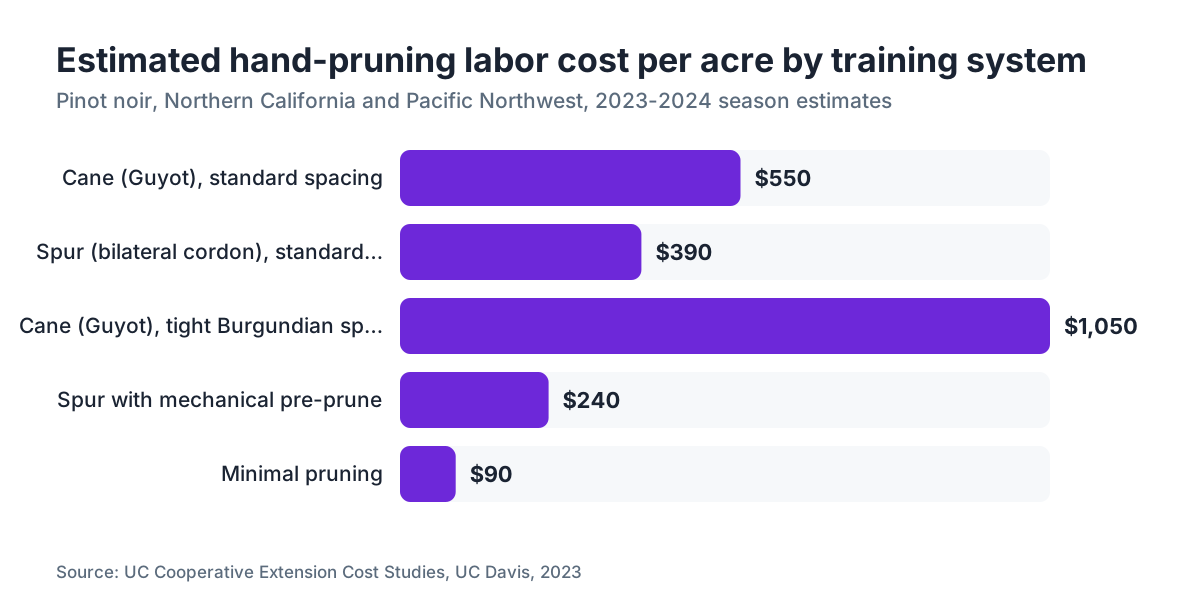
Labor is the dominant cost. Hand-pruning rates in California, Oregon, and Washington typically run $350 to $700 per acre for a full dormant prune, depending on vine spacing, terrain, training system, and local labor markets. Tight spacing (1 meter by 1.5 meter Burgundian-style blocks) can push that past $1,000 per acre. Most estimates for VSP-trained blocks at standard California spacing (4x8 or 5x8 feet) land in the $400 to $600 range [5].
Mechanical pre-pruning, where a hedging machine makes a rough cut that workers then hand-finish, cuts hand-pruning time by 30 to 50% in spur-pruned blocks. The machine's capital cost or the custom operation rate eats some of that saving, but in large blocks it usually pencils out. Cane-pruned blocks benefit less, because hand cane selection still needs experienced eyes.
Wound protectant materials add roughly $20 to $60 per acre depending on product and application method. That's small next to labor and cheap insurance against trunk disease [1].
For context, vineyard establishment in premium California regions runs $15,000 to $35,000 per acre or more, which makes annual pruning cost look modest. Protecting that investment with proper wound management is not where you want to cut the budget.
Frequently asked questions
When exactly should I prune pinot noir in the Willamette Valley?
Target the four weeks before your average budbreak date, which in most Willamette Valley sites falls between mid-February and mid-March. Pruning in January or early February maximizes your labor window but leaves wounds open longer through the wet months when Eutypa spores are active. If frost is a concern, use the nurse-cane technique to delay budbreak on vulnerable blocks. Cornell extension covers this timing strategy for cool-climate sites.
Can pinot noir be spur pruned, or does it need cane pruning?
Pinot noir can be spur pruned, and many successful vineyards use bilateral cordons with two-bud spurs. The trade-off is that cordon systems accumulate trunk disease faster, and dead spurs are harder to replace than canes selected fresh each year in a Guyot system. For most small producers, cane pruning gives better long-term vine health. If your block is already on cordons, aggressive wound protection and periodic trunk renewal keep it healthy.
How many buds per vine is standard for pinot noir?
A reasonable starting range is 30 to 60 nodes per vine depending on vigor. Moderate-vigor hillside blocks do well at 30 to 45. High-vigor valley floor sites may need 45 to 65. Low-vigor old-vine or dry-farmed blocks should stay at 20 to 35. The Ravaz Index (fruit weight divided by pruning weight, targeting 5 to 10) gives you a calibration tool once you have two or three seasons of yield and pruning weight data.
What is the best wound protectant to use after pruning pinot noir?
UC Davis research supports thiophanate-methyl (Topsin-M) as the most consistently effective fungicide for Eutypa prevention when applied immediately after pruning. Apply it the same day cuts are made, targeting any wound larger than 2 cm in diameter. Trichoderma-based biofungicides show variable results in field trials and work best as a complement to, not a replacement for, synthetic fungicide protection in high-disease-pressure blocks.
How does delayed pruning reduce trunk disease in pinot noir?
Pruning closer to budbreak, in the last four weeks before buds swell, leaves fresh wounds open for a shorter period during the cool, wet months when Eutypa lata spores are most active. UC Davis research shows spore dispersal peaks during fall and winter rain events. A wound exposed for three weeks before budbreak carries far less infection risk than one exposed for four months after an early-December prune, even with wound protectant applied.
What pruning records do I need to keep for organic certification or state compliance?
For USDA Organic, you need field activity logs showing all inputs applied, including fungicide wound treatments with product, rate, field ID, and date. For California DPR compliance, any pesticide application during pruning requires a written spray record tied to the operator's license. Oregon, Washington, and New York have equivalent state requirements. Most certification programs also want records of training system, pruning dates, and bud targets for their annual audit package.
What is the Ravaz Index and should I use it for pinot noir pruning decisions?
The Ravaz Index is fruit weight (kg) divided by pruning weight (kg) from the same vine or block, measured at harvest and pruning respectively. A ratio of 5 to 10 indicates a reasonably balanced vine. Values above 10 suggest overcropping and values below 5 suggest excessive vigor. For pinot noir, many premium producers target 5 to 7. It requires weighing pruning brush by block, which takes effort, but gives you a data-based feedback loop on bud count decisions.
How do I prune pinot noir in the first three years after planting?
Year one: cut to two buds, establish the trunk, take no crop. Year two: select the best shoot as your trunk, begin arms or cane positions at the fruiting wire, still no commercial crop. Year three: select two canes of five to seven buds each or begin light spur positions, take a modest crop. UC Cooperative Extension recommends resisting heavy cropping in young vines because root-to-shoot balance set during establishment affects vine health for decades.
Can I mechanically pre-prune pinot noir vines to save labor costs?
Yes, for spur-pruned blocks. A hedging machine makes a rough pass that workers then hand-finish, cutting hand-pruning time by 30 to 50% in uniform blocks. The savings are meaningful at scale. Cane-pruned blocks get less benefit because cane selection still requires experienced human eyes. Mechanical pre-pruning works best in VSP-trained, high-wire bilateral cordon systems with good row uniformity.
What worker safety rules apply during pinot noir pruning?
Pruning with no pesticide involvement carries no EPA Worker Protection Standard re-entry interval. But if workers enter fields after a recent spray, REIs must be respected and posted at a central location on the property. California's heat illness prevention standard applies to outdoor agricultural workers even in winter if temperatures exceed thresholds. Provide gloves, eye protection, and appropriate footwear. On steep terrain, non-slip footwear is essential and should be required, not suggested.
How does pinot noir pruning differ by clone?
Significantly. High-vigor clones like Dijon 667 on rich soils need more buds and can support a larger canopy. Lower-vigor clones like Pommard and old Swan selections on shallow or lean soils need fewer buds and are more sensitive to overcropping. Dijon 115 is known for large clusters and moderate vigor. If you have multiple clones in one block, consider block-by-block bud counts rather than a single vineyard-wide target, especially as the vines mature and vigor differences sharpen.
Is it ever okay to skip pruning pinot noir, or do minimal pruning?
Minimal pruning (leaving most shoots uncut) is practiced in some high-volume operations for cost reduction, but it's a poor fit for premium pinot noir. Without pruning, the vine accumulates excessive nodes, throws hundreds of weak shoots, and produces thin, overcropped fruit. Canopy management becomes very difficult. Some research suggests minimal pruning on high-vigor rootstocks can lower vigor over time, but for quality-focused pinot it's not a sensible approach.
What's the biggest mistake growers make when pruning pinot noir?
Leaving too many buds, especially on young or low-vigor vines, is the most common error. The urge to maximize crop early in a vine's life leads to overcropping, depleted root reserves, and a structurally weak vine that underperforms for its entire life. The second most common mistake is ignoring wound protection. A fungicide wound sealant is a low-cost step that many growers skip until they start losing arms to Eutypa dieback years later.
Sources
- UC Davis Plant Pathology, Eutypa Dieback of Grapevine: Eutypa lata spore dispersal peaks during fall and winter rain events; infected wood progresses 2 to 10 cm per year; Topsin-M and fungicide wound treatments reduce infection rates in field trials
- UC Cooperative Extension, Grapevine Canopy Management and Vine Balance: Ravaz Index target of 5 to 10 for balanced vines; overcropping pinot noir directly reduces wine quality; resist heavy cropping on young vines to protect root reserves
- Cornell Cooperative Extension, Viticulture and Enology, Delayed Pruning for Frost Avoidance: Delayed pruning and nurse-cane technique can delay budbreak by one week or more on frost-prone cool-climate sites
- Washington State University Extension, Trunk Disease Management in Wine Grapes: Botryosphaeria infections are strongly associated with spur-pruned systems; trunk renewal protocols for cordon systems described with illustrated guidance
- UC Cooperative Extension, Sample Costs to Establish and Produce Wine Grapes: Hand-pruning labor costs estimated at $350 to $700 per acre for dormant pruning depending on vine spacing, training system, and region; mechanical pre-pruning reduces hand labor 30 to 50%
- EPA Worker Protection Standard, 40 CFR Part 170: WPS requires re-entry intervals be communicated to workers, safety information posted centrally, first aid supplies accessible, and pesticide application records retained for two years
- California Department of Pesticide Regulation, Pesticide Use Reporting: California requires written spray records tied to the operator's license for all pesticide applications including fungicide wound treatments; records must include product, rate, field ID, and date
- Oregon Department of Agriculture, Pesticide Program: Oregon has state pesticide record-keeping requirements equivalent to California DPR for agricultural pesticide use
- USDA National Organic Program, Organic Regulations 7 CFR Part 205: USDA Organic certification requires field activity logs showing all inputs applied, including product, rate, field ID, and date, subject to annual audit
Last updated 2026-07-09