Pruning Valiant grape vines: the complete seasonal guide
TL;DR
- Prune Valiant in full dormancy, usually late February through early April in USDA zones 3-5, before bud swell.
- Spur pruning fits home and small commercial plantings; cane pruning suits higher-yielding systems.
- Leave 2-4 buds per spur or 8-12 buds per retained cane.
- Remove 70-90% of last year's wood to prevent overcropping and watery juice.
What makes Valiant different from other wine grapes for pruning?
Valiant is a cold-hardy hybrid bred at South Dakota State University, crossed in 1966 and released in 1977. [1] It carries heavy Vitis riparia genetics. That gives it winter hardiness down to around -40°F, but it also grows hard and sets fruit on the first two or three nodes of a cane. That single fact rewrites your pruning approach.
Vitis vinifera varieties like Cabernet or Chardonnay behave differently. Primary bud fruitfulness climbs as you move away from the base of the cane, so short spurs of two or three buds can miss most of the crop. Valiant is nearly the reverse. The fruitful buds sit near the base. Cornell's viticulture extension work on hybrids notes that basal bud fruitfulness in riparia-derived cultivars runs high, which means shorter cuts still bring in a good crop. [2] Leave too many buds and Valiant overcrops badly, giving you watery, insipid juice that ferments poorly.
Then there's the growth. An unpruned or lightly pruned Valiant vine can push 15 to 20 feet of new wood in a single season. That density is exactly the canopy powdery mildew, botrytis, and downy mildew want. Hard dormant pruning is your first disease tool and your cheapest one. Get the cut counts right in February and you spray less in July.
Growers also plant Valiant where Concord won't reliably survive, and sometimes use it as a rootstock. If you run it in zone 4 or colder, the timing rules below are not optional. A late frost after early bud swell can take the entire crop.
When is the right time to prune Valiant grape vines?
Prune from full dormancy through early bud swell. For most of the northern Great Plains, upper Midwest, and northern New England where Valiant grows, that lands between late February and early April, shifting with elevation and microclimate. [3]
Wait until the worst cold is behind you. Valiant handles extreme cold fine as dormant wood, but fresh pruning wounds are more exposed than intact bark. A hard freeze after a February cut won't kill the vine. It can slow wound callusing and open a door for wood-rotting fungi like Eutypa lata. South Dakota State extension advises holding off until average daytime temperatures sit consistently above 28°F in northern climates. [1]
Bud swell is your hard stop. Once green tissue pushes at the node, cuts near those buds knock off the emerging shoots. Some growers push right up to half-inch green in the warmer parts of Valiant's range. That works, but don't make a habit of it. Wounded tissue near active buds is more open to Botrytis cinerea.
Delayed pruning as frost insurance is worth a mention. Holding off two to three weeks can push bud break back five to ten days in some varieties, which buys a little protection against late spring frost. Washington State University's cold-climate extension material describes this tactic for high-risk sites. [4] Whether it pays depends on your crew and your acreage. On a small planting, it's a fair hedge. On 10-plus acres, it can jam up your schedule and cost you more in quality than the frost protection saves.
Don't prune frozen wood. Below about 20°F the canes turn brittle and you get ragged, splintered cuts that heal slowly.
Spur pruning vs. cane pruning: which method works better for Valiant?
Both work for Valiant. The right pick comes down to your trellis, your yield target, and how much time you actually have.
Spur pruning cuts each fruiting cane back to a short stub of two to four buds. Those spurs sit at regular spacing along a permanent cordon arm, usually 6 to 8 inches apart. Once the system is set, it's fast to run and easy to teach a crew. The catch is that each spur position piles up wood as callus builds around repeated cuts, and after 8 to 10 years you get knotty, ugly cordons that are harder to work. Renewing one or two spur positions per vine each year keeps the cordon clean.
Cane pruning strips off nearly all of last year's growth and keeps one or two long, pencil-thick canes tied down as new fruiting wood. Each cane gets 8 to 12 buds. You also keep a short renewal spur near the head so you have a replacement cane the next year. Cane pruning spreads fruit more evenly along the wire and often gives better fruit exposure. It takes more time per vine and more skill to spot the right replacement canes.
Either system overcrops Valiant easily. Cornell recommends aiming for roughly 20 to 40 clusters per vine as a starting point for hybrid table and wine grapes on standard trellis, then adjusting for vine vigor and last year's fruit quality. [2] That works out to about 3 to 5 spurs with 2 or 3 buds each, or one to two canes with 8 to 10 buds total. Start low and thin if you have to.
Running a high-wire cordon like Geneva Double Curtain? Cane pruning usually fits better, since the architecture is built for longer wood and downward shoot growth. WSU's cold-climate viticulture resources go deeper on matching trellis to system. [4]
How many buds should you leave per vine?
This is where most home growers and small commercial operators go wrong. They leave too many buds because cutting off more wood than you keep feels like waste. It isn't.
The standard starting point for most hybrids including Valiant is 30 to 40 buds per vine on a VSP (vertical shoot positioning) trellis, adjusted for last season's vigor. [2] The formula most extension programs teach is balanced pruning: weigh the canes you removed, then leave roughly 20 to 30 buds per pound of pruned wood. Nelson Shaulis developed it at Cornell in the 1960s. [2]
A moderately vigorous Valiant vine puts out 0.5 to 1.5 pounds of pruning brush. Run that through the formula and you land anywhere from 10 to 45 buds, which is a wide spread. Experienced growers cap it at 30 to 35 buds until they learn how their specific site behaves.
Spur-pruned vines: 2 buds per spur is baseline. Three buds is fine if the vine ran very vigorous last year. Four is too many for Valiant in most situations.
Cane-pruned vines: 8 to 10 buds per cane, one or two canes kept. Most Valiant growers on cane systems settle at one cane of 10 buds plus a two-bud renewal spur.
If you're tracking pruning weights across seasons to dial in your balanced pruning formula, a field-operations tool like VitiScribe handles the recording. You enter the weight at the vine and it does the bud-count math over time, no separate spreadsheet.
Shoot length is your feedback over the years. Shoots averaging 3 to 4 feet at season's end signal good balance. Under 2 feet says you cut too hard. Over 5 feet says you left too many buds, or the vine has more vigor than your system can hold.
What does the actual pruning process look like, step by step?
Walk the row before you touch anything. Find your strongest, best-placed canes from last season. You want pencil-diameter wood, about 3/8 inch or a touch smaller, with tight nodes and healthy brown bark. Skip the toothpick wood (thin and spindly) and the thumb wood (over-thick and pithy). Both make poor keepers.
Step 1: Remove all dead, diseased, or winter-damaged wood first. Cut back to green, healthy pith. If a cane is brown all the way through, keep cutting toward the cordon until you hit white or pale yellow wood. Haul damaged wood away from the row. Leaving it on the vineyard floor feeds disease inoculum.
Step 2: Pick your keepers. For spur pruning, these are last year's shoots off the spur positions along your cordon. For cane pruning, look for two or three candidate canes per vine near the head or off the previous year's renewal spurs.
Step 3: Make your cuts. Use sharp, clean bypass pruners. Angle the cut about 45 degrees, roughly 1/4 inch above the top bud you're keeping. Don't leave long stubs. They die back and become wood-rot entry points. Reach for loppers or a pruning saw on larger cordons and trunks.
Step 4: Tie down retained canes (cane pruning only). Tie horizontally along the fruiting wire with biodegradable ties or Max-Tapener-style clips. Don't kink the cane.
Step 5: Leave renewal spurs. On cane systems, always keep a short two-bud renewal spur near the head or at a cordon junction so you have cane options next year.
Sanitize your tools between vines if you see any sign of crown gall (Agrobacterium vitis) or Eutypa dieback, which shows up as dead arms and dark internal wood staining. A 10% bleach solution or 70% isopropyl alcohol between cuts won't clear a systemic infection, but it slows the spread. UC Davis Cooperative Extension lists tool sanitation as standard practice in any vineyard with a wood-disease history. [5]
How do you train young Valiant vines in their first three years?
The first three years build permanent structure, not fruit. It's frustrating advice, and skipping it costs you years down the road.
Year 1: After planting, pick the single strongest shoot and train it straight up a stake. Tie it loosely. Rub off every other shoot at the base. The aim is one vertical trunk reaching your first training wire by season's end. If it makes the wire, pinch the tip. If it falls short, don't panic. Some Valiant plantings on poor soil need until year two to reach wire height.
Year 2: If the trunk hit the first wire in year one, pick two lateral shoots at wire height and train them in opposite directions along the wire. These become your cordon arms (spur system) or permanent head (cane system). Remove all other laterals. Let no fruit develop. Some extension programs suggest rubbing off flower clusters by hand even when they appear, because the vine needs its energy going to wood and roots. [3]
Year 3: Allow a partial crop. For spur systems, set spur positions along the cordon, make two-bud cuts, and let the vine carry maybe half of its eventual full crop. For cane systems, pick one good cane and leave 6 to 8 buds. Strip any flower clusters beyond what the young vine can carry.
Don't expect full production until year 4 or 5 on most cold-climate sites. Push Valiant too hard early, and this naturally vigorous variety pays you back with uneven cordon architecture and weak trunks that need fixing later.
The USDA Natural Resources Conservation Service plant guides for cold-hardy grapes back the phased establishment approach and give reasonable density and spacing benchmarks for northern production. [6]
What trellis systems work best with Valiant grape vines?
Valiant does well on most standard trellis systems. The two most common for small and commercial plantings are VSP (vertical shoot positioning) and high-wire cordon.
VSP sets your fruiting wire at about 36 inches and uses catch wires above to train shoots upward. It's the dominant system across wine-grape regions and works well for Valiant because it keeps the canopy open and manageable. Spur or cane pruning both fit.
High-wire cordon, sometimes called a Kniffin system in older literature, trains the cordon at about 60 inches and lets shoots hang down. It needs less summer shoot tucking and suits very vigorous varieties. Honestly, Valiant's aggressive growth is better contained in a VSP system with two or three catch wires, because you get cleaner canopy division. High-wire tends to produce a dense curtain with Valiant that takes more work to manage after pruning.
Post spacing of 20 to 24 feet with end posts anchored at 45 degrees is standard. Vine spacing within rows varies, but 8 feet is common for high-vigor hybrids like Valiant. At 8-foot vine spacing with 10-foot rows, you're at about 545 vines per acre. [4]
For a small home planting, a simple two-wire fence trellis (one wire at 36 inches, one at 60 inches) is plenty. No reason to over-engineer the support for a variety this forgiving.
What are the most common pruning mistakes with Valiant and how do you fix them?
Leaving too much wood is the top error by a mile. Valiant growers, especially in the first few production years, hate cutting away healthy-looking canes. You end up with a canopy so dense that air circulation drops to nothing, disease pressure spikes, and fruit ripens unevenly. Fix: weigh your pruning brush once or twice to calibrate your eye against the balanced pruning formula.
Pruning too early in cold climates is the second most common miss. A February hard-pruning in zone 3 exposes fresh wounds to -20°F nights for weeks. Most wounds callus fine, but the risk isn't nothing, especially on older vines already carrying Eutypa or Botryosphaeria. Wait for consistently above-freezing days.
Neglecting trunk and cordon renewal is a slow-burn mistake. Valiant cordons can run 15 to 20 years before they get so gnarled and diseased they drag down the whole vine. Good operators keep a trunk or cordon sucker growing as a spare every 5 to 7 years on older vines. UC Davis extension covers trunk disease management and renewal pruning in detail for California, and the core principles carry over to cold-climate hybrids. [5]
Dull pruners are underrated as a problem. Dull blades crush instead of cut, leaving ragged wounds that callus slowly and hand wood pathogens an easy entry. Sharpen or swap blades every 100 to 200 vines. A good pair of Felco or Bahco bypass pruners runs $40 to $80 and lasts years with sharpening.
Ignoring the renewal spur. Cane pruning with no renewal spur means you may not have a well-placed cane next year, which forces bad selections or overly long wood just to reach a good bud position.
Do you need to apply wound sealants after pruning cuts on Valiant vines?
This is more contested than most extension publications let on. The old advice was to paint large cuts over 1 inch across with latex paint or a commercial pruning sealant to keep Eutypa lata and other wood pathogens out of fresh wounds.
More recent UC Davis research finds that many sealants don't reliably block Eutypa, and some trap moisture and make things worse. The current UC Davis line is that if you use a sealant, pick a fungicide-based product registered for vineyard use rather than a purely occlusive one. [5] Topsin-M (thiophanate-methyl) and Pristine (boscalid plus pyraclostrobin) are among the products researchers have evaluated for wound protection. Check current registrations in your state before you use anything.
For Valiant in cold climates, where trunks and cordons run younger than in established vinifera regions, sealant is less likely to matter on small-diameter cuts under 3/4 inch. Spend your wound-management budget on large cordon or trunk cuts, and on any vine already showing wood disease.
Spray any wound-protection product and you're applying a pesticide, which means you have to record it. EPA's Worker Protection Standard requires application records including the product name, EPA registration number, application rate, and date for agricultural workplaces. [7] Non-compliance can trigger fines starting at $650 per violation under the WPS.
How does pruning connect to your spray program and compliance records?
Pruning is the first link in the season-long chain. The buds you leave and how you open the canopy set your fungicide load for the next 12 months. A well-pruned Valiant vineyard with real air circulation can stretch early-season spray intervals from every 7 days to every 10 to 14 days in low-pressure years. That's real money.
On the compliance side, pruning itself usually triggers no pesticide recordkeeping. But the season opens with pruning, and your first spray follows within 4 to 6 weeks of bud break. Get your records straight at pruning time, before the season turns chaotic. That's just good management.
EPA's Worker Protection Standard kicks in the moment you apply any restricted-use or general-use pesticide. Under 40 CFR Part 170, growers with agricultural workers or pesticide handlers must keep application records for at least two years, post safety information at a central location, and tell workers about applications in areas where they work. [7] State agriculture departments often stack extra requirements on top.
Field-operations platforms like VitiScribe let you log pruning dates, bud counts, and pruning weights right alongside your spray records, so the whole season lives in one place. That's what you want when a state ag inspector asks to see your program for the past two years.
Other records worth keeping at pruning: vine mapping (which vines got skipped or lightly pruned for disease), cane weights if you're doing balanced pruning, and notes on any trunk or cordon damage you spotted. You'll want this next dormant season, and you won't recall it accurately from memory.
What are realistic yield expectations from a pruned Valiant vineyard?
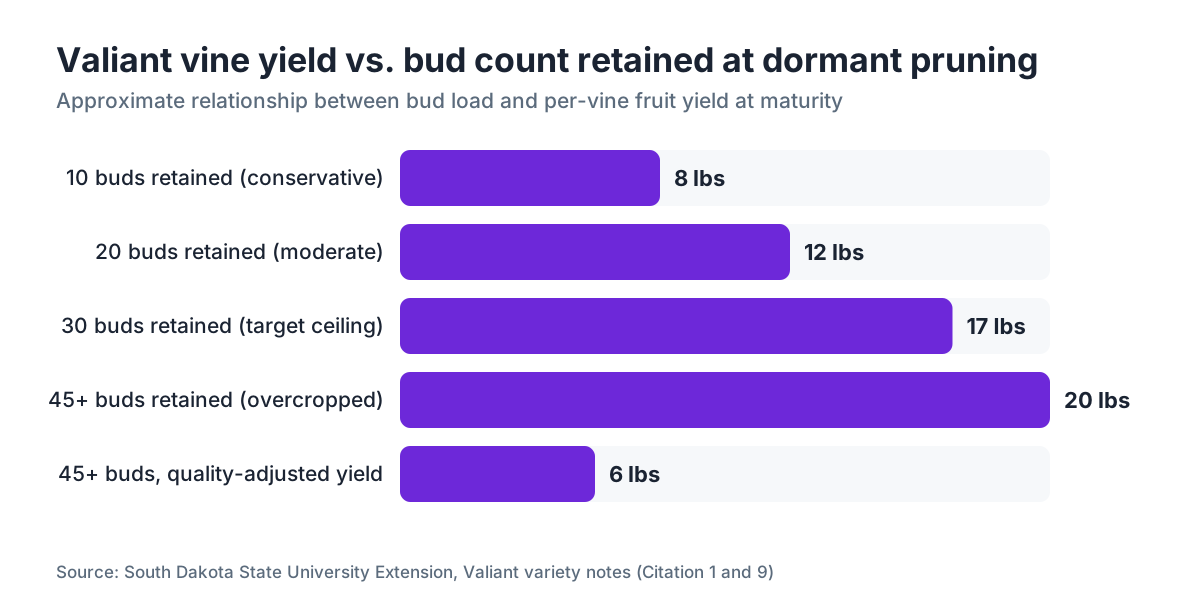
Valiant is a productive variety. Under good management with proper pruning, a mature vine in year 4 or 5 produces 8 to 20 pounds of fruit per vine, depending on site and pruning level. [1] At 545 vines per acre (8-foot by 10-foot spacing), that's roughly 4,000 to 10,000 pounds per acre, or 2.7 to 7 tons per acre.
Most small wineries chasing quality fruit aim for 4 to 6 tons per acre with Valiant. Push past 6 tons and the juice thins out, and the natural acid, already high in Valiant (often pH 3.0 to 3.2 and titratable acidity of 10 to 16 g/L), gets even harder to manage in fermentation. [1]
Yield and quality ride directly on bud count. It's the clearest lever you have. South Dakota State University variety notes show consistently that Valiant overcrops when pruning runs too light, producing fruit that never reaches adequate sugar. Target Brix for Valiant wine sits at 18 to 22 degrees, already lower than most vinifera. [1]
For Valiant sold as table grapes or fresh juice, slightly higher crop loads pass, since the buyer isn't expecting wine-grade sugar concentration. Even for table use, though, 8 to 10 tons per acre is about the ceiling before quality falls off visibly.
Record yield against bud count for two or three seasons and you'll have a calibrated system for your exact site. No extension publication beats your own multi-year data.
How do you handle Valiant vines that were neglected or improperly pruned for years?
Neglected Valiant vines are common on older rural properties. Someone planted a row in the 1980s, watered it a few years, then mostly walked away. What you find is a tangle of dead and live wood, multiple trunks heading in random directions, and a vine still setting fruit while 80% of its canopy is dead-weight old wood.
The honest answer: remediation takes two to three years, and no shortcut gives you quality results.
Year 1 of remediation: Do a hard cutback. Strip all dead wood and pick the one or two healthiest trunks from ground level or near it. Cut everything else to the ground or back to the main trunks. It looks brutal. It's right. The vine won't die. Valiant's root system is deeply established after 5-plus years and it comes back with vigorous new growth.
Year 2: Treat the vine like a second-year planting. Pick the best new growth off the trunks you kept, train it to your wire system, and remove the rest. Allow no fruit, or very little.
Year 3: Start normal production pruning.
If the vine carries real trunk disease (dark wood streaking, dead arms, gummosis), cutting the diseased trunk all the way down to a healthy basal sucker usually beats trying to prune around it. UC Davis viticulture extension has detailed trunk disease identification guides worth reading before you start cutting. [5]
Some old Valiant vines on good sites are genuinely worth the effort. The root systems run deep and wide, giving the vine drought tolerance and mineral access that a new planting needs a decade to build.
Frequently asked questions
Can you prune Valiant grape vines in the fall instead of late winter?
Fall pruning isn't recommended in cold climates. Removing wood before the vine is fully dormant interferes with carbohydrate storage and cold hardening, and it leaves wounds exposed to months of hard freezing. Wait until late February or early March, when the hardest cold has passed but vines stay fully dormant. South Dakota State University extension recommends late dormant pruning for maximum cold protection.
How long does it take to prune a Valiant vine by hand?
An experienced pruner working spur-pruned Valiant on an established cordon moves at roughly 200 to 400 vines per hour in good conditions. Neglected or cane-pruned vines run slower, sometimes 100 to 150 vines per hour. A 1-acre planting at 545 vines could take 1.5 to 5 hours for one skilled worker. Mechanical pre-pruning with a hedger cuts labor 40 to 60% on larger blocks.
What tools do I need to prune grape vines properly?
Sharp bypass pruners handle most cuts. Felco 2 and Bahco P-series are the common choices. Loppers take cordons and older wood over about 3/4 inch. A pruning saw handles trunk work and severe remediation. Leather gloves protect against blisters and punctures. If you're sealing large cuts, a small brush or spray applicator. Clean, sharp tools matter more than the brand name.
Do Valiant grapes need a trellis to produce well?
Technically they'll grow and fruit without one, but canopy management gets nearly impossible and disease pressure climbs fast. A basic two-wire fence trellis at 36 and 60 inches handles a home planting fine. Commercial plantings need proper end-post anchoring and catch wires for VSP training. A Valiant vine sprawling on the ground overcrops, ripens unevenly, and stays chronically diseased.
How many years does a Valiant vine take to produce a full crop?
Expect year 4 or 5 for a full commercial crop. Year 1 is establishment only. Year 2 focuses on permanent structure with no fruit. Year 3 allows a partial crop at about 50% of target yield. South Dakota State variety trials and most cold-climate extension programs use this 4-to-5-year timeline. Rushing production in years 2 and 3 gives you weaker vines and lower yields for the long haul.
What is balanced pruning and does it work for Valiant?
Balanced pruning is a formula developed at Cornell in the 1960s that ties bud count to the weight of cane you removed. The general rule: keep 20 to 30 buds per pound of pruned cane weight. It works well for Valiant. Weigh a random sample of brush from 5 to 10 vines early, calculate the average per vine, then set your bud target. It beats guessing by eye.
Should I remove flower clusters on young Valiant vines in year 2 or 3?
Yes. In year 2, remove all flower clusters by hand or rub them off early. In year 3, allow roughly half the clusters the vine would normally carry. The reason is simple: young vines need their energy going into root and trunk development. Full cropping in year 2 or 3 consistently produces weaker vines that underperform in years 5 through 10 compared with vines managed properly early.
What is the difference between spur pruning and cane pruning for Valiant?
Spur pruning leaves short 2-4 bud stubs at fixed positions along a permanent cordon arm. Cane pruning removes almost all year-old wood and keeps one or two long canes with 8-12 buds as the new fruiting wood each season. Spur pruning is faster and easier to teach but builds up woody cordon tissue over time. Cane pruning needs more skill and time but gives more flexibility in wood placement and often better fruit distribution.
How do I know if my Valiant vine is overcropped?
Check shoot length at the end of the growing season. Shoots averaging under 24 inches, poor leaf color, delayed or uneven ripening, and clusters that never reach target Brix (below 18 degrees for wine) all point to overcropping. Valiant's target is roughly 20 to 40 clusters per vine on a standard trellis. Seeing 60 or 80 clusters per vine means you left too many buds at dormant pruning.
What records should I keep during and after pruning season?
At minimum: pruning date per block, system used (spur or cane), average buds retained per vine, and notes on winter damage, trunk disease, or dead vines. If you're doing balanced pruning, record average cane weights. These records help you calibrate bud counts year over year and are useful documentation for crop insurance. Under EPA's Worker Protection Standard, pesticide application records must be kept at least two years once you start spraying.
Can Valiant vines survive if I skip pruning for one year?
They won't die, but the fallout compounds fast. A skipped year leaves double or triple the normal bud load, giving you a dense, unmanageable canopy with high disease pressure and dilute, possibly uncroppable fruit. The cordon or head also gets much harder to clean up the following year. If labor or weather forces a skip, at least do a rough mechanical hedging pass to knock down the worst excess growth.
Are there any EPA or state requirements specifically for pruning activities?
Pruning itself has no federal pesticide recordkeeping requirements. But EPA's Worker Protection Standard under 40 CFR Part 170 applies the moment any pesticide is used in the vineyard, including wound sealants that contain fungicides. Workers entering treated areas must get safety information and follow restricted-entry intervals. Some states require extra training or records. Check your state department of agriculture for the requirements where you are.
What Brix level should Valiant fruit reach at harvest and how does pruning affect that?
Target Brix for Valiant used in wine sits at 18 to 22 degrees, lower than most vinifera wine grapes. Overcropping, driven directly by leaving too many buds at pruning, is the main reason Valiant fruit fails to clear even the 18-degree floor. South Dakota State variety notes document the relationship between crop load and sugar accumulation. Proper dormant pruning is the single most effective move for better Brix.
Sources
- South Dakota State University Extension, Valiant Grape variety profile: Valiant was developed at SDSU, released in 1977, tolerates temperatures to approximately -40 degrees F, and typical yield for mature vines is 8 to 20 pounds per vine; target Brix for wine use is 18 to 22 degrees
- Cornell Cooperative Extension, Viticulture and Enology, pruning and training of grapevines: Balanced pruning formula: retain 20 to 30 buds per pound of pruned cane weight; basal bud fruitfulness is high in riparia-derived hybrids; target 20 to 40 clusters per vine for hybrid grapes on standard trellis
- University of Minnesota Extension, cold-hardy grape production: Optimal dormant pruning window for cold-climate grapes in zones 3 to 5 is late February through early April before bud swell; delaying pruning until after the coldest weather passes reduces wound exposure
- Washington State University Extension, viticulture for cool and cold climates: Delaying pruning by 2 to 3 weeks can push bud break back 5 to 10 days; 8-foot vine spacing with 10-foot rows approximates 545 vines per acre; high-wire cordon and VSP trellis system descriptions
- UC Davis Cooperative Extension, trunk disease management in grapevines: Tool sanitation is a standard practice in vineyards with history of wood disease; many wound sealants do not reliably prevent Eutypa; fungicide-based wound protectants such as thiophanate-methyl have been evaluated for pruning wound protection
- USDA Natural Resources Conservation Service, PLANTS Database plant guides for grapes: Phased establishment for cold-hardy grapes; density and spacing benchmarks for northern production
- U.S. EPA, Worker Protection Standard for Agricultural Pesticides, 40 CFR Part 170: Agricultural employers must maintain pesticide application records for at least two years; workers must receive safety information about pesticide applications; non-compliance fines start at $650 per violation
- Cornell University, Geneva Double Curtain and trellis system descriptions for hybrid grapes: Geneva Double Curtain and high-wire cordon systems suit vigorous varieties; VSP with catch wires is recommended for canopy management of high-vigor hybrids
- South Dakota State University Extension, overcropping and fruit quality in hybrid grapes: Overcropping from excess bud retention is the primary driver of below-target Brix in Valiant; relationship between crop load and sugar accumulation documented in SDSU variety trials
- University of Minnesota Extension, managing Vitis riparia-derived varieties: Removing flower clusters in year 2 and limiting crop in year 3 produces stronger vines with better long-term yield potential compared to early full cropping
Last updated 2026-07-09