Pruning young grape vines: a year-by-year training guide
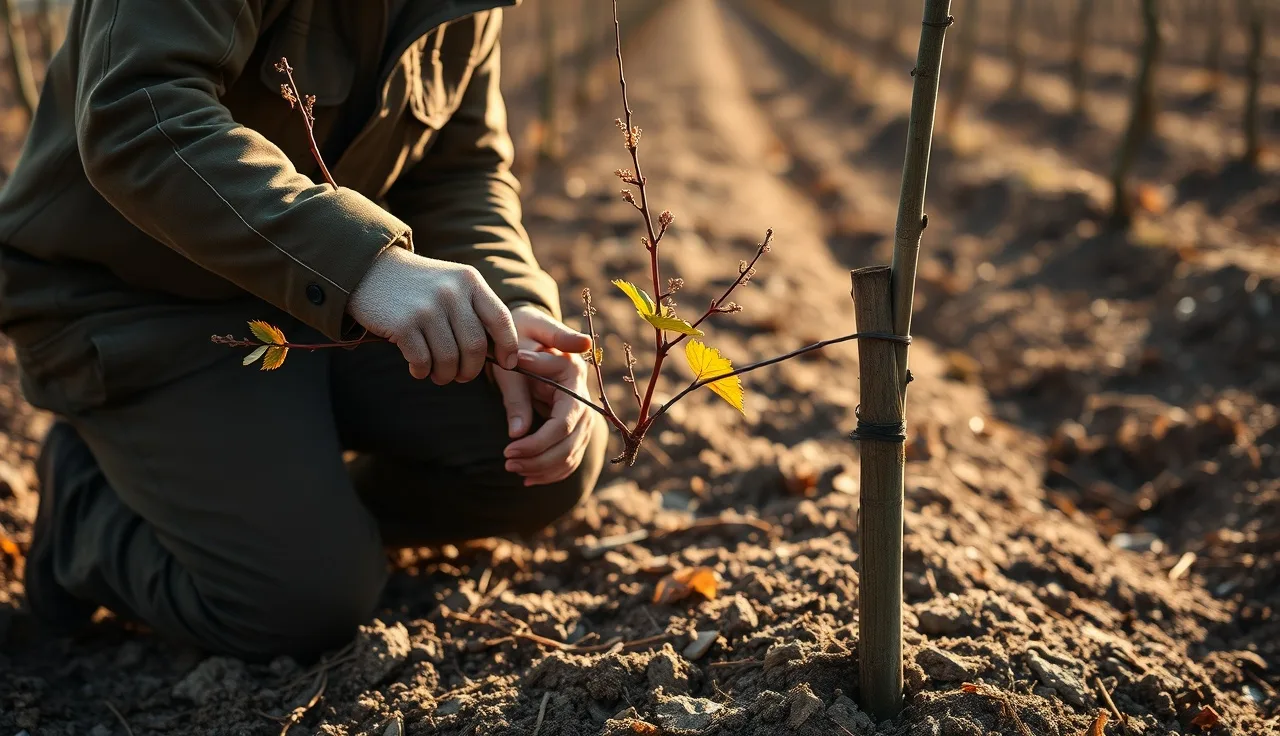
TL;DR
- Young vines need three years of deliberate pruning to build a permanent trunk and framework before you ask them to make fruit.
- Year 1 trains a single upright shoot to the wire.
- Year 2 sets trunk height and the first arms.
- Year 3 finishes the cordon or cane structure and allows a small crop.
- These early cuts decide vine health and yield for decades.
What is the purpose of pruning young grape vines?
Pruning a young vine isn't about managing crop load. You have no crop yet. The whole point is architecture.
Grapes fruit on one-year-old wood, so every season's growth sets next season's fruiting potential. But before fruiting wood matters, you need a permanent structure: a trunk and primary arms (cordons or canes) that will anchor the vine for 20 to 40 years. Pruning in years 1 through 3 does exactly that. It pushes the vine's energy into the few shoots you've chosen to become that structure and cuts away everything else, so the plant doesn't scatter its reserves across a tangle of weak growth.
Washington State University's viticulture program frames young vine pruning as selecting and training the permanent trunk and establishing the fruiting zone before yield ever enters the conversation [1]. UC's viticulture extension makes the same point: vines trained badly in the first three seasons rarely reach the trunk diameter or bud distribution needed for steady yield later [2].
There's a root-to-shoot balance argument here too, and it's worth taking seriously. A young vine has a big root system relative to its canopy. Leave it unpruned and it pushes dozens of thin shoots, each fighting for the same carbohydrate reserve. Pick one or two strong shoots, cut the rest, and that energy goes into thick, well-lignified wood. That's the trunk you'll lean on for the life of the block.
When should you start pruning a newly planted vine?
The first real cut happens at planting or just after, whether you set out a dormant bare-root vine or a green potted one. Both need it. The timing of the details differs, but the principle is the same: concentrate the energy early.
For bare-root vines, most extension programs say cut back to two or three buds at planting [2]. It feels brutal. Do it anyway. It forces the vine's best energy into a few shoots instead of spreading it across whatever the nursery handed you. The nursery cane is often dried out, partly damaged, or growing at an angle that won't fit your trellis. Cut it off. Keep two good buds and move on.
For container-grown vines set out in spring, you may already have growing shoots. If one clearly dominant shoot heads straight up, let it run and rub off the others. If three shoots look equally strong with no clear winner, pick the most vertical and remove the rest.
The dormant pruning season, the winter cut that defines each training year, runs from after leaf drop through early spring. That's roughly late November through March across most North American wine regions, though the window shifts earlier in warm places like Paso Robles and later in cool sites. You want the vine fully dormant but not yet pushing buds. Prune too early, right after harvest, and you can trim cold hardiness. Prune too late and you get "bleeding," where sap weeps from the cuts [3]. Bleeding looks alarming and rarely kills anything. It mostly means your timing slipped a little past ideal.
How do you prune a young vine in year 1?
Year 1 has one job: get a single shoot up to your first trellis wire.
After planting and cutting back to two or three buds, growth starts within a few weeks. As shoots emerge, pick the strongest and most vertical one. Pinch or rub off the rest the moment you can name the winner, usually when shoots are 3 to 6 inches long. Don't wait. Every day those competing shoots grow, they steal energy from your chosen leader.
Tie the selected shoot loosely to a stake or bamboo cane every 6 to 8 inches as it climbs. You want it straight and vertical. Lateral shoots can stay, with one caveat: if a lateral gets aggressive and starts competing with the leader, pinch its tip back to 5 or 6 leaves. It'll keep photosynthesizing without stealing dominance.
The end-of-year-1 dormant cut is simple. If the shoot reached your first wire, cut it just above the wire and leave two to four buds below the wire as insurance. If it fell short, cut back to two or three buds and repeat next season. Cornell's viticulture program notes that vines missing the wire in year 1 are common in cool or wet seasons, and skipping the cut-back to force the issue produces crooked, poorly anchored trunks [3].
Don't let a year-1 vine carry any fruit. If clusters form, pull them. The energy belongs to structure.
What cuts define year 2 pruning for young vines?
Year 2 is where your target system, cordon, bilateral cordon, Guyot cane, high-wire, VSP, starts to matter in the field.
At the start of year 2 dormant pruning, you have a trunk that reached the wire (or close) and several lateral shoots along it. Here's the read:
- The trunk: keep it. Leave it alone except to strip any shoots growing from below the graft union.
- The laterals near the wire: pick the two strongest, one heading each direction along the trellis. These become your cordons (cordon systems) or your cane candidates (cane-pruned systems).
- Everything below: cut off all shoots on the lower trunk. You want a clean, bare trunk with no fruiting wood below the intended fruiting zone.
For bilateral cordon systems, the most common setup in warm-climate commercial vineyards, tie those two laterals horizontally along the wire. Head each back to 8 to 12 buds, depending on vigor and your eventual spur spacing. That's the start of your permanent cordon arms.
For cane-pruned systems (Guyot, double Guyot), pick one or two long canes near the head, tie them horizontally, and leave 8 to 12 buds on each. Then keep one or two renewal spurs (2-bud cuts close to the head) to grow next year's replacement canes.
WSU's viticulture materials flag the top year-2 mistake as leaving too much wood, too many buds, because growers are itching to see production [1]. A young root system can't feed 40 buds evenly. You get weak, patchy shoot growth and a badly developed cordon. Err toward fewer buds in year 2.
How does year 3 pruning complete the vine's framework?
By the start of year 3 dormant pruning, a well-trained vine has a sturdy trunk and two cordon arms (or the cane equivalent) running along the wire. Year 3 finishes that framework and, in most systems, lets the vine carry its first small crop.
For cordon systems, the year-3 cuts set spur positions. Along each arm, pick lateral shoots spaced roughly 4 to 6 inches apart and cut each to a 2-bud spur. That's the spur pattern that feeds your fruiting shoots from here on. Remove any shoots on the underside of the cordon or pointing down.
The cordon itself may need another season to fill if it hasn't reached the end post. If the arm is still short, head the terminal back to an outward-facing bud and tie it out along the wire. Keep extending until the cordon fills its space, then treat the terminal like any other spur.
For cane-pruned systems, year 3 means picking the best canes off year-2 growth, heading them to 8 to 12 buds, and setting two to four renewal spurs. The renewal spurs matter because cane-pruned vines need fresh canes every year, and those canes have to come from a predictable spot near the head.
A partial crop in year 3, roughly 25 to 50 percent of a mature vine's load, is standard commercial practice and backed by extension programs. UC's grape growing guidelines suggest holding year-3 vines to 1 to 2 clusters per shoot so you don't over-crop a vine still building its permanent frame [2].
If you're tracking dozens of young vines at different training stages, a digital field log earns its keep here. Tools like VitiScribe let you tag each vine's training status and log pruning dates by block, which matters when you've got mixed planting years in the ground.
What's the difference between spur pruning and cane pruning for young vines?
The spur-versus-cane choice is mostly a variety decision, though site and labor push it one way or the other in practice.
Spur pruning keeps permanent cordon arms with short 2-bud spurs spaced along them. Each spur pushes two shoots in the growing season, and at the next dormant pruning you cut back to 2 buds again. The appeal is repeatability. Once your cordon is set, every pruning cycle runs the same pattern. Machine pruning is far easier on spur-pruned vines, which matters on large blocks.
Cane pruning replaces the whole fruiting cane every year. You pick one or two long, well-placed canes from last season, tie them to the wire, and head them to your bud count. Renewal spurs near the head keep the cycle going. Cane pruning is the right call for varieties with low basal node fruitfulness, where the first bud or two on a shoot don't reliably set clusters. Pinot Noir is the classic case: basal fruitfulness is low enough that short spurs give you a lot of blind, unfruitful shoots [4].
| System | Best for | Basal fruitfulness needed | Mechanization ease | Pruning labor |
|---|---|---|---|---|
| Spur / cordon | Cabernet, Merlot, Zinfandel, Syrah | High | High | Lower per vine |
| Cane (Guyot) | Pinot Noir, Chardonnay, Riesling | Low to medium | Low | Higher per vine |
| Double cane | High-vigor, wide spacing | Medium | Low | Highest |
For young vine training, the first two years look almost identical no matter which mature system you're building toward. The split comes at year 3, when you either start building permanent cordon arms (spur) or commit to an annual cane selection routine.
How many buds should you leave on a young vine?
There's no universal number, and anyone who hands you one without knowing your variety, rootstock, soil, and irrigation is guessing. That said, extension programs give sane starting ranges.
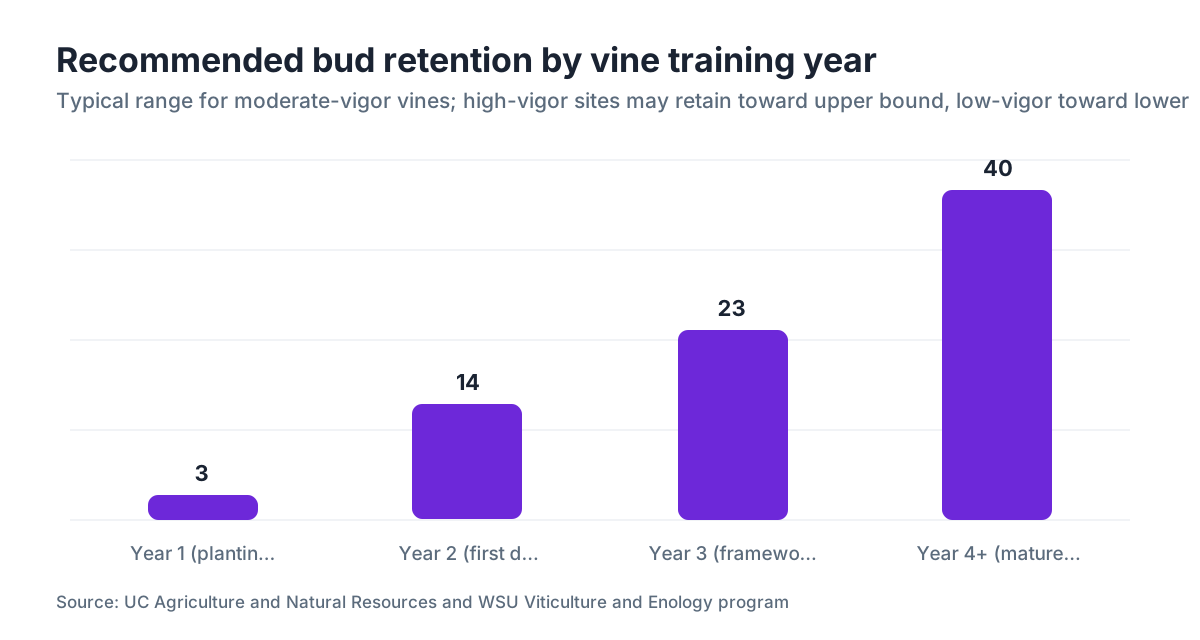
Year 1 at dormant pruning: 2 to 4 buds on the trunk. You're just pushing one good shoot. Nothing else counts.
Year 2 at dormant pruning: 8 to 20 buds total, depending on vigor and system. A low-vigor vine on poor soil gets 8. A high-vigor vine on deep loam under irrigation might take 18 to 20, but only if the cane diameter can back it up.
Year 3 at dormant pruning: 16 to 30 buds, moving toward your mature target. WSU's rule of thumb is to weigh the previous season's prunings and assign roughly 20 buds per pound removed [1]. This is balanced pruning, developed by Nelson Shaulis at Cornell in the 1960s, and it's still one of the most useful ways to match bud load to real vine capacity [4].
Cane diameter is a quick field check. A cane 8 to 12 millimeters across at the base sits in the sweet spot: thick enough to carry 8 to 12 buds, not so thick it's running vegetative. Canes under 6 millimeters get cut to 1 or 2 buds no matter how long they are. They can't feed more.
What tools and wound care do you need for young vine pruning?
Sharp bypass pruners handle nearly all young vine work. Bypass pruners cut with a scissoring action and leave a clean, compressed face. Anvil pruners crush the wood a little and leave a ragged edge that calluses over slowly. Buy good bypass pruners, a Felco 2 or equivalent, and sharpen them often. A dull blade is the most common cause of preventable pruning wounds.
For bigger wood, any cut over about 1 inch across, a hand saw or loppers gives a cleaner result with less splitting. You won't hit that size often on young vines, but if you're keeping a large trunk section or doing corrective work, reach for the right tool.
Wound dressings and pruning sealants are a fight worth understanding. The research on whether commercial sealants actually cut Botryosphaeria or Eutypa infection in grapevines is mixed at best. UC Davis work found that cut timing beat sealant use: pruning in late dormancy, close to bud break when callus forms fast, dropped wood pathogen infection sharply compared with early-winter pruning [5]. In a high-disease environment, delay pruning as long as you can rather than trusting a can of sealant.
Worker safety belongs in this conversation. The EPA's Worker Protection Standard (40 CFR Part 170) requires that field workers, including dormant pruning crews, get pesticide safety training if they might contact treated surfaces [6]. If your vines caught a systemic fungicide before dormancy, that coverage applies. Keep the training records current.
One detail small growers overlook is wrist angle. Thousands of cuts a day in an awkward wrist position stacks up repetitive strain injuries season after season. Ergonomic pruner handles exist and pay for themselves if you're doing this work yourself at any scale.
What mistakes kill young vines or set back production by years?
The list of recoverable mistakes is long. The list of ones that genuinely cost you years of production is shorter and worth memorizing.
Leaving too many buds in years 1 and 2 is the classic. It feels generous. The vine throws a dozen shoots, everything looks lush, and at harvest you find a thicket of pencil-thin, poorly lignified wood with no real trunk diameter. The vine goes into winter weak and exposed to cold damage and trunk disease. The fix is simple and hard: be ruthless in years 1 and 2. Two to four buds in year 1. Full stop.
Allowing fruit in year 1, or a heavy crop in year 2, sets trunk development back at least a full season most of the time. Ripening even a few clusters on a vine that hasn't sorted out its root-to-shoot balance costs real carbohydrate. Strip all clusters in year 1. Strip most in year 2.
Forgetting to pull shoots below the graft union is a quiet killer. Rootstock suckers are often vigorous, and left alone they outcompete the scion. They grow fast, they don't make wine-quality fruit, and by the time you notice, they may have shaded your trained leader for a whole season. Check below the union every time you walk the rows.
Poor trunk orientation bites you years down the line. A trunk trained at a 45-degree angle because someone tied it crooked in year 1 becomes a mechanical stress point for the vine's whole life. It's also harder to train cordons evenly off an angled head. Stake every vine vertically and tie the shoot every 6 to 8 inches. Five minutes in June saves hours of corrective pruning later.
Trunk disease through pruning wounds is the long game. Eutypa lata, the pathogen behind Eutypa dieback, can enter through pruning wounds and sit latent for 5 to 10 years before symptoms show [9]. By the time you see dead spurs and dying cordons, the infection happened half a decade ago. Pruning late in dormancy shrinks the infection window a lot.
How do you handle a vine that grew poorly or was damaged in its first season?
It happens. Deer browse the shoot off in June. A careless tractor pass snaps it at the base. A late frost kills the growing tip. These things happen in well-run vineyards too, and the recovery is simpler than most growers fear.
If the shoot is damaged but the vine is alive, cut back to the lowest healthy bud and start over. The root system is already in the ground. A vine that reshoots from dormant buds in June often catches back up to the normal training schedule by the next spring, especially in warm climates. In cool climates with short seasons, you may lose a full year, which pushes your target first commercial harvest back by one.
If the vine died outright, the call is replant versus remove and skip the space. On a high-density planting (1,500 vines per acre or more), losing 2 to 3 percent to replants is manageable. On wider spacing, missing vines leave big unproductive gaps that hurt at harvest. Set replacement vines as early as you can in spring so they get the full season to establish.
For vines that just grew slowly from poor soil, drought stress, or cover crop competition, don't rush the timeline. A vine that needs four years to reach the wire is better off taking four than being shoved into year-3 protocols on immature wood. Cornell's viticulture program warns against advancing training milestones on weak vines, since forcing bud retention on undersized trunks produces spindly cordons that underperform for years [3].
For managers tracking replants and training status across multiple blocks and planting years, a field record system with per-vine status saves headaches at audit time. VitiScribe is built for exactly this kind of block-level tracking, with fields for training year, pruning date, and per-vine notes.
Does pruning timing affect vine health and disease risk?
Yes, and it's one of the most actionable pieces of research a grower has right now.
Eutypa lata, Botryosphaeria species, and the other wood-decay pathogens behind trunk disease get into vines mainly through fresh pruning wounds. Those wounds stay open to infection for several days to a few weeks after the cut, depending on temperature and humidity. Spore release for most of these pathogens peaks in wet winter weather, which is exactly when early-season pruning happens.
UC Davis research found that pruning in late January or later sharply cut the share of wounds colonized by Eutypa lata compared with November or December pruning in California Central Valley and coastal vineyards [5]. The mechanism is straightforward: vines pruned close to bud break callus over their wounds faster, shortening the window infection can slip through.
The practical read is this. If you can stagger your crew to prune young vines last, or at least after most of the winter rain has passed, you drop trunk disease pressure without spending a dollar on materials. That's not always possible on a big operation. On a small farm with a few hundred young vines, the timing flexibility is real.
Cold hardiness is the competing pressure. Pruning too late in a region with spring frost risk strips some of the vine's cold-weather redundancy, and if a hard frost hits, already-pruned vines have less to fall back on. In places like New York's Finger Lakes or Ontario, that tradeoff genuinely complicates the late-pruning play. Cornell's viticulture program has written about this tension and recommends site-specific timing built on historical frost data [3].
What records do you need to keep for pruning young vines?
For regulatory compliance in most U.S. states, the bar for pruning-specific records is low. Pruning is an agronomic operation, not a pesticide application, so there's no federal mandate for an application record when all you did was cut wood.
That said, the Worker Protection Standard under 40 CFR Part 170 does require you to track pesticide safety training for agricultural workers, and that includes your pruning crew when they work where pesticides were applied [6]. If you spray dormant copper or oil before pruning, the WPS provisions apply to anyone entering the treated area within the restricted entry interval. California's Department of Pesticide Regulation stacks one of the strictest state records rules on top of the federal floor, requiring written pesticide application records within 24 hours of application and kept accessible for at least 3 years [7].
Beyond the regulatory minimum, the records that actually help you run a vineyard are: planting date by vine, target training system, current training year, dormant pruning date, buds left, pruning weight removed (for balanced pruning math), and notes on abnormalities like suspected trunk disease, graft failure, or rootstock sucker pressure. These feel tedious to keep in year 1. They become genuinely useful in year 5, when you're trying to work out why one row's cordons came in thinner than the rest.
For vineyards with mixed planting years, which is normal on farms expanding a little at a time, good records prevent the ugly mistake of running mature-vine pruning protocols on second-year vines because nobody remembered which row went in when.
Frequently asked questions
How long does it take for a young grape vine to produce fruit after planting?
Most commercial vineyards target a small first crop in year 3 and a full commercial crop by years 4 to 5, depending on variety, rootstock, and how well the vine was trained in its first two seasons. Some fast-establishing vineyards in warm climates see small harvests in year 3. Forcing early production at the expense of trunk development usually costs more yield in years 5 through 10 than it gains upfront.
Should you remove all clusters from a young vine in year 2?
Most extension programs say remove all clusters in year 1 and the large majority in year 2. UC advises holding year-3 vines to 1 to 2 clusters per shoot. In year 2, stripping all fruit is the safer call unless the vine showed exceptional vigor and its trunk diameter is nearing 12 millimeters or more. The carbohydrate cost of ripening fruit on an immature vine is real and shows up as reduced wood development.
What is the balanced pruning formula for young vines?
Balanced pruning, developed by Nelson Shaulis at Cornell, sets retained buds by the weight of wood pruned away. A common starting ratio is 30 buds for the first pound of prunings plus 10 buds for each additional pound (the 30-10-10 system). For young vines still developing, most growers use a lower base count and treat the formula as a check rather than a strict rule until the vine reaches full maturity around years 4 to 5.
Can you prune a young vine in summer or do you have to wait for dormancy?
Dormant pruning is the main structural event each year. Summer pruning, meaning shoot thinning, leaf removal, or tip pinching, is a separate canopy tool that complements the winter cut. For young vines in training, summer shoot selection (rubbing off unwanted shoots early) matters and should happen promptly when shoots are 3 to 6 inches long. Structural cuts to the trunk or arms belong in dormancy.
How do you prune a young vine trained on a high-wire trellis versus VSP?
High-wire systems (GDC, Sylvoz, Scott Henry) and VSP (vertical shoot positioning) differ mainly in where the fruiting zone sits and how shoots are oriented. Young vine training for the first two seasons is nearly identical either way: establish a clean trunk to wire height in year 1, begin cordon or cane development in year 2. The trellis-specific differences show up in year 3, when you position spurs and decide which direction shoots train.
Is there a difference between pruning vinifera and hybrid grape varieties?
The structural principles are the same, but hybrids (Norton, Marquette, Frontenac, and similar cold-hardy types) often show more vigor and faster trunk development than many vinifera. Some hybrids also have better basal node fruitfulness than cool-climate vinifera like Pinot Noir, making spur pruning more viable. Cornell and WSU extension programs both publish variety-specific pruning guides for hybrid cultivars grown in colder regions.
Do you need to seal pruning cuts on young vines?
The evidence for sealants reducing trunk disease is mixed. UC Davis research shows that late-season pruning timing (close to bud break) cuts wound colonization by Eutypa lata more reliably than sealants applied after early-winter pruning. If you must prune early, a registered sealant may give marginal protection. If you can delay pruning to late January or February in California-like climates, that's the more proven move.
What happens if you skip pruning a young vine for one season?
Skipping a season on a young vine is costly. The vine pushes many shoots, none of which becomes a solid trunk candidate. The next winter you'll spend extra time hunting a dominant shoot out of a tangle of half-lignified canes, and the vine ends up at least a full season behind on trunk development. Skipping dormant pruning on a mature vine is bad. On a vine in training, it's worse.
How many workers does it take to prune one acre of young vines?
Young vine pruning goes faster per vine than mature pruning because there's less wood and fewer decisions. A skilled worker can move through 200 to 300 young vines an hour on straightforward shoot selection and simple cuts. At 500 to 1,000 vines per acre, a typical spacing, one worker can often finish an acre of year-1 or year-2 vines in a single day. Year-3 pruning with spur establishment runs slower, closer to mature vine pace.
Can a vine recover from a crooked or poorly trained trunk?
Sometimes, but it takes time and the recovery is imperfect. Catch the deviation in year 2 or early year 3 and you can select a new shoot from near the base and retrain it, cutting out the crooked section. If the trunk is already mature and large-diameter, corrective retraining means cutting back to a low position and losing two to three years of development. Straight stakes and frequent tying in years 1 and 2 are far cheaper than trunk correction later.
What rootstocks affect how you prune young vines?
Rootstock affects vigor, not pruning technique, but vigor changes how many buds you keep. High-vigor rootstocks like 110R or 1103P push more growth and support higher bud counts in years 2 and 3. Low-vigor rootstocks like 420A or Riparia Gloire make less wood and need more conservative bud retention. Matching bud count to actual vine vigor (measured by pruning weight) rather than a fixed number is the most reliable approach regardless of rootstock.
Do organic or biodynamic vineyards prune young vines differently?
The structural pruning principles are identical. The difference comes after the cut: organic programs can't use synthetic fungicide wound sealants and lean harder on pruning timing and cultural practices to manage trunk disease. Late-season pruning is especially relevant for certified organic young vineyards. The USDA National Organic Program doesn't restrict pruning techniques themselves, only the materials applied to treated vines that workers later contact.
How does irrigation affect young vine pruning decisions?
Irrigated young vines usually build their trunks faster than dry-farmed vines, often reaching the first wire in year 1 rather than needing a second season. That means irrigated vineyards often move pruning milestones up by a year relative to dry-farmed plantings. The tradeoff is that irrigated vines also tend to show higher vigor in years 2 and 3, which calls for more disciplined bud count restriction to avoid overly vegetative growth.
Sources
- Washington State University Viticulture and Enology program: Young vine pruning focuses on selecting and training the permanent trunk and establishing the fruiting zone; leaving too many buds in year 2 is the most common training error; roughly 20 buds per pound of pruning weight is a practical balanced pruning guideline
- University of California Agriculture and Natural Resources, grape production guidance: Vines trained improperly in the first three seasons rarely develop the trunk diameter or bud distribution needed for consistent yield; cut bare-root vines to two or three buds at planting; limit year-3 clusters to 1 to 2 per shoot
- Cornell College of Agriculture and Life Sciences, Cornell Agritech viticulture and enology: Forcing training milestones on weak vines produces underperforming cordons; pruning too early can reduce cold hardiness while too-late pruning causes sap bleeding; late-pruning timing should be built on site-specific historical frost data
- Cornell University grapevine pruning principles (Nelson Shaulis balanced pruning research): The balanced pruning formula (30 buds per first pound of pruning weight, 10 per additional pound) was developed at Cornell and remains a practical tool for calibrating bud load; Pinot Noir has low basal node fruitfulness requiring cane pruning
- UC Davis Department of Plant Pathology, grapevine trunk disease and Eutypa research: Pruning in late January or later significantly reduced the percentage of wounds colonized by Eutypa lata compared with November or December pruning; cut timing matters more than wound sealant application
- EPA Worker Protection Standard, 40 CFR Part 170: The Worker Protection Standard requires pesticide safety training for agricultural workers, including pruning crews, who may contact surfaces treated with pesticides within the restricted entry interval
- California Department of Pesticide Regulation, Pesticide Use Reporting: California requires written pesticide application records within 24 hours of application, to be kept for at least 3 years
- Washington State University Viticulture and Enology program, grapevine training systems: For balanced pruning, approximately 20 buds per pound of pruning weight removed is a practical field guideline for calibrating bud retention to vine capacity
- UC Statewide Integrated Pest Management Program, grape pest management: Eutypa lata can remain latent for years after infection through pruning wounds before showing visible symptoms of dieback
- USDA Agricultural Marketing Service, National Organic Program: The National Organic Program does not restrict pruning techniques; restrictions apply to synthetic materials applied to treated plant surfaces that workers later contact
Last updated 2026-07-09