Pure spray mineral oil in vineyards: what it does, how to use it safely

TL;DR
- Pure spray mineral oil (PSMO) is a highly refined, narrow-range petroleum oil that smothers mites, mealybugs, and scale insects and suppresses powdery mildew.
- It's low-toxicity, carries a 0-day pre-harvest interval on most labels, and mites can't develop resistance to it.
- The effective in-season rate is 1 to 2 percent v/v.
- Phytotoxicity is the real risk, mostly from heat or nearby sulfur.
What is pure spray mineral oil and how does it differ from other horticultural oils?
Pure spray mineral oil is a highly refined, narrow-range petroleum oil with an unsulfonated residue (UR) of 92 percent or higher. That UR number is the one that matters. Oils below 92 percent carry more phytotoxic compounds and get classified as dormant or superior oils, not narrow-range. PSMO sits at the refined end: lighter, cleaner, and safe to use on green tissue in a way older heavy oils never were. [1]
"Pure spray" is a trade category, not a brand name, though you'll see it work as both in the market. Cornell's IPM program describes narrow-range horticultural oils as refined to strip out the aromatic and unsaturated hydrocarbon fractions that burn plant tissue, leaving mostly saturated aliphatics that spread, wet insect cuticle, and evaporate without harmful residue. [2]
Where does it sit against the other oils a vineyard might reach for? Dormant oils are heavier (viscosity around 100 SUS) and phytotoxic to green tissue. Superior oils are a middle grade. PSMO is the lightest, most refined category, and it's the one you can spray all season. Neem is a botanical with a different mode of action. Canola-based spray oils are another option but behave differently on powdery mildew.
What pests and diseases does mineral oil control in grapes?
The main targets are mites (Pacific spider mite and European red mite especially), grape mealybug, obscure mealybug, San Jose scale, grape scale, and lecanium scale. The mechanism is physical every time: oil spreads across the cuticle or spiracles, blocks gas exchange, and the pest suffocates or dries out. There's no biochemical target. That's why no spider mite or scale population has ever developed resistance to oil after a century of use. [1]
Against powdery mildew (Erysiphe necator), oil breaks up conidial germination and distorts the fungal mycelium. It isn't your strongest solo fungicide, but at 1 to 2 percent it suppresses sporulation and pulls its weight as a rotation partner that slows resistance to QoI (strobilurin) and SDHI fungicides. UC Davis plant pathologists note oils work best on young, actively growing colonies, not on infections that have already set in. [3]
Botrytis? Oil does little. Downy mildew? Very limited evidence. Don't ask it to carry your disease program alone.
The honest picture: mineral oil earns its keep as a mite and mealybug tool, with powdery mildew suppression as a bonus you can count on only when a real fungicide program runs alongside it. Leafhopper eggs, thrips, and grape berry moth eggs show some oil susceptibility, but efficacy is patchy enough that I wouldn't build a program around it for any of them.
What are the correct application rates for mineral oil in vineyards?
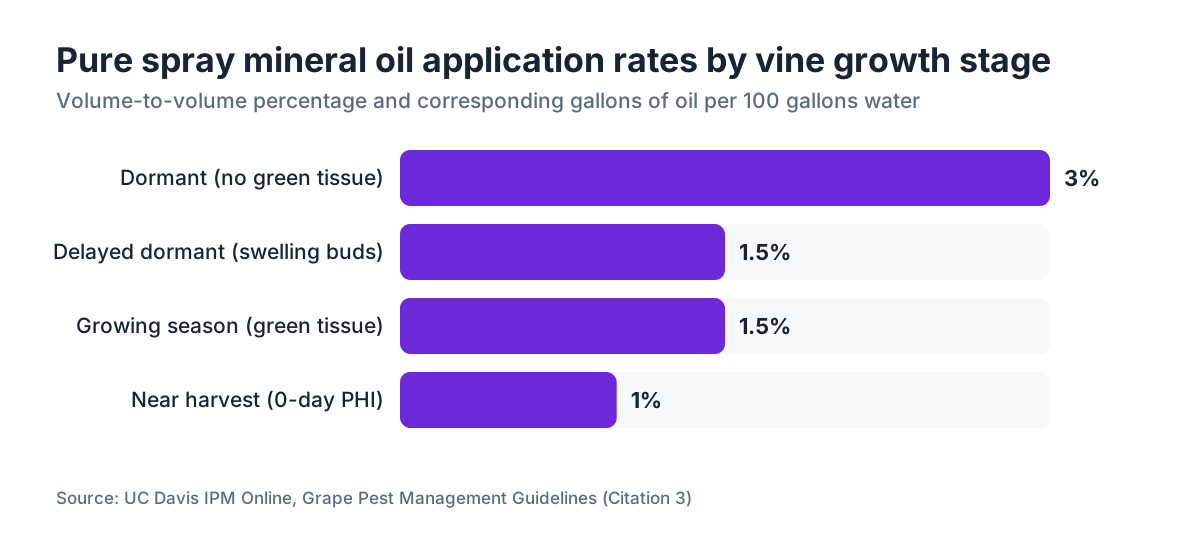
In-season rates run 1 to 2 percent volume-to-volume (v/v), which works out to roughly 1 to 2 gallons of oil per 100 gallons of finished spray. Dormant or delayed-dormant timings can go up to 3 to 4 percent, though most California advisors hold at 2 percent even at dormancy to stay safe on young wood. [3]
The percentages are simple. Gallons per acre is where people go wrong. A high-volume air-blast sprayer at 100 gpa lays down 1 to 2 gallons of oil per acre. A low-volume dilute rig at 50 gpa puts on half that. Mite control lives or dies on coverage of the under-leaf surface, and low-volume concentrate spraying often misses it. Washington State University extension recommends calibrating to a full-coverage dilute equivalent when you're targeting mites on the abaxial leaf surface. [4]
Here's a quick reference table:
| Application timing | Recommended rate (v/v) | Gallons of oil per 100 gal water |
|---|---|---|
| Dormant (no green tissue) | 2 to 4% | 2 to 4 gal |
| Delayed dormant (swelling buds) | 1 to 2% | 1 to 2 gal |
| Growing season (green tissue) | 1 to 2% | 1 to 2 gal |
| Harvest interval | None (most labels) | 0-day PHI |
For mealybug crawlers, timing beats rate. Crawlers emerge in spring and again mid-summer in most regions. Oil at 1 to 1.5 percent hitting them at emergence kills far more than the same rate applied two weeks later, once crawlers have settled and started building waxy cover.
When should you NOT apply mineral oil to grapevines?
Temperature is the biggest constraint. Most labels bar application when temperatures top 90°F (32°C), or when they're forecast to within 24 hours. Heat drives off the carrier fast while the oil fraction lingers on the leaf at a higher effective concentration, and that's what burns. In hot inland valleys the window slams shut from June through August. Crews in the San Joaquin Valley routinely start before 7 a.m. in summer for exactly this reason. [3]
The sulfur rule is the one to tattoo on your arm: don't apply mineral oil within 14 days of a sulfur application, either direction. Oil and sulfur on the same tissue react and can defoliate a vine. Most labels state "do not apply within 14 days of a sulfur spray," and the same window runs in reverse. If you're spraying sulfur every 10 to 14 days for powdery mildew, common on cool coastal sites, you have to map your oil window carefully or swap one application for a different mode of action. [2]
Other situations where PSMO causes trouble:
- Stress-weakened vines (water stress, root disease): a compromised cuticle absorbs more and burns easier.
- High humidity after application: oil spreads and dries slowly, so contact time and burn risk climb.
- Young green tissue from budbreak through the 6-leaf stage: some labels restrict use before 6 inches of shoot growth.
- Tank-mixing with emulsifiable concentrate formulations of some organophosphates: check label compatibility first.
Coastal ground gives you room. Where morning fog burns off by 10 a.m. and temperatures stay mild, your window is much wider. Sonoma coast or Santa Cruz Mountains vineyards can spray oil in conditions that would be reckless in Fresno County.
Is mineral oil safe for workers, and what does the EPA Worker Protection Standard require?
Mineral oil has a mild toxicological profile. Most PSMO products carry the EPA signal word "Caution" (Toxicity Category III or IV), the lowest risk categories, and none of the narrow-range oils are restricted-use. Acute dermal and oral LD50 values are high, effectively non-toxic by those measures. The occupational concern is respiratory: prolonged inhalation of oil mist can cause lipoid pneumonia in chronic, high-exposure cases. That's rare in the field but worth flagging for enclosed-cab operators. [5]
Under the EPA Worker Protection Standard (WPS), 40 CFR Part 170, every agricultural pesticide use carries a minimum 4-hour restricted-entry interval (REI) unless the label sets a shorter one. Most PSMO labels land on a 4-hour REI. If a label says 12 hours, 12 hours wins. Go with whichever is longer, label or WPS. [6]
The WPS also requires that workers be told about the application through central posting or direct notification, that PPE be provided and kept in working order, and that a pesticide safety information station stay up on-site. For mineral oil, label PPE is usually chemical-resistant gloves, protective eyewear, and long-sleeved clothing. Respirator requirements vary by product, so read your label.
California's Department of Pesticide Regulation adds its own layer under Food and Agricultural Code sections 11400 et seq. California workers must get WPS training, and spray records must reach the county agricultural commissioner within 7 days. PSMO applications count as reportable pesticide use in California whether or not the product is restricted-use. [7]
How do you mix and apply mineral oil without phytotoxicity?
Order of mixing matters. Fill the tank half full with water, add the oil with agitation running, then top off with water. Oil needs the emulsifier built into the formulation to stay dispersed. Dump it into a nearly-full tank with weak agitation and it separates, so the first spray hitting the vines is a slug of concentrated oil. Bad mixing causes more burn incidents than anything else. [4]
Keep agitation running the whole spray. PSMO emulsions break slower than you'd guess, but a full tank sitting idle 20 minutes in summer heat loses homogeneity. Break down mid-block? Agitate 2 to 3 minutes before you resume.
Nozzle choice drives coverage and drift. Hollow-cone nozzles, standard on air-blast rigs, push into a dense canopy. Flat-fans can work but need careful calibration to reach the under-leaf surface. Aim for thorough wetting without runoff. Oil dripping off the leaf is wasted and just loads the ground.
Calibrate before every season and re-check after any pump or nozzle change. Mite control at 1 to 2 percent oil needs enough water volume to wet the abaxial surface. WSU extension recommends clipping water-sensitive paper cards to the underside of mid-canopy leaves to verify coverage during calibration. [4]
Every PSMO application needs a record: product name, EPA registration number, date and time, field or block ID, rate applied (gallons per acre of finished spray plus oil v/v percentage), applicator name and license number where required, REI posted, and any re-entry notation. Tools like VitiScribe log these fields digitally with GPS block mapping, which pays off the day a county ag commissioner asks for your 7-day filing. Set that structure up before spray season and you skip the scramble.
Does mineral oil work for grape mealybug, and when should you apply it?
Yes, with clear limits. Oil at 1 to 2 percent kills first-instar crawlers (the mobile stage) and does a marginal job on second instars. It does almost nothing to third instars or adults tucked under waxy cotton or bark. That one fact shapes the entire program: timing to crawler emergence is everything. [3]
For grape mealybug (Pseudococcus maritimus), Central Valley crawlers leave overwintering sites on the trunk and cordons from roughly late April to early June, depending on heat. UC Davis IPM online runs a degree-day model on a 50°F base. Crawlers turn active around 200 to 300 degree-days (base 50°F) after January 1. [3]
One or two oil sprays timed to crawler emergence, with good coverage of the wood, knock early-season populations down hard before they climb to the clusters. High-pressure vineyards usually still need a follow-up systemic like spirotetramat or buprofezin later, but the oil trims the population that systemic has to hit.
Obscure mealybug (Pseudococcus viburni) colonizes clusters harder than grape mealybug does. Same timing logic, slightly different population dynamics. UC Davis viticulture resources carry separate monitoring guidance for the two species. [3]
Straight talk: mealybug control in old vineyards with thick corky bark is genuinely hard with any contact material. Oil is part of the answer. It's not the whole answer.
How does mineral oil affect beneficial insects and the vineyard ecosystem?
Here's where oil beats most alternatives. No systemic action, minimal residual. Once the spray dries, it's basically inert. Predatory mites (Galendromus occidentalis, Neoseiulus californicus) do get hit by direct contact, so you'll knock down some beneficials during application. But with no residual, predators recolonize faster after oil than after conventional miticides like abamectin or bifenazate. [2]
Parasitic wasps (Anagrus species) that attack leafhopper eggs take a hit from direct contact but bounce back quickly after oil. Same goes for lacewings and minute pirate bugs. The move is to spray only when you need to and to monitor beneficials before and after. With a well-established predatory mite population, think hard before you blanket the canopy.
Honeybees are at low risk from PSMO. Most labels either say nothing about bees or carry brief "do not apply when bees are actively foraging" language, standard for any spray. Skip applications during bloom anyway, not because oil is especially bee-toxic but because any bloom spray can cut fruit set.
Organic programs: PSMO is allowed under the National Organic Program (NOP) as long as the specific product is OMRI-listed or otherwise approved. Not every mineral oil carries an OMRI listing, so verify before you buy if certification matters. [8]
What are the resistance management benefits of mineral oil?
Physical mode of action means zero target-site resistance risk. Spider mites (Tetranychus urticae, Panonychus ulmi) have beaten nearly every conventional miticide group: organophosphates, pyrethroids, bifenazate, spiromesifen, abamectin. The literature on mite resistance runs from the 1950s to today. Mineral oil has been in use for over a century, and no resistance mechanism has ever turned up in any mite species. [1]
That's the strongest argument for keeping oil in a resistance rotation. It doesn't matter what resistance alleles your mites carry. Oil works the same on susceptible and resistant mites. WSU extension's mite guidance lists narrow-range oils as resistance-management tools to rotate against other mode-of-action groups. [4]
Powdery mildew tells a similar story. QoI (FRAC Group 11) resistance in E. necator is documented in California, Oregon, and the eastern U.S. SDHIs (FRAC Group 7) are under selection pressure now. Oil in the rotation stretches the working life of those fungicides.
The practical takeaway: don't save oil for the day you're desperate. Build it into the rotation as a standard tool, early season on mites and mealybug, and as a mildew rotation partner in any program leaning hard on a single FRAC group.
How do you keep proper spray records for mineral oil applications?
California requires pesticide application records filed with the county agricultural commissioner within 7 days under California Code of Regulations Title 3, Section 6624. The record has to carry the operator's name and address, the site (township, range, section, and commodity), application date, product name and EPA registration number, amount applied, area treated, and method. [7]
Other states set their own rules. Oregon requires records kept 3 years (ORS 634.372). Washington requires 3 years under RCW 17.21. Federal FIFRA doesn't mandate grower records for non-restricted-use pesticides, but the WPS record requirements still apply. And if you grow under crop insurance or a GAP certification, your auditor wants those records no matter what state law says. [11]
What belongs in a strong mineral oil record beyond the legal minimum?
- Block or vineyard ID, mapped, not a verbal description
- Pest or disease target plus the monitoring threshold or scouting data that triggered the spray
- Weather at application: temperature, wind speed, relative humidity
- Application start and end time
- Water volume per acre (gpa)
- Oil rate as both v/v percentage and gallons of oil per acre
- Sprayer ID and calibration date
- Applicator name and Pest Control Adviser (PCA) if one recommended it
- REI posted (the date and time the REI expires)
A digital system that ties records to block maps and flags filing deadlines takes the load off during a busy spray week. Spreadsheet, a platform like VitiScribe, or a state ag department form, the structure matters more than the medium. What the county ag commissioner checks in an audit is whether your dates, rates, and filing line up. Paper gaps are the most common violation.
What are the best PSMO products on the market and what do labels actually say?
Widely used products in North American vineyards include JMS Stylet-Oil (EPA Reg. No. 65765-1), Purespray Green Spray Oil (registration numbers vary by state), Saf-T-Side (an older formulation), and Monterey Horticultural Oil. Each runs a slightly different adjuvant system, which changes emulsion stability and spray behavior. [12]
Read your specific label rather than leaning on general guidance. Rates, REIs, crop restrictions, and tank-mix prohibitions differ by product, and the label is the law under FIFRA. Things to check:
- "For use on" crops: confirm grapes or wine grapes are listed by name.
- Timing restrictions: "do not apply before 6-inch shoot growth" is common.
- Temperature cutoff: usually 85°F or 90°F.
- Sulfur interval: nearly always 14 days, but confirm.
- Pre-harvest interval: most PSMO labels state "no pre-harvest interval" or "0-day PHI," a real advantage. Confirm on yours.
- Maximum applications per season: some labels cap total sprays or total gallons per acre.
JMS Stylet-Oil is the most-studied PSMO in the published literature and shows up in both UC Davis and Cornell IPM material, which makes it a fair default if you're starting cold. Other OMRI-listed formulations perform right alongside it in the field, though. There's no evidence any single formulation is dramatically better once UR and viscosity match. The UC IPM online guidelines for grapes list several acceptable products under each pest section. [3]
How does mineral oil fit into an integrated pest management (IPM) program for vineyards?
IPM means spray decisions built on monitoring data and economic thresholds, not the calendar. For mites, the UC Davis threshold for Pacific spider mite is roughly 20 to 30 percent of leaves infested with motile mites when predatory mite populations aren't keeping up. European red mite thresholds run similar. Oil fits the model because it's selective enough (low residual, low impact on beneficials once dry) to fire off a threshold-based decision without wrecking your biocontrol. [3]
Mealybug is different. There's no clean economic threshold like there is for mites, because the damage is often about virus transmission (grapevine leafroll-associated virus, which mealybugs vector) as much as feeding. Any crawlers moving through a block with known leafroll are a problem regardless of density. Oil at crawler emergence fits IPM because you're hitting the most vulnerable life stage with the lowest-toxicity tool you have.
Powdery mildew IPM uses disease models (the UC Powdery Mildew Risk Index) to time fungicides to weather-driven infection periods. Oil slots in as a rotation partner on low-risk days, or as the pick when you want to break a run of same-mode sprays. [10]
The vineyard math over five years: a program with PSMO as a core tool tends to spend less on pesticides, because you keep beneficials doing free work on mites and slow resistance in your pathogens. Nobody has a controlled study that pins that vineyard-specific ROI down cleanly. The individual pieces, though, are well-supported.
Frequently asked questions
Can I mix pure spray mineral oil with copper fungicide in the same tank?
Usually yes, but check both labels. Most PSMO formulations mix fine with copper hydroxide or copper oxychloride at standard rates. Mixing order is water first, copper second, then oil with continuous agitation. Skip fixed copper at high rates in hot conditions. Run a small jar test before committing a full tank. It costs you two minutes and can save a burned block.
What is the pre-harvest interval for mineral oil on wine grapes?
Most pure spray mineral oil labels set a 0-day pre-harvest interval, meaning no mandatory wait between the last spray and harvest. That's one of the genuine advantages over many conventional pesticides. Confirm on your specific product label, since PHI language varies by formulation and registration state. Your label is the controlling document under FIFRA.
How long after applying sulfur can I spray mineral oil?
The standard interval is 14 days in either direction: wait 14 days after sulfur before oil, and 14 days after oil before sulfur. Oil and sulfur on the same tissue react and can cause severe leaf burn and defoliation. This 14-day rule sits on virtually all PSMO labels and shows up consistently in UC Davis and Cornell IPM guidance.
Is pure spray mineral oil allowed in certified organic vineyards?
Yes, if the specific product is OMRI-listed or otherwise approved under the USDA National Organic Program. Not every mineral oil product carries an OMRI listing. Check the product's OMRI certificate or your certifier's approved materials list before you buy. JMS Stylet-Oil, for one, carries OMRI listing. Your organic certifier has final say on what's allowed in your operation.
At what temperature does mineral oil become phytotoxic to grapevines?
Most labels restrict application above 85°F to 90°F, or when those temperatures are forecast within 24 hours. High heat drives water off the spray mix, leaving oil at higher effective concentrations on the leaf longer than intended. Stressed vines are more sensitive. Early morning applications before the heat climbs are standard practice in hot inland regions through summer.
How many times can I apply mineral oil per season in a vineyard?
It varies by label, so read yours. Some set no maximum per season; others cap total seasonal use at a set volume per acre. UC Davis guidance commonly runs 2 to 4 applications per season, spaced by pest monitoring rather than the calendar. Too many sprays in one season raises phytotoxicity risk, especially on water-stressed vines or in heat.
Does mineral oil control leafhoppers in vineyards?
Leafhopper eggs have some susceptibility to oil, but efficacy is inconsistent and not reliable enough to anchor a leafhopper program. Direct contact kills some nymphs; adults mostly shrug it off. UC Davis and WSU IPM guidance doesn't list mineral oil as a primary leafhopper tool. Parasitic wasps (Anagrus species) are the more effective biological control, and oil's low residual makes it less disruptive to those beneficials than most alternatives.
What are the EPA Worker Protection Standard requirements for applying mineral oil?
Under 40 CFR Part 170, workers must receive WPS safety training, be informed of applications (central posting or direct notification), and have access to label-specified PPE. The minimum REI for most PSMO products is 4 hours. Workers can't enter the treated area until the REI expires. A pesticide safety information station must stay on-site with emergency contact information and product safety data sheets.
How do you calculate gallons of mineral oil per acre for a spray application?
Multiply your spray volume per acre (gpa) by the target oil concentration as a decimal. At 100 gpa and 1.5% oil: 100 x 0.015 = 1.5 gallons of oil per acre. At 50 gpa and 2%: 50 x 0.02 = 1.0 gallon of oil per acre. Calibrate the sprayer to know your actual gpa first. Assumed gpa is often wrong, especially after nozzle wear.
Can mineral oil spread leafroll virus in a vineyard?
Mineral oil itself doesn't spread leafroll virus. The vectors are mealybugs and soft scales. Apply oil to mealybug crawlers before they pick up virus from an infected plant and move to a healthy one, and you cut vector pressure and can slow spread. Oil applied after crawlers have already fed on infected material won't inactivate the virus they carry. Managing mealybugs at crawler emergence is the intervention that counts.
How does mineral oil compare to abamectin for spider mite control in vineyards?
Abamectin is faster knockdown with proven efficacy, but resistance is documented in some California mite populations and it carries a 28-day pre-harvest interval under most labels. Mineral oil has no PHI, essentially zero resistance risk, and lower impact on predatory mites after the spray dries. In resistance rotations, most PCAs use both: abamectin for a heavy early infestation needing quick knockdown, oil for season-long rotation and late-season use when PHI is a constraint.
Do I need a pesticide applicator license to apply mineral oil in California?
Pure spray mineral oil is a general-use pesticide in California, not restricted-use. The property owner or operator can apply it without a license. If you hire a commercial applicator to do the work, they must hold a valid Qualified Applicator License or Certificate. A Pest Control Adviser recommendation isn't legally required to buy or apply PSMO, though documenting who recommended the application is good practice.
How soon after application can workers safely re-enter a mineral-oil-treated vineyard?
The restricted-entry interval on most PSMO labels is 4 hours. Workers can't enter until the REI expires and, for enclosed spaces, the area has been ventilated. In field conditions the 4 hours have to pass. The REI clock starts when the application is complete, not when it begins. Post the REI at the field entry point as the EPA Worker Protection Standard requires.
Sources
- UC ANR Publication 3453, Pest Management Guidelines: Grape: PSMO classified as narrow-range oil with UR of 92% or higher; resistance not documented in any mite species after decades of use
- Cornell University, NYS IPM Program, Horticultural Oils: Narrow-range horticultural oils refined to remove aromatic and unsaturated hydrocarbons; 14-day sulfur interval standard guidance
- UC Davis IPM Online, Pest Management Guidelines: Grape (Powdery Mildew, Mealybug, Spider Mite sections): In-season PSMO rate 1-2% v/v; oils most effective on young powdery mildew colonies; mealybug degree-day model for crawler timing; mite threshold 20-30% leaves infested
- Washington State University Extension, Grape Pest Management, Mite Management Section: WSU recommends narrow-range oils as resistance-management tools; calibrate for full-coverage dilute equivalent for mite control; water-sensitive paper for coverage verification
- U.S. National Library of Medicine, Hazardous Substances Data Bank, Mineral Oil: Mineral oil has high acute dermal and oral LD50 values; prolonged oil-mist inhalation associated with lipoid pneumonia in chronic high-exposure scenarios
- EPA Worker Protection Standard, 40 CFR Part 170: WPS requires minimum 4-hour REI, worker training, central posting or direct notification, PPE provision, and pesticide safety information station on-site
- California Department of Pesticide Regulation, Pesticide Use Reporting; CCR Title 3 Section 6624: California requires pesticide application records filed with county agricultural commissioner within 7 days; all pesticide use including general-use products is reportable
- USDA National Organic Program, Allowed and Prohibited Substances: OMRI-listed mineral oil products allowed under NOP for certified organic production; certification requires approved product verification
- UC Davis IPM Online, Powdery Mildew Risk Assessment Model (UC Risk Index): UC Powdery Mildew Risk Index used to time fungicide applications to weather-driven infection periods; oil cited as rotation partner in mildew programs
- Washington State Legislature, RCW 17.21, Washington Pesticide Application Act: Washington state requires pesticide application records retained for 3 years under RCW 17.21
- EPA Pesticide Product and Label System; JMS Stylet-Oil, EPA Reg. No. 65765-1: JMS Stylet-Oil bears EPA Reg. No. 65765-1; OMRI listed; 4-hour REI; 0-day PHI on grapes; 14-day sulfur interval stated on label
Last updated 2026-07-09