QAL exam prerequisites and application process for vineyard managers
TL;DR
- A Qualified Applicator License (QAL) lets vineyard managers legally apply or supervise restricted-use pesticides.
- To qualify, you typically need proof of age (18+), a passing score on a state core exam plus a category exam, and an application fee ranging from roughly $50 to $250 depending on state.
- Some states also require documented hours working under a licensed applicator before you can sit for the exam.
What is a QAL and why do vineyard managers need one?
A Qualified Applicator License, almost always called a QAL, is the credential that lets you buy, apply, or directly supervise the application of restricted-use pesticides (RUPs) in a commercial setting. California defines the term under Food and Agricultural Code Section 11701, and the California Department of Pesticide Regulation (CDPR) runs the program [1]. Other states use different names. Washington calls it a commercial pesticide applicator license. Oregon calls it a commercial applicator license. The federal floor comes from EPA's rules under FIFRA Section 11, which require states to certify applicators before they touch RUPs [2].
For vineyard managers, this matters in a direct, practical way. Several fungicides and insecticides commonly used on wine grapes, including some organophosphates and certain systemic materials, are classified as restricted-use. Without a QAL, you can't legally purchase or direct their application. You're also in a weak position if a county agricultural commissioner shows up for an inspection, because the penalty for uncertified RUP use starts at a notice of violation and can climb to serious fines or license revocation for the operation.
The QAL is different from a Qualified Applicator Certificate (QAC). A QAC lets you apply RUPs but not supervise others doing so. Most vineyard managers running a crew need the QAL, not the QAC. California draws this line explicitly: QAC holders work only under the direct supervision of a QAL holder. If you're in charge of a spray program and directing workers, you want the QAL.
Small vineyards sometimes assume that because they grow grapes for their own wine (not a pesticide-for-hire business), they're exempt. They aren't. The commercial applicator classification covers any agricultural use, including grapes grown for your own winery.
What are the basic eligibility requirements before you apply?
Every state sets its own floor. Across the major wine grape states the common requirements line up: you have to be at least 18, submit a completed application to the state lead agency, pay a fee, and pass the required exams before the license is issued [1][3].
California adds a layer most other states don't. You need to document 40 hours of work experience under the direct supervision of a licensed pest control adviser or QAL holder before CDPR will license you. The 40 hours don't have to come before the exam. CDPR just won't issue the license until the experience is verified. Plenty of applicants take the exam first and log the hours after, which is a reasonable sequence.
Washington requires passing both a core exam and at least one category exam. WSU Extension publishes study guides for each category, and the Washington State Department of Agriculture (WSDA) administers the exams at testing centers statewide [3]. Oregon uses a similar two-part structure through the Oregon Department of Agriculture.
Here's a point worth checking. If you already hold a current, valid QAL or equivalent in another state, several states will accept it as a basis for reciprocity or expedited licensure. California does not offer full reciprocity but will credit documented experience. Ask your state ag department directly, because this changes.
A criminal background check is not a universal requirement. Some states do ask about prior pesticide law violations on the application form. Lying on that section is a separate basis for denial, so answer accurately.
What exams do you have to pass, and how hard are they?
The exam structure almost everywhere follows the EPA model: a core (general standards) exam covering pesticide laws, safety, environmental fate, label reading, and protective equipment, plus one or more category exams tied to the pest control work you do. For vineyard managers the relevant category is almost always agricultural pest control, sometimes split into plant (crops) and soil/fumigation [1][2].
In California, CDPR administers written exams at county agricultural commissioner offices. The core exam runs 100 questions. The agricultural category exam runs roughly 50 to 80 questions depending on which categories you pick. Passing score is 70% in California [1]. Washington's WSDA uses a third-party testing vendor and also requires 70% on both sections [3].
People ask whether the exams are hard. They're not graduate-level material, but they're not a walk either. The core exam wants you to know pesticide label law in real detail, understand signal words (Danger, Warning, Caution), tell acute from chronic toxicity categories, and work through basic dilution and mixing math. The agricultural category exam gets into pest identification, resistance management, and integrated pest management.
UC Davis and WSU Extension both publish free study guides and practice exams [4][5]. The UC IPM program's online resources are the strongest for the label-reading sections, because they walk through California's pesticide use reporting rules in a way that mirrors the exam questions. Spend 20 to 30 hours with those materials, work the practice tests, and you're in solid shape for both sections.
Format varies. Some states still use paper-and-pencil at the county office. Others use Pearson VUE or a similar computer-based center. California county offices schedule directly, so your wait depends on your county. In busy ag counties like Napa, Fresno, or Monterey, expect a few weeks for an exam slot during peak season.
How do you actually submit the QAL application?
In California, the QAL application goes to CDPR, not your county. You download the Qualified Applicator License application from the CDPR website, fill it out, attach proof of passing exam scores, document your 40 hours of experience with supervisor signatures, and mail it with the fee to CDPR in Sacramento [1].
The California fee structure in recent years: a $135 QAL application for a two-year license, plus $54 per pest control category listed on the license. These figures come from CDPR's fee schedule and can shift with legislative adjustment, so verify the current amounts on the CDPR website before you submit [1].
Washington runs through the WSDA Pesticides Program. You register for the exam through WSDA, pay the exam fee (around $60 on the most recent published schedule), and after passing you apply for the commercial applicator license through the same agency [3]. Oregon uses a similar online portal through the Oregon Department of Agriculture.
Here's what slows most applications down: incomplete supervisor verification for the experience hours. Make sure whoever signs off on your hours is currently licensed and that their license number is on the form. CDPR kicks it back without that, and you lose weeks.
Applying for a pest control business license instead of just a personal QAL layers on more requirements: proof of insurance, a designated QAL as the responsible licensee, and a bond in some states. That's a different credential from the individual QAL, and most vineyard managers working in-house only need the individual license.
Running vineyards in more than one state means separate licenses in each. A larger operation with vineyards in both Washington and California needs a license in both. There's no national QAL. Plan around it.
How much does the QAL process cost in total?
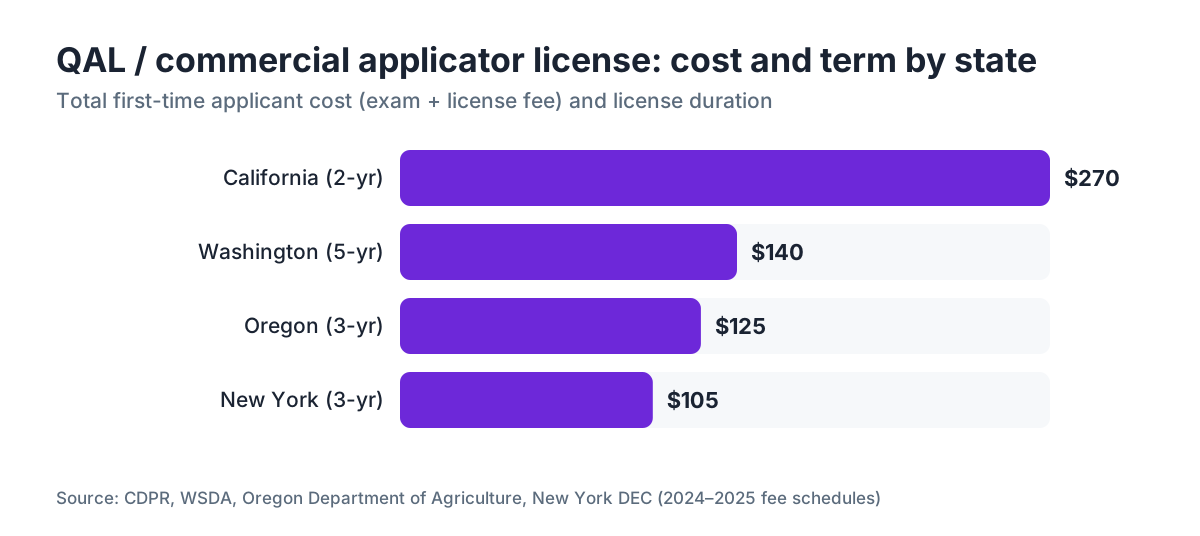
The honest answer: costs vary by state and by how many exam attempts you need. Here's a comparison of the major wine grape states.
| State | Exam Fee | License Fee | License Term | Approx. Total First-Time Cost |
|---|---|---|---|---|
| California | No separate exam fee (county handles it) | $135 base + $54/category | 2 years | $189, $350+ depending on categories |
| Washington | ~$60 per exam session | ~$70, $90 | 5 years | $130, $150 |
| Oregon | ~$50 | ~$50, $100 | 3 years | $100, $150 |
| New York | ~$30 exam | ~$50, $100 | 3 years | $80, $130 |
Sources: CDPR fee schedule [1], WSDA pesticide program [3], Oregon Department of Agriculture [6], New York DEC [7]. These ranges hold for 2024 to 2025, but fees move with budget cycles, so verify before you write the check.
Beyond the state fees, factor in study materials (free if you use extension resources [4][5]) and any prep courses. County farm bureaus in California and extension offices in Washington sometimes run one-day exam prep workshops for $50 to $150. Those are worth it if you haven't been deep in the pesticide regs recently, because they aim straight at what shows up on the exam.
Fail and retake, and most states charge the exam fee again. California county offices set their own re-examination scheduling, and some hold a waiting period before you can retake.
How long does it take to get your QAL from start to finish?
For a prepared applicant who has the experience hours or can document them fast, the realistic California timeline is 2 to 4 months from starting the process to holding the license. Roughly: 2 to 4 weeks to get an exam appointment, exam day, then 4 to 8 weeks for CDPR to process the application after all documents are in [1].
Washington is faster on processing. WSDA typically turns around commercial applicator licenses in 2 to 4 weeks after a passing score is verified [3].
The bottleneck in California is the 40-hour experience requirement if you're starting cold. A new vineyard manager who came up through an office or sales role rather than field work may need a full season shadowing a licensed applicator before licensure. Plan for that if it applies to you.
One practical note: your license is not issued on exam day. You get a score report, and if you pass, you then submit the full application. Don't assume you can order restricted-use pesticides the week after your exam. Wait until the actual license document is in your hand.
Renewal is another calendar item. California QALs expire every two years and require 20 hours of continuing education (CE) during the license period, with set hours in pesticide laws and regulations and in worker safety [1]. Miss your renewal window and your license lapses, and you may have to retest. A digital record system, something like VitiScribe's spray and compliance module, tracks CE credits alongside your pesticide use records so renewal doesn't sneak up on you.
What study resources actually work for the QAL exam?
The best free resources come from university extension programs. UC Davis IPM Online (ipm.ucanr.edu) has study guides, pest identification resources, and practice questions that map closely to the California exams [4]. For Washington, WSU Extension's Pesticide Safety Education Program publishes category-specific manuals that are openly available and aligned to what WSDA tests [5].
Cornell University's Pesticide Management Education Program does the same for New York, with manuals organized by exam category and updated regularly [8]. If you're in the Northeast or prepping for New York's certification, Cornell's materials are the clearest available.
EPA's Worker Protection Standard (WPS) training material is directly tested in the core exam. The WPS for agricultural employers covers posting requirements, pesticide safety training for workers and handlers, and decontamination requirements, and all of it shows up as exam questions [9]. Reading the actual rule (40 CFR Part 170) alongside EPA's compliance guide gives you both the rule text and the practical application.
Reading pesticide labels is probably the single most effective exam prep you can do. The core exam tests label comprehension heavily: signal words, first aid statements, REI (restricted entry interval), and PHI (pre-harvest interval). Pull the labels for products you actually use on your vineyard and read them front to back. If you can explain every section of a copper fungicide label and a systemic insecticide label, you've covered a big chunk of what the exam asks.
Skip the third-party prep courses that aren't tied to a state agency or extension program. Several exist and charge $200 to $400 for content you can get free from CDPR or WSU. Save the money.
What continuing education is required to keep your QAL current?
In California, QAL holders must complete 20 hours of approved continuing education every two-year license period [1]. At least 4 of those hours must be in laws and regulations, and at least 2 hours must cover worker safety, which ties directly to the EPA Worker Protection Standard [9]. The rest can be any approved category, and CDPR keeps a list of approved providers and courses.
Washington requires 40 hours of continuing education over a five-year license period for commercial applicators [3]. That's about 8 hours a year, manageable if you attend the annual pest management conferences, county extension workshops, or online courses through WSU.
CE credits show up through county agricultural commissioner workshops, California Association of Pest Control Advisers (CAPCA) events, UC Cooperative Extension field days, and industry conferences like the Unified Symposium. Some product manufacturers offer CDPR-approved CE through their training programs, though the quality varies.
The record-keeping that comes with CE is easy to ignore and painful to reconstruct later. Keep a folder, physical or digital, with certificates from every course. CDPR audits CE records, and if you can't document your hours at renewal time, you're in trouble.
How does the QAL interact with EPA Worker Protection Standard requirements?
The WPS and QAL are separate obligations that overlap in the field. The WPS, codified at 40 CFR Part 170, sets baseline protections for agricultural workers and pesticide handlers on farms, nurseries, and greenhouses [9]. Your QAL doesn't automatically satisfy your WPS duties, and your WPS compliance doesn't replace the need for a QAL.
EPA's WPS guidance states that agricultural employers must provide pesticide safety training, notify workers of treated areas, and ensure handlers can reach pesticide labeling information. That's your obligation as the vineyard operator regardless of who holds the QAL.
The WPS also requires that pesticide handlers (anyone mixing, loading, or applying pesticides) get specific training every year. In California, that handler training requirement runs more detailed than the federal floor. County agricultural commissioners, CDPR's enforcement arm, audit WPS compliance during field inspections, and they look at training records, PPE, and posted Pesticide Safety Information Series (PSIS) sheets [1].
For a vineyard manager running a crew, the practical read is this: track WPS training dates and trainer qualifications for every handler on your team, document REI compliance on your spray records, and post the required notices at field entry points. A paper system can handle it, but it gets unwieldy across multiple blocks and multiple products. That's where a digital spray record tool earns its keep. You want a timestamped log showing the product applied, the REI, who applied it, and when the field was safe to re-enter.
What happens if you supervise pesticide applications without a QAL?
The short answer: serious civil penalties, potential criminal liability in egregious cases, and real exposure for your employer or your own business.
In California, unpermitted use or supervision of restricted-use pesticides can bring civil penalties up to $5,000 per violation under Food and Agricultural Code Section 12999 [10]. Each application event is a separate violation. So if your crew sprays RUPs on a Saturday and again on Tuesday without a licensed supervisor, that's two violations. County agricultural commissioners handle enforcement and have broad authority to issue stop-work orders and conduct inspections without notice.
Beyond the fines, a violation creates a record that follows an individual through future licensing. CDPR and most state ag departments ask about prior violations on any pest control license application, and a serious history can end in denial.
There's employment liability too. If you supervise RUP applications without a QAL for a management company or a winery and an incident happens, workers' compensation and liability insurance coverage can get complicated by the unlicensed activity.
The fix is straightforward. Get licensed before you direct RUP applications. If you're overseeing spray operations right now without a license, make the QAL a priority for this season. The exam prep timeline is achievable in 4 to 6 weeks of part-time study.
Are there any shortcuts or exemptions for small vineyard owners?
There aren't many, and the ones that exist are narrower than most people assume.
The Private Applicator exemption (or its state equivalent) is the most relevant for small vineyard owners. In California, a private applicator certificate lets a person apply RUPs on land they own or rent for producing an agricultural commodity, without the full commercial QAL requirements. The private certificate still requires passing an exam, but the exam is sometimes shorter, and there's no 40-hour experience requirement in California for it [1].
Here's the catch. If you hire a crew and direct their pesticide applications, even on your own property, you're in commercial applicator territory, not private applicator territory. The private certificate only covers your own hands on the equipment. The moment you supervise someone else applying RUPs, you need a QAL.
Small wineries that contract out all their pesticide applications to a licensed pest control operator dodge the in-house licensing issue, but they still carry WPS obligations as the agricultural employer, and they're still responsible for the applications on their land. For paso robles wineries or smaller south coast winery operations that use contracted applicators, the paperwork burden doesn't disappear. It just shifts.
Certified Crop Adviser (CCA) credentials and Pest Control Adviser (PCA) licenses in California are separate from the QAL and don't substitute for it. A PCA can recommend pesticide applications but can't apply or supervise them without also holding a QAL or QAC.
How do you stay organized and compliant after you're licensed?
The license is the start of the compliance obligation, not the end. Once you're licensed and running a spray program, you generate pesticide use records that must be filed with your county agricultural commissioner in California, typically monthly [1]. Other states run similar reporting timelines. Those records have to include the operator name and license number, the site treated (legal description or site name), the pesticide applied with EPA registration number, the amount used, the application date, and the target pest.
Missed or inaccurate pesticide use reports are one of the most common compliance citations CDPR issues. They're also one of the easiest to avoid with a system.
Keep those records in a purpose-built vineyard management system, like VitiScribe, and your spray log is already structured to match the fields CDPR and WSDA require on their forms. You're not transcribing from a field notebook into a state form at month's end. The data is already in the right shape.
Aside from spray records, stay on top of CE certificate tracking, license renewal dates, and WPS training records for your team. A single shared folder with those documents, updated after every training event, takes maybe five minutes per event and saves hours if you're inspected or need to document your program for a buyer, a bank, or a certification body.
The more organized vineyard operations treat pesticide compliance as a year-round process rather than a seasonal scramble, and the difference in audit outcomes shows.
Frequently asked questions
Can I take the QAL exam without any prior pesticide experience?
In most states, yes, you can sit for the exam before logging experience hours. California requires 40 hours of documented experience under a licensed supervisor, but you can take the exam first and accumulate the hours afterward. CDPR won't issue the license until the experience is verified, but there's no rule against testing before you have all the hours. Washington and Oregon have no documented-hours requirement for the commercial applicator license.
How is a QAL different from a Pest Control Adviser license in California?
A PCA (Pest Control Adviser) is licensed to recommend pesticide applications and prescribe pest management strategies. A QAL holder is licensed to apply or supervise the application of restricted-use pesticides. They're separate licenses with separate exams and separate CE requirements. Some vineyard managers hold both, but the QAL is the one that authorizes hands-on application and supervision. A PCA without a QAL cannot legally direct a crew applying RUPs.
Does a California QAL work in other states?
No. There's no national QAL, and California does not have full reciprocity agreements with other states. If you manage vineyards in both California and Washington, you need separate licenses in each state. Some states accept out-of-state exam scores or experience on a case-by-case basis, but you should contact each state's lead pesticide agency directly. The process is not automatic anywhere.
What is the passing score for the QAL exam?
In California, the passing score is 70% on both the core exam and the category exam. Washington State also uses a 70% threshold. Oregon sets 75% for its commercial applicator exam. New York's DEC requires 70% on both core and category sections. If you fail, most states allow a retake after a waiting period, typically two weeks to one month, with another exam fee required.
How many continuing education hours do I need to renew a California QAL?
California QAL holders need 20 hours of approved CE every two-year license period. At least 4 hours must be in pesticide laws and regulations, and at least 2 hours must cover worker safety topics tied to the EPA Worker Protection Standard. The remaining hours can be in any CDPR-approved subject area. Failing to complete CE before your renewal date means your license lapses, and reinstatement may require retesting.
What restricted-use pesticides are commonly used on wine grapes?
Several organophosphate insecticides used for leafhopper and mealybug control carry restricted-use classification, including some formulations of chlorpyrifos (now banned in California but still relevant in other states) and certain neonicotinoids in specific formulations. Some soil fumigants used for nematode management before planting are also RUPs. The specific list changes as EPA reclassifies products, so checking the current label is the only reliable way to confirm classification before purchase.
Does the vineyard owner have to hold a QAL, or can a vineyard manager hold it for the operation?
Either person can hold the QAL, and in many operations the vineyard manager is the licensed individual rather than the ownership group. What matters is that whoever is supervising restricted-use pesticide applications on-site holds a valid QAL. The license is personal, not transferable. If a QAL-holding manager leaves, the operation needs another licensed person before RUP applications can legally continue under in-house supervision.
Can I get a QAL if I've had a prior pesticide violation?
It depends on the severity and how recent the violation is. California's QAL application asks about prior pesticide law violations, and CDPR reviews each case individually. A single minor paperwork violation years ago is unlikely to result in denial. A criminal conviction for pesticide misuse or a pattern of serious violations creates real risk of denial or a conditional license. Disclosing accurately on the application is mandatory; omitting a known violation is an independent basis for denial or revocation.
What is the private applicator certificate and how does it differ from the QAL?
A private applicator certificate in California allows an individual to apply restricted-use pesticides on land they own or rent for agricultural production, without the full commercial QAL. The exam is less extensive, and there's no 40-hour experience requirement. The limitation is that a private certificate only covers your own applications, not supervision of others. If you direct any hired workers applying RUPs, you need a QAL. The private certificate is most appropriate for sole operators with no hired help.
Are there online QAL exam prep resources I can use for free?
Yes. UC Davis IPM Online offers study materials and pest management guides directly applicable to California exams. WSU Extension's Pesticide Safety Education Program publishes free category manuals for Washington's certification. Cornell's Pesticide Management Education Program covers New York. All are publicly available without registration. The EPA's Worker Protection Standard compliance guide is also free and directly relevant to the core exam's worker safety sections.
How long is a QAL valid, and when should I start the renewal process?
California QALs are valid for two years. Washington's commercial applicator license runs five years. Oregon's is three years. Start the renewal process at least 60 days before expiration to account for processing time and to make sure your CE hours are complete. CDPR sends renewal notices, but don't rely on that. Track your own renewal date and set a calendar reminder. A lapsed license means you cannot legally supervise RUP applications until reinstatement is complete.
Do vineyard workers need pesticide certification, or just the manager?
Workers who only perform tasks inside a treated field after the restricted entry interval has expired don't need any pesticide certification. Workers classified as handlers, meaning anyone who mixes, loads, applies, or assists with pesticide application equipment, must receive annual WPS handler safety training under 40 CFR Part 170. That training is different from licensing. Only the person supervising the actual application of restricted-use pesticides needs a QAL. Regular harvest or pruning crews are covered by WPS worker protections, not licensing requirements.
What documentation do I need to submit with my QAL application in California?
California's QAL application requires the completed application form with your signature, proof of passing scores on the core and required category exams, a supervisor verification statement documenting 40 hours of supervised experience with the supervisor's name and license number, and the application fee (currently $135 base plus $54 per category). Submitting incomplete documentation is the most common reason for processing delays. Double-check every line of the experience verification section before mailing.
Sources
- California Department of Pesticide Regulation, Licensing and Certification: QAL application requirements, 40-hour experience requirement, fee schedule ($135 base + $54/category), 20-hour CE requirement, and California Food and Agricultural Code Section 11701 definition
- EPA, Federal Insecticide Fungicide and Rodenticide Act (FIFRA) Section 11: Federal requirement for states to certify pesticide applicators before they can purchase or use restricted-use pesticides
- Washington State Department of Agriculture, Pesticides Program: WSDA commercial pesticide applicator exam fee (~$60), license fee (~$70-$90), 5-year license term, and 40 CE hours per renewal period
- UC Davis IPM Online, University of California Agriculture and Natural Resources: Free study guides and pest management resources applicable to California QAL exam preparation
- WSU Extension Pesticide Safety Education Program, Washington State University: Category-specific certification exam study manuals published for Washington State commercial applicator exams
- Oregon Department of Agriculture, Pesticides Program: Oregon commercial pesticide applicator exam fee (~$50), license fee ($50-$100), 3-year license term, 75% passing score
- New York State Department of Environmental Conservation, Pesticides Program: New York commercial applicator exam fee (~$30), license fee ($50-$100), 3-year license term, 70% passing score
- Cornell University Pesticide Management Education Program: Free category-specific certification manuals for New York applicator exams, updated regularly
- EPA Worker Protection Standard, 40 CFR Part 170: WPS requirements for agricultural employers including handler training, REI posting, decontamination, and annual pesticide safety training; basis for WPS-related CE requirements in California QAL renewal
- California Food and Agricultural Code, Section 12999: Civil penalties up to $5,000 per violation for unpermitted use or supervision of restricted-use pesticides in California
- EPA, Pesticide Worker Safety and Applicator Certification: Federal framework for state certification programs, including private vs. commercial applicator distinctions and minimum competency standards under 40 CFR Part 171
Last updated 2026-07-10