R-11 surfactant in vineyard sprays: what it does and how to use it safely

TL;DR
- R-11 is an organosilicone surfactant (80% trisiloxane ethoxylate) that improves spray coverage on waxy grape leaf surfaces.
- Use it at 0.05 to 0.25% v/v, and it lowers the water volume you need.
- R-11 has no pre-harvest interval on its own because it isn't a pesticide.
- The tank-mix partner sets the PHI and the WPS re-entry interval.
What exactly is R-11 and why do vineyard managers use it?
R-11 is a concentrated organosilicone surfactant made by Momentive (formerly Witco/OSi Specialties). The active ingredient is trisiloxane ethoxylate at 80% concentration, and that molecule is the reason it behaves so differently from standard crop oil or nonionic surfactants. Trisiloxane breaks surface tension so hard that a water droplet on a waxy grape leaf spreads instead of beading. That spreading is the whole point.
Grape leaves are hard to wet. The epicuticular wax layer on Vitis vinifera and most American hybrids creates a contact angle that makes standard spray droplets bounce or roll off, especially on the abaxial (underside) surface where powdery mildew and leafhoppers actually live. R-11 can cut contact angle on plant surfaces by 50 to 70% compared to water alone [1]. That's not a marginal gain.
The payoff is better coverage per gallon applied. UC Davis Cooperative Extension work on spray technology shows that surfactant choice is one of the highest-leverage inputs in a spray program, often mattering more than nozzle upgrades or equipment brand. When you're pushing a fungicide through a dense canopy with enough coverage to suppress Botrytis or downy mildew, the right surfactant matters as much as the active ingredient label rate.
R-11 also acts as a penetrant. The organosilicone molecule moves some systemic chemistries into leaf tissue, which matters for products like phosphonate fungicides or foliar nutrients. That dual role, spreader and penetrant, is why it caught on in vineyards and orchards rather than staying confined to the turf and ornamental programs where it was first widely marketed.
What is the correct R-11 mixing rate for grapevines?
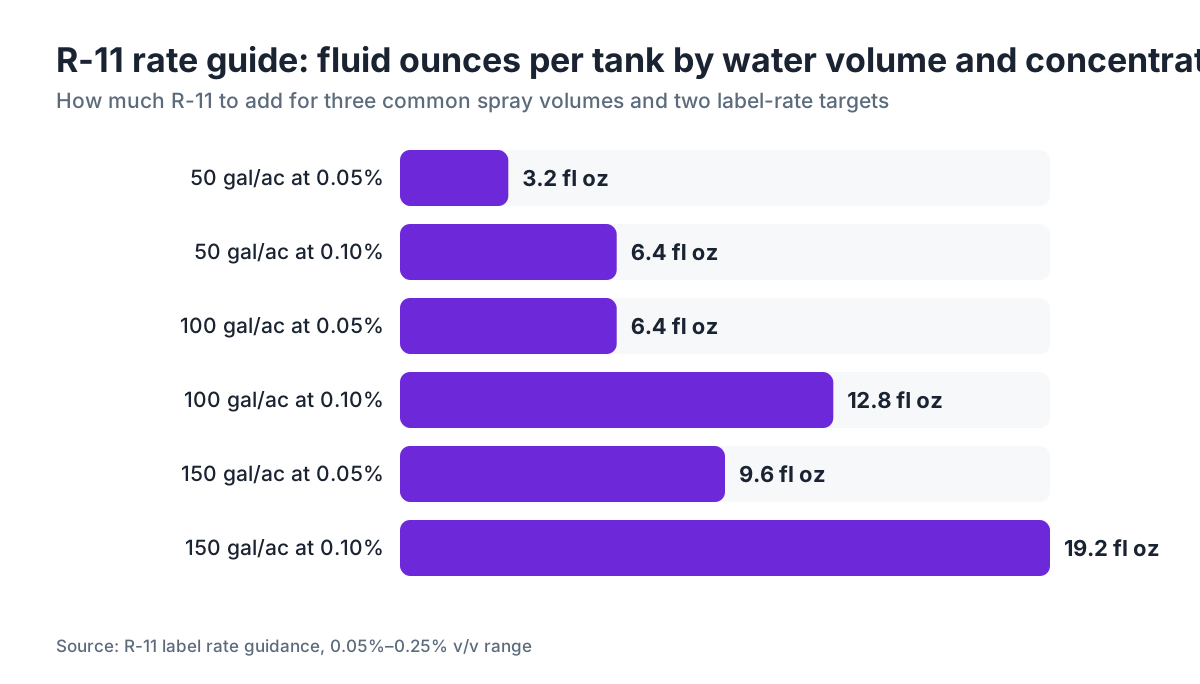
The label recommends 0.05% to 0.25% v/v in the finished spray solution. In practical terms for vineyard applications:
| Water volume (gal/acre) | R-11 at 0.05% | R-11 at 0.1% | R-11 at 0.25% |
|---|---|---|---|
| 50 | 3.2 fl oz | 6.4 fl oz | 16 fl oz |
| 100 | 6.4 fl oz | 12.8 fl oz | 32 fl oz |
| 150 | 9.6 fl oz | 19.2 fl oz | 48 fl oz |
Most vineyard applications run at 0.1% (the midpoint) unless there's a specific reason to go higher. For powdery mildew (Erysiphe necator) applications, 0.1% gives good spreading without pushing so much material into the plant that you risk phytotoxicity. For foliar nutrient sprays, 0.05% is usually enough. For contact insecticides targeting leafhoppers or mites on the underside of leaves, some applicators push to 0.125 to 0.2% for aggressive coverage.
Do not exceed 0.25%. Organosilicone surfactants turn phytotoxic at high concentrations, and grapevines are relatively sensitive compared to tree crops. Cornell's viticulture team has noted phytotoxic responses at concentrations above 0.3% during hot weather, particularly on young shoot tissue [2]. Young vines and heat-stressed vines are more vulnerable. The risk climbs sharply once temperatures pass 90°F and when you're spraying new growth.
One thing that trips applicators up: R-11 is NOT the same as nonionic surfactant (NIS) at the typical 0.25% v/v rate you see on many herbicide labels. It's much more aggressive. If a herbicide label says "add nonionic surfactant at 0.25%," swapping in R-11 at the same volume will likely burn the crop. R-11 rates run 4 to 5 times lower than NIS for the same wetting. Always read the specific pesticide label for surfactant class guidance before you substitute.
Is there a pre-harvest interval (PHI) for R-11?
R-11 itself has no pre-harvest interval because it is not a pesticide. It is registered as an inert ingredient and surfactant adjuvant. EPA does not regulate application timing for adjuvants the way it does for pesticide active ingredients [3].
Here's where people get into trouble. The PHI that governs your application is always set by the pesticide it's mixed with. Add R-11 to Pristine (boscalid + pyraclostrobin), and the 0-day PHI on Pristine for grapes controls your timing. Add it to Captan 80WDG, and the 3-day PHI on Captan controls. Use R-11 alone as a spreader with a foliar nutrient, and there's no pesticide PHI at all, though you still need to check whether the nutrient product carries label restrictions.
The compliance risk is that applicators sometimes leave R-11 off the spray record because "it's just a surfactant." That's a mistake. USDA National Organic Program rules require that all materials applied to organic fruit be either on the National List or documented as exempt, and adjuvants are not automatically exempt [4]. For conventional production, some third-party audit programs (SCS Global, Primus, and others) require full ingredient disclosure including adjuvants. Record what you mix. Every time.
How does R-11 affect worker protection standard (WPS) requirements?
This is the question vineyard managers most often get wrong, and it shows up in compliance audits.
R-11 is not a pesticide under FIFRA, so the EPA Worker Protection Standard (40 CFR Part 170) re-entry interval requirements do not apply to R-11 by itself [5]. The WPS REI for any application is set entirely by the pesticide in the tank. Spray Movento 240SC (spirotetramat, 24-hour REI) with R-11, and your REI is 24 hours. Spray wettable sulfur (4-hour REI) with R-11, and your REI is 4 hours.
That said, two things stay on my radar. R-11 increases foliar penetration, so it may increase dermal absorption of the co-applied pesticide if workers contact treated foliage. WPS regulations don't address this directly, but it's a real worker health question. Organosilicone surfactants are known skin penetration enhancers in the dermatology literature [6]. If you're applying anything with systemic toxicity concerns, a full REI plus a check-in is reasonable caution.
The WPS posting and notification requirements still cover the whole mixture. You post the most restrictive REI from any product in the tank. The application block, timing, and restricted-entry information go to workers before the application, and the field posting goes up [5]. That process doesn't change because R-11 is in the mix.
WSU Extension's integrated pest management guides for Pacific Northwest vineyards recommend listing every adjuvant on spray records with tank partner, rate, and timing, both for WPS documentation and for troubleshooting if phytotoxicity or residue questions come up later [7].
Can you use R-11 in organic vineyards?
Generally no, unless your certifier has specifically approved it. R-11 is a synthetic organosilicone compound. It is not on the USDA National Organic Program's National List of Allowed and Prohibited Substances. Synthetic surfactants not on the National List are not permitted as adjuvants in organic production [4].
Some certifiers take a materials-review approach and might approve specific adjuvants case by case, but that's uncommon for synthetic trisiloxane products. If you're farming certified organic, your realistic options are plant-oil-based spreader-stickers (yucca extract, soy lecithin, natural latex-based products) or approved silica-based wetting agents. These do not perform like R-11, to be honest. The spreading and penetration you get from an organosilicone is genuinely hard to match with organic-approved materials, and that's a real tradeoff organic growers accept.
If you're in transition or working toward organic certification, pull R-11 from your spray program before the certification period begins, not at the end. Certifiers look at spray records from prior years.
What are the phytotoxicity risks of R-11 on grapevines?
Phytotoxicity is the main practical risk with R-11, and it's real enough that WSU Extension flags it in their spray technology recommendations [7]. The factors that raise the risk:
Temperature is the biggest one. Applications above 85 to 90°F sharply increase the chance of leaf burn, especially on young tissue. The spray dries fast in heat, concentrating the surfactant on the leaf surface before it spreads and volatilizes as expected. Early morning applications, before temperatures peak, are standard practice for a reason.
Growth stage matters. New shoot growth, from bud break through about 6-inch shoot length, is most vulnerable. The cuticle on expanding tissue is thinner and the wax layer isn't fully formed. Some applicators drop to 0.05% during this window or skip R-11 entirely until shoots harden off.
Sunburn-stressed or drought-stressed vines are more susceptible. Stress compromises the cuticle integrity that normally buffers foliar chemistry. If your vines show heat stress symptoms, rethink whether this is the week to add an organosilicone.
The co-applied pesticide matters too. Some fungicides and insecticides are themselves mildly phytotoxic at label rates, and R-11 increases the uptake of everything in the tank, which can push a borderline application into visible injury. Copper-based fungicides have documented phytotoxicity interactions with organosilicones at higher rates [2].
Organosilicone phytotoxicity shows up as necrotic spotting, often around the spray droplet contact points, and marginal leaf burn. It typically appears 2 to 5 days after application. It's rarely lethal to a mature vine, but it looks bad, and repeated phytotoxic events cut photosynthetic capacity and can stress berry development near fruit zone leaves.
How does R-11 compare to other vineyard adjuvants?
There are three main surfactant categories vineyard managers work with, and they're not interchangeable.
| Adjuvant type | Typical active | Spreading | Penetration | Phytotox risk | Organic-allowed |
|---|---|---|---|---|---|
| Organosilicone (R-11) | Trisiloxane ethoxylate | Very high | High | Moderate | No |
| Nonionic surfactant (NIS) | Alkyl ethoxylate | Moderate | Low-moderate | Low | Some formulations |
| Crop oil concentrate | Petroleum or veggie oil + emulsifier | Moderate | Moderate | Moderate | Some formulations |
| Yucca / natural wetting | Saponins | Low-moderate | Low | Very low | Yes |
For most fungicide applications in vineyards (sulfur, sterol inhibitors, QoI fungicides), a NIS at 0.25% v/v or R-11 at 0.05 to 0.1% will both deliver adequate coverage if your spray equipment is calibrated and your water volume is right. R-11 earns its keep when you're spraying into a dense, closed canopy where droplet penetration is genuinely limited, or when you're applying contact materials where every leaf surface counts.
For herbicide applications in vine rows, the herbicide label specifies adjuvant type, and you should follow that label exactly rather than defaulting to R-11.
Crop oil concentrates work well for miticide and some insecticide applications where you want both surface spreading and a contact-carrier effect. They're a reasonable alternative to R-11 for those uses without the same phytotoxicity risk in high heat.
The honest takeaway: R-11 is the strongest spreader you can buy, and strength cuts both ways. It's worth the precision it demands in hot, dense-canopy situations. For routine fungicide programs on open canopies in mild weather, a NIS is fine and less likely to bite you.
What should a vineyard spray record include when R-11 is used?
Spray record requirements vary by state, but the federal floor comes from EPA WPS requirements and, for anyone selling to wineries with food safety audits, from commodity-level good agricultural practice standards.
At minimum, a complete spray record for an application using R-11 as a tank additive should capture:
- Date and time of application
- Block or vineyard location (map reference if you have one)
- All products applied: pesticide(s) with EPA registration number, R-11 with product name and lot number, any other adjuvants
- Rate of each product per acre or per gallon of water
- Total water volume applied per acre
- Equipment used and sprayer calibration date
- Weather conditions (temperature, wind speed and direction, relative humidity)
- Growth stage at time of application (BBCH or Eichhorn-Lorenz scale)
- REI established and posted, based on most restrictive tank-mix partner
- Applicator name and license number if applicable
- PHI at time of application and estimated days to harvest
That last item catches people. Even though R-11 has no PHI of its own, you're legally and commercially required to know the PHI of every registered pesticide in the mix and document that you're in compliance.
Keeping this in a searchable digital format pays off when auditors ask for records by block, by product, or by date range. Paper binders work fine until someone needs all sulfur applications from 2023 in fifteen minutes. Tools like VitiScribe are built around exactly that records structure for vineyard operations, with spray logs that capture adjuvants alongside pesticide entries so nothing slips.
WSU Extension's Pacific Northwest Pest Management Handbook recommends keeping spray records for a minimum of two years for most certifications, and some export markets require three years of traceable records [7].
Does R-11 affect pesticide efficacy or residue levels?
Yes to both, in ways worth understanding.
On efficacy: the research is fairly consistent that organosilicone surfactants improve efficacy of contact and locally systemic fungicides and insecticides at equal active ingredient rates. A 1997 study in Pesticide Science (now Pest Management Science) found trisiloxane-based surfactants improved coverage uniformity on grape leaves by up to 40% compared to NIS controls, with matching improvements in powdery mildew control under moderate pressure [1]. More recent work from Cornell and the USDA ARS on Botrytis management in tight-clustered varieties points to better coverage inside the cluster when organosilicone surfactants go on during bloom applications, though the data on final disease incidence is less clean [2].
On residues: enhanced penetration can push more of a systemic pesticide inside berry tissue rather than just onto the skin. This is generally not a tolerance problem because MRLs (maximum residue limits) are set for whole-berry or juice-extraction scenarios, not surface wash-off. But it's a relevant consideration if you're close to harvest and using a systemic with a detectable juice residue profile. EPA tolerance data by commodity and pesticide is searchable through the Pesticide Tolerances database [12].
For export markets, the European Union's MRLs are often stricter than US tolerances for the same pesticide-commodity combination. If you're sourcing fruit for a winery that exports wine to the EU, know those limits. The EU Pesticide Database provides current MRLs [8]. Adding R-11 to a systemic fungicide applied 10 days before harvest on an EU-export-destined block is a conversation worth having with your winery buyer before you spray.
How do you troubleshoot poor spray coverage even when using R-11?
If you're running R-11 at 0.1% and still getting poor coverage, the problem is almost certainly not the surfactant. Here's where to look.
Calibration first. Nozzle output variation above 10% between individual nozzles causes coverage gaps that no surfactant fixes. Check outputs quarterly during the season with a calibration catch test. Worn nozzles change droplet spectra, and a nozzle past its service life may be putting out large, off-target droplets instead of the fine pattern you need for canopy penetration [9].
Water volume is the most underestimated variable. R-11 improves coverage efficiency, but it doesn't substitute for adequate water. Dense canopies at veraison may need 100 to 150 gallons per acre for good coverage. The same vineyard at 3-inch shoot length needs far less. If you're running 50 gpa into a closed canopy at 80% coverage, you're under-covering the interior no matter what surfactant is in the tank.
Water pH and hardness can affect R-11 stability in the tank. Hard water above 500 ppm can interfere with some organosilicone formulations. If your irrigation water is very hard, a water conditioner or pH adjustment to 6 to 7 before adding surfactant can help. Add R-11 to the tank last or near-last in the mixing sequence, after the pesticide is fully dispersed.
Drive speed matters. At typical row speeds of 2.5 to 4 mph with an airblast sprayer, coverage is acceptable. Faster speeds cut dwell time and coverage on interior leaves. This sounds obvious, but operators often speed up late in the day to finish a block, and water-sensitive paper studies consistently show the speed-coverage tradeoff is real [9].
One more thing: water-sensitive paper placed in multiple canopy zones (exterior top, exterior bottom, interior) before and after a calibration spray is one of the cheapest diagnostic tools you have. UC Davis's spray technology resources include protocols for using it [10].
Where can vineyard managers find reliable R-11 label and safety information?
The current R-11 label and safety data sheet are maintained by Momentive Performance Materials. EPA registers many inert adjuvants under FIFRA Section 25(b), so the product label is the primary legal document governing use [3].
For university-level guidance on adjuvant use in vineyards:
UC Davis's Department of Viticulture and Enology has spray technology resources that address surfactant selection, and cooperative extension publishes the UC IPM Guidelines for grapes, which specify adjuvant recommendations by pest and growth stage [10].
Cornell's viticulture extension program covers spray application technology in its New York and Great Lakes region recommendations, and the fact sheets address phytotoxicity risk and mixing guidance [2].
WSU Extension's Pacific Northwest Pest Management Handbook covers adjuvant use explicitly in its grape sections, including organosilicone-specific guidance [7].
For worker protection and compliance, EPA's WPS resources are the reference. The full text of 40 CFR Part 170 governs agricultural worker protection requirements [5].
For spray records, PHI compliance, and keeping everything audit-ready across multiple blocks and spray events, VitiScribe handles the adjuvant and pesticide record structure that auditors expect, so you're not rebuilding that documentation when you need it.
One thing nobody talks about enough: the R-11 SDS is worth reading once even if you've used it for years. The skin and eye hazard section drives handler PPE choices, even though the material isn't classified as a pesticide. Organosilicone surfactants can enhance dermal absorption of other materials on skin, which has direct implications for handler glove and eye protection when they're mixing the tank.
Frequently asked questions
Is R-11 the same as Silwet L-77?
They're the same chemistry class (organosilicone trisiloxane ethoxylate) and perform very similarly. R-11 is the Momentive brand; Silwet L-77 is the Momentive/Setre brand in some markets. Both are 80 to 85% trisiloxane active. For practical vineyard use, they're interchangeable at equal rates, and some extension publications cite them together. Check the label of whichever product you have, since formulation concentrations can vary slightly between lots.
Can R-11 be used with copper fungicides on grapevines?
Use caution. Copper-based fungicides already carry phytotoxicity risk on grapevines, and organosilicone surfactants increase foliar penetration of whatever they're tank-mixed with. Cornell extension has noted that copper plus high-rate organosilicone applications in warm weather can push marginal copper applications into visible burn. If you use R-11 with copper, keep R-11 at the low end (0.05%) and apply in cooler morning temperatures to cut the risk.
Does R-11 have a signal word on its label?
R-11's label carries the signal word CAUTION, the lowest hazard tier under EPA labeling requirements. Its acute oral, dermal, and inhalation toxicity are relatively low for a spray adjuvant. It is a moderate eye irritant, so splash goggles are appropriate during tank mixing. The SDS from Momentive specifies PPE for handlers, including chemical-resistant gloves and eye protection during concentrate handling.
How do I record R-11 on a spray record if it's not a pesticide?
Record it as an adjuvant in a separate field from your pesticide entries. Include product name, EPA establishment number (from the label), rate per tank or per acre, and the lot number. Many third-party food safety audit standards and some state pesticide record-keeping regulations require full ingredient disclosure including adjuvants. The two-minute effort of adding it to every record beats reconstructing records during an audit.
What is the re-entry interval for a block sprayed with R-11 plus sulfur?
Wettable sulfur typically carries a 4-hour REI under EPA WPS requirements, though you should confirm the specific REI on the sulfur product's label because formulations vary. R-11 has no independent REI since it isn't a registered pesticide. The posted REI for the block is 4 hours (from the sulfur). Workers cannot enter the treated area until that interval expires unless they wear the PPE specified on the sulfur label.
Can I use R-11 with glyphosate in vineyard floor management?
Yes, but with caution around vine trunks. R-11 sharply increases glyphosate uptake through plant tissue. That helps with hard-to-control perennial weeds, but it also means glyphosate drift or contact with green vine tissue is far more damaging with R-11 in the mix than without it. Use low-drift nozzles, shield sprayers, and apply in low-wind conditions. The herbicide label governs adjuvant type, so confirm the glyphosate product label permits organosilicone surfactants.
Does temperature affect R-11 performance on grapevines?
Significantly, in both directions. Cold temperatures (below about 50°F) slow spreading and cut efficacy because trisiloxane viscosity rises and plant surfaces are less receptive to wetting. High temperatures above 85 to 90°F raise phytotoxicity risk as spray dries faster on leaves, concentrating the surfactant. The sweet spot for most vineyard applications is 55 to 82°F with low to moderate humidity, applied early morning before temperatures peak.
Is R-11 allowed for use in Certified Sustainable or LIVE-certified vineyards?
Certification programs vary. Most sustainability programs (California Sustainable Winegrowing Alliance, LIVE, SIP) are less restrictive than organic certification and do not categorically prohibit synthetic adjuvants like R-11. They do require complete spray records and may restrict specific chemistries at certain thresholds. Check your certification body's materials list and confirm R-11 is not excluded before use. Thorough adjuvant records are required under all major sustainability audits.
What mixing order should I follow when adding R-11 to a tank?
Add R-11 last or near-last in your tank-filling sequence, after water is partially added and your pesticide products are dissolved or dispersed. Organosilicone surfactants added first can cause foaming or interfere with wettable powder and water-dispersible granule dissolution. Fill the tank to about 75% capacity, add pesticide products with agitation running, then add R-11, then finish filling. Agitate gently rather than with high turbulence to hold down foam.
How long does R-11 remain active in a prepared tank mix?
Use prepared tank mixes within 24 hours. Organosilicone surfactants can hydrolyze in aqueous solution, particularly at pH above 8 or below 4, losing effectiveness over time. If you're preparing a large batch for a multi-day spray operation, mix daily rather than prepping multi-day volumes. Hard or highly alkaline water speeds hydrolysis. Adjust tank water to pH 6 to 7 with a buffering agent if your source water is consistently alkaline.
Does R-11 affect spray droplet size from my airblast sprayer?
Yes. Organosilicone surfactants cut surface tension so effectively that they can shift the droplet size distribution toward finer droplets, raising drift potential at the same nozzle settings. Worth knowing if you're spraying near property boundaries or sensitive areas. Some applicators using R-11 move to a slightly larger orifice nozzle or drop pressure to compensate. Water-sensitive paper testing after you change adjuvant chemistry is a good habit.
What state record-keeping requirements apply to R-11 use in California?
The California Department of Pesticide Regulation requires pesticide use reports for all applications by licensed applicators, but adjuvants that are not pesticides do not require their own use report. The pesticide application record itself must be retained for at least three years under California Food and Agricultural Code Section 12981. Best practice is to list all adjuvants on that record even when not legally required, since inspections and commodity audits may ask for complete formulation records.
Sources
- Pest Management Science (formerly Pesticide Science), Silwet surfactant coverage studies: Trisiloxane-based surfactants improved coverage uniformity on grape leaves by up to 40% compared to NIS controls in spray deposition studies
- Cornell University Cooperative Extension, Viticulture and Enology Program: Cornell extension notes phytotoxic responses from organosilicone surfactants above 0.3% concentration, especially during hot weather and on young shoot tissue, and interactions with copper fungicides
- U.S. EPA, Pesticide Registration and Inerts: R-11 is classified as an inert ingredient and adjuvant; EPA does not establish pre-harvest intervals for adjuvants that are not themselves pesticide active ingredients
- USDA Agricultural Marketing Service, National Organic Program National List: Synthetic surfactants not on the National List of Allowed and Prohibited Substances are not permitted as adjuvants in certified organic production
- U.S. EPA, Worker Protection Standard for Agricultural Pesticides (40 CFR Part 170): WPS re-entry interval requirements apply to pesticide applications; the REI for a tank mix is set by the most restrictive pesticide in the mixture; adjuvants without pesticide registration do not independently trigger REI requirements
- Journal of Controlled Release, organosilicone skin penetration enhancement literature: Organosilicone trisiloxane surfactants are documented dermal penetration enhancers in pharmaceutical and dermatology research, relevant to handler exposure assessment
- European Commission EU Pesticide Database (MRLs): EU MRLs for pesticide residues in grapes and wine are often more stringent than US tolerances; export-destined fruit requires compliance with destination-country limits
- UC Agriculture and Natural Resources, Pest Management Guidelines for Grapes, Spray Application: UC IPM grape guidelines address nozzle calibration, water-sensitive paper protocols, and drive speed effects on coverage; nozzle output variation above 10% causes coverage gaps
- UC Davis Department of Viticulture and Enology, Spray Technology Resources: UC Davis viticulture resources address surfactant selection and spray technology, including protocols for water-sensitive paper canopy coverage assessment
- California Department of Food and Agriculture, Pest Management: California Food and Agricultural Code Section 12981 requires pesticide application records to be retained for at least three years
- U.S. EPA, Pesticide Tolerances Database: EPA MRLs (tolerances) for pesticide residues are set for whole-berry or juice-extraction scenarios and are searchable by pesticide and commodity
Last updated 2026-07-09