Recording application equipment calibration data in vineyard logs
TL;DR
- Vineyard spray records must include nozzle output, pressure, travel speed, and spray volume per acre measured at calibration.
- The federal EPA Worker Protection Standard requires records kept two years, and most state ag departments require three plus equipment calibration details.
- Calibrate and log every new crop season, after any nozzle change, and whenever output drifts more than 5 to 10 percent off your target rate.
What calibration data actually belongs in a vineyard spray log?
A spray log that lists only product name, rate, and date is incomplete. Inspectors from state departments of agriculture and EPA enforcement programs want the equipment side too, because the application rate on paper means nothing if the sprayer wasn't delivering what you thought.
At a minimum, a calibration entry should record: nozzle type and size (the tip model number, more than "flat fan"), operating pressure at the boom or air-blast head in PSI, travel speed in mph or minutes per 100 feet, output per nozzle per minute (measured, not calculated), effective swath width or canopy coverage distance, and the resulting gallons per acre (GPA) derived from those numbers. Some states also want the calibration date, the name of the person who performed it, and the sprayer's hour-meter reading at that time.
The EPA Worker Protection Standard (WPS), 40 CFR Part 170, requires application records be retained for two years after the date of application, and many states mandate three [1]. A calibration record counts as supporting documentation for the application record, so the same retention window applies. Don't keep them in separate binders where they can drift apart.
The practical reason to log all of this is simple. If a residue question comes up at harvest, or a neighbor files a drift complaint, your calibration data shows the actual delivered rate. That's your defense, or it's how you find the problem. Either way, you want it written down.
How often should you calibrate and record it?
Calibrate at the start of each season, after any nozzle or tip replacement, and whenever a spot-check shows output has drifted more than 5 percent from baseline. That's the WSU Extension recommendation [2]. Most experienced vineyard managers also run a quick output check mid-season, especially after a pump seal or pressure regulator gets serviced.
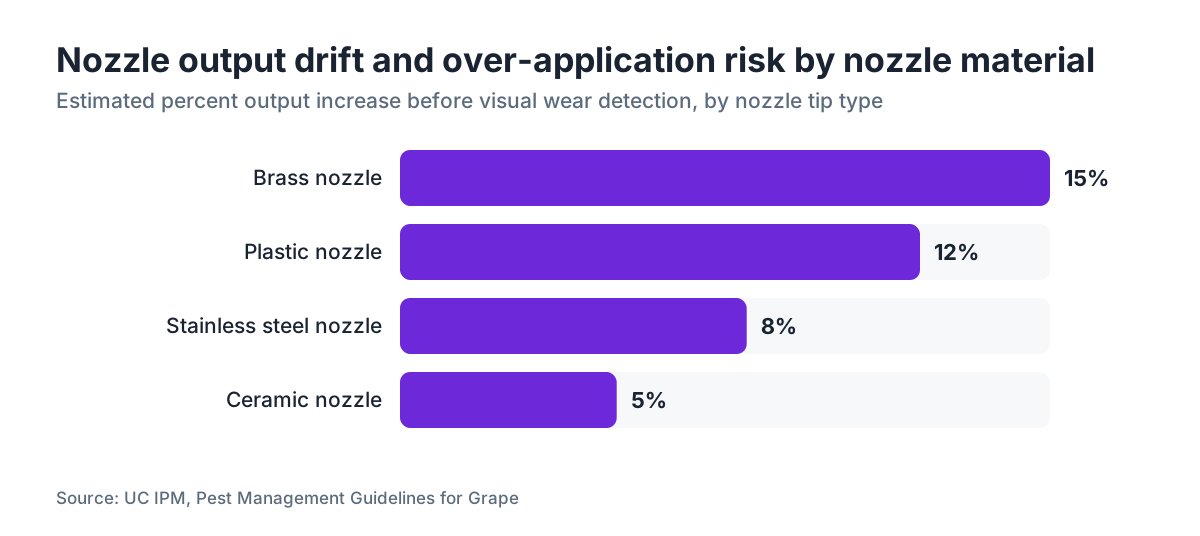
For air-blast sprayers in vineyards, nozzle wear is the main drift variable. Ceramic and stainless tips last longer than brass, but all of them wear eventually. UC IPM notes that a worn nozzle can increase output by 10 to 15 percent or more before a visual inspection would catch it [3]. That's a 10 to 15 percent overdose of whatever you're spraying, which is both a residue risk and money burned.
Record the calibration the day you do it. Don't batch-enter at the end of the week. The entry should be timestamped to the day, because if you swap nozzles Tuesday and a problematic application happens Wednesday, you need the paper trail to show the calibration came first.
Some operations run a written pre-season equipment check form covering the whole sprayer (pump output, pressure gauge accuracy, PTO speed, nozzle uniformity) and attach it to the first spray record of the year. That's a clean approach, and it's what most county farm advisors will tell you to do if you ask them.
What do EPA and state regulations actually require in equipment records?
The federal floor is the EPA Worker Protection Standard. Under 40 CFR Part 170.309, agricultural employers must keep records of pesticide applications that include the location and description of the treated area, product name and EPA registration number, active ingredient, date and times of application, and the name of the certified applicator [1]. Equipment calibration specifics aren't spelled out in the WPS text, but the rule also requires application rates to match the label, and the label carries the force of law under FIFRA.
Label language matters here. Many fungicide and insecticide labels say something like "apply in sufficient water to obtain thorough coverage" or give a GPA range. If a product is labeled for 50 to 150 GPA and your uncalibrated sprayer is putting out 200 GPA, you've made an off-label application, full stop. Your calibration log is what shows you stayed inside the range.
California goes past the federal minimum. The Department of Pesticide Regulation requires pesticide use reports (PURs) that include application method and equipment type, and county agricultural commissioners run field inspections that frequently include equipment records [4]. Washington requires written calibration records for commercial applicators under RCW 17.21 [5]. New York's DEC and Cornell Cooperative Extension both publish guidance treating calibration records as part of the application record, subject to the same retention rules [6].
If you hold a private or commercial applicator license, your state may want to see calibration logs during a renewal audit. Check with your state lead agency. The pesticide program contacts are listed through the EPA's pesticide program directory [7].
How do you actually calculate and record gallons per acre for a vineyard sprayer?
The GPA calculation for a vineyard air-blast sprayer is a little different from a boom sprayer over open ground, because you're treating canopy volume rather than a flat surface. Even so, the number logged in records is usually GPA referenced to ground area, because that's what labels use.
The basic field calculation:
- Mark off a 100-foot test course in the row.
- Run the sprayer at the operating RPM and travel speed you'll use during the application. Time how long it takes to cover 100 feet.
- Collect output from each nozzle for that same number of seconds into a graduated container.
- Use this formula: GPA = (nozzle output in ounces x 495) / (nozzle spacing in inches x travel speed in mph). Or use the simplified catch-cup method: multiply ounces caught per nozzle per minute by a factor based on row spacing and mph.
WSU Extension publishes a calibration worksheet that walks through both the catch-cup method and the pressure-based calculation, and it's the clearest step-by-step available for Pacific Northwest conditions [2].
What goes in the log: the actual measured ounces per nozzle per minute (not your target), the pressure reading at time of measurement, the travel speed in mph or seconds per 100 feet, the calculated GPA, the target GPA from the label, and whether the two matched within your tolerance (usually plus or minus 5 percent). If you had to adjust and re-measure, log both the before and after numbers. That shows due diligence.
For air-blast sprayers, also record the fan speed or PTO RPM, because air volume affects canopy penetration even when liquid output is dead on. Some county advisors and third-party auditors (GlobalG.A.P., SCS Global) now ask for this as part of IPM documentation.
What format should calibration records take, paper or digital?
Neither format is legally required over the other in federal law, and most states accept either. What regulators care about is that records are legible, retained for the required period, and produced on request, usually within 72 hours under most state inspection protocols.
Paper has one real advantage. It's tamper-evident in a way that's obvious: crossed-out entries, initials, dates in ink. Regulators trust handwritten logs partly because editing them leaves a trace. The downside is that paper gets wet, smells like a spray shed within a season, and needs manual transcription if you ever want to spot a trend.
Digital records logged in field apps or spreadsheets are searchable and can be backed up. The risk is that a plain spreadsheet lets you change a number with no audit trail, which is exactly why some auditors eye digital records more skeptically unless the system carries timestamps and edit logs. A system like VitiScribe, which logs edits with a timestamp and user ID, closes that gap and makes the digital record defensible the same way a handwritten one is.
Whatever format you use, link the calibration record to the application record it supports, physically or digitally. Don't keep a calibration binder in the shop and an application log in the house. An inspector should pull one document and see both.
What are the most common calibration logging mistakes that create compliance problems?
The biggest one is recording target numbers instead of measured numbers. If your target is 40 GPA and you write down 40 GPA without running the catch-cup test, you've created a false record. Under FIFRA, falsifying pesticide records is a civil violation with penalties reaching several thousand dollars per violation per day [8]. Don't do it.
Second is skipping the nozzle type. "Hollow cone, size 02, D5-25" tells an inspector something. "Spray nozzle" tells them nothing and suggests you filled in a form rather than documented what happened.
Third is missing the re-calibration entry after a mid-season nozzle swap. You replace three worn tips in row 12, apply a fungicide that afternoon, and there's no calibration record between the last full check and that application. That gap becomes a problem if a residue issue or a neighbor complaint surfaces later.
Fourth is dropping the pressure unit. PSI and bar both show up on different gauges and sprayer brands. Log the unit, more than the number. 30 PSI and 30 bar are very different things.
Fifth, and this one gets ignored, is not logging the water source or tank mix order. It doesn't affect calibration directly, but it's part of a full application record and some state agencies ask for it. Mixing order matters for tank-mix compatibility and can change efficacy, so it's worth having.
How does calibration documentation connect to pesticide label compliance?
The pesticide label is a legal document under FIFRA, and applying a product in a manner inconsistent with the label is a federal violation [8]. Labels give rates in fluid ounces per acre, pints per acre, or pounds of active ingredient per acre, and they often set a gallons-per-acre range for carrier volume.
Your calibration record is the bridge between what the label requires and what your sprayer delivered. If the label says apply at 0.5 to 1.0 lb ai per acre in 30 to 100 GPA, and your log shows the sprayer was calibrated to deliver 65 GPA at the intended speed and pressure, you can demonstrate label compliance. No calibration data, and you can't demonstrate anything.
Cornell's Pesticide Safety Education Program puts it plainly: "Calibration is the only way to know you are applying pesticides at the rates specified on the label" [6]. That's not hedged. It's the straightforward reason calibration records exist.
For restricted-use pesticides (RUPs), the documentation burden climbs. The certified applicator is personally responsible for the accuracy of the application record, and calibration data is treated as part of that record under many state interpretations. If you're applying RUPs in your vineyard, your calibration log isn't optional paperwork. It's evidence of professional competence.
What should a single calibration log entry look like in practice?
Here's a realistic example of a full entry. It isn't a template from any particular agency, just what a well-documented entry looks like based on published extension guidance.
Date: June 14, 2025
Operator: J. Martinez (CA Private Applicator License #XXXXX)
Sprayer ID: Rear-mount air-blast, 100-gallon tank, 2019 Gregoire
Nozzle type and size: Albuz ATR 80 blue, size 02
Nozzle condition: Replaced full set June 1, 2025 (13 nozzles total)
Operating pressure: 50 PSI at manifold
PTO speed: 540 RPM
Travel speed: 2.4 mph (timed 100-foot course, 25 seconds)
Row spacing: 8 feet
Output per nozzle (measured): 14.8 oz/min average (range 14.2-15.3 oz/min)
Calculated GPA: 47.2
Target GPA (from label): 40-60 GPA
Result: Within target range, no adjustment needed
Notes: Nozzle #7 on right side at 15.3 oz/min, within 5% tolerance, will recheck at next calibration
That entry is a complete record. It shows who, what, when, measured versus targeted, and a note about the one slightly high nozzle. An inspector or auditor can read it and understand the whole equipment story for that spray event.
Note that the 14.2 to 15.3 oz/min range across 13 nozzles is about an 8 percent spread. A spread wider than 10 percent usually means nozzles are mismatched or some are worn, and calibration guidance from UC IPM and WSU both point to replacing or rebalancing before application [2][3].
How long do you need to keep calibration records, and how should you store them?
Federal baseline under EPA WPS is two years from the date of application [1]. California, Washington, New York, and most other major wine-producing states require three [4][5][6]. Oregon requires two years for private applicators and three for commercial applicators under its pesticide record rules [10]. If you work across state lines or custom-crush for several ranches, apply the strictest standard that touches any of your operations, which lands you at three years as a practical default.
Storage matters. Records have to be legible and retrievable. "In a box somewhere in the barn" doesn't meet the 72-hour production requirement most state inspection programs impose. County agricultural commissioners in California, for example, can request records within a short window under Food and Agriculture Code Section 12981 [4].
For paper records: a dedicated binder per calendar year, stored inside (not in the spray shed where moisture and chemical vapors degrade paper), organized by date. Label the spine with the year and property name.
For digital records: keep a backup off the primary device (cloud or external drive), and check periodically that old records are still accessible and not locked behind a lapsed software subscription. This is a real problem with proprietary farm management apps. Make sure you can export your data in a standard format.
At the end of the three-year window, don't just shred everything. Review first. If there's any open legal matter, neighbor dispute, or residue question involving that period, hold those records until it's resolved.
Do third-party audits like GlobalG.A.P. or SCS require calibration records too?
Yes, and they often go past what state agencies require. GlobalG.A.P. IFA (Integrated Farm Assurance) version 5.4 requires that "application equipment is calibrated at least once a year by the farmer or a competent person" and that records of calibration are kept [9]. The checklist under control point AF 7.6 looks specifically for calibration documentation, and a gap there is a minor non-conformance that accumulates toward a major one if it keeps showing up.
SCS Global and CCOF organic certification programs have similar requirements. For organic operations, calibration records also document that no prohibited materials carried over through residual contamination from a previous conventional application, which is why calibration and tank cleaning records often get reviewed together during organic inspections.
Retail buyer programs, especially the ones tied to large grocery chains, increasingly ask for three to five years of spray records including equipment documentation as part of supplier qualification. That's not a regulatory requirement, but it's effectively a market requirement if you sell to certain buyers.
The upside of clean calibration logs is that third-party audits go fast. An auditor who walks in and sees dated, complete calibration entries attached to application records moves on quickly. One who can't find them spends the extra time hunting your operation for other gaps.
What tools and worksheets are available to make calibration logging easier?
Several land-grant university extension programs publish free calibration worksheets built for vineyard and orchard sprayers.
WSU Extension's pesticide application calibration guide covers air-blast and boom sprayers with step-by-step calculation sheets you can print and fill in the field [2]. UC IPM's Pest Management Guidelines for wine grapes include a calibration section with field-ready worksheets [3]. Cornell's Pesticide Safety Education Program publishes a detailed calibration manual covering the sprayer types common in the Northeast [6].
Beyond worksheets, a handful of phone apps handle the math. Most calculate GPA from inputs you enter (pressure, speed, nozzle output), which kills arithmetic errors but doesn't remove the need to do the catch-cup measurement. The app runs the formula. You still go outside with a measuring cup and a stopwatch.
For operations logging six or more spray events per season, a digital field records system starts to pay for itself in time and searchability. VitiScribe's spray record module includes calibration data fields that link directly to application records, so the audit trail builds itself rather than getting assembled by hand. That said, a well-organized paper system works fine. The key is consistency, not sophistication.
One genuinely useful analog tool: a laminated reference card for each sprayer listing the calibrated GPA at common pressure and speed combinations. Hang it inside the tractor cab. Operators can verify at a glance that they're running at a calibrated setting, and the card itself is dated, so it also shows when the last calibration was done.
How does sprayer calibration data support pesticide use efficiency and cost control?
Calibration documentation isn't only a compliance chore. It's the only way to know whether you're spending the right amount on inputs.
A 10 percent overdose on a $40 per acre fungicide application is $4 per acre you didn't need to spend. On 100 acres with eight fungicide passes per season, that's $3,200 burned. Nobody tracks it because nobody measured it. A calibrated log makes the loss visible.
Underdosing has its own cost. If your sprayer delivers 30 GPA when the label calls for a 40 to 60 GPA minimum, coverage is thin, the fungicide may fail, and you make a corrective application at full cost. The cost of calibration is 20 minutes and a graduated cylinder.
Water use is the other angle. Many vineyard operations are water-limited, especially in California and Southern Oregon. A sprayer running at 80 GPA when 50 GPA would give adequate coverage uses 60 percent more water per acre. Over a season, that adds up. Calibration data lets you track and tighten that number on purpose instead of by accident.
UC IPM and UC agricultural economics cost studies show pesticide materials at roughly 8 to 12 percent of total production costs per acre in most California wine grape regions [3]. That's a big enough line item that a few hours per season on calibration and documentation is a straightforward return on time.
Frequently asked questions
What is the minimum information required in a vineyard pesticide application record under federal law?
Under EPA WPS at 40 CFR Part 170.309, records must include the location and description of the treated area, the product name and EPA registration number, the active ingredient, the date and times of application, and the name of the certified applicator. Most states add equipment and calibration details on top of that federal minimum. Records must be retained for at least two years; many states require three.
How often should I calibrate my vineyard air-blast sprayer?
WSU Extension recommends calibrating at the start of each season, after any nozzle or tip replacement, and whenever output has drifted more than 5 percent from your baseline measurement. In practice, a quick mid-season nozzle output check is also wise, especially if you've had pump or pressure regulator service. Document each calibration separately, dated to the day it was performed.
Can I use digital records for calibration documentation instead of paper?
Yes. Neither federal EPA regulations nor most state programs specify paper over digital. The requirement is that records are legible, retained for the required period (two to three years depending on state), and producible on request, usually within 72 hours. Digital systems should carry an edit audit trail showing any changes were logged with a timestamp and user ID, which makes them as defensible as handwritten records.
What happens if my calibration records show I applied a pesticide above the label rate?
Applying a pesticide in a manner inconsistent with its label violates FIFRA and can result in civil penalties reaching several thousand dollars per violation per day for private applicators. If your calibration data shows an overdose, document the corrective action you took (nozzle replacement, pressure adjustment), re-calibrate, and keep all records. Voluntary disclosure and documented correction are viewed far more favorably than an uncorrected pattern.
What is an acceptable nozzle-to-nozzle output variation during calibration?
Both UC IPM and WSU Extension guidance indicate nozzle output should be within plus or minus 5 percent of the average output across all nozzles on the sprayer. A spread wider than 10 percent suggests nozzle wear mismatch or clogging and warrants replacement or cleaning before the application. Log the full range of measured outputs, more than the average, so the spread is documented.
Do I need calibration records for organic vineyard operations?
Yes, and organic certification programs often review them more carefully than conventional audits. Calibration and tank cleaning records together show no prohibited residues carried over from a previous application. CCOF and similar certifiers check these records during annual inspections. The same retention requirements apply, and three years is the safe standard.
What sprayer settings should I record beyond just gallons per acre?
Log nozzle type and model number, operating pressure in PSI (specify the unit), travel speed in mph, PTO or fan RPM for air-blast sprayers, effective swath width, measured output per nozzle per minute (not calculated), and the calibration date and operator name. For air-blast sprayers, PTO RPM matters because air volume affects canopy penetration independently of liquid output rate.
How do GlobalG.A.P. audits evaluate sprayer calibration records?
GlobalG.A.P. IFA version 5.4 requires calibration at least once per year by a competent person, with records kept. This falls under control point AF 7.6. Missing or incomplete calibration documentation is a minor non-conformance on a single audit and can escalate to a major non-conformance if repeated. Auditors typically want a dated record linked to the relevant application records.
If I replace only a few nozzles mid-season, do I need a new calibration entry?
Yes. Any nozzle change can alter output uniformity and total GPA. WSU and UC IPM both recommend re-calibrating after any nozzle replacement, even partial. At minimum, collect output from the new nozzles and compare them to the adjacent unchanged nozzles. Log the partial check with the date and which nozzles were replaced, and note whether full re-calibration was performed or a spot-check only.
Are there free calibration worksheets designed for vineyard sprayers?
Yes. WSU Extension publishes air-blast and boom sprayer calibration worksheets with field-ready step-by-step calculations. UC IPM includes calibration guidance in its wine grape pest management guidelines. Cornell's Pesticide Safety Education Program covers the sprayer types common in the Northeast. All are free, downloadable PDFs from .edu domains and designed to be printed and filled out in the field.
What is the penalty for falsifying pesticide application or calibration records?
Under FIFRA, falsifying pesticide records is a civil violation. Private applicators can face penalties reaching several thousand dollars per violation per day. Commercial applicators face higher limits. State penalties stack on top of federal penalties in many cases. California's DPR and county agricultural commissioners can both impose separate fines. Beyond fines, a falsification finding can result in applicator license suspension or revocation.
How do I calculate gallons per acre for an air-blast sprayer in a vineyard row spacing?
Run the sprayer over a timed 100-foot course at operating speed and PTO RPM. Collect output from each nozzle for the same number of seconds into graduated containers. Then: GPA equals ounces per nozzle per minute multiplied by 495, divided by nozzle spacing in inches multiplied by travel speed in mph. WSU Extension's calibration worksheet walks through this formula with worked examples for common vineyard configurations.
How far in advance should calibration be done before a spray application?
Calibrate before the application, same day if possible, especially after any equipment change. A calibration done the day before is fine if nothing on the sprayer has been touched since. A calibration from two weeks ago doesn't account for nozzle wear, a replaced tip, or a pressure regulator that drifted. The goal is that your log entry and your application entry sit as close in time as practical.
Does row spacing affect how I calculate and record GPA in a vineyard?
Yes. GPA in a vineyard is typically calculated as ground area GPA based on row spacing, because pesticide labels state rates per acre of ground area. An 8-foot row spacing and a 10-foot row spacing give different GPA values at identical sprayer settings. Always record the row spacing used in the calibration entry, and verify that your calculated GPA matches the sprayer's actual output for that specific row spacing.
Sources
- EPA, Worker Protection Standard 40 CFR Part 170: WPS requires application records retained for two years; records must include product name, EPA registration number, active ingredient, date and times, location, and certified applicator name
- WSU Extension (pesticide application equipment calibration guidance): WSU Extension recommends calibrating at season start, after any nozzle change, and when output drifts more than 5% from baseline
- UC IPM, Pest Management Guidelines for Grape: Worn nozzles can increase output 10-15% or more before visual inspection detects wear; pesticide materials represent roughly 8-12% of total production costs per acre in most California regions
- California Department of Pesticide Regulation, Pesticide Use Reporting: California requires pesticide use reports including application method and equipment type; county agricultural commissioners conduct field inspections including equipment records; records producible on request under Food and Agriculture Code Section 12981
- Washington State Legislature, RCW 17.21 Pesticide Application Act: Washington state requires written records of calibration for commercial pesticide applicators
- Cornell Cooperative Extension, Pesticide Safety Education Program: Cornell PSEP states: 'Calibration is the only way to know you are applying pesticides at the rates specified on the label'; calibration records are considered part of the application record with the same retention requirements
- EPA, Pesticides program (state lead agency contacts): EPA maintains a directory of state lead agency pesticide program contacts for applicator license and record-keeping requirements
- EPA, FIFRA and pesticide enforcement: Under FIFRA, applying a pesticide inconsistent with the label is a federal violation; private applicators can face civil penalties per violation per day; falsifying pesticide records is separately penalized
- GlobalG.A.P., Integrated Farm Assurance Standard v5.4: GlobalG.A.P. IFA v5.4 control point AF 7.6 requires sprayer calibration at least once per year with records kept; missing documentation is a minor non-conformance escalating to major if repeated
- Oregon Department of Agriculture, pesticide program: Oregon requires pesticide application records retained two years for private applicators and three years for commercial applicators
Last updated 2026-07-11