Recording disease scouting observations in vineyard field logs

TL;DR
- A complete vineyard disease scouting log captures date, block ID, growth stage, disease symptoms observed (type, severity, percent incidence), weather conditions, and the scout's name.
- These records satisfy EPA Worker Protection Standard documentation requirements, support spray timing decisions, and create the historical baseline that makes year-over-year disease pressure comparisons possible.
Why does disease scouting need its own log entry, separate from spray records?
Spray records and scouting logs are different documents that do different jobs. Your spray record is a legal artifact, required by most state departments of agriculture, that proves what was applied, when, and under what conditions. Your scouting log is your decision journal. It answers one question: what did you actually see in the vineyard before you made a call?
Without a scouting log, your spray record has no context. An inspector or an auditor sees a fungicide application on June 15th. Fine. But was that spray triggered by real disease pressure, a calendar schedule, or a hunch? A linked scouting entry from June 13th, showing 12% powdery mildew incidence on shoot tips in Block 4, tells a completely different story than no documentation at all.
There's also a practical reason that has nothing to do with compliance. Memory is terrible. Vineyard managers routinely misjudge their own disease pressure history across years because they're relying on mental notes that fade. A written log is the only honest record of what you actually saw versus what you remember seeing.
Washington State University's extension program on integrated pest management treats scouting records as the foundation of any IPM program, noting that without documented observations, pattern recognition across seasons is impossible [1]. UC Davis viticulture resources make the same point: scouting data that isn't written down doesn't exist for management purposes [2].
What information should every disease scouting entry include?
A good scouting entry has eight data fields. Skip any of them and you'll regret it by harvest, or the following spring when you're trying to reconstruct what happened.
Date and time. Record more than the date. Disease development is temperature- and humidity-driven, and a morning scout in wet conditions versus an afternoon scout after the canopy has dried can produce meaningfully different incidence numbers for some pathogens.
Block or vineyard unit identifier. Every block needs a consistent ID that matches your spray records, your maps, and your tax plat. If you call it "the upper Cabernet" verbally but "Block 7" in your spray log, pick one and use it everywhere.
Growth stage. Use a standard scale. BBCH or the modified E-L (Eichhorn-Lorenz) system are both common in North American viticulture [3]. "Bud swell" means nothing. "E-L stage 12" (2-3 leaves unfolded) means something reproducible.
Disease or pest observed. Be specific. "Fungal issue" is useless. "Botrytis cinerea on cluster stems" is useful. If you're not certain of the ID, write "suspected downy mildew, pending confirmation" and follow up.
Incidence. What percentage of the sample showed symptoms? This is a count, not an impression. If you looked at 50 shoot tips and 7 showed powdery mildew colonies, that's 14% incidence. Write the numerator and denominator, more than the percentage.
Severity. For diseases that matter, incidence alone isn't enough. A rating scale (0-4, 0-5, or percent leaf area affected) tells you how advanced the infection is. Cornell's Integrated Pest Management resources provide standardized severity scales for key diseases including powdery mildew and Botrytis [4].
Weather and canopy conditions at time of scouting. Temperature, relative humidity if you have it, recent rainfall, and canopy wetness. Even a quick note like "82°F, canopy dry, no rain in 5 days" anchors the data.
Scout's name. This matters more than people think. Different scouts have different detection thresholds. If your incidence numbers jump 8% between two dates and the scout changed, you need to know that.
What sample sizes and methods give you reliable incidence numbers?
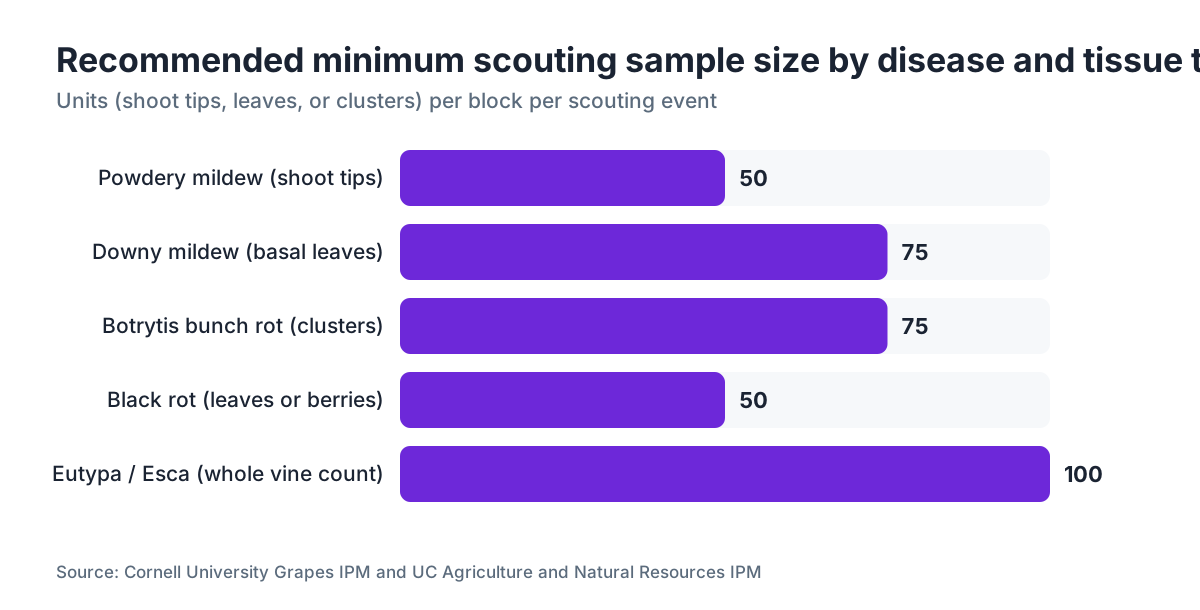
Reliability comes from consistency, not from large sample sizes. The practical standard in most extension guidance is to examine a minimum of 50 to 100 shoot tips or clusters per block per scouting event, chosen by a systematic method rather than by eye [2][4].
Systematic sampling means something specific. You walk a fixed transect through the block (often a Z or W pattern), stop at predetermined intervals, and examine a fixed number of vines at each stop. You don't stop at vines that look bad. You don't skip vines that look clean. Random-walk methods where you go wherever the disease looks interesting are a well-documented source of bias in incidence estimates.
For early-season powdery mildew, flag shoots are the priority. For downy mildew, look at basal leaves on the shaded, humid side of the canopy. For Botrytis, clusters are the target tissue from veraison onward, but shoot tip observations earlier in the season give you inoculum-load signals worth tracking.
Record the sample plan in the log, more than the result. "Examined 10 vines per row, every 4th row, 5 shoots per vine = 50 shoot tips total" is a reproducible method. "Walked through and checked a bunch of shoots" is not.
| Disease | Primary tissue to scout | Key season window | Minimum sample (shoots or clusters) |
|---|---|---|---|
| Powdery mildew | Flag shoots, then leaves and clusters | Budbreak through veraison | 50 shoot tips per block |
| Downy mildew | Basal leaves (abaxial surface) | Pre-bloom through summer | 50-100 leaves per block |
| Botrytis bunch rot | Clusters, flower debris | Bloom, pre-harvest | 50-100 clusters per block |
| Eutypa / Esca | Symptomatic cordons and trunks | Growing season, any time | Walk entire block; count symptomatic vines |
| Black rot | Leaves and berries | Post-bloom through veraison | 50 leaves or berries per block |
How do you record disease severity, more than presence or absence?
Incidence (percent of units with any symptom) and severity (how bad each infected unit is) are two different numbers that answer two different questions. A block with 80% incidence but severity scores of 1 out of 5 is in a very different situation than a block with 30% incidence and severity scores averaging 4 out of 5.
For powdery mildew, the most common rating scale in western U.S. viticulture uses 0 to 5, where 0 is no symptoms and 5 is more than 75% of leaf area colonized [2]. UC Davis extension materials describe this scale explicitly. Print it out and laminate it for field use.
For Botrytis cluster rot, a percent-of-berry-surface rating is more practical: what percentage of the cluster surface shows visible sporulation or rotted berry tissue? Cornell's guidelines use a similar approach, rating clusters from 0 (clean) to 4 (greater than 50% surface infected) [4].
Write both numbers in the log. "Powdery mildew: incidence 22% (11/50 shoot tips), mean severity 1.4/5" gives your next-season self real information. "PM pressure moderate" gives them nothing.
How do vineyard disease logs connect to EPA Worker Protection Standard requirements?
The EPA Worker Protection Standard (WPS) at 40 CFR Part 170 requires that employers maintain records related to pesticide applications and worker safety [5]. The WPS doesn't mandate a specific disease scouting log format, but it does create a documentation ecosystem where scouting records are practically necessary.
Here's the connection. The WPS requires that workers receive specific information about pesticide applications, including the basis for restricted entry interval decisions. If your REI or application timing decisions are driven by scouting observations, having those observations documented supports your decision record. It also protects you legally. If a worker alleges improper exposure and questions whether a spray was necessary, a scouting log that shows documented disease pressure is meaningful evidence.
Beyond WPS, many states have their own pesticide record-keeping regulations that go further. California's DPR, for example, requires licensed pest control advisers to document the findings that justify a pesticide recommendation, under CCR Title 3 [6]. If your spray decisions are made by or with input from a licensed PCA, their scouting findings should appear in your records.
The practical takeaway: keep scouting logs with the same discipline you keep spray records, and store them together. Auditors and inspectors look at both.
What format works best: paper, spreadsheet, or purpose-built software?
All three can work. Each has a real failure mode.
Paper field notebooks are fast and reliable when there's no cell service, which describes most vineyards. The failure mode is transcription: field notes that never get transferred to a permanent record, or handwriting that becomes illegible by February. If you use paper, designate one binder per season per property, date-stamp every page, and don't let it live in the truck cab indefinitely.
Spreadsheets are flexible and searchable. The failure mode is inconsistency. When five different people fill out the same spreadsheet over a season, the disease names, block IDs, and rating scales drift unless you've locked down the format with data validation and a written protocol. A spreadsheet without input controls is a data quality problem waiting to happen.
Purpose-built software designed for vineyard operations ties scouting observations directly to block records, maps, and spray logs, so you're not matching data across three separate systems at year-end. Tools like VitiScribe let you log scouting observations in the field from a phone, attach photos, and link observations to the relevant block and growth stage automatically. Dedicated software or a disciplined spreadsheet, the principle is the same: the format has to be consistent enough that a second person could pick it up mid-season and log data the same way you would.
One thing that's genuinely underrated: photos. A timestamped photo of a symptomatic cluster or leaf, attached to the log entry, ends any ambiguity about what was observed and gives new team members a training reference.
How often should you be scouting and logging during the season?
Frequency should track disease risk, which tracks the calendar and the weather. A flat weekly schedule is better than nothing, but it's not optimal.
The highest-risk periods for most of the major diseases are pre-bloom through 6 weeks post-bloom. This is when powdery mildew and downy mildew infections that will drive the whole season get established. During this window, twice-weekly scouting in high-risk blocks is defensible, especially after rain events that exceed 0.1 inches [2][4].
After fruit set, once the critical infection window narrows, you can back off to weekly. Late-season Botrytis scouting from veraison to harvest warrants twice-weekly again, particularly in tight-clustered varieties.
WSU's extension materials on disease management timing recommend scouting within 24 to 48 hours after rain events, specifically to assess canopy wetness duration and flag potential infection periods before symptoms appear [1]. That's the key insight. You're more than documenting what you see. You're building the record that lets you correlate future symptoms to past weather events.
Every scouting event gets a log entry, even if the entry says "0 symptoms observed." Clean observations are data. They tell you your fungicide program is holding, or that pressure in this block is genuinely low. A log that only records when you find something is systematically misleading.
How do you use historical scouting logs to improve next year's disease program?
This is where the whole record-keeping investment pays off. A multi-year scouting database answers questions that nothing else can.
Which blocks consistently develop symptoms first? If Block 3 always shows powdery mildew two weeks before Block 8, Block 3 is your sentinel. You scout it more often early, and you don't let spray intervals slip there.
What's your typical first detection date for each disease? With three years of logs, you can calculate a mean first-detection growth stage or calendar date for each pathogen in each block. That number is worth more than any calendar spray schedule.
Are your fungicide programs actually suppressing disease? Year-over-year severity score trends tell you. A program that's holding mean Botrytis severity at 0.8/4 in a given block is working. A program where severity scores creep up despite the same chemistry is signaling resistance or coverage failure.
Cornell's disease forecasting resources note that historical incidence data from the same site is one of the most reliable inputs to disease prediction models [4]. The models they recommend for powdery mildew and Botrytis incorporate local inoculum load, which your multi-year logs help you estimate.
Plan a 30-minute post-harvest review each year. Pull the season's logs and answer four questions. Where did we first see disease, and when? Where did we lose the most ground? Did our spray program match our scouting data? What would we change? Write the answers down. They're next year's starting point.
What are the most common mistakes in vineyard disease scouting logs?
The most common mistake is vague language. "Light powdery mildew pressure" in a log entry is nearly useless. The scout who wrote it knows what they meant. Anyone reading it a year later, or a different scout reading it mid-season, doesn't. Numbers beat adjectives every time.
The second most common mistake is inconsistent block naming. If your blocks have three different names depending on which document you're looking at, your scouting data and your spray data can't be linked. Pick official block IDs and enforce them everywhere.
Using impressions instead of counts is the third. Walking a block and concluding "about 20% infection" without actually counting is consistently inaccurate across vineyard managers, and inaccurate in systematic ways. People overestimate low incidence and underestimate high incidence. Count. Write down the count.
Failing to log zero-observation events comes fourth. A log that only has entries on days when you found disease looks like you didn't scout the clean days. For an auditor, that's a problem. For your own analysis, it's a gap that corrupts any trend analysis you try to do.
The fifth is not training scouts consistently. If different people use different severity scales or sample differently, your data isn't comparable across scouts. A one-page written protocol with the scale printed on it, given to every person who scouts your vineyard, fixes this.
What growth stage notation should you use in scouting records?
Use the E-L (Eichhorn-Lorenz) scale or the BBCH scale, and be consistent about which one you use. Both are documented in the literature and both are understood by extension specialists, crop advisers, and auditors [3].
The E-L scale runs from stage 1 (winter dormancy) to stage 47 (leaves yellowing and falling), with 47 stages total. The stages most relevant to disease scouting are E-L 5 through 38: roughly budbreak through veraison. Your log should record the actual E-L number, not a descriptive phrase. "E-L 19" (10-12 leaves separated, shoots 30+ cm, early bunch visible) is a reproducible reference. "Early season" is not.
The BBCH scale is used more often in research contexts and European viticulture but is equivalent in precision. UC Davis extension materials and WSU disease management publications both reference phenological stage as a scouting trigger, which is why using a standardized scale matters: it lets you compare your observations against published research thresholds [1][2].
If you're working with a crop adviser or PCA who uses a different notation, agree on one system and document it at the start of the season. Two scouts using two scales in the same log is a mess that's hard to untangle later.
How should you handle uncertain or unconfirmed disease identifications in your log?
Write what you see, and flag the uncertainty explicitly. "Suspected downy mildew on basal leaves, not yet confirmed" is a perfectly legitimate log entry. It's honest, it creates a follow-up obligation, and it doesn't inflate your records with a definitive diagnosis you're not sure of.
For confirmation, the practical options are three. Send a fresh sample to your state's diagnostic lab (most university extension systems run plant disease clinics [4][7]). Consult with a licensed PCA or CCA. Or photograph the symptoms and share with an extension specialist. Many land-grant universities offer online image-based diagnosis services, though they typically require fresh, high-quality photos.
When you get a confirmed ID, add a follow-up entry to the log: date of confirmation, method (lab, PCA, visual), and confirmed diagnosis. Don't retroactively change the original uncertain entry. The original observation and the subsequent confirmation are both real data.
Unconfirmed identifications that you acted on are worth flagging too. If you made a spray decision based on a suspected diagnosis that turned out to be wrong, that's useful operational information. Document it honestly.
Are there vineyard certification programs that require specific scouting log formats?
Several do, and the requirements vary enough that you need to check the current program standards directly rather than relying on a summary.
Lodi Rules for Sustainable Winegrowing, one of the most widely adopted vineyard sustainability certification programs in California, requires that growers document pest and disease monitoring as part of IPM compliance. The Lodi Winegrower's Workbook specifies that monitoring records must include date, location, pest or disease observed, and population level or damage rating [8]. The workbook is publicly available through the Lodi Winegrape Commission's resources.
VINEA, which runs the Sustainable Winegrowing New Zealand standard that some U.S. operations reference, requires dated scouting records with block-level specificity.
Stewardship Index for Specialty Crops (SISC) metrics, which underlie several retail buyer sustainability requirements, include IPM documentation that covers monitoring records.
If you sell to wineries with sustainability commitments or export to markets with traceability requirements, check what their audit standards actually require before designing your log format. Building to the most demanding standard you're likely to face is usually less work than retrofitting records later.
For growers in California, the California Department of Food and Agriculture's pest management guidelines also reference record-keeping as part of integrated pest management programs [6].
Frequently asked questions
How long do I need to keep vineyard disease scouting records?
State pesticide record-keeping laws typically require spray records to be kept 2 to 3 years (California is 3 years under the Food and Agriculture Code). Scouting records have no universal federal retention requirement, but keeping them at least as long as your spray records is standard practice. Many certification programs and crop insurance audits request multi-year histories, so keeping records indefinitely in a digital format costs essentially nothing and is the practical answer.
What's the difference between incidence and severity in a scouting log?
Incidence is the proportion of sampled units showing any symptom, expressed as a percentage. If 14 out of 50 clusters show Botrytis, incidence is 28%. Severity is a rating of how bad each infected unit is, usually on a 0-5 or 0-4 scale based on percent tissue affected. Both numbers belong in the log. Incidence tells you how far the disease has spread; severity tells you how much damage it's actually doing.
Can I use the same log format for all diseases, or do different diseases need different forms?
One core log format works for all diseases if it includes fields for block ID, date, growth stage, disease name, incidence count (numerator/denominator), severity rating, weather conditions, and scout name. Some operations add disease-specific fields for particularly important pathogens, like cluster tightness for Botrytis or inoculum source notes for Eutypa. A single format with a notes field for disease-specific detail is usually cleaner than maintaining separate forms.
Do zero-observation scouting events need to be logged?
Yes, always. A log entry that says "50 shoot tips examined, 0 symptoms of powdery mildew observed" is important data. It confirms you scouted that block on that date, establishes a clean baseline, and supports any IPM documentation requirement. A log that only records positive observations creates an audit gap and prevents you from calculating accurate first-detection dates or clean-block histories.
What sample size do I need for a statistically reliable incidence estimate in a vineyard block?
Most extension guidance recommends a minimum of 50 to 100 units (shoot tips, leaves, or clusters) per block per scouting event, sampled systematically. At 50 samples and true incidence around 10-20%, your margin of error is roughly plus or minus 8-10 percentage points at 95% confidence. That's adequate for management decisions. If you need tighter estimates for research or certification purposes, 100 to 200 samples reduce that error substantially.
How do I document disease scouting when I'm using a crop adviser or PCA?
In California and several other states, a licensed PCA or Certified Crop Adviser must document the pest findings that support their recommendations. Get a copy of those written recommendations and attach them to your own log. Your scouting log should cross-reference the PCA's report: date, adviser's name, findings summary, and recommended action. This creates a complete record linking observed conditions to spray decisions, which is exactly what an auditor wants to see.
Should scouting logs be linked to spray records, and how?
Yes, and the link is usually a shared block ID and date reference. When you make a spray application, note in the spray record: "based on scouting observation [date] showing X% incidence of [disease] in this block." When you write the scouting entry, note whether it triggered an action. Some digital record-keeping systems link these automatically; paper systems require a consistent cross-referencing convention that your whole team uses.
What photographic evidence should I include with disease scouting logs?
Timestamped photos of symptomatic tissue are the most useful supplement to written logs. Photograph the affected tissue close enough to see symptoms clearly, a wider shot showing the vine or cluster in context, and any unusual patterns (a disease front moving through a block, disease concentrated near a specific irrigation head). Store photos with the date and block ID in the filename. Many vineyard apps attach photos directly to log entries, which is cleaner than a separate photo folder.
Do I need to record scouting observations for organic vineyards differently?
The basic log structure is the same. For certified organic operations, USDA NOP regulations (7 CFR Part 205) require that you document your pest management activities as part of your Organic System Plan. Scouting records that show you identified a disease problem and used an allowable response are part of demonstrating that you followed your OSP. Your certifier can tell you exactly what format they prefer, but the data fields in a standard scouting log satisfy the underlying requirement.
What's the best way to train new employees to scout and record observations consistently?
Give them a one-page written protocol with the block ID map, the growth stage scale you use, the disease names and abbreviations you use, the severity rating scale with visual descriptions, and the sample method (how many vines, which rows, how many shoots per vine). Walk the vineyard with them during an active scouting event. Have them fill out a practice entry while you fill out the same block independently, then compare and discuss any differences. Do this once at the start of the season, and repeat if you hire mid-season.
How do scouting logs support crop insurance claims for disease losses?
If you experience a yield loss from disease and file a crop insurance claim, the adjuster will look for evidence of the timeline: when disease appeared, how quickly it progressed, and what management steps you took. A scouting log with dated incidence and severity records, matched to spray and cultural practice records, shows that timeline clearly. Adjusters treat well-documented IPM programs and scouting logs as evidence of good management, which can affect coverage determinations.
Can I use my vineyard disease scouting logs to apply for USDA EQIP cost-share for IPM practices?
USDA NRCS EQIP Practice Standard 595 (Pest Management) covers IPM documentation as an eligible practice in some states, and applications typically require you to demonstrate an existing or planned monitoring program. Your scouting logs are evidence of that program. Contact your local NRCS office for current payment schedules and documentation requirements, since they vary by state and funding cycle.
Sources
- Washington State University Extension, Viticulture and Enology Program: IPM scouting records are the foundation of pattern recognition across seasons; WSU recommends scouting within 24-48 hours after rain events to correlate future symptoms to infection periods.
- UC Agriculture and Natural Resources, UC IPM Pest Management Guidelines: Grape: Minimum sample of 50-100 shoot tips per block per scouting event; powdery mildew severity rated on a 0-5 scale; scouting data not recorded does not exist for management purposes.
- UC Agriculture and Natural Resources, Grapevine Growth Stages (Modified E-L System): The Eichhorn-Lorenz (E-L) scale and BBCH scale are standard phenological staging systems used in North American viticulture research and extension.
- Cornell University College of Agriculture and Life Sciences, Cornell Grapes IPM: Cornell IPM provides standardized severity rating scales for powdery mildew, Botrytis, and other grape diseases; historical incidence data from the same site is a key input to disease prediction models.
- U.S. EPA, Worker Protection Standard, 40 CFR Part 170: EPA WPS requires employers to maintain pesticide application records and worker safety documentation; scouting records support documented decision-making under this framework.
- California Department of Food and Agriculture, Plant Health and Pest Prevention Services: California regulations (CCR Title 3) require licensed pest control advisers to document pest findings that justify pesticide recommendations.
- Cornell University College of Agriculture and Life Sciences, Plant Disease Diagnostic Clinic: University extension systems operate plant disease diagnostic labs where growers can submit samples for confirmed pathogen identification.
- Lodi Winegrape Commission, Lodi Rules for Sustainable Winegrowing Workbook: Lodi Rules certification requires monitoring records including date, location, pest or disease observed, and population level or damage rating as part of IPM compliance.
- USDA Agricultural Marketing Service, National Organic Program 7 CFR Part 205: NOP regulations require certified organic operations to document pest management activities as part of their Organic System Plan, including monitoring records.
- WSU Extension, Grapevine Disease Management, Powdery Mildew: Rain events exceeding 0.1 inch are a trigger for increased scouting frequency during the pre-bloom to 6-weeks post-bloom critical infection window.
Last updated 2026-07-11