Recording irrigation application depth and duration in vineyard logs

TL;DR
- Vineyard irrigation logs should capture application date, start and stop time, duration in hours, flow rate (gph per emitter), emitter count, calculated depth in inches, and block or zone ID.
- Those seven fields satisfy most state water-use reporting rules, support regulated deficit irrigation decisions, and hold up under pesticide re-entry and audit review.
What information does a vineyard irrigation log actually need to include?
Most growers write down a run time and walk away. That leaves a log that's nearly useless for water budgeting or compliance. A complete irrigation record needs seven fields at minimum: date, block or zone ID, start time, stop time, total run duration (hours and minutes), flow rate per emitter (gallons per hour), and emitter count per vine or per row foot. With those numbers you can calculate applied depth in inches, which is the unit most water districts and state agencies want.
The calculation is short. Applied depth (inches) = (flow rate per emitter in gph × run time in hours × emitters per acre) ÷ 27,154 gallons per acre-inch. UC Cooperative Extension and the California Department of Water Resources both use acre-inches as the reporting unit for agricultural water use [1][2].
Two more fields earn their space even when nobody requires them. Log a soil moisture reading before irrigation (centibars if you use a tensiometer, or volumetric water content percent if you use a capacitance probe) and a short weather note (heat event, wind, recent rain). Those two columns turn a compliance record into a management tool. Without them you're just proving you ran water. You're not learning whether the vine needed it.
Why does recording irrigation depth matter for compliance and audits?
Water-use reporting is expanding fast in California, Washington, and Oregon. California's SGMA (Sustainable Groundwater Management Act) requires groundwater users in medium- and high-priority basins to report total annual extraction [3]. That number has to come from somewhere. If your logs show only run times, you're reconstructing depth from memory or asking your drip installer to dig up the original emitter specs. That's a painful audit.
The EPA's Worker Protection Standard (WPS), revised in 2015, requires irrigation records to be available for inspection when pesticide applications interact with irrigation timing, specifically for fields where restricted-entry intervals (REIs) were extended or shortened based on irrigation [4]. A WPS inspector asking why the REI dropped to 4 hours instead of 12 wants to see that you applied at least 0.5 inches within the label window. That's a depth measurement. A time stamp won't do it.
Washington's Department of Agriculture requires pesticide application records for two years under WAC 16-228 [5]. California's DPR requires three years under Food and Agricultural Code Section 12981 [6]. Irrigation logs that back those pesticide records should live the same length of time. Toss them after one season and you've created a gap that's hard to explain when a re-entry complaint surfaces eighteen months later.
State water districts increasingly ask for annual water-use reports in acre-feet per acre. Without per-event depth records, growers estimate. Estimates that arrive suspiciously round draw follow-up questions.
How do you calculate applied water depth from drip system data?
The math takes about thirty seconds once you know your emitter specs. Here's the formula broken into two steps a field worker can run on a phone:
- Total gallons applied per acre = emitters per acre × emitter flow rate (gph) × run hours
- Applied depth in inches = total gallons per acre ÷ 27,154
Say you have 726 emitters per acre (one per vine at 6×10 spacing), each rated at 0.5 gph, and you ran for 4 hours.
- Total gallons = 726 × 0.5 × 4 = 1,452 gal/acre
- Depth = 1,452 ÷ 27,154 = 0.053 inches
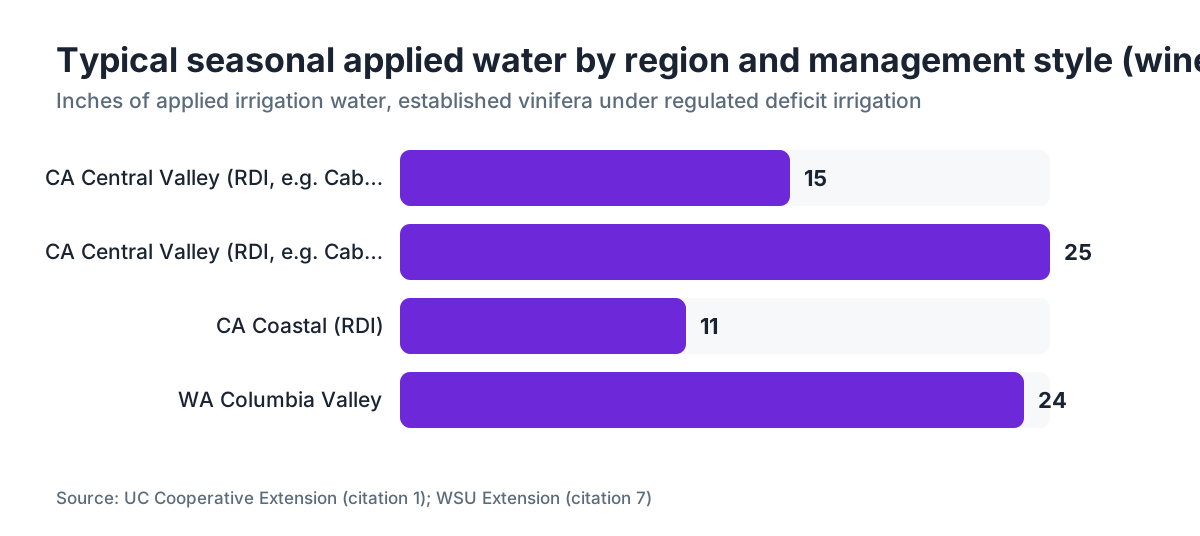
That's a small deficit correction. A full irrigation to replace real evapotranspiration might run 0.3 to 0.8 inches depending on vine size, rootstock, and soil texture. UC Cooperative Extension's Irrigation of Wine Grapes in California notes that established Cabernet Sauvignon vines in the Central Valley can use 15 to 25 inches of seasonal applied water under regulated deficit irrigation (RDI) [1].
If your system runs multiple zones at different emitter spacings or flow rates, log each zone on its own line. Treat a 20-acre block with two emitter types as one record and you get a meaningless average depth that's wrong for both zones.
| Zone | Emitters/acre | GPH/emitter | Run hours | Gal/acre | Depth (in) |
|---|---|---|---|---|---|
| A | 726 | 0.5 | 4.0 | 1,452 | 0.053 |
| B | 605 | 1.0 | 4.0 | 2,420 | 0.089 |
| C | 484 | 0.5 | 6.0 | 1,452 | 0.053 |
This is the per-zone breakdown a water district audit wants to see.
What's the difference between logging duration versus logging depth, and does it matter?
Duration tells you how long the pump ran. Depth tells you how much water reached the root zone. They're related but not interchangeable, and every grower who's swapped drip tape or emitter models mid-season without updating the log has accidentally reported phantom water.
Emitter flow rates drift. A three-year-old pressure-compensating emitter rated at 0.5 gph often flows at 0.45 or 0.55 depending on biofilm buildup and pressure at the end of long laterals. The only way to know your real delivery is to catch-can test or run an inline flow meter on the submain. WSU Extension recommends annual uniformity checks for vineyard drip systems, using the coefficient of uniformity (CU) to flag zones where low-end emitters get much less water than high-end ones [7].
For audits and water budgeting, depth is the number that matters. Duration is the input you use to get there. Log both. Sum depth at season end.
One honest caveat: nobody has great field data on how much emitter drift happens in commercial vineyards over time. The WSU work on drip uniformity found CU values from 72% to 96% across surveyed blocks, which means depth estimates built on nameplate flow rates can be off by 5 to 15% in practice [7]. Note that in your log methodology section if you're prepping for a formal water audit.
How should vineyard irrigation logs be organized and stored?
Paper logs work fine if you design the form well and store it somewhere dry and findable. A laminated field sheet with one row per event, kept in a weatherproof binder at the pump house, is what most small operations actually use. The fields on that sheet should map directly to the calculation columns so whoever fills it out can check the math on the spot.
Digital logs are easier to total and harder to lose. A shared spreadsheet (Google Sheets, or Excel on a shared drive) is the minimum viable digital system. Each block gets its own tab. Columns run: date, start time, stop time, duration (auto-calculated), zone ID, emitter gph, emitters per acre, total gallons, depth in inches. Freeze the header row. Color-code the depth column so anything below your minimum threshold turns red. One hour of setup pays off every time you pull a seasonal total.
VitiScribe's record-keeping tools are built around this kind of per-event field logging, with block-level irrigation history that ties back to spray records and soil moisture data in one place. Worth a look if you're running more than a few blocks or trying to consolidate paper records.
Whatever the format, the retention rule is simple: keep for at least three years, longer if your state's pesticide record requirement runs longer. California's three-year pesticide rule [6] sets the floor. SGMA water reporting may eventually push retention longer as basin plans mature [3].
Keep one backup off-site. A barn fire that takes your entire paper history has happened to real operations. A photo of each completed sheet uploaded to cloud storage takes ten seconds.
How do you log irrigation for regulated deficit irrigation (RDI) programs?
Regulated deficit irrigation is where the log earns its keep. RDI means deliberately withholding water during specific phenological windows (usually berry set through veraison) to control vegetative growth and berry size. You need records that prove you hit the target stress level, more than records showing you skipped a watering.
An RDI log should carry the standard irrigation fields plus one stress measure: pre-dawn leaf water potential (bars) if you measure it, stem water potential if that's your method, or soil moisture readings (centibars or percent VWC) from sensors in the root zone. Cornell Cooperative Extension's vineyard water management resources recommend logging midday stem water potential at least weekly during the deficit period, with target ranges that vary by cultivar and wine style [8].
Typical moderate-RDI targets for Cabernet Sauvignon run from -10 to -14 bars midday stem water potential during berry development. Chardonnay gets managed lighter, often -8 to -12 bars, to hold acidity. Your log entry during the deficit period should show both the measured stress level and any partial irrigation you applied to stay in range.
When you do irrigate during an RDI phase, log the depth precisely. A 0.1-inch correction on a hot day is exactly the small application that's easy to forget and important to document if you ever defend your water numbers, or your wine quality decisions, to a buyer running an on-site audit.
What soil moisture data should you record alongside irrigation events?
You don't have to record soil moisture. But if you're irrigating on vine need rather than a calendar, you need a reference point to know whether your applied depth moved the soil from stressed to adequate or just wet the surface.
The two most common tools in California and Pacific Northwest vineyards are tensiometers (reading in centibars, 0 being saturated and higher numbers drier) and capacitance probes (reading volumetric water content as a percent). Both have merit and real limits.
For tensiometers, a practical protocol is to read the gauge before each event and 24 hours after. Log both. Typical trigger thresholds for drip-irrigated Vitis vinifera in loam soils run 40 to 60 centibars in the 12-inch zone, though UC Cooperative Extension recommends calibrating thresholds to your soil texture and vine stage [2].
Capacitance probes usually log automatically at 15- to 30-minute intervals. Your irrigation log should reference the probe data file (by date range and sensor ID) instead of transcribing every reading. Note the pre-irrigation reading, the post-irrigation reading 24 hours out, and whether the wetting front reached your target depth sensor.
Nobody logs this perfectly. The honest answer is that most operations monitor soil moisture in one or two representative blocks and apply the lessons to similar blocks. That's a reasonable compromise, as long as you document which blocks your monitoring stands in for.
How do vineyard irrigation records connect to pesticide application logs?
The connection is the re-entry interval. Several fungicide and insecticide labels allow a reduced REI (often 4 hours instead of 12 or 24) if the application is immediately followed by irrigation that moves the pesticide off the foliage or into the soil. The EPA WPS final rule, published in 2015, addresses this directly: label instructions for reduced REIs based on irrigation must be followed, and records of that irrigation must be available for inspection [4].
In practice, your irrigation log entry for the day of or day after a pesticide application has to show depth. If the label says "irrigate with at least 0.5 inches within 4 hours of application," your log should show you ran enough water to put 0.5 inches on that block in that window. A log that reads "ran drip 2 hours" proves nothing if an inspector asks what depth that produced.
Calculate the irrigation depth, write it on the pesticide application record as a cross-reference, and write the pesticide record number on the irrigation log entry. That two-way link takes thirty seconds and makes audits far less stressful.
For operations running spray logs and irrigation records together, see the vineyard field operations resources at /articles/vineyard.
What format does UC Davis, Cornell, or WSU recommend for irrigation logs?
None of the three publish a single mandated format, which is both freeing and slightly annoying. What they do give you is guidance on the minimum data fields for water budgeting and compliance.
UC Cooperative Extension's Irrigation of Wine Grapes in California (Prichard et al.) recommends tracking seasonal applied water in inches, broken down by growth stage, and keeping records at the block level rather than whole-ranch [1]. Their sample field sheets include date, block ID, ETc estimate (from CIMIS or an on-site weather station), applied irrigation depth, and running seasonal total.
Cornell's viticulture extension team (New York State IPM Program) recommends putting soil type and root zone depth in the log header, since those constants shape how you read applied depth numbers [8].
WSU Extension's drip guidance for tree fruit and vineyards emphasizes logging system pressure at the head of each zone alongside flow rates, because pressure variation is the most common cause of emitter non-uniformity [7].
So build one log that carries UC Davis's phenological staging columns, Cornell's block-header soil info, and WSU's pressure field. That covers what any extension specialist would want to see, and it's more than enough for a state agency audit.
How often should you take and record irrigation readings during the growing season?
Log every irrigation event. No exceptions. That sounds obvious, but in busy stretches (heat events stacked back to back, harvest prep) it's easy to let three events pile up and reconstruct from memory. Memory is wrong more often than people think, especially on exact run times.
For seasonal planning, keep a running cumulative depth total updated after every event. That tells you where you stand against your water budget and your historical averages. Applied 8 inches by mid-July and your typical season ends at 12 to 15? You're tracking fine. Sitting at 14 inches by mid-July? Something went wrong, and you want to catch it before you hit an allocation limit.
Flag phenological checkpoints in the log: bud break, bloom, berry set, veraison, harvest. A horizontal line across the sheet at each stage takes two seconds and makes end-of-season analysis much easier. You see at a glance how much water went on during each growth stage, which is exactly what an RDI program forces you to track.
During peak summer ET, established Cabernet on California's Central Coast can demand 0.15 to 0.25 inches of replacement water per day in a heat event. At that pace, an event every two or three days means fifteen to twenty logged events in a single month. A well-designed form makes that fast enough to fill out while the system pressurizes.
Can a simple spreadsheet handle vineyard irrigation record-keeping, or do you need specialized software?
A well-built spreadsheet handles everything a small to mid-size vineyard needs. The trick is building it before the season starts, not improvising during a heat spike in August.
A workbook with one tab per block, auto-calculated depth fields, a summary tab that pulls seasonal totals, and conditional formatting to flag odd values takes maybe three hours to build. It works for a ten-block, sixty-acre operation without any paid software. Export to PDF for your annual water report. Done.
Spreadsheets break down at scale (twenty-plus blocks with multiple irrigators logging events), when you need irrigation and pesticide records cross-referenced in the same report, or when a water district portal wants a specific file format. That's the point where purpose-built tools start paying for themselves in time saved.
VitiScribe is built around exactly this kind of field-level block record, connecting irrigation logs to spray records and compliance reports in one place. A free trial is at vitiscribe.com if you want to see how it handles your block structure before committing.
Honestly, though: if you're a small operation and your spreadsheet works, don't switch just because software exists. The best log system is the one your crew actually fills out right.
What are the most common mistakes growers make in irrigation logs?
The single most common mistake is recording run time without flow rate or emitter count, which makes depth impossible to reconstruct. Second most common: logging the whole ranch as one record when zones have meaningfully different emitter specs.
A few others worth calling out.
Using nameplate emitter flow rates without ever catch-can testing. If your system has aged laterals or marginal pressure at the distal end, your logged depth may run 15% higher than what actually landed in the root zone. Log a note when you last checked uniformity.
Forgetting to log partial events. When a pump trips and restarts, growers often log the intended event, not the real one. A 4-hour run that became two 90-minute runs with a 45-minute gap has a different soil moisture outcome than a continuous run. Log what happened, not what you planned.
Leaving out block area. If your zone IDs don't tie to a clear acreage figure somewhere in the log, you can't calculate total water use in acre-feet. That bites during SGMA extraction reporting or a water district audit.
Switching units mid-season. Start the year in gpm and switch to gph in July and your seasonal totals are garbage. Pick a unit in March, stick with it, note it at the top of the log.
Not dating the sheet header separately from individual event dates. Sheets get separated (they do), and a header date is the only thing that keeps a loose sheet from ending up unfiled.
Frequently asked questions
How do I convert drip irrigation run time to inches of water applied?
Multiply emitter flow rate (gph) by run hours by emitters per acre, then divide by 27,154 (gallons per acre-inch). For example, 726 emitters per acre at 0.5 gph run for 4 hours deliver 1,452 gallons per acre, equal to 0.053 inches. Log the emitter spec and emitter count alongside run time so you can always back-calculate depth.
How long do I need to keep vineyard irrigation records in California?
California's Food and Agricultural Code Section 12981 requires pesticide application records for three years. Irrigation logs that back those records, especially where irrigation affected a re-entry interval, should be kept the same three years. SGMA groundwater reporting may require longer retention as basin plans develop; check with your Groundwater Sustainability Agency for current rules.
Do irrigation records count as part of EPA Worker Protection Standard compliance?
Yes, in specific cases. When a pesticide label allows a reduced restricted-entry interval based on post-application irrigation, the EPA WPS final rule (2015) requires records of that irrigation to be available for inspection. Those records need to show applied depth, more than run time, to demonstrate the label threshold was met.
What should be in the header of a vineyard irrigation log form?
At minimum: ranch name, block or zone ID, block acreage, soil texture, emitter model and rated flow rate (gph), emitter spacing, and the year. These are constants that don't change event to event. Having them in the header means you can calculate depth from any event row without hunting for specs in a separate file.
Is there a standard irrigation log format required by California water districts?
No single statewide standard exists, but SGMA-covered basins increasingly require annual extraction reports in acre-feet. Your log format has to produce that number. A per-event depth column (inches), a running seasonal total, and a block acreage field give you everything to convert: depth in feet times area in acres equals acre-feet.
How do I log irrigation for multiple drip zones that run at the same time?
Log each zone as its own row on the same date, even when they run simultaneously. Different zones almost always have different emitter spacings or flow rates, so their applied depths differ. A single combined entry gives you an acreage-weighted average that's accurate for neither zone. The extra thirty seconds per zone is worth it at audit time.
What soil moisture thresholds should trigger an irrigation event in vineyards?
UC Cooperative Extension suggests tensiometer trigger points of 40 to 60 centibars in the 12-inch zone for drip-irrigated vinifera on loam soils, with adjustments for sandier or heavier soils. During regulated deficit irrigation (berry set to veraison), many growers let tension climb on purpose to 80 to 100 centibars or higher. Log whatever threshold you're targeting so the decision logic shows in the record.
Can I use a flow meter instead of calculating depth from emitter specs?
Yes, and it's more accurate. An inline turbine or ultrasonic flow meter on the submain reads total gallons delivered directly. Log the meter reading at start and end of each event. Divide total gallons by acres served, then by 27,154, to get inches. This bypasses emitter-drift uncertainty entirely and produces the most defensible depth figure for any audit.
What's the difference between gross applied water and net crop water use in irrigation logs?
Gross applied water is what your drip system delivers, the number in your log. Net crop water use (ETc) is what the vine consumed, estimated from reference ET times a crop coefficient. The gap between them (gross minus net) covers system inefficiency, drainage below the root zone, and buffering for uniformity losses. Log gross applied; track ETc separately from CIMIS or your on-site weather station.
How do I handle irrigation logging when I have both drip and overhead systems in the same vineyard?
Keep them in separate log sections or tabs. Overhead systems (frost protection, evaporative cooling) apply water very differently from drip and carry different efficiency assumptions. Overhead sprinkler application rate is measured in inches per hour at the design rate; log that separately from drip events. Mixing the two in one record creates totals that are hard to interpret and harder to defend.
Do organic certification audits require irrigation records?
Not specifically for irrigation depth, but USDA National Organic Program (NOP) audits can request field history and input records. If you applied any nutrient or amendment through a fertigation system, those injection events have to be logged as part of your input records. Clean, dated irrigation logs with event-level detail simplify an NOP inspection, even though irrigation itself isn't a certification criterion.
What's a reasonable seasonal water budget for wine grapes in a dry climate?
UC research on established vinifera under regulated deficit irrigation in the Central Valley puts seasonal applied water at 15 to 25 inches depending on cultivar, rootstock, vine age, and regional ET demand. Coastal California vineyards often use 8 to 14 inches. Washington's Columbia Valley can run 18 to 30 inches. Your local extension office's evapotranspiration data is the right starting point for your conditions.
How does logging irrigation depth help with regulated deficit irrigation programs?
RDI only works if you know exactly how much water you withheld and when. A depth-based log lets you calculate cumulative deficit against full ET replacement, which is what your enologist or viticulturist needs to predict berry size and concentration. Run-time logs alone can't give you that number because they ignore flow rate variability and emitter drift.
Sources
- UC Cooperative Extension, Irrigation of Wine Grapes in California (Prichard et al.): Established Cabernet Sauvignon vines in California's Central Valley can use 15 to 25 inches of seasonal applied water under regulated deficit irrigation; recommendation to track applied water at the block level by growth stage.
- UC Cooperative Extension, Drought Tip: Measuring Soil Moisture for Irrigation Scheduling: Typical tensiometer trigger thresholds for drip-irrigated Vitis vinifera in loam soils run 40 to 60 centibars in the 12-inch zone, with calibration to soil texture and vine stage recommended.
- California Department of Water Resources, SGMA Groundwater Management: California's Sustainable Groundwater Management Act requires groundwater users in medium- and high-priority basins to report total annual extraction.
- US EPA, Agricultural Worker Protection Standard (WPS), 2015 final rule: The EPA WPS final rule (2015) requires that label instructions for reduced restricted-entry intervals based on irrigation be followed and that records of that irrigation be available for inspection.
- Washington State Department of Agriculture, pesticide record requirements (WAC 16-228): Washington requires pesticide application records to be kept for two years under WAC 16-228.
- California Department of Food and Agriculture, California Food and Agricultural Code Section 12981: California requires pesticide application records to be kept for three years under California Food and Agricultural Code Section 12981.
- WSU Extension, Drip Irrigation Management for Pacific Northwest Vineyards: WSU Extension found coefficient of uniformity values ranging from 72% to 96% across surveyed vineyard drip blocks, and recommends annual uniformity checks; pressure variation at the submain is the most common cause of emitter non-uniformity.
- Cornell Cooperative Extension, New York State IPM Program, Vineyard Water Management: Cornell extension recommends logging midday stem water potential at least weekly during deficit irrigation periods, with target ranges varying by cultivar and wine style; soil type and root zone depth should be noted in log headers.
- California Department of Water Resources, CIMIS (California Irrigation Management Information System): CIMIS provides reference ET estimates used by UC Cooperative Extension for vineyard irrigation scheduling and seasonal water budget benchmarking.
- USDA National Organic Program, NOP Regulations 7 CFR Part 205: USDA NOP audits can request field history and input records; fertigation events must be logged as part of organic certification input records.
Last updated 2026-07-11